DOI: https://doi.org/10.7473/EC.2020.55.1.51
Characterization on the Thermal Oxidation of Raw Natural Rubber Thin Film using Image and FT-IR Analysis
Ik-Sik Kim † , Hwanjeong Cho, Kyung-Suk Sohn, Hwa-Soon Choi, Sung-Uk Kim, and Sinkon Kim Aero Technology Research Institute, ROKAF, P.O. Box 304-150, 352 Ayang-ro, Dong-gu, Daegu 41052, Republic of Korea
(Received February 5, 2020, Revised February 12, 2020, Accepted February 17, 2020)
Abstract: In this study, the thermal oxidation of raw natural rubber (NR) was investigated under controlled conditions by optical image and fourier transform infrared (FT-IR) analysis. The thermal oxidation was performed on a transparent thin film of raw NR coated on a KBr window in a dark chamber at 80℃ under low humidity conditions to completely exclude moisture and restrict light oxidation. Images of the thin film of raw NR were obtained before and after thermal oxidation.
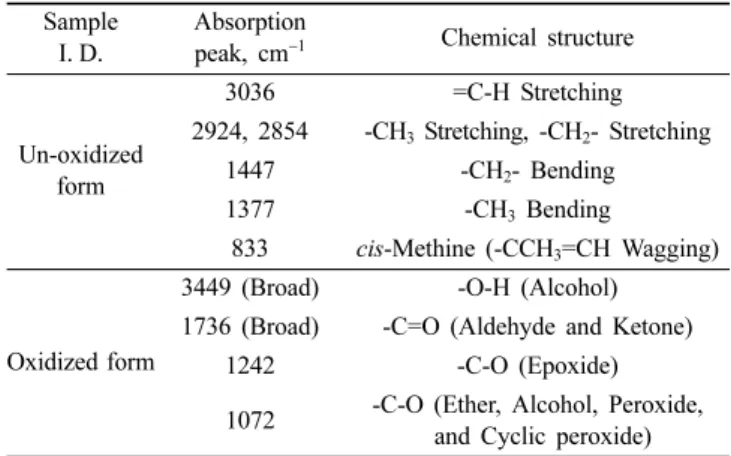
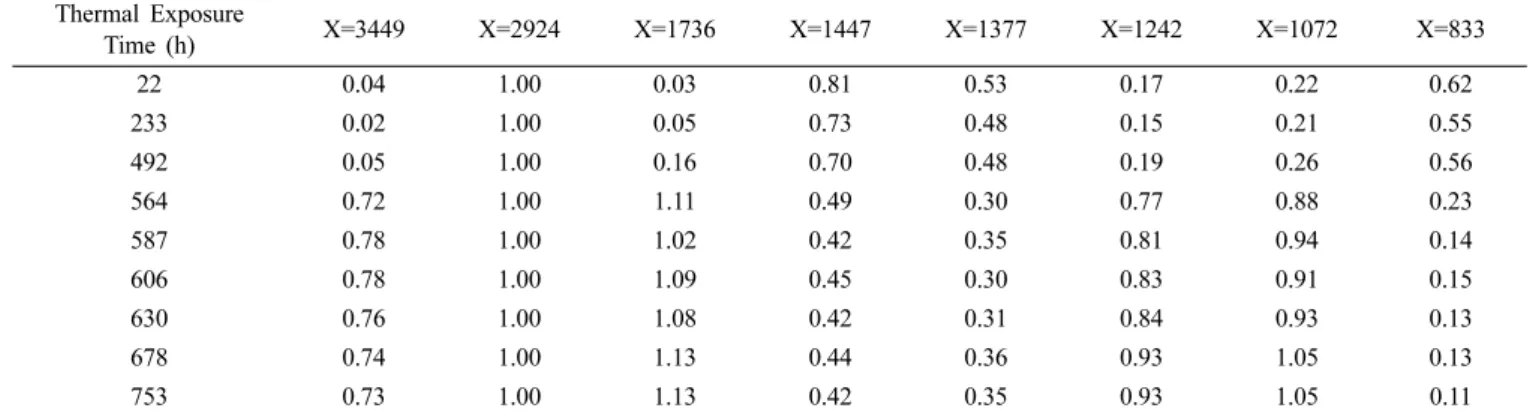
FT-IR absorption spectra were measured in the transmission mode at different thermal exposure times. The thermal oxi- dation of NR was examined by the changes in the absorption peaks at 3449, 1736, 1447, 1377, 1242, 1072, and 833 cm
–1, which corresponded to a hydroxyl group (-OH), a carbonyl group (-C=O) from an aldehyde and a ketone, a methylene group (-CH
2-), a methyl group (-CH
3), a carbon-oxygen single bond (-C-O) from an epoxide, a carbon-oxygen bond (-C-O) from an ether, an alcohol, a peroxide, or a cyclic peroxide, and a cis-methine group (cis-CCH
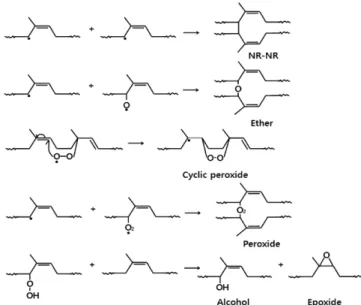
3=CH-), respectively. In the initial stage of thermal oxidation, two different types of free radicals were produced quickly and randomly by the homolytic cleav- age of a double bond and allylic hydrogen abstraction. Aldehydes and ketones were formed from chain scissions of the dou- ble bonds and alcohols were produced from allylic hydrogen abstraction at the methylene or methyl groups. Two reactions seemed to proceed competitively with each other. At a later stage, oxidative crosslinks seemed to dominate through the com- bination of free radicals such as an allyl radical (CH=CHCH
2·), alkoxy radical (RO·), and peroxy radical (ROO·) and the reaction of a hydroperoxide (-ROOH) with a double bond. The image obtained after thermal oxidation showed hardening without cracks. Based on these observations, a plausible two-step mechanism was suggested for chain hardening caused by the thermal oxidation.
Keywords: Thermal Oxidation, Natural Rubber, FT-IR, Image, Chain Scission, Analysis
Introduction
Most of polymers usually contain high levels of unsatu- ration in the polymer backbone. The unsaturation of polymer means what includes carbon-carbon double bond (-C=C-) in its backbone. Such polymers are natural rubber (NR), styrene butadiene rubber (SBR), and polybutadiene rubber (BR). “R”
expressed in the ASTM designations does not mean “rubber”
but does refer to “the presence of unsaturation” in the poly- mer backbone. Most of these polymers are susceptible to degradation when exposed to ultra-violet (UV) radiation, heat, water, ozone, and oxygen. The lifetime of a material is determined by UV radiation (photochemical degradation), thermal oxidation, ozone oxidation, or a combination of these factors.
1-6The reaction of NR with oxygen in heat has been the sub-
ject of considerable research and a number of reviews of the field are available. The thermal oxidation will either cause hardening or softening, depending on the microstructure of the diene elastomer. BR usually undergoes oxidative hard- ening whereas NR is known as oxidative softening when exposed to heat and oxygen. NR is known to undergo a com- petitive reaction of chain scission and crosslinking during the thermal oxidation. Although the general mechanism of ther- mal oxidation is well understood, the actual chain scission and crosslinking steps are often unknown. The reaction is known to be a complex through a free radical chain reaction.
NR has four kinds of microstructures in its molecular chain which are cis-1,4-, trans-1,4-, 1,2-, and 3,4-polyisoprene.
The main ingredient of NR is cis-1,4-polyisoprene. There are numerous publications on the degradation processes of both vulcanized and unvulcanized NR. Degradation products of NR that have been identified are hydroperoxides, peroxides, alcohols, aldehydes, ketones, epoxides, ethers, and carbox-
†