https://doi.org/10.9721/KJFST.2019.51.5.452
452
©The Korean Society of Food Science and Technology
Physicochemical and antioxidant properties of garlic (
A. sativum)
prepared by different heat treatment conditions
Il-Doo Kim1, Yong-Sung Park2, Jae-Jeong Park2, Sanjeev Kumar Dhungana3, and Dong-Hyun Shin2,*
1International Institute of Research & Development, Kyungpook National University 2School of Applied Biosciences, Kyungpook National University
3National Institute of Crop Science, Rural Development Administration
Abstract The objective of this study was to investigate the physicochemical characteristics and antioxidant potential of garlic processed using different heat treatments conditions, which is an effective method for removing the unpleasant odor and taste of raw garlic. The pH and soluble solid content of raw garlic (pH 6.07, 7.7oBx) were almost equal or slightly higher than that of processed garlic samples (pH 5.06-6.09, 7.1-7.4oBx). The color of processed garlic was also significantly affected. The amounts of amino acids such as γ-amino-n-butyric acid and few essential amino acids also increased after the thermal treatment of garlic. The antioxidant potentials of red and black garlic were higher than that of raw garlic. The polyphenol content of processed garlic (38.51-81.51 µg gallic acid equivalent/g sample) was significantly higher than that of raw garlic (30.66 µg gallic acid equivalent/g sample). These results indicated that heat treatment for different durations under a controlled environment enhanced the nutritional and functional properties of garlic.
Keywords: Allium sativum, antioxidant pothential, heat treatment, polyphenol content
Introduction
Garlic (Allium sativum) has been used as a culinary seasoning and a medicinal herb for a long time (Butt et al., 2009). It contains various nutrients and functional materials like anthocyanin, glycosides, essential oil, flavonoids, lectins, fructan, adenosine, pectin, vitamins B1, B2, B6, C and E, prostaglandins, biotin, essential amino acids, nicotinic acid, glycolipids, fatty acids and phospholipids (Bozin et al., 2008). Allicin, one of the major phytochemicals of garlic, is well known for its pharmacological properties, including antibacterial, antihyperlipidaemia, antitumour, and immunoregulatory activity (Ye and Zhang, 2003).
Unpleasant odor and taste are main reasons for the limited consumption of raw garlic in many countries in spite of its high food and medicinal values. The unpleasant odor and taste of raw garlic could be eliminated by heat treatment. Thermal treatment could also improve the palatability of garlic (Capuano and Fogliano, 2011). Thus, heat treatment has been considered as an effective technique to process the raw garlic and to improve the flavor and quality, and further enrich the processed garlic with new functions (Corzo-Martinez et al., 2007). When garlic is subjected to heat treatment, its bioactive aspects are greatly influenced (Corzo-Martinez et al., 2007). Heat treatment changes alliin and deoxidised alliin to allyl sulfurcontaining compounds, and some of which in thermal degradation have a fragrant smell (Lanzotti,
2006). The heat treatment also causes many unstable and unpleasant compounds in raw garlic to get converted into stable and tasteless compounds.
Black garlic, a processed product of raw garlic, is prepared by exposing the whole raw garlic to high temperature (70~80oC) environment under controlled humidity conditions for 1~3 months without additives (Kim et al., 2012). This processed black garlic has a fruity taste and is edible in uncooked form. In addition, the black garlic does not cause abdominal pain or other gastrointestinal problems (Bae et al., 2012). Black garlic has higher antioxidant potential than fresh garlic (Corzo-Martinez et al., 2007) and are more effective in preventing metabolic diseases and alcoholic hepatotoxicity (Ide and Lau, 1999).
The heat treatment may lead to nonenzymatic browning reactions, such as the Maillard reaction, caramelisation and the chemical oxidation of phenols. The nonenzymatic browning reactions can provide the black garlic a typical dark brown color, and lead to the formation of some antioxidant compounds (Osada and Shibamoto, 2006). Considering the non-enzymatic reactions during thermal treatments as well as nutritional and functional value of heat treated garlic, the objective of this study was to investigate the quality characteristics and antioxidant potentials of heat treated garlic for different aging periods.
Materials and Methods
Chemical and Materials
Folin-Ciocalteu phenol reagent and 1,1-diphenly-2-picrylhydrazyl (DPPH) were purchased from Sigma-Aldrich (St. Louis, MO, USA). All the chemical and reagents were analytical grade. Fresh garlics (Allium sativum L.) from the 2018 harvest season were obtained from a local market in Namhae-gun, Korea.
*Corresponding author: Dong-Hyun Shin, School of Applied Bio-sciences, Kyungpook National University, Daegu 41566, Korea Tel: +82-53-950-5707
Fax: +82-53-958-6880 E-mail: [email protected]
Received August 17, 2019; revised September 28, 2019; accepted October 10, 2019
Preparation of garlic sample
Garlic cloves were separated from the bulbs and peeled off for treatment. Three different samples were prepared from the raw/ fresh garlic cloves. The samples were named by their color developed with different aging durations as W-G: raw garlic without any treatment, Y-G: yellow garlic prepared by heating the fresh garlic under controlled condition of 60 and 60% relative humidity for 3 days, R-G: Red garlic prepared by heating the fresh garlic under controlled condition of 60 and 60% relative humidity for 4.5 days, and B-G: Black garlic prepared by heating the fresh garlic under controlled condition of 60 and 60% relative humidity for 10 days.
All garlic samples were freeze-dried and ground into powder using a commercial grinder (HIL-G-501, Hanil Co., Seoul, Korea). The pulverized samples were stored at 4 until analyses.
Determination of pH and total soluble solid
Five grams of sample powder was mixed with 45 mL of distilled water. The pH value of the sample mixture was determined using a pH meter (Model 210; Hanna, Seoul, Korea). The total soluble solid (TSS) content of the sample powder was measured by following the method described in the Official Methods of the National Tax Service (2006).
Color measurement
The International Commission on Illumination (CIE) Lab color scale was used to determine Hunter L* (lightness), a* (redness, + or greenness, ), and b* (yellowness, + or blueness, ) values of the garlic powders. Color values were determined using a Chroma Meter (CR-300; Minolta Corporation, Osaka, Japan). A Minolta calibration plate (YCIE=94.5, XCIE=0.3160, YCIE=0.3330) and a Hunter lab standard plate (L*=97.51, a*=0.18, b*= +1.67) were used to standardize the instrument with D65 illuminant as described earlier (Kim et al., 2014).
Determination of free amino acid
Amino acid composition of the garlic powder was determined using an amino acid analyzer (Biochrom-20, Pharacia Biotech Co., Stockholm, Sweden) by following the method described earlier (Je et al., 2005). Sample powder (1 g) was hydrolyzed with 6 N hydrochloric acid (10 mL) in a sealed-vacuum ampoule at 110oC for 24 h. The hydrochloric acid was eliminated by evaporating using a rotary evaporator, and then the extract was mixed with 5 mL 0.2 M sodium citrate buffer (pH 2.2).
For the determination of free amino acid content in the garlic powders, the sample (1.5 g) was homogenized (12,000 rpm, 2 min) with ice-cold 6% (v/v) perchloric acid (10 mL) in an ice bath using an ACE homogenizer (Nissei AM-7, Nihonseikei Kaisha Ltd., Tokyo, Japan) and then incubated in ice for 30 min. Two milliliters of the reaction mixture was mixed with 1 mL lithium citrate buffer (pH 2.2) and the mixture was used to determine the free amino acids using the amino acid analyzer.
Determination of mineral composition
The sample powder (0.5 g) was digested in a mixture of 15 mL
nitric acid (65%) and 2 mL H2O2 (35%). The sample mixture was diluted with an equal volume of distilled water. The mineral elements in the garlic powders were determined using an inductively coupled plasma atomic emission spectrometer (ICP AES; Varian Inc., Victoria, Australia) by following the method described by Skujins (1998). The instrument was calibrated using known standards for each mineral.
DPPH radical scavenging activity
The DPPH radical scavenging potential of garlic powders was determined by following the method described by Blois (1958). One gram of sample powder was extracted with 10 mL absolute methanol at room temperature for 3 h. The mixture was centrifuged at 1,660×g for 10 min, and the supernatant was filtered through a syringe filter (0.22 µm). An equal volume (100 µL) of sample extract and freshly prepared DPPH solution (0.1%, w/v in methanol) was mixed in microplate wells and left in dark for 30 min. The optical densities of reaction mixtures were measured at 517 nm using a microplate spectrophotometer (Multiskan GO, ThermoFischer Scientific, Vantaa, Finland). The DPPH radical scavenging activity was calculated using the following equation.
DPPH radical scavenging potential (%)=[1−(AAb)/Ao]×100 where A is the absorbance of sample and DPPH mixture, and Ab is the absorbance of sample and methanol mixture, and Ao is the absorbance of DPPH and methanol mixture.
ABTS radical scavenging activity
The ABTS radical scavenging activity of garlic powder was determined following the method described by Re et al. (1999). The radical cation of ABTS (ABTS+) was produced by mixing an equal volume of potassium persulfate (2.5 mM) and ABTS (7 mM) and incubating in the dark for 16 h. The solution was diluted with distilled water to get the absorbance value near to 0.7. Twenty microliters of sample extracts (as prepared for DPPH assay) were mixed with 180μL of ABTS solution and the absorbance of reaction mixture was measured at 734 nm using a spectrophotometer (Multiskan GO, Thermo Fischer Scientific). The ABTS radical scavenging activity was calculated using the following equation.
ABTS radical scavenging activity (%)=[(ACtrl–ASample)/ACtrl)]×100 where ACtrl is the absorbance of ABTS radical cation and ASample is the absorbance of a mixture of ABTS radical solution and sample extract.
Polyphenol content
The polyphenol content in garlic samples was determined following the Folin-Ciocalteau method (Singleton, 1999). Sample extracts of garlic powders were prepared as in the DPPH assay. The sample extracts (50μL) was mixed with 2% (w/v) aqueous Na2CO3 (1000μL) and allowed to react for 3 min. After 3 min, 50 μL of 1 N Folin-Ciocalteau reagent was added to the mixture and incubated in dark for 30 min at room temperature. The absorbance value of reaction mixtures was measured at 750 nm using a
microplate spectrophotometer (Multiskan GO, Thermo Fischer Scientific). Gallic acid was used as standard to make calibration curve. Polyphenol content was determined as gallic acid equivalents (μg GAE/g dry weight).
Statistical analysis
Data were subjected to analysis of variance using SAS 9.4 (SAS Institute, Cary, NC, USA) and significant differences among the samples were determined using Tukey test at 5% probability. The mean values of triplicate measurements were considered for statistical analysis unless otherwise mentioned in any specific analysis.
Results and Discussion
General chemical properties
The pH and soluble solid contents of garlic samples were significantly different with heat treatments and/or aging time (Table 1). The pH values of R-G (5.18) and B-G (5.06) were significantly lower than those of W-G (6.07) and Y-G (6.09). The soluble solid contents of processed garlic samples were significantly reduced as compared to the raw garlic. The highest value of soluble solid content was found in R-G (7.4oBx) followed by B-G (7.3oBx) and Y-G (7.1oBx).
Similar results of decreased pH in the aged garlic were also found in a previous study (Kang, 2016). The reduction in pH values of heat-treated garlic samples was, in part, resulted due to the production of browning compounds, including carboxylic acid, and decreased basic amino acids by combining with sugar upon heat treatment (Bae et al., 2014). In the present study, the soluble solid content of processed garlic was lower than that of raw garlic. This reduced soluble solid content in the processed garlic was in opposite to a previous report (Ríos-Ríos et al., 2016) which might be due to the variation in treatment conditions including temperature and relative humidity.
Color
The color of processed garlic is an important factor from the viewpoint of consumers’ preference. The color values of processed
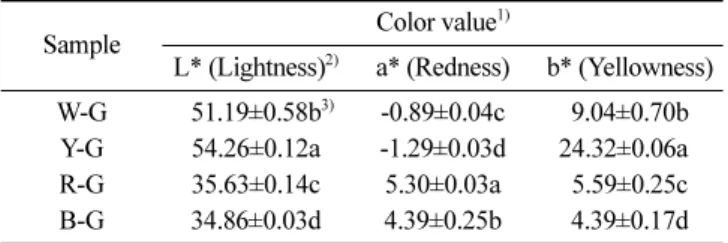
garlic were significantly affected by the heat treatments, as expected. The highest lightness, redness, and yellowness values were found in G (L value: 54.26), R-G (a value: 5.30), and Y-G (b value: 24.32), respectively (Table 2).
Color of foods plays a big role in buying behavior of consumers. The change in color of different garlic samples might be due to an extended drying and high temperature (Cui et al., 2003). Similar results of color variations found in the present study of heat-treated garlic were found in a previous study (Choi et al., 2014). The color variations in heat-treated garlics might have resulted due to the Maillard reaction, known as non-enzymatic browning reaction.
Free amino acid
A total of 8 and 23 essential and non-essential amino acids were detected in at least one garlic sample (Table 4). All 8 essential Table 1. General chemical properties of heat-treated garlic for
different aging times
Properties Sample 1) W-G Y-G R-G B-G pH 6.07±0.01a2 6.09±0.01a 5.18±0.04b 5.06±0.01c Soluble solid (oBx) 7.7±0.0a 7.1±0.1d 7.4±0.0b 7.3±0.1c 1)W-G: raw garlic without any treatment, Y-G: yellow garlic prepared
by heating the fresh garlic under controlled condition of 60 and 60% relative humidity for 3 days, R-G: Red garlic prepared by heating the fresh garlic under controlled condition of 60 and 60% relative humidity for 4.5 days, and B-G: Black garlic prepared by heating the fresh garlic under controlled condition of 60 and 60% relative humidity for 10 days.
2)Values are mentioned as mean±SD of triplicate measurements,
Values followed by different letters in the same row are significant different (p<0.05).
Table 2. Hunter color values of heat-treated garlic for different aging times
Sample Color value
1)
L* (Lightness)2) a* (Redness) b* (Yellowness) W-G 051.19±0.58b3) -0.89±0.04c 9.04±0.70b
Y-G 54.26±0.12a -1.29±0.03d 24.32±0.06a0 R-G 35.63±0.14c 5.30±0.03a 5.59±0.25c B-G 34.86±0.03d 4.39±0.25b 4.39±0.17d 1)W-G: raw garlic without any treatment, Y-G: yellow garlic prepared
by heating the fresh garlic under controlled condition of 60 and 60% relative humidity for 3 days, R-G: Red garlic prepared by heating the fresh garlic under controlled condition of 60 and 60% relative humidity for 4.5 days, and B-G: Black garlic prepared by heating the fresh garlic under controlled condition of 60 and 60% relative humidity for 10 days.
2)L: lightness (100, white; 0, black), a: redness (-, green; +, red), b:
yellowness (-, blue; +, yellow).
3)Values are mentioned as mean±SD of triplicate experiments. The
values followed by the different letters in the same column are significantly different, according to Tukey test (p<0.05).
Table 3. DPPH and ABTS radical scavenging activities and polyphenol contents of heat-treated garlic for different aging times Sample1) DPPH (% Inhibition) ABTS (%) Polyphenol content (µg GAE*/ g sample powder) W-G 085.38±0.51c2) 24.26±1.21d 30.66±1.56d Y-G 56.20±0.69d 38.58±0.69c 38.51±0.55c R-G 89.27±0.28b 83.83±0.23a 81.51±0.24a B-G 90.80±0.42a 79.27±0.32b 60.79±0.11b 1)W-G: raw garlic without any treatment, Y-G: yellow garlic prepared
by heating the fresh garlic under controlled condition of 60 and 60% relative humidity for 3 days, R-G: Red garlic prepared by heating the fresh garlic under controlled condition of 60 and 60% relative humidity for 4.5 days, and B-G: Black garlic prepared by heating the fresh garlic under controlled condition of 60 and 60% relative humidity for 10 days.
2)Values are mentioned as mean±SD of triplicate experiments. Values
followed by different letters in the same column are significantly different (p<0.05).
amino acids were detected in all samples but not all 23 non-essential amino acids were detected in all garlic samples. The highest amount of essential amino acid was found in B-G (9.43 mg/g sample powder) followed by W-G (7.85 mg/g sample powder) and R-G (7.74 mg/g sample powder). However, total amino acid content of raw garlic, W-G (57.66 mg/g sample powder) was higher than those of the processed garlic samples, Y-G (1.37 mg/g sample powder), R-Y-G (38.38 mg/g sample powder), and B-G (44.01 mg/g sample powder). The amino acid content of Y-G was much lower than the other samples. The ratio of essential to non-essential amino acids was the highest for B-G (0.27 mg/g
sample powder) followed by R-G (0.25 mg/g sample powder), Y-G (0.23 mg/g sample powder), and W-Y-G (0.16 mg/g sample powder). The content of γ-amino-n-butyric acid (GABA) was 1.13, 0.01, 1.53, and 2.77 µg/g in W-G, Y-G, R-G, and B-G, respectively. The heat treatment significantly increased the GABA contents of R-G and B-G.
The variation in amino acid content was probably due to the degradation of proteins or peptides, which may result from enzymatic hydrolysis or non-enzymatic hydrolysis, such as pyrolysis (Liang et al., 2015). Thermal processing, perhaps caused by reactions with reducing sugars, such as the Maillard reaction might also have Table 4. Free amino acid composition (mg/g sample powder) of heat-treated garlic for different aging times
Amino acid Sample
1)
W-G Y-G R-G B-G
Essential amino acid
L-Threonine 1.17±0.02a2) 0.02±0.01d 0.74±0.02c 1.03±0.04b
L-Valine 1.20±0.03c 0.07±0.01d 2.27±0.03b 2.73±0.07a
L-Methionine 0.21±0.05a 0.01±0.01b 0.24±0.02a 0.28±0.03a
L-Isoleucine 0.41±0.02c 0.02±0.01d 0.78±0.02b 0.99±0.02a
L-Leucine 0.38±0.01a 0.04±0.01c 1.07±0.03b 1.11±0.03b
L-Phenylalanine 1.01±0.02b 0.05±0.01c 1.03±0.05b 1.34±0.02a
L-Lysine 2.82±0.03a 0.04±0.02d 1.41±0.02c 1.73±0.02b
L-Histidine 0.65±0.02a 0.01±0.01c 0.21±0.01b 0.21±0.03b
Total essential amino acid 7.85 0.26 7.75 9.42
Non-essential amino acid
O-Phospho-L-serine 0.45±0.01a 0.09±0.01b ND* ND
Taurine ND 0.08±0.02a ND ND
L-Aspartic acid 11.03±0.15a 0.05±0.03d 1.54±0.02c 2.16±0.01b
L-Serine 0.95±0.02c 0.03±0.01d 1.13±0.02a 1.05±0.02b
L-Glutamic acid 2.07±0.03c 0.30±0.02d 2.91±0.03a 2.81±0.03b
L-Sarcosine ND ND 0.16±0.02a 0.18±0.03a
L-α-Aminoadipic acid ND 0.02±0.01a ND ND
Glycine 0.41±0.03a 0.01±0.01d 0.18±0.03c 0.26±0.05b
L-Alanine 2.71±0.02a 0.11±0.02d 1.67±0.03c 1.83±0.01b
L-Citrulline ND 0.02±0.01a ND ND
L-α-Amino-n-butylric acid ND ND ND 0.02±0.01a
L-Cystine 0.23±0.01c ND 0.71±0.02b 1.01±0.03a
Cystathionine 0.11±0.03c 0.01±0.01d 0.40±0.01a 0.37±0.01b
L-Tyrosine 1.72±0.02a 0.07±0.01d 1.17±0.05c 1.38±0.02b
β-Alanine 0.14±0.03c 0.01±0.01d 0.28±0.03b 0.52±0.03a
D,L-β-Aminoisobutyric acid ND 0.02±0.01a ND ND
γ-Amino-n-butyric acid 1.13±0.05c 0.01±0.01d 1.53±0.02b 2.77±0.07a
Ethanolamin 0.08±0.02a 0.02±0.01b 0.04±0.01b 0.04±0.01b
Ammonia 0.46±0.03a 0.06±0.02c 0.29±0.02b 0.46±0.03a
Hydroxylysine 0.08±0.01a ND ND ND
L-Ornithine 0.28±0.02a 0.02±0.01c 0.09±0.02b 0.11±0.01b
L-Arginine 27.02±2.12a 0.08±0.01c 16.96±1.31b 18.66±2.00b
Proline 0.94±0.01b 0.11±0.02c 1.57±0.02a 0.96±0.01b
Total non-essential amino acid 49.81 1.12 30.63 34.59
Total 57.66 1.38 38.38 44.01
1)W-G: raw garlic without any treatment, Y-G: yellow garlic prepared by heating the fresh garlic under controlled condition of 60 and 60% relative
humidity for 3 days, R-G: Red garlic prepared by heating the fresh garlic under controlled condition of 60 and 60% relative humidity for 4.5 days, and B-G: Black garlic prepared by heating the fresh garlic under controlled condition of 60 and 60% relative humidity for 10 days.
2)Values are mentioned as mean±SD of triplicate experiments. Values followed by different letters in the same row are significantly different
(p<0.05).
played roles in causing variations in amino acid contents of raw and processed garlic samples (Ichikawa et al., 2006). Foods containing higher ratios of essential to non-essential amino acids are considered good from the protein deposition viewpoint (Reeds, 2000). Glutamic acid is a precursor for the synthesis of GABA in plant tissues (Nikmaram et al., 2017). GABA is thought to be related to learning and memory; against stroke and neurodegenerative diseases; relieving anxiety, sedation, anticonvulsant; and muscle relaxation functions (Oh and Oh, 2004). The foods containing high GABA are known as brain foods and believed to play roles in different bioactive functions, including regulating blood cholesterol and pressure, decreasing insomnia and depression, and relieving pain (Dhakal et al., 2012). GABA is also reported to have function against diabetes (Reeds, 2000). The increased GABA contents in red and black garlics shows that heat treatment technology could be adopted to enhance the nutritional value of raw garlic. Mineral content
The amount of mineral elements in raw and processed garlics was significantly different according to aging time (Table 5). The most abundant mineral found in the raw and processed garlic samples was K. Garlic samples R-G (15,294 mg/kg) had the highest and Y-G (575.25 mg/kg) had the lowest amounts of K among the samples. Na contents of processed garlic samples (192.12-303.98 mg/kg) were significantly reduced as compared to the raw garlic (1,254 mg/kg). Samples R-G and B-G had significantly higher amounts of Mn and Zn than in W-G. The total mineral contents of garlic samples were in the order of R-G>W-G>B-G> Y-G.
The amounts of several mineral elements found in the heat-treated garlic samples were increased compared to the raw garlic. The increased mineral contents in the processed garlics than in the raw garlic might be due to the physiological changes occurred
during heat treatment (Kang, 2016). High Na and low K intake are reported to have association with hypertension and cardiovascular disease risk (Luta, 2018). Thus the elevated K and reduced Na in the processed garlic could be an ideal food to improve health. Zn is associated with growth, development, differentiation, DNA synthesis, RNA transcription, and cellular apoptosis (MacDiarmid et al., 2000). Thus, heat treatment could be an effective technique to reduce the amount of undesirable element like Na and to increase the amount of others like K and Zn, making the processed garlic more beneficial to human health.
DPPH and ABTS radical scavenging activities and polyphenol contents
The DPPH and ABTS radical scavenging activities and polyphenol content of processed garlic were higher than those of raw garlic (Table 3). The ABTS radical scavenging activity and polyphenol content of R-G (83.83% and 81.51 µg GAE/g sample powder) were more than three- and two-time higher as compared to W-G (24.26% and 30.66 µg GAE/g sample powder).
The result of higher polyphenol content in aged garlic as compared to the raw was in agreement with that of Jastrzebski et al. (2007). This increased phenolic content might be due to heat treatment (Xu et al., 2007). The aging treatment did not have constantly increased the antioxidant potential and polyphenol contents of processed garlic samples. Gorinstein et al. (2008) also found that the garlic processing conditions affect the contents of bioactive compounds of the processed garlic, such as polyphenols, and that this is influenced by the type and duration of treatment. The change in total phenols content affects the total antioxidant capacity of heat-processed garlic (Jastrzebski et al., 2007). Although significant, the heat treatment was not found to effectively improve the DPPH scavenging potentials of the processed garlics. However, ABTS radical scavenging activities and polyphenol contents of Table 5. Mineral content (mg/kg dry powder) of heat-treated garlic for different aging times
Mineral Element Sample1) W-G Y-G R-G B-G K 13,221.85±11.23b2),0 0575.25±10.17d 15,294.47±9.78a000, 11,952.68±15.17c00, Ca 697.80±6.79a0 224.99±6.23d 467.02±7.12b0 401.09±10.66c Na 1,254.58±8.88a00, 303.957±5.37b0 192.12±1.15d0 262.74±2.90c0 Mg 701.17±8.00a0 208.91±2.71d 682.31±5.66b0 568.48±3.21c0 Mn 08.07±0.02b 07.74±0.02c 09.72±0.07a 09.68±0.18a Cu 06.80±0.03a 04.94±0.17c 06.01±0.12b 06.22±0.17b Zn 18.63±1.23c 12.41±1.66d 24.39±0.98b 26.52±0.71a As 0ND* ND ND ND Cd ND ND ND ND Hg ND ND ND ND Pb ND ND ND ND Total 15,908.9 1,338.197 16,676.04 13,227.41
1)W-G: raw garlic without any treatment, Y-G: yellow garlic prepared by heating the fresh garlic under controlled condition of 60 and 60% relative
humidity for 3 days, R-G: Red garlic prepared by heating the fresh garlic under controlled condition of 60 and 60% relative humidity for 4.5 days, and B-G: Black garlic prepared by heating the fresh garlic under controlled condition of 60 and 60% relative humidity for 10 days.
2)Values are mentioned as mean±SD of triplicate experiments. Values followed by different letters in the same row are significantly different
(p<0.05).
the processed garlics were remarkably increased by the heat treatments. One of the reasons for this discrepancies might be due to the complex nature of the antioxidant potential of foods as an outcome of various factors, including the partitioning properties of particular antioxidants, the oxidation conditions, and the physical state of the oxidizable substrate (Frankel and Meyer, 2000). Thus, an increment in a particular antioxidant, including total polyphenol content, might not always contribute to an enhanced antioxidant potentials as found in W-G and Y-G. Consumption of antioxidant-rich foods is considered as a preventive way to control various diseases (Serafini, 2006).
Conclusion
Garlic cloves were subjected to heat treatment at controlled conditions of 60oC and 60% relative humidity for 3, 4.5, and 10 days. The physicochemical characteristics and antioxidant potentials of garlic processed at the different aging time were investigated. The pH and soluble solid content of processed garlic samples were significantly reduced as compared to unprocessed raw garlic. The color of processed garlic was also varied by heat treatments. The amounts of amino acids like γ-amino-n-butyric acid and few essential amino acid contents of the processed garlic were also increased. Minerals like K, Mn, and Zn were increased in some of the heat-treated garlic samples. The antioxidant potentials and polyphenol content of processed garlic samples were enhanced by the heat treatments. Overall results of this study showed that heat treatments under controlled humidity conditions could be carried out to enhance the nutritional and functional values of garlic.
Conflict of interest
The authors declare no conflict of interest.
Acknowledgments
This work was financially supported by Kyungpook National University Research Fund, 2018, Daegu, Korea
References
Bae SE, Cho SY, Won YD, Lee SH, Park HJ. A comparative study of the different analytical methods for analysis of S-allyl cysteine in black garlic by HPLC. LWT-Food Sci. Technol. 46: 532-535 (2012)
Bae SE, Cho SY, Won YD, Lee SH, Park HJ. Changes in S-allyl cysteine contents and physicochemical properties of black garlic during heat treatment. LWT-Food Sci. Technol. 55: 397-402 (2014)
Blois MS. Antioxidant determinations by the use of a stable free rad-ical. Nature 181: 1199-1200 (1958)
Bozin B, Mimica-Dukic N, Samojlik I, Goran A, Igic R. Phenolics as antioxidants in garlic (Allium sativum L., Alliaceae). Food Chem. 111: 925-929 (2008)
Butt MS, Sultan MT, Butt MS, Iqbal J. Garlic: nature’s protection against physiological threats. Crit. Rev. Food Sci. Nutri. 49: 538-551 (2009)
Capuano E, Fogliano V. Acrylamide and 5-hydroxymethylfurfural (HMF): A review on metabolism, toxicity, occurrence in food
and mitigation strategies. LWT-Food Sci. Technol. 44: 793-810 (2011)
Choi I, Cha H, Lee Y. Physicochemical and antioxidant properties of black garlic. Molecules 19: 16811-16823 (2014)
Corzo-Martínez M, Corzo N, Villamiel M. Biological properties of onions and garlic. Trends Food Sci. Technol. 18: 609-625 (2007) Cui ZW, Xu SY, Sun DW. Dehydration of garlic slices by combined
microwave-vacuum and air drying. Drying Technol. 21: 1173-1184 (2003)
Dhakal R, Bajpai VK, Baek KH. Production of GABA (
γ-aminobu-tyric acid) by microorganisms: a review. Braz. J. Microbiol. 43: 1230-1241 (2012)
Frankel EN, Meyer AS. The problems of using onedimensional methods to evaluate multifunctional food and biological antioxi-dants. J. Sci. Food Agric. 80: 1925-1941 (2000)
Gorinstein S, Leontowicz H, Leontowicz M, Namiesnik J, Najman K, Drzewiecki J, Cvikrová M, Martincová O, Katrich E, Trakht-enberg S. Comparison of the main bioactive compounds and anti-oxidant activities in garlic and white and red onions after treatment protocols. J. Agric. Food Chem. 56: 4418-4426 (2008) Ichikawa M, Yoshida J, Ide N, Sasaoka T, Yamaguchi H, Ono K.
Tetrahydro-β-carboline derivatives in aged garlic extract show antioxidant properties. J. Nutr. 136: 726S-731S (2006)
Ide N, Lau BHS. Aged garlic extract attenuates intracellular oxidative stress. Phytomedicine 6: 125-131 (1999)
Jastrzebski Z, Leontowicz H, Leontowicz M, Namiesnik J, Zachwieja Z, Barton H, Pawelzik E, Arancibia-Avila P, Toledo F, Gorinstein S. The bioactivity of processed garlic (Allium sativum L.) as shown in vitro and in vivo studies on rats. Food Chem. Toxicol. 45: 1626-1633 (2007)
Je JY, Park PJ, Jung WK, Kim SK. Amino acid changes in fer-mented oyster (Crassostrea gigas) sauce with different fermenta-tion periods. Food Chem. 91: 15-18 (2005)
Kang OJ. Physicochemical characteristics of black garlic after differ-ent thermal processing steps. Prev. Nutr. Food Sci. 21: 348-354 (2016)
Kim ID, Lee JW, Kim SJ, Cho JW, Dhungana SK, Lim YS, Shin DH. Exogenous application of natural extracts of persimmon (Diospyros kaki Thunb.) can help in maintaining nutritional and mineral composition of dried persimmon. Afr. J. Biotechnol. 13: 2231-2239 (2014)
Kim JH, Nam SH, Rico CW, Kang MY. A comparative study on the antioxidative and antiallergic activities of fresh and aged black garlic extracts. Int. J. Food Sci. Technol. 47: 1176-1182 (2012) Lanzotti V. The analysis of onion and garlic. J. Chromatogr. A 1112:
3-22 (2006)
Liang T, Wei F, Lu Y, Kodani Y, Nakada M, Miyakawa T, Tanokura M. Comprehensive NMR analysis of compositional changes of black garlic during thermal processing. J. Agric. Food Chem. 63: 683-691 (2015)
Luta X, Hayoz S, Krause CG, Sommerhalder K, Roos E, Strazzullo P, Beer-Borst S. The relationship of health/food literacy and salt awareness to daily sodium and potassium intake among a work-place population in Switzerland. Nutr. Metab. Cardiovasc. Dis. 28: 270-277 (2018)
MacDiarmid CW, Gaither LA, Eide D. Zinc transporters that regulate vacuolar zinc storage in Saccharomyces cerevisiae. EMBO J. 19: 2845-2855 (2000)
Nikmaram N, Dar BN, Roohinejad S, Koubaa M, Barba FJ, Greiner R, Johnson SK. Recent advances in ãaminobutyric acid (GABA) properties in pulses: An overview. J. Sci. Food Agric. 97: 2681-2689 (2017)
Official Methods of the National Tax Service. National Rural Resources Development Institute. Food composition table. Rural Development Administration, Seoul, Korea. pp. 353-370 (2006) Oh CH, Oh SH. Effect of germinated brown rice extracts with
enhanced levels of GABA on cancer cell proliferation and apop-tosis. J. Med. Food 7: 19-23 (2004)
Osada Y, Shibamoto T. Antioxidative activity of volatile extracts from Maillard model system. Food Chem. 98: 522-528 (2006) Re R, Pellegrini N, Proteggente A, Pannala A, Yang M, Rice-Evans
cat-ion decolorizatcat-ion assay. Free Radical Biol. Med. 26: 1231-1237 (1999)
Reeds PJ. Dispensable and indispensable amino acids for humans. J. Nutr. 130: 1835S-1840S (2000)
Ríos-Ríos KL, Gaytán-Martínez M, Mercado-Silva E, Rivera-Pastrana DM, Moreno-Mayorga S, Vázquez-Barrios ME. Effect of convec-tive drying pretreatment on the physicochemical properties of black garlic pp. 845-852. In: VIII International Postharvest Sym-posium: Enhancing Supply Chain and Consumer Benefits-Ethical and Technological Issues, June 21-24, Cartagena, Region of Mur-cia, Spain (2016)
Serafini M. The role of antioxidants in disease prevention. Medicine 34: 533-535 (2006)
Singleton VL, Orthofer R, Lamuela-Raventós RM. Analysis of total phenols and other oxidation substrates and antioxidants by means of folin-ciocalteu reagent. Methods Enzymol. 299: 152-178 (1999)
Skujins S. Handbook for ICP-AES (Varian-Vista). A Short Guide to Vista Series ICP-AES operation. Varian Int. AG, Zug. Version 1.0. Switzerland (1998)
Xu G, Ye X, Chen J, Liu D. Effect of heat treatment on the phenolic compounds and antioxidant capacity of citrus peel extract. J. Agric. Food Chem. 55: 330-335 (2007)
Ye HY, Zhang ZY. Study progress on immune regulation effect of garlic. J. Chin. Med. Pharmacol. 3: 54-56 (2003)