INTRODUCTION
Upper extremity’s (UE) motor coordination, manual dex- terity, muscle strength and sensibility are essential for ade- quate performance of manual tasks (1). Manual asymmetry refers to the tendency to favor one hand for performance of skilled manual tasks, and is important in every sensory and motor function (2). Superior performance has been linked to several factors, including the processing characteristics of the left hemisphere/right-hand system and task complexity (3).
Many clinical tests have been used to evaluate key aspects of UE performance, specifically dexterity, coordination, strength and sensibility. However, these tests measure separate ele- ments, so comprehensive UE evaluation requires the use of multiple methods. However, comparison of the rates of decline across the UE dimensions, some tests are more clinically use- ful than others (1). Further, when assessing differences in an individual’s left versus right hand performance, hand prefer- ence and manual skill with respect to handedness must also be taken into account.
Manual dexterity is defined as the ability to integrate pre- cision and speed with finely coordinated movements of the arm, hand and fingers. During hand rehabilitation, dexteri- ty testing is frequently used to assess manual function. Sev-
eral methods that measure gross manual dexterity have been developed for this purpose, including the VALPAR assess- ment systems, the box-and-block test, and the Purdue peg- board test (4, 5).
Grip force varies according to elbow position, and numer- ous studies have investigated this aspect of manual perfor- mance with respect to sex, age, and hand dominance (6-8).
There is some confusion about differences in hand strength between dominant and non-dominant hands in both left- handers and right-handers.
Measurement of pressure pain threshold (PPT) is widely used in clinical and/or experimental pain research (9, 10).
Since laterality of manual function is less pronounced in left- handed people than in right-handed people, it is not surpris- ing that left-handers also show less laterality of pain sensi- tivity than right-handers (11).
Touch pressure threshold is another parameter used for manual function assessment. This is most accurately deter- mined using Semmes-Weinstein monofilaments. The 2.83 Semmes-Weinstein monofilament is suitable for testing most of the body (12, 13) .
Understanding the differences in overall performance and motor and sensory capacity of dominant and non-dominant hands of right- and left-handers is important when assess-
Ayse Ozcan, Zeliha Tulum, Lamia PInar, Ferdi Baskurt
Dokuz Eylul University School of Physical Therapy and Rehabilitation, Inciralti, 35340, Izmir-Turkey
Address for correspondence Ayse Ozcan, M.D.
Dokuz Eylul University School of Physical Therapy and Rehabilitation, Inciralti, 35340, Izmir-Turkey Tel : +90.232-277-8714, Fax : +90.232-277-5030 E-mail : [email protected]
874
Comparison of Pressure Pain Threshold, Grip Strength, Dexterity and Touch Pressure of Dominant and Non-Dominant Hands within and Between Right- and Left-Handed Subjects
This study was done to evaluate differences in pressure pain threshold, grip strength, manual dexterity and touch pressure threshold in the dominant and non-dominant hands of right- and left-handed subjects, and to compare findings within and between these groups. Thirty-nine right-handed and twenty-one left-handed subjects partic- ipated in the study. Pressure pain threshold was assessed using a dolorimeter, grip strength was assessed with a hand-grip dynamometer, manual dexterity was eval- uated using the VALPAR Component Work Sample-4 system, and touch pressure threshold was determined using Semmes Weinstein monofilaments. Results for the dominant and non-dominant hands were compared within and between the groups.
In the right-handed subjects, the dominant hand was significantly faster with the VALPAR Component Work Sample-4, showed significantly greater grip strength, and had a significantly higher pressure pain threshold than the non-dominant hand.
The corresponding results for the two hands were similar in the left-handed subjects.
The study revealed asymmetrical manual performance in grip strength, manual dex- terity and pressure pain threshold in right-handed subjects, but no such asymme- tries in left-handed subjects.
Key Words : Laterality; Handedness; Sensory Thresholds; Hand Strength; Motor Skills
Received : 9 March 2004 Accepted : 19 July 2004
. .
. . . .
¸
¸
¸
. .
∙
∙ ∙
∙
ing progress during hand rehabilitation. Recent studies have attempted to provide a definitive picture of the performance differences between subjects’ dominant and non-dominant hands (6-8, 11, 14, 15). However, few studies have explored manual dexterity, grip strength, pressure pain threshold and touch pressure threshold in right- and left-handed subjects.
Our aim in this study was to investigate differences in cer- tain motor and sensory elements of dominant and non-domi- nant hand performance in right- versus left-handed subjects.
MATERIALS AND METHODS
Sixty individuals volunteered to participate in the study.
All were staff and students in the School of Physical Thera- py and Rehabilitation. The Ethics Committee of the Dokuz Eylul University approved the study protocol, and each sub- ject completed a Rights of Human Subjects consent form indicating his or her willingness to take part. The exclusion criteria were previous surgery on either UE, or any disorder that affected UE performance.
The 60 subjects included 39 healthy right-handed and 21 healthy left-handed individuals. None reported ambidexteri- ty. The right-handers (dextrals) were 10 males and 29 females of mean age 23.7 yr (SD=4.49). The left-handers (sinistrals) were 7 males and 14 females of mean age 24.9 yr (SD=6.31).
There were no significant differences between the groups with respect to age or sex.
Grip strength, hand dexterity, pressure pain threshold, and touch threshold tests were performed respectively. Each sub- ject received standardized instructions before each test. All testing was done on the same day in the same room. The dominant hand was defined as the one used for writing. The same physiotherapist conducted all tests on the dominant hand first, and then conducted all tests on the non-dominant hand. There was a rest period of 5 min between each test category. All data were collected using the same test equip- ment.
Pressure Pain Threshold was assessed using a dolorimeter (A Wagner Instruments, Greenwich, CT, U.S.A.). The head of the dolorimeter was a 0.6 cm-diameter hemisphere, and was positioned vertically at the measurement site. The mea- surement site in each hand was the tip of the middle finger.
Pressure was applied in increments of 1 kg/cm2/sec. The test was stopped when pain was first perceived. The instrument was removed immediately and the maximum pressure applied was recorded in kg/cm2. In each subject, three trials were made at each site. The mean was recorded as the PPT value (9).
Grip strength was measured using a factory-calibrated Jamar dynamometer (Lafayette Instrument Company, Lafayette, IN, U.S.A.). For this study, the dynamometer was set at the sec- ond handle position. The UE was positioned according to the recommendations of the American Hand Society of Hand Therapists: shoulder adducted and neutrally rotated, fore-
arm in neutral position, and wrist slightly extended (0-30°).
Grip strength was measured with the elbow in 90°and 0° flexion. The subject made a total of three attempts in each position, and the highest of these readings was recorded (16).
To control for fatigue, the subject alternated between the two elbow positions and took a rest period of 30 sec between each attempt.
Precision and fine-motor dexterity were assessed using the VALPAR Component Work Sample-4 (VCWS 4) system (VALPAR International Corporation, Tucson, Arizona, U.S.A.).
The evaluation involved four assembly exercises for each hand in a specially designed workbox that contained nuts that were to be applied to screws fixed to the box. The inside of the box was divided into red and blue halves including four panels.
The right hand worked the red side and the left hand worked the blue side. Using one hand at a time (dominant hand first), the subject picked up one nut at a time from a storage com- partment outside the box, reached through an opening in the front of box, positioned the nut on the screw, and then screwed it down until it was snug to the side of the box. After all nuts were applied, the subject removed each one (one hand at a time, as above) and placed each one back in the storage com- partment. Assembly for each panel and disassembly for all panels for the dominant and non-dominant hand were mea- sured in seconds.
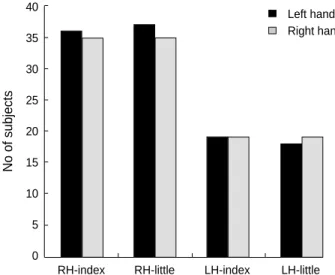
Touch pressure thresholds were determined using a stan- dard protocol described by Bell-Krotoski and a 20-piece kit of Semmes-Weinstein monofilaments (Rolyan, Smith & Nephew, U.S.A.). The measurement sites in each hand were the dis- tal phalanx of the index and little finger. The test was started with the 2.83 monofilament. If the response to this monofila- ment was “No” the next monofilaments were applied in order (3.22, 3.61, and 3.84, respectively) using the same protocol until a “Yes” response was given (12, 17). Number of sub- jects felt 2.83 monofilament were recorded.
For each of the two groups (right-handed and left-handed subjects), mean values (M) and standard deviations (SD) were calculated for the grip strength (lbs), VCWS 4 (seconds), PPT (kg/cm2) and touch pressure threshold test results in the domi- nant and non-dominant hands.
The paired-sample t-test was used to compare differences between dominant and non-dominant hands within each group. The independent sample t-test was also used to make inter-group comparisons of mean test values (dominant right- handed vs. dominant left-handed, and non-dominant right- handed vs. non-dominant left-handed). A p value <0.05 was accepted as significant. All statistical analyses were performed using Statistical Package for the Social Sciences 10.0 (SPSS) computer software.
RESULTS
Pressure pain threshold assessment in the right-handed
. .
subjects revealed significantly higher PPT in the dominant hand than in the non-dominant hand (p<0.05). The corre- sponding comparison in the left-handed group revealed no significant PPT difference between the hands (p>0.05). These results were shown in Fig. 1.
Concerning grip strength, the dominant hands of the right- handed subjects were significantly stronger than the non- dominant hands at both elbow positions (p<0.05). The hands of the left-handed subjects exhibited no significant differences in grip strength at either elbow position (p>0.05). The results of grip strength were shown in Fig. 2.
In dexterity testing, the mean times for completion of each panel of the VCWS 4 revealed that the dominant hands of the right-handers worked significantly faster than the non-
dominant hands for all (p<0.05). A similar trend was observed in the left-handers, but the difference between the mean domi- nant and non-dominant performance times for each panel was not significant (p>0.05). The dexterity findings were illustrated in Fig. 3.
Neither of the groups exhibited a significant difference in touch pressure threshold between the dominant and non- dominant hand (p>0.05) (Fig. 4).
Inter-group comparisons showed that the dominant hands of the right- and left-handers were not significantly different with respect to grip strength, PPT or touch pressure threshold (p>0.05). However, the dominant hands in the right-hand- ed group were significantly faster than the dominant hands in the left-handed group for three of the four VCWS 4 pan- els (bottom, top, front) (p<0.05).
Pressure pain threshold (lbs)
5 4,9 4,8 4,7 4,6 4,5 4,4
4,3
R L
Fig. 1.The pressure pain threshold results for the two groups. RH, Right-handed; LH, Left-handed; R, Right hand; L, Left hand.
RH LH
Lbs
35 30 25 20 15 10 5
0
RH-F RH-E LH-F LH-E
Fig. 2.Grip strength findings for the groups in the two elbow posi- tions. RH, Right-handed; LH, Left-handed; F, 90�Flexion; E, Exten- sion.
Left hand Right hand
Time (sec)
200
150
100
50
0
panel 1 panel 2 panel 3 panel 4 Assembly panels
RH-R RH-L LH-L LH-R
Fig. 3.Dexterity results on the VALPAR Component Work Sam- ple-4 (VCWS 4) panels. RH, Right-handed; LH, Left-handed; R, Right hand; L, Left hand.
No of subjects
40 35 30 25 20 15 10 5
0
RH-index RH-little LH-index LH-little Left hand Right hand
Fig. 4.The results for touch pressure threshold (index finger and little finger sites) in the two groups. RH, Right-handed; LH, Left- handed.
Inter-group comparisons of the test results in the non-domi- nant hands revealed no significant differences between the right- and left-handed subjects (p>0.05).
DISCUSSION
The superior performance of the preferred hand over the non-preferred hand in most tasks has been documented exten- sively. In particular, the preferred hand is faster and more accu- rate than the non-preferred one. This superiority has been attributed to cerebral laterality. In humans, one group of func- tions related to language and other motor and sensory per- formance is more or less localized to the neocortex (3, 18).
Although overall superiority of the dominant hand has been established, the specific dominance-related differences in per- formance during various manual tasks have not been inves- tigated to date. Identifying which differences are “typical” and obtaining reliable measurements of these would provide use- ful baseline performance values. These could be applied in both the diagnosis and treatment of impaired hand function.
This was our rationale for assessing manual performance para- meters (hand grip strength, dexterity, pressure pain thresh- old and touch pressure threshold) in dominant and non-domi- nant hands of self-reported right- and left-handers, and com- paring within and between these groups.
A recent investigation by Pauli et al. (11) assessed PPT asymmetry of the left and right third digits in 12 right-handed and 12 left-handed subjects using an automated-pressure algometer. The results showed clear PPT asymmetry in the right-handed participants, whereas no such finding was ob- served in the left-handed group. We noted higher sensitivi- ty in the non-dominant hands of right-handed subjects, but no PPT asymmetry in the left-handed group. Our findings in the right-handed group parallel those of above-mentioned authors.
A study conducted by Armstrong and Oldham (6) com- pared dominant and non-dominant hand strength in both right- and left-handed participants. The authors found no significant differences between the hands in the left-handed group, and observed small but significant differences between the dominant and non-dominant hands in the right-handed group. Incel et al. (8) documented significantly more grip strength in dominant hands than in non-dominant hands for right-handed people. Similarly, the results from our right- handed subjects indicated significantly greater grip strength in the dominant hand in both flexed and extended elbow positions. The left-handed subjects exhibited no such differ- ence in either elbow position.
There were no studies comparing hand dexterity of domi- nant and non-dominant hands in right-and-left handed sub- jects. Therefore, our study will lead to compare hand dexteri- ty in right-and left-handed subjects. Our data from dexteri- ty testing with the VCWS-4 system showed that the right-
handers completed all four panels significantly faster with their dominant hand than with their non-dominant hand. In contrast, the left-handed subjects showed statistically simi- lar dexterity of the dominant and non-dominant hands on all the panels.
Hage and et al. (14) reported that there was no difference between dominant and non-dominant hands of right-hand- ed subjects for touch pressure threshold. Van Turnhout et al.
(15) found no difference in touch pressure threshold in 51%
of all right-handed subjects. Likewise we observed no touch pressure threshold asymmetry in either the right- or left-hand- ed participants in our study.
In addition to within-group comparisons of manual per- formance, we also did inter-group comparisons. This revealed no significant differences between the dominant hands of right- and left-handed subjects with respect to grip strength, PPT and touch pressure threshold. However, the dominant hands of the right-handed subjects were significantly faster than the dominant hands of the left-handed subjects in the bottom, top, and front panels of the VCWS-4. The non-domi- nant hands of the right- and left-handers performed similar- ly on all tests. These results may be partially explained by left-handed people living in a world designed for right-han- ders. This requires a left-handed person to use the right (non- dominant) hand for many tasks that would naturally be done by the dominant hand of right-handers. Understanding the extent of manual performance asymmetry is very important in many respects. In our study, right-handers exhibited domi- nant hand superiority in grip strength and manual dexterity, whereas left-handers showed no such differences. We also observed asymmetry of pain sensitivity in the right-handed group but not the left-handed group. Defining and quanti- fying such dominant hand differences in specific tasks is im- portant as a baseline for diagnosing and treating hand injuries.
We hope to learn more about the symmetry specifics of hand dominance in larger groups and more detailed experiments.
REFERENCES
1. Desrosiers J, Hebert R, Bravo G, Rochette A. Age-related changes in upper extremity performance of elderly people: A longitudinal study. Exp Gerontol 1999; 34: 393-405.
2. Rondinelli RD, Dunn W, Hassanein KM, Keesling CA, Meredith SC, Schulz TL, Lawrence NJ. A simulation of hand impairments:
effects on upper extremity function and implications toward medical impairment rating and disability determination. Arch Phys Med Reha- bil 1997; 78: 1358-63.
3. Francis KL, Spirduso WW. Age differences in the expression of man- ual asymmetry. Exp Aging Res 2000; 26: 169-80.
4. Desrosiers J, Bravo G, Hebert R, Dutil E, Mercier L. Validation of the box and block test measure of dexterity of elderly people: relia- bility, validty, and norms studies. Arch Phys Med Rehab 1994; 75:
751-5.
5. Desrosiers J, Bravo G, Hebert R, Mercier L. Impact of elbow posi- tion on grip strength of elderly men. J Hand Ther 1995; 8: 27-30.
6. Armstrong CA, Oldham JA. A Comparison of dominant and non- dominant hand strengths. J Hand Surg 1999; 24-B: 421-5.
7. Hanten WP, Chen WY, Austin AA, Brooks RE, Carter HC, Law CA, Morgan MK, Sanders DJ, Swan CA, Vanderslice AL. Maximum grip strength in normal subjects from 20 to 64 years of age. J Hand Ther, 1999; 12: 193-200.
8. Incel NA, Ceceli E, Durukan PB, Erdem HR, Yorgancloglu ZR. Grip strength: effect of hand dominance. Singapore Med J 2002; 43: 234-7.
9. Nussbaum EL, Downes L. Reliability of clinical pressure-pain algo- metric measurements obtained on consecutive days. Phys Ther 1998;
78:160-9.
10. Vatine JJ, Shapira SC, Magora F, Adler D, Magora A. Electronic pressure algometry of deep pain in healthy volunteers. Arch Phys Med Rehabil 1993; 74: 526-30.
11. Pauli P, Wiedemann G, Nickola M. Pressure pain thresholds asym- metry in left-and right-handers: association with behavioural mea- sures of cerebral laterality. Eur J Pain 1999; 3: 151-6.
12. Bell-Krotoski J, Weinstein S, Weinstein C. Testing sensibility, includ-
ing touch-pressure, two-point discrimination, point localization and vibration. J Hand Ther 1993; 6: 114-23.
13. Bell-Krotoski J, Fess EE, Figarola JH, Hiltz D. Threshold detection and Semmes-Weinstein monofilaments. J Hand Ther 1995; 8: 155-62.
14. Hage JJ, van der Steen LP, de Groot PJ. Difference in sensibility between the dominant and non-dominant index finger as tested using the Semmes-Weinstein monofilaments pressure aesthesiometer. J Hand Surg 1995; 20-A: 227-9.
15. Van Turnhout AA, Hage J, De Groot PJ, De Lange-De, Klerk ES.
Lack of difference in sensibility between the dominant and non-dom- inant hands as tested with Semmes-Weinstein monofilaments. J Hand Surg 1997; 22-B: 768-71.
16. Fess EE. The need for reliability and validity in hand assessment instruments. J Hand Surg 1986; 11-A: 621-3.
17. Callahan AD. Sensibility Testing: Clinical methods. In: Hunter JM, Schneider LH, Mackin EJ, Callahan AD (Ed). Rehabilitation of the hand, 3rd ed. Mosby, St Louis, 1990: 594-610.
18. Ganong WF. Higher functions of the nervous system: Conditioned reflexes learning & related phenomena. Review of Medical Physiol- ogy 16th ed. Lange Medical Publ, California, 1993: 247-8.