40(4) : 376 381 (2009)
376
상추 7 품종의 Quinic Acid 유도체 분석 및 Peroxynitrite 소거효과
누그로호 아궁·장석우1·김원배1·이강노2·최재수3·박희준
*
상지대학교제약공학과
,
1농촌진흥청고령지농업연구센터2성균관대학교약학대학
,
3부경대학교식품생명공학부Analysis of Quinic Acid Derivatives on Seven Cultivars of the Lettuce ( Lactuca sativa L.) and Peroxynitrite Scavenging Effect
Agung Nugroho
1, Suk-Woo Jang
2, Won-Bae Kim
2, Kang Ro Lee
3, Jae Sue Choi
4and Hee-Juhn Park
5,*
Department of Pharmaceutical Engineering, Sangji University, Sangji University, Wonju 220-702, Korea
1
Highland Agriculture Research Center, Rural Development Administration, Pyeongchang 232-950, Korea
2Natural Products Laboratory College of Pharmacy, SungKyunKwan University, Suwon, 440-736, Korea
3
Devision of Food Science and Biotechnology, Pukyong National University, Busan 608-737, Korea
Abstract −
The compositional analysis and the peroxynitrite (ONOO
-) scavenging assay were undertaken to demonstrate ben- eficial dietary effect of lettuce ( Lactuca sativa L., Compositae). Quinic acid derivatives of the seven cultivars were qualitatively and quantitatively analyzed by HPLC to lead to the finding of 3,4-di- O -caffeoyquinic acid and 3- O - p -coumaroylquinic acid and their contents ranged over 2.72-4.47 mg/g and 8.97-23.26 mg/g, respectively. A cultivar Hacheong had the highest quantity of quinic acid derivatives. The peroxynitrite scavenging effect of the five cultivars (Jangsu, Gosina 27, Gopung, Yeo- lpungjeogchima, and Mipungjeogchugmyeon) were ranged over 7.45-8.26
µg/ml as IC
50s while those of Hacheong and Mihong had less effect (IC
50>10
µg/ml).
Key words −
Lactuca sativa , Compositae, peroxynitrite, quinic acid, HPLC
상추는한국뿐아니라세계적으로도널리식용되고있는 채소중하나이다
.
상추는국화과의식물로서그학명이Lactuca sativa L.
이며그잎을식용하며약용으로할때는건위
,
최면,
진정,
항창종등의목적으로사용한다.
1)최근에는식생활의변화로인해당뇨병
,
고지혈증,
비만,
동맥경화알츠하이머질환등다양한성인병으로인해채식을통해 이러한질병의예방과치료를도모하고자하는사람들이많 다
.
이에따라저자들도넘취,
2)고려엉겅퀴,
3)누룩치4,5) 등의생리활성성분에관한연구를지속해오고있다
. Peroxynitrite(ONOO
-)
는superoxide anion radical(·O
2-)
와nitric oxide(·NO)
의반응에의해생체내에서생성된다고알려져있으며
,
이것은감염성질환에대응하기위해필요하다고한다
.
6)그러나,
과량으로생성된peroxynitrite
는오히려지질과단백질을과산화시키고나아가세포독성을야기할
수있다
.
7)그뿐아니라,
과량생성된peroxynitrite
는고콜레스테롤혈증
,
동맥경화,
당뇨병및비만을일으킬수있다고한다
.
8-10)그러므로,
본연구에서는 상추 품종 추출물의peroxynitrte
소거효과를관찰함으로써이러한질병의예방에유효한품종을선발하고자하였다
.
특히
,
식물의잎에는페놀류등항산화물질이많이알려져있어서플라보노이드
,
탄닌,
안토시아닌,
페닐프로파노이드
, caffeoylquinic acid
등이함유되어있다.
이중quinic
유도체는
p -coumaric acid, ferulic acid
혹은caffeic acid
가quinic acid
에에스테르결합한화합물로서다양하게존재하여진통효과
,
소염효과,
간보호효과,
항산화효과,
혈소판응집억제효과등이보고되었다
.
11)저자들은산채자원과약용식물에대하여이러한연구를 수행하면서식용으로하고있는상추에대하여
quinic acid derivative
의분석과peroxynitrite
소거효과를규명하고자하였다
.
특히상추7
품종에대하여이러한연구를수행하여peroxynitrite
소거효과에따른성인병예방효과가있는지를*교신저자(E-mail):[email protected] (Tel):+82-33-730-0564
파악하기위하여실험을수행하였다
.
실험에사용된7
품종의특성을설명하면다음과같다
.
하청은
1999
년다수성인하지청축면을모본으로하고,
추대가늦은오톰골드
(Autumn Gold)
를부본으로하여교배육성한품종으로초다수성이며
,
만추대,
연녹색이며,
팁번저항성특성을갖고있는청축면상추이다
.
장수는2000
년추대가늦고다수성이나적색발현이문제점을갖고있는열 풍적치마를모본으로하고
,
적색발현이뛰어난서울약치마를교배하여육성한적치마상추이다
,
육성목표대로고온기후반까지기존품종보다적색발현이좋고
,
식미감,
저장성,
추대성등도향상된품종으로봄
,
가을겨울재배에적합하다
.
고풍은2000
년적색발현이좋으나수량성이떨어지는문제점을가진안동적축면모본으로하고
,
축면상추중수량성이좋은뚝섬적축면을교배하여육성한적축면상추이 다
.
모양이단아하고아름다운특성을가지고있으며,
저장성및잎한장의무게가무거운특성이있으며추대도늦은 다수성품종이다
.
봄,
여름,
가을재배에적합한품종이다.
미홍은
2000
년적색발현이좋으나수량이적고추대가빠른문제점을가진단홍적축면모본으로하고
,
축면상추중추대성이늦은하지청축면을교배하여육성한적축면상추 이다
.
안토시아닌발현이매우진하고,
모양이아름다운특성을가지고있으며추대도늦은품종으로봄
,
여름,
가을재배도가능한품종이다
.
고시나27
호는현재신품종출원을위한전국지적시험에공시한계통으로치마형상추이면서 포기상추의특성을지닌중간형계통으로엽색이진흑색을 띄며
,
식미감이좋으며,
봄,
가을재배에적합한계통이다.
미풍적축면과열풍적치마는권농종묘에서육성한시판품종 이다
.
재료 및 방법
기기 및 시약 − 분석에 사용한
HPLC
는Prostar 210 solvent delivery module, Prostar 325-Vis detector
및20
µL sample loop (Rheodyne, Rohnert Park, CA, USA)
로 구성된
Varian HPLC system
이었다.
분리를위해사용한컬럼은Hamilton (Reno, Nevada, USA)
에서 구입한Shiseido (Chouku, Tokyo, Japan)
사의Capcell Pak C18 comlumn (5
µL, 250 mm × 4.6 mm I.D.)
이었다. HPLC
분석용이동상의용매는
J.T. Baker (Philipsburg, NJ, USA)
사로부터구입한
HPLC
급용매이었다.
표준화합물로사용한3,4-di- O - caffeoylquinic acid(3,4-DQ), 3,5-Di- O -dicaffeoyl- muco -quinic acid(3,5-DeQ), 3,5-di- O -caffeoylquinic acid (3,5-DQ), 4,5- di- O -caffeoylquinic acid(4,5-DQ), 5- O -caffeoylquinic acid (5-CQ), 3- O -caffeoylquinic acid(3-CQ), 3- O - p -coumaroyl- caffeoylquinic acids(3-pCQ)
의7
종화합물은Lactuca indica
에서분리된것이다
.
12)Dihydrorhodamine 123(DHR 123)
과peroxynitrite
는 생리활성 실험을 위하여 각각Molecular Probes (Eugene, OR, USA)
와Cayman Chemical Co. (Ann Arbor, MI, USA)
로부터구입하여사용하였다.
식물재료 − 하청
,
장수,
고풍,
미홍,
고시나27
호는농촌진흥청고령지농업연구센터에서육성한품종을
,
미풍적축면,
열풍적치마는권농종묘㈜에서육성한품종이다
.
추출 −
500 ml
삼각플라스크에10 g
의상추7
품종식물재료를 각각 넣고
400 ml
의MeOH
을 넣어서ultrasonic cleaner (Branson 8510)
을 이용하여60
oC
에서24
시간sonication
하였다.
추출액을여과하여진공농축기를이용하여감압하에농축한다음이들을각각동결건조기를이용 하여
24
시간동결건조하였다.
그수득률을계산한결과다음과같다
.
괄호안에수득률을나타내어미홍(13.0%),
고풍
(12.3%),
고시나27(12.6%),
미풍적축면(13.5%),
장수(13.0%),
열풍적치마(12.5%),
하청(11.5%)
의수득률을 보였다
.
Peroxynitrite 소거활성 실험 −
Peroxynitrite scavenging activity
를측정하기위하여Kooy
의방법에13)준하여수행하였다
.
이방법은Peroxynitrite
존재하에비형광성의DHR
123
으로부터생성되는 강한 형광성의rhodamine 123
을monitoring
하는방법이다. Rhodamine buffer (pH 7.4)
용액은
50 mM sodium phosphate dibasic, 50 mM sodium phosphate monobasic, 90 mM sodium chloride, 5 mM potassium chloride, and 100
µM DTPA
용액이다.
마지막DHR 123
농도는5
µM
이었다.
이완충액은사용직전에조제하여빙상에보관하면서사용하였다
.
상추품종추출물은10% DMSO
에 녹여 검액으로 하였다. 0.2N sodium
hydroxide
에용해된peroxynitrite (10
µM)
을첨가한후5
분지나서마지막형광강도를측정하였다
.
바탕값(background)
를측정하기위하여같은방법으로
peroxynitrite
용액의첨가없이마지막형광강도를측정하였다
.
산화된DHR 123
의형광강도는
microplate fluorescence reader FL 500 (Bio- Tek Instruments Inc., Winooski, VT, USA)
를이용하여 각각
480 nm
와530 nm
의excitation
과emission
에서측정하였다
. Peroxynitrite
소거활성은DHR 123
산화의검출을통하여마지막형광값에서배경형광값을빼서산출하였다
.
그결과는이검색법을
3
회실시하여IC
50값으로평균±
표준오차
(SEM)
으로나타내었다.
HPLC 분석 −
7
종추출물과표준화합물을각각80%
메탄올에녹이고
HPLC
에주입하기전0.50
µm syringe filter
로여과하였다
.
자외선검출기의고정파장246 nm
를사용하여 검출하였다
.
이동상으로solvent A
로서0.05%
phosphoric acid
수용액을, solvent B
로서MeOH
를사용하여다음과같이기울기용리법으로용출하였다
. 0-15 min,
60% A : 40% B; 15-20 min, 50% A : 50% B; 20-26 min,
45% A : 55% B; 26-30 min, 60% A : 40% B
로설계하여전개하였으며흐름속도는
0.70 mL min
-1이었다. 50, 100 and
200
µg/mL
의세농도에서각각의피크면적을얻은회귀직선방정식을얻었다
.
결 과
실험에사용된
7
종의상추품종에대하여quinic acid
유도체 표준 화합물
7
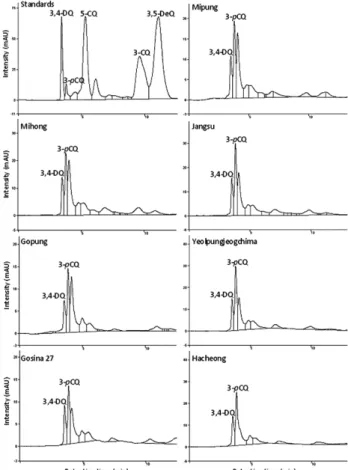
종으로HPLC
에서 분석한결과3,4-
dicaffeoylquinic acid
와3-p-coumaroylquinic acid
만이 각각retention time 3.5
분과3.8
분에서검출되었다. Retention time
이
3.5
분에나타난3,4-di-O-caffeoylquinic acid
는회귀방정식이
Y = 66.84X – 526.7
로서그R
2값이0.996
이었으며3.8
분에나타난3- O - p -coumaroylquinic acid
는Y = 23.02X- 112.2
로서 그R
2 값이0.999
이었다.
각 추출물HPLC
chromatogram
에서상기두화합물피크면적을얻은다음각화합물의함량을계산하였으며그결과를
Table I
에나타내었다
.
그 화학구조는
Fig. 1
에 나타내었으며 각품종HPLC chromatographic profile
을Fig. 2
에나타내었다.
표준화합물로사용된다른
5
종의quinic acid
유도체는관찰되지않았다
.
그 함량 값을Table I
에 나타내었듯이, 3,4-
dicaffoylquinic acid
는2.72-4.47 mg/g
의값으로큰차이를보이지않았고
,
이중가장낮은값을보인품종은고풍이었으며가장높은값을보인품종은열풍적치마이었다
. 3- p -coumaroylquinic acid
는8.97-23.26 mg/g
의값을나타내큰차이를보이지않았고
,
이중가장낮은값을보인품종은역시고풍이었으며가장높은값을보인품종은역시열풍 적치마이었다
.
총함량에서도고풍은가장낮은함량을,
열Table I.
Content of the two quinic acid derivatives (mg/g of dried weight) in the MeOH extract of seven cultivars of L. sativa Sample 3,4-DQ Caffeoylquinic acid (mg/g of dried weight) 3- p CQ Sum % of extract
Mihong 4.42±0.15
a15.64±0.50 20.06±0.61 15.43±0.47
Gopung 2.72±0.13 8.97±0.69 11.69±0.70 9.50±0.57
Gosina 27 3.40±0.10 11.44±0.31 14.84±0.38 11.78±0.30
Mipungjeogchukmyeon 3.70±0.23 13.02±0.67 16.73±0.77 12.39±0.57
Jangsu 4.78±0.16 21.23±0.83 26.01±0.99 20.01±0.76
Yeolpungjeogchima 4.47±0 .20 17.35±0.26 21.83±0.06 17.46±0.05
Hacheong 3.78±0.04 23.26±0.49 27.04±0.52 23.51±0.45
a
Values represent mean ± S.D. based on three experiments.
Abbreviation: 3,4-DQ (3,4-di-O-caffeoylquinic acid), 3-
pCQ (3-p-coumaroylquinic acid)
Fig. 1.
Structure of 3,4-di-O-caffeoylquinic acid (the left) and 3- O - p -coumaroylquinic acid (the right) identified from HPLC analysis.
Fig. 2.
HPLC chromatographic profiles of seven cultivars of L.
sativa and a mixture of seven standard compounds
Abbreviation : Mipung (Mipungjeogchugmyeon)
풍적치마는가장높은함량을보였다
.
메탄올추출물중함량은
9.50-23.51%
로서비교적고른함량을보였다. Peroxynitrite
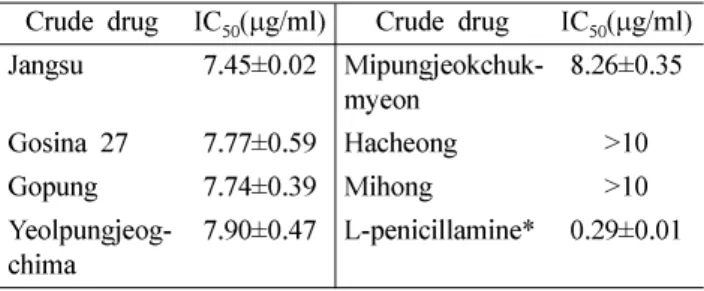
소거활성의결과는Table II
에나타내었다.
장수
,
고시나27,
고풍,
열풍적치마,
미풍적축면,
하청등은그
IC
50값이7.45-8.26
µg/ml
의값을보여그활성이비교적 강함을 보여주었다
.
한편 대조약물로 사용된L- penicillamine
은그IC
50값은0.29
µg/ml
으로나타났다.
고 찰
국화과의야생산채식물에는다양한식물성분이함유되 어 있지만
caffeoylquinic acid
류 화합물들이왕고들빼기( Lactuca indica ),
12,14)울릉미역취( Solidago virga-aurea var.
gigantea ),
15)참취( Aster scaber )
16)등에함유되어있다.
이와같이국화과산채류에
quinic acid
유도체가풍부하게함유되어있음에따라본연구에서는식용채소인상추
7
종의표준화합물을이용하여
quinic acid
유도체의동정과함유량을
HPLC
를 이용하여 밝혔다.
본 연구 중3,4-di- O - caffeoylquinic acid
와3- p -coumaroylquinic acid
의단2
종의quinic acid
유도체성분이밝혀졌고그함유량도취나물류에비하여매우낮은것으로평가되었다
.
레몬
,
오렌지 등의Citrus
속 식물의 과일17,18) 큰peroxynitrite
소거활성을가지는hesperetin
을풍부히함유19)모세혈관투과성억제
,
20)항발암,
항종양,
항염,
항산화작용등20-23)다양한작용을나타낸다고하였다
.
또,
과일, cereals,
채소
, legume,
포도주등의polyphenol
성분이비만과관련하여 연구수행이된바있다
.
특히, luteolin, kaempferol, quercetin, epigallocathechin galate (EGCG)
등의항비만효과가보고되어있다
.
24)Caffeoylquinic acid
의대표적성분인chlorogenic acid
의peroxynitrite
소거활성으로그IC
50값이2.78
µM
로보고된바있다.
25)Kim
등은26)항산화물질이풍부한상추등을포함하는채소혼합물섭취가마우스식이성고지혈증을감소시킨다고 하였다
. Lettuce
에 함유된cyanidin-3- O -(6''-malonyl-
β-D- glucopyranoside)
와여기서즉시바뀐화합물인cyanidin-3- O -(6''-malonyl-
β-D-glucopyranosidemethyl ester)
는cycolo
oxygenase-2
와지질과산화를억제하는효능이크다고하였다
.
그리고,
상추로부터chicoric acid, quercetin glucoside, ferulic acid, caffeic acid
가분리되었다고한다.
27)상추의성분으로그왁스의주성분이
oleanolic acid
와ursolic acid
로구성되어있음이밝혀졌으며
,
28)색소성분인cyanidin 3-O- (6''-malonylglucoside),
29)carotenoid
로서lactucaxanthin,
30)sesquiterpene lactone
으로서lactucin, 11
β,13-dihydrolactucin, lactupicrin, melampolide, 3
β,14-dihydroxy-11
β,13-dihydro costunolide
등이알려져있다.
31)이이외에도red leaf lettuce ( L. sativa L.)
로부터mono- and dicaffeoyltartaric acid, mono- and dicaffeoylquinic acid, quercetin 3-malonylglucoside, quercetin 3-glucoside, cyanidin 3-malonylglucoside, cyanidin 3-malonylglucoside
를 분리하여alkylperoxyl radical scavenging effect
를측정한바있다.
32)한편
, Peroxynitrite
과량생성은고콜레스테롤혈증,
동맥경화
,
비만과당뇨병같은여러질환을일으키는것으로알려져있다
.
8-10)본연구중에서도상추가이러한peroxynitrite
소거활성이관찰되어있으므로상기질환의예방과치료에 유익한것으로예상된다
. 7
품종중미홍과하청은효과가상대적으로약하여
peroxynitrite
소거효과로서그IC
50값이10
µg/ml
이상이었으나그외장수,
고풍,
고시나27
호,
미풍적축면
,
열풍적치마는7.45-8.26
µg/ml
범주에서관찰되었으므로비만
,
고지혈증,
동맥경화,
당뇨병등에유익할것으로 예상된다
.
또, HPLC
분석에서 확인된3,4-di- O - caffeoylquinic acid
와3- p - O -coumaroylquinic acid
는상추로부터처음밝혀진것이다
.
결 론
세계적으로이용되는채소인상추
( Lactuca sativa L.,
국화과
)
섭취가미치는건강상의유익한점을밝히고우수품종을밝히기위한일환으로
peroxynitrite
소거효과와HPLC
분석을수행하였다
.
상추7
품종에대해HPLC
에의한정성및정량분석을수행하여
3,4-di- O -caffeoyquinic acid and 3- O - p -coumaroylquinic acid
의존재를확인하고전자가2.72- 4.47 mg/g dried weight
의 함량을 보였고 후자가8.97- 23.26 mg/g
의함량을보였다.
특히하청품종은quinic acid
유도체가가장많이함유하는것으로나타났다
.
장수,
고시나
27
호,
고풍,
열풍적치마,
미풍적축면은peroxynitrite
소거효과의
IC
50가7.45-8.26
µg/ml
수준에서나타나고하청과미홍은
10.0
µg/ml
이상의값을나타냄으로써그효과가상대적으로낮은것으로밝혀졌다
.
Table II.
IC
50value (
µg/mL) on peroxynitrite scavenging activity of the MeOH extracts of seven cultivars of L. sativa Crude drug IC
50(
µg/ml) Crude drug IC
50(
µg/ml) Jangsu 7.45±0.02 Mipungjeokchuk-
myeon 8.26±0.35
Gosina 27 7.77±0.59 Hacheong >10
Gopung 7.74±0.39 Mihong >10
Yeolpungjeog-
chima 7.90±0.47 L-penicillamine* 0.29±0.01 ONOO
-scavenging activity was measured by monitoring the oxidation of DHR 123 as described in materials and methods.
Data are mean ± SEM of triplicate experiments. *used as a
positive control.
인용문헌
1. Kim, T. J. (1996) Korean Resources of Plants, Publishing Center of Seoul National University, Seoul, p. 317.
2. Choi, J. W., Park, J. K., Lee, K., T., Park, J. K., Park, K. K., Kim, W. B., Lee, J. H., Jung, H. J. and Park, H. J. (2005) In Vivo Antihepatotoxic effect of Ligularia fischeri var. spic- iformis and of the active component, 3,4-dicaffeoylquinic acid. J. Med. Food
8: 348-352.
3. Yoo, Y. M., Nam, J. H., Kim, M. Y., Choi, J. W., Park, H. J.
(2008) Pectolinarin and pectolinarigenin of Cirsium setidens prevent the rat hepatic injury caused by D-galactosamine via antioxidant mechanism. Biol. Pharm. Bull.
31: 760-764 (2008).
4. Jung, H. J., Kim, S. G., Nam, J. H., Park, K. K., Chung, W.
Y., Kim, W. B., Lee, K. T., Won, J. H., Choi, J. W. and Park, H. J. (2005) Isolation of saponins with the inhibitory effect on nitric oxide formation from Pleurospermum kamtschaticum . Biol. Pharm. Bull.
28: 1668-1671.
5. Won, J. H., Im, H. T., Kim, Y. H., Yun, K J., Park, H. J., Choi, J. W. and Lee K. T. (2006) Anti-inflammatory effect of bud- dlejasaponin IV through the inhibition of iNOS and COX-2 expression in RAW 264.7 macrophages via the inactivation of NF-
κB. Brit. J. Pharmacol .
148: 216-225.
6. Radi, R., Beckman, J. S., Bush, K. M. and Freeman, B. A.
(1991) Peroxynitrite oxidation of sulfhydryls. The cytotoxic potential of superoxide and nitric oxide. J . Biol . Chem .
266: 4244-4250.
7. Haenen, G. R., Paquay, J. B., Korthouwer, R. E. and Bast, A.
(1997) Peroxynitrite scavenging by flavonoids. Biochem . Biophys . Res . Commun .
236: 591-593.
8. Korda, M., Kubant, R., Patton, S. and Malinski, T. (2008) Leptin-induced endothelial dysfunction in obesity. Am . J . Physiol . Heart Circ . Physiol .
295: 1514-1521.
9. Patcher, P., Obrosova, I. G., Mabley, J. G., and Szabo, C.
(2005) Role of nitrosative stress and peroxynitrite in the pathogenesis of diabetic complications. Emerging new ther- apeutical strategies. Curr . Med . Chem .
12: 267-275.
10. Drel, V. R., Patcher, P., Vareniuk, I., Pavlov, I., Lyzogulbov, V.
V., Grovez, J. T., and Obrosova, I. G. (2007) A peroxynitrite decomposition catalyst counteracts sensory neuropathy in streptozotocin-diabetic mice. Eup . J . Pharmacol .
569: 48-58.
11. Zhao, Y. and Zhao, J. (2006) Advances in caffeoylquinic acid research. Zhonguo Zhongyao Zazhi
31: 869-874.
12. Kim, K. H., Lee, K. H., Choi, S. U., Kim, Y. H. and Lee, K.
R. (2008) Terpene and phenolic constituents of Lactuca indica L. Arch. Pharm. Res.
31: 983-988.
13. Kooy, N. W., Royall, J. A., Ischiropoulos, H. and Beckman, J. S. (1994) Peroxynitrite-mediated oxidation of dihydror- hodamine 123. Free Radic. Biol. Med .
16: 149-156.
14. Kim, K. H., Kim, Y. H. and Lee, K. R. (2007) Isolation of quinic acid derivatives and flavonoids from the aerial parts of
Lactuca indica L. and their hepatoprotective activity in vitro.
Bioorg. Med. Chem. Lett.
17: 6739-6743.
15. Choi, S. Z. and Choi, S. U. and Lee, K. R. (2004) Phy- tochemical constituents of the Aerial parts from Solidago virga-aurea var. gigantea Miq.. Arch. Pharm. Res.
27: 164- 16. Kwon, H. C., Jung, C. M., Shin, C. G., Lee, J. K., Choi, S. U., 168.
Kim, S. Y. and Lee, K. R. (2000) A new caffeoyl quinic acid from Aster scaber and its inhibitory activity against human immunodeficiency virus-1 (HIV-1) integrase. Chem. Pharm.
Bull.
48: 1796-1798.
17. Kim, J. Y,, Jung, K. J., Choi, J. S. and Chung, H. Y. (2004) Hesperetin: a potent antioxidant against peroxynitrite. Free Radic. Res.
38: 761-769.
18. Mouly, P. P. M., Arzouyan, C. G., Gaydou, E. M. and Esti- enne, J. M. (1994) Differentiation of citrus juices by factorial discriminate analysis using liquid chromatography of fla- vanone glycosides. J. Agric. Food Chem.
42: 70-79.
19. Rouseff, R. L., Martin, S. F. and Youtsey, C. O. (1987) Quan- titative survey of narirutin, naringin, hesperidin and neo- hesperidin in citrus. J. Agric. Food Chem.
35: 1027-1030.
20. Kimura, Y., Kubo, M., Tani, T., Arichi, S. and Okuda, H.
(1981) Studies on scutellariae radix. IV. Effects on lipid per- oxidation in rat liver. Chem. Pharm. Bull.
29: 2610-2617.
21. Bracke, M. E., Bruyneel, E. A., Vermeulen, S. J., Vennekens, K. I., Marck, V. V. and Mareel, M. M. (1994) Citrus fla- vonoid effect on tumor invasion and metastasis. Food Tech- nol.
48: 121-124.
22. Middeton, E. and Kanadaswami, C. (1994) Potential health promoting properties of citrus flavonoids. Food Technol.
48: 115-119.
23. Attaway, J. A. (1994) Citrus juice flavonoids with anticar- cinogenic and antitumor properties, In: Huang, M.T., Osawa, T., Ho, C.T. and Rosen, R.T., eds, Food phytochemicals for cancer prevention. I. Fruits and vegetables, American Chem- ical Society, Washington, DC, pp 240–248.
24. Rayalam, S., Della-Fera, M. A. and Baile, C. A. (2008) Phy- tochemicals and regulation of the life cycle. J. Nutr. Biochem.
19
: 717-726.
25. Jung, H. A., Chung, H. Y., Kang, S. S., Hyun, S. K., Kang, H. S. and Choi, J. S. (2005) A phenolic glucoside isolated from Prunus serrulata var. spontanea and its peroxynitrite scavenging activity. Arch. Pharm. Res.
28: 1277-1130.
26. Kim, M. Y., Cheong, S. H., Kim, M. H., Son, C., Yook, H. S., Sok, D. E., Kim, J. H., Cho, Y., Chun, H. and Kim, M. R.
(2009) Leafy vegetable mix supplementation improves lipid profiles and antioxidant status in C57BL/6J mice fed a high fat and high cholesterol diet. J. Med. Food.
12: 877-884.
27. Mulabagal, V., Ngouajio, M., Nair, A., Zhang, Y., Got-
tumukkala, A. L. and Nair, M. G. (2010) In viro evaluation of
red and green lettuce ( Lactuca sativa ) for functional food
properties. Food Chemistry
118: 300-306.
28. Bakker, M. I., Baas, W., Sijm, D. T. H. M. and Kolloeffel (1998) Leaf wax of Lactuca sativa and Plantago major . Phy- tochemistry
47: 1489-1493.
29. Yamaguchi, M. A., Kawanobu, S., Maki, T. and Ino, I. (2006) Cyanidin 3-malonylglucosdide and malonyl-coenzyme A:
Anthocyanidin malonylacyltransferase in Lactuca sativa leaves. Phytochemistry
42: 661-663.
30. Harms, D. S., Hertzberg, S., Borch, G. and Liaaen-Jensen, S.
(1981) Lactucaxanthin, an
ε,
ε-carotene-3,3
'-diol from Lac-
tuca sativa. Phytochemistry
20: 85-88.
31. Mahmoud, Z. F., Kassem, F. F., Abdel-Salam, N. A. and Zdero, C. (1986) Sesquiterpene lactones from Lactuca sativa . Phytochemistry
25: 747-748.
32. Caldwell, C. R. (2003) Alkylperoxyl radical scavenging activity of red leaf lettuce ( Lactuca sativa L.) phenolics. J.
Agric. Food Chem.
51: 4589-4595.
(2009년 10월 22일 접수)