• 검색 결과가 없습니다.

A Pilot Study on the Control Performance of Foot-Controlled Mouse Devices for the Nondisabled People

N/A
N/A
Protected

Academic year: 2021

Share "A Pilot Study on the Control Performance of Foot-Controlled Mouse Devices for the Nondisabled People"

Copied!
10
0
0

로드 중.... (전체 텍스트 보기)

전체 글

(1)

JESK http://jesk.or.kr eISSN:2093-8462

A Pilot Study on the Control Performance of Foot-Controlled Mouse Devices for the

Nondisabled People

Seung Kweon Hong

Department of Industrial and Management Engineering, Korea National University of Transportation, Chungju-si, 27460

Corresponding Author Seung Kweon Hong Department of Industrial and

Management Engineering, Korea National University of Transportation, Chungju-si, 27460

Mobile : +82-10-9797-5389 Email : [email protected]

Received : March 31, 2016 Revised : April 12, 2016 Accepted : May 11, 2016

Objective: In this study, two types of foot-controlled mouse devices are compared with a hand mouse in the input tasks requiring repetitively switching between a keyboard and a mouse.

Background: Foot-controlled mouse devices have been developed for persons with impairments in the mobility of their hands. However, some researchers insisted that the foot-controlled mouse devices could be effectively used by the persons with no limits to their hand mobility. There are needs to investigate the efficiency of the foot-controlled mouse devices, when they are used by the nondisabled people.

Method: Participants conducted the input tasks, requiring repetitive switches between a keyboard and a computer mouse. The used computer mouse devices were two types of foot-controlled mouse and a typical hand mouse. Participants performed three types of input task for five days and three types of task performance were measured; the number of completed input tasks within a given practice time, subjective satisfaction level and the time wasted for the mouse control.

Results: For five days, the performance of input tasks sharply increased in input tasks by foot-controlled mouse devices rather than a hand mouse. After five days, the level of satisfaction on the foot-controlled mouse devices approached to about 76% of a hand mouse satisfaction level. The control time of the foot-controlled mouse devices also approached to about 109% of a hand mouse control time.

Conclusion: After only five-day practice, the input task performance by foot-controlled mouse devices approached to that of a hand mouse. This result may suggest that the foot-controlled mouse devices can be effectively used as an alternative input device for the nondisabled people, if input tasks are easy and enough practice time is provided.

Application: The results of this study might help to design foot-controlled mouse devices and to expend the usage of them.

Keywords: Foot-controlled mouse, Learning effects, Input devices, Disabled people

Copyright@2016 by Ergonomics Society of Korea. All right reserved.

ccThis is an open-access article distributed under the terms of the Creative Commons Attribution Non-Commercial License (http://

creativecommons.org/licenses/by-nc/3.0/), which permits unrestricted non-commercial use, distribution, and reproduction in any medium, provided the original work is properly cited.
1. Introduction

The input devices were typically designed for persons with no impairments in the

mobility of their hands. Computer interaction with these input devices by the

disabled people may be impractical depending on their individual disability. They

may experience any of several difficulties, such as frequent typing mistakes, multiple

(2)

keystrokes, inability to accurately and repeatedly control the device, or the inability to access the device partially or entirely. Many researchers had developed alternative input devices for the disabled people such as alternative keyboard and mouse devices;

eye-input devices and voice recognition tools (Hutchinson et al., 1989; Karl et al., 1993; Shneiderman, 2000).

The foot has not been extensively used as a limb to control any devices. Input devices controlled by the foot are not popular in our daily life. A few examples are foot pedals to drive cars and foot switches for industrial workers. These devices are activated by just pushing them as required. The foot produces simple vertical movements for controlling the devices.

The foot-controlled mouse devices developed as an alternative of a hand mouse for the disabled people are requiring more complex foot movements, compared to the traditional foot-controlled devices. When the complex foot movements are required, the controllability of the devices may be questionable. Many previous studies indicated that foot movements were less efficient than hand movements (Hoffmann, 1991; Springer and Siebes, 1996; Hong and Kim, 2012). Regardless of this low efficiency, people with impairment of hand mobility may unavoidably use the foot-controlled mouse devices as an alternative mouse.

However, some researchers suggested a possibility that the foot-controlled mouse could be effectively used for the nondisabled people (Simpson, 2013). When nondisabled people conduct the input tasks that require repetitively switching between keyboard and a typical hand mouse, they are suffering from the time lose in the process of switching two input devices. This is because the keyboard and hand mouse are controlled by the same hand. If a foot-controlled mouse is used as an alternative of the hand mouse, it may be contribute to the reduction of the time lose.

In this study, two types of foot-controlled mouse devices are compared with a hand mouse in the input tasks requiring repetitively switching between a keyboard and a mouse. It is measured how the efficiency of the devices is changed according to the degree of practice.

2. Method 2.1 Participants

Four paid volunteers (1 male, 3 female) were recruited from Korea National University of Transportation. Participants ranged from 20 to 28 years old (mean = 23). All were daily users of computer hand mouse. None had prior experience with foot-controlled mouse devices. All participants had no impairment in the foot and hand mobility. They took part in all experimental conditions.

2.2 Apparatuses

Input devices used in this experiment were a hand mouse and two types of foot-controlled mouse devices. A typical optical mouse was used as a hand mouse. Two foot-controlled mouse devices were selected among commercially available devices (Figure 1). Footime mouse (Bili Inc.) is a two-part input device; the "slipper" that goes on a user's foot is for cursor control, and the pedal is for mouse clicks and shortcuts. The slipper-shaped cursor control is the similar to the typical hand mouse. The pedal for the mouse clicks and shortcuts includes several push buttons.

No-Hands mouse (Fentek Inc.) consists of two pedals; a cursor pedal and a click pedal. The cursor pedal is mounted on a base

that stays stationary on the floor. The pedal itself pivots on top of the base and moves in any direction a user presses his/her

foot. This movement will be translated into cursor movement on the screen. The more firmly a user presses on the pedal in

any direction, the faster the cursor goes. The click pedal is also mounted on a base like the cursor pedal. The pedal only allows

movement in an up and down rocking-like motion from heel to toe. The toe click is equivalent to the left button and the heel

(3)

click is equivalent to the right button.

2.3 Tasks

All participants performed three types of input tasks, requiring repetitive switches between a keyboard and a computer mouse.

Figure 2(a) shows the simplest input tasks among three input tasks. Participants should type a short word indicated in the

instruction box of the left side. After clicking the input box of the right side by the computer mouse, participants input the text

using the keyboard. A series of this task is conducted in a screen. Figure 2(b) is a task to correct the text after finding an incorrect

(4)
(5)

text. More precise mouse work is needed than the first input task. The cursor should be exactly placed and clicked in the front of incorrect text within the input box. Figure 2(c) is the most complicated input task, requiring mouse drags, text inputs and cursor movements. The third task is an input task adding mouse drag work to the first input task. Participants should input a text in the input box in the top of the screen and the box should be dragged into the appropriate position.

2.4 Design of experiments

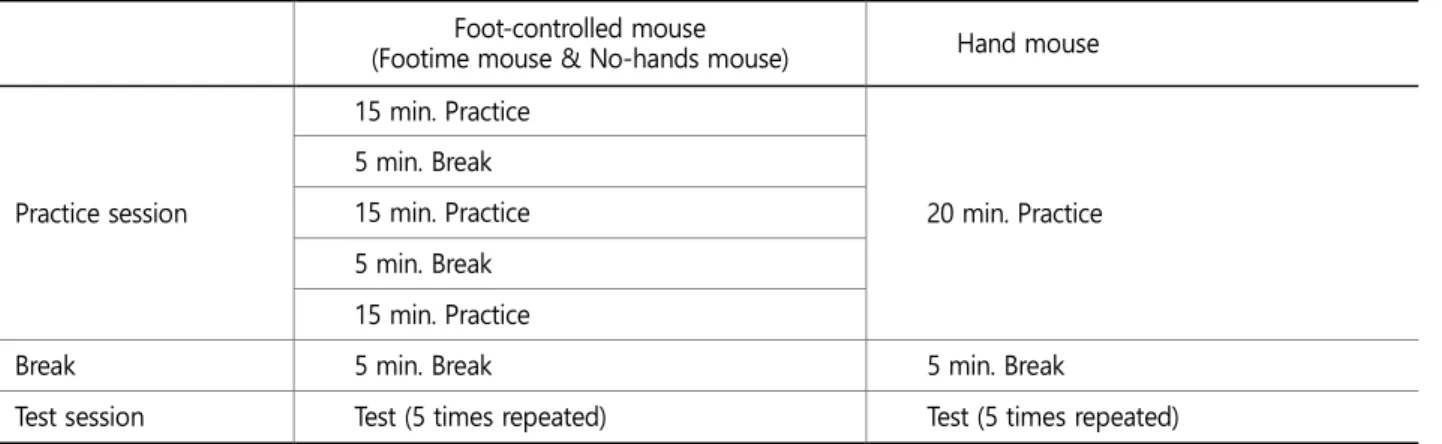
Participants conducted three types of input tasks using three types of computer mouse devices for five days. Input tasks for a day were divided into a practice session and a test session shown in Table 1. The practice session for the foot-controlled mouse devices took 55 minutes including 2 times of 5 minutes break. Three types of input tasks were sequentially performed during practice session. The practice session for the hand mouse took only 20 minutes without a break. The short practice time was setup because participants were already experienced enough to the hand mouse control. In the test session, participants conducted 5 times of three input tasks using each mouse devices.

3. Results

3.1 The number of input tasks completed for a practice session

The number of input tasks completed for a practice session of each day was measured in input tasks using each computer mouse devices and a keyboard. If all three types of input tasks were completed, it was counted as 1, two types of input tasks as 2/3 and one type of input tasks as 1/3. Figure 3 shows the phenomenon that the number of completed input tasks is changing with the practice. For five days, the performance of input tasks sharply increased in input tasks by foot-controlled mouse devices than a hand mouse. In particular, learning effect of the Footime mouse was highest among three mouse devices. Two-way ANOVA (2 levels for the foot-controlled mouse devices, 5 levels for the practice) was conducted. Footime mouse was more efficient than the No-Hands mouse ( F (1, 39)=33.15, p < 0.001). The number of completed input tasks was insignificant different according to the practice ( F (4, 39)=43.60, p < 0.001). There was no interaction between foot controlled mouse devices and practice ( F (4, 39)=0.30, p = 0.88).

Table 1. Experiment schedule for a day

Foot-controlled mouse

(Footime mouse & No-hands mouse) Hand mouse

Practice session

15 min. Practice

20 min. Practice 5 min. Break

15 min. Practice 5 min. Break 15 min. Practice

Break 5 min. Break 5 min. Break

Test session Test (5 times repeated) Test (5 times repeated)

(6)

3.2 Analysis of satisfaction levels

Subjective satisfaction level was measured after the completion of experiments in each day. Seven point rating scale ranging one

(very low) to seven (very high) was used for the subjective rating. Seven point stands for the satisfaction level that is the same

to the hand mouse satisfaction. The satisfaction level on the foot-controlled mouse devices increased with the practice ( F (4,

119)=5.19, p < 0.01) as shown in Figure 4. The Footime mouse provided higher satisfaction than the No-Hands mouse ( F (1,

119)=26.88, p < 0.001). After five days, the satisfaction level of Footime mouse approached to about 76% (=5.7/7.0) of a hand

mouse satisfaction level. On the other hand, the simpler the input task was, the higher the satisfaction level was ( F (2, 119)=13.57,

p < 0.001). That is, the first type of input tasks provided the highest satisfaction level as shown in Figure 5.

(7)

3.3 Analysis of mouse control times

The mouse control times were measured in the test session of each day. The mouse control time was significantly different according to the three main factors (task type, date and mouse) and there were significant interaction between all pairs of three main factors (task type*date, mouse*task type and date*mouse task) as shown in Table 2.

As shown in Figure 6, the mouse control times of the foot-controlled mouse devices sharply decreased with the practice, while the mouse control time of a hand mouse was not significantly changed according to the practice. On the other hand, when the difficulty of input task was low, the difference between control times of each mouse devices was not large, while the difficulty was high, the difference was large.

The standard deviations of mouse control times were analyzed. The standard deviation was significantly different according to the Table 2. ANOVA of mouse control times

DF Seq SS Adj SS Adj MS F p

Task Type 2 263.652 263.652 131.826 440.18 0.000

*

Date 4 39.461 39.461 9.865 32.94 0.000

*

Mouse 2 79.318 79.318 39.659 132.43 0.000

*

Task Type*Date 8 9.9 9.9 1.238 4.13 0.000

*

Task Type*Mouse 4 68.356 68.356 17.089 57.06 0.000

*

Date*Mouse 8 14.719 14.719 1.84 6.14 0.000

*

Errors 151 45.222 45.222 0.299

Total 179 520.628

(8)

three main factors (task type, date and mouse) and there were significant interaction between task type and mouse and between date and mouse task as shown in Table 3.

As shown in Figure 7, the standard deviations of the mouse control times of the foot controlled mouse devices sharply decreased with the practice, while those of a hand mouse were not significantly changed with the practice. On the other hand, when the difficulty of input task was low, the difference between the standard deviations of each mouse devices was not large, while the difficulty was high, the difference was large.

4. Discussions and Conclusion

Foot-controlled mouse devices were developed for persons with impairments in the mobility of their hands. However, there may Table 3. ANOVA of standard deviations of mouse control times

DF Seq SS Adj SS Adj MS F p

Task Type 2 48.1491 48.1491 24.0746 42.3 0.000

*

Date 4 13.0838 13.0838 3.271 5.75 0.000

*

Mouse 2 29.0116 29.0116 14.5058 25.49 0.000

*

Task Type*Date 8 7.3129 7.3129 0.9141 1.61 0.127

Task Type*Mouse 4 17.3352 17.3352 4.3338 7.61 0.000

*

Date*Mouse 8 10.9623 10.9623 1.3703 2.41 0.018

*

Errors 151 85.9435 85.9435 0.5692

Totals 179 211.7985

(9)

be some possibility that the foot-controlled mouse devices could be effectively used by the nondisabled people, because computer interaction requires too much workload on the users' hands and there is a need to share the workload with the other limb.

This study investigated the efficiency of the foot-controlled mouse devices, comparing with that of a typical hand mouse, when they are used by the nondisabled people. The input tasks requiring repetitive switches between a keyboard and a computer mouse was conducted by the participants. The control times of foot-controlled mouse devices decreased with the increase of practice time, while those of a hand mouse were not decreased. After five days, the control time of the foot-controlled mouse devices approached to about 109% of a hand mouse control time. The satisfaction level of the foot-controlled mouse devices also approached to about 76% of a hand mouse satisfaction level. The control performance of the foot-controlled mouse devices was higher in the simple input tasks than the complex input tasks.

There was also significant difference in the control performance according to the types of foot-controlled mouse devices. The Footime mouse was more efficient than the No-Hand mouse in the control time and satisfaction level. To sum up, the foot- controlled mouse devices can be effectively used as an alternative input device for the nondisabled people. If input tasks are easy and enough practice time is provided, the effectiveness of the foot-controlled mouse devices would be more increased.

Acknowledgements

This research was supported by Basic Science Research Program through the National Research Foundation of Korea (NRF) funded by the Ministry of Education (Grant-#NRF-2011-0023681).

References

Hoffmann, E.R., A Comparison of Hand and Foot Movement Times. Ergonomics , 34(4), 397-416, 1991.

Hong, S.K. and Kim, S.S., Visual Feedback and Human Performance in the Foot Mouse Control, Journal of the Ergonomics Society

(10)

of Korea , 31(6), 725-731, 2012.

Hutchinson, T.E., White, K.P., Martin, W.N., Reichert, K.C. and Frey, L.A., Human- Computer Interaction Using Eye-Gaze Input, IEEE Transactions on Systems, Man And Cybernetics , 19(6), 1527-1534, 1989.

Karl, L., Pettey, M. and Shneiderman, B., Speech versus Mouse Commands for Word Processing Applications: An empirical evaluation.

International Journal of Man-Machine Studies , 39(4), 667-687, 1993.

Shneiderman, B., The Limits of Speech Recognition, Communications of the ACM , 43(9), 63-65, 2000.

Simpson, R.C., Computer Access for People with Disabilities: A Human Factors Approach, Rehabilitation Science in Practice, CRC Press, pp. 58-59, 2013.

Springer, J. and Siebes, C., Position Controlled Input Device for Handicapped: Experimental studies with a footmouse, International Journal of Industrial Ergonomics , 17, 135-152, 1996.

Author listings

Seung Kweon Hong: [email protected]

Highest degree: PhD. Department of Industrial Engineering, State University of New York

Position title: Professor, Department of Industrial & Management Engineering, Korea National University of Transportation

Areas of interest: Cognitive Engineering, HCI, Macroergonomics, Service Design

수치

Table 1. Experiment schedule for a day

참조

관련 문서

1 John Owen, Justification by Faith Alone, in The Works of John Owen, ed. John Bolt, trans. Scott Clark, &#34;Do This and Live: Christ's Active Obedience as the

a group of components such as pumps, actuators, control valves, and conductors arranged so that will perform a useful task.

To this end, prior studies of the type of value, design paradigm and design value were considered, and three types of design value (practical value,

This research further enriches the previous research on the influencing factors of employee organizational commitment and OCB, which help Chinese companies

Parents of the children completed a questionnaire, The questionnaire was consisted of the prevalence and types of alternative medicine used in the children,

The scheduling equations are mutually dependent: the release jitter of a receiver task (equation 31) depends on the arrival time of the message a m (equation

 Waveforms at various points in the system. Top trace in each panel shows a speech input measured at an output node of the analog preprocessor, and the bottom three

The unbalanced currents and the input powers on three phase induction motors applied by the unbalanced voltages are analyzed. For this analysis, a real load