Corresponding author: Kyung-Sook Bang
College of Nursing, Seoul National University, 103, Daehak-ro, Jongno-gu, Seoul 03080, Korea.
Tel: +82-2-740-8819, Fax: +82-2-765-4103, E-mail: [email protected]
- This work has been supported by a research grant from the Korea Forest Service(No. S211214L010140).
Conflicts of interest: The authors declared no conflict of interest regarding the publication of this paper.
Received: Jul 15, 2016 / Revised: Aug 17, 2016 / Accepted: Aug 17, 2016
This is an open access article distributed under the terms of the Creative Commons Attribution Non-Commercial License (http://creativecommons.org/licenses/
by-nc/3.0), which permits unrestricted non-commercial use, distribution, and reproduction in any medium, provided the original work is properly cited.
Comparative Study on the Effectiveness of a Health Promotion Program Using School Forest and a Traditional School-based Health Promotion
Program in Elementary Students
Insook Lee
1․ Kyung-Sook Bang
1․ Sungjae Kim
1․ Heeseung Choi
1․ Juna Lee
21
College of Nursing, The Research Institute of Nursing Science, Seoul National University,
2
Department of Nursing, Graduate School of Seoul National University
ABSTRACT
Purpose: This study compared the effects of two six-week school-based intervention programs - a health promo- tion program using a school forest and a traditional school health promotion program (TSHPP) - on physical and mental health among elementary school students. Methods: A total of 73 students participated in the study: 21 students in the 6-week school forest program conducted in a rural area and 52 students in the 6-week TSHPP conducted in an urban area. Children's health promotion behavior, depression and hyperactivity were measured using a self-report questionnaire. To assess children’s physical health, body mass index (BMI), body fat percent- age, and heart rate variability (HRV) were used. Results: Overall, both intervention programs improved partic- ipants' physical and mental health. Both programs significantly decreased the body fat percentage; this effect was more prominent in the TSHPP group. Only the TSHPP significantly decreased the participants’ BMI after the intervention. The school forest group showed significantly improved relaxation and diminished hyperactivity; the TSHPP group showed significantly improved health promoting behavior and social relationship after the intervention. Comparing the two groups’post-pre difference scores, the two groups significantly differed only in social relationship. Both group showed significantly improved depression after the intervention. Conclusion:
These findings support the effectiveness of these 6-week school-based health promotion programs in improving physical and mental health among school-aged children.
Key Words: Forests, Health promotion, Child, School health services
INTRODUCTION
Early childhood is a crucial period in the process of hu- man development, in which physical, mental and social development takes place in balance. Particularly regard- ing establishing good health habits, which affect sub- sequent health status in later life, childhood is regarded as an important period. Accordingly, many attempts have been made to improve child’s health behavior through
various school-based health promotion programs; these programs have reported positive effects on physical[1-3], mental[4], and social health[5] among school-aged child- ren.
It remains the case, however, that almost 20% of ele- mentary school students are overweight in Korea[6], and experiencing high level of stress and depression[7].
Interpersonal problems (e.g. bullying) are also serious at
this age[8]. Though various programs targeting both
physical and mental health among school-aged children have been developed and implemented, health promotion programs utilizing existing resources or natural environ- ment in the community is still limited.
Currently, nature-related activities are known to pos- itively affect physical and mental health at various ages.
Exposure to a natural forest environment, or forest walking, has been found to improve perceived general health[9] and alleviate stress and depression through psychological relax- ation in healthy adults [10-12]. Recently, the Korean govern- ment of forest service has constructed school forest nation- wide, expecting its benefits to students’ physical and men- tal health. In previous study, the forest experience made a great help to elementary school students to have a respect and dignity of life and recognize the importance of the natu- ral environment [13]. In other study, it demonstrated the as- sociations between the characteristics of school forest and students’ satisfaction [14]. However, experimental studies testing the effects of school forest on child’s health has not been conducted.
Filling this gap in the available information, the present study was designed to compare the effects of two different school-based intervention programs-a school-based health promotion program utilizing school forest (the“school for- est program”) in one rural elementary school and a tradi- tional school-based health promotion program (TSHPP) in one urban elementary school-regarding physical and men- tal health among elementary school students. We hypothe- sized that (1) After providing programs, physical and men- tal health of children will be significantly improved in both of school forest program group and TSHPP group. (2) The difference in physical and mental health between pre and post program will be greater in school forest program group than those of TSHPP group.
METHODS 1. Study Design
This study used a quasi-experimental, non-equivalent pretest-post design to compare the effects of the school for- est program and the TSHPP.
2. Participants
Considering the accessibility and positive effect of ex- posure to forest on health[9-14], we selected one elementary school with school forest located in rural area for the school forest program. In addition, we selected another elementary school located in urban area for the TSHPP. Power analysis
using Cohen’s (1988) method was performed to calculate a proper sample size for the study. As a result, 54 participants (27 subjects in each group) were required to perform Mann Whitney U test at the level of -0.05, effect size 0.8, power 0.8, and two independent variables.
Participants were 73 elementary school students (4th and 5th grade) recruited from one rural and one urban elementary school using convenient sampling. 21 stu- dents from rural area were assigned to the school forest program (the “school forest group”); 52 students from urban area were assigned to the TSHPP (the “TSHPP group”).
3. Instruments
Four scales were used to measure children’s psychosocial health status and health promotion behavior. Depression was measured using the Kovacs’Children's Depression In- ventory[15], which was modified by Cho & Lee[16] in Korea. This scale is composed of five subcategories: de- pressed mood (5 items), behavior problems (7 items), loss of interest (7 items), self-degradation (4 items), and physio- logical symptoms (4 items). Responses used a 3-point scale (0, 1, or 2). This scales’ reliability, as Cronbach’s ⍺, was .91 in this study.
Hyperactivity was measured using the Conners-Wells’
Adolescent Self-report Scale-Short form (CASS-S), modified by Bahn et al.,[17] in Korea. This scale is composed of 27 items; responses used a 4-point scale (0, 1, 2, or 3). Higher scores indicated greater hyperactivity. This scale’s Cron- bach’s ⍺ was .89 in this study.
Social relationship was measured using the scale devel- oped by Bae[18] and modified by Choi[19]. This scale is composed of seven subcategories: diligence (5 items), soci- ability (5 items), autonomy (5 items), rule-adherence (5 items), responsibility (5 items), cooperation (5 items), and sympathy (5 items). Responses used a 4-point scale (1, 2, 3, or 4). This scale’s Cronbach's ⍺ was .86 in this study.
Health promotion behavior was assessed using a 36-item questionnaire developed by Walker et al.,[20] and trans- lated by Kim & Chung[21]; 11 items for eating habits, 8 items for exercise habits, 7 items for healthy living con- ditions, 5 items for personal relations, and 5 items for self-realization[20,21]. This scale’s Cronbach’s ⍺ was .91 in this study.
4. Physiological Measurement
To assess changes in physiological health, we measured
body weight, height and body fat percentage with a body
composition analyzer (J10, Biospace, Seoul, Korea). Body mass index was calculated by dividing the child’s body weight (kg) by the square of the child’s height (m
2). We also measured participants' body fat percentage, as an indicator of the proportion of body fat to body weight.
In addition, heart rate variability (HRV) was measured using a HRV measurement device (LXC3203, LAXTHA, Daejeon, Korea). Measurements of HRV were performed during daytime in a separate room. Participants were asked to remain seated and quiet with their eyes closed for five minutes while HRV was measured. Regarding HRV analy- sis, low frequency (LF) refers to sympathetic nerve activa- tion, and high frequency (HF) refers to parasympathetic nerve activation, indicating the participant’s level of relax- ation[22].
5. Description of Intervention Program
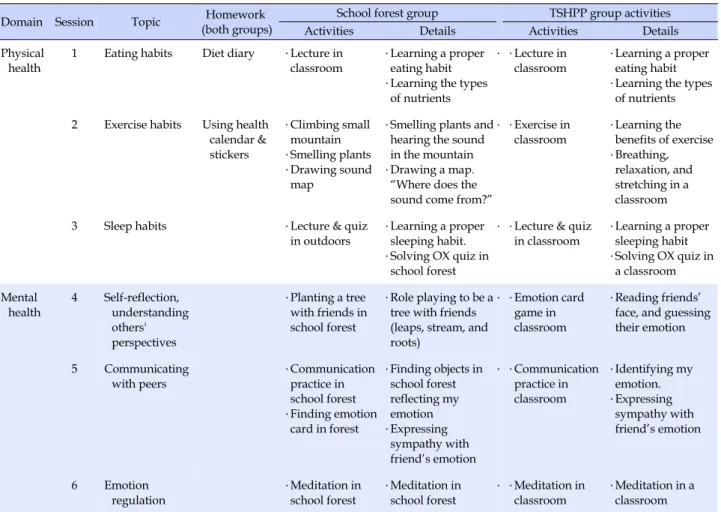
School forest program and TSHPP were developed by modifying the program developed by Lee et al.,[23] for school-aged children. They were 6-week programs in- tended to improve physical and mental health among the 4th and 5th grade of elementary school students. Both pro- grams were administered once a week for six weeks during regular class hours. The program consisted of three physical health promotion sessions and three mental health promo- tion sessions. Physical health sessions focused on increasing health promoting behaviors including healthy diet, exer- cise, and regular sleep habits. Mental health promotion ses- sions addressed self-reflection and understanding others' perspectives, communication skills, and emotional regu- lation (Table 1).
6. Study Procedure
The present study was approved by the Institutional Review Board of S. university (Approval No.: 2013-64). Re- garding the present study, one elementary school from a ru- ral area and one elementary school from an urban area were selected; these provided participants for the school forest group and the TSHPP group, respectively. This group allo- cation was based on the accessibility of school forest.
After obtaining approval from the schools’principals and health teachers, we distributed information packages pro- viding a full explanation of the purpose, content, and for- mat of the programs to students and their parents. Parental written consent and child assent were obtained before col- lecting baseline data. Participants were assured of con- fidentiality, and informed that they could withdraw from the study at any time.
In both groups, we provided intervention sessions once a week for 6 weeks (Table 1). Each intervention session pro- ceeded for 45 minutes during class hours. The pretest was performed at the end of March 2014 before the first inter- vention session; the posttest was carried out in June 2014, after the last intervention session. Data were collected by well-trained research team members who thoroughly un- derstood the study procedure. It took approximately 30 mi- nutes for participants to complete the self-administered questionnaire, and complete the body composition test and HRV. Results of the physical and mental health measures were provided to the parents and children.
7. Data Analysis
Statistical analysis was performed using SPSS version 21.0. To examine baseline differences between the two groups, homogeneity tests were performed using inde- pendent t-test and Mann Whitney U test. To test the hypoth- esis 1, the differences between pre and posttest in each group were analyzed using paired t-test. In addition, for testing hypothesis 2, the effects of the two intervention pro- grams on health were analyzed using an independent t-test and Mann Whitney U test. The significance level was set at p<.05.
RESULTS
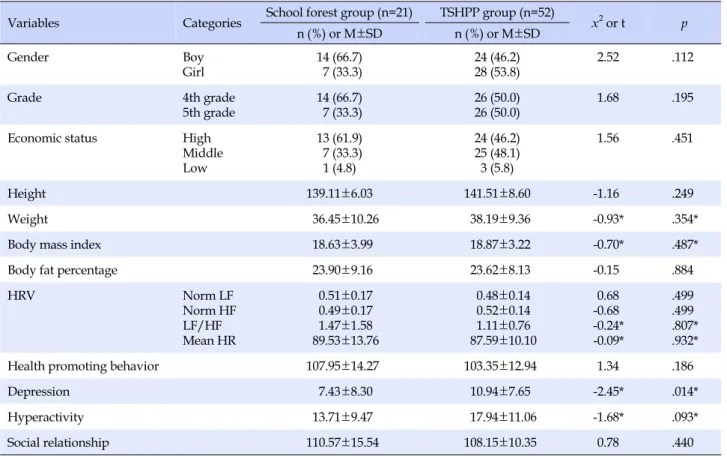
1. Homogeneity Test between the Two Groups No significant differences were found in demographic characteristics and dependent variables between the two groups, except in depression (Table 2). Children in the TSHPP group reported significantly higher levels of depres- sion than those in the school forest group at baseline (t=-2.45, p=.014).
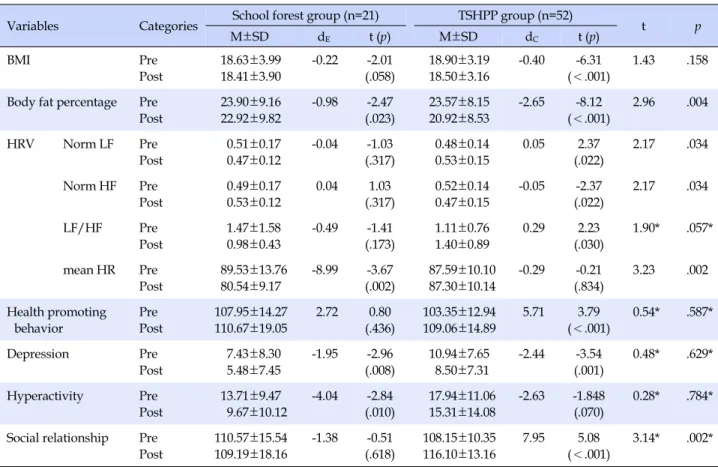
2. Changes of Pre and Post Programs in Each Group In each of two groups showed significant decreases in body fat percentage after the 6-week intervention; this change was greater in the TSHPP group than the school forest group (t=2.96, p=.004). Only the TSHPP group show- ed a significant decrease in BMI after the intervention. The school forest group also showed a decreased mean LF/HF ratio and heart rate (HR) after the intervention, though on- ly the change in mean HR was statistically significant (t=
-3.67, p=.002).
Both groups showed significant improvement in depres-
sion scores after the intervention. In addition, children in
Table 1. Group Activities for Each Session
Domain Session Topic Homework
(both groups)
School forest group TSHPP group activities
Activities Details Activities Details
Physical health
1 Eating habits Diet diary ․Lecture in classroom
․Learning a proper eating habit
․Learning the types of nutrients
․ ․Lecture in classroom
․Learning a proper eating habit
․Learning the types of nutrients 2 Exercise habits Using health
calendar &
stickers
․Climbing small mountain
․Smelling plants
․Drawing sound map
․Smelling plants and hearing the sound in the mountain
․Drawing a map.
“Where does the sound come from?”
․ ․Exercise in classroom
․Learning the benefits of exercise
․Breathing, relaxation, and stretching in a classroom
3 Sleep habits ․Lecture & quiz
in outdoors
․Learning a proper sleeping habit.
․Solving OX quiz in school forest
․ ․Lecture & quiz in classroom
․Learning a proper sleeping habit
․Solving OX quiz in a classroom Mental
health
4 Self-reflection, understanding others' perspectives
․Planting a tree with friends in school forest
․Role playing to be a tree with friends (leaps, stream, and roots)
․ ․Emotion card game in classroom
․Reading friends’
face, and guessing their emotion
5 Communicating with peers
․Communication practice in school forest
․Finding emotion card in forest
․Finding objects in school forest reflecting my emotion
․Expressing sympathy with friend’s emotion
․ ․Communication practice in classroom
․Identifying my emotion.
․Expressing sympathy with friend’s emotion
6 Emotion regulation
․Meditation in school forest
․Meditation in school forest
․ ․Meditation in classroom
․Meditation in a classroom TSHPP=Traditional school health promotion program.
the school forest group showed significant improvement in hyperactivity, whereas the TSHPP group showed signifi- cant improvement in health promoting behavior and social relationship after the intervention. In summary, hypothesis 1 was partially supported (Table 3).
3. Comparisons of Changes of Pre and Post Programs between Two Groups
Comparing the two groups’ post-pre difference scores, the two groups differed significantly in social relationship (t=3.14, p=.002). Regarding post-pre difference scores, school forest program was more effective than TSHPP only in LF (t=2.17, p=.034), HF (t=2.17, p=.034) and mean heart rate (t=3.23, p=.002). In summary, hypothesis 2 was supported just in LF, HF, and mean heart rate.
Both programs significantly improved in physical and mental health in some aspects, and school forest program was more effective only in improving mental health.
DISCUSSION
This study was conducted to compare the effects of two
different school-based intervention programs-the school
forest program and the TSHPP-on physical and mental
health among elementary school students. Overall, both in-
tervention programs showed positive effects on physical
and mental health among elementary school students. Con-
cerning physical health, both programs showed significant
beneficial effects on body fat percentage; this effect was
more prominent in the TSHPP group. Only the TSHPP pro-
gram showed a significant beneficial effect on BMI after the
intervention. Previous studies have reported positive ef-
fects of school-based health promotion programs on de-
creasing BMI and improving eating habits among elemen-
tary school children[24,25]. The effect of the TSHPP on ur-
ban children’s physical health was particularly significant,
as children from urban areas, who often have a more seden-
tary lifestyle than children from rural areas, may respond
dramatically to school-based health promotion programs.
Table 2. Homogeneity of General Characteristics and Examined Variables at Baseline
Variables Categories School forest group (n=21) TSHPP group (n=52)
x
2or t p
n (%) or M±SD n (%) or M±SD
Gender Boy
Girl 14 (66.7)
7 (33.3) 24 (46.2)
28 (53.8) 2.52 .112
Grade 4th grade
5th grade 14 (66.7)
7 (33.3) 26 (50.0)
26 (50.0) 1.68 .195
Economic status High
Middle Low
13 (61.9) 7 (33.3) 1 (4.8)
24 (46.2) 25 (48.1) 3 (5.8)
1.56 .451
Height 139.11±6.03 141.51±8.60 -1.16 .249
Weight 36.45±10.26 38.19±9.36 -0.93* .354*
Body mass index 18.63±3.99 18.87±3.22 -0.70* .487*
Body fat percentage 23.90±9.16 23.62±8.13 -0.15 .884
HRV Norm LF
Norm HF LF/HF Mean HR
0.51±0.17 0.49±0.17 1.47±1.58 89.53±13.76
0.48±0.14 0.52±0.14 1.11±0.76 87.59±10.10
0.68 -0.68 -0.24*
-0.09*
.499 .499 .807*
.932*
Health promoting behavior 107.95±14.27 103.35±12.94 1.34 .186
Depression 7.43±8.30 10.94±7.65 -2.45* .014*
Hyperactivity 13.71±9.47 17.94±11.06 -1.68* .093*
Social relationship 110.57±15.54 108.15±10.35 0.78 .440
*Mann-Whitney U test; TSHPP=Traditional school health promotion program; HRV=Heart rate viability; Norm LF=Normalized low frequency;
Norm HF=Normalized high frequency; HR=Heart rate.
On the other hand, the school forest program was partic- ularly effective in decreasing hyperactivity and increasing relaxation indicated by normalized LF, normalized HF, and mean heart rate in HRV. Previous studies examining adults have also reported that the effect of intervention programs on relaxation was strengthened when the programs were conducted in a forest, rather than in a city[21,25]. Similarly, recent studies examining children have reported that forest therapy effectively alleviates depression, anxiety, and anger [26,27]. Additionally, school forest programs have been found to lead students to become more interested in nature [14]. It is possible that the soothing effect of the school forest program, delivered in nature, promoted relaxation and de- creased hyperactivity in the present study. Decreased hy- peractivity, which was observed in the present study, has significant implications regarding the improvement of at- tention deficit hyperactivity disorder (ADHD) symptoms.
ADHD symptoms and stress have been found to predict levels of depression in elementary school students[7].
Regarding mental health, children in both programs showed significant improvement in depression scores after the intervention. In addition, the TSHPP was found to be effective in improving social relationship among children.
Various school-based health promotion programs have been found to improve children’s ability to regulate emo- tions and social stress, and social and communication skills [28-30]. It is not clear, however, why only the TSHPP was found to be effective in improving social relationship among children. Further studies, examining more representative samples, are required to provide clearer explanations of the effect of school-based health promotion programs on social relationship.
Several limitations of the present study require mention.
First, two groups were not comparable in sizes due to the difficulties in recruitment, and small sample size was an- other limitation of the present study. Second, recruiting participants in two different schools, we cannot ignore un- expected effect and factors caused by two different regions.
For the present study, we compared the effects of TSHPP and school forest program on elementary school children.
Both programs significantly decreased body fat percentage;
this effect was more prominent in the TSHPP group. In ad-
dition, the TSHPP was found to improve BMI, health pro-
moting behavior, depression, and social relationships. On
the other hand, the school forest program was more effec-
tive in decrease hyperactivity and increase relaxation among
Table 3. Comparisons of Changes in Physical and Mental Health Variables between School Forest Group and TSHPP Group
Variables Categories School forest group (n=21) TSHPP group (n=52)
t p
M±SD d
Et (p) M±SD d
Ct (p)
BMI Pre
Post
18.63±3.99 18.41±3.90
-0.22 -2.01 (.058)
18.90±3.19 18.50±3.16
-0.40 -6.31 (<.001)
1.43 .158
Body fat percentage Pre Post
23.90±9.16 22.92±9.82
-0.98 -2.47 (.023)
23.57±8.15 20.92±8.53
-2.65 -8.12 (<.001)
2.96 .004
HRV Norm LF Pre
Post
0.51±0.17 0.47±0.12
-0.04 -1.03 (.317)
0.48±0.14 0.53±0.15
0.05 2.37
(.022)
2.17 .034
Norm HF Pre
Post
0.49±0.17 0.53±0.12
0.04 1.03 (.317)
0.52±0.14 0.47±0.15
-0.05 -2.37 (.022)
2.17 .034
LF/HF Pre
Post
1.47±1.58 0.98±0.43
-0.49 -1.41 (.173)
1.11±0.76 1.40±0.89
0.29 2.23
(.030)
1.90* .057*
mean HR Pre
Post
89.53±13.76 80.54±9.17
-8.99 -3.67 (.002)
87.59±10.10 87.30±10.14
-0.29 -0.21 (.834)
3.23 .002
Health promoting behavior
Pre Post
107.95±14.27 110.67±19.05
2.72 0.80 (.436)
103.35±12.94 109.06±14.89
5.71 3.79
(<.001)
0.54* .587*
Depression Pre
Post
7.43±8.30 5.48±7.45
-1.95 -2.96 (.008)
10.94±7.65 8.50±7.31
-2.44 -3.54 (.001)
0.48* .629*
Hyperactivity Pre
Post
13.71±9.47 9.67±10.12
-4.04 -2.84 (.010)
17.94±11.06 15.31±14.08
-2.63 -1.848 (.070)
0.28* .784*
Social relationship Pre Post
110.57±15.54 109.19±18.16
-1.38 -0.51 (.618)
108.15±10.35 116.10±13.16
7.95 5.08
(<.001)
3.14* .002*
*Mann-Whitney U test; dE=Mean differences in the experimental group; dC=Mean differences in the comparison group; BMI=Body mass index;
TSHPP=Traditional school health promotion program; HRV=Heart rate viability; Norm LF=Normalized Low frequency; Norm HF=Normalized High frequency; HR=Heart rate.