서 론 연구의 필요성
1.
산림이 지닌 건강 증진 효과에 대한 과학적인 연구가 진행 되면서 최근에는 산림을 단순한 여가 및 휴식을 위한 공간으 로 여기던 것에서 한걸음 더 나아가 건강 증진의 효과를 기대
하는 치유 공간으로 간주하며 적극적인 활용을 모색하기 시 작하였다 독일 프랑스 스위스 등 유럽 여러 나라에서는 이. , , 미 오래 전부터 국민들의 질병 예방 치료 재활치유 등 건강, , 증진을 목적으로 산림이나 해양을 활용해 왔으며,1)일본에서 도 숲 치유 프로그램을 적극적으로 활용하는 사례가 보고되 고 있다.2,3)산림은 환경적으로 맑은 공기 건강 물질 등 필수, 적인 인프라를 제공함으로써 인간의 건강이 유지되고 향상되
지역보건의료계획에 근거한 보건소 숲 건강증진 프로그램 현황
이인숙1·김성재1·방경숙1·최희승1·고진강1·김지은2·김선영3
서울대학교 간호대학 교수1,서울대학교 간호대학 박사과정2,서울대학교 간호대학 석사과정3
An Analysis of Health Promotion Programs Utilizing Forests based on Korea’s Regional Healthcare Program Plans
Lee, Insook1· Kim, Sungjae1· Bang, Kyung-Sook1· Choi, Heeseung1· Ko, Chinkang1· Kim Jieun2· Kim Sunyoung3
1Professor, College of Nursing · The Research Institute of Nursing Science, Seoul National University, Seoul
2Phd Student, College of Nursing, Seoul National University, Seoul
3Master student, College of Nursing, Seoul National University, Seoul, Korea
Purpose: The aim of this study was to analyze health promotion programs utilizing forests by reviewing regional healthcare program plans in Korea. Methods: We analyzed 227 regional healthcare program plans from 2011 to 2014; seven health promotion programs of the 16 major healthcare programs were prescribed by public health law. Results: Our analysis revealed that only 35 health promotion programs from 29 sites were utilizing forests.
Furthermore, of 21 known categories of health promotion programs, only nine incorporated the use of forests.
Atopy-asthma healthcare programs were the most common forest health promotion programs, which also in- cluded specialized disease management programs (e.g., for atopy prevention and healing, patients with metabolic syndrome or cancer) and specialized mental health management programs (e.g., for addiction or dementia pre- vention). Others included programs on the development of forest roads or industrial development using forest products. Conclusion: Health programs using forests in Korea are still very limited and primarily comprise ato- py-asthma prevention/management, health behavioral change, and mental health programs. This study provided useful information for developing health policies and forest health promotion programs further in Korea.
Key Words: Regional health planning, Forest program, Health promotion, Community healthcare program development
주요어: 지역보건의료계획 숲 프로그램 건강증진 프로그램 보건소 프로그램, , , Corresponding author: Bang, Kyung-Sook
College of Nursing, Seoul National University, 103 Daehak-ro, Jongno-gu, Seoul 110-799, Korea.
Tel: +82-2-740-8819, Fax: +82-2-765-4103, E-mail: [email protected]
- 본 연구는 산림청의 산림과학기초연구지원사업의 산림치유연구사업단 제 세부- 4 “보건학적 관점에서 산림자원 활용의 건강증진정책 개발”과
제에서 연구비를 수혜 받아 진행된 연구임.
- This study was supported by a grant from the Korea Forest Service.
투고일 2013년10월 일3 / 심사완료일 2014년 월1 17일 / 게재확정일 2014년 월1 17일
도록 도울 뿐 아니라 정신적 안정과 회복력을 갖추도록 한, 다.4,5)우리나라는 지역사회 자원으로 산림을 포함하여 도시 숲 공원 등을 쉽게 확보할 수 있는 환경적 여건을 갖추고 있, 어 이러한 숲 자원을 기반으로 보건소와 초등학교를 통한 집, 단별 건강증진 프로그램을 연계한다면 효과적인 건강지식 제 공을 통한 건강 행위 실천 등 건강증진의 효과를 기대해 볼 수 있을 것이다.
한편 전국의 시 군 구 단위 보건소에서는 현재 각 지역의, , , 상황에 맞고 수요자의 요구에 적절한 건강관리사업을 전개하 기 위해 년 단위로 지역보건의료계획을 수립하여 수행하고4 있다 지역보건의료계획은 기초 및 광역 자치단체에 의하여. 작성되는 것으로 질병양상 고령화 지역사회 환경 공공보건, , , 의료의 역할 등 급속하게 변화하는 외부 환경의 변화에 대응 하여 지역사회 건강을 이끌기 위한 방향을 수립하므로 지역사 회의 건강관리 질병예방행위 환경 주거 도시혼란 지역경, , , , , 제 고용 소득 교육에 영향을 미친다, , , .6)최근에는 숲 치유의 효용성에 대한 과학적 근거들이 나타나면서 지역보건의료계 획에도 지역사회의 산림을 이용한 다양한 건강증진사업이 제 시되고 있다.7)그러나 아직 숲을 이용한 건강증진사업이 얼마 만큼 계획되어 있는가에 대한 전체적인 분석은 이루어지지 못 하였다.
따라서 본 연구에서는 지역보건의료계획에 포함되어 있는 숲 이용 건강관리사업을 분석함으로써 향후 공공 보건소를 중 심으로 지역주민에 대한 신체적 정신적 건강관리 프로그램에, 숲을 활용할 수 있는 프로그램을 개발하는데 기초자료로 활용 하고자 한다.
연구목적 2.
본 연구의 목적은 지역보건의료계획에 포함되어 있는 숲 이 용 건강관리사업을 지역별 건강증진사업별 특화사업별로 분, , 석하여 숲 환경을 건강증진사업에 활용하는 정도를 파악하는 것이다.
연 구 방 법 연구설계
1.
본 연구는 전국 지역보건의료계획을 연구목적에 따라 분석 한 서술적 조사연구이다.
연구대상 2.
전국 보건소253개에서 지역보건의료계획서를 작성하는 행 정단위230개이며 여기서 누락된 보고서 개 서울시 영등포, 3 ( 구 충청남도 아산시 경기도 고양시 를 제외하고 전국 지역보, , ) , 건의료계획서227 (98.7%)개 를 이차분석 대상으로 하였다.
자료수집 및 자료분석 3.
전국 보건소 253개에서 지역보건의료계획서를 작성하는 행정단위230개이며 여기서 누락된 보고서 개 서울시 영등, 3 ( 포구 충청남도 아산시 경기도 고양시 를 제외하고 공개 자료, , ) , 인2011~2014년의 전국 지역보건의료계획서227 (98.7 %)개 를 이차 분석하였다 분석 자료의 선정기준은 지역보건의료계. 획서에 제시된16개 보건소 업무 중에서 금연사업 건강생활, 실천 맞춤형 통합서비스사업 건강검진사업 심뇌혈관질환 예, , 방관리사업 정신보건사업 노인보건사업 지역사회 중심 재, , , 활사업을 포함하였으며 일반주민의 건강증진과 관련이 없는, 개 사업 맞춤형방문건강관리 구강보건 암 관리 모자보건
9 ( , , , ,
감염병 예방 진료 의약무 관리 공중위생 영양플러스 을 분, , , , ) 석에서 제외하였고 보건소 특화사업에서 숲을 이용한 건강사, 업은 추가로 포함하여 계획서에서 기술된 사업내용을 목적에 입각하여 이차 분석하였다 분석방법은 해당사업의 목적 대. , 상 프로그램 내용 실시 방법 및 전략 실시 장소에 대해 엑셀, , , 파일로 기술정리하고 기술된 내용을 재검토하여 동일 목적, 별 동일 대상별 동일 장소별 프로그램의 특성을 재그룹화하, , 여 설명요소를 추출하였다 분석 기간은. 2012년 월7 24일부 터11월15일까지였다.
연 구 결 과 지역별 숲 이용 프로그램 분석 1.
개 지역보건의료계획 중 숲을 이용한 프로그램을 포함 227
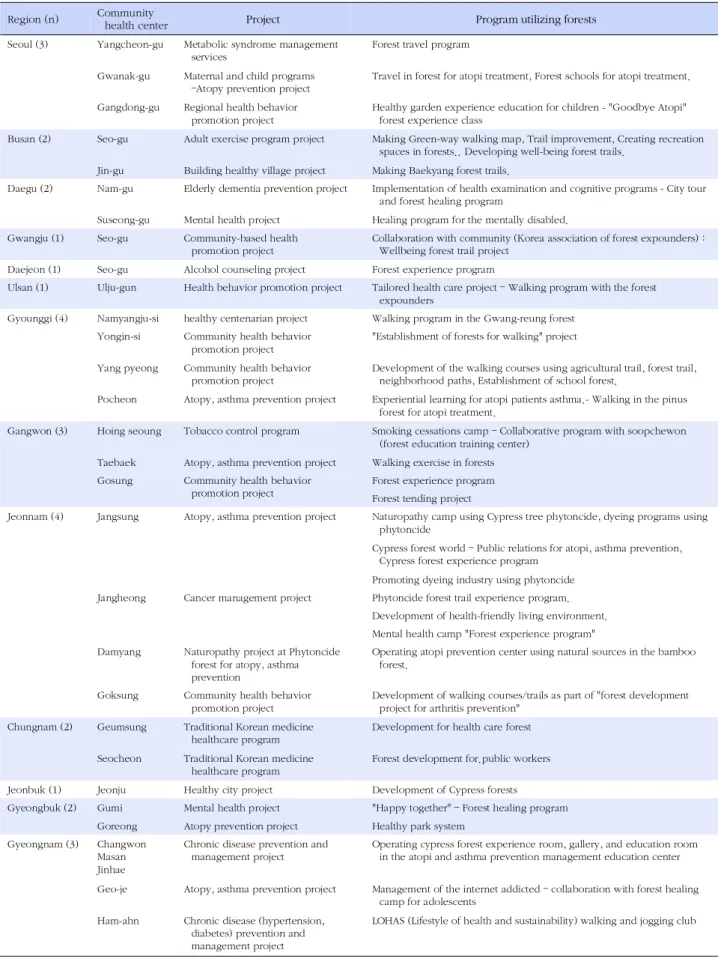
하고 있는 지역은29개소의35개 프로그램이 있었으며 지역, 별로는 전라남도가 개소에서 개 프로그램을 포함하고 있어4 8 가장 많은 숲 이용 프로그램이 계획되어 있었다(Table 1).
건강증진사업별 숲 이용 프로그램 분석 2.
건강증진과 관련 된 사업에서 숲을 이용한 프로그램이 포함
Table 1. Programs using Forests by Region Region (n) Community
health center Project Program utilizing forests
Seoul (3) Yangcheon-gu Metabolic syndrome management services
Forest travel program
Gwanak-gu Maternal and child programs Atopy prevention project –
Travel in forest for atopi treatment, Forest schools for atopi treatment.
Gangdong-gu Regional health behavior promotion project
Healthy garden experience education for children - "Goodbye Atopi"
forest experience class
Busan (2) Seo-gu Adult exercise program project Making Green-way walking map, Trail improvement, Creating recreation spaces in forests.. Developing well-being forest trails.
Jin-gu Building healthy village project Making Baekyang forest trails.
Daegu (2) Nam-gu Elderly dementia prevention project Implementation of health examination and cognitive programs - City tour and forest healing program
Suseong-gu Mental health project Healing program for the mentally disabled.
Gwangju (1) Seo-gu Community-based health promotion project
Collaboration with community (Korea association of forest expounders) : Wellbeing forest trail project
Daejeon (1) Seo-gu Alcohol counseling project Forest experience program
Ulsan (1) Ulju-gun Health behavior promotion project Tailored health care project–Walking program with the forest expounders
Gyounggi (4) Namyangju-si healthy centenarian project Walking program in the Gwang-reung forest Yongin-si Community health behavior
promotion project
"Establishment of forests for walking" project
Yang pyeong Community health behavior promotion project
Development of the walking courses using agricultural trail, forest trail, neighborhood paths, Establishment of school forest.
Pocheon Atopy, asthma prevention project Experiential learning for atopi patients asthma.- Walking in the pinus forest for atopi treatment.
Gangwon (3) Hoing seoung Tobacco control program Smoking cessations camp Collaborative program with soopchewon– (forest education training center)
Taebaek Atopy, asthma prevention project Walking exercise in forests Gosung Community health behavior
promotion project
Forest experience program Forest tending project
Jeonnam (4) Jangsung Atopy, asthma prevention project Naturopathy camp using Cypress tree phytoncide, dyeing programs using phytoncide
Cypress forest world Public relations for atopi, asthma prevention,– Cypress forest experience program
Promoting dyeing industry using phytoncide Jangheong Cancer management project Phytoncide forest trail experience program.
Development of health-friendly living environment.
Mental health camp "Forest experience program"
Damyang Naturopathy project at Phytoncide forest for atopy, asthma prevention
Operating atopi prevention center using natural sources in the bamboo forest.
Goksung Community health behavior promotion project
Development of walking courses/trails as part of "forest development project for arthritis prevention"
Chungnam (2) Geumsung Traditional Korean medicine healthcare program
Development for health care forest
Seocheon Traditional Korean medicine healthcare program
Forest development for.public workers
Jeonbuk (1) Jeonju Healthy city project Development of Cypress forests
Gyeongbuk (2) Gumi Mental health project "Happy together" Forest healing program– Goreong Atopy prevention project Healthy park system
Gyeongnam (3) Changwon Masan Jinhae
Chronic disease prevention and management project
Operating cypress forest experience room, gallery, and education room in the atopi and asthma prevention management education center
Geo-je Atopy, asthma prevention project Management of the internet addicted collaboration with forest healing– camp for adolescents
Ham-ahn Chronic disease (hypertension, diabetes) prevention and management project
LOHAS (Lifestyle of health and sustainability) walking and jogging club
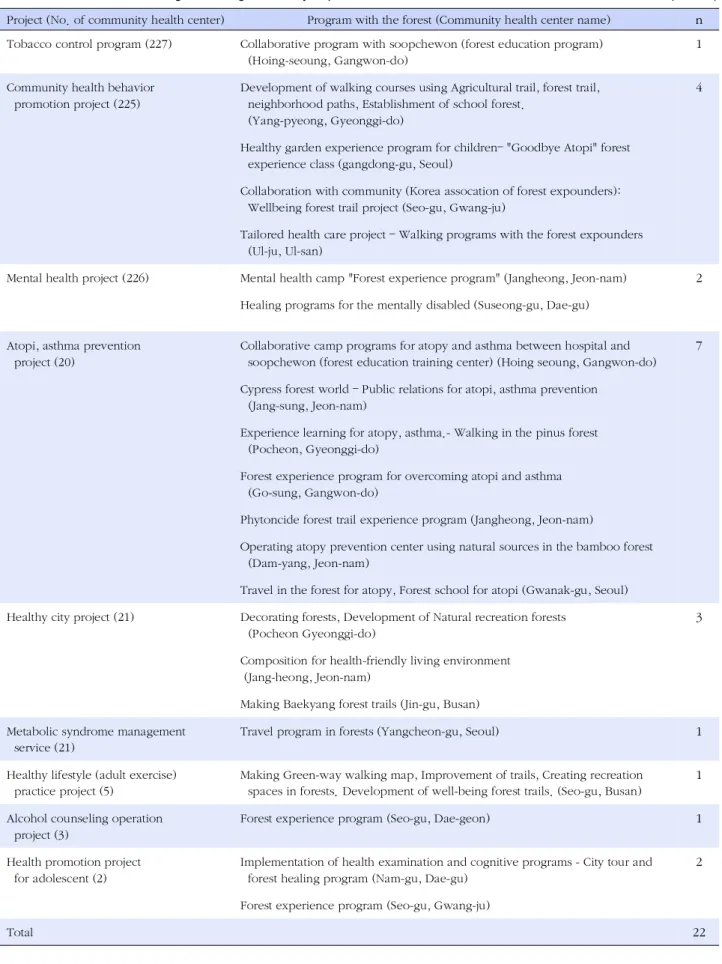
Table 2. Health Promotion Programs using Forests by Topics (N=227) Project (No. of community health center) Program with the forest (Community health center name) n Tobacco control program (227) Collaborative program with soopchewon (forest education program)
(Hoing-seoung, Gangwon-do)
1
Community health behavior promotion project (225)
Development of walking courses using Agricultural trail, forest trail, neighborhood paths, Establishment of school forest.
(Yang-pyeong, Gyeonggi-do)
4
Healthy garden experience program for children "Goodbye Atopi" forest– experience class (gangdong-gu, Seoul)
Collaboration with community (Korea assocation of forest expounders):
Wellbeing forest trail project (Seo-gu, Gwang-ju)
Tailored health care project Walking programs with the forest expounders– (Ul-ju, Ul-san)
Mental health project (226) Mental health camp "Forest experience program" (Jangheong, Jeon-nam) 2 Healing programs for the mentally disabled (Suseong-gu, Dae-gu)
Atopi, asthma prevention project (20)
Collaborative camp programs for atopy and asthma between hospital and soopchewon (forest education training center) (Hoing seoung, Gangwon-do)
7
Cypress forest world Public relations for atopi, asthma prevention– (Jang-sung, Jeon-nam)
Experience learning for atopy, asthma.- Walking in the pinus forest (Pocheon, Gyeonggi-do)
Forest experience program for overcoming atopi and asthma (Go-sung, Gangwon-do)
Phytoncide forest trail experience program (Jangheong, Jeon-nam)
Operating atopy prevention center using natural sources in the bamboo forest (Dam-yang, Jeon-nam)
Travel in the forest for atopy, Forest school for atopi (Gwanak-gu, Seoul) Healthy city project (21) Decorating forests, Development of Natural recreation forests
(Pocheon Gyeonggi-do)
3
Composition for health-friendly living environment (Jang-heong, Jeon-nam)
Making Baekyang forest trails (Jin-gu, Busan) Metabolic syndrome management
service (21)
Travel program in forests (Yangcheon-gu, Seoul) 1
Healthy lifestyle (adult exercise) practice project (5)
Making Green-way walking map, Improvement of trails, Creating recreation spaces in forests. Development of well-being forest trails. (Seo-gu, Busan)
1
Alcohol counseling operation project (3)
Forest experience program (Seo-gu, Dae-geon) 1
Health promotion project for adolescent (2)
Implementation of health examination and cognitive programs - City tour and forest healing program (Nam-gu, Dae-gu)
2
Forest experience program (Seo-gu, Gwang-ju)
Total 22
되어 있는 사업으로는 지역특화 건강행태 개선사업 정신 보, 건사업 아토피 천식 사업 건강도시 사업 대사증후군 관리, , , , 사업 건강생활 실천 사업 알코올 상담센터 운영사업 청소년, , , 건강증진사업이 있었다 아토피 천식 사업 중 개 지역특화. , 7 , 건강행태 개선사업 중 개 건강도시 사업 중 개 등 총4 , 3 22개 의 사업이 숲 관련 프로그램을 포함하고 있었으며 숲을 이용, 하고 있는 사업이 가장 많은 것은 아토피 천식 관련 사업인 것, 으로 나타났다(Table 2).
숲 이용 프로그램의 질병별 특화 프로그램 분석 3.
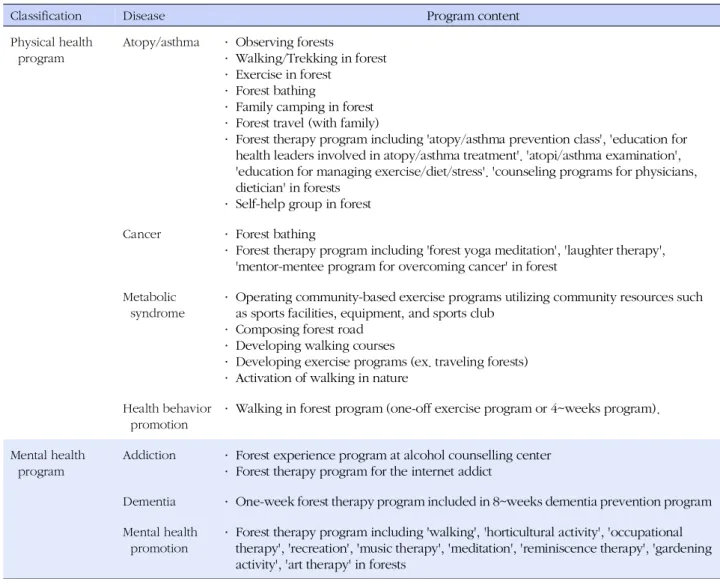
질병별 특화 숲 프로그램으로는 아토피 완화 프로그램 암, 환자 프로그램 대사증후군 대상 프로그램 전반적인 건강행, , 태 개선 프로그램으로 분류되었다 아토피완화 프로그램의 경. 우 숲 바라보기 및 걷기 프로그램 숲 체험 프로그램 숲 캠핑, ,
프로그램과 아토피와 아토피 관리에 대한 교육 아토피 검사, , 의료진 상담 등을 숲에서 진행하는 치료 프로그램 숲에서의, 자조모임 프로그램이 진행되고 있다 암 환자를 대상으로 하. 는 숲 프로그램으로는 요가 명상 웃음치료 같은 보완대체요, 법을 숲에서 진행하거나 산림욕을 진행하고 있다 대사증후군. 대상 프로그램은 지역사회 자원을 이용하여 지역사회 내 형성 되어 있는 운동단체나 운동시설을 연계하거나 숲길을 조성하, 여 걷기 프로그램을 강조하였으며 건강행태 개선 프로그램도, 대부분 숲 걷기 프로그램으로 구성되어 있다(Table 3).
기타 특화 프로그램 분석 4.
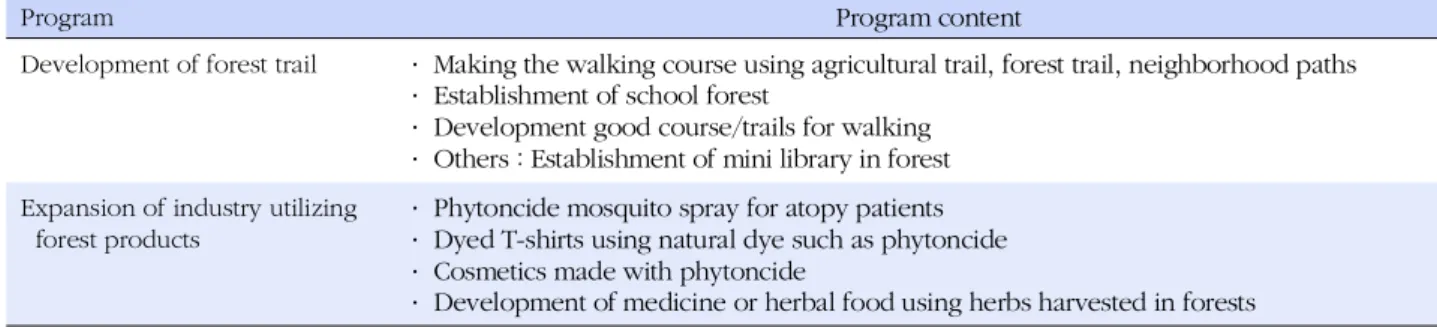
지역보건의료계획에 포함된 기타 특화 프로그램으로 숲과 관련된 사업은 숲 길 조성 프로그램과Forest Product를 이 용한 산업 양성 프로그램으로 구성되어 있다 숲길은 새로 조.
Table 3. Disease-specific Programs using Forests
Classification Disease Program content
Physical health program
Atopy/asthma ․ Observing forests
․ Walking/Trekking in forest
․ Exercise in forest
․ Forest bathing
․ Family camping in forest
․ Forest travel (with family)
․ Forest therapy program including 'atopy/asthma prevention class', 'education for health leaders involved in atopy/asthma treatment'. 'atopi/asthma examination', 'education for managing exercise/diet/stress'. 'counseling programs for physicians, dietician' in forests
․ Self-help group in forest Cancer ․ Forest bathing
․ Forest therapy program including 'forest yoga meditation', 'laughter therapy', 'mentor-mentee program for overcoming cancer' in forest
Metabolic syndrome
․ Operating community-based exercise programs utilizing community resources such as sports facilities, equipment, and sports club
․ Composing forest road
․ Developing walking courses
․ Developing exercise programs (ex. traveling forests)
․ Activation of walking in nature Health behavior
promotion
․ Walking in forest program (one-off exercise program or 4~weeks program).
Mental health program
Addiction ․ Forest experience program at alcohol counselling center
․ Forest therapy program for the internet addict
Dementia ․ One-week forest therapy program included in 8~weeks dementia prevention program Mental health
promotion
․ Forest therapy program including 'walking', 'horticultural activity', 'occupational therapy', 'recreation', 'music therapy', 'meditation', 'reminiscence therapy', 'gardening activity', 'art therapy' in forests
성하기보다는 기존에 보유하고 있는 자원을 확대 발전시켜, 활용하고 있다 숲 주변의 농로나 동네 길을 이용하여 걷기. 실천율을 높이는 전략과 학교 내에 나무나 꽃을 심어 학교 숲 을 조성하고 기존 등산로에서 일부를 숲길로 대체하여 효율, 성을 높이거나 숲에 미니 도서관을 설립하여 자연스럽게 숲 길을 조성하였다. Forest Product를 이용한 산업으로는 구 체적으로 피톤치드 화장품 아토피 환자의 차성 피부질환, 2 예방제품 피톤치드 천연염색 약선 약초 음식 개발이 있다, , / (Table 4).
논 의
의 과학 기술의 발달로 평균수명은 날로 연장되고 있지만․ 건강하게 삶을 영위할 수 있는 건강수명은 크게 나아지지 않고 있으며 국내에서도 전반적인 경제적 수준의 향상에 따라 건강, 에 대한 관심과 삶의 질 증진에 대한 요구도가 높아지고 있다.
국민건강을 위해서는 개인 차원에서뿐 아니라 국가적인 정책 과 지원을 통해 건강을 향상시킬 수 있는 방안 모색이 필요한 상황이다 한편 만성질환 스트레스성 질환 및 유전적 환경적. , , 요인 등 복합적인 요인에 의한 질환은 완치가 어렵고 스스로의 조절이 중요하므로 투약 이외에도 건강관리에 영향을 주는 다 양한 요소들에 대한 관심이 증가되고 있으며 그 중 대표적인, 것의 하나가 최근 관심을 끌고 있는 산림요법이다 산림요법이. 란 인체에 미치는 생리적 심리적 효과를 과학적 근거 하에 체․ 계적 프로그램을 통해 검증하고 그 결과를 토대로 산림을 심신 치유에 활용하는 것을 말하는데 독일 일본 등 선진국의 경우, ․ 산림요법이 건강증진과 질병예병 건강회복 등의 수단으로 자, 리 잡아 가고 있다 유럽연합의 유럽과학기술연구협력. (COST:
European Cooperation in the Field of Scientific and Tech- 프로젝트에서는 산림 및 인간건강과 웰빙을 nical Research)
연구하는 분과(Action E39: Forest, Trees and Human Health 를 별도로 구성하여 관련 연구를 추진하여 많 and Wellbeing)
은 과학적 연구결과를 축적하였다.1)일본은2004년부터 대규 모의 현장실험을 통해 숲의 건강 생리적 효과에 대한 연구를․ 통해 숲의 치유효과 규명을 위한 임상연구 등이 활발히 진행되 고 있는데, Li와Kawada8)는2~3일간의 숲 치료가 자연 살해 세포의 활성화에 긍정적인 효과가 있으며 일간의 중재에서는7 이 뿐 아니라 림프구의 intracellular anticancer protein이 증 가했다는 이전 연구에 이어 일간의 숲 여행으로 여행 직후 및1 일 후의 검사에서 자연 살해세포가 활성화되는 효과가 유지 7
됨을 보고하기도 하였다.
우리나라는 특히 국토의65%가 산림으로 구성되어 있어 숲 에 대한 접근성이 매우 높으며 우리나라 사람들은 산을 여가 및 건강에 정기적 부정기적으로 활용하는 인구가 많으므로 숲 을 이용한 건강증진 및 관리의 활용도가 매우 높다는 특성을 갖고 있다 국내에서도 숲에서의 걷기와 도심에서의 걷기를. 비교한 결과 숲에서의 걷기를 진행한 실험군의 인지기능 긍, 정적 정서변화에 효과가 있음을 확인하였으며9)산림과 도시 숲을 이용한 프로그램이 모두 우울과 스트레스 감소 등 정신 건강에 효과가 있다는 국내 연구들이 보고되고 있다.10-12)
그러나 전국의 지역보건의료계획을 검토한 결과227개 중 숲을 이용한 건강증진사업에 계획되어 있는 곳은29개 지역의 개 프로그램에 불과해 아직은 매우 제한적인 것으로 보이며
35 ,
특히 전국적으로 산림이 분포해있음에도 불구하고 숲을 이용한 프로그램은 전남 등 일부 도에 편중되어 있는 것으로 나타났다.
이는 지역적 환경이라기보다는 보건의료계획을 세우는 정책 입 안 및 결정자들의 관심이 중요하게 작용한 것으로 판단된다.
본 연구결과 숲을 이용한 프로그램의 대부분은 아동을 대상 으로 한 아토피와 천식 예방 및 관리 프로그램과 정신건강 증진 프로그램이 가장 두드러지게 나타나고 있었는데 숲의 효능을, 확인하기 위한 연구에서도 아동의 아토피 등 면역성 환경성, 질환과 관련된 연구가 많이 진행된 바 있다.13,14)다음으로는 정 신건강 프로그램이 지역보건의료계획에 많이 포함되어 있었는 데 숲의 정신건강에 대한 효능은 국내 여러 연구에서도 일반인
Table 4. Other Specialized Programs
Program Program content
Development of forest trail ․ Making the walking course using agricultural trail, forest trail, neighborhood paths
․ Establishment of school forest
․ Development good course/trails for walking
․ Others : Establishment of mini library in forest Expansion of industry utilizing
forest products
․ Phytoncide mosquito spray for atopy patients
․ Dyed T-shirts using natural dye such as phytoncide
․ Cosmetics made with phytoncide
․ Development of medicine or herbal food using herbs harvested in forests
대상 연구15)와 중독이나 우울 등 정신건강에 문제 있는 대상자 에 대한 연구16-18)모두에서 긍정적으로 보고되고 있다.
그러나 선행연구에서는 국내에서도 숲 태교부터19,20)숲 유 치원21),아동 대상 건강증진 프로그램22),만성질환에 대한 효
과23,24)등 매우 다양한데 비해 아직 지역보건의료계획에 숲
관련 프로그램들이 다양하게 반영되지는 못한 상황임을 확인 할 수 있었다.
아토피와 정신건강 프로그램 이외에 지역보건의료계획에는 대사증후군 예방과 암 환자의 치유 증진 프로그램 등이 있었는 데 숲 체험이 고혈압 환자와 당뇨병 환자의 생리적 심리적 안, , 정에 긍정적인 효과가 있으며 보고되고 있으며25,26)암 예방적 효과가 있다는 연구결과를 볼 때27),향후 보건소 사업과 연계하 여 만성질환관리에도 적극적으로 적용될 수 있을 것으로 생각 된다.
특히 숲을 이용한 프로그램이 직접 숲에서의 캠프나 삼림욕 뿐 아니라 학교나 마을 주변에 숲길이나 산책로를 조성하여 일상생활에서의 활용도를 높이거나 학교 근처에 나무와 꽃을 심어 자연친화적인 환경을 만들어 자연을 존중하고 함께 살아 가기의 중요성을 인식시키는 프로그램 등도 고려해 볼만 하 다 기존 연구에서도 학교 숲 조성사업이 학령기 아동의 환경. 존중 인식 향상에 도움이 된다고 보고하였다.28)
본 연구에서 전국 단위의 보건의료계획을 분석한 것은 전국 적인 수준에서 숲을 이용한 건강관리 프로그램의 현황을 가장 잘 파악할 수 있는 자료의 하나라는 점에서 분석의 의의가 있 다고 본다 현재 보건소 중심의 건강관리와 학교 중심의 건강. 관리 사업은 지역사회 공공 건강증진사업의 핵심적 역할을 하 는 곳이므로 향후 보건소와 학교를 연계하여 건강증진사업의 효율성을 높일 수 있는 한 방안으로 숲을 이용한 사업을 연계 할 수 있도록 개발하기 위해서는 구체적인 프로그램 분석 그, 리고 보건소와 학교의 프로그램 담당자들로부터의 의견 수렴 등이 필요할 것이다.
결 론 및 제 언
전국의 지역보건의료계획을 검토한 결과227개 중 숲을 이 용한 건강증진사업에 계획되어 있는 곳은29개 지역의35개 프로그램에 불과해 아직은 매우 제한적인 것으로 보이며 특, 히 전국적으로 산림이 분포해있음에도 불구하고 숲을 이용한 프로그램은 전남 등 일부 도에 편중되어 있는 것으로 나타났 다 또한 숲을 이용한 프로그램의 대부분은 아동을 대상으로. 한 아토피와 천식 예방 및 관리 프로그램과 중독 치매 지역, ,
내 정신장애자의 정신건강 증진 프로그램이 가장 두드러지게 나타나고 있었으며 그 이외에 대사증후군 예방과 암 환자의 치유 증진 프로그램 등이 있었는데 보건소 사업과 연계한다, 면 향후 만성질환관리에도 적극적으로 적용될 수 있을 것으로 생각된다 본 연구에서는 숲을 건강증진과 질병의 치료에 적. 용할 수 있는 국내 보건정책에 대해 확인하였는데 이는 접근, 이 용이한 지역사회 자원인 숲을 이용하여 숲이 지닌 신체적, 정신적 건강증진의 효과를 보다 적극적으로 활용하고자 하는 시도이다 전국 단위의 보건의료계획을 분석한 것은 전국에. 산재된 공공기반의 숲 프로그램을 요약하고 분석함으로써 전, 국적인 수준에서 숲을 이용한 건강관리 프로그램의 현황을 가 장 잘 파악할 수 있는 자료의 하나라는 점에서 분석의 의의가 있다고 본다 그러나 지역보건의료계획에 보고된 자료를 기반. 으로 하여 실제 사용되고 있는 병원 사유림 기반의 프로그램, 운영 정보는 확인하지 못하였으며 해당 숲 프로그램의 건강 기능 효과나 질은 확인하지 못하였다는 제한점이 있다.
본 연구를 바탕으로 향후 보건소와 학교를 연계하여 건강증 진사업의 효율성을 높일 수 있는 한 방안으로 숲을 이용한 사 업을 연계하고 확산할 수 있도록 개발해 나가는 것이 필요할 것이다.
REFERENCES
1. Nilsson K, Sangster M, Gallis C, Hartig T, De Vries S, Seeland K, et al. Forests, trees and human health. New York: Springer;
2010.
2. Kang MJ, Yoo RH, Song TG, Ahn YS, Ahn KW. A Proposal concerning the healing forest policy of Jellanamdo areas through an analysis of the Japan's forest therapy policy. J Korean isl. 2011;23(2):85-102.
3. Song MY. Management of school forest decoration, extra- curricular activities, and a discretionary activity curriculum. J Korean Soc Holist Educ. 2004;8(1):46-71.
4. Lee J, Park BJ, Tsunetsugu Y, Ohira T, Kagawa T, Miyazaki Y.
Effect of forest bathing on physiological and psychological re- sponses in young Japanese male subjects. Public Health.
2011;125(2):93-100.
http://dx.doi.org/10.1016/j.puhe.2010.09.005
5. Park BJ, Tsunetsugu Y, Kasetani T, Kagawa T, Miyazaki Y.
The physiological effects of Shinrin-yoku(taking in the forest atmosphere or forest bathing): evidence from field experi- ments in 24 forests across Japan. Environ Health Prev Med.
2010;15(1):18-26.
http://dx.doi.org/10.1007/s12199-009-0086-9
6. Takano T, Nakamura K. An analysis of health levels and vari-
ous indicators of urban environments for Healthy Cities pro- jects. J Epidemiol Community Health. 2001;55(4):263-70.
7. Ministry of Health and Welfare. [The 5th community health plan - 2012 integration practice plan guideline]. Seoul: Ministry of Health and Welfar; 2011.
8. Li Q, Kawada T. [Effect of forest therapy on the human psy- cho-neuro-endocrino-immune network]. Nihon Eiseigaku Zasshi. 2011;66(4):645-50.
9. Choi KM, Shin WS, Yeoun PS, Cho YM. The influence of for- est walking exercise on human, stress and fatigue. J Korean Inst For Recreat. 2011;15(1):61-6.
10. Kim KM, Lim HJ, Kim SH, Choi YH, Shin WS, Park BJ. The dif- ference of psychological relaxation effects between natural recreation forest and urban forest. J Korean Inst For Recreat.
2012;16(1):53-8.
11. Lee MS, Ka JN, Kim SA, Park MW, Lee JW, Park BJ. Effect of Walking at the Urban Arboretums on Psychological Stability of Male University Students. J Korean Soc People Plants En- viron. 2011;14(5):271-7.
12. Shin WS, Yeoun PS, Lee JH, Kim SK, Joo JS. The relationships among forest experience, anxiety and depression. J Korean Inst For Recreat. 2007;11(1):27-32.
13. Lee SI, Ahn KM, Lee KS, Kwon HG, Cho HJ, Kim JH. The in- fluence of national park healing camp on patients with atopic dermatitis. J Korean Inst For Recreat. 2010;14(2):45-50.
14. Yoo Y, Lee SM, Seo SC, Choung JT, Lee SJ, Park SJ, et al. The clinical and immunological effects of forest camp on child- hood environmental diseases. J Korean Inst For Recreat. 2011;
15(2):85-93.
15. Lee HE, Shin WS, Yeoun PS, Cho YM, Yeom SH. Effects of in- halation of essential oil(chamaecyparis obtusa) on stress and depression in college students. J Korean Inst For Recreat.
2011;15(2):61-8.
16. Cha JK, Kim S. Healing effects of the forest experience on alcoholics. J Korean Acad Nurs. 2009;39(3):338-48.
http://dx.doi.org/10.4040/jkan.2009.39.3.338
17. Song JH, Shin WS, Yeoun PS, Choi MD. The influence of for- est therapeutic program on unmarried mothers' depression and self-esteem. J Korean For Soc. 2009;98(1):82-7.
18. Yeoun PS. The relationships between forest experience and
depression. J Korean Inst For Recreat. 2007;11(3):1-6.
19. Kim BY, Yim HJ, Choi YH, Kim SH, Park BJ. The stress reduc- tion effects of forest prenatal education on pregnant woman.
In: [2012 Joint Conference on Forest Science]; 2012 Feb 8-9;
Jeju, Korea. Seoul: Korean Forest Society; 2012. p. 687-90.
20. Park EK, Lim YJ, Kwon MH, Lee HJ, Kim SS. The effects of the forest prenatal program using emotional rest and attachment of pregnant women. In: [2011 Fall Conference of Korean In- stitute of Forest Recreation]; 2011 Nov 25; Chungcheongbuk- do, Korea. [place unknown]: Korean Institute of Forest Recrea- tion; 2011. p. 82-93.
21. Kim EJ, Lim JT, Byun JH. A comparison between the forests class and the general class on physique, body composition and physical fitness in children. J Korean Soc Early Child Teacher Educ. 2012;16:167-86
22. Jeong TS, Shin WS, Yeoun PS, Lee JH, Lee JH. The influence of school forest on elementary school students' psychological traits. J Korean Inst For Recreat. 2010;14(3):87-98.
23. Choi JH, Shin WS, Rho KT, Yeon PS. Effects of acute forest walking exercise on blood glucose of IGT, NIDDM in the elderly. J Korean For Soc. 2010;99:47-51.
24. Choi JH, Shin WS, Seo KW, Cha WS, Yeon PS, Yoo RH. The influence of exercise in a forest environment on blood pres- sure, heart rate, MDA and SOD. J Korean For Soc. 2008;97:
417-22.
25. Mao GX, Cao YB, Lan XG, He ZH, Chen ZM, Wang YZ, et al.
Therapeutic effect of forest bathing on human hypertension in the elderly. J Cardiol. 2012;60(6):495-502.
http://dx.doi.org/10.1016/j.jjcc.2012.08.003
26. Ohtsuka Y, Yabunaka N, Takayama S. Shinrin-yoku(forest-air bathing and walking) effectively decreases blood glucose lev- els in diabetic patients. Int J Biometeorol. 1998;41(3):125-7.
27. Li Q. Effect of forest bathing trips on human immune function.
Environ Health Prev Med. 2010;15(1):9-17.
http://dx.doi.org/10.1007/s12199-008-0068-3
28. Kang SM, Lee JH, Jeong YO. A Study on the influence of ex- perience activity using school forest on the elementary school students' environment sensitivity and environment-friendly attitude. J Korean Pract Arts Educ. 2011;24:105-24.