
오픈소스기반 니팅기 사용자 인터페이스 디자인 사용편의성에 관한 연구
조재윤1, 남원석2, 장중식2*
1국민대학교테크노디자인전문대학원 제품이노베이션디자인학과 석사과정, 2국민대학교 공업디자인학과 교수
A Study on the Ease of Use of Open Source-based Knitting Machine User Interface Design
Jae-Yoon Jo1, Won-Suk Nam2, Joong-Sik Jang2*
1Doctoral Course, Product Innovation Design, Graduate School Of Techno Design, Kookmin University
2Professor, Department of Industrial Design, Kookmin University
요 약 본 논문은 오픈소스기반 니팅기의 상용화로 인한 사용편의성 개선을 위한 연구로, 문헌조사를 통해 오픈소스 기반의 니팅기에 대해 알아보고, 분류 및 분석하였다. 분석한 내용을 바탕으로 전문가 집단 토론(FGD)를 실시해 고려 사항을 도출하고 도출된 내용을 바탕으로 평가요소를 파악, 최종적으로 오픈소스기반 니팅기 사용자 인터페이스 사용편 의성 평가원칙을 도출하였다. 도출된 평가원칙을 바탕으로 UI(사용자 인터페이스) 상황 별 Task를 제작하여 수행시간 및 오류빈도를 측정하였다. 분석결과 모델 C가 학습성, 간결성, 인지적합성, 편의성, 상태 유지성, 직관성면에서 사용편 의성이 가장 높은 것으로 나타났으며, 위의 평가원칙 요소들을 바탕으로 개선한다면 오픈소스기반 니팅기 사용자 인터 페이스 디자인의 사용편의성을 향상시킬 수 있을 것이다.
주제어 : 오픈스소, 사용자디자인, 니팅기, 사용편의성, 사용자인터페이스디자인
Abstract This paper is a study to improve the usability due to the commercialization of open source-based knitting machines. Based on the analysis, FGD was conducted to derive considerations and to evaluate the evaluation factors based on the derived contents. Based on the evaluation principles derived, tasks were created for each UI (user interface) situation to measure execution time and error frequency. The analysis results show that model C has the highest user-friendliness in terms of learning, conciseness, cognitive fitness, convenience, state maintainability, and intuition. Ease of use will be improved.
Key Words : Open Sourfce, User Design, Knitting Machine, Ease of Use, User InterfaceDesign
*This work was supported by the National Research Foundation of Korea(NRF) Grant funded by the Korean.
Government(MSIP)(No. Grant Number – 2015R1A5A7037615)
*Corresponding Author : Joong-Sik Jang([email protected]) Received January 13., 2020
Accepted March 20, 2020 Revised February 28, 2020
Published March 28, 2020
1. 서론 1.1 연구의 배경 및 목적
4차 산업혁명으로 인해 디자인의 개념 또한 융합적 의
미로 확장되며 소비자가 직접 디자인이나 제품의 제작에 참여하는 수준까지 발전하였다. 이로 인해 패션의 흐름을 빠르게 타는 한국의 특성에 맞게 DIY 옷 제작에 대한 개 념과 관심이 대두되고 있다. 큰 크기의 공업용 자동화 니
팅기는 높은 가격대의 형성으로 일반 소비자의 관점에서 구매가 어려운 것이 현실이다. 앞서 밝힌 DIY 옷 제작이 나 중소기업의 빠른 보급을 위해 몇몇 창업자들이 오픈 소스를 기반으로 한 니팅기를 개발 및 출시하였으며, 상 용화되었다. 기존 제품에 추가적인 기능이 접목되거나, 비자동화부분이 자동화되어 제작이 빨라지는 등 다양한 니팅기들이 시장에 나타나며 소비자 선택의 폭이 넓어졌 다. 하지만, 구체적인 사용자 인터페이스를 고려하지 않 고 개발로 이어져, 사용편의성에 대한 객관화된 자료가 부족한 상태이다. 따라서 본 논문에서는 이러한 문제점을 개선하고자 오픈소스기반 니팅기 사례를 분석하고 사용 편의성 평가원칙을 도출해 오픈소스기반의 니팅기 사용 자 인터페이스 디자인의 사용편의성 연구를 진행하였다.
본 연구를 통해 앞으로 개발될 니팅기 디자인의 사용편 의성 향상과 사용자 관점의 니팅기 관련 연구가 이루어 지길 바란다.
1.2 연구의 방법
본 논문은 제 1장에서 연구의 배경 및 목적, 절차 및 방법에 대해 기술하며, 제 2장은 이론적 고찰을 통해 니 팅기의 개념과 구분 그리고 특징에 대해 알아보았다. 사 용편의성과 사용자 인터페이스의 개념을 알아보고, 현재 검증된 사용성 평가원칙 사례를 조사하였다. 이를 바탕으 로 니팅기의 인터페이스 구성에 대해 심층적으로 조사 분석하였다. 제 3장에서는 연구분석의 틀을 제시하는데, 이론적 고찰에서 진행한 문헌조사를 바탕으로 전문가 집 단 토론(FGD)을 진행하여 평가원칙을 도출하였다. 제 4 장에서는 도출한 평가원칙을 바탕으로 상위 3종의 오픈 소스기반 니팅기의 실증연구를 진행하였다. 실증연구는 각 TASK 별 사용시간과 오류빈도 측정을 통해 비교를 진행하였다. 제 5장에서는 오픈소스기반 니팅기 사용자 인터페이스 디자인을 위한 제언 및 연구의 결론 및 제한 점을 제시하며 연구를 마친다.
2. 이론적 고찰 2.1 니팅기의 이해
2.1.1 니팅기의 개념
니팅기는 소형 편직기와 같은 개념으로 전파되었으며 반자동, 자동기기를 내포한다. 실로 뜨개질한 것처럼 면 을 짜는 기계이며, 다양한 재질의 실들을 이용하여 원하
는 패턴의 원단을 제조하거나 완성된 옷을 제작하는 것 을 목표로 하는 기기이다. 현재에는 많은 발전을 통해 굉 장히 촘촘한 형태의 오늘날의 티셔츠를 만드는 데까지 이르렀다.
2.1.2 니팅기의 구분과 특징
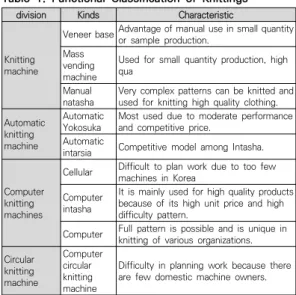
니팅기의 각 기능적 특징 및 구분은 아래의 Table 1 과 같다. 니팅기는 수편기, 자동 편직기, 컴퓨터 편직기, 환편기로 나뉜다. 오픈소스 기반의 니팅기는 2.4에서 확 인할 수 있다[1].
division Kinds Characteristic
Knitting machine
Veneer base Advantage of manual use in small quantity or sample production.
Mass vending machine
Used for small quantity production, high qua
Manual
natasha Very complex patterns can be knitted and used for knitting high quality clothing.
Automatic knitting machine
Automatic
Yokosuka Most used due to moderate performance and competitive price.
Automatic
intarsia Competitive model among Intasha.
Computer knitting machines
Cellular Difficult to plan work due to too few machines in Korea
Computer intasha
It is mainly used for high quality products because of its high unit price and high difficulty pattern.
Computer Full pattern is possible and is unique in knitting of various organizations.
Circular knitting machine
Computer circular knitting machine
Difficulty in planning work because there are few domestic machine owners.
Table 1. Functional Classification of Knittings
2.2 사용편의성의 이해 2.2.1 사용편의성의 개념
사용편의성이란 제품이나 서비스의 사용에 있어 사용 자의 경험을 바탕으로 제품을 얼마나 편리하게 사용할 수 있는지의 정도를 의미한다.
2.2.2 사용편의성의 평가원칙
사용편의성의 평가원칙은 국제표준기구(ISO)에 정의 되어있으며, 다양한 항목에 대한 평가방법이 존재한다.
ISO 9126에서 사용편의성을 “특정 목적을 이루기 위한 제품이나 서비스의 사용 시 효과성, 효율성, 만족도에 대 한 것”이라 정의하였다[1]. Jakob Nielsen은 학습성, 효 율성, 기억성, 오류, 만족성을 사용편의성 평가원칙이라 주장하였고, 이를 바탕으로 ISO 9241-11에서 사용성 평 가원칙이 제시되었다[2]. Table 2
Rule Contents
Learning How fast a new user of the system can learn to complete a task
Efficiency Higher degree of work efficiency based on the skill of use
Memory How much to remember if you use it after a period of inactivity
Error The extent to which the user does not commit errors and the room for recovery
Satisfaction Subjective satisfaction with what the user is using
Table 2. Principles of Use of the InternationalOrganization for Standardization iso 9241-11
2.3 사용자 인터페이스의 이해
사용자 인터페이스(UI:User Interface)란 사용자와 대상의 상호작용을 의미한다. 본 논문에서는 니팅기로 대 상을 한정한다. 시각디자인 위주의 인식으로 인해 범위가 축소되는 경향이 있지만, 사용자 인터페이스는 제품, 운 송기기, 시각, 패션 등 다양한 디자인에 적용되는 항목이 다. 특히, 제품디자인에서는 소비자들의 사용 경험을 바 탕으로 사용편의성을 향상시키기 위해 꼭 필요한 요소이 다. 사용자 인터페이스는 모든 제품사용 환경에서 나타나 기 때문에 매우 중요한 요소라고 판단된다.
2.4 오픈소스기반 니팅기 사용자 인터페이스 디자인 의 이해
2.4.1 오픈소스기반 니팅기의 특징과 구성요소 오픈소스기반의 니팅기는 보통 형태적 분류로 나뉜다.
구분과 특징은 아래의 Table 3과 같다.
Division Characteristic
Semi-automatic Knitting Machine
Although it is relatively complicated and the intensity of labor is high, the various elements can be selected and used as desired by the user.
Circular knitting machine
It is possible to make fabric or clothes in a circle, and it is effective for making a quick circle.
Automatic knitting machine
If you choose the type of clothes you want and choose a color, you can easily make clothes.
Table 3. Morphological Classification of Open-source- based Knitting Machines
오픈소스를 기반으로한 니팅기는 반자동 니팅기, 원형 니팅기, 완전자동 니팅기 총 3개로 구분할 수 있다. 반자 동의 경우 편직기에 모터와 레일이 있어, 실을 거치하고 직접 손으로 헤드부분을 밀어야 한다. 따라서, 노동강도
가 높다. 하지만, 오류 상황에서 빠르고 직접적인 대응이 가능하다는 장점도 있다. 원형 니팅기는 직조부가 원형으 로 되어있다. 실을 거치한 뒤 손잡이를 한 방향으로 돌리 거나 모터로 반복 작업을 진행한다. 완전자동 니팅기는 메인보드와 여러 개의 모터를 포함하여 설정 후 자동으 로 니팅을 진행한다[3,4].
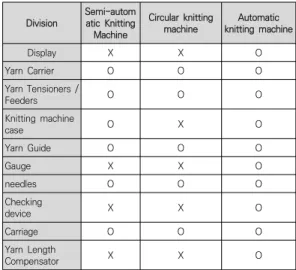
니팅기는 기본적으로 바늘과 얀 케리어(실 이동장치), 케리지(실 배치조절장치), 얀 텐셔너(실 텐션조절장치)를 포함하고 있다. 각 형태와 특징에 따라 구성요소는 다를 수 있다. 오픈소스기반 니팅기의 형태에 따른 분류 별 구 성요소 다음 Table 4와 같다[5-7].
Division Semi-autom atic Knitting Machine
Circular knitting
machine Automatic
knitting machine
Display X X O
Yarn Carrier O O O
Yarn Tensioners /
Feeders O O O
Knitting machine
case O X O
Yarn Guide O O O
Gauge X X O
needles O O O
Checking
device X X O
Carriage O O O
Yarn Length
Compensator X X O
Table 4. Morphological Classification of Open-source- based Knitting Machines
하우징 혹은 케이스는 반자동 니팅기와 완전자동 니팅 기 모두에서 확인할 수 있었다. 사용 후 정리를 하거나 작업상황의 노출을 막기위해 존재한다. 디스플레이, 계량 기와 텐션체킹 디바이스, 원사 길이 보정기는 완전 자동 니팅기에서만 확인할 수 있었다.
2.4.2 오픈소스기반 니팅기 사용자 인터페이스 디자인 2.3에서 열거한 내용과 같이 사용자 인터페이스 (UI:
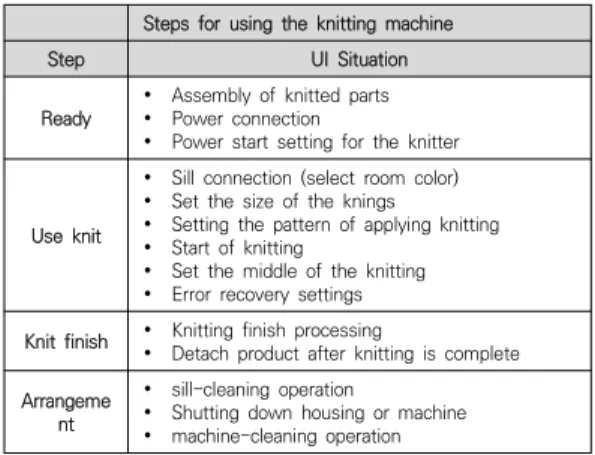
User Interface)는 제품을 사용하는 사용자와 제품 간의 상호작용을 의미한다. 따라서, 2.4.1에서 파악한 오픈소 스기반 니팅기의 구성요소를 바탕으로 문헌조사와 페르 소나를 통해 니팅기를 사용할 때 나타나는 UI 상황을 정 리 및 분석하였다[8]. Table 5
Steps for using the knitting machine
Step UI Situation
Ready Assembly of knitted parts
Power connection
Power start setting for the knitter
Use knit
Sill connection (select room color)
Set the size of the knings
Setting the pattern of applying knitting
Start of knitting
Set the middle of the knitting
Error recovery settings Knit finish Knitting finish processing
Detach product after knitting is complete Arrangeme
nt
sill-cleaning operation
Shutting down housing or machine
machine-cleaning operation
Table 5. Organize UI situation by stage of using open source based knitting machine
3. 연구분석의 틀
3.1 FGD를 통한 오픈소스기반 니팅기 사용자 인터 페이스 디자인 사용편의성 평가원칙 도출 3.1.1 FGD의 목적 및 개요
니팅기 별 사용법은 각기 다르기 때문에 문헌조사를 바탕으로 형태적 분류 중 대표 모델을 선정하고 니팅기 마다 30분간 사용 교육 실시하였다. FGD 개요는 아래 Table 6과 같이 정리하였다.
Investigation
method Expert Focus Group Discussion (FGD) Subject of
investigation (Specialist)
Development of Knitting machines 1 Knittingi Education 1
Knitting Machine Operator Operator 2 UX/UI Specialist 1
Scope of investigation
Expertise on the ease of use of the Knittings user interface design
Collect expert opinions to improve the design of the Knittings user interface
Developing Principles for Evaluating the Usability of Knitting Machine User Interface Design
Enforcement
date November 25, 2019 (7 p.m. Monday)
Table 6. Overview of the Focus Group Discussion (FGD)
3.1.2 전문가 집단 토론 (FGD)의 결과
본 FGD는 앞서 진행된 문헌조사 및 분석을 바탕으로 진행되었으며, FGD를 통해 니팅기들의 문제점과 니팅기 사용자 인터페이스 디자인, 사용편의성에 대한 의견을 수 렴할 수 있었다. FGD를 통해 오픈소스기반 니팅기의 사
용자 인터페이스 디자인 사용편의성에 대한 고려요소를 도출하였다. Table 7
1. Ready
In assembling the knitting machine structure, fast recognition and assembly should be possible.
There should be as few assembly elements as possible.
In assembly, there should be no error elements.
There should be no safety problems.
The start button must be in the proper position.
The position of the start button should be convenient to recognize.
2. Use knit
Thread mounting and connection location should be more than a certain distance from user working area.
Thread connection should be convenient and simple.
In setting the size of the knitting product, it should be simple.
In setting the size of the knitting product, constant fixing must be achieved.
Applying patterns to knitting products should be simple.
When changing from pattern part to merias in the knitting product, the change should be free.
Notifications at the start of the monitoring should indicate the start time or location.
Stopping and restarting in the middle of the knitting should be convenient.
Operating range of motion should be minimized.
It is good to have the shortest possible time.
There should be no errors in the pattern during knitting.
Free form changes should be possible.
The action should be seamless.
Minimize movement or information.
Operation should be possible with minimal training.
3. Error Recovery
In the case of a bad bed escape, it should be immediately recognizable.
Bad escape of the room should be possible to recover or extend immediately.
To minimize errors, the knitting should be continued at the proper speed and angle.
Work space must be secured and free of interference.
4. Knit finish
In finishing the knitting, it must be completed in the correct pattern.
In a finishing environment, there should be no errors.
At the end of knitting, there should be no loosening of the knitting products.
The separation of the knitting machine and the finished product should be convenient.
5. Arrangement
It is advantageous to have a housing.
The instrument or needle must be stored intact.
The power switch must be in the proper position.
The separation and storage of parts should be easy.
It must be appropriately sized for storage.
Table 7. Factors Considering Usability of User Interface Design of Open Source Based Knitting Machine
3.1.3 오픈소스기반 니팅기 사용자 인터페이스 디자인 사용편의성 평가요소
FGD를 통해 도출한 고려 사항을 바탕으로 니팅기 사 용자 인터페이스 디자인 사용편의성 평가원칙을 정리하
Task Contents Key factors Ready
1 Set up the device. Learningability
2 Fix the thread.
Learningability, Cognitive Suitability, Cognitive Suitability 3 Set up the pattern. Learningability,
Operational Ease of Action
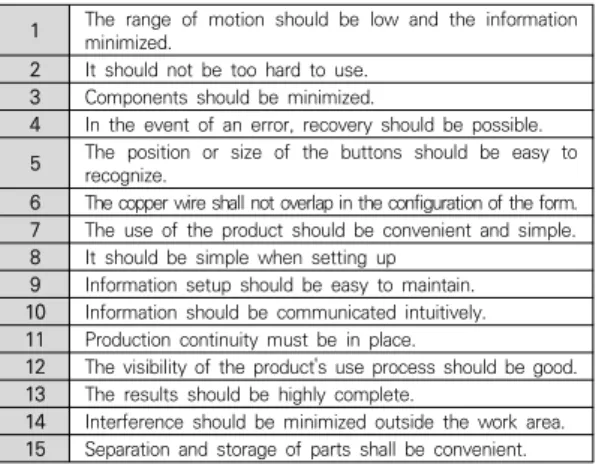
Table 11. Task contents and main elements 였다. 추출한 고려 사항들은 중복되는 항목을 접목하고통일하였다. 니팅기 사용자 인터페이스 디자인에 직접적 인 활용도가 낮은 고려 사항은 제외하고 진행하였다. 내 용은 Table 8와 같다.
1 The range of motion should be low and the information minimized.
2 It should not be too hard to use.
3 Components should be minimized.
4 In the event of an error, recovery should be possible.
5 The position or size of the buttons should be easy to recognize.
6 The copper wire shall not overlap in the configuration of the form.
7 The use of the product should be convenient and simple.
8 It should be simple when setting up 9 Information setup should be easy to maintain.
10 Information should be communicated intuitively.
11 Production continuity must be in place.
12 The visibility of the product's use process should be good.
13 The results should be highly complete.
14 Interference should be minimized outside the work area.
15 Separation and storage of parts shall be convenient.
Table 8. Evaluation Factors for User Interface Design of an Open Source-Based Nitting Machine
3.1.4 오픈소스기반 니팅기 사용자 인터페이스 디자인 사용편의성 평가원칙 수립
추출한 평가요소를 니팅기 사용자 인터페이스 디자인 사용편의성 실증연구를 위한 평가원칙을 재정하였다. 평 가요소에서 중복된 항목은 한 가지 항목으로 통합하여 도출하였다. 오픈소스기반 니팅기 사용자 인터페이스 디 자인 사용편의성 평가원칙은 아래 Table 9과 같다[9-13].
1 Learningability Was learning simple and ready to use?
2 Operational
Ease of Action Is it suitable for range of motion or for configuration of the knitter structure?
3 Brevity Was it easy to use the knitter?
4 Error recovery Was recovery from errors fast and simple?
5 Cognitive
Suitability Is the size or position of the button appropriate to recognize?
6 Convenience Is the overall knitting process convenient?
7 Poetism Can information such as buttons or alerts be viewed at a glance?
8 Operational
convenience Was it convenient to operate buttons or tools?
9 State
Maintainability Was it easy to maintain working conditions?
10 Intuitive Can you intuitively view knit fabrication information?
11 Production
Continuity Has it been easy for continuous operation to change the knitted motion?
12 Completeness Are you satisfied with the completeness of the knitted output?
13 Safety Are you safe with the use of a knitter?
Table 9. Principles for Evaluating the Usability of User Interface Design for Open Source-Based Nitting machines
4. 실증연구 4.1 실연연구의 설계
4.1.1 실증연구 대상의 선정 및 분석
오픈소스기반 니팅기 사용자 인터페이스 디자인의 사 용편의성의 차이를 알아보기 위해 동일한 가격대의 시장 점유율이 높은 3기종을 비교 모델로 선정했다. 최종 선정 모델 3기종은 Table 10과 같다. 모델 A는 수평으로 작 동하는 편직기이며, 모델 B는 원형으로 작동하는 원형니 팅기이다. 모델 C는 편직방식을 자동화시킨 자동편직기 이다.
Model Name Model A Model B Model C
Exterior
Device Name Ayab KH910 CircularKnitic Kniterate
Development Time 2016 2014 2017
Table 10. Final Selection Model
4.1.2 실증연구 방법의 구성
FGD를 통해 도출한 평가원칙을 바탕으로 실증연구를 진행하였다. 관찰실험은 TASK 별 수행시간, 오류 빈도 의 비교 분석과 심층면접을 통해 평가원칙 항목 별 사용 편의성의 차이를 분석하였다. 수행도 측정을 통한 객관적 인 데이터 추출과 심층 면접을 통한 주관적 평가를 모두 실시하였다.
4.1.3 TASK 설계
평가원칙 요소들을 포함한 11가지의 수행 과제(Task) 를 선정하였다. 니팅기의 사용 순으로 구성하였으며, 각 모델에 중복 적용되는 기능만으로 선정하였다. 제작 대상은 같은 패턴을 기준으로 같은 길이의 옷으로 하였다 [14, 15].
4 Set the size of the clothes. Learningability, Operational Ease of Action Use knit
5 Proceed with the knitting.
Learningability, Operational Ease of Action, Brevity, Poetism, State Maintainability, Production Continuity, Completeness, Safety Error Recovery
6 Insert the missing knot. Error recovery, Brevity, Intuitive 7 Loosen the twisted knot. Error recovery,
Intuitive Knit finish
8 Finish the knitting.
Brevity, Convenience, Operational convenience, Completeness 9 Clean up the last knot. Brevity 10 Disconnect from the device. Cognitive
Suitability, Poetism Arrangement
11 Completely shut down the knitting machine.
Cognitive Suitability, Convenience, Poetism
Day 1 Day 2 Day 3 Day 4 Day 5
29 / M 23 / W 28 / M 21 / M 43 / W
27 / M 20 / W 35 / M 30 / W 25 / M
27 / M 34 / W 35 / M 37 / W 33 / M
27 / M 43 / W 28 / M 42 / W 32 / W
30 / M 45 / M 30 / M 20 / W 27 / W
32 / W 32 / W 28 / W 23 / W 26 / M
26 / W 32 / W 26 / W 22 / W 29 / M
25 / W 27 / M 26 / M 23 / W 21 / W
26 / W 28 / W 25 / M 22 / M 20 / W
Table 12. Observation experiments and in-depth interviews
4.2 관찰실험 및 심층면접
4.2.1 관찰실험 및 심층면접의 개요
사용자 관찰 기법을 통해 수행도 측정 실험을 진행하 였으며, 고정 카메라 1대, 스마트폰 카메라 1대 총 두 대 의 카메라로 관찰을 진행하였다. Task 별 오픈소스기반 니팅기 사용자 인터페이스 디자인의 평가원칙을 중심으 로 분석하였다.
4.2.2 관찰실험 및 심층면접의 구성 및 절차 관찰실험 대상자는 FGD를 통해 결정했으며, 니팅기 사용경험이 2번 이하인 일반인을 기준으로 실시하였다.
사용 경험이 겹치지 않는 3분류의 3모델이기 떄문에, 그
룹을 나누지 않고, 일반인 45명(남성 20명, 여성 25명)을 대상으로 진행하였다. Task 실행 전 모델 별 30분의 사 전 교육(사용교육)을 실시 후 관찰실험을 진행했다.
심층면접은 Task 관찰실험 직후에 실시하여, 내용의 즉각적인 적용이 가능하였으며, 사용 심리와 기기사용의 만족도, 안전성, 추가 개선의견을 알아보기 위해 Table 12의 괄찰실험 대상자 전원에게 진행하였다.
Fig. 1. Observation Experiment Image
4.2.3 관찰실험 및 심층면접의 결과 분석
45명을 대상으로 Task 수행시간 및 오류빈도 측정과 심층면접을 진행하였다. 비교분석은 IBM SPSS Statis tics 22를 사용하였으며, 일원분산분석과 Scheffe의 사 후 검증을 통해 분석하였다. 오픈소스기반 니팅기 사용자 인터페이스 디자인 사용편의성 평가원칙을 바탕으로 수 행시간과 오류빈도에 대한 연관성을 확인할 수 있었으며, 오류빈도 평균은 소수점 1의 자리에서 반올림한 평균을 기입하였다. 모델A, 모델B, 모델C의 수행시간 평균 및 오류빈도는 다음 Table 13과 같다
Task Average run time order and average error frequency.
(Sec), (/Count) Task1 A(194.54.s)/4 < B(101.21s)/3 < C(72.32s)/1 Task2 B(29.82s)/2 < C(14.97s)/0 < A(12.22.s)/1 Task3 B(-)/ < A(21.66.s)/1 < C(3.32s)/0 Task4 B(-)/ < A(8.45.s)/1 < C(4.13s)/0 Task5 A(-)/2 < B(-)/1 < C(-)/1
Task6 C(129.97s)/1 < B(18.32s)/4 < A(14.91.s)/5 Task7 B(-)/2 < A(4.32.s)/5 < C(0.00)/0 Task8 B(29.82s)/2 < A(15.92s)/0 < C(12.22.s)/1 Task9 A(945.93.s)/1 < B(371.77s)/2 < C(5.12s)/0 Task10 B(29.82s)/2 < C(16.24s)/0 < A(12.22.s)/1 Task11 C(8.67s)/0 < A(2.17.s)/1 < B(1.42s)/2
Table 13. Order of execution time and error frequency for each task [Task] of model a,b,c
Task3, 4, 7의 경우 모델 B의 경우 형태나 기능적 한 계로 인해 측정이 무의미 하여 제외하였으며, Task5의
경우 기술적 차이로 나타나는 출력시간이라고 판단하여 오류 횟수만 측정하였다.
Task1에서는 모델 C, Task2에서는 모델A, Task3은 모델 C, Task4는 모델 C, Task6에서는 모델 A, Task7 은 모델C, Task8에서는 모델 C, Task9는 모델 C, Task10은 모델A, Task11에서는 모델 B의 사용편의성 이 가장 높은 것으로 나타났다. Task별 수행시간 및 오 류 빈도를 바탕으로 사용편의성 측정에서는 모델 C의 사 용편의성이 가장 높은 것으로 나타났으며, 모델 B의 사 용편의성이 가장 낮은 것으로 나타났다. 모델 B의 경우 상대적으로 사용 가능 기능이 모델 A, B에 비해 적었다.
Task 별 포함된 요소를 바탕으로 분석해 본 결과, 모델 C가 학습성, 간결성, 인지적합성, 편의성, 상태 유지성, 직관성면에서 사용편의성이 가장 높은 것으로 나타났다.
심층면접의 결과 사용 심리와 만족도, 안전성 등을 조 사하였는데, 모델 C의 만족도와 안전성이 가장 높았으며, 모델 A의 만족도와 안전성이 가장 낮은 것으로 나타났 다. 추가 개선의견의 경우 즉각적인 오류 수정에는 모델 A가 탁월했지만, 너무 많은 노동시간과 강도가 요구된다 는 의견이 많았으며, 모델 B의 경우 속도의 조절이나 제 작 제품의 변형이 불가능해서 한계가 너무 많다는 의견 이었다. 모델 A의 경우 전반적으로 만족한다는 의견이 가장 많았다.
5. 결론
5.1 오픈소스기반 니팅기 사용자 인터페이스 디자인 을 위한 제언
오픈소스기반 니팅기 사용자 인터페이스 디자인 사용 편의성에 대해 다음과 같이 제언한다.
첫째, 오픈소스기반 니팅기의 사용준비에 있어, 정신 적, 육체적 노력을 최소화해야 한다. 따라서, 직관성과 학 습성, 편의성을 높인다면 사용편의성을 높일 수 있을 것 으로 판단된다.
둘째, 오픈소스기반 니팅기의 버튼에 있어, 작업영역 과 최대한 가깝고, 직관적이여야한다. 니팅기 개발에 있 어 버튼 위치나 크기를 디자인하는데 있어,직관성과 간결 성, 인지적합성, 편의성을 고려한다면 사용편의성을 높일 수 있을 것이다. 또한, 니팅 작업 범위의 밖에 버튼을 두 는 것이 실수로 버튼을 눌리는 오류를 개선하는데 도움 이 될 것이다.
셋째, 작업 정보제공에 있어 구성을 최소화하고, 지속 적인 관찰이 가능하게 해야한다. 따라서, 디스플레이나 계량기의 직관성과 간결성을 높인다면, 사용편의성을 높 일 수 있을 것이다.
5.2 연구의 결론 및 제한점
오픈소스기반 니팅기 사용자 인터페이스 사용편의성 향상을 위한 디자인적 접근 방향은 다음과 같다.
첫째, 정보전달에 있어, 디스플레이를 적용하여 직관 성과 학습성, 간결성을 높이는 것이 전반적인 시안성을 높여 니팅기의 사용편의성에 긍정적인 영향을 줄 수 있 을 것이다. 둘째, 수동작업을 최대한 줄이고, 자동작업을 도입하고 오류빈도를 줄인다면, 운영 편의성과 상태 유지 성을 향상시켜 사용편의성에 긍정적인 영향을 미칠 것이 다. 셋째, 속도제어와 하우징의 계폐가 자유롭게 개선한 다면, 오류 상황에서 사용자의 개입 또한 자유로워 오류 복구에 대한 개선이 편리할 것이다. 넷째, 얀 케리어가 니 팅기 본체와 부착되어 있다면, 니팅 시작이나 마무리 시 동작 횟수와 시간을 줄여 사용편의성에 긍정적인 영향을 미칠 것이다. 다섯째, 얀 텐셔너 및 실 고정장치는 하우징 안쪽 혹은 하우징 근처에 배치한다면, 외부요인으로부터 실의 텐션을 유지하여 사용편의성에 긍정적인 영향을 미 칠 것이다.
본 연구의 제한점으로는 연구 대상이 국내로 한정되어 있어 연구 대상의 확대를 통해 좀 더 객관적이고 확장된 결과를 이끌어낼 수 있을 것이다. 또한, 좀 더 다양한 오 픈소스기반 니팅기를 적용하여, 연구의 확장성을 줄 필요 성이 있다. 향후 본 연구를 바탕으로 디자인제안 및 비교, 개발이 가능할 것으로 판단된다.
REFERENCES
[1] Aaron. (2019). Different Types of Knitting Machines:
that you can use in your Textile Industry. World [Online].
https://www.xdknitmachinery.com/types-of-knitting- machines.
[2] J. Y. Jo. (2018). A Study on the Usability of VR Device PUI (Physical User Interface) Design. Mastet`s Thesis.
Graduate School of Techno Design, Kookmin Universitym, Seoul.
[3] R. Kovar. (2011). Flat Knitting Machine. Advances in Knitting Technology. Cornwall : Woodhead Publishing.
[4] J. Eichhoff & T. Gries. (2013). Circular Knitting
Machine. Multidisciplinary Know-How for Smart- Textiles Develo pers. Cornwall: Woodhead Publishing.
[5] Kniterate. (2019). Kniterate Homepage. World [Online].
https://www.kniterate.com/product/kniterate-the-digi tal-knitting-machine
[6] Varvara & Mar. (2014). Circular Knitic . World [Online]. http://varvarag.info/circular-knitic/
[7] E. M. S. Wiki. (2016). Wiki_KH-910. World [Online].
https://wiki.evilmadscientist.com/AYAB _KH-910 [8] J. Y Jo. (2019). A Study on the Usability of VR Device.
Jo gJournal of Integrated Design Research, 18(1), 161-184.
[9] S. W. Jeng. (2012). A Study A Study on Treadmill Control Interface Usability in Terms of User Experience. Mastet`s Thesis. Graduate. School of Techno Design, Kookmin Universitym, Seoul.
[10] L. A. Um. (2011). A Study on the User Interface Design of Large Screen Interactive Information Display from an Affinity Viewpoint. Mastet`s Thesis. Ewha Womans University, Seoul.
[11] I. G. Seo. (2013). A Research on the interface design for the self-care blood pressure monitoring system centered on the user experience. Mastet`s Thesis.
EInje University, Gyeongsangnam-do.
[12] J. Y. Park. (2012). A Study on the Application Process of User Participation Design: Focused on Smart TV Remote Control Interface Design Case. Mastet`s Thesis. Ewha Womans University, Seoul.
[13] Y. S. Jo. (2013). A Research on the Systematization of the Augmented Reality User Interface Design According to the Expandability of the Visual Perceptions of the HMD. Doctoral dissertation.
Hanyang University Graduate School Seoul.
[14] M. R. Kim. (2010). A study on the design of task lamp based on the formative flow of design. Mastet`s Thesis. Hongik University Graduate School, Seoul.
[15] C. H. Lee. (2013). A Study on Interface Design for File management in Mass storage Mobile phone : Focused on apply User's prior experience in Windows Explorer. Mastet`s Thesis. Graduate School of Techno Design, Kookmin Universitym, Seoul.
조 재 윤(Jae-Yoon Jo) [정회원]
․ 2019년 9월 : 국민대학교테크노디자 인전문대학원 제품이노베이션디자인 학과 박사과정
․ 관심분야 : UX, UI, 제품디자인, 3D프 린팅
․ E-Mail : [email protected]
남 원 석(Won-Suk Nam) [정회원]
․ 2011년 3월 : 국민대학교 공업디자인 학과 (교수)
․ 관심분야 : 제품디자인, 플랫폼디자인
․ E-Mail : [email protected]
장 중 식(Joong-Sik Jang) [정회원]
![Table 13. Order of execution time and error frequency for each task [Task] of model a,b,c](https://thumb-ap.123doks.com/thumbv2/123dokinfo/4990871.547010/6.799.416.710.758.943/table-order-execution-time-error-frequency-task-model.webp)
