Effects of Early Life Stress on the Development of Depression and Epigenetic Mechanisms of p11 Gene
Mi Kyoung Seo
1, Ah Jeong Choi
1, Jung Goo Lee
1,2, Sang-Hwa Urm
3, Sung Woo Park
1,4* and Dae-Hyun Seog
5*
1Paik Institute for Clinical Research, Inje University, Busan 47392, Korea
2Department of Psychiatry, College of Medicine, Haeundae Paik Hospital, Inje University, Busan 48108, Korea
3Department of Preventive Medicine, College of Medicine, Inje University, Busan 47392, Korea
4Department of Convergence Biomedical Science, College of Medicine, Inje University, Busan 47392, Korea
5Department of Biochemistry, College of Medicine, Inje University, Busan 47392, Korea
Received April 2, 2019 /Revised April 10, 2019 /Accepted April 22, 2019
Early life stress (ELS) increases the risk of depression. ELS may be involved in the susceptibility to subsequent stress exposure during adulthood. We investigated whether epigenetic mechanisms of p11 promoter affect the vulnerability to chronic unpredictable stress (CUS) induced by the maternal sepa- ration (MS). Mice pups were separated from their dams (3 hr/day from P1-P21). When the pups reached adulthood, we applied CUS (daily for 3 weeks). The levels of hippocampal p11 expression were analyzed by quantitative real-time PCR. The levels of acetylated and methylated histone H3 at p11 promoter were measured by chromatin immunoprecipitation. Depression-like behavior was meas- ured by the forced swimming test (FST). The MS and CUS group exhibited significant decreases in p11 mRNA level and the MS plus CUS group had a greater reduction in this level than the CUS group. The MS plus CUS group also resulted in greater reduction in H3 acetylation than the CUS group. This reduction was associated with an upregulation of histone deacetylase 5. Additionally, the MS plus CUS group showed a greater decrease in H3K4met3 level and a greater increase in H3K27 met3 level than the CUS group. Consistent with the reduction of p11 expression, the MS plus CUS group displayed longer immobility times in the FST compared to the control group. Mice exposed to MS followed by CUS had much greater epigenetic alterations in the hippocampus compared to adult mice that only experienced CUS. ELS can exacerbate the effect of stress exposure during adulthood through histone modification of p11 gene.
Key words : Chronic unpredictable stress, depression, epigenetic mechanisms, maternal separation,
p11
*Corresponding authors
*Tel : +82-51-890-6071, Fax : +82-51-894-6709
*E-mail : [email protected] (Sung Woo Park)
*Tel : +82-51-890-6974, Fax : +82-51-894-5801
*E-mail : [email protected] (Dae-Hyun Seog)
This is an Open-Access article distributed under the terms of the Creative Commons Attribution Non-Commercial License (http://creativecommons.org/licenses/by-nc/3.0) which permits unrestricted non-commercial use, distribution, and reproduction in any medium, provided the original work is properly cited.
Journal of Life Science 2019 Vol. 29. No. 9. 1002~1009 DOI : https://doi.org/10.5352/JLS.2019.29.9.1002
서 론
우울증은 자살을 초래하며 질병 부담이 큰 정신질환에 해당 된다. 유소년기의 학대와 방임과 같은 정신적 외상은 성인기 우울증의 원인이 된다고 알려져 있다[9, 12]. 생애 초기 유해 경험(early life stress)은 후성유전기전(epigenetic mechanisms) 을 통해 게놈(genome)에 지속적인 후성유전 표지를 남기고 성체가 되었을 때 유전자 발현을 변화시켜, 뇌신경 기능 및
행동 기능에 영향을 미쳐 우울 행동을 유발함이 동물실험에 의하여 확인되었다[14, 16]. 후성유전기전에는 히스톤 변형 (histone modification)과 DNA 메틸화(DNA methylation)가 알려져 있다. 우울증 동물모델에서 히스톤 변형 기전 중 히스 톤 아세틸화(histone acetylation)와 히스톤 메틸화(histone methylation)가 가장 많이 연구되어 있다[21].
히스톤 아세틸화와 메틸화는 히스톤 꼬리의 라이신(lysine;
K)에서 일어난다. 히스톤이 아세틸화되면 라이신의 양전하를
중화시켜 음전하를 가진 DNA와 히스톤 단백질과의 결합을
풀리게 한다[2, 4]. 이러한 변형으로 인해 특정 유전자의 pro-
moter에 전사조절인자들이 쉽게 결합하여 전사가 활성화되어
유전자발현이 증가된다[2, 4]. 반면, 히스톤 아세틸화가 감소하
면 유전자 발현이 억제된다. Histone acetyltransferases (HATs)
와 histone deacetylases (HDACs)는 히스톤 아세틸화의 균형
을 조절한다. HATs는 히스톤 아세틸화를 촉진시켜 유전자 발
현을 증가시키는 반면, HDACs는 히스톤의 탈아세틸화 반응
을 촉진시켜 전사 조절을 억제 시킴으로써 유전자 발현을 감
Fig. 1. Experimental design schematic. Mice pups were separated from their dams for 3 hr per day from postnatal day 1 through 3 weeks of age. When the pups became adults (60 days), they were subjected to chronic unpredictable stress (CUS; daily for 4 weeks). Forced swimming test was performed 24 hr after the last CUS.
소시킨다[5, 27]. 히스톤 아세틸화가 전사 활성을 증가시킴으 로써 유전자 발현을 증가시키는 반면, 히스톤 메틸화는 라이 신 위치와 메틸화 양에 따라서 유전자 발현을 증가시키거나 억제시킨다[11]. 히스톤 H3의 4번째 라이신에 3분자의 메틸기 가 결합하고(H3K4me3), H3의 36번째 라이신에 3분자의 메틸 기가 결합하면(H3K36met3) 유전자발현이 증가된다. 반면 H3 의 9번째 라이신에 3분자의 메틸기(H3K9met3), H3의 27번째 라이신에 3분자의 메틸기(H3K27met3)가 결합하면 유전자발 현이 감소하는 것으로 알려져 있다[11].
p11은 우울증의 병태 생리와 항우울제의 작용 기전에 관여 한다[23]. 효모 two-hybrid기법을 이용한 연구에서 p11이 세 로토닌 수용체 1B, 1D 그리고 4(5-HT1B receptor, 5-HT1D re- ceptor, 5-HT4 receptor)와 결합하여 상호작용함으로써 우울 증과 항우울제의 새로운 표적단백질로 작용함이 확인 되었다 [22, 29]. 우울증 동물 모델 및 우울증 환자의 사후 검정 한 뇌에서 p11 mRNA와 단백질 양이 감소하였다[22]. 반면, 전기 충격요법(electroconvulsive therapy) 및 선택적 세로토닌 재 흡수 억제제(selective serotonin reuptake inhibitors; SSRIs)와 같은 항우울제의 장기 투여는 p11 발현을 증가시켰다[22, 29].
p11 knockout 생쥐는 강제수영검사, 꼬리매달기검사, 자당섭 취량검사와 같은 다양한 우울증 동물모델에서 우울증과 유사 한 행동 양상을 나타내었다[6, 22, 29]. 항우울제를 투여한 야생 형 생쥐는 항우울 행동을 보이는데, 항우울제를 투여한 p11 knockout 생쥐는 이러한 행동 양상을 보이지 않았다. 반면, p11을 과발현(overexpression) 시키는 형질전환 생쥐(trans- genic mice)는 항우울 행동을 나타내었다[22].
본 연구에서는 출생 후 새끼 생쥐를 어미 생쥐로부터 분리 하는 모성 분리(maternal separation; MS)와 성체 기간에 장기 간 예측 불가능한 스트레스(chronic unpredictable stress;
CUS) 모델을 사용하였다. 두 종류의 스트레스 모델을 사용하 여 생애 초기 유해경험이 p11 유전자의 히스톤 변형을 통해 성체 스트레스 취약성에 미치는 영향을 조사하였다.
재료 및 방법
실험동물
본 동물실험을 수행하기 위해 인제대학교 의과대학 동물실
험 윤리 위원회(IACUC)의 심의 및 승인(승인번호 2016-053)을 받았다. 인제대학교 의과대학 준청정사육실을 사용하였으며, 기준 온도(21±2℃) 하에서 하루 12시간씩의 낮/밤 주기를 유 지한 상태로 충분한 물과 사료를 제공하면서 사육하였다.
동물실험 설계
임신한 지 15일되는 20마리의 C57BL/6 생쥐(Daehan Biolink, Chungbuk, Korea)를 구입하였으며, 사육 상자 당 임신 쥐 2마 리씩 배분하였다. 생후 22일째에 성별을 분리하여 수컷만 사 육하였다. 각 실험동물군은 다음과 같이 분류하였다(Fig. 1).
CON군(n=11): 출생 후 MS 및 성체 기간에 CUS를 가하지 않 은 대조군; MS군(n=13): 출생 후 MS를 경험하고 성체 기간에 CUS를 가하지 않은 실험군; CUS군(n=12): 출생 후 MS를 경험 하지 않고 성체 기간에 CUS를 가한 실험군; MS+CUS군(n=
12): 출생 후 MS 및 성체 기간에 CUS를 모두 가한 실험군으로 하였다.
모성 분리(MS)
출생 후 전체 새끼 쥐의 1/2마리는 어미 쥐와 함께 사육하 였고, 나머지 1/2마리는 21일 동안 오전 9시부터 오후 12시까 지 하루 3시간 동안 어미 쥐와 분리 사육하였다. 어미쥐로부터 분리되는 동안 체온 유지를 위해 사육 상자 바닥 온도를 30±2
℃로 유지하였으며, 분리 시간이 끝나면 어미 쥐가 있는 사육 상자로 돌려보내 사육하였다.
장기간 예측 불가능한 스트레스(CUS)
성체가 되었을 때(생후 60일) 수컷 생쥐에게 CUS를 적용하 였다. 본 연구에서는 Willner 과 Banasr 등이 사용한 방법을 일부 수정하여 7가지 스트레스를 사용하였다[1, 32]. CUS는 4주간에 걸쳐 총 4주기를 반복하였다. 실험동물에 가해진 CUS의 한 주기는 깔짚 제거, 구속스트레스, 사육 상자 기울이 기, 수영, 꼬리 꼬집기, 물과 먹이 박탈, 축축한 깔짚 등을 포함 하였다(Table 1).
강제수영검사(FST)
강제수영검사는 Porsolt 등의 방법을 변형하였다[18]. 마지
막 CUS 다음날 강제수영감사를 수행하였다. 윗면이 개방된
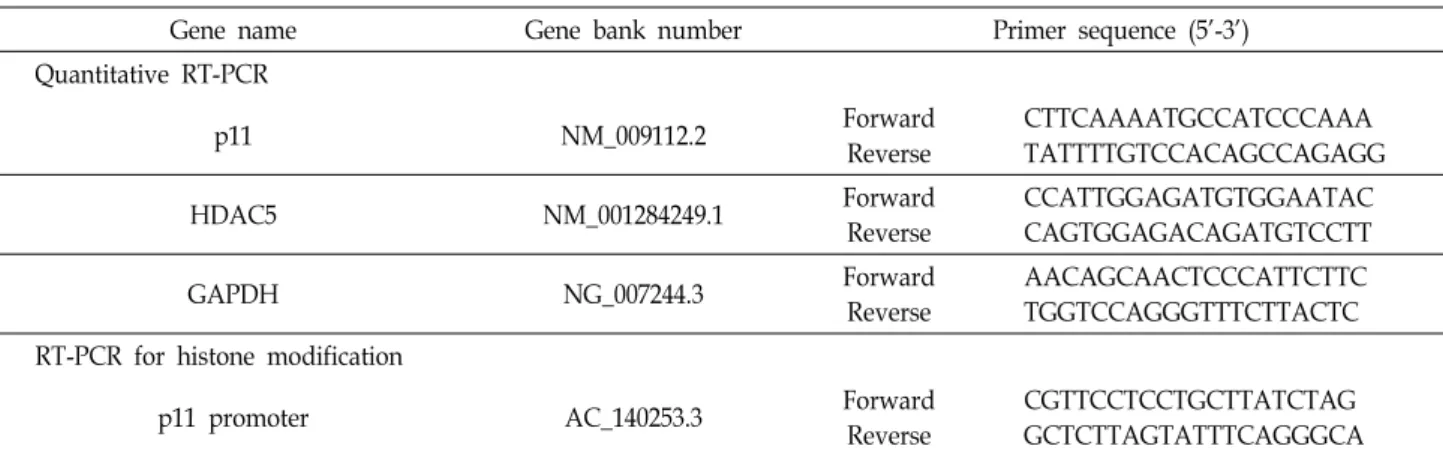
Table 2. Lists of all primers used in this study
Gene name Gene bank number Primer sequence (5’-3’)
Quantitative RT-PCR
p11 NM_009112.2 Forward
Reverse
CTTCAAAATGCCATCCCAAA TATTTTGTCCACAGCCAGAGG
HDAC5 NM_001284249.1 Forward
Reverse
CCATTGGAGATGTGGAATAC CAGTGGAGACAGATGTCCTT
GAPDH NG_007244.3 Forward
Reverse
AACAGCAACTCCCATTCTTC TGGTCCAGGGTTTCTTACTC RT-PCR for histone modification
p11 promoter AC_140253.3 Forward
Reverse
CGTTCCTCCTGCTTATCTAG GCTCTTAGTATTTCAGGGCA GAPDH: Glyceraldehyde 3-phosphate dehydrogenase, HDAC5: Histone deacetylase 5, p11: S100A10
Table 1. Stressor used in the chronic unpredictable stress (CUS)
Day Stressors Duration
1 2 3 4 5 6 7
Empty cage Restraint stress Tilt cage at 45˚
Swim Nip tail
Water and food deprivation Wet cage
24 hr 4 hr 4 hr 5 min 1 min 24 hr 24 hr During the CUS protocol, one stressor was applied daily for 4 weeks.
원통모양의 아크릴 수조(높이 25 cm, 지름 10 cm)에 깨끗한 수돗물(수온 25±2℃)을 수조 바닥에서부터 12 cm까지 채운 후, 생쥐를 한 마리씩 수조에 넣고 총 7분 동안 강제로 수영 시킨 후, 물에서 건져 올려 마른 수건으로 닦아 사육 상자로 돌려보냈다. 검사 시행 전체를 디지털 카메라에 기록하고, 기 록된 영상을 최초 2분은 적응시간으로 측정하지 않고, 마지막 5분 동안의 부동 상태(immobility) 시간을 계측하였다.
RNA 추출 및 역전사
강제수영검사가 끝난 직후 뇌에서 해마를 적출하여, 실험에 사용할 때까지 모든 조직을 액체 질소로 동결하여 -80℃에 보 관하였다. 해마의 전체 RNA는 Qiazol (Qiagen, Valencia, CA, USA) 방법으로 추출하였다. RNA 농도는 NanoDrop 2000/
2000c UV-Vis (Thermo Scientific, Waltham, MA, USA)를 사 용하여 측정하였다. RNA로부터 cDNA를 합성하기 위해, amfiRivertII™ cDNA Synthesis Master Mix (GenDepot, Baker, TX, USA)를 이용하였다. 1 μg RNA 시료를 사용하여 25℃에서 5분, 50℃에서 1시간, 70℃에서 15분간 반응하여 cDNA를 합성하였다.
Real-time polymerase chain reaction (PCR)을 이용 하여 mRNA 정량분석
Real-time PCR (ABI 7500, Applied Biosystems, Foster City, CA, USA) 기기를 사용하여 mRNA를 정량 분석하였다.
합성된 cDNA 100 ng, 2X PreMIX (SYBR Green with low ROX; RT500, Enzynomics, Daejeon, Korea) 12.5 μl, 10 pmole forward primer 0.5 μl, 10 pmole reverse primer 0.5 μl와 멸균 수로 최종 25 μl를 맞추어 수행하였다. 반응 조건은 95℃에서 10분, 95℃에서 15초, 55℃에서 35초, 72℃에서 35초로 하여 총 40 cycles 반복하였다. Melting curve의 분석은 0.5℃ 간격 으로 55℃에서부터 95℃까지 상승시켰다. 상대적인 유전자 발 현 양은 2
-ΔΔCt방법(comparative Ct method)을 이용하였다.
Glyceraldehyde 3-phosphate dehydrogenase (GAPDH)를 사 용하여 보정하였다. 본 연구에 사용된 primer 염기서열은 Table 2와 같다(Table 2).
염색질 면역 침전 분석
특정 유전자의 히스톤 아세틸화 및 메틸화 양을 염색질 면 역침전분석법(Chromatin immuno-precipitation assay, ChIP assay)으로 측정하였다. ChIP assay는 ChIP Plus Enzymatic Chromatin IP Kit (Cell signaling, cell signaling, Beverly, MA, USA)를 사용하였다. 해마 조직을 1.5% formaldehyde로 고정 시키고, glycine으로 고정을 멈춘 후에 초음파발생장치를 사용 하여 염색질 단편이 100~500 base pairs가 되도록 하였다. 염 색질 단편 10 μg에 anti-acetyl-H3 (K9+K14) (06-599, Milli- pore, Billerica, MA, USA), anti-histone H3 trimethyl lysine 4 (H3K4me3; ab8580, abcam, Cambridge, MA, USA), an- ti-histone H3 trimethyl lysine 27 (H3K27me3; ab6002, abcam) 항체를 각각 첨가하였다. Phenol/chloroform (Amresco, Solon, OH, USA) 추출 및 ethanol (Merck, Hunterdon, NJ, USA) 침 전을 통해 DNA를 분리 정제하였다. p11 promoter에 특이적 인 primer (Table 2)를 사용하여 real-time PCR을 수행하였다.
면역 침강된 샘플은 면역 침강되지 않은 input DNA로 보정하
였다. 정량 값은 2
-△△Ct방법을 사용하였다.
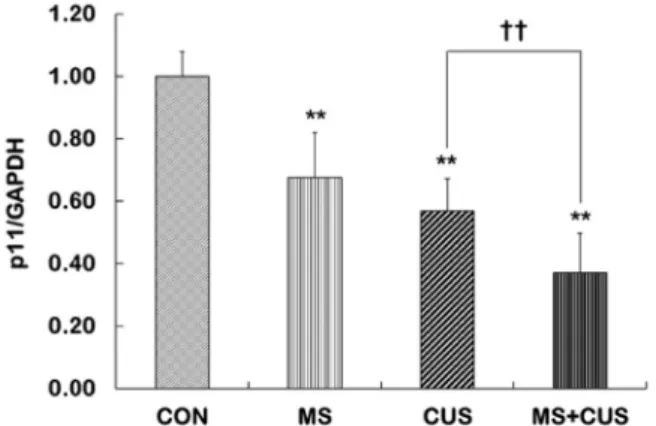
Fig. 2. Expression of p11 mRNA in the hippocampus of control, MS, CUS, and MS+CUS groups. Mice pups were sepa- rated from their dams (3 hr per day from postnatal day 1 through 3 weeks). When they became adults (60 days), mice were subjected to chronic unpredictable stress (CUS; daily for 4 weeks) (n=11-13 animals/group). The p11 mRNA levels the hippocampus were measured by quantitative real-time reverse transcription polymerase chain reaction (RT-PCR). This experiment was repeated twice. Quantitative analysis was normalized to Glyceral- dehyde-3-phosphate dehydrogenase (GAPDH). Results are expressed as a value relative to the control group using the 2-△△ct method. CON, non-MS, non-CUS mice;
MS, MS adult mice; CUS, non-MS, CUS mice; MS+CUS, MS plus CUS mice. Data represent the mean ± S.E.M.
**p<0.01 vs. control group; ††p<0.01 vs. CUS group.
통계처리
모든 실험결과는 평균값±표준 오차로 나타내었다. 통계 프 로그램은 GraphPad Prism 8.0 software (Windows용 ver. 8.0, GraphPad Software Inc., La Jolla, CA, USA)를 사용하였다.
유전자 발현 및 히스톤 변형에 관한 결과 분석은 One-way analysis of variance (ANOVA)를 사용하여 Tukey’s multi- ple-comparison test로 사후 검정 하였다. 강제수영검사 결과 분석은 Kruskal–Wallis test를 시행하였으며, Mann-Whitney U-test로 사후 검정 하였다. p 값이 0.05 미만인 것(p<0.05)을 통계적 유의수준으로 하였다.
결 과
p11 mRNA 발현 변화
CON군(대조군), MS군, CUS군, MS+CUS군의 해마에서 p11 mRNA 발현 양을 비교 분석하였다. CON군(1.00±0.08)과 비교하였을 때, MS군(0.68±0.14, p=0.009), CUS군(0.54±0.10,
p<0.001), MS+CUS군(0.37±0.13, p<0.001)에서 p11 발현 양이모두 유의하게 감소하였다(Fig. 2). 성체기간에만 스트레스를 받은 CUS군과 비교하였을 때, 출생 후 모성 분리를 경험하고 성체 기간에 CUS를 함께 경험한 MS+CUS군에서 p11 mRNA
발현 양이 유의하게 감소하였다(p=0.004).
p11 promoter의 히스톤 H3 아세틸화 변화와 HDAC5 mRNA 발현 변화
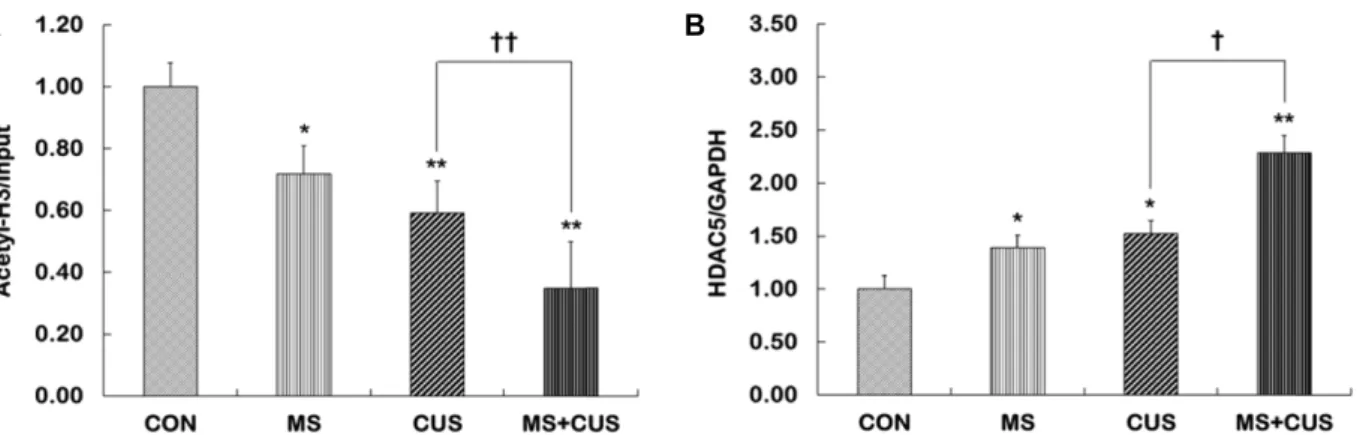
p11 발현 변화에 p11 유전자의 후성유전기전이 영향을 미 치는지를 알아보기 위하여, p11 promoter 영역에서 히스톤 H3 아세틸화를 측정하였다. CON군(1.00±0.08)과 비교하였을 때, MS군(0.72±0.09, p=0.020), CUS군(0.59±0.10, p<0.001), MS +CUS군(0.35±0.15, p<0.001)에서 H3 아세틸화가 모두 유의하 게 감소하였다(Fig. 3A). 또한 CUS군과 비교하였을 때, MS+
CUS군에서 H3 아세틸화가 유의하게 감소하였다(p<0.001). 이 러한 아세틸화 변화는 p11 발현 패턴과 일치하였다.
H3 아세틸화의 감소 기전에 HDAC5가 관여하는지를 알아 보기 위하여, CON군, MS군, CUS군, MS+CUS군의 해마에서 HDAC5 mRNA 발현 양을 측정하였다. CON군(1.00±0.13)과 비교하였을 때, MS군(1.39±0.12, p=0.040), CUS군(1.52±0.12,
p<0.001), MS+CUS군(2.29±0.16, p<0.001)에서 HDAC5 발현양이 모두 유의하게 증가하였다(Fig. 3B). 또한 CUS군과 비교 하였을 때, MS+CUS군에서 HDAC5 발현 양도 유의하게 증가 하였다(p=0.030). 이러한 발현 증가는 p11 promoter의 히스톤 H3 아세틸화의 증가 패턴과 일치하였다.
p11 promoter의 히스톤 H3 메틸화 변화
히스톤 H3 메틸화를 측정하기 위해 라이신 K4에 3분자의 메틸기가 결합하여 해당 유전자의 발현을 증가시키는 H3K4 met3과 K27에 3분자의 메틸기가 결합하여 해당유전자의 발현 을 억제시키는 H3K27met3의 항체를 각각 사용하였다.
CON군(1.00±0.10)과 비교하였을 때, MS군(0.70±0.08, p=0.005), CUS군(0.59±0.09, p<0.001), MS+CUS군(0.23±0.13, p<0.001)에 서 H3K4met3이 모두 유의하게 감소하였다(Fig. 4A). 또한 CUS군과 비교하였을 때, MS+CUS군에서 H3K4met3이 유의 하게 감소하였다(p<0.001). H3K27met3의 경우, CON군(1.00±
0.09)과 비교하였을 때, MS군(1.31±0.09, p=0.040), CUS군(1.71
±0.10, p<0.001), MS+CUS군(2.25±0.11, p<0.001)에서 모두 유 의하게 증가하였다(Fig. 4B). 또한 CUS군과 비교하였을 때, MS+CUS군에서 H3K27met3이 유의하게 증가하였다(p=0.030).
강제수영검사에서 우울 행동 변화
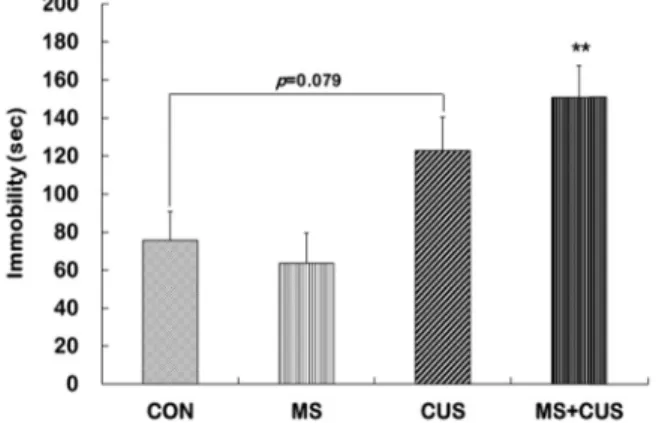
우울 유사 행동을 측정하기 위해 강제수영검사에서 우울 행동 지표인 부동 시간을 계측하였다. CON군(75.6±15.1 sec) 과 비교하였을 때, MS군(63.7±15.9 sec)은 부동 시간에 아무런 변화가 없었으나, CUS군(123.0±17.5 sec)에서 부동 시간이 증 가되는 경향이 나타났다(p=0.079). 또한 MS+CUS군(150.8±
16.8 sec)은 CON군에 비해 부동 시간이 현저히 증가하는 것으
로 보아(p=0.009), p11 발현이 가장 많이 감소하고, 히스톤 변
형에서 가장 큰 변화를 보였던 MS+CUS군에서 우울 유사 행
A B
Fig. 3. The levels of acetylated histone H3 at p11 promoter and HDAC5 mRNA expression in the hippocampus of control, MS, CUS, and MS+CUS groups. Mice pups were separated from their dams. When they became adults, mice were subjected to chronic unpredictable stress (n=11-13 animals/group). Chromatin immunoprecipitation (ChIP) assays were performed to measure the levels of acetylated H3 (A) at p11 promoter in the hippocampus using anti-acetyl-H3 (K9+K14) antibody.
Quantitative analysis was normalized to the ‘input’ DNA. The p11 mRNA levels (B) in the hippocampus were measured by quantitative RT-PCR. Quantitative analysis was normalized to GAPDH. These experiments were repeated twice. Results are expressed as a value relative to the control group using the 2-△△ct method. CON, non-MS, non-CUS mice; MS, MS adult mice; CUS, non-MS, CUS mice; MS+CUS, MS plus CUS mice. Data represent the mean±S.E.M. *p<0.05 vs. control group; **p<0.01 vs. control group; ††p<0.01 vs. CUS group.
A B
Fig. 4. The levels of methylated histone H3 at p11 promoter in the hippocampus of control, MS, CUS, and MS+CUS groups. Mice pups were separated from their dams. When they became adults, mice were subjected to chronic unpredictable stress (n=11-13 animals/group). ChIP assays were performed to measure the levels of trimethylated H3K4 (A) and H3K27 (B) at p11 promoter in the hippocampus using anti-H3K4met3 and anti-H3K27met3 antibodies, respectively. Quantitative analysis was normalized to the ‘input’ DNA. This experiment was repeated twice. Results are expressed as a value relative to the control group using the 2-△△ct method. CON, non-MS, non-CUS mice; MS, MS adult mice; CUS, non-MS, CUS mice; MS+CUS, MS plus CUS mice. Data represent the mean ± S.E.M. *p<0.05 vs. control group; **p<0.01 vs. control group; †p<0.05 vs. CUS group;
††p<0.01 vs. CUS group.
동을 보인다는 것을 알 수 있다(Fig. 5).
고 찰
본 연구에서 출생 후 모성 분리 및 성체 기간에 장기간 예측 불가능한 스트레스가 각각 p11 발현을 감소시켰다. 또한 모성 분리와 성체 기간에 스트레스를 함께 받았을 경우, 성체기간 에만 스트레스를 받은 생쥐보다 p11 발현이 훨씬 더 많이 감소 하였는데 이러한 발현 감소에 p11 promoter의 히스톤 H3 아
세틸화 및 메틸화기전이 관여한다는 것을 밝혔다.
모성 분리와 같은 생애 초기 유해 경험이 성체 우울 행동을
야기하는데 이에 후성유전이 관여한다는 다수의 보고들이 있
다. 이러한 연구는 주로 brain-derived neurotrophic factor
(BDNF) 및 glucocorticoid receptor (GR) 유전자에 집중되어
있다[3, 8, 20, 26]. 출생 후 모성 분리가 불안 및 우울 행동을
야기한다. 이러한 생쥐는 HDAC 발현 증가와 함께 해마
BDNF promoter IV에서 히스톤 H3 및 H4의 아세틸화 감소를
보이며, 후성유전기전을 통해 BDNF 발현을 감소시킨다[19].
Fig. 5. Behavioral changes in the forced swimming test (FST) in control, MS, CUS, and MS+CUS groups. Mice pups were separated from their dams. When they became adults, mice were subjected to chronic unpredictable stress (n=11-13 animals/group). Immobility time was measured 24 hr after the last CUS session. CON, non- MS, non-CUS mice; MS, MS adult mice; CUS, non-MS, CUS mice; MS+CUS, MS plus CUS mice. Data represent the mean±S.E.M. **p<0.01 vs. control group.
GR 유전자 연구에서는 출생 후에 어미 생쥐가 새끼 생쥐를 돌보는 질적 차이가 새끼 생쥐의 GR promoter I
7의 후성유전 변화에 영향을 준다고 보고하였다. 어미 생쥐는 새끼 생쥐를 핥아주고 털 손질을 해주며 등을 아치형으로 굽혀 새끼 생쥐 를 품어주는(lick-groom and arched-back nursing; LG-ABN) 행동을 보인다. 높은 LG-ABN 행동을 보여주는 어미 생쥐의 새끼 생쥐는 낮은 LG-ABN 행동을 보여주는 어미 생쥐의 새끼 생쥐에 비해서 GR promoter I
7의 낮은 DNA 메틸화와 높은 H3의 아세틸화를 보여주었다[30, 31]. 본 연구에서는 출생 후 모성 분리가 p11 발현 양을 감소시켰으며, 이러한 기전에 p11 promoter의 H3 아세틸화와 H3K4 메틸화 감소 및 H3K27 메 틸화 증가가 관여한다는 것을 알 수 있었다. 또한 HDAC5가 증가 하였는데 이러한 증가는 H3 아세틸화 감소에 영향을 준 것으로 보인다.
p11 knockout 생쥐는 다양한 우울증 동물모델에서 우울 행 동을 보이며, p11 결핍이 우울증을 유발 할 수 있다. 본 연구에 서는 모성 분리를 경험한 생쥐가 성체가 되었을 때 우울 행동 을 보이지 않았다. 모성 분리가 히스톤 변형의 변화를 초래하 여 p11 mRNA 발현을 감소시켰을 지라도, 모성 분리가 신경 내분비 변화 및 다양한 분자적 변화에 복합적으로 작용하여 우울 행동에 영향을 주지 않았을 가능성이 있다. 강제수영검 사 보다 자당섭취량검사가 더 정확한 우울 행동을 예측 할 수 있는 방법이다. 따라서 향후 실험에서는 자당섭취량검사를 수행하여 우울 행동을 조사할 필요가 있다. 본 연구에서는 생 애 초기 유해 경험이 p11 유전자의 후성유전변화를 초래하였 고, 이러한 변화가 청년기까지 지속됨을 밝혔으나 언제까지 후성유전변화가 지속되는지는 규명하지 못하였다. 따라서 향
후 실험에서는 생애 초기 유해 경험이 중년기 및 노년기까지 를 포함하여 조사한다면 모성 분리가 성인기 어느 시점까지 우울 행동에 영향을 미치는지 확인 가능 할 것으로 보인다.
성체 기간에 적용한 장기간 예측 불가능한 스트레스는 예상 치 못한 일상생활의 스트레스 요인에 가깝기 때문에 우울증에 더 가까운 동물모델이다[33]. 이 스트레스 모델은 무쾌감 (anhedonia)과 부동 상태와 같은 우울 유사 행동을 보여주며, 우울증 환자에서 보이는 것과 유사한 인지 손상을 보여준다 [33]. Li 등의 연구에 의하면, 장기간 예측 불가능한 스트레스 가 강제수영검사 및 오픈필드검사(open-field test)에서 우울 행동 및 불안 행동을 보여 주었다[13]. 또한 전전두엽과 해마에 서 H3K14, H3K23 및 H4K16의 아세틸화가 감소하였으며, HDAC5의 발현도 증가하였다. 우울증에 취약한 특정한 유전 자가 아닌 전전두엽과 해마 조직 전체 히스톤 아세틸화를 정 량한 것이라는 점에서 본 연구와 차이점이 있지만, 히스톤 아 세틸화 패턴은 본 연구결과와 유사하였다. HDAC은 히스톤 아세틸화 변화를 조절하는 중요한 효소이다[5, 27]. HDAC은 탈아세틸화 반응을 통하여 히스톤 아세틸화를 감소시켜 유전 자 발현을 억제시킨다[5, 27]. HDACs은 4종류가 있으며 HDAC5는 class II에 속한다[5, 27]. 본 연구에서 HDAC5를 확인한 이유는 이미 여러 우울증 동물모델에서 HDAC5의 발 현 증가가 보고되었기 때문이다. 만성 사회적 패배 스트레스 (chronic social defeat stress)는 HDAC5 발현을 증가시켰으며 [7], 이 스트레스에서 HDAC5의 과발현은 항우울제 이미프라 민(imipramine)의 항우울효과를 차단하였다[25]. 또한 임상연 구에서는 우울증 환자의 혈액에서 HDAC5 mRNA 발현이 증 가되어 있었다[10]. 이들 연구들은 HDAC5 발현 증가가 우울 증의 발생과 관련된다는 것을 의미한다.
p11 유전자의 후성유전기전에 관한 최초 연구는 유전자조
작으로 인해 우울증환자에서 보이는 행동, 신경 화학적, 약리
적 특징들을 보이는 FSL (Flinders Sensitive Line) 생쥐를 사용
한 연구이다[8]. FSL 생쥐의 전전두엽에는 p11 mRNA 및 단백
질 발현이 대조군(Flinders Resistant Line 생쥐: FRL 생쥐)에
비해 감소하였고, p11 promoter의 DNA 메틸화가 FRL 생쥐에
비해 증가하였다. 또한 항우울제 투여는 이러한 후성유전변화
를 회복시켰다. Wistar 생쥐는 사육 환경에 따라 우울증 동물
모델인 만성 가벼운 스트레스(chronic mild stress)에 대한 취
약성과 회복력에 행동 차이를 보이는데, 이러한 행동 차이에
p11 promoter의 DNA 메틸화 및 p11 발현 변화가 관여하였다
[24]. Neyazi 등의 연구는 p11 promoter의 DNA 메틸화가 전
기충격요법의 항우울효과를 예측한다고 보고하였다[17]. 이들
연구는 모두 p11 유전자의 DNA 메틸화 기전에만 국한 되어
있다. 따라서 본 연구는 p11 promoter의 히스톤 변형 기전을
조사하였다는 점에서 의미 있는 연구이다. 장기간 예측 불가
능한 스트레스가 우울 행동 경향성을 보였고, 여기에는 p11
promoter의 히스톤 아세틸화 및 메틸화를 통한 히스톤 변형
기전을 통해 p11 발현 감소가 영향을 미쳤을 것으로 보인다.
본 연구결과에서 모성 분리는 히스톤 변형을 통해 p11 발현 을 억제시켜 성체 기간의 스트레스 효과를 더욱더 악화시켰으 며 모성 분리를 경험하고 성체 기간 스트레스를 받은 생쥐는 성체기간에만 스트레스를 받은 생쥐보다 훨씬 더 높은 HDAC5 발현 양을 보여주었다. 또한 p11 promoter의 히스톤 H3 아세 틸화 및 메틸화에 더 많은 변화를 보였는데, 이러한 결과는 HDAC5 발현 패턴과 일치 하였으며, 더 많은 감소를 보인 p11 의 발현패턴과도 일치하였다. 강제수영검사에서는 모성 분리 와 성체 스트레스를 모두 경험한 생쥐에서 대조군에 비해 부 동 시간이 증가하는 우울 행동이 나타났는데, 이들 생쥐는 p11 발현이 가장 많이 감소되었으며, 히스톤 변형에서 가장 큰 변 화를 보였던 생쥐들이다. 그러므로 생애 초기 유해경험으로 인한 p11 유전자의 후성유전변화가 성체기간까지 지속되어 성체 기간에 스트레스를 함께 받았을 경우, 성체기간에만 스 트레스를 받은 생쥐보다 더 큰 후성유전변화를 보여준다고 설명 할 수 있다. 이는 유아기 때 유해환경을 경험한 성인이 스트레스를 받으면 유해 경험 없이 스트레스를 받은 성인 보 다 훨씬 더 우울증에 잘 빠진다는 가설을 지지한다. 이 가설에 p11 유전자의 후성유전기전이 관여한다는 것을 보여주는 연 구로써는 본 연구가 처음이다. 히스톤 변형 패턴에 영향을 미 치는 생애 초기 스트레스 효과가 생애 초기에만 국한되는 것 이 아니라 성체기간까지 지속 되어 성체 스트레스에 대한 취 약성을 증가시켜 우울증의 위험을 증가시킨다는 것을 확인하 였다.
감사의 글
본 논문은 2016년도 정부(미래창조과학부 및 교육부)의 재 원으로 한국연구재단의 지원을 받아 수행된 기초연구사업임 (2016R1A2B4010157 및 2016R1A6A3A11930127).
References
1. Banasr, M., Valentine, G. W., Li, X. Y., Gourley, S. L., Taylor, J. R. and Duman, R. S. 2007. Chronic unpredictable stress decreases cell proliferation in the cerebral cortex of the adult rat. Biol. Psychiatry 62, 496-504.
2. Borrelli, E., Nestler, E. J., Allis, C. D. and Sassone-Corsi, P.
2008. Decoding the epigenetic language of neuronal plasti- city. Neuron 60, 961-974.
3. Boulle, F., van den Hove, D. L., Jakob, S. B., Rutten, B. P., Hamon, M., van Os, J., Lesch, K. P., Lanfumey, L., Stein- busch, H. W. and Kenis, G. 2012. Epigenetic regulation of the BDNF gene: implications for psychiatric disorders. Mol.
Psychiatry 17, 584-596.
4. Choi, J. K. and Howe, L. J. 2009. Histone acetylation: truth of consequences? Biochem. Cell Biol. 87, 139-150.
5. de Ruijter, A. J., van Gennip, A. H., Caron, H. N., Kemp,
S. and van Kuilenburg, A. B. 2003. Histone deacetylases (HDACs): characterization of the classical HDAC family.
Biochem. J. 370, 737-749.
6. Egeland, M., Warner-Schmidt, J., Greengard, P. and Sven- ningsson, P. 2010. Neurogenic effects of fluoxetine are atte- nuated in p11 (S100A10) knockout mice. Biol. Psychiatry 67, 1048-1056.
7. Erburu, M., Munoz-Cobo, I., Dominguez-Andres, J., Beltran, E., Suzuki, T., Mai, A., Valente, S., Puerta, E. and Tordera, R. M. 2015. Chronic stress and antidepressant induced changes in Hdac5 and Sirt2 affect synaptic plasticity. Eur.
Neuropsychopharmacol. 25, 2036-2048.
8. Farrell, C. and O'Keane, V. 2016. Epigenetics and the gluco- corticoid receptor: a review of the implications in depression.
Psychiatry Res. 242, 349-356.
9. Heim, C. and Nemeroff, C. B. 2001. The role of childhood trauma in the neurobiology of mood and anxiety disorders:
preclinical and clinical studies. Biol. Psychiatry 49, 1023-1039.
10. Hobara, T., Uchida, S., Otsuki, K., Matsubara, T., Funato H., Matsuo, K., Suetsugi, M. and Watanabe, Y. 2010. Altered gene expression of histone deacetylases in mood disorder patients. J. Psychiatr. Res. 44, 263-270.
11. Izzo, A. and Schneider, R. 2010. Chatting histone mod- ifications in mammals. Brief Funct. Genomics 9, 429-443.
12. Kendler, K. S., Sheth, K., Gardner, C. O. and Prescott, C.
A. 2002. Childhood parental loss and risk for first-onset of major depression and alcohol dependence: the time-decay of risk and sex differences. Psychol. Med. 32, 1187-1194.
13. Li, H. Y., Jiang, Q. S., Fu, X. Y., Jiang, X. H., Zhou, Q. X.
and Qiu, H. M. 2017. Abnormal modification of histone ace- tylation involved in depression-like behaviors of rats in- duced by chronically unpredicted stress. Neuroreport 28, 1054-1060.
14. McGowan, P. O., Suderman, M., Sasaki, A., Huang, T. C., Hallett, M., Meaney, M. J. and Szyf, M. 2011. Broad epi- genetic signature of maternal care in the brain of adult rats.
PLoS One 6, e14739.
15. Melas, P. A., Rogdaki, M., Lennartsson, A., Björk, K., Qi, H., Witasp, A., Werme, M., Wegener, G., Mathé, A. A., Svenningsson, P. and Lavebratt, C. 2012. Antidepressant treatment is associated with epigenetic alterations in the promoter of P11 in a genetic model of depression. Int. J.
Neuropsychopharmacol. 15, 669-679.
16. Murgatroyd, C., Patchev, A. V., Wu, Y., Micale, V., Bockmuhl, Y., Fischer, D., Holsboer, F., Wotjak, C. T., Almeida, O. F.
and Spengler, D. 2009. Dynamic DNA methylation pro- grams persistent adverse effects of early-life stress. Nat.
Neurocsi. 12, 1559-1566.
17. Neyazi, A., Theilmann, W., Brandt, C., Rantamäki, T., Matsui, N., Rhein, M., Kornhuber, J., Bajbouj, M., Sperling, W., Bleich, S., Frieling, H. and Löscher, W. 2018. p11 promoter methylation predicts the antidepressant effect of electro- convulsive therapy. Transl. Psychiatry 8, 25.
18. Porsolt, R. D., Le Pichon, M. and Jalfre, M. 1977. Depression:
a new animal model sensitive to antidepressant treatments.
Nature 266, 730-732.
초록:생애 초기 유해 경험이 우울증의 발병과 p11 유전자의 후성유전기전에 미치는 영향
서미경
1․최아정
1․이정구
1,2․엄상화
3․박성우
1,4*․석대현
5*
(1인제대학교 백인제기념임상의학연구소, 2인제대학교 해운대백병원 의과대학 정신건강의학교실, 3인제대학교 의
과대학 예방의학교실, 4인제대학교 의과대학 생의학융합교실, 5인제대학교 의과대학 생화학교실)
생애 초기 유해 경험은 우울증의 위험성을 높이며, 성인기 스트레스의 민감성에 영향을 미칠 수 있다. 출생 후 모성 분리(MS)로 인한 성인기 스트레스(장기간 예측 불가능한 스트레스; CUS)의 취약성에 p11 유전자의 후성유 전기전이 영향을 미치는 지를 확인하였다. 출생 직후부터 21일 동안 하루 3시간 동안 새끼 생쥐를 어미 생쥐로부 터 분리시켜 새끼 생쥐가 성체가 되었을 때 CUS를 3주 동안 매일 적용하였다. Real time PCR기법으로 해마의 p11 발현 양을 측정하였고, 염색질 면역 침전 분석법으로 p11 promoter의 히스톤 H3 아세틸화 및 메틸화 양을 측정하였다. 강제수영검사에서 우울 유사 행동을 측정하였다. MS군 및 CUS군은 p11 mRNA 발현 양을 유의하게 감소시켰으며, MS+CUS군은 CUS군에 비해 p11 발현 양을 유의하게 증가시켰다. 또한 MS+CUS군은 CUS군에 비해 H3 아세틸화를 감소시켰다. 이러한 감소는 HDAC5 mRNA 발현 증가와 일치하였다. MS+CUS군은 CUS군 에 비해 H3K4 메틸화를 감소시켰으며, H3K27 메틸화를 증가시켰다. 강제수영검사에서 p11 발현이 가장 많이 감 소된 MS+CUS군이 대조군에 비해 더 긴 부동 시간을 나타내었다. 출생 후 모성 분리를 경험하고 성체 기간에 스트레스를 함께 받은 생쥐는 성체기간에만 스트레스를 받은 생쥐보다 훨씬 더 큰 후성유전 변화를 보여주었다.
생애 초기 유해 경험은 해마에서 p11 유전자의 히스톤 변형을 통해 성체 스트레스 효과를 더 악화시키는 것으로 생각된다.
19. Seo, M. K., Ly, N. N., Lee, C. H., Cho, H. Y., Choi, C. M., Nhu, L. H., Lee, J. G., Lee, B. J., Kim, G. M., Yoon, B. J., Park, S. W. and Kim, Y. H. 2016. Early life stress increases stress vulnerability through BDNF gene epigenetic changes in the rat hippocampus. Neuropharmacology 105, 388-397.
20. St-Cyr, S. and McGowan, P. O. 2015. Programming of stress- related behavior and epigenetic neural gene regulation in mice offspring through maternal exposure to predator odor.
Front Behav. Neurosci. 9, 145.
21. Sun, H., Kennedy, P. J. and Nestler, E. J. 2013. Epigenetics of the depressed brain: role of histone acetylation and meth- ylation. Neuropsychopharmacology 38, 124-137.
22. Svenningsson, P., Chergui, K., Rachleff, I., Flajolet, M., Zhang, X., El Yacoubi, M., Vaugeois, J. M., Nomikos, G. G.
and Greengard, P. 2006. Alterations in 5-HT1B receptor function by p11 in depression-like states. Science 311, 77-80.
23. Svenningsson, P., Kim, Y., Warner-Schmidt, J., Oh, Y. S. and Greengard, P. 2013. p11 and its role in depression and ther- apeutic responses to antidepressants. Nat. Rev. Neurosci. 14, 673-680.
24. Theilmann, W., Kleimann, A., Rhein, M., Bleich, S., Frieling, H., Löscher, W. and Brandt, C. 2016. Behavioral differences of male Wistar rats from different vendors in vulnerability and resilience to chronic mild stress are reflected in epi- genetic regulation and expression of p11. Brain Res. 1642, 505-515.
25. Tsankova, N. M., Berton, O., Renthal, W., Kumar, A., Neve, R. L. and Nestler, E. J. 2006. Sustained hippocampal chroma- tin regulation in a mouse model of depression and anti- depressant action. Nat. Neurosci. 9, 519-525.
26. Turecki, G. and Meaney, M. J. 2016. Effects of the social environment and stress on glucocorticoid receptor gene methylation: a systematic review. Biol. Psychiatry 79, 87-96.
27. Vogelauer, M., Wu, J., Suka, N. and Grunstein, M. 2000.
Global histone acetylation and deacetylation in yeast. Nature 408, 495-498.
28. Warner-Schmidt, J. L., Chen, E. Y., Zhang, X., Marshall, J.
J., Morozov, A., Svenningsson, P. and Greengard, P. 2010.
A role for p11 in the antidepressant action of brain-derived neurotrophic factor. Biol. Psychiatry 68, 528-535.
29. Warner-Schmidt, J. L., Flajolet, M., Maller, A., Chen, E. Y., Qi, H., Svenningsson, P. and Greengard, P. 2009. Role of p11 in cellular and behavioral effects of 5-HT4 receptor stim- ulation. J. Neurosci. 29, 1937-1946.
30. Weaver, I. C., Cervoni, N., Champagne, F. A., D'Alessio, A.
C., Sharma, S., Seckl, J. R., Dymov, S., Szyf, M. and Meaney, M. J. 2004. Epigenetic programming by maternal behavior.
Nat. Neurosci. 7, 847-854.
31. Weaver, I. C., D'Alessio, A. C., Brown, S. E., Hellstrom, I.
C., Dymov, S., Sharma, S., Szyf, M. and Meaney, M. J. 2007.
The transcription factor nerve growth factor-inducible pro- tein a mediates epigenetic programming: altering epigenetic marks by immediate-early genes. J. Neurosci. 27, 1756-1768.
32. Willner, P. 2005. Chronic mild stress (CMS) revisited: con- sistency and behavioural- neurobiological concordance in the effects of CMS. Neuropsychobiology 52, 90-110.
33. Wu, R., Shui, L., Wang, S., Song, Z. and Tai, F. 2016. Biloba- lide alleviates depression-like behavior and cognitive deficit induced by chronic unpredictable mild stress in mice. Behav.
Pharmacol. 27, 596-605.