Uses and Gratifications on Subscribed YouTube Channels
: Centered on Motives for Ritualized use and Instrumental Use, Flow, and Satisfaction
Jihyuyk Joo
Professor, Department of Journalism & Communication, Far East University
유튜브 구독자의 이용과 충족에 관한 연구
: 의례적 이용동기, 도구적 이용동기, 몰입 및 만족을 중심으로
극동대학교 언론홍보학과 교수주지혁
Abstract This study aimed to explore YouTube subscribers’ uses and gratification through PLS path modeling. Especially, we identified the types of use motives grounded on ritualized (MR) and instrumental (MI) use motives; and then showed two motives have an effect on satisfaction directly and indirectly through mediating of flow. We employed PLS path modeling to analyze structural causalities among the constructs. We found all of the presented hypotheses are supported respectively. Two motives (MR and MI) had an effect on flow and satisfaction. Flow also had an effect on satisfactions.
Namely, satisfaction was explained directly and indirectly, through mediated with flow, by MR and MI.
Finally, we presented implications of findings and suggestion for future study.
Key Words : YouTube subscriber, Uses and gratifications, Motive for ritualized use, Motive for instrumental use, Flow, Satisfaction
요 약 이 연구는 유튜브 구독자의 이용과 충족을 탐색하기 위해 PLS 경로분석을 통해 분석하였다. 특히 이 연구는 유튜브 구독자의 의례적 이용동기(Motives for Ritualized use)와 도구적 이용동기(Motives for Instrumental use) 구조를 확인하고, 이 두가지 동기가 만족에 직접적으로, 몰입(flow)을 매개로 간접적으로 영향을 미친다는 것을 밝혔 다. PLS 경로 모형분석을 통해 변인들 사이의 구조적 인과관계를 분석하여, 제안된 가설이 모두 채택 되었다는 것을 밝혔다. 즉 유튜브 구독자의 만족은 의례적 이용동기와 도구적 이용동기에 의해서 직접적으로 그리고 몰입을 중개변인 으로 하여 간접적으로 영향을 미치고 있음을 규명하였다. 끝으로 연구 결과의 함의와 후속 연구를 위한 제안을 제시하 였다.
주제어 : 유튜브 구독자, 이용과 충족, 의례적 이용동기, 도구적 이용동기, 몰입, 만족
*This work was supported by 2019 Far East University research grant(FEU2019R27)
*Corresponding Author : Jihyuk Joo([email protected]) Received September 18, 2019
Accepted December 20, 2019 Revised December 5, 2019 Published December 28, 2019
1. Introduction
YouTube has become the key distribution
platform of visual contents, especially as smartphones being popularized to people globally. As the smartphone has multiple
functions of communication, information, entertainment, and so forth, the smartphone is a major consumption device for YouTube. In February 2005 YouTube, video-sharing website, was founded by three young venturers, Chad Hurley, Steve Chen, and Jawed Karim. Google bought the site to operate as one of Google’s subsidiaries since November 2006. In the site the users are able to act: uploading, viewing, sharing, adding to playlists, reporting, commenting on videos, and subscribing to other users. YouTube offers a variety of user-generated and corporate media videos. As of February 2017, more than 400 hours of content were uploaded to YouTube each minute, and one billion hours of content being watched on YouTube every day. As of May 2019, there were more than 500 hours of video content uploaded to YouTube every minute [1].
As of August 2018, YouTube is ranked as the second-most popular site in the world, according to Alexa Internet[1,2].
According to MediaOneul(Media Today), as of August 2018, YouTube reached 30.93 million pure-users a month in Korea. A Korean used YouTube through 1077 minutes per month. Total hours of YouTube usage covered 33.3 billion minutes, increased 42% relatively last year. The teenagers used YouTube for the longest hours.
Moreover, they used four times more than Kakaotalk. The generation familiar with YouTube also is not searching on the web, but on YouTube. As for generations, 10s, 20s, 50s and over, 30s, and 40s in order used YouTube[3].
According to a survey[4], the most favorite category in YouTube is a short edited broadcasted-video, called ‘TV Zzalbang (39.1%).
Subsequently, educational contents(34%), the public performance video featuring popular entertainers and singer(30.6%), the eating and cooking show, named ‘Meokbang/cookbang’(25.9%), and sports(23.1%) in order were favorite(Up to five redundant responses). The first favorite YouTuber is
‘Banzz’(23.7). With the following, English
Man(22.6%), Great Library(15.8%), Risabae(11.5%), Korea Grandma Park Mak-rye(9.8%), Carrie TV(9.0%), and so on were the favorite(Up to five redundant responses).
As aforementioned, in Korea all of the generations consume and enjoy a variety of contents on YouTube. In the context of YouTube in Korea, this research explores subscriber’s uses and gratifications (U&G) on YouTube channels.
Specifically, we would identify the types of use motives on YouTube channels based on ritualized and instrumental use motives.
Furthermore, the research analyzes PLS path modeling and then shows two motives would have an effect on satisfaction directly and indirectly through mediating of flow. Present research would enable to attain implication;
practically, we would realize why and how people use YouTube channels and then guide creators what to plan and produce; academically, the research would extend theoretical relationship between Rubin’s two types of use motives and satisfaction[5] with flow.
2. Theoretical Background 2.1 Uses and Gratifications Approach
Uses and gratifications approach(U&G) examines why and how people seek to use media to fulfill their needs and motives[5,6]. The approach postulates that people’s use of media is purpose-oriented and that the user actively seeks to satisfy his or her various needs[6,7]. The U&G also assumes that users’ motives are generated by their individual needs and characteristics[6,8];
Motives play an important role in facilitating individuals’ behavioral intent and actual use of media[6,8,9].
U&G has identified significance on explaining audience’s media usage. The approach plays a useful role and shows highly explanatory power in people’s media usage. The approach has been
adapted to a variety of new media and communication technologies; e.g., the video cassette recorder (VCR)[10,11], cable TV[12], the World Wide Web[13], online services[14], the Internet in general[15], the pager[16], the mobile phone[17,18], the mobile Internet[19], computer-based VoIP phone[8], and Korean’s smartphone usage[6].
U&G is based on the belief that people’s choices about media usage are motivated by their desire to gratify a variety of needs. The theory posits that (a) audiences are active, (b) audiences’ former experience with media helps them make “motivated choices” and that (c) audiences use media as one of several ways to satisfy every day needs[20]
Audience’s media usage is divided into two patterns: ritualized and instrumental[5,21,22]. Rubin [5] identified that ritualized media use is more habitual and used more for diversionary reasons (e.g., companionship, time consumption, relaxation) with a greater affinity for the medium itself. The author[5], furthermore, defined instrumental media use as a more goal-oriented use of media content for the purpose of gratifying
“informational needs or motives”[6]. Ritualized uses serve needs that pertain to ”companionship, entertainment, personal identify, and escape”[20]
and that satisfy certain abstract needs, i.e. the need for curiosity, adventure, advice seeking and community feelings). However, instrumental uses serve information needs that meet he users’
goal-oriented needs, i.e. gaining a financial edge or a useful piece of information for business or everyday living[20]. Some studies distinguished ritualized needs in which the audience goes into a passive mode from instrumental needs that require a more active mode[6,20]. Moreover, instrumental or cognitive needs motivate users to seek informational content and to become involved in cognitive processes[5,21].
2.2 Flow
Traditionally, U&G research has repeatedly demonstrated that entertainment or enjoyments a key component to media use, however, the approach does not have a solution on how enjoyment occurs, why it differs among individuals, and why I dislike musicals except when my daughter is performing in one[23].
Csikszentmihalyi[24] shows a possibility to answer the questions with the concept ‘flow’. The researcher[24] presented flow theory in which enjoyment is conceived as both arousal and relaxation, offering an escape from the real world while engaged in fantasy behavior.
Although flow does not originate in explanation of media enjoyment, flow theory corresponds with understanding of media enjoyment and fits the experience well[23].
Flow research has been emerged to understand the experiences during which individuals are fully involved in the present moment. Flow research and theory derived from the desire to understand this phenomenon of intrinsically motivated, or autotelic (auto=self, telos=goal), activity: activity rewarding in and of itself, quite apart from its end product or any extrinsic good that might result from the activity[25].
Being “in flow” for one means the subjective experience of engaging just-manageable challenges by tackling a series of goals, continuously processing feedback about progress, and adjusting action based on this feedbac.[25]. Under these conditions, experience seamlessly unfolds from moment to moment, and one enters a subjective state with the following characteristics[25]:
∙ Intense and focused concentration on what one is dong in the present moment
∙ Merging of action and awareness
∙ Loss of reflective self-consciousness(i.e., loss of awareness of oneself as a social actor)
∙ A sense that one can control one’s action:
that is, a sense that one can in principle deal with the situation because one knows how to respond to whatever happens next
∙ Distortion of temporal experience(typically, a sense that time has passed faster than normal)
∙ Experience of the activity as intrinsically rewarding, such that often the end goal is just an excuse for the process.
When in flow, the individual operates at fully capacity[25-28]. The state means one of dynamic equilibrium. Entering flow depends on establishing a balance between perceived action capacities and perceived action opportunities [25,29,30]. The balance is intrinsically fragile. If the challenge begins to exceed skills, one first becomes vigilant and then anxious; if the skill begins to exceed challenges, one first relaxes and then becomes bored. The shift in subjective state provides feedback about the changing relationship to the environment. Experiencing anxiety or boredom presses a person to adjust one’s level of skill and/or challenge in order to escape the aversive state and reenter flow.
An activity that is most likely to create the flow state is a something that “(a)has concrete goals with manageable rules; (b) makes it possible to adjust opportunities for action to or capabilities; (c)provides clear information on how we are doing; and (d)screens out distraction and makes concentration possible.”[31]. Clearly, media use provides an enjoyable experience. The gratification of media usage for escaping and forgetting is indicative of the intense focus and loss of self-consciousness in media use. People has experienced temporal distortion, losing track of time while using media. Thus, flow theory shows the possibility to explain the usage of new media (e.g. YouTube) that need more active behavior than the use of traditional media (e.g.
TV or radio).
3. Research Question and Hypotheses
We, at first, explore how the structure of user’s
motives on subscribed YouTube channel are composed. Rubin[5] largely divided the motives of media use into two types: ritualized or instrumental. Ritualized media use, aforementioned, is more habitual and used more for diversionary reasons, that is, companionship, time consumption, or relaxation with a greater affinity for the medium itself. Instrumental media use refers to a more goal-oriented use of media content for the purpose of gratifying informational needs or motives. Based on the two types of media use motives, we set up the following research questions:
RQ1: How are use motives on subscribed YouTube channels composed?
The two types of media use motives would result in flow that is an optimal subjective state.
Especially the use of new media such as YouTube requires more activity of the user than traditional media. The use of the subscribed YouTube channels has something to do with enjoyment which is conceived as both arousal and relaxation in flow theory[24]; and is an intrinsically motivated activity[25]. Thus, we set up the following hypotheses,
H1: Ritualized use motive will have an effect on flow.
H2: Instrumental use motive will have an effect on flow
Traditionally, U&G regards use motives as independent variable, where satisfaction as dependent variable. That is, use motives predict satisfaction[32,33]. Therefore, present research sets up the following hypotheses,
H3: Ritualized use motives will have an effect on satisfaction.
H4: Instrumental use motives will have an effect on satisfaction.
In Korean media research, flow has been valued important as an antecedent that leads to
user’s positive attitude on the media service and as a litmus test whether a media service is successful. Previous studies on the usage of game [34,35], on-line community[36,37], smartphone [38], SNS(social network service)[39,40], and on-line UCC(user created contents)[41,42] have shown that flow have an positive effect on satisfaction.
In context of subscribed YouTube usage, we could assume that flow predict satisfaction.
Therefore, the following is hypothesized.
H5: Flow will have an effect on satisfaction The proposed research model of the current study is illustrated in Fig.1.
Fig. 1. Hypothesized research model
4. Method
4.1 Sample and Survey administration Participators recruited for present study were 320 Korean college students who subscribe more than one YouTube channel. They were chosen through a convenience sampling method. Their demographic profiles are shown in Table 1.
As Table 1 show, 54.1% of the respondents were male with 45.9% female. As for grade, in order of junior (31.9%), sophomore (24.7%), freshman (24.1%), and senior (19.4%) is shown.
Respondents reside in Seoul (55%) and Gyeonggi (45%). Moreover, mean age of participants is 23.34 years old (SD=1.828).
Demographic N %
Gender Male 173 54.1
Female 147 45.9
Grade
Freshman 77 24.1
Sophomore 79 24.7
Junior 102 31.9
Senior 62 19.4
Residence Seoul 176 55.0
Gyeonggi 144 45.0
Sum 320 100.0
Table 1. Demographic profile
To examine the research question and hypotheses, the current study employed a self-reported survey of Korean collegians who have subscribed one or more YouTube channels. Questionnaires were administered by trained interviewers who major in communication studies for over three years. The survey was administered for a week for May 21 to May 27, 2019. We choose the respondents through convenience sampling method. However, because the respondents are a heaviest YouTube user group, phenomena on YouTube use could be explained well.
4.2 Measurement
We examine the structural relationships among the use motives, flow, and satisfaction of Korean collegians in context of subscribed YouTube channels usage. The measurement items consist of a 4-part questionnaire that was modified from a wide range of source to gather information regarding demographics, motives to use the subscribed YouTube channels, flow and satisfaction. Five-point Likert scales, anchored with strongly disagree to strongly agree, were employed for participants to evaluate the aforementioned constructs.
First, the items of motives to use subscribed YouTube channels were chosen to represent the two types of motive to use media from previous studies [5,6], and then modified to suit a subscribed YouTube context. The motives to use
Items Factor loadings
1 2
Motives for instrumental use(MI)
In order to help my job or learning .754
In order to a variety of news .753
Because it informs me for things that happen in
everyday life .680
In order to get information about products and
services .643
In order to escape for everyday life* .598
Because it relaxes me* .435
Motives for ritualized use(MR)
Because it passes the time away, particularly when
I'm bored. .867
Because it entertains me .851
Eigenvalue 2.61 1.56
Common variance% 32.7 19.6
Note: * The item was excluded due to inappropriate to the factor criteria
Table 3. Factor analysis for motives the subscribed YouTube channels were measured
through eight items.
Second, questions on flow consist of three items, adapted from Joo[43] and Choi and Kim [44].
The last, the construct of satisfaction consists of four items, modified from Lee and Sung[40].
Constructs and items in the current research are shown in Table 2.
Constructs Measurement items
Motives
I use the subscribed YouTube channels in order to escape for everyday life I use the subscribed YouTube channels in order to a variety of news
I used the subscribed YouTube channels because it passes the time away, particularly when I'm bored.
I used the subscribed YouTube channels because it relaxes me
I used the subscribed YouTube channels because I informs me for things that happen in everyday life
I used the subscribed YouTube channels in order to help my job or learning I used the subscribed YouTube channels in order to get information about products and services
I used the subscribed YouTube channels because it entertains me
Flow
I am not conscious of the passage of time while using the subscribed YouTube channels When using the subscribed YouTube channels, I am unaware of what is going on around me When using the subscribed YouTube channels, I concentrate hard.
Satisfaction
I am satisfied with the contents of the subscribed YouTube channels
I would like to use more the subscribed YouTube channels
I enjoy using the subscribed YouTube channels The subscribed YouTube channels satisfies my needs to use
Table 2. Constructs and measurement items
4.2 Data analysis
This study employed PLS (Partial Least Square) path modeling approach to understand the relationship among the four underlying constructs: motives for ritualized use, motives for instrumental use, flow, and satisfaction. PLS path modeling has more advantage than the covariance-based structural equation modeling (SEM) approach (e.g. LISREL, AMOS)[43,45]. While SEM is conservative on sample size, PLS path
modeling is relatively liberal. PLS path modeling, accordingly, has advantages for small sample study. The sample in PLS path modeling requires 10 times than the item number of the most complex construct. Furthermore, PLS path modeling is a proper method for exploratory study[43,45]. The current study has the attribute of exploratory research because there are a few studies on usage of the subscribed YouTube channels. Thus, we employed PLS path modeling through analyzing with SmartPLS 3[46] package.
5. Results
5.1 Motives to use the subscribed YouTube channels
Participants marked their agreement with each of the eight statements of motives for using the subscribed YouTube channels. Types of use motives were abstracted by intercorrelating the items and conducting a principal factors analysis with Varimax rotation. We determined a factor with the following criteria: eigenvalue of 1.0 or greater; more than two items; and the each item of primary factor loading of 0.60 or over and second factor loading of 0.40 or below. The
-thesisHypo Path β t -
value p Result
H1 MR ->
flow 0.274 5.097 p<0.001 supported (two-tailed
test) H2 MI ->
flow 0.353 5.589 p<0.001 supported (two-tailed
test) H3 MR ->
satisfac
-tion 0.410 9.523 p<0.001 supported (two-tailed
test) H4 MI ->
satisfac
-tion 0.152 3.616 p<0.001 supported (two-tailed
test) H5 flow ->
satisfac
-tion 0.362 7.708 p<0.001 supported (two-tailed
test) Table 6. Hypotheses test result
factor solution, as summarized in Table 3, identifies two factors and explains 52.33% of total variance.
Factor 1, named Motives for instrumental use(MI), had an eigenvalue of 2.617 and explained 32.714% of common variance. This factor consisted of help with job and learning, news, daily life and commercial information.
Factor 2 had an eigenvalue of 1.569 and accounted for 19.612% of the common variance.
On the factor were loaded passing time and entertainment. Therefore, we named the factor Motives for ritualized use(MR).
5.2 Reliability and validity of measurement To examine the reliability and validity of measurement, the current study executed PLS algorithm on Calculate tap in SmartPLS package to get PLS quality criteria: AVE(Average Variance Extracted), composite reliability, R square, and Cronbach’s alpha(α). Table 4 shows the overview of PLS quality criteria. In table 4, each composite reliability is greater than minimum criterion, 0.7;
consequently, each reliability of measurement scale is appropriate to analyze. Every Cronbach’s alpha of constructs is over 0.6, minimum criterion, and indicates reliable values.
To test construct validity of the measurement model, this study adopted convergent and discriminant validity[43,47]. We estimate AVE to evaluate convergent validity. Convergent validity is valid when AVE is greater than 0.5[43,48].
According to Table 4, each AVE value is 0.5 or over, and then we approved convergent validity.
Cronbach's
Alpha Composite
Reliability AVE R
Square
MI 0.723 0.827 0.545
MR 0.679 0.860 0.755
flow 0.746 0.853 0.661 0.214
satisfaction 0.808 0.874 0.637 0.463
Table 4. PLS quality criteria overview
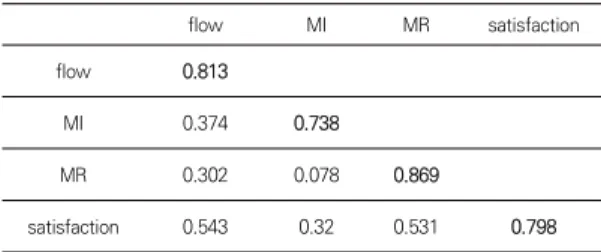
flow MI MR satisfaction
flow 0.813
MI 0.374 0.738
MR 0.302 0.078 0.869
satisfaction 0.543 0.32 0.531 0.798
Note: Bolds in the diagonal show the square root of AVE Table 5. Latent constructs correlation
To identify discriminant validity, we compared the intercorrelation within latent constructs with the square root of AVE of latent constructs.
When the square root of AVE is greater than its correlation with the other latent constructs, it is approved that discriminant validity is significant [43,49]. Table 5 identifies that every square root of AVE is appropriate to the criterion respectively. Accordingly, discriminant validity of measurement is approved.
5.3 Test of structural model
The results of the hypotheses test and path coefficients of the proposed research model are identified in the following Table 6. PLS path modeling verifies model validity through the R square value and the structural path coefficient [43,50]. We executed Bootstrapping on Calculate Tap of SmartPLS package to estimate the statistical significance of the proposed path
coefficient through the critical value of t-test.
In above Table 5, MR and MI explained 21.4%
of flow(R2=0.214). Of satisfaction(R2=0.463) was explained 46.3% by MR, MI, and flow. Therefore the proposed research model was valid.
As shown Table 6, each hypothesis is significant and supported. Specifically, MR(β
=0.274, t=5.097, p<0.001, two-tailed test) and MI (β=0.353, t=5.589, p<0.001, two-tailed test) predicted flow respectively. MR(β=0.410, t=9.523, p<0.001, two-tailed test) and MI(β=0.152, t=3.616, p<0.001, two-tailed test) also predicted satisfaction respectively. The findings of testing H1 and H2 identify that MI had more effect on flow than MR. When using the subscribed YouTube, the more goal-oriented users are more fallen into flow than the users with diversionary reasons. However, in examining of H3 and H4, MR had more effect on satisfaction than MI. That is, in context of the subscribed YouTube channel usage, satisfaction was more explained by MR than MI. Consequently, flow and satisfaction had been impacted by diversionary reasons (companionship, time consumption, relaxation), or the certain abstract needs(e.g., curiosity, adventure, advice seeking, community feelings), and the goal-oriented needs(e.g., gaining a financial edge, useful information for business or everyday living)[6,51]. Flow was more impacted by the goal-oriented needs than the certain abstract needs, whereas satisfaction vice versa.
Accordingly, in the respect that ritualized needs are attributed to a passive mode and instrumental needs require a more active mode [6,20], in the context of subscribed YouTube channels usage, flow derived from more active needs and satisfaction was guided by more passive needs. Finally, flow has an effect on satisfaction(β=0.362, t=7.708, p<0.001, two-tailed test). This finding is similar to the previous study on YouTube users[40]. In the context of subscribed YouTube channels usage, flow explained satisfaction. In terms of effect among
the constructs, respectively MR and MI have an indirect effect of 0.099 and 0.128 on satisfaction.
The total effect of MR and MI on satisfaction shows 0.509 and 0.280 respectively.
5. Discussion and conclusion
YouTube is a key distribution channel of visual contents. As soon as a smartphone is popularizing in global, the smartphone becomes a major consumption device for YouTube. As of May 2019, more than 500 hours of video content are uploaded to YouTube ever day. YouTube won the second-most popular site in the world in August 2018. In Korea, YouTube got 30.93 million Pure-users a month on August 2018. A Korean used YouTube through 1077 minutes a month and Total hours of YouTube usage covered 33.3 billion minutes. The teenagers used YouTube for the longest hours in Korea, and 20s, 50s and over, 30s and 40s followed in order. In Korea, the most favorite content is a short edited broadcasted-video, as known as ‘TV Zzalbang’.
All of Korean generations have consumed and enjoyed a variety of content on YouTube.
Based on the context, we explored the subscribers’ uses and gratifications on YouTube.
Especially, we identified the types of use motives grounded on ritualized and instrumental use motives; and then showed two motives have an effect on satisfaction directly and indirectly through mediating of flow with using PLS path modeling. The following summarizes specific findings of hypothesis tests.
Through the factor analysis, the study identified two types of motives: ritualized (MR) and instrumental use motives (MI). The factor MR consists of 2 items (because it passes the time away, particularly when I’m bored; because it entertains me) which explained 19.6% of variance. The other factor, MI, consists explained 32.7% of variance with 4 items (in order to help
my job or learning; in order to a variety of news;
because it informs me for things that happen in everyday life; in order to get information about products and services).
Analyzing PLS path modeling with SmartPLS, we found all of the presented hypotheses are supported respectively. First, MI (β=0.353) had a more effect on flow than MR (β=0.274). This means flow is more fueled by goal-oriented and informational needs than habitual needs, diversionary reasons and the certain abstract needs. In other words, flow is more operated on active mode than passive mode. Second, satisfaction was explained directly by MR (β
=0.410) and MI (β=0.152). Though the indirect effect of MR(0.099) on satisfaction was less than MI(0.129), the total effect of MR(0.509) by combining direct and indirect effects was greater than MI(0.280). It means satisfaction is more triggered by passive mode than active mode.
Consequently, in the context of subscribed YouTube channel usage, flow derived from more active needs, whereas satisfaction was fueled by more passive needs. Finally, flow had an effect on satisfaction (β=0.362). In terms of the finding, flow could play a role as an antecedent which leads to users’ positive attitude on the subscribed YouTube channel; and as a touchstone which tests whether the subscribed YouTube channel is successful or not.
Consequently, in terms of total effect among hypothesis paths, MR had a most powerful effect on satisfaction. Grounded in the finding, subscribers of YouTube channels got more satisfied from ritualized motives than instrumental. Namely, most of the subscribers use YouTube to satisfy diversionary reasons and the certain abstract needs for the passive mode. The study identified the subscribers tend to use more relatively with passive mode than active mode.
Thus, for increasing revenue of YouTube and creators, they should manage, plan and produce the contents with above considering; less-serious
contents focusing on stimulating more diversionary than goal-oriented needs.
Finally, we suggest some advice for future studies. There are not many studies on YouTube users grounded on uses and gratifications perspective, and especially is a rare study on YouTube subscribers. In terms of practice, as aforementioned, the following studies should analyze subscriber behaviors for spreading YouTube to get more revenue. Thus, a future study should draw out the practical implications through structural analyses inputting a variety of variables (e.g. gratification sought and gratifications obtained, perceived ease of use and usefulness, perceived enjoyment, etc.).
REFERENCES
[1] Wikipedia. (2019, April 30). YouTube. [Online].
https://en.wikipedia.org/wiki/YouTube
[2] Youtube.com traffic. (2019). Demographics and Competitors. [Online]. www.alexa.com
[3] J. K. Keum. (2018, September, 11). YouTube, the 1st of use time in all generation. MediaOneul(Media Today) [Online].
http://www.mediatoday.co.kr/?mod=news&act=article View&idxno=144466
[4] M. S. Kim. (2019, January 13). What's the top of the user's list of 'popular YouTubers and YouTube topics'? ZDNet Korea. [Online].
https://www.zdnet.co.kr/view/?no=20190111195413 [5] A. M. Rubin. (1984). Ritualized and instrumental
television viewing. Journal of Communication, 34(3), 67-77.
[6] J. Joo & Y. Sang. (2013). Exploring Koreans’ smartphone usage: An integrated model of the technology acceptance model and uses and gratifications theory.
Computers in Human Behavior, 29, 2512-2518.
[7] E. Katz, J. Blumler & M. Gurevich. (1974). Utilization of mass communication by the individual In E. Katz &
J. G. Blumler (Eds.), The Uses of Mass Communications:
Current Perspectives on Gratifications Research (pp.
19-32). Beverly Hills, CA: Sage.
[8] N. Park. (2010). Adoption and use of computer-based over internet protocol phone service: Toward an integrated model. Journal of Communication, 60(1), 40-72.
[9] N. Park, K. M. Lee & P. H. Cheong. (2007). University
instructors’ acceptance of electronic courseware: An application of the technology acceptance model.
Journal of Computer-mediated Communication, 13(1). [10] A. M. Rubin & C. R. Bantz. (1987). Utility of videocassette recorders. In J. L. Salvaggio & J. Bryant (Eds.), Media use in the information age: Emerging patterns of adoption and consumer use (pp. 463-482).
Hillsdale, NJ: Lawrence Erlbaum Associates.
[11] A. A. Cohen, M. R. Levy & K. Golden. (1988).
Children’s uses and gratification of home VCRs:
Evolution or Revolution, Communication Research, 15(6), 772-780.
[12] C. R. Bantz. (1982). Exploring uses and gratifications:
A comparizon of reported uses of television and reported uses of favorite program type.
Communication Research, 9(3), 352-379.
[13] D. A. Ferguson & E. M. Perse. (2000). The World Wide Web as a functional alternative to television Journal of Broadcasting and Electronic Media, 44(2), 155-174.
[14] C. A. Lin. (1999). Online-service adoption likelihood.
Journal of Advertising Research, 39(2), 79-89.
[15] A. J. Flanagin & M. J. Metzger. (2001). Internet use in the contemporary media environment. Human Communication Research, 27(1), 153-181.
[16] L. Leung & R. Wei. (1998). The gratification of pager user: Sociability, information-seeking, entainment, utility, and fashion and staus. Telematics and Informatics, 15(4), 253-264.
[17] K. Aoki & E. J. Downes. (2003). An analysis of young people’s use of and attidues toward cell phones.
Telematics and Informatics, 20(4), 349-364.
[18] L. Leung & R. Wei. (2000). More than just taik on the move: Uses and gratifications of the cellular phone.
Jornalism and Mass Communication Quaterly, 77(2), 79-89.
[19] M. L. Gillenson & T. F. Stafford. (2004). Motivations for mobile devices: Uses and gratifications for m-commerce. Paper presented at the The 3rd Annual Workshop on HCI Research in MIS, Washington, DC.
[20] J. Livaditi, K. Vassilopoulou, C. Lougos, & K.
Chorianopoulos. (2003). Needs and gratifications for interactive TV implications for designers. Paper presented at the 36th Annual Hawaii International Conference on System Sciences, 2003. Proceedings of the.
[21] A. M. Rubin. (1983). Television uses and gratifications:
The interactions of viewing patterns and motivations.
Journal of Broadcasting, 27(1), 37-51.
[22] S. Windahl. (1981). Uses and gratifications at the crossroads. In G. C. Whlhoit & H. deBock (Eds.), Mass Communication Review Yearbook (2, pp. 174-185).
Beverly Hills, CA: Sage.
[23] J. L. Sherry. (2004). Flow and media enjoyment.
Communication theory, 14(4), 328-347.
[24] M. Csikszentmihalyi. (1997). Finding flow: The psychology of engagement with everyday life. New York: Basic Book.
[25] J. Nakamura & M. Csikszentmihalyi. (2014). The concept of flow Flow and the foundations of positive psychology (pp. 239-263): Springer.
[26] R. de Charms. (1968). Personal causation. New York:
Academic Press.
[27] E. Deci. (1975). Intrinsic motivation. New York:
Plenum.
[28] R. White. (1959). Motivation reconsidered: The concept of competence. Psychological Review, 66, 197-333.
[29] D. E. Berlyne. (1960). Conflict, arousal, and curiosity. New York: McGraw-Hill.
[30] J. Hunt. (1965). Intrinsic motivation and its role in development Nebraska Symposium on Motivation, 12, 189-282.
[31] M. Csikszentmihalyi. (1993). The evolving self: A psychology for the third millennium. New York:
Harper Perennial.
[32] S. Park. (2012). A Study of Smartphone Users' Flow Experience on Types of Use Motivation and Degree of Usage Korean Journal of Broadcasting &
Telecommunications Research, 81, 97-126.
[33] J. Park & J. Song. (2010). College Students’ Motivations for Playing Online Games and Experiential Satisfaction Korean Journal of Journalism and Communication Studies, 54(5), 131-154.
[34] Y. Kim & S. Park. (2007). A Study on the Online Game Use Influences in Game Flow and Addiction: Focusing on the Uses and Gratifications Approach Korean Journal of Journalism and Communication Studies, 51(1), 355-377.
[35] S. Lee & K. Lee. (2008). Study on the Factors Affecting the Online Game Users' Loyalty - the roles of Flow Experiences, Attitude, Satisfaction The e-Business Studies, 9(3), 84-108.
[36] E. Park & J. Kim. (2006). The effect of involvement and identity in on-line community on community citizenship behavior. Journal of Cybercommunication, 19, 41-77.
[37] H. Lee & J. Kim. (2010). The Effect of Online University Community Characteristics on Community Commitment and Reuse Intentions. The e-Business Studies, 11(4), 165-185.
[38] S. Kim & M. Seo. (2013). A Study on Antecedents of Flow, Flow, and Satisfaction in Marathoner Users The Journal of Internet Electronic Commerce Research, 13(4), 305-324.
[39] R. Kim & E. Han. (2016). The Impacts of Use Motivation of Instagram Brand Account on Satisfaction and Continuous Use Intention : Focusing
on the Mediating Effect of Flow Advertising Research, 111, 5-39.
[40] K. Lee & D. Sung. (2018). Factors influencing on the flow and satisfaction of YouTube users. The Journal of the Korea Contents Association, 18(12), 660-675.
[41] B. Chun. (2008). Content Creation and Flow : Why They Click or Create UCCs The Journal of the Korea Contents Association, 8(12), 222-235.
[42] O. Ban & J. Park. (2016). A Study on Structural Relationships of Internet Personal Broadcasting Continuous Use : TAM 2 Journal of Communication Science, 16(1), 59-95.
[43] J. Joo. (2016). Exploring Korean Collegians' Smartphone Game Behavior: Focusing on Conciseness, Perceived Ease of Use, Perceived Enjoyment, Flow, and Intent to Use Journal of Digital Convergence, 4(1), 379-386.
[44] D. Choi & J. Kim. (2004). Why people continue to play online games: In search of critical design factors to increase customers loyalty to online contents.
Cyberpsychology & Behavior, 7(1), 11-24.
[45] M. Hajli. (2012). An integrated model for e-commerce adoption at the customer level with the impact of social commerce. International Journal of Information Science and Management, 16(Special Issue), 77-97.
[46] C. M. Ringle, S. Wende, & J.-M. Becker. (2015).
SmartPLS 3. Retrieved from www.smartpls.com [47] W. W. Chin, A. Gopal & W. D. Salisbury. (1997).
Advancing the theory of adaptive structuration: The development of a scale to measure faithfulness of appropriation. Information Systems Research, 8(4), 342-367.
[48] D. Gefen & D. W. Straub. (2004). Consumer trust in B2C e-commerce and the importance of social presence: Experiments in e-Products and e-Services.
Omega, 32(6), 407-424.
[49] D. Gefen, D. Straub & M.-C. Boudreau. (2000).
Structural equation modeling and regression:
Guidelines for research practice. Communications of the association for information systems, 4(1), Article 7.
[50] P. Chwelos, I. Benbasat & A. S. Dexter. (2001).
Research report: Empirical test of an EDI adoption model. Information Systems Research, 12(3), 304-321.
[51] J. Livaditi, K. Vassilopoulou, C. Lougos & K.
Chorianopoulos. (2003). Needs and gratifications for interactive TV application: Implications for designers.
Paper presented at the The 36th Hawaii International Conference on System Sciences.
주 지 혁(Jihyuk Joo) [종신회원]
․ 1996년 2월 : 한양대학교 신문방송학 과(문학사)
․ 1998년 2월 : 한양대학교 신문방송학 과(문학석사)
․ 2003년 2월 한양대학교 신문방송학과 (문학박사)
․ 2003년 3월 ~ 현재 : 극동대학교 언론 홍보학과 교수
․ 관심분야 : 뉴미디어, 수용자, 정량분석
․ E-Mail : [email protected]