DOI: 10.5532/KJAFM.2013.15.2.085
ⓒ Author(s) 2013. CC Attribution 3.0 License.
농업생태계에서 농경지유형에 따른 C 4 식물의 출현과 분포
조광진1·오영주2·강기경1·한민수1·나영은1·김미란1·최락중1·김명현1*
1국립농업과학원 기후변화생태과, 2(주)미래환경생태연구소 (2013년 4월 22일 접수; 2013년 6월 17일 수정; 2013년 6월 19일 수락)
Occurrence and Distribution of C
4Plants under Diverse Agricultural Field Types in Korea
Kwang-Jin Cho1, Young-Ju Oh2, Kee-Kyung Kang1, Min-Su Han1, Young-Eun Na1, Miran Kim1, Lak-Jung Choe and Myung-Hyun Kim1*
1Climate change and Agro-ecology Division, National Academy of Agricultural Science, RDA, Suwon, 441-707, Korea
2Institute for Future Environmental Ecology, Suwon, 441-853, Korea (Received April 22, 2013; Revised June 17, 2013; Accepted June 19, 2013)
ABSTRACT
In order to search for distribution characteristics on C4 plants at the paddy fields, uplands, orchard and roadside in South Korea, vascular plants were investigated. Flora investigation had been carried out from May 2002 to October 2006 at 241 plots. In the results of survey, the flora of these areas consist of 74 families, 231 genera and 352 species totally. The class frequencies were arranged by the order of Magnoliopsidae (255 species), Monocotyledoneae (89 species), Pteropsida (7 species) and Sphenopsida (1 species). The number of species in each investigated agricultural field types was 55 families with 203 species in paddy field, 49 families with 218 species in uplands, 44 families with 115 species in orchard and 48 families with 202 species in roadside respectiviely. Representative species compositions of these four agricultural field types were characterized by Artemisia princeps, Persicaria thunbergii in paddy field, Artemisia princeps, Erigeron annuus in upland and roadside, Commelina communis, Digitaria ciliaris in orchard, respectively. Therefore, indicative species in agricultural ecosystem was Artemisia princeps.
Among the investigated 352 species, C4 plants identified were 38 species, and the occurrence ratio of C4 monocotyledonous plants were higher in paddy field, orchard and roadside than upland. Such differences in the occurrence ratio of C4 plants under diverse agricultural field types reflect differences in environmental condition such as micro-climate, soil moisture under various agricultural fields. Dominant C4 monocotyledonous plants were Digitaria ciliaris and Commelina communis, while C4 dicotyledonous plants were Amaranthus mangostanus and Chenopodium album var. centrorubrum in agricultural fields.
Naturalized plants were identified as 47 species and occurrence ratio were higher in upland and roadside than other agricultural field types. Among the investigated naturalized plants, C4 plants were Amaranthus mangostanus and Amaranthus retroflexus. Distribution characteristics of representative C4 plants in agricultural field types, revealed that the projected increase in temperature due to climate change may provide better conditions for the growth of C4 plants. Thus, the necessity of long-term monitoring should be conducted on the diffusion of C4 plants that may threaten influence agroecosystem in Korea.
Key words: C4 plants, Agricultural field types, Monocotyledonous plants, Dicotyledonous plants, Naturalized plants, Climate change
* Corresponding Author : Myung-Hyun Kim ([email protected])
I. 서 론
고등식물의 대부분은 광합성 유형에 따라 C3식물과 C4식물로 구분되며(Kortschak et al., 1965; Hatch and Slack, 1966; Black, 1971; Takeda and Fukuyama, 1971), 이들 유형은 빛의 강도(Hesketh and Moss, 1963), 온도(Long, 1999; Larcher, 2003), 수분조건 (Takeda et al. 1977; Takeda et al., 1980; Long, 1999), CO2 농도(Arp et al., 1993; Sardans et al., 2012) 등의 환경요인에 따라 각기 다른 반응을 나타 낸다. 또한, 일반적으로 C3식물은 낮은 기온, 충분한 수분 및 적은 광량에 적응한 식물인 반면, C4식물은 고온건조, 높은 광량에 적응한 식물이다(Chang and Lee, 1983; Kim et al., 2011). 이러한 생태적 특성 으로, 최근 들어 논점이 되고 있는 CO2 농도 증가, 기온 상승, 강우패턴 등의 기후변화와 관련된 연구에 C3식물과 C4식물이 널리 이용되어 오고 있다(Teeri and Stowe, 1976; Teeri et al., 1980; Takeda and Hakoyama, 1985; Ueno and Takeda, 1992; Ehleringer et al., 1997; Collatz et al., 1998; Pyankov et al., 2000; Kim et al., 2011). 예를 들어, C4단자엽식물 은 온도와 밀접한 관계가 있는데, Epstein et al.(1997)은 Great Plains에서 벼과식물 가운데 C3/C4 분포비율이 온도와 상관관계가 매우 깊다고 하였으며, Teeri and Stowe(1976)는 북아메리카의 벼과 C4식물 의 지리적 분포를 확인한 연구에서 온도와 해발고도가 매우 밀접한 상관관계가 있다고 하였다. 또한 생육기 최저온도가 높을수록 벼과 식물 가운데 C4광합성 빈 도가 높아지는 것으로 보고되어 있으나 총 강수량은 C4식물의 분포를 결정하는 결정적인 요소가 되지 않는 것으로 나타났다(Teeri and Stowe, 1976).
국내에는 4,476종의 관속식물 가운데 C4 (C3-C4중 간형 포함) 206종(4.6%)이 분포하며 쌍자엽식물 53종 과 단자엽식물 153종으로 이루어져 있다(Kim et al., 2011). 이러한 C4식물은 대부분 초본류로서 나무의 수 관으로 가려진 산림 내에는 그늘에 의해 기온, 수분 및 광량조건이 맞지 않아 적응하기가 어렵다. 그래서 C4식물이 정착하기에 적당한 장소는 논둑, 밭둑 및 길 가와 같은 농경지 주변이며, Chang and Lee(1983)는 논에 인위적인 간섭이 가해지지 않는다면, 벼 경작지 는 모두 C4식물로 우점 될 것이라 하였다(Chang and Lee, 1983).
농업생태계에서 C4식물의 생육범위에 대한 이해는 바랭이, 돌피 등과 같은 농업에서의 악성잡초로 여겨 지고 있는 식물들에 대한 제초 및 방제에 도움이 될 뿐만 아니라 곤충이나 병해충 방제에도 도움이 될 것 으로 기대된다.
따라서, 본 연구에서는 인간의 관리에 의해 유지되 는 생태계이지만, 기후, 토지이용 및 영농방법에 따라 변화하는 농업생태계의 농경지 유형에 따른 식물상을 목록화 하고, 더불어 C4식물의 분포특성을 규명하여 농업생태계의 관리를 위한 기초자료를 제공하고자 하 였다.
II. 재료 및 방법
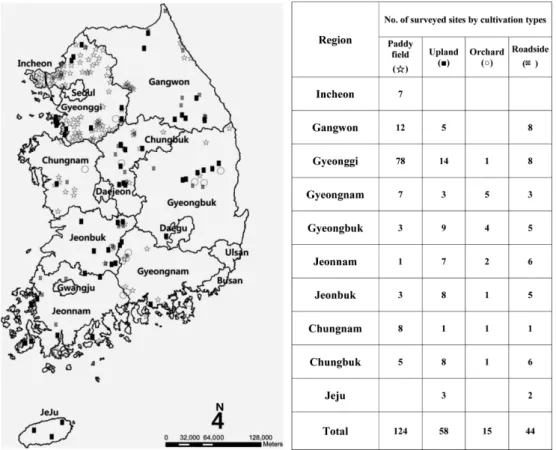
조사지역은 전국적으로 분포하는 농경지를 무작위로 선정하여 논 124지점, 밭 58지점, 과수원 15지점, 도로 변 44지점 등 총 241지점을 대상으로 하였으며, 조사 지점은 경작지 주변의 특정 환경조건과 지형적 요인을 고려하여 서식처유형을 전형적이고 대표적으로 나타낼 수 있는 곳을 선정하였다(Fig. 1). 논에서는 논둑과 농수로 주변을 조사하였고, 밭에서는 밭 내부와 밭둑 을 조사하였으며, 과수원은 과수원 내부에 생육하는 식물을 중점적으로 조사하였다. 도로변은 농경지와 인 접한 도로를 대상으로 포장여부와 관계없이 좌우 1m 이내에 분포하는 식물상을 조사하였다.
식물상 조사는 2002년부터 2006년까지 5년간 수행 하였으며, 식물종의 생활형, 생활환 그리고 계절성 등 을 고려하여 5월부터 10월에 걸쳐 수행하였다. 현장조 사에서는 도보로 이동하면서 육안으로 관찰하고 별도 로 기재하였으며, 현장에서 미동정된 식물은 채집하여 실험실에서 각종 문헌을 비교하여 정확히 동정하였다.
식물명은 Lee(1996)를 기준으로 하였으며 일부종에 대하여 Lee(1999), 국가표준식물목록(Korea National Arboretum and The Korean Society of Plant Taxo- nomists, 2007)을 활용하였다. 그리고 귀화식물은 Park(2009)과 Lee et al.(2011)을 참고하였으며 출현 식물에 대한 C4식물의 분류는 Kim et al.(2011)을 이용하였다.
토양의 수분함량은 241개의 조사지점에서 토양함수 측정기(Takemura, DM-18)를 이용하여 방형구당 5곳 을 측정하여 평균한 값을 이용하였다.
각각의 농경지유형에 출현한 식물종의 기여도는 총
조사지점에 대한 특정식물종이 출현한 조사지점 수로 표현되는 상재도(CD; constancy degree)로 나타내었 다(식 1). 상재도는 5등급(I; 1-20%, II; 21-40%, III; 41-60%, IV; 61-80%, V; 81-100%)으로 표현되 며 각 농경지유형에 출현한 식물종의 질적인 기여도를 이해할 수 있다(Kim and Lee, 2006).
CD(%) = (ni/N)
× 100
(1) 여기서, N은 농경지유형에서 조사된 총 조사지점이며ni는 i종이 출현한 조사지점 수이다.
III. 결과 및 고찰
조사지역에서 확인된 관속식물상은 총 74과 231속 352종으로, 이 중 쌍자엽식물(255종, 72.4%)의 출현빈 도가 가장 높았다(Appendix 1). 농경지유형별로는 논 에서 55과 203종, 밭에서 49과 218종, 과수원에서 44과 115종, 도로변에서 48과 202종이 출현하였다 Table 1. Number of vascular plants by taxonomic levels in surveyed sites
Class Family Genus Species
PF UL OR RS PF UL OR RS PF UL OR RS
Pt 3 3 1 4 4 3 1 7 4 3 1 8
An Mo 13 6 4 6 42 31 19 32 55 44 21 43
Di 39 40 39 38 106 121 75 106 144 171 93 151
Total 55 49 44 48 152 156 95 145 203 218 115 202
Pt:Pteridophyta, An:Angiospermae, Mo:Monocotyledoneae, Di:Dicotyledoneae, PF:Paddy field, UL:Upland, OR:Orchard, RS :Roadside
Fig. 1. Location map of surveyed sites.
(Table 1). 밭에서 가장 많은 식물종이 관찰되었고 과 수원에서 가장 적은 식물종이 관찰되었는데, 과수원에 서 출현한 식물종수가 낮은 것은 조사된 다른 농경지 유형에 비해 상대적으로 조사지점의 수가 적었기 때문 으로 향후 추가적인 조사를 통하여 종수를 반영해야 할 것으로 생각되었다.
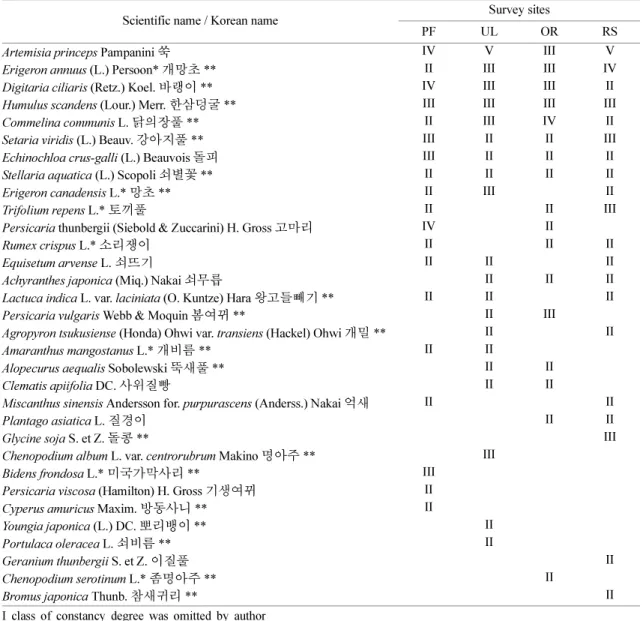
논에서는 쑥, 고마리, 바랭이, 돌피, 강아지풀, 미국 가막사리, 한삼덩굴 등이 높은 기여도를 나타내었으며 밭에서는 쑥, 개망초, 한삼덩굴, 망초, 명아주, 바랭이,
닭의장풀 등이 높은 출현율을 보였다. 과수원에서는 닭의장풀, 바랭이, 쑥, 개망초, 한삼덩굴, 봄여뀌 등이 높은 기여도를 나타내었으며 도로변에서는 쑥, 개망초, 토끼풀, 한삼덩굴, 강아지풀, 돌콩 등이 높은 출현율을 보였다(Table 2). 본 조사를 통하여 논은 쑥과 고마리, 밭과 도로변은 쑥과 개망초, 과수원은 닭의장풀과 바 랭이로 대표되며 농업생태계의 대부분 지역에 나타내 는 식물종은 쑥으로 확인되었다. 쑥은 양지를 선호하 는 호광성 선구종으로 비농경지에서도 발생이 많으며,
Table 2. List of main plants by constancy degree order in surveyed sites
Scientific name / Korean name Survey sites
PF UL OR RS
Artemisia princeps Pampanini 쑥 IV V III V
Erigeron annuus (L.) Persoon* 개망초 ** II III III IV
Digitaria ciliaris (Retz.) Koel. 바랭이 ** IV III III II
Humulus scandens (Lour.) Merr. 한삼덩굴 ** III III III III
Commelina communis L. 닭의장풀 ** II III IV II
Setaria viridis (L.) Beauv. 강아지풀 ** III II II III
Echinochloa crus-galli (L.) Beauvois 돌피 III II II II
Stellaria aquatica (L.) Scopoli 쇠별꽃 ** II II II II
Erigeron canadensis L.* 망초 ** II III II
Trifolium repens L.* 토끼풀 II II III
Persicaria thunbergii (Siebold & Zuccarini) H. Gross 고마리 IV II
Rumex crispus L.* 소리쟁이 II II II
Equisetum arvense L. 쇠뜨기 II II II
Achyranthes japonica (Miq.) Nakai 쇠무릅 II II II
Lactuca indica L. var. laciniata (O. Kuntze) Hara 왕고들빼기 ** II II II
Persicaria vulgaris Webb & Moquin 봄여뀌 ** II III
Agropyron tsukusiense (Honda) Ohwi var. transiens (Hackel) Ohwi 개밀 ** II II
Amaranthus mangostanus L.* 개비름 ** II II
Alopecurus aequalis Sobolewski 뚝새풀 ** II II
Clematis apiifolia DC. 사위질빵 II II
Miscanthus sinensis Andersson for. purpurascens (Anderss.) Nakai 억새 II II
Plantago asiatica L. 질경이 II II
Glycine soja S. et Z. 돌콩 ** III
Chenopodium album L. var. centrorubrum Makino 명아주 ** III
Bidens frondosa L.* 미국가막사리 ** III
Persicaria viscosa (Hamilton) H. Gross 기생여뀌 II
Cyperus amuricus Maxim. 방동사니 ** II
Youngia japonica (L.) DC. 뽀리뱅이 ** II
Portulaca oleracea L. 쇠비름 ** II
Geranium thunbergii S. et Z. 이질풀 II
Chenopodium serotinum L.* 좀명아주 ** II
Bromus japonica Thunb. 참새귀리 ** II
I class of constancy degree was omitted by author
PF : Paddy field, UL: Upland, OR : Orchard, RS : Roadside
* : Naturalized plant, ** : Annual & Biennial plant
특히, 띠형으로 생육하는 초본성 임연군락인 소매군락 (hem community)의 주요 식물종이다(Kim, 2004). 본 조사에서도 쑥은 주로 논둑이나 밭둑, 도로변 주변에 서 띠형태 군락을 이루고 있었다. 고마리는 수위변동 이 심하거나 주기적 또는 비주기적으로 관리되고 있는
불안정한 수변입지에서 생육하는데(Lee and Kim, 2005) 본 조사에서도 그러한 서식환경을 갖추고 있는 논둑과 인접한 농수로 주변에서 많이 관찰되었다. 밭 과 도로변에서 출현빈도가 높았던 개망초는 귀화식물 로서 생육환경이 불안정한 초기 휴경지에 선구적으로
Table 3. List of C4 plants by constancy degree order in surveyed sites
Scientific name / Korean name Survey sites
Class
PF UL OR RS
Digitaria ciliaris (Retz.) Koel. 바랭이 IV III III II Mo
Commelina communis L. 닭의장풀 II III II Mo
Setaria viridis (L.) Beauv. 강아지풀 III II II III Mo
Echinochloa crus-galli (L.) Beauvois 돌피 III II II II Mo
Amaranthus mangostanus L. 개비름 * II II I I Di
Chenopodium album L. var. centrorubrum Makino 명아주 I III I I Di
Cyperus amuricus Maxim. 방동사니 II I I I Mo
Eragrostis ferruginea (Thunb.) Beauvois 그령 I I I I Mo
Eragrostis multicaulis Steudel 비노리 I I I I Mo
Arthraxon hispidus (Thunb.) Makino 조개풀 I I I I Mo
Miscanthus sinensis Andersson for. purpurascens (Anderss.) Nakai 억새 II I II Mo
Portulaca oleracea L. 쇠비름 I II I Di
Imperata cylindrica (L.) Beauv. var. koenigii (Ritz.) Durand & Sunitz 띠 I I I Mo
Pennisetum alopecuroides (L.) Sprengel 수크령 I I I Mo
Spodiopogon sibiricus Trinius 큰기름새 I I I Mo
Fimbristylis dichotoma (L.) Vahl 하늘지기 I I I Mo
Cyperus microiria Steud. 금방동사니 I I Mo
Echinochloa crus-galli (L.) Beauvois var. echinata Honda 물피 I I Mo
Digitaria violascens Link 민바랭이 I I Mo
Cuscuta japonica Choisy 새삼 I I Di
Cuscuta australis R. Brown 실새삼 I I Di
Eragrostis pilosa (L.) Beauvois 큰비노리 I I Mo
Cymbopogon tortilis (Presl.) Hitch. var. goeringii (Steud.) Hand.-Mazz. 개솔새 I Mo Kochia scoparia (L.) Schrader for. littorea (Makino) Kitamura 갯댑싸리 I Di
Kochia scoparia (L.) Schrader 댑싸리 I Di
Euphorbia pseudo-chamaesyce Fischer 땅빈대 I Di
Fimbristylis miliacea (L.) Vahl 바람하늘지기 I Mo
Amaranthus lividus L.비름 I Di
Eleocharis acicularis (L.) Roemer & Schultes for. longiseta (Svenson) T. Koyama 쇠털골 I Mo
Lipocarpha microcephala (R.Br.) Kunth 세대가리 I Mo
Zea mays L. 옥수수 I Mo
Eleusine indica (L.) Gaertner 왕바랭이 I Mo
Setaria italica (L.) Beauv. 조 I Mo
Muhlenbergia japonica Steudel 쥐꼬리새 I Mo
Paspalum thunbergii Kunth 참새피 I Mo
Miscanthus sinensis Andersson참억새 I Mo
Amaranthus retroflexus L. 털비름 * I Di
Cyperus brevifolius (Rottb.) Hassk. var. leiolepis (Fr. et Sav.) T. Koyama 파대가리 I Mo PF : Paddy field, UL: Upland, OR : Orchard, RS : Roadside
* : Naturalized plant, Mo : Monocotyledoneae, Di : Dicotyledoneae
정착하며, 휴경연수가 오래된 곳에서는 우점하지 않는 경향이 있어(Kang et al., 2003) 밭과 도로변의 불안정 한 서식환경을 잘 나타내고 있다. 닭의장풀과 바랭이 는 전형적인 터주식물로서 길가나 풀밭 등에서 흔히 자생하며, 특히, 바랭이는 사과, 배, 복숭아, 포도, 매 실 그리고 자두 과수원에서 출현빈도가 높고 영남지역 과수원에서도 발생잡초 적산우점 순위에서 가장 높게 나타난다고 보고된 바 있다(Hwang et al., 2004).
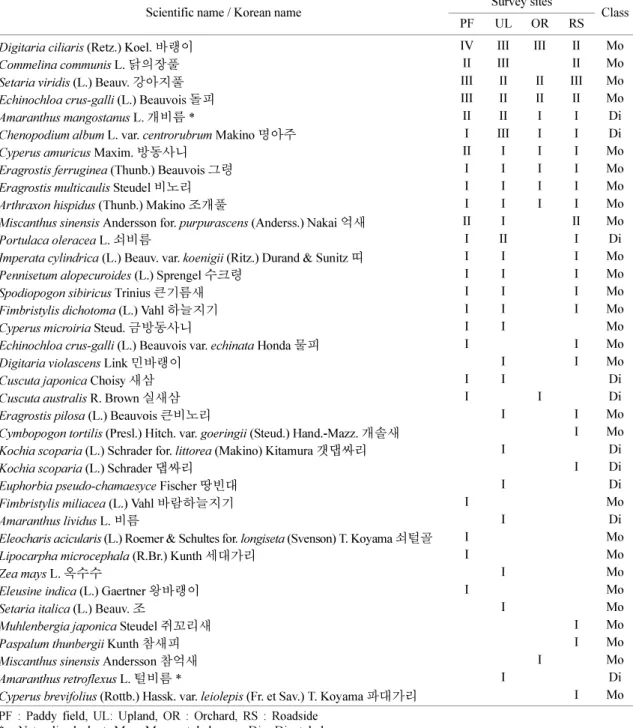
한편, 본 조사에서 관찰된 식물 중 C4식물은 8과 25속 38종으로 확인되었고(Table 3) 조사지역에서 관 찰된 352종의 식물 중 10.8%를 차지하여, 우리나라에 분포하는 206종의 C4식물의 18.4%에 해당하였다. 조 사지역의 C4식물들은 쌍자엽식물 26.3%(10종)와 단자 엽식물 73.7%(28종)로 이루어져 있으며, 과별 구성비 는 벼과가 52.6%(20종)로 가장 높은 출현율을 보였고 다음으로 사초과 18.4%(7종), 비름과 7.9%(3종), 명아 주과 7.9%(3종) 등의 순이었다.
농경지유형별 C4식물은 논에서 24종, 밭에서 26종, 과수원에서 12종, 도로변에서 24종이 관찰되었다. 과 수원에서 C4식물의 출현빈도가 낮은 이유는 정기적인 제초와 과수의 수관으로 가려진 과수원 하단부 내에는 그늘에 의한 일사 부족, 상대적 저온 등 군락 미기후 상의 변화로 인해 C4식물의 유입과 적응이 어렵기 때 문인 것으로 사료된다.
농경지유형별 C4식물의 종조성을 살펴보면, 논에서 바랭이, 강아지풀, 돌피, 닭의장풀, 방동사니 등의 단자 엽식물이, 밭에서는 명아주, 쇠비름, 개비름 등의 쌍자 엽식물과 바랭이, 닭의장풀, 강아지풀, 돌피 등의 단자 엽식물이 높은 빈도로 출현하고 있었다. 과수원에서는 닭의장풀, 바랭이, 강아지풀, 돌피, 명아주 등이 생육하 고 있었고, 도로변에서는 강아지풀, 닭의장풀, 바랭이, 돌피 등이 확인되었다. 본 조사를 통해 농업생태계를 대표하는 C4식물은 단자엽식물은 바랭이와 닭의장풀이 며 쌍자엽식물은 개비름과 명아주로 확인되었다.
농경지유형별 C4쌍자엽 및 단자엽식물 분포 비율 을 살펴보면, 총 38종의 C4식물 가운데 밭(21.1%)에 서 쌍자엽식물의 출현율이 높았으며, C4단자엽식물의 비율은 도로변(52.6%)에서 높게 나타났다(Fig. 2). C4
쌍자엽식물과 단자엽식물의 분포는 건조와 온도조건의 환경요인에 의한 적응성 차이로 나타나는데, C4쌍자엽 식물은 건조조건 적응형으로, C4단자엽식물은 온도조 건 적응형으로 설명된다(Okuda and Furukawa, 1990,
Kim et al., 2011). 따라서, C4쌍자엽식물과 단자엽식 물이 혼생하는 우리나라 밭 주변 식물서식환경은 높은 온도조건과 건조한 토양환경이 복합적으로 반영된 고 온건조형으로 판단되며, 논, 과수원은 상대적으로 습윤 한 토양환경(Fig. 3)과 미기후조건에서 건조조건이 아 니라 온도조건에 의해 C4 단자엽식물이 우점 분포하는 것으로 사료된다. 도로변의 식물서식환경은 밭과 유사 하게 고온건조형으로 생각되나 답압(踏壓)으로 인한 토 양고결 등의 특수한 서식처의 입지조건으로 인해 인위 적인 밟힘에 약한 광엽초본형의 식물보다는 적응성이 강한 화본형(벼과, 사초과)의 식물종이 생육하고 있는 것으로 사료된다.
Fig. 2. Distribution of C4 plants between dicotyledonous and monocotyledonous plants by agricultural field types. The total occurrence C4 plants were 38 species.
Fig. 3. Moisture content between agricultural field types.
Table 4. List of Naturalized plants by constancy degree order in surveyed sites
Scientific name / Korean name Survey sites
PF UL OR RS
Erigeron annuus (L.) Persoon 개망초 II III III
Erigeron canadensis L. 망초 II III I II
Trifolium repens L. 토끼풀 II I II III
Rumex crispus L. 소리쟁이 II I II II
Amaranthus mangostanus L. 개비름 II II I I
Oenothera odorata Jacg. 달맞이꽃 I I I I
Cerastium glomeratum Thuill. 유럽점나도나물 I I I I
Carduus crispus L. 지느러미엉겅퀴 I I I I
Bidens frondosa L. 미국가막사리 III I I
Chenopodium serotinum L. 좀명아주 I II I
Lepidium apetalum Willd. 다닥냉이 I I I
Ambrosia trifida L. 단풍잎돼지풀 I I I
Erechtites hieracifolia (L.) Rafinesque 대룡국화 I I I
Rumex obtusifolius L. 돌소리쟁이 I I I
Ambrosia artemisiaefolia L. var. elatior (L.) Desc. 돼지풀 I I I
Taraxacum officinale Weber 서양민들레 I I I
Veronica arvensis L. 선개불알풀 I I I
Lactuca scariola L. 가시상치 I I
Medicago polymorpha L. 개자리 I I
Fallopia dumetorum (L.) Holub 닭의덩굴 I I
Aster pilosus Willd. 미국쑥부쟁이 I I
Sonchus oleraceus L. 방가지똥 I I
Trifolium pratense L. 붉은토끼풀 I I
Erigeron bonariensis L. 실망초 I I
Dactylis glomerata L. 오리새 I I
Phytolacca esculenta van Houtte 자리공 I I
Amorpha fruticosa L. 족제비싸리 I I
Veronica persica Poiret 큰개불알풀 I I
Fallopia dentato-alata (Fr.Schmidt) Holub 큰닭의덩굴 I I
Galinsoga ciliata (Raf.) Blake 털별꽃아재비 I I
Potentilla supina L. 개소시랑개비 I
Senecio vulgaris L. 개쑥갓 I
Festuca myuros L. 구주김의털 I
Quamoclit angulata Bojer 둥근잎유홍초 I
Thlaspi arvense L. 말냉이 I
Phytolacca americana L. 미국자리공 I
Galinsoga parviflora Car. 별꽃아재비 I
Abutilon theophrasti Medicus 어저귀 I
Astragalus sinicus L. 자운영 I
Plantago lanceolata L. 창질경이 I
Cosmos bipinnatus Cav. 코스모스 I
Conyza sumatrensis (Retz.) E. Walker 큰망초 I
Sonchus asper (L.) Hill 큰방가지똥 I
Amaranthus retroflexus L. 털비름 I
Persicaria orientalis Spach 털여뀌 I
Polium perenne L. 호밀풀 I
Melilotus alba Medicus 흰전동싸리 I
PF : Paddy field, UL: Upland, OR : Orchard, RS : Roadside
재배식물을 제외한 우리나라에 생육하는 C4식물 196종 가운데 28종(약 14%)이 외래식물이며(Kim et al., 2011) 고온, 건조에 적응성이 높은 외래 C4식물 의 농업생태계로의 유입은 자생식물의 서식지 교란에 영향을 미칠 것으로 판단된다. 특히, 국내 농업정책의 변화와 농업인구의 감소, 농업노동력의 고령화 등으로 인한 휴경지 증가와 방치된 경작지의 건답화에 의한 토양환경 변화는 C4 식물의 발생량을 크게 증가시켜 각종 병해충의 서식지 역할을 하여 주변 경작지에 피 해를 입힐 수도 있다.
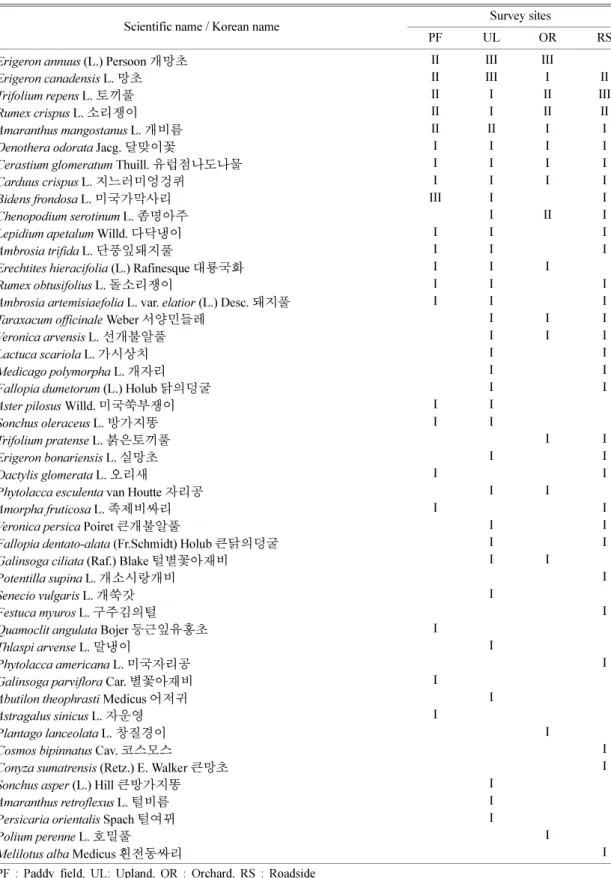
본 조사지역에서 47종의 귀화식물이 확인되었으며, 망 초속(Genus Erigeron)의 출현이 특징적이었다(Table 4). Song(1977)은 휴경지의 식물사회학적 연구에서 지 역에 따라 차이가 있으나 Erigeron ssp.의 우점화가 특징적이라고 보고한 바 있으며 이는 기존에 농경지 주변에 생육하고 있던 Erigeron ssp.의 유입에 따른 결과인 것으로 사료된다. 47종의 귀화식물 가운데 C4
식물은 비름속(Genus Amaranthus)의 개비름과 털비름 2종으로 확인되었으며 단자엽식물은 관찰되지 않았다.
온도에 적응성이 높은 C4 단자엽식물이 동정되지 않았 지만 지구온난화로 인한 기온의 상승으로 고온에 적응 성이 높은 외래 C4식물의 새로운 유입과 이미 유입된 종 가운데 물참새피, 털물참새피 등과 같이 농업생태 계로의 유입가능성이 있는 식물종의 번성은 농업생태 계의 생물종 다양성에 영향을 미칠 것으로 예상되므로 지속적인 모니터링과 정착에 대한 평가가 이루어져야 할 것이다.
IV. 적 요
본 연구는 논, 밭, 과수원, 도로변에 생육하고 있는 식물상을 조사하여 C4식물의 분포특성을 규명하고자 하였다. 현장조사는 2002년부터 2006년까지 5년간 수 행되었다. 그 결과, 총 74과 231속 352종이 확인되었 으며, 쌍자엽식물 255종, 단자엽식물 89종, 양치식물 8종으로 분류되었다. 농경지유형별로는 논에서 55과 203종, 밭에서 49과 218종, 과수원에서 44과 115종, 도로변에서 48과 202종이 출현하였다. 본 조사를 통 하여 논은 쑥과 고마리, 밭과 도로변은 쑥과 개망초, 과수원은 닭의장풀과 바랭이로 대표되며 농업생태계에 서 출현율이 가장 높은 식물은 쑥으로 확인되었다. 또 한, 출현식물 중 C4식물은 8과 25속 38종으로 확인되
었으며, 논, 과수원, 도로변에서는 C4단자엽식물의 출 현율이 높았으며 밭에서는 다른 농경지유형에 비해 쌍 자엽식물의 출현빈도가 높았다. 이러한 C4식물의 출현 율 차이는 고온 건조한 우리나라 밭 주변 식물서식환 경을 반영하고 있으며, 논과 과수원은 상대적으로 습 윤한 미기후조건에서 건조조건이 아니라 온도조건에 의해 C4 단자엽식물이 분포하는 것으로 생각되었다.
또한 농업생태계를 대표하는 C4식물 중 단자엽식물은 바랭이와 닭의장풀이며 쌍자엽식물은 개비름과 명아주 로 확인되었다. 본 조사에서 총 47종의 귀화식물이 확 인되었으며 토양의 수분환경조건이 상대적으로 건조한 밭과 도로변에서 많은 귀화식물이 출현하였다. 귀화식 물 가운데 C4식물은 비름속의 개비름과 털비름 2종 으로 나타났으며, 단자엽식물은 관찰되지 않았다. 본 연구에서는 농경지유형에 따른 대표적인 C4식물의 분 포특성이 확인되었으며 지구온난화로 인한 기온의 상 승으로 고온에 적응성이 높은 C4식물의 새로운 유입과 이미 유입된 종 가운데 농업생태계에 나쁜 영향을 미 칠 수 있는 외래식물의 확산에 대한 장기적인 모니터 링의 필요성을 제안하였다.
감사의 글
본 연구는 2013년도 농촌진흥청 국립농업과학원 박 사후연수과정지원사업(과제번호 : PJ008608)의 지원에 의해 이루어진 것입니다.
REFERENCES
Arp, W. J., B. G. Drake, W. T. Pockman, P. S. Curtis, and D. F. Whigham, 1993: Interactions between C3 and C4 salt marsh plant species during four years of exposure to elevated atmospheric CO2. Vegetatio 104/105, 133-143.
Black, C. C., 1971: Ecological implications of dividing plants into group with distinct photosynthetic production capacities. Advances in Ecological Research 7, 87-114.
Chang, N. K., and S. K. Lee, 1983: Studies on the classification, productivity and distribution of C3, C4 and CAM plants in vegetation of Korea III. The distribution of C3 and C4 type plants. Korean Journal of Ecology 6, 128-141.
Collatz, G. J., J. A. Berry, and J. S. Clark, 1998: Effects of climate and atmospheric CO2 partial pressure on the global distribution of C4 grasses: present, past, and further. Oecologia 114, 441-454.
Ehleringer, J. R., T. E. Cerling, and B. R. Helliker, 1997:
C4 photosynthesis, atmospheric CO2 and climate. Oecologia
112, 285-299.
Epstein, H. E., W. K. Lauenroth, I. C. Burke and D. P.
Coffin, 1999: Productivity patterns of C3 and C4 functional types in the U.S. Great Plains. Ecology 78, 722-731.
Hatch, M. D., and C. R. Slack, 1966: Photosynthesis by sugar- cane leaves. A new carboxylation reaction and reaction and the pathway of sugar formation. Biochemical Journal 101, 103-111.
Hesketh, J. D., and D. N. Moss, 1963: Variation in the response of photosynthesis in light. Crop Science 3, 107- 110.
Hwang, J. B., S. B. Song, D. C. Lee, S. T. Park, S. C. Kim, and J. E. Park, 2004: Occurrence Characteristics and Dynamics of Weed Flora in Orchards of the Yeongnam Area. Korean Journal of Weed Science 24, 43-50.
Kang, B. H., S. I. Shim, and K. H. Ma, 2003: Floristic composition of plant community in set-aside fields with regard to seral stages. Korean Journal of Environmental Agriculture 22, 53-59.
Kim, J. W., 2004: Vegetation ecology. Worldscience. Seoul.
Korea.
Kim, J. W., and Y. K. Lee, 2006: Classification and assessment of plant communities. Worldscience. Seoul. Korea.
Kim, M. H., M. S. Han, K. K. Kang, Y. E. Na, and H. S.
Bang, 2011: Effects of climate change on C4 plant list and distribution in South Korea: A review. Korean Journal of Agricultural and Forest Meteorology 13, 123- 139.
Korean National Arboretum and the Plant Taxonomy Society of Korea, 2007: A Synonymic List of Vascular Plants in Korea. Korean National Arboretum, Pocheon.
Kortschak, H. P., C. E. Hartt, and G. O. Burr, 1965: Carbon dioxide fixation in sugar-cane leaves. Plant Physiology 40, 209-213.
Larcher, W., 2003: Physiological plant ecology, (Eds. 4th), Springer-Verlag, Berlin, pp. 81-83.
Lee, T. B., 1999: Illustrated flora of Korea. Hyangmoonsa.
Seoul. Korea.
Lee, W. T., 1996: Standard illustrations of Korean plants.
Academybook. Seoul. Korea.
Lee, Y. K., and J. W. Kim, 2005: Riparian vegetation of South Korea. Keimyung university press. Daegu. Korea.
Lee, Y. M., S. H. Park, S. Y. Jung, S. H. Oh, and J. C.
Yang, 2011: Study on the current status of naturalized plants in South Korea. Korean Journal of Plant Taxonomy 41, 87-101.
Long, S. P., 1999: Environmental responses, In R Sage, R
Monson, (eds), C4 plant biology. Academic Press, San Diego, pp. 215-249.
Okuda, T., and A. Furukawa, 1990: The occurrence and distribution of C4 plants in Japan. Japanese Society of Ecology 40, 91-124.
Park, S. H., 2009: New Illustrations and Photographs of Naturalized Plants of Korea. Ilchokak. Seoul. Korea.
Pyankov, V. I., P. D. Gunin, S. Tsoog, and C. C. Black, 2000: C4 plants in the vegetation of Mongolia: their natural occurrence and geographical distribution in relation to climate. Oecologia 123, 15-31.
Sardans, J., A. Rivas-Ubach, and J. Penuelas, 2012: The C:N:P stoichiometry of organisms and ecosystems in a changing world: A review and perspectives. Perspectives in Plant Ecology, Evolution and Systematics 14, 33-47.
Song, J. S., 1977: A Phytosociological study on the weed communities in the cultivated and abandoned fields of Korea, The Korean Journal of Ecology 20, 191-200.
Takeda T., and S. Hakoyama, 1985: Studies on the ecology and geographical distribution of C3 and C4 grasses. II.
Geographical distribution of C3 and C4 grasses in far east and south east Asia. Japanese Journal of Crop Science 54, 65-71.
Takeda, T., W. Agata, S. Hakoyama, and H. Tanaka, 1977:
Studies on weed vegetation in non-cultivated paddy fields II. The relation between the ecological distribution of Gramineous C3- and C4-weeds and the soil moisture condition in non-cultivated paddy fields. Japanese Journal of Crop Science 46, 558-568.
Takeda, T., and M. Fukuyama, 1971: Studies on the photosynthesis of the Gramineae. I. Differences in photosynthesis among subfamilies and their relations with the systematics of the Gramineae. Japanese Journal of Crop Science 40, 12-20.
Takeda, T., S. Hakoyama, and W. Agata, 1980: Studies on weed vegetation in non-cultivated paddy fields. . Effects of different soil moisture levels on growth during early stage of some summer grasses. Japanese Journal of Crop Science 49, 432-438.
Teeri, J. A., and L. G. Stowe, 1976: Climatic patterns and the distribution of C4 grasses in North America. Oecologia 23, 1-12.
Teeri, J. A., L. G. Stowe, and D. A. Livingstone, 1980: The distribution of C4 species of the Cyperaceae in North America in relation to climate. Oecologia 47, 307-310.
Ueno, O., and T. Takeda, 1992: Photosynthetic pathways, ecological characteristics, and the geographical distribution of the Cyperaceae in Japan. Oecologia 89, 195-203.
Appendix 1. Plant list of surveyed sites
Family Species CT Survey sites
PF UL OR RS
Equisetaceae 속새과 Equisetum arvense L. 쇠뜨기 Pt II II I II
Schizaeaceae 실고사리과 Lygodium japonicum (Thunb.) Swartz 실고사리 Pt I I
Pteridaceae 고사리과 Coniogramme intermedia Hieron. 고비고사리 Pt I I
Pteridium aquilinum (L.) Kuhn var. latiusculum (Desv.) Underwood
고사리 Pt I I I
Pteris multifida Poiret 봉의꼬리 Pt I
Aspidiaceae 면마과 Athyrium niponicum (Mett.) Hance 개고사리 Pt I I
Athyrium yokoscense (Fr. et Sav.) Christ 뱀고사리 Pt I
Thelypteris palustris (Sallisb.) Schott. 처녀고사리 Pt I
Salicaceae 버드나무과 Salix gracilistyla Miquel 갯버들 Di I
Betulaceae 자작나무과 Carpinus laxiflora (S. et Z. ) Blume 서어나무 Di I
Corylus heterophylla Fischer 난티잎개암나무 Di I
Fagaceae 참나무과 Quercus aliena Blume 갈참나무 Di I
Cannabaceae 삼과 Humulus scandens (Lour.) Merr. 한삼덩굴 Di III III III III Moraceae 뽕나무과 Morus bombysis Koidzumi for. dissecta Nakai 가새뽕나무 Di I
Urticaceae 쐐기풀과 Boehmeria longispica Steud. 왜모시풀 Di I
Boehmeria nivea (L.) Gaud. 모시풀 Di I I
Boehmeria plantanifolia Fr. et Sav. 개모시풀 Di I I
Boehmeria spicata (Thunb.) Thunb. 좀깨잎나무 Di I I I
Pilea mongolica Weddell 모시물통이 Di I I I
Pilea peploides (Gaudichaud) Hooker & Arnott 물통이 Di I I I
Urtica angustifolia Fischer 가는잎쐐기풀 Di I
Polygonaceae 마디풀과 Fallopia dentato-alata (Fr. Schmidt) Holub 큰닭의덩굴 Di I I
Fallopia dumetorum (L.) Holub 닭의덩굴 Di I I
Persicaria hydropiper (L.) Spach 여뀌 Di I I I
Persicaria lapathifolia (L.) S. F. Gray 흰여뀌 Di I I I I Persicaria longiseta (De Btuyn) Kitagawa 개여뀌 Di I I
Persicaria orientalis Spach 털여뀌 Di I
Persicaria perfoliata (L.) H. Gross 며느리배꼽 Di I I I I Persicaria senticosa (Meisner) H. Gross 며느리밑씻개 Di I I I
Persicaria sieboldii (Meisner) Ohki 미꾸리낚시 Di I I I
Persicaria sieboldii (Meisner) Ohki var. aestiva Ohki 민미꾸리낚시 Di I
Persicaria thunbergii (Siebold & Zuccarini) H. Gross 고마리 Di I II I Persicaria viscosa (Hamilton) H. Gross 기생여뀌 Di II I I Persicaria vulgaris Webb & Moquin 봄여뀌 Di I II III I
Polygonum aviculare L. 마디풀 Di I I I I
Rumex acetosa L. 수영 Di I I I I
Rumex crispus L. 소리쟁이 Di II I II II
Rumex japonicus Houtt. 참소리쟁이 Di I I
Rumex obtusifolius L. 돌소리쟁이 Di I I I
Phytolacaceae 자리공과 Phytolacca americana L. 미국자리공 Di I
Phytolacca esculenta van Houtte 자리공 Di I I
Molluginaceae 석류풀과 Mollugo pentaphylla L. 석류풀 Di I I I
Portulacaceae 쇠비름과 Portulaca oleracea L. 쇠비름 * Di I II I
Caryophyllaceae 석죽과 Cerastium glomeratum Thuill. 유럽점나도나물 Di I I I I Cerastium holosteoides Fries var. hallaisanense (Nakai) Mizushima
점나도나물 Di I I I I
Sagina japonica (Swartz) Ohwi 개미자리 Di I I
Spergularia marina (L.) Grisebach 갯개미자리 Di I
Stellaria alsine Grimm var. undulata (Thunb.) Ohwi 벼룩나물 Di I I I I
Appendix 1. Continued
Family Species CT Survey sites
PF UL OR RS
Caryophyllaceae 석죽과 Stellaria aquatica (L.) Scopoli 쇠별꽃 Di II II II II
Stellaria media (L.) Villars 별꽃 Di I I I
Chenopodiaceae 명아주과 Chenopodium album L. var. centrorubrum Makino 명아주 * Di I III I I
Chenopodium koraiense Nakai 참명아주 Di I
Chenopodium serotinum L. 좀명아주 Di I II I
Kochia scoparia (L.) Schrader 댑싸리 * Di I
Kochia scoparia (L.) Schrader for. littorea (Makino) Kitamura
갯댑싸리 * Di I
Suaeda glauca (Bunge) Bunge 나문재 Di I
Amaranthaceae 비름과 Achyranthes japonica (Miq.) Nakai 쇠무릅 Di I II II II
Amaranthus lividus L. 비름 * Di I
Amaranthus mangostanus L. 개비름 * Di II II I I
Amaranthus retroflexus L. 털비름 * Di I
Ranunculaceae
미나리아재비과 Aconitum pseudo-laeve Nakai 진범 Di I
Caltha palustris L. var. membranacea Turcz. 동의나물 Di I I
Clematis apiifolia DC. 사위질빵 Di I II II I
Clematis brachyura Maxim. 외대으아리 Di I
Clematis mandshurica Ruprecht 으아리 Di I I
Ranunculus chinensis Bunge 젓가락풀 Di I
Ranunculus japonicus Thunberg 미나리아재비 Di I I
Thalictrum kemense Fries var. hypoleucum (S. et Z.)
Kitagawa 좀꿩의다리 Di I
Lardizabalaceae 으름덩굴과 Akebia quinata (Thunb.) Decaisne 으름덩굴 Di I
Menispermaceae 방기과 Cocculus trilobus (Thunb.) DC. 댕댕이덩굴 Di I
Menispermum dahuricum DC. 새모래덩굴 Di I I I I
Theaceae 차나무과 Camellia japonica L. 동백나무 Di I
Guttiferae 물레나물과 Hypericum ascyron L. 물레나물 Di I
Papaveraceae 양귀비과 Chelidonium majus L. var. asiaticum (Hara) Ohwi 애기똥풀 Di I I I I
Corydalis ochotensis Turcz. 눈괴불주머니 Di I I I
Cruciferae 십자화과 Brassica campestris L. ssp. napus (L.) Hook. var.
nippo-oleifera Makino 유채 Di I
Capsella bursa-pastoris (L.) Medicus 냉이 Di I I I I
Cardamine flexuosa With. 황새냉이 Di I I I I
Cardamine impatiens L. 싸리냉이 Di I
Cardamine komarovi Nakai 는쟁이냉이 Di I I
Cardamine lyrata Bunge 논냉이 Di I
Cardamine scutata Thunb. 큰황새냉이 Di I
Descurainia sophia (L.) Webb 재쑥 Di I
Draba nemorosa L. 꽃다지 Di I I I I
Lepidium apetalum Willd. 다닥냉이 Di I I I
Rorippa indica (L.) Hiern 개갓냉이 Di I
Rorippa islandica (Oeder) Borbas 속속이풀 Di I I I I
Thlaspi arvense L. 말냉이 Di I
Eucommiaceae 두충과 Eucommia ulmoides Oliver 두충 Di I
Crassulaceae 돌나물과 Sedum kamtschaticum Fischer 기린초 Di I
Sedum sarmentosum Bunge 돌나물 Di I I
Saxifragaceae 범의귀과 Chrysosplenium grayanum Maxim. 괭이눈 Di I
Rosaceae 장미과 Agrimonia pilosa Ledeb. 짚신나물 Di I I
Duchesnea chrysantha (Zoll. et Mor.) Miquel 뱀딸기 Di I I I I
Geum aleppinum Jacquin 큰뱀무 Di I
Potentilla fragarioides L. var. major Maxim. 양지꽃 Di I I
Appendix 1. Continued
Family Species CT Survey sites
PF UL OR RS
Rosaceae 장미과 Potentilla supina L. 개소시랑개비 Di I
Rosa multiflora Thunb. 찔레나무 Di I I I I
Rubus crataegifolius Bunge 산딸기나무 Di I I I I
Rubus oldhamii Miquel 덩굴딸기 Di I I
Rubus parvifolius L. 멍석딸기 Di I I I I
Sanguisorba officinalis L. 오이풀 Di I I
Spiraea prunifolia S. et Z. for. simpliciflora Nakai 조팝나무 Di I I I
Spiraea salicifolia L. 꼬리조팝나무 Di I
Stephanandra incisa (Thunb.) Zabel 국수나무 Di I I
Leguminosae 콩과 Aeschynomene indica L. 자귀풀 Di I I
Amorpha fruticosa L. 족제비싸리 Di I I
Amphicarpaea trisperma (Miq.) Baker 새콩 Di I I I
Astragalus sinicus L. 자운영 Di I
Cassia nomame (Siebold) Honda 차풀 Di I I I
Dumbaria villosa (Thunb.) Makino 여우팥 Di I
Glycine soja S. et Z. 돌콩 Di I I I III
Kummerowia stipulacea (Maxim.) Makino 둥근매듭풀 Di I I
Kummerowia striata (Thunb.) Schneidler 매듭풀 Di I I I
Lespedeza bicolor Turcz. 싸리나무 Di I
Lespedeza cuneata (Dumont d. Cours.) G. Don 비수리 Di I I I
Medicago polymorpha L. 개자리 Di I I
Melilotus alba Medicus 흰전동싸리 Di I
Pueraria lobata (Willd.) Ohwi 칡 Di I I I I
Sophora flavescens Solander 고삼 Di I I
Trifolium pratense L. 붉은토끼풀 Di I I
Trifolium repens L. 토끼풀 Di II I II III
Vicia amoena Fischer 갈퀴나물 Di I I I I
Vicia anguste-pinnata Nakai 가는갈퀴나물 Di I
Vicia angustifolia L. 가는살갈퀴 Di I
Vicia hirsuta (L.) S. F. Gray 새완두 Di I I
Vigna angularis (Willd.) Ohwi & Ohashi var. nipponensis (Ohwi)
Ohwi & Ohashi 새팥 Di I I I I
Oxalidaceae 괭이밥과 Oxalis corniculata L. 괭이밥 Di I I I I
Oxalis stricta L. 선괭이밥 Di I
Geraniaceae 쥐손이풀과 Geranium thunbergii S. et Z. 이질풀 Di I I I II
Geranium wilfordi Maxim. 세잎쥐손이 Di I
Euphorbiaceae 대극과 Acalypha australis L. 깨풀 Di I I I I
Euphorbia pseudo-chamaesyce Fischer 땅빈대 * Di I
Phyllanthus ussuriensis Rupr. & Maxim. 여우주머니 Di I
Rutaceae 운향과 Zanthoxylum schinifolium S. et Z. 산초나무 Di I
Aceraceae 단풍나무과 Acer ginnala Maxim. 신나무 Di I
Acer pseudo-sieboldianum (Pax.) Komarov 당단풍나무 Di I
Sapindaceae 무환자나무과 Koelreuteria paniculata Laxmann 모감주나무 Di I
Balsaminaceae 봉선화과 Impatiens textori Miq. 물봉선 Di I I I
Celastraceae 노박덩굴과 Celastrus orbiculatus Thunb. 노박덩굴 Di I I I
Euonymus japonicus Thunb. 사철나무 Di I
Vitaceae 포도과 Ampelopsis brevipedunculata (Maxim.) Trautvetter 개머루 Di I I
Cayratia japonica (Thunb.) Gagnepain 거지덩굴 Di I I
Parthenocissus tricuspidata (S. et Z.) Planchon 담쟁이덩굴 Di I I