• 검색 결과가 없습니다.

IEG 환경지질연구정보센터

N/A
N/A
Protected

Academic year: 2021

Share "IEG 환경지질연구정보센터"

Copied!
5
0
0

로드 중.... (전체 텍스트 보기)

전체 글

(1)

Preliminary study on pseudotachylyte-like rock injected along a fault zone in Daeheuksan island

진 원 주 WonJu JIN 1)

*

, 최 진 혁 Jin-Hyuck CHOI 1) , 에드워드 폴 Paul EDWARDS 1) , 김 영 석 Young-Seog KIM 1)

1)

부경대학교 지구환경과학과, Dept. of Earth Environmental Sciences, Pukyong National University

Key words: Pseudotachylyte-like rock, paleoearthquake fossil, Faults, Injection, Cataclastic texture, Daeheuksan island.

1. Introduction

Pseudotachylyte is generally considered as a black melt-generated material produced by frictional heating associated with several mechanisms. However, classically, it is considered as a fault rock indicating an earthquake event( Toro et al., 2005 ). It is sometimes called a 'paleoearthquake fossil'.

Therefore, an accurate study of pseudotachylytes can give us a lot of information about features of ancient earthquakes and fault mechanisms. Recently, some pseudotachylyte-like rocks were found at several locations near a reactivated fault zone in Daeheuksan island, in the southwest part of the Korean Peninsula. Peudotachylyte has not previously been reported in Korea and this could be the first case if it is proved.

2. Observation and occurrences 2.1 General geologic setting

Daeheuksan Island is tectonically located in the southwestern extension of the Okcheon Belt. This area is composed of Late Proterozoic rocks(KIGAM, 1:1,000,000). The Munamsan Formation of the Daeheuksan Group is composed of sandstone and quartzite (Lim et al., 2003) and is exposed in the study area (Fig. 1.).

EW and NW trending faults and fractures are well developed in Daeheuksan island. The pseudotachylyte-like rocks mainly fill these fractures and are developed along the NW trending fault zone that has a maximum 15m wide fault core. They occur as simple vein types along fault plains or as a complex network of veins that are injected into fractures in the wall rocks. The width and frequency of pseudotachylyte generally decreases away from the fault core (Fig. 2. a, b).

* 교신저자: [email protected]

(2)

Fig. 1. Geological map of the Daeheuksan island site (modified from KIGAM, 2003).

C D

A B

Fig. 2. a, b) NNW trending main fault and NW trending secondary extension fractures

(modified from Lee, 2010), c, d) Pseudotachylyte-like rocks fill the fault zone.

(3)

2.2 Characteristics of pseudotachylyte-like rocks

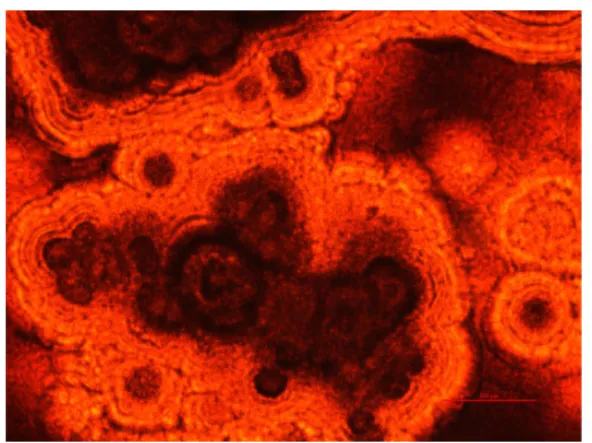
The field evidence such as occurrence, structures and vein densities support that these pseudotachylyte-like rocks are directly related to the NW trending fault. In thin section, they consist of aggregates of fibrous crystals with one or more minerals, radiating from spherulite nucleus (Fig. 3.).

These spherulitic overgrowth structures around quartz clasts have been described in some pseudotachylytes (e.g. “quartz-nucleus spheru-lites”: Lin, 1994; Di Toro and Pennacchioni, 2004), where inclusion-rich quartz rims surround rounded quartz clasts. However, these features cannot be univocally related to the achievement of single-quartz melting point (Bestmann et al., 2011). The host rock shows undulatory extinction in quartz minerals (Fig. 4.). The cataclastic and mylonitic features indicate melting and quenching during faulting. Also quartz minerals in this quartzite shows mineral content with sutured grain boundarys (ie. partial melting: Kim et al., 1993).

Fig 3. Spherulite nucleus of pseudotachylyte-like rocks in thin section.

Fig 4. Cataclastic part and undulatory extinction in thin section.

3. Discussion

The quartzite within the studied rocks is weakly metamorphosed, deformed and has many angular

cracks with reddish material (possibly iron oxide) precipitated in the cracks. The reported range of

estimated and inferred friction melt temperatures is between 650 - 1730(under dry conditions)°C (Sibson

and Toy, 2006, Deer et al., 1992). Pseudotachylyte-like rock forming temperature, can be estimated by

(4)

looking at the minerals that have survived the melting process (e.g. Maddock, 1983). Earthquakes along intracontinental fault zones commonly occur in the shallow part of the continental crust (2-18 km), which represents the seismogenic zone (Sibson, 1982, 1983; Scholz, 1988). The elusive nature of these fault related rocks, i.e. pseudotachylyte-like rocks, demonstrates that observations at outcrop and optical microscope scales are not sufficient to eliminate the possiblity of frictional melting as a consequence of seismic slip in similar fault rocks (Griffith et al., 2008). Pseudotachylyte-like rocks are evidence of frictional melting and coseismic slip and abundant quartz veins are evidence of transient fluid flow, both together are characteristic of earthquake faulting (Scholz, 1988, 1990; Sibson, 1989).

The microstructural textures of these pseudotachylyte-like rocks, have both cataclastic and mylonitic features (i.e. angular cataclastic fault breccia and spherulite texture). Shallow crustal fault rocks, ranging from pseudotachylytes to cataclasites and can be related to a paleo-history of coseismic slip events. As a result, these pseudotachylyte-like rocks might have been created at a shallower depth than the 10-12km depth usually associated with pseudotachylyte.

4. Conclusion

The pseudotachylyte-like rocks in the study area were injected into small cracks in a fault breccia composed of angular blocks of quartzite with an iron oxide matrix. This means that iron oxide materials are supplied by hydro thermal activity after the pseudotachylyte-like rocks are formed. So it may indicate that the pseudotachylyte-like rocks are generated by fault reactivation.

Reference

김주용, 1993, 대흑산도에 분포하는 퇴적암류의 층서와 퇴적환경, 한국지구과학회지, 14권, 1호, pp.25-31 임순복, 최현일, 고희재, 최범영, 2003, 대흑산도의 층서와 퇴적환경, 대한지질학회지 초록, pp.87

Bestmann M., Pennacchioni G., Frank G., Göken M., Wall H. D., 2011, Pseudotachylyte in muscovite-bearing quartzite: Coseismic friction-induced melting and plastic deformation of quartz, Journal of Structural Geology, Vol.33, pp.169-186.

Deer, W.A., Howie, R.A., Zussman, J., 1992, An Introduction to the Rock Forming Minerals. Longman Scientific and Technical, pp. 696

Di Toro, G., Pennacchioni, G., 2004, Superheated friction-induced melts in zoned pseudotachylytes within the Adamello tonalites (Italian Southern Alps), Journal of Structural Geology, Vol.26, pp.1783-1801.

Di Toro, G., Pennacchioni, G., Nielsen, S., 2009, Pseudotachylytes and earthquake source mechanisms.

In: Fukuyama, E. (Ed.), Fault-zone Properties and Earthquake Rupture Dynamics, International Geophysics Series, Vol.94, pp.87-133.

Griffith W. A., Toro G. D., Pennacchioni G., Pollard D. D., 2008, Thin pseudotachylytes in faults of the Mt. Abbot quadrangle, Sierra Nevada: Physical constraints for small seismic slip events, Journal of Structural Geology, Vol.30, pp.1086–1094.

Lin, A., 1994, Microlite morphology and chemistry in pseudotachylite, from the Fuyun fault zone, China. Journal of Geology, Vol.102, pp.317-329.

Lin, A., 2008, Fossil Earthquakes: The Formation and Preservation of Pseudotachylytes, Lecture Notes

in Earth Sciences, Vol.111, pp.348.

(5)

Maddock, R.H., 1983, Melt origin of fault-generated pseudotachylytes demonstrated by textures, Geology, Vol.11, pp.105-108.

Scholz, C.H., 1988. The brittle/plastic transition and the depth of seismic faulting, Geologische Rundschau, Vol.77, pp.319-328.

Sibson, R.H., 1982. Fault zone models, heat flow, and the depth distribution of earthquakes in the continental crust of the United States, Bulletin of the Seismological Society of America, Vol.72, pp.151-163.

Sibson, R.H., 1983. Continental fault structure and the shallow earthquake source, Journal of the Geological Society of London, Vol.140, pp.741-767.

Sibson, R.H., 1986, Earthquakes and rock deformation in crustal fault rocks, Annual Reviews of Earth Planetary Sciences, Vol.14, pp.149-175

Sibson, R.H., Toy, V., 2006, The habitat of fault-generated pseudotachylyte: presence vs. absence of friction melt. In: Abercrombie, R., McGarr, A., Di Toro, G., Kanamori, H. (Eds.), Earthquakes: Radiated Energy and the Physics of Faulting, Geophysical Monograph Series, Vol.170, pp.153-166

Spray, J.G., 1992, A physical basis for the frictional melting of some rock-forming minerals, Tectonophysics, Vol.204, pp.205-221.

Swanson, M.T., 2006. Late Paleozoic strike-slip faults and related vein arrays of Cape Elizabeth, Maine, Journal of Structural Geology, Vol. 28, pp.456–473

Swanson, M.T., 1992, Fault structure, wear mechanisms and rupture processes in pseudotachylytes generation, Tectonophysics, Vol.204, pp.223-242.

Toro G. D., Nielsen S., Pennacchioni G., 2005, Earthquake rupture dynamics frozen in exhumed ancient

faults, Nature, Vol.436, pp.1009-1012.

수치

Fig.  2.  a,  b)  NNW  trending  main  fault  and  NW  trending  secondary  extension  fractures  (modified  from  Lee,  2010),  c,  d)  Pseudotachylyte-like  rocks  fill  the  fault  zone.
Fig  3.  Spherulite  nucleus  of  pseudotachylyte-like  rocks  in  thin  section.

참조

관련 문서

Enterprises concentrate limited managerial resources on the important business and they are trying to execute outsourcing in logistics function that is

The characteristics of typhoons were examined via synoptic analysis and track examination, and the damage types and scales were analyzed to contribute to

(Saturated zone is the zone in which the voids in the soil and rocks are filled with water at a pressure greater than atmospheric pressure).. (Unsaturated zone is the zone

Skilled workers at DaimlerChrysler are not only expected to manufacture products of flawless quality. Given the cost of the production systems which manufacturing

1) Zone of viscous action (boundary layer): frictional effects cannot be neglected. 2) Flow in the reservoir and central core of the tube: primary forces are pressure

Luminous flux: A monochromatic light source emitting an optical power of (1/683) Watt at 555 nm has a luminous intensity of 1 lm. :The photometric quantities are related

Parallel light rays that pass through and illuminate the specimen are brought to focus at the rear focal plane of the objective, where the image of the

If you started writing your hypothetical novel using L A TEX instead of a WYSIWYG editor, and used custom environments for typesetting events in different dimensions, and