• 검색 결과가 없습니다.

지상 및 미소중력 환경에서 물리적 승화법 공정에 미치는 불순물의 영향 분석:염화제일수은에 대한 응용성

N/A
N/A
Protected

Academic year: 2021

Share "지상 및 미소중력 환경에서 물리적 승화법 공정에 미치는 불순물의 영향 분석:염화제일수은에 대한 응용성"

Copied!
7
0
0

로드 중.... (전체 텍스트 보기)

전체 글

(1)

Communication http://dx.doi.org/10.14478/ace.2016.1028

지상 및 미소중력 환경에서 물리적 승화법 공정에 미치는 불순물의 영향 분석 : 염화제일수은에 대한 응용성

김극태⋅권무현*

한남대학교 화공신소재공학과 , *우석대학교 에너지공학과 (2016년 3월 21일 접수, 2016년 3월 29일 심사, 2016년 4월 5일 채택)

Numerical Analysis for Impurity Effects on Diffusive-convection Flow Fields by Physical Vapor Transport under Terrestrial and Microgravity Conditions:

Applications to Mercurous Chloride

Geug Tae Kim

and Moo Hyun Kwon

*

Department of Advanced Materials and Chemical Engineering, Hannam University, 1646, Yuseong-daero, Yuseong-gu, Daejeon, 34054 Republic of KOREA

*

Department of Energy Engineering, Woosuk University, 66, Daehak-ro, Jincheon-eup, Jincheon-gun Chungcheongbuk-do, 27841 Republic of Korea

(Received March 21, 2016; Revised March 29, 2016; Accepted April 5, 2016)

초 록

본 연구에서는 지상 및 미소중력환경하에서 물리적 승화법 공정에서의 확산-대류유동에 미치는 불순물의 영향을 이 론적으로 Hg

2

Cl

2

-I

2

시스템에 적용하여 규명하는 것이다. 이론적 해석은 증기상에서 확산-대류 흐름, 열 및 물질전달을

속도 벡터 흐름, 유선, 온도, 농도 분포를 통하여 제시된다. 결정 영역에서의 전체 몰플럭스는 중력가속도와 성분 I

2

,

불순물에 상당히 민감하게 반응한다. 성분 I

2

을 증가시켰을 때, 농도 대류효과는 확산-대류 유동흐름을 안정화시키는

경향이 있다. 지상중력가속도의 0.001환경에서는 유동흐름은 1차원포물선의 흐름 구조를 나타내며, 확산지배형태를 보여주고 있다. 10

-3

지상중력가속도 이하에서는 대류 영향은 무시할 수 있다.

Abstract

In this study, impurity effects on diffusive-convection flow fields by physical vapor transport under terrestrial and microgravity conditions were numerically analyzed for the mixture of Hg

2

Cl

2

-I

2

system. The numerical analysis provides the essence of diffusive-convection flow as well as heat and mass transfer in the vapor phase during the physical vapor transport through velocity vector flow fields, streamlines, temperature, and concentration profiles. The total molar fluxes at the crystal regions were found to be much more sensitive to both the gravitational acceleration and the partial pressure of component I

2

as an impurity. Our results showed that the solutal effect tended to stabilize the diffusive-convection flow with increasing the partial pressure of component I

2

. Under microgravity conditions below 10

-3

g

0

, the flow fields showed a one-dimensional parabolic flow structure indicating a diffusion-dominant mode. In other words, at the gravitational levels less than 10

-3

g

0

, the effects of convection would be negligible.

Keywords: microgravity, crystal growth

1)

1. Introduction

Over the past 45 years since the results of the Apollo space flights, many researches on the role of gravity as a major parameter in materi-

† Corresponding Author: Hannam University,

Department of Advanced Materials and Chemical Engineering, 1646, Yuseong-daero, Yuseong-gu, Daejeon, 34054 Republic of KOREA Tel: +82-42-629-8837 e-mail: [email protected]

pISSN: 1225-0112 eISSN: 2288-4505 @ 2016 The Korean Society of Industrial and Engineering Chemistry. All rights reserved.
als science and engineering, crystal growth have been extensively car-

ried out in the United States, Russia, Germany, and Japan etc. In par-

ticular, through the International Space Station (ISS), various experi-

ments have been carried out based on the American Skylab or

Spacelab missions, the German D1 and D2 missions, the Russian Mir

station of Foton flights, the European Eureca mission, or the German

and the Japanese sounding rocket programs[1]. Fontana et al.[2] had

investigated crystal growth of sodium chloride in both terrestrial and

microgravity environments on the ISS. Single crystal growth diffraction

(2)

gravity conditions in various countries[6-18]. In particular, Konishi and Mudawar[19] reported reviews of flow boiling and critical heat flus in microgravity. Carotenuto[20] addressed reviews and relevant results on crystal growth from the vapour phase under microgravity environments, which would be contributed to future microgravity research on board the International Space Station. Yeckel and Derby[21] had investigated the g-jitter (transient acceleration) with steady magnetic fields in verti- cal Bridgman crystal growth system whose results were relevant to dy- namics of three-dimensional convection in microgravity crystal growth.

For transverse jitter at intermediate frequencies, flow oscillations were found to be increased, considering in most cases, application of a mag- netic field suppresses flow oscillations. Zeng et al.[22] investigated three-dimensional oscillatory Marangoni convection in silicone oil liq- uid bridge under microgravity environments and provided temperature contour lines and projected velocity vector for the range of Marangoni number, from 2.0 × 10

4

up to 5.0 × 10

4

. Maekawa et al.[23] studied the possibility of growing a uniform binary compound crystal in space for InAs-GaAs binary semiconductor by the Bridgman and zone methods. The solution-crystal interface was found to be deformed by buoyancy driven convection in the case of the Bridgman method even in the gravitational acceleration of 10

-6

g

0

which is supposed to be the gravity level in the International Space Station. Liu et al.[24] carried out simulation of directional solidification or refined Al-7 wt% Si Alloys with comparison with benchmark microgravity experiments.

In general, the crystal growth method by physical vapor transport (PVT) is referred to as a mechanism of sublimation-condensation. The source component-bearing species are vaporized from the source material and recrystallized on a seed crystal, in closed silica glass ampoules in temperature gradient imposed between the source material and the grow- ing crystal. With regard to studies on the PVT in the vapor phase, re- cently Tebbe et al.[25] extended for transition to chaos flow fields in specialty materials of mercurous chloride in applications of microgravity experiments. They have addressed the underlying phenomena in the PVT processes on the relative importance and influencing parameters of dif- fusion-advection, thermal and/or solutal convection on mass transport. It is reported that Hg

2

Cl

2

single crystals have applications for acousto-optic and opto-electronic devices such as Bragg cells, X-ray detectors operat- ing at ambient temperatures[26]. In study we employ a material of Hg

2

Cl

2

as a model sample and investigate numerically the influence of

in a comparison with our previous study[27-28] is centered into the ef- fects of gravitational accelerations and the partial pressure of component I

2

with high molecular weight through numerical simulations of vector, streamline, temperature and concentration profiles.

2. Numerical Analysis

A physical model is created with a two-dimensional rectangular en- closure with aspect ratio (transport length L to height H) of 5, as shown in Figure 1. The source is maintained at a temperature T

s

, while the growing crystal is at a temperature T

c

, with T

s

> T

c

. PVT of the transported component A (Hg

2

Cl

2

) occurs inevitably, due to presence of impurity, i.e., a component B (I

2

). The transport of fluid within a rectangular PVT crystal growth reactor is governed by a system of el- liptic, coupled conservation equations for mass (continuity), mo- mentum, energy and species (diffusion), Eq. (1) with appropriate boun- dary conditions, Eqs. (2)-(4), which can be found in Refs.[27-29]. The density of the vapor mixture of component A (Hg

2

Cl

2

) and B (I

2

) is assumed constant except the buoyancy body force term, which would be a function of both temperature and concentration.

(1) On the walls (0 < x

*

< L/H, y

*

= 0 and 1) :

(2)

On the source (x

*

= 0, 0 < y

*

< 1) :

(3)

(3)

Figure 2. Effects of gravitational levels on the total molar flux for various gravitational accelerations, 10

-5

g

0

≤ g ≤ 1g

0

, in the negative y-direction, where g0 denotes the Earth’s gravitational acceleration of 981 cm s

-2

. Based on aspect ratio = 5 (L = 10 cm), a linear wall temperature profile between T

s

= 623.5 K and T

c

= 563.15 K.

Figure 3. Effects of gravitational levels on |U|

max

for various gravitational accelerations, 10

-5

g

0

≤ g ≤ 1g

0

, corresponding to Figure 2.

Figure 4. Interfacial distributions of the total molar flux for three different gravitational levels, 1g

0

, 0.1g

0

and 10

-3

g

0

.

On the crystal (x

*

= L/H, 0 < y

*

< 1) :

(4)

3. Results and Discussion

The purpose of this research is to perform the numerical analysis of the influence of impurity and gravitational levels on diffusive-con- vection flow fields by the PVT of Hg

2

Cl

2

with impurity of I

2

, from a point of view of the total mass flux and interfacial distributions.

Because the molecular weight of an impurity (I

2

) is not equal to that of the crystal component (Hg

2

Cl

2

) during the physical vapor transport, both thermal and/or solutal convection always occur and also become much important in mass transport. In this study, a linear temperature profile at the walls is chosen. Detailed data such as typical process pa- rameters and physical properties for the operating conditions could be found in Refs.[27-29].

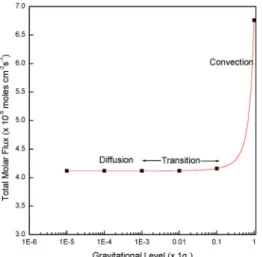
Figure 2 shows our numerical results for the effects of gravitational levels on the total molar flux for various gravitational accelerations, 10

-5

g

0 ≤

g ≤ 1g

0

, in the negative y-direction, where g

0

denotes the Earth’s gravitational acceleration of 981 cm s

-2

. The convection is pre- dominant over the diffusion for the range from 1g

0

down to 0.1g

0

. The total molar flux is sharply decreased with decreasing the gravitational level from 1g

0

down to 0.1g

0.

From a point of view of the total mass flux, the transition from the convection to the diffusion mode occurs in the range of 10

-2

g

0

≤ g ≤ 0.1g

0

, and reflects the diffusion-convec- tion mode. There is little difference of the total mass flux between 0.1g

0

and 10

-2

g

0

. The total molar flux in a convection region of 1g

0

is greater than in the diffusion region of 10

-2

g

0

by a factor of 1.6. It should be noted that the flow fields under terrestrial conditions include both the convection and diffusion, but the convection is predominant over the diffusion.

Figure 3 shows the effects of gravitational levels on |U|

max

for vari- ous gravitational accelerations, 10

-5

g

0

≤ g ≤ 1g

0

, corresponding to Figure 2. The |U|

max

denotes the dimensional maximum magnitude of velocity vector in the vapor phase, and reflects the intensity of con- vection in the vapor phase during the physical vapor transport of Hg

2

Cl

2

with impurity of I

2

. As the gravitational level is decreased from 1g

0

down to 0.1g

0

, the |U|

max

under the condition of 0.1g

0

is reduced to one-fifth of the |U|

max

under the condition of 1g

0.

With decreasing the gravitational level from 0.1g

0

down to 10

-2

g

0

, the |U|

max

under the condition of 10

-2

g

0

leads to one half of the |U|

max

under the condition of 0.1g

0.

Considering little difference of total mass flux between 0.1g

0

and 10

-2

g

0

previously, from a point of view of dimensional maximum

magnitude of velocity vector, the transition from the convection to the

diffusion mode occurs in the range of 10

-3

g

0

≤ g ≤ 0.1g

0

. From

Figures 3 and 4, it is concluded that the transition from the convection

(4)

Figure 5. (a) velocity, (b) streamline (ѱ = 2, ѱ

max

= 21.71, ѱ

min

= 2), (c) temperature (T = 0.1, T

max

= 1.0, T

min

= 0), (d) concentration (C = 0.1, C

max

= 1.0, C

min

= 0), based on aspect ratio = 5, T = 60 K (623.15 K → 563.15 K), and 1g

0

. A relative velocity vector with a magnitude of 100 has 1.4 cm. The maximum velocity vector is 0.35 cm s

-1

.

Figure 6. (a) velocity, (b) streamline ( △ ѱ = 0.37, ѱ

max

= 3.6, ѱ

min

= 0.2), (c) temperature (T = 0.1, T

max

= 1.0, T

min

= 0), (d) concentration (C = 0.1, C

max

= 1.0, C

min

= 0), based on aspect ratio

= 5, T = 60 K (623.15 K → 563.15 K), and 10

-3

g

0

. A relative velocity vector with a magnitude of 100 has 1 cm. The maximum velocity vector is 0.033 cm s

-1

.

to the diffusion mode occurs in the range of 10

-3

g

0

≤ g ≤ 0.1g

0

. Figure 4 shows the interfacial distributions of the total molar flux for three different gravitational levels, 1g

0

, 0.1g

0

and 10

-3

g

0

. The case of 1g

0

shows the convective flow indicates asymmetrical at the posi- tion of y = 1 cm and three dimensional flow structure. The case of 0.1g

0

is also likely to be slightly asymmetrical at the position of y = 1 cm and three dimensional flow structure. It is clear that the profiles of the total molar flux against the interfacial position are symmetrical at the position of y = 1 cm and nearly flat. The deviations of max- imum and minimum total molar flux from the average total molar flux for 0.1g

0

and 10

-3

g

0

are much smaller than for 1g

0

.

The mass transport phenomena occurring in the vapor phase when growing single crystals of Hg

2

Cl

2

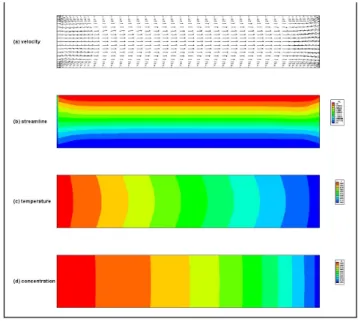
by the method of vapor crystal growth under terrestrial and microgravity environments are numerically investigated. By examining plots of the distributions of vector and stream function, and temperature and concentration, an appreciation for the nature of the diffusive-convection and/or diffusive flow and the temperature, and the concentration fields can be obtained. Figures 5 and 6 show (a) velocity, (b) streamline, (c) temperature, (d) concen- tration field, based on Ar = 5, △T = 60 K (623.15 K → 563.15 K), corresponding to 1g

0

, and 10

-3

g

0

, respectively. In Figure 5, a relative velocity vector with a magnitude of 100 has 1.4 cm and the maximum velocity vector is 0.35 cm s

-1

, whereas in Figure 6, a relative velocity vector with a magnitude of 100 has 1 cm and the maximum velocity vector is 0.033 cm s

-1

. As shown in Figure 5, all fields (5(a)-5(d)) are asymmetrical about the centerline axis of y = 1 cm and exhibit a three dimensional flow structure with one single cell in the vapor phase. To study the effects of gravitational acceleration on flow fields of vector, stream function, temperature and concentration, a 10

-3

g

0

of micro-

gravity acceleration is chosen, under whose condition it would increase the diffusive flow and yield one-dimensional parabolic flow pattern in the vapor phase. This indicates thermal and/or solutal buoyancy driven convection is very weak under 10

-3

g

0

of microgravity, it is impossible for the effect of buoyancy force to contribute significantly to heat and/or mass transport. Thus, our results at the 10

-3

g

0

of microgravity show that both temperature and concentration gradients become uni- form near the crystal region, which is an ideal growth condition for the high quality of crystal. For the simulations shown in Figures 5 and 6, we choose a field strength of P

B

= 100 Torr for the cases considered here.

As shown in Figure 5(a), the magnitudes of velocity vector near the crystal region are shown to be greater than those near the source interface. The magnitudes of velocity vector in the lower half region are nearly same those in the upper half region along the centerline, di- mensional y = 1 cm, which indicates a strong convective structure un- der operating conditions of △T = 60 K (623.15 K → 563.15 K), and 1g

0

, P

B

= 100 Torr, aspect ratio (transport length-to-width) = 5.0, Prandtl number = 1.1, Lewis number = 0.7, thermal Grashof number

= 1.0 × 10

5

, solutal Grashof number = 4.7 × 10

5

, thermal diffusivity

of 0.07 cm

2

s

-1

, kinematic viscosity of 0.08 cm

2

s

-1

, binary diffusivity of

0.10 cm

2

s

-1

. The temperature profile along the centerline of dimen-

sional y = 1 cm exhibits a cosine wave curve, indicating a uniform im-

posed temperature profile on ampoule walls. As shown in Figure 5(d),

with regards to concentration profile, the concentrations in front of the

source interface are relatively uniform, and significantly varied near the

crystal interface. As shown in Figure 6, all fields (6(a)-6(d)) are sym-

metrical about the centerline axis of y = 1 cm and exhibit a one-di-

mensional flow structure, diffusion-dominant in comparison with the

(5)

Figure 7. Effects of partial pressure of component B, P

B

(Torr) on the total molar flux for various partial pressure of component B, P

B

, 10

P

B

(Torr) ≤ 400.

Figure 8. Effects of partial pressure of component B, P

B

(Torr) on

|U|

max

for various partial pressure of component B, P

B

, 10 ≤ P

B

(Torr)

400, corresponding to Figure 7.

Figure 9. Interfacial distributions of the total molar flux for five partial pressures of component B, P

B

(Torr).

effect of convection.

One of the practical methods for controlling the crystal growth rate is to increase the partial pressure of the component B as an impurity.

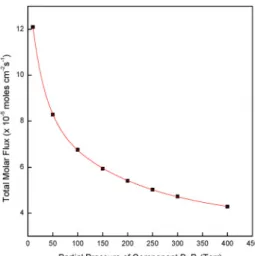
Thus, we investigate the influences of the impurity on diffusive-con- vection flow fields by physical vapor transport. Figure 7 shows the ef- fects of partial pressure of component B, P

B

on the total molar flux for various partial pressure of component B, 10 ≤ P

B

(Torr) ≤ 400.

The total molar flux decays second-order exponentially with increasing the partial pressure of component B, for 10 ≤ P

B

(Torr) ≤ 400. For 10 ≤ P

B

(Torr) ≤ 100, the total molar flux falls sharply, and for 10

≤ P

B

(Torr) ≤ 400, the total molar flux is nearly linearly decreased with the partial pressure of component B. The total molar flux at P

B

= 10 Torr is nearly doubled than that at P

B

= 150 Torr, with decreas- ing the partial pressure of component B by a factor of one-seventh.

Figure 8 shows the effects of partial pressure of component B, P

B

(Torr) on |U|

max

for various partial pressure of component B, P

B

, 10

≤ P

B

(Torr) ≤ 400, corresponding to Figure 7. The |U|

max

decays sec-

ond-order exponentially with increasing the partial pressure of compo- nent B, P

B

, for 10 ≤ P

B

(Torr) ≤ 400. The |U|

max

decreases with parti- al pressure of component B, P

B

by a gradient of 8.6 × 10

-4

cm s

-1

Torr

-1

for 10 ≤ P

B

(Torr) ≤ 150. The |U|

max

decreases directly and linearly with partial pressure of component B, P

B

by a gradient of 2.4 × 10

-4

cm s

-1

Torr

-1

for 150 ≤ P

B

(Torr) ≤ 400. The gradient in the range of 10 ≤ P

B

(Torr) ≤ 150 is found to be 3.58 times than that in the range of 150 ≤ P

B

(Torr) ≤ 400.

Figure 9 shows the interfacial distributions of the total molar flux

for five partial pressures of component B, P

B

to study non-uni-

formities against the center of y = 1 cm. The convection enhances the

overall mass transport of component A (Hg

2

Cl

2

), and, then results in

an increase in its total molar flux, but pays for the expense of uni-

formity in the total molar flux, with the specific interfacial distribution

revealing dominance of diffusive convection. This result is consistent

with earlier results[30-31]. The total molar fluxes for all cases under

consideration, as shown in Figure 9, imply the occurrence of one cell

in front of the crystal region, and the results for P

B

= 100 Torr, and

1g

0

are found to be confirmed, as shown in Figure 3. All profiles of

the total molar flux against dimensional interfacial position are asym-

metric against the center position of y = 1 cm. Moreover, the max-

imum value of the total molar flux for all cases occurs between y =

0 cm and y = 0.5 cm, the maximum value of the total molar flux for

the case of P

B

= 10 Torr is about twice that for P

B

= 100 Torr. It

should be noted that fluid is assumed to cling to solid surfaces, i.e.,

walls with which it is in contact. In other words, the velocities of the

mixture of vapor A and B at walls, i.e., y = 0 cm and 2 cm, are as-

sumed to be zero. As shown in Figures 7 through 9, our results have

indicated that by increasing the partial pressure of component B, the

solutal effect is found to have the stabilizing effect of diffusive-con-

vection flow and, thus, the maximum total molar flux near at y = 0.5

cm is decreased.

(6)

of convection is likely to be negligible.

Acknowledgement

This research has been financially supported by the Hannam University for support of the current investigations through a one-year professor-yeonguneon program starting from September 1, 2014 (September 1, 2014 to August 31, 2015).

References

1. K. W. Benz and P. Dold, Crystal growth under microgravity: pres- ent results and future prospects towards the international space sta- tion, J. Cryst. Growth, 237-239, 1638-1645 (2002).

2. P. Fontana, J. Schefer, and D. Pettit, Characterization of sodium chloride crystals grown in microgravity, J. Cryst. Growth, 324, 207-211 (2011).

3. M. Nobeoka, Y. Takagi, Y. Okano, Y. Hayakawa, and S. Dost, Numerical simulation of InGaSb crystal growth by temperature gradient method under normal- and micro-gravity fields, J. Cryst.

Growth, 385, 66-71 (2014).

4. K. Kinoshita, Y. Arai, Y. Inatomi, T. Tsukada, S. Adachi, H.

Miyata, R. Tanaka, J. Yoshikawa, T. Kihara, H. Tomioka, H.

Shibayama, Y. Kubota, Y. Warashina, Y. Sasaki, Y. Ishizuka, Y.

Harada, S. Wada, T. Ito, M. Takayanagi, and S. Yoda, Growth of a Si

0.50

Ge

0.50

crystal by the traveling liquids-zone (TLZ) method in microgravity, J. Cryst. Growth, 388, 12-16 (2014).

5. K. Abe, S. Sumioka, K.-I. Sugioka, M. Kubo, T. Tsukada, K.

Kinoshita, Y. Arai, and Y. Inatomi, Numerical simulation of SiGe crystal growth by the traveling llquidus-zone method in a micro- gravity environment, J. Cryst. Growth, 402, 71-77 (2014).

6. C. Stelian and T. Duffar, Influence of rotating magnetic fields on THM growth of CdZnTe crystals under microgravity and ground conditions, J. Cryst. Growth, 429, 19-26 (2015).

7. Z. Li, J. H. Peterson, A. Yeckel, and J. J. Derby, Analysis of the effects of a rotating magnetic field on the growth of cadmium zinc telluride by the traveling heater method under microgravity con- ditions, J. Cryst. Growth, Doi: 10.1016/j.jcrysgro.2015.12.046.

8. W. M. B. Duval, N. B. Singh, and M. E. Glicksman, Physical va- por transport of mercurous chloride crystals: design of a micro- gravity experiment, J. Cryst. Growth, 174, 120-129 (1997).

9. E. N. Kolesnikova, Yu. A. Polovko, V. S. Yuferev, and A. I.

ditions employing experimental and numerical approaches, J.

Cryst. Growth, 245, 278-288 (2002).

14. M. Catauro, F. Bollino, and F. Papale, Response of SAOS-2 cells to simulated microgravity and effect of biocompatible sol-gel hy- brid coatings, Acta Astronaut., 122, 237-242 (2016).

15. K. Harth, T. Trittel, K. May, S. Wegner, and R. Stannarius, Three-dimensional (3D) experimental realization and observation of a granular gas in microgravity, Adv. Space Res., 55, 1901-1912 (2015).

16. K. Nishino, T. Yano, H. Kawamura, S. Matsumoto, I. Ueno, and M. K. Ermakov, Instability of thermocapillary convection in long liquid bridges of high Prandtl number fluids in microgravity, J.

Cryst. Growth, 420, 57-63 (2015).

17. Y. Yang, L. M. Pan, and J.-J. Xu, Effects of microgravity on Marangoni convection and growth characteristic of a single bubble, Acta Astronaut., 100, 129-139 (2014).

18. D. E. Melinikov, V. Shevtsova, T. Yano, and K. Nishino, Modeling of the experiments on the Marangoni convection in liq- uid bridges in weightlessness for a wide range of aspect ratios, Int.

J. Heat Mass Transf., 87, 119-127 (2015).

19. C. Konishi and I. Mudawar, Review of flow boiling and critical heat flux in microgravity, Int. J. Heat Mass Transf., 80, 469-493 (2015).

20. L. Carotenuto, Crystal growth from the vapour phase in micro- gravity, Prog. Cryst. Growth Charact. Mater., 48/49, 166-188 (2004).

21. A. Yeckel and J. J. Derby, Dynamics of three-dimensional con- vection in microgravity crystal growth: G-jitter with steady mag- netic fields, J. Cryst. Growth, 263, 40-52 (2004).

22. Z. Zeng, H. Mizuseki, K. Simamura, T. Fukuda, K. Higashino, and Y. Kawazoe, Three-dimensional oscillatory thermocapillary con- vection in liquid bridge under microgravity, Int. J. Heat Mass Transf., 44, 3765-3774 (2001).

23. T. Maekawa, Y. Hiraoka, K. Ikegami, and S. Matsumoto, Numerical modelling and analysis of binary compound semi- conductor growth under microgravity conditions, J. Cryst. Growth, 229, 605-609 (2001).

24. D. R. Liu, N. Mangelinck-Noël, C. A. Gandin, G. Zimmermann, L. Sturz, H. Nguyen-Thi, and B. Billia, Simulation of directional solidification of refined Al-7wt.% Si alloys– Comparison with benchmark microgravity experiments, Acta Mater., 93, 24-37 (2015).

25. P. A. Tebbe, S. K. Loyalka, and W. M. B. Duval, Finite element

modeling of asymmetric and transient flow fields during physical

(7)

vapor transport, Finite Elem. Anal. Des., 40, 1499-1519 (2004).

26. N. B. Singh, M. Gottlieb, G. B. Brandt, A. M. Stewart, R.

Mazelsky, and M. E. Glicksman, Growth and characterization of mercurous halide crystals: mercurous bromide system, J. Cryst.

Growth, 137, 155-160 (1994).

27. Y. K. Lee and G. T. Kim, Effects of convection on physical vapor transport of Hg

2

Cl

2

in the presence of Kr-Part I: under micro- gravity environments, J. Korean Cryst. Growth Cryst. Technol., 23, 20-26 (2013).

28. G. T. Kim, Effects of aspect ratio on diffusive-convection during physical vapor transport of Hg

2

Cl

2

with impurity of NO, Appl.

Chem. Eng., 26, 746-752 (2015).

29. G. T. Kim and M. H. Kwon, Effects of solutally dominant con- vection on physical vapor transport for a mixture of Hg

2

Br

2

and Br

2

under microgravity environments, Korean Chem. Eng. Res., 52, 75-80 (2014).

30. D. W. Greenwell, B. L. Markham, and F. Rosenberger, Numerical modeling of diffusive physical vapor transport in cylindrical Ampoules, J. Cryst. Growth, 51, 413-425 (1981).

31. B. L. Markham, D. W. Greenwell, and F. Rosenberger, Numerical

modeling of diffusive-convective physical vapor transport in cylin-

drical vertical ampoules, J. Cryst. Growth, 51, 426-437 (1981).

수치

Figure 3. Effects of gravitational levels on |U| max  for various gravitational  accelerations, 10 -5 g 0  ≤ g  ≤  1g 0 , corresponding to Figure 2
Figure 5. (a) velocity, (b) streamline ( △ ѱ = 2, ѱ max  = 21.71, ѱ min  =  2), (c) temperature ( △ T = 0.1, T max  = 1.0, T min  = 0), (d) concentration  ( △ C = 0.1, C max  = 1.0, C min  = 0), based on aspect ratio = 5,  △ T =  60  K (623.15 K  → 563.15
Figure 7. Effects of partial pressure of component B, P B (Torr) on the  total molar flux for various partial pressure of component B, P B , 10

참조

관련 문서

1 John Owen, Justification by Faith Alone, in The Works of John Owen, ed. John Bolt, trans. Scott Clark, &#34;Do This and Live: Christ's Active Obedience as the

difference depending upon health state of the family (p=.000). In conclusion, the family's depression had positive correlation with burden as well as physical and

To visualize the vari- ation in various transport characteristics (the non-dimen- sional axial velocity and temperature distributions, pressure gradient, rate of heat

In gi ngi va,LCs are found i n oralepi thel i um ofnormalgi ngi va and i n smal l er amountsi nthesul cul arepi thel i um,buttheyareprobabl yabsentfrom thejuncti onal epi thel

To investigate the PL quenching sensitivity behaviors of the organic vapor, an organic vapor sensor based on rugate PSi filters was fabricated and tested

: Determine the superficial liquid and vapor velocities (V sl and V sg ) and the actual liquid and vapor velocities (V l and V g ) for the following liquid holdups,

High heat transfer coefficient High thermal conductive material coatings.. Can reduce the constriction resistance

→ For the turbulent jet motion and heat and mass transport, simulation of turbulence is important.. in the mean-flow equations in a way which close these equations by