Paenibacillus woosongensis의 Xylanase 유전자 클로닝과 특성분석
윤기홍
우송대학교 식품생물과학과
Cloning and Characterization of Xylanase Gene from Paenibacillus woosongensis
Ki-Hong Yoon
Department of Food Science and Biotechnology, Woosong University, Daejeon 300-718, Republic of Korea (Received April 23, 2012 / Accepted May 15, 2012)
A gene encoding the xylanase (XynA) predicted from partial genomic sequence of Paenibacillus woosongensis was cloned into Escherichia coli by PCR. This xynA gene consisted of 633 nucleotides, encoding a polypeptide of 211 amino acid residues. The deduced amino acid sequence exhibited 85-89% identity with those of several Paenibacillus xylanases, belonging to the glycosyl hydrolase family 11. As a results of expression of the structural gene by T7 promoter of a pET23a(+) expression vector, xylanase activity was higher in cell-free extract than culture filtrate of a recombinant Escherichia coli BL21(DE3) CodonPlus. However, the expression level of xylanase was not sufficient be detected by SDS-PAGE. The cell-free extract showed maximal xylanase activity at 60℃and pH 5.5.
The predominant products resulting from xylan and xylooligosaccharide hydrolysis were xylose and xylotriose. The enzyme could hydrolyze xylooligosaccharides larger than xylbiose.
Keywords: Paenibacillus woosongensis, cloning, reaction property, xylanase
*For correspondence. E-mail: [email protected]; Tel.: +82-42-630-9742;
Fax: +82-42-636-2676
대부분의 육지식물은 cellulose, hemicellulose와 lignin으로 이루어져 있는데 이들중 hemicellulose의 주요 구성 성분으로 알 려져 있는 xylan은 기본골격이 β-1,4 결합을 하고 있는 D-xylose 로 구성되어 있고 이러한 xylose 잔기에 acetyl group, α -L-arabinofuranose와 4-O-methyl-α-D-glucuronopyranose 등이 측쇄로 연결되어 존재하고 있다(Thomson, 1993). 이를 분해하 는데 여러 종류의 효소가 관여하며 그들 중 endo-β-1,4-xylanase (xylanase)와 β-xylosidase의 역할이 중요하다.
Xylanase는 heteroxylan의 골격을 이루는 β-D-1,4-xylopyranosyl 결합을 무작위로 분해하여 xylooligosaccharides로 전환시키며, 이것은 β-xylosidase에 의해 xylose로 분해된다. 따라서 xylanase 는 glucanase 및 mannanase와 함께 재생가능한 식물자원인 반 섬유소를 생물이 용이하게 대사할 수 있는 탄소원으로 전환시키 기 위해 활용되고 있으며, 제빵, 펄프와 제지가공 및 사료첨가용 효소로 이용되고 있다(Subramaniyan and Prema, 2002).
Xylanase는 대부분이 glycosyl hydrolase (GH) family 10과 11 에 속하며, 일부 효소는 GH5, 8에 속하는 것으로 알려졌다 (Gallardo et al., 2010; Cuyvers et al., 2011). 일반적으로 GH10
xylanase는 GH11의 효소보다 분자량이 크며, 활성영역을 포함 하여 2개 이상의 기능영역으로 구성된 것이 많이 보고되었다.
Paenibacillus는 1993년도에 새로운 속으로 분류되었으며, 현재까지 100 종 이상이 알려져 있고 이들 중 새로운 균종으로 밝혀진 xylan 분해균이 다수 포함되어 있다. P. barcinonensis (Valenzuela et al., 2010), P. campinasensis (Ko et al., 2010), P. curdlanolyticus (Waeonukul et al., 2009), Paenibacillus sp.
W-61 (Fukuda et al., 2010), Paenibacillus sp. HC1 (Harada et al., 2008), Paenibacillus sp. DG-22 (Lee et al., 2007)와 Paenibacillus sp. JDR-2 (Stjohn et al., 2006) 유래의 xylanase 유전자와 효소특성에 대한 연구가 수행되었다. 이들 균주의 xylanase는 다른 미생물이 생산하는 효소와 동일하게 대부분이 균체외로 분비되지만, 일부의 효소는 분비되지 못하는 것으로 알려졌다 (Gallardo et al., 2010). Xylan 분해능을 갖는 균주로 분리된 P. woosongensis는(Lee and Yoon, 2008), galactomannan 의 분해 효소인 mannanase, β-mannosidase와 α-galactosidase 를 생산하는 것으로 확인되었으며(Yoon, 2010). 최근 β -xylosidase/α-arabinofuranosidase 기능을 동시에 보이는 효소 와 그 유전자에 대한 특성이 보고된 바 있다(Kim and Yoon, 2010). 본 연구에서는 P. woosongensis로부터 GH11 xylanase 유전자를 크로닝하여 효소 반응특성을 분석하였다.
재료 및 방법
사용균주와 플라스미드
P. woosongensis KCTC 3953 (DSM 16972)은 유전자 제공 원으로 사용되었고 tryptic soy broth (TSB; 17 g of tryptone, 3 g of soytone, 2.5 g of dextrose, 5 g of NaCl, 2.5 g of K2HPO4 per L, pH 7.2)를 사용하여 37℃에서 배양하였다. 유전자조작을 위 한 숙주와 vector로는 Escherichia coli DH5α와 플라스미드 pUC19, xylanase 유전자의 과잉발현을 위해서는 E. coli BL21(DE3) CodonPlus와 pET23a(+)을 각각 사용하였다.
DNA 분리와 조작
TSB 액체배지에서 배양한 P. woosongensis 균체로부터 총 염색체 DNA를 분리하기 위해서는 Genomic DNA prep kit (Solgent, Korea)를 사용하였다. Genome Sequencer FLX Titanium (Roche, Germany)으로 총 염색체 염기서열을 분석하고 GS FLX Titanium Cluster (PSSC Labs, USA)로 조합하여 86 contigs 로 구성된 5,651 kb의 서열을 결정하였다 (Solgent, Korea). Xylanase 유전자를 클로닝하기 위해서는 유전체의 염기서열을 활용하여 제 조한 upper (CATTAACATACCTTCAATGTGTATC)와 lower primer (GTTCCACCCTGGACGAACACA)로 95℃ (25초), 6 0℃ (40초), 72℃ (2분)의 조건에서 pfu DNA polymerase를 사 용하여 PCR 반응을 실시하였으며 증폭된 DNA 단편을 HincII 로 절단한 pUC19에 도입하였다. 이를 E. coli DH5α에 형질전환 하고 oat spelt xylan (0.5%)와 ampicillin을 첨가한 LB 배지에 도말한 후 xylan 분해환을 갖는 형질전환주를 선발하였다.
Xylanase 유전자의 과잉발현
Xylanase 유전자를 과잉발현 시키기 위해 구조유전자를 pET23a의 T7 promoter 하단에 도입하였다. Xylanase의 구조유 전자내에 NdeI 절단위치 서열이 있으므로 pET23a(+)의 NdeI과 XhoI 사이에 유전자를 도입하기 위해 4종류의 primers를 이용하여 재조합 플라스미드를 제조하였다. Primers Ns-F (GTAGGTCA- TATGTTTAAGTTCAAGAAGAAAATGC)와 X-R (GGCCAGT- CTCGAGTTACCACACTGTTACGTTAGAGC)에는 크로닝을 위 한 NdeI과 XhoI 절단위치를 각각 도입하였고, Nm-R (TATAC- ATCATATGTGCCCCCATC)과 Nm-F(GGGGGCACATATG- ATGTATACAC)는 구조유전자의 NdeI 절단위치 지역에 해당 한다. 먼저 primer Nm-F와 X-R을 사용하여 증폭한 xylanase 유 전자 하반부분을 NdeI과 XhoI으로 절단하여 pET23a(+)에 도입 한 재조합 플라스미드를 제조한 후, Ns-F와 Nm-R을 사용하여 증폭한 xylanase 유전자 상반부분을 NdeI으로 절단하여 앞 단계 에서 제조된 재조합 플라스미드의 NdeI 위치에 삽입함으로써 pEYX137을 제조하였다. 재조합 플라스미드 pEYX137에 의해 얻은 E. coli BL21(DE3) CodonPlus형질전환주는 ampicillin (100 µg/ml)과 chloramphenicol (30 µg/ml)을 첨가한 LB broth (10 g of tryptone, 5 g of yeast extract, 10 g of NaCl per L, pH 7.0)에서 배양하였다. Xylanase 유전자를 과잉 발현하기 시키기 위해서는 평판배지에서 자란 콜로니를 항생제를 첨가한 LB에
접종하여 37℃에서 하룻밤 배양한 후, 동일배지 100 ml을 함유한 baffled flask에 배양액을 1%가 되도록 접종하고 30℃에서 진탕 배양하면서 흡광도(OD600)가 0.6에 도달했을 때 IPTG를 0.5 mM이 되도록 첨가하여 25℃에서 5시간 진탕 배양하였다. 배양 액을 원심분리하여 얻은 배양균체를 초음파 파쇄하고 이를 다시 원심분리하여 상등액을 xylanase 조효소액으로 사용하였다.
Xylanase 반응특성 분석
Xylanase 활성은 oat spelt xylan을 기질로 하여 15분 동안 반 응 후에 유리된 환원당을 3, 5-dinitrosalicylic acid 방법으로 정 량함으로써 측정하였으며, 효소 활성도 1.0 unit은 위의 조건에 서 1분 동안 oat spelt xylan으로 부터 1 μmol의 xylose에 상응하 는 환원당을 생성하는 효소의 양으로 정의하였다(Miller et al., 1960; Yoon, 2009). 효소 활성에 미치는 반응 온도의 영향을 조 사하기 위하여 반응 pH를 5.5로 고정하고 30–70℃ 범위의 온도 에서 반응을 수행하였으며, 반응 pH의 영향을 조사하기 위해서 는 반응온도를 55℃로 고정하고 pH 3.5–9.0의 범위에서 반응을 수행하여 xylanase 활성을 각각 측정하였다. 이때 pH 3.5–6.0의 범위에서는 citrate 완충용액, pH 6.0–8.0에서는 phosphate 완충 용액, pH 8.0–9.0의 범위에서는 Tris 완충용액을 각각 사용하였 다. Xylanase에 의한 xylan 가수분해 산물을 분석하기 위해서 xylan과 xylooligosacharides를 기질로 하여 과량의 효소를 첨가 하고 반응액의 pH는 최적으로 조절하여 40℃에서 5시간 반응을 수행한 후 95℃에서 3분간 열처리하고 원심분리하여 얻은 상등 액을 적정량 취해 chloroform, acetic acid와 증류수[4.3:5:0.7, (v/v)] 혼합용액을 전개용액으로 하여 silica gel-precoated thin layer plate (Merck Kiesegel, No. 5748)에서 전개하였다. 발색제 (para-anisaldehyde 0.5 ml, conc. H2SO4 0.5 ml, 95% ethanol 9 ml, glacial acetate 2-4방울)를 뿌려 120℃에서 10분간 방치함으 로써 전개된 물질을 발색시켜 관찰하였다.
결과 및 고찰
Xylanase 유전자 클로닝과 염기서열
부분적으로 결정된 염색체 염기서열로부터 xylanase 유전자 로 예상되는 4개의 ORF가 발견되었는데, P. barcinonensis (Gallardo et al., 2010), Paenibacillus sp. W-61 (Fukuda et al., 2010)과 Paenibacillus sp. HC1 (Harada et al., 2008)에도 2종류 이상의 xylanases가 존재한다고 보고되었다. 본 연구에서는 P.
woosongensis xylanase의 유전자로 유추되는 orf 중 그 크기가 가장 작으며 GH11에 속하는 xylanase (xynA) 유전자로 예상되 는 DNA 단편을 PCR로 증폭한 후 E. coli DH5α에 도입함으로 써 oat spelt xylan을 첨가한 평판배지에서 투명한 분해환을 보이 는 형질전환주를 얻었다.
이로부터 플라스미드를 분리하고 클로닝된 PCR 단편의 염기서 열을 분석한 결과 유전체 분석에서 결정된 서열과 동일한 것으 로 확인되었으며(Fig. 1), xynA의 개시코돈으로 예측되는 ATG 가 연속해서 존재하였다. SD 서열로 예측되는 서열(GGGAGGT) 과의 간격 및 Paenibacillus sp. HY8 (GenBank accession no.
Fig. 1. Nucleotide sequence and deduced amino acid sequence of xylanase gene. The amino acid deduced from the open reading frame is shown with the one-letter code below the nucleotide sequence. Putative ribosome binding site (SD) and promoter sequence (-35 and -10) are depicted below the underlines, respectively. Amino acids corresponding to the putative signal sequence are italicized. Bold italics indicate the putative catalytic amino acid residues (Glu105 and Glu198) and substrate binding residues (Tyr96 and Tyr107). Palindrome sequence that may act as a transcription terminator is indicated by arrows facing each other. The numbers at the end of each line correspond to the nucleotide positions. The upper and lower primers are underlined with bold character in the start and end positions of complete nucleotide sequence.
ABD66557), Paenibacillus sp. DG-22 (Lee et al., 2007)과 Paenibacillus sp. W-61 (Watanabe et al., 2008) 유래 GH11 xylanase의 아미노산 잔기와 비교할 때 뒤의 ATG가 개시코돈으 로 판단되었다. 한편 xynA 구조유전자의 GC 함량은 48.7%로 나 타났으며, 재조합 대장균에서 생산된 XynA는 균체내ㆍ외에서 모두 그 활성이 낮게 관찰되었다.
P. woosongensis의 xynA 서열에서 유추된 아미노산 잔기배 열을 NCBI database의 다른 단백질과 비교한 결과 Paenibacillus sp. HY8 (ABD66557), P. mucilaginosus KNP414 (AEI41899), Paenibacillus sp. JDR-2 (ACT03278), Paenibacillus sp. DG-22 (ABI96991) 등 다수의 Paenibacillus 속 균주 및 Aeromonas punctata (BAA06837) 유래의 xylanases 와 85-89% 수준의 상 동성을 보였고 이들은 모두 211 아미노산 잔기로 구성된 효소로 아미노 말단의 28 잔기가 signal peptide로 예측되었다. 또한 82%의 상동성을 보이는 B. subtilis 168 (CAA84276)의 xylanase 는 213 아미노산 잔기로 구성되었으며 28 잔기가 signal peptide 로 밝혀졌다(Murakami et al., 2005). P. woosongensis xylanase 를 비롯하여 이와 유사한 서열을 갖는 작은 크기의 상기 효소는 모두 GH family 11에 속하며 활성영역인 단일한 기능 영역만 보 유하고 있다. P. barcinonensis BP-23의 xylanase A는 320개 아 미노산 잔기로 구성된 GH10 효소로 그 크기는 XynA보다 크지 만 단일 활성영역으로 구성되어 있고(Valenzuela et al., 2010), Paenibacillus sp. W-61의 xylanse 5 (Fukuda et al., 2010)와 P.
curdlanolyticus B-6의 xyn10A (Waeonukul et al., 2009)는 모두 활성영역을 포함하여 2개 이상의 기능영역으로 구성되어 있다.
B. subtilis 168의 xylanase 단백질 구조로부터 밝혀진 활성잔 기 Glu106과 Glu200 및 기질결합에 관여하는 잔기 Tyr97와 Tyr108 (Murakami et al., 2005)에 해당하는 잔기는 XynA에서 Glu105, Glu198, Tyr96과 Tyr107로 각각 예측되었으며 이와 상 동성이 높은 xylanase에서도 이들 잔기가 모두 확인되었다.
재조합 대장균이 생산하는 xylanase의 반응특성
플라스미드 pUC19에 클로닝된 xynA는 재조합 대장균에서 그 발현량이 매우 낮아 XynA의 생산성을 높이기 위해 xynA 구 조유전자를 pET23a의 T7 promoter 하단에 도입한 재조합 플라 스미드 pEYX137을 제조하였다. 이를 E. coli BL21(DE3)와 E.
coli BL21(DE3) CodonPlus에 각각 도입하고 IPTG로 과잉발현 을 유도한 결과 모두 그 발현량이 낮아 SDS-PAGE에서 발현된 단백질을 확인하기 어려웠다. 이는 signal peptide를 제거하지 않 고 발현을 시킨 때문으로 판단되는데 B. subtilis의 mannanase 유전자도 signal peptide 부분을 제거하지 않았을 때 재조합 대장 균에서 과잉 발현이 유도되지 않는 것으로 보고된 바 있다 (Kweun et al., 2004). 그러나 signal peptide를 제거한 상태에서 는 재조합 대장균에서 B. subtilis와 Pseudomonas fluorescens (Bolam et al., 1996)의 mannanase 유전자가 모두 IPTG에 의해 과잉 발현된 것으로 알려졌다. 한편 과잉 발현되지는 않았지만
(A) (B)
pH
3 4 5 6 7 8 9
Relative xylanase activity(%)
0 20 40 60 80 100
Temperature(oC)
30 40 50 60 70
Temperature(oC)
0 10 20 30 40 50 60
Residual relative activity(%)
0 20 40 60 80 100 120
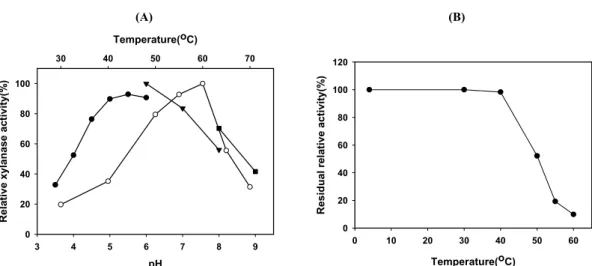
Fig. 2. Temperature and pH optima (A), and thermostability (B) of the XynA. Temperature profile (open symbols) was obtained by measuring the xylanase activity at different temperatures with fixed pH 5.5 for oat spelt xylan hydrolysis. The pH profile (closed symbols) was obtained by measuring the enzyme activities at various pHs with constant temperatures of 55℃. Buffers (50 mM) used were as follows: sodium citrate (pH 3.5–6; -●-), sodium phosphate (pH 6–8; -▼-), and Tris (pH 8–9; -■-). Thermostability was determined by measuring the residual activities after pre-incubation for 1 h at different temperatures. Each curve represents the average of three independent experiments.
Fig. 3. Thin-layer chromatogram of β-1,4-linked xylooligosaccharide and xylan hydrolysis products generated by crude enzyme of the cell-free extract. Reaction mixtures containing the crude enzyme and xylooligosaccharides or xylans in 50 mM sodium citrate buffer (pH 5.5) were incubated for 5 h at 40℃. X1 to X5 represent xylose to xylopentaose. BX and OX stand for hydrolysates of birchwood xylan and oat spelt xylan, respectively. E, cell-free extract.
재조합 대장균에서 생성된 xylanase의 활성을 측정한 결과 균체 외 보다는 균체내에서 활성이 높았으며, BL21(DE3) 보다는 BL21(DE3) CodonPlus에서 xylanase 생산성이 높았다 (결과 미제 시). 대장균의 희귀 tRNA를 보강한 CodonPlus 균주에서 외래 유 전자 발현량이 증가하는 현상은 P. woosongensis의 β-xylosidase/
α-arabinofuranosidase 유전자를 과잉발현에서도 보고된 바 있다 (Kim and Yoon, 2010). 또한 Paenibacillus sp. DG-22의 xylanase 는 재조합 대장균의 periplasm에 대부분이 존재하는 것으로 알 려졌다(Lee et al., 2007).
따라서 효소활성이 높은 재조합 대장균의 균체 파쇄상등액을 조효소액으로 사용하여 반응온도와 pH가 xylanase 활성에 미치 는 영향을 조사한 결과 Fig. 2A에 보인 바와 같이 60℃와 pH 5.5
에서 최대활성을 보였으며 pH 3.5에서도 최대활성의 30% 이상 의 활성을 나타냈다. 열안정성 조사를 위해 조효소액을 여러 온 도에서 1시간 방치 후 잔존활성을 측정하였는데 40℃이하에서는 안정하였으나, 50℃에서는 약 50% 정도의 활성을 유지하였으며, 55℃ 이상에서는 급격히 실활되었다(Fig. 2B). Paenibacillus sp. DG-22의 6ⅹHis tag이 융합된 xylanase A는 60℃와 pH 6.0 에서 최대활성을 보이고 열 안정성도 XynA와 유사하며(Lee et al., 2007), Paenibacillus sp. HC1의 xylanase-I과 -II는 모두 45℃
와 pH 5.0에서 최대활성 보이는 것으로 알려졌다(Harada et al., 2008). 한편 GH10에 속하며 단일 기능영역으로 구성된 60℃와 pH 9.0에서 최대활성을 보이는 P. barcinonensis의 xylanase A (Valenzuela et al., 2010)와 65℃에서 4시간 방치 후에도 50%
정도의 활성을 유지하는 것으로 알려진 P. campinasensis BL11 (Ko et al., 2010)의 xylanase와는 반응특성에 차이가 큰 것을 알 수 있다. 또한 기질에 따른 반응성을 조사한 결과 XynA는 carboxymethyl cellulose, locust bean gum과 같이 xylan이 아닌 섬유질계 물질을 분해하지 못하였고 para-nitrophenyl-β-xyloside 나 para-nitrophenyl-β-glucoside도 분해하지 못하였다. 그리고 oat spelt xylan 대비 birchwood xylan의 분해능은 약 76% 정도 수준으로 나타났다.
XynA에 의한 oat spelt xylan과 birchwood xylan 및 xylobiose, xylotriose, xylotetraose와 xylopentaose의 가수분해 산물을 TLC로 분석한 결과 xylobiose는 분해하지 못하였으나(결과 미 제시), xylotriose 이상의 중합도를 갖는 올리고당은 분해하는 것 으로 나타났으며 또한 xylopentaose가 xylotetraose보다는 더 잘 분해되는 양상을 보였다(Fig. 3). 그리고 xylan과 xylo 올리고당 의 분해산물로 xylose가 가장 많이 관찰되었으며, xylotriose와 xylobiose뿐 아니라 이보다 중합도가 큰 올리고당이 생성된 것으 로 보아 XynA는 endoxylanase로 판단되었다. P. barcinonensis 의 xylanase A는 birchwood xylan을 분해하여 xylose, xylobiose와 aldotetraouronic acid을 주요반응 산물로 생성하며(Valenzuela et al., 2010), Paenibacillus sp. HC1의 xylnase-I은 xylo 올리고 당을 xylose와 xylobiose로 분해한다는 것과(Harada et al., 2008) 비교해 보면 XynA는 xylose를 주된 산물로 생산한다는 점에서 이들 효소와 유사하다. 한편 여러 기능영역으로 구성된 Paenibacillus sp. JDR-2의 xylanse A는 methylglucurono xylan 을 분해하여 주요반응 산물로 xylobiose와 aldotetrauronate을 생 산하는 것으로 보고되었다(Stjohn et al., 2006).
적 요
Paenibacillus woosongensis의 유전체 부분 염기서열로부터 유추된 xylanase 유전자를 PCR 증폭하여 대장균에 클로닝하였 다. Xylanase 유전자는 211 아미노산으로 구성된 단백질을 코드 하며 633 뉴클레오티드로 이루어졌다. 아미노산 잔기배열을 분 석한 결과 xylanase는 glycosyl hydrolase family 11에 속하며 Paenibacillus의 xylanase와 85–89% 상동성을 보였다. Xylanase 유전자를 T7 promoter로 과잉발현한 결과 그 발현량이 높지 않 았으며, 균체내ㆍ외에서 모두 효소활성이 관찰되었다. 재조합 대장균의 균체파쇄상등액을 사용하여 효소 반응특성을 조사한 결 과 pH 5.5와 60℃에서 최대 반응활성을 보였다. 한편 xylanase 의 기질로 xylan과 xylooligosaccharides를 사용하였을 때 xylose 와 xylotriose가 주된 최종 반응산물로 관찰되었으며 xylobiose는 분 해하지 못하였으나 이보다 중합도가 큰 xylooligosaccharides는 분 해하였다.
참고문헌
Bolam, D.N., Hughes, N., Virden, R., Lakey, J.H., Hazlewood, G.P., Henrissat, B., Braithwaite, K.L., and Gilbert, H.J. 1996. Mannanase A from Pseudomonas fluorescens spp. cellulosa is a retaining glycosyl hydrolase in which E212 and E320 are the putative catalytic
residues. Biochemistry 35, 16195–16204.
Cuyvers, S., Dornez, E., Delcour, J.A., and Courtin, C.M. 2011. The secondary substrate binding site of the Pseudoalteromonas haloplanktis GH8 xylanase is relevant for activity on insoluble but not soluble substrates. Appl. Microbiol. Biotechnol. 92, 539–549.
Fukuda, M., Watanabe, S., Yoshida, S., Itoh, H., Itoh, Y., Kamio, Y., and Kaneko, J. 2010. Cell surface xylanases of the glycoside hydrolase family 10 are essential for xylan utilization by Paenibacillus sp. W-61 as generators of xylo-oligosaccharide inducers for the xylanase genes. J. Bacteriol. 192, 2210–2219.
Gallardo, O., Pastor, F.I., Polaina, J., Diaz, P., Lysek, R., Vogel, P., Isorna, P., Gonzalez, B., and Sanz-Aparicio, J. 2010. Structural insights into the specificity of Xyn10B from Paenibacillus barcinonensis and its improved stability by forced protein evolution. J. Biol. Chem. 285, 2721–2733.
Gallardo, O., Fernandez-Fernandez, M., Valls, C., Valenzuela, S.V., Roncero, M.B., Vidal, T., Diaz, P., and Pastor, F.I. 2010.
Characterization of a family GH5 xylanase with activity on neutral oligosaccharides and evaluation as a pulp bleaching aid. Appl.
Environ. Microbiol. 76, 6290–6294.
Harada, K.M., Tanaka, K., Fukuda, Y., Hashimoto, W., and Murata, K.
2008. Paenibacillus sp. strain HC1 xylanases responsible for degradation of rice bran hemicelluloses. Microbiol. Res. 163, 293–
298.
Lee, J.-C. and Yoon, K.-H. 2008. Paenibacillus woosongensis sp. nov., a xylanolytic bacterium isolated from forest soil. Int. J. Syst. Evol.
Microbiol. 58, 612–616.
Lee, T.H., Lim, P.O., and Lee, Y.E. 2007. Cloning, characterization, and expression of xylanase A gene from Paenibacillus sp. DG-22 in Escherichia coli. J. Microbiol. Biotechnol. 17, 29–36.
Kim, Y.A. and Yoon, K.-H. 2010. Characterization of a Paenibacillus woosongensis β-xylosidase/α-arabinofuranosidase produced by recombinant Escherichia coli. J. Microbiol. Biotechnol. 29, 1711–
1716.
Ko, C.-H., Lin, Z.-P., Tu, J., Tsai, C.-H., Liu, C.-C., Chen, H.-T., and Wang, T.-P. 2010. Xylanase production by Paenibacillus campinasensis BL11 and its pretreatment of hardwood kraft pulp bleaching. Inter.
Biodeterior. Biodegr. 64, 13–19.
Kweun, M.A., Shon, J.Y., and Yoon, K.-H. 2004. High-level expression of a Bacillus subtilis mannanase gene in Escherichia coli. Kor. J.
Microbiol. Biotechnol. 32, 212–217.
Miller, M.L., Blum, R., Glennon, W.E., and Burton, A.L. 1960.
Measurement of carboxymethylcellulase activity. Anal. Biochem. 2, 127–132.
Murakami, M.T., Arni, R.K., Vieira, D.S., Degreve, L., Ruller, R., and Ward, R.J. 2005. Correlation of temperature induced conformation change with optimum catalytic activity in the recombinant G/11 xylanase A from Bacillus subtilis strain 168 (1A1). FEBS Lett. 579, 6505–6510.
Stjohn, F.J., Rice, J.D., and Preston, J.F. 2006. Paenibacillus sp. strain JDR-2 and XynA1: a novel system for methylglucuronoxylan utilization. Appl. Environ. Microbiol. 72, 1496–1506.
Subramaniyan, S. and Prema, P. 2002. Biotechnology of microbial xylanases: enzymology, molecular biology, and application. Crit.
Rev. Biotechnol. 22, 33–64.
Thomson, J.A. 1993. Molecular biology of xylan degradation. FEMS Microbiol. Rev. 104, 65–82.
Valenzuela, S.V., Diaz, P., and Javier Pastor, F.I. 2010. Recombinant expression of an alkali stable GH10 xylanase from Paenibacillus barcinonensis. J. Agric. Food Chem. 58, 4814–4818.
Waeonukul, R., Pason, P., Kyu, K.L., Sakka, K., Kosugi, A., Mori, Y., and Ratanakhanokchai, K. 2009. Cloning, sequencing, and expression of the gene encoding a multidomain endo-β-1,4-xylanase from Paenibacillus curdlanolyticus B-6, and characterization of the recombinant enzyme. J. Microbiol. Biotechnol. 19, 277–285.
Watanabe, S., Viet, D.N., Kaneko, J., Kamio, Y., and Yoshida, S. 2008.
Cloning, expression, and transglycosylation reaction of
Paenibacillus sp. strain W-61 xylanase 1. Biosci. Biotechnol.
Biochem. 72, 951–958.
Yoon, K.-H. 2009. Cloning of a Bacillus subtilis AMX-4 xylanase gene and characterization of the gene product. J. Microbiol. Biotechnol.
19, 1514–1519.
Yoon, K.-H. 2010. Mannanolytic enzyme activity of Paenibacillus woosongensis. Kor. J. Microbiol. 46, 397–400.