혼합 메탄균과 반추위 섬유소 분해균 첨가가 메탄발생에 미치는 영향
김지애·윤영만1·김창현*
한경대학교 바이오정보기술대학원, 1한경대학교 바이오가스연구센터
Effects of Supplementation of Mixed Methanogens and Rumen Cellulolytic Bacteria on Biochemical Methane Potential
Ji-Ae Kim, Young-Man Yoon1, and Chang-Hyun Kim*
The Graduate School of Bio and Information Technology, Hankyong National University, Anseong, 456-749, Republic of Korea
1Biogas Research Center, Hankyong National University, Anseong, 456-749, Republic of Korea
The study investigated the biochemical methane potential (BMP) assay of cellulose supplementing with mixed methanogens and cellulolytic bacteria to improve anaerobic digestion for methane production. For the BMP assay, 7 different microbial supplementation groups were consisted of the cultures of mixed methanogens (M), Fibrobacter succinogenes (FS), Ruminococcus flavefaciensn (RF), R. albus (RA), RA+FS and M+RA+FS including control. The cultures were added in the batch reactors with the increasing dose levels of 1% (0.5 mL), 3% (1.5 mL) and 5% (2.5 mL). Incubation for the BMP assay was carried out for 40 days at 38℃ and anaerobic digestate obtained from an anaerobic digester with pig slurry as inoculum was used. In results, 5% FS increased total biogas and methane production up to 10.4∼22.7% and 17.4∼27.5%, respectively, compared to other groups (p<0.05). Total solid (TS) digestion efficiency showed a similar trend to the total biogas and methane productions. Generally the TS digestion efficiency of the FS group was higher than that of other groups showing at the highest value of 64.2% in the 5% FS group. Volatile solid (VS) digestion efficiencies of 68.4 and 71.0% in the 5% FS and the 5% RF were higher than other groups. After incubation, pH values in all treatment groups were over 6.4 indicating that methanogensis was not inhibited during the incubation. In conclusion, the results indicated that the hydrolysis stage for methane production in anaerobic batch reactors was the late-limiting stage compared with the methanogenesis stage, and especially, as the supplementation levels of F. succinogenes supplementation increased, the methane production was increased in the BMP assay compared with other microbial culture addition.
Key words: BMP (biochemical methane potential), Methanogens, Rumen cellulolytic bacteria, Fiberobacter succinogenes
접수 : 2012. 7. 12 수리 : 2012. 8. 16
*연락저자 : Phone: +82316705095 E-mail: [email protected]
서 언
생활수준의 향상과 식생활의 변화로 국내 축산물 소비량 이 지속적으로 증가하면서 가축 사육두수 또한 급격히 증가 였다. 이에 최근 19만여 축산 농가에서 소, 돼지 및 닭 등을 약 1,1960천두가 사육되고 있다. 그 중 소, 돼지의 가축분뇨 발생량은 133,964 m3 day-1에 달하며, 분뇨 발생량은 돼지 (78,148 m3 day-1), 한우 (35,478 m3 day-1), 젖소 (20,338 m3 day-1) 순으로 나타나고, 양돈에서 기인하는 양돈슬러리 는 전체가축분뇨 발생량의 58%를 차지하고 있다 (ME, 2009).
혐기성 소화 (Anaerobic digestion)는 호기성 처리와 비교하
여 고농도의 유기물 분해가 가능하며, 최종 슬러지 발생량 과 에너지 요구량이 낮고, 혐기적 분해과정 중 병원성 미생 물도 제거시킬 수 있는 장점 (Dannish energy agency, 1992) 이 있어, 유기성의 폐기물계 바이오매스의 안정화 처리를 위한 우수한 방법으로 알려져 있다 (Lettinga, 2001). 또한, 혐기소화 후 소화액은 악취요인이 현저히 감소되어 친화적 인 자원화 처리가 가능함과 동시에 발효과정에서 생성되는 바이오가스 (메탄함량 약 60% 이상)는 고유가 시대의 화석 연료를 대체할 수 있은 유용한 청정에너지원이다 (Bonmati et al., 2001; Clemens et al. 2006; van Lier et al., 2001).
혐기성 소화 반응은 성장속도가 서로 다른 다양한 종류 의 혐기미생물들에 의한 복합적인 다단계의 미생물 화학반 응 (multistage biochemical process)에 의해 이루어지며, 일 반적으로 가수분해단계 (hydrolysis), 산생성단계 (acidogenesis),
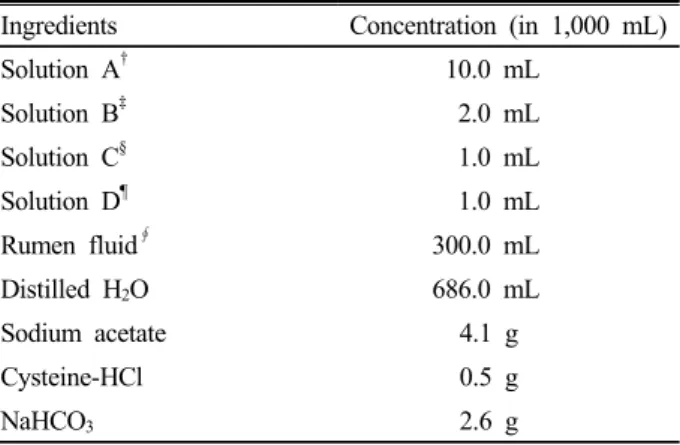
Table 1. Composition of the medium for mixed methanogens used in the experiment.
Ingredients Concentration (in 1,000 mL)
Solution A† 10.0 mL
Solution B‡ 2.0 mL
Solution C§ 1.0 mL
Solution D¶ 1.0 mL
Rumen fluid∮ 300.0 mL
Distilled H2O 686.0 mL
Sodium acetate 4.1 g
Cysteine-HCl 0.5 g
NaHCO3 2.6 g
†Solution A : NH4Cl 100 g, NaCl 10 g, MgCl2․6H2O 10 g, CaCl2
․2H2O 5 g in 1 L D.W., ‡Solution B : K2HPO4․3H2O 200 g in 1 L D.W., §Solution C : FeCl2․4H2O 2 g, H3BO3 0.05 g, ZnCl2 0.05 g, CuCl2․2H2O 0.038 g, MnCl2․4H2O 0.05 g, (NH4)6Mo7O24․ 4H2O 0.05g , AlCl2 0.05 g, CoCl2․6H2O 0.05 g, NiCl2․6H2O 0.092 g, Ethylenediaminetetraaetate 0.5 g, Concentraed HCl 1 mL, Na2SeO3․5H2O 0.1 g in 1 L D.W., ¶Solution D : Biotin 2 mg, Folic acid 2 mg, Pyridoxine hydrochioride 10 mg, Riboflavin 5 mg, Thiamine 5 mg, Nicotinic acid 5 mg, Pantothenic acid 5 mg, Vitamin B12 0.1 mg, p-aminobenzoic acid 5 mg, Thioctic acid 5 mg in 1 L D.W., ∮Rumen fluid was clarified by centrifugation (13,000 × g), autoclaving and recentrifugation to obtain a clear yellow solution.
메탄생성단계 (methanogenesis)로 구분된다 (Lewrence and McCarty, 1967). 다단계의 미생물 반응 중 가수분해, 산생 성, 초산생성 단계를 거친 유기물은 초산과 수소 (H2)로 전 환되며, 메탄생성균 (Methanogens)에 의해 최종적으로 메 탄과 이산화탄소 (CO2)가 생산된다. 메탄생산과정에는 주로 H2를 기질로 이용하는 수소이용 메탄균 (Hydrogenotrophic methanogens)과 초산을 기질로 이용하는 초산이용 메탄균 (Acetoclastic methanogens)에 의해 이루어지고, 메탄의 약 72%가 초산으로부터 전환되는 것으로 보고되고 있다 (Leslie Grady et al., 1999). 이러한 혐기적 메탄생성은 기질의 조 성분 (단백질, 지방, 탄수화물 및 리그닌 등)의 함량과 혐기 소화 중에 발생되는 저해물질의 발생정도에 영향 받는다 (Angelidake and Ahring, 2000). 특히 혐기소화 과정에서 가수분해 과정은 첫 번째 혐기적 분해반응 단계로서 일반적 으로 입자성 또는 교질성 유기물의 분해에 가장 오랜 시간 이 요구되는 율속단계 (Rate limiting step)로 작용한다 (van Leier et al., 2001). 이러한 이유로 혐기소화에서 원료의 고 농도, 고부하 투입에 한계가 있으며, 전체 혐기소화조의 용 적이 커지는 문제가 발생한다 (Gijen et al., 1986). 따라서 여러 연구자들에 의해 고분자 유기물을 물리적, 화학적으로 전처리하거나 (Shin et al, 1992), 반응조 내에 미생물 보유 량을 증가시키는 방법으로 가수분해 반응을 촉진시켜 소화 조 효율을 증진시키는 방법이 연구되고 있다. 또한, 가수분 해 반응에 활성이 큰 가수분해 미생물을 선별한 뒤 혐기소 화에 적용하여 혐기소화 효율을 향상시키는 연구도 진행되 고 있다 (Muller and Trosch, 1986). 소와 같은 반추동물의 반추위 내 존재하는 미생물들은 셀룰로오스 (Cellulose) 등 의 고분자 물질을 효율적으로 가수분해할 수 있으며 (Gijen et al., 1986), 이러한 반추위 미생물을 활용한 농산 바이오 매스의 혐기소화효율 증진 연구가 제지슬러지, 농축산 바이 오매스 및 유기성 고형폐기물 등을 대상으로 진행되어 대부 분의 경우에 있어서 혐기소화효율을 증진시키는 것으로 보 도되고 있다 (Gijen et al., 1986).
따라서, 본 연구에서는 셀룰로오스계 바이오매스의 혐기 소화 효율 증진을 위한 방법으로 가수분해 미생물 투입 영 향을 파악하기 위하여 초산 선택성 배지 (acetate selection medium)를 이용하여 메탄생성에 직접적으로 관여하는 초 산이용 메탄균을 우점화시킨 후, 셀룰로오스 가수분해 반응 에 활성이 뛰어난 반추위 내 섬유소 분해균인 Fibrobacter succinogenes, Ruminococcus flavefacien 및 Ruminococcus
albus를 이용하여 셀룰로오스를 기질로 하여 메탄생산퍼텐
셜을 평가하였다. 메탄생산퍼텐셜의 측정은 회분식 혐기반 응기를 이용하였으며, 각각의 섬유소 분해 미생물 배양액을 첨가하였을 때, 메탄생산퍼텐셜 (Biochemical methane potential;
BMP)의 변화를 분석하였다.
재료 및 방법
시험재료 본 연구에서는 혼합 메탄균 (methanogens)과 반추위 섬유소 분해균 배양액의 투입이 섬유소가 많이 포함 된 원료에 대한 메탄발생량에 미치는 영향을 평가하기위하 여 BMP 시험에 주로 이용되는 표준기질인 cellulose (No.
C5678, Sigma, USA)를 시험에 사용하였다. 혼합 메탄균 (methanogens)은 초산이용메탄균을 위한 선택배지에서 배 양하였으며, 섬유소 분해균은 반추위 내 대표적인 혐기성 섬유소 분해균인 Fiberobacter succinogenes H23 (KCTC 15118), Ruminococcus albus Hungate (ATCC 27211) 및 Ruminococcus flavefaciens sijpesteijn (ATCC 19208)을 시험에 사용하였 다. 혼합 메탄균의 배양은 Angelidaki et al. (1990)이 제시 한 BMP용 메탄균 배지를 참고하여 Table 1과 같이 초산이 용메탄균을 선택배양 할 수 있게 변형하여 사용하였으며, 반추위 섬유소 분해균의 배양은 Table 2와 같이 D-(+)-cellobiose (No. C7252, Sigma, USA)를 배지의 0.5% 수준으로 첨가한 배지 (Dehority’s artificial (DA) medium; Dehority, 1963) 을 이용하였다. 초산이용 메탄균을 선택적으로 배양하기 위 해 양돈분뇨를 기질로 하는 혐기소화시설 (안성 일죽)에서 소화액을 채취하여 초산이용 메탄균 선택배지에 접종하여
Table 2. Composition of Dehority’s artificial medium.
Ingredients Concentration (in 100 mL)
Mineral I solution† 20.0 mL
Mineral II solution‡ 20.0 mL
Resazurine§ 0.1 mL
Vitamin mixture¶ 1.0 mL
VFA solution∮ 6.7 mL
Hemin solution∫ 0.1 mL
Cellobiose 0.5 g
Amicase 0.2 g
8% Na2CO3 5.0 mL
2.5% Cysteine-HCl 0.1 mL
†Mineral Ⅰ solution : KH2PO4 4.5g in 1 L D.W., ‡Mineral Ⅱ solution : CaCl2 0.25 g, MgSO4 0.25 g, NaCl 4.5 g, MnSO4․H2O 0.10 g, FeSO4․7H2O 0.10 g, CoCl2․6H2O 0.01 g in 1 L D.W.,
§Resazurine 0.1% solution : Resazurine 0.1g in 100 mL D.W.,
¶Vitamin solution : ① Pyridoxine HCl 0.20 g, riboflavin 0.20 g, thiamine HCl 0.20 g, nicotinic acid amide 0.20 g, Ca-d-pantothenate 0.20 g, para-amino benzoic acid 0.01 g, stock solution 1.0 mL in 1 L D.W., ② stock solution : Folic acid 0.125 g, biotin 0.125 g, cobalamine 0.125 g in 25 mL D.W., ∮VFA solution : Acetic acid 17 mL (2.9 × 10⁻²M), propionic acid 6 mL (8.0 × 10⁻³M), and n-valeric, isovaleric and DL-α-methylbutyric acids, 1 mL each (9
× 10-4M), ∫Hemin solution : Dissolve 50 mg hemin in 1 mL 1N NaOH and make to 100 mL with D.W.
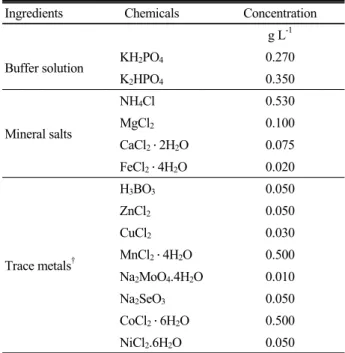
Table 3. Composition of basic anaerobic medium for the biochemical methane potential assay in the experiment.
Ingredients Chemicals Concentration g L-1
Buffer solution KH2PO4 0.270
K2HPO4 0.350
Mineral salts
NH4Cl 0.530
MgCl2 0.100
CaCl2․2H2O 0.075 FeCl2․4H2O 0.020
Trace metals†
H3BO3 0.050
ZnCl2 0.050
CuCl2 0.030
MnCl2․4H2O 0.500 Na2MoO4.4H2O 0.010
Na2SeO3 0.050
CoCl2․6H2O 0.500 NiCl2.6H2O 0.050
†Trace metals are prepared as the stock solution (×1,000).
일주일 간격으로 3번 계대배양 한 후 혼합 메탄균 배양액으 로 사용하였으며, 각각의 반추위 섬유소 분해균은 DA 배지 에서 48시간 배양한 후 그 배양액을 이용하였다. 혼합 메탄
균과 섬유소 분해균들은 모두 38℃에서 배양하였다. BMP시 험에 배양액을 첨가할 때는 각 균들의 총 균수는 혼합 메탄 균, R. albus, R. flavefaciens 및 F. succinogenes 각각 6.34, 2.89, 2.98 및 3.18 log cfu-1 mL-1 이었다.
BMP 시험 시험구의 처리는 멸균증류수를 첨가한 대조구 (Control)와 각각의 미생물 배양액을 첨가한 혼합 메탄균 첨 가구 (M), F. succinogenes 첨가구 (FS) R. flavefaciensn 첨 가구 (RF), R. albus 첨가구 (RA) 및 RA+FS 혼합첨가구 (RA +FS) 와 M+RA+FS 혼합 첨가구 (M+RA+FS)로 총 7개 처리 구로 각 처리구별 3반복으로 진행하였다. 미생물 배양액의 첨가량은 식종액과 기초혐기배지 (anaerobic basic medium) 혼합액 50 mL에 1% (0.5 mL), 3% (1.5 mL) 및 5% (2.5 mL) 씩 첨가 하였으며, RA+FS와 M+RA+FS 혼합 첨가구는 미 리 멸균하여 준비한 50 mL serum bottle에 각 미생물의 배 양액을 10 mL씩 동일 량을 혼합한 후 첨가용 배양액으로 사 용하였다. BMP 시험에서 혐기성 미생물이 이용할 영양물질 의 공급을 위하여 Shelton and Tiedje (1984)의 방법을 따라 기초혐기배지를 조제하였다 (Table 3). 조제한 기초혐기배 지에 1N NaOH와 1N HCl을 이용하여 pH를 7.0으로 조정하 였고, 미생물 발효반응에 의한 급격한 산형성에 따른 pH 저 하를 억제하기 위해 중탄산염 (NaHCO3)을 1.2 g L-1 넣어 준 후 질소 가스로 충분히 주입하여 배지내의 산소를 제거 하였다. 메탄 생산 퍼텐셜의 측정을 위한 회분식 혐기반응 기는 120 mL serum bottle을 이용하였으며, 각 serum bottle 에 먼저 반응기질 (cellulose)을 휘발성고형물 (VS) 기준 2 g L-1 로 (Owen et al., 1979) 정량하여 투입하였고 여기에 혐 기기초배지를 혐기조건을 유지하면서 45 mL 씩 분주하고 butyl rubber stopper로 밀봉한 후 고압멸균기를 이용하여 121℃에서 10분 정도 멸균하였다. 멸균 후 5 m3 day-1 처리 규모의 혐기소화시설 (경기도, 안성)에서 채취한 양돈분뇨 소화액을 4겹의 거즈로 여과한 후 그 여액을 각 bottle에 5 mL 씩 접종하여 각 처리별로 미생물 배양액을 첨가하였다.
이러한 과정은 모두 산소를 차단하기 위해 질소가스로 충진 하면서 혐기적 조건에서 수행하였으며, serum bottle을 butyl rubber로 밀봉한 후 38℃를 유지하는 배양기에서 40 일간 배양하였다. 배양기간 중 주기적으로 바이오가스 생산 량과 바이오가스 성상을 측정하였다.
분석방법 메탄가스발생량 측정을 위한 회분식 혐기반응 기의 가스발생량은 수주차식 가스측정기를 이용하여 측정 하였다 (Willams, 1996; Beuvink, 1992). 가스의 성분분석 은 발생가스 중 5 mL을 가스포집용 주사기로 채취하여 TCD (Thermal conductivity detector)가 장착된 가스크로마토그 래피 (GC2010, Shimazhu, Japan)를 이용하였다. 가스성분 은 CO2, H2 및 CH4를 분석하였으며, GC의 조건은 주입부 (Injector) 150℃, 컬럼부 (Column) 90℃, 검출부 (Detecter) 200℃이었으며, 분석용 column은 packed column (Shincarbon
Table 4. Effects of supplementary levels of the cultures of mixed methanogens and rumen cellulolytic bacteria on cumulative biogas production (mL) in the BMP assay using cellulose as a substrate and anaerobic digestate with pig slurry as inoculum during an incubation period of 40 days at 38℃.
Treatment Supplementation levels (of total volume)
1% 3% 5% SEM
--- mL ---
Control 54.3a∫ 53.7ab 53.8b 0.53
M† 52.8ab 50.9bc 49.5c 0.71
FS‡ 52.2b 54.5a 60.3a 0.91
RF§ 52.8ab 55.1a 54.0b 0.58
RA¶ 48.3c 47.0d 46.6c 0.47
RA+FS 48.9c 48.6cd 49.3c 0.33
M+RA+FS 46.4d 48.0cd 46.6c 0.44
SEM∮ 1.77 1.78 2.07
†M, mixed methanogens, ‡FS, Fibrobacter succinogenes, §RF, Ruminococcus flavefaciens, ¶RA, Ruminococcus albus, ∮SEM, standard error of means, ∫Means in the same column with different superscripts differ significantly (p<0.05).
ST 50/80, Shimazhu, Japan)을 사용하였다. 이동상 (Carrier gas)으로는 He 가스를 사용하였다. BMP 시험 전과 후 배양 액의 성상을 조사하기 위하여, pH, 총고형물 (Total solid, TS) 및 휘발성 고형물 (volatile solid, VS)를 APHA (1998)의 standard methods에 따라 분석하였다.
통계분석 VS의 분해율과 총누적바이오가스 및 메탄가스 의 발생량에 대하여 미생물 처리간 3반복의 data를 수집하 여 SAS package (SAS, 1999)를 이용하여 분산분석 (general linear model (GLM) procedure)을 실시하였으며, 평균간 차 이는 Duncan (1955)의 다중검정법에 의해 95% 유의수준으 로 분석하였다.
결과 및 고찰
메탄 발생량 Table 4에서 BMP 시험 40일 동안 혼합 메탄 균과 혐기성 섬유소 분해균 배양액의 첨가량에 따른 총 바 이오가스 발생량을 나타내었다. 1% 미생물배양액 첨가하였 을 때 대조구 (Control)가 1%의 FS (Fibrobactor succinogenes 첨가구), RA (Ruminococcus albus 첨가구), RA+FS (R. albus와 F. succinogenes 혼합첨가구) 및 M+RA+FA (혼합 methanogens, R. albus와 F. succinogenes 혼합첨가구)에 비하여 각각 3.8, 11.0, 9.9 및 14.5%의 높은 가스발생량을 나타내었다 (p<0.05), 하지만, 1% FS 및 R. flavefaciens 첨가구 (RF)의 총 바이오가스 발생량은 대조구와 통계적으로 유의한 차이 가 없었다. 특히, 1%의 미생물 배양액 처리구들 중 M+
RA+FS가 가장 가스발생량이 낮았다. 3%의 미생물 배양액 첨가구들에 대한 결과에 있어서, FS와 RF가 M, RA, RA+FS 및 M+RA+FS에 비하여 각각 6.7 및 7.7%, 13.8 및 14.7%, 10.9 및 11.8% 그리고 12.0 및 12.9%로 가스발생량이 높게 나타났다 (p < 0.05). 그러나 3% FS와 RF는 대조구의 가스 발생량과는 1% 첨가구에서와 같이 유의적으로 차이가 없었 다. 5%의 미생물 배양액 첨가구들 중 FS가 가장 높은 가스 발생량을 나타내었다 (p < 0.05). 특히 1% 및 3% 배양액 첨 가에서의 가스발생량 차이보다 FS의 첨가량을 5%로 증가하 였을 때 다른 처리구보다도 월등히 높은 가스발생량을 보이 고 있으며, 이러한 차이는 FS보다 대조구, M, RF, RA, RA+FS 및 M+RA+FS가 각각 10.8, 17.9, 10.4, 22.7, 18.2 및 22.7%로 더 적은 량의 바이오가스를 발생시켰다. 각 처 리구별 배양액을 1%, 3% 및 5%로 증가하여 첨가하더라도 총 바이오가스 생산량에는 배양액 증가에 따른 유의적인 차 이는 나타나지 않았다.
본 실험은 섬유소 분해력이 강력한 미생물을 바이오가스 생산을 위한 BMP시험에 첨가하면 바이오가스 생산 및 메탄 생산량을 증가시키는 지를 조사하기 위해 실행되었다. 특 히, F. succinogenes, R. albus 및 R. flavefaciens는 혐기성
박테리아 중 반취위내에서 가장 섬유소 분해력이 강한 박테 리아로 알려져 있다 (Hungate, 1963). 본 실험에서 미생물 혼합첨가구 중 R. albus와 R. flavefaciens를 혼합한 첨가구 가 없는 이유는 R. albus가 생산하는 생장억제물질에 의해 R. flavefaciens이 억제받기 때문에본 실험의 처리구에서는 제외하였다 (Odenyo, 1994). Table 4에서 총 바이오가스 생 산량을 보게 되면 R. albus가 첨가된 모든 처리구는 총 가스 발생량이 대조구보다 낮은 것으로 나타났다. 이것은 비록 반추위가 아닌 양돈슬러리를 이용한 혐기소화액을 식종액 으로 사용한 BMP시험에서도 발효과정에 배양과정 동안 이 균에 의한 길항작용를 나타내고 있음을 알 수 있고, 특히, 기질을 cellulose로 사용하였을 때 더 효과가 크게 나탄 것 으로 생각된다. R. albus 첨가한 처리구 이외에도 혼합 메탄 균이 3%와 5% 첨가된 처리구도 총 바이오가스 발생량이 낮게 나타나고 있는데, 회분식 미생물 배양방법인 BMP시험 의 배양초기 단계에서 methanogen을 첨가하는 효과는 총 가스 발생에는 미미한 것으로 생각된다. 따라서 회분식 혐 기소화 초기 배양단계에서는 메탄균보다는 cellulose의 가수 분해를 시키는 섬유소 분해균의 영향이 더 중요한 것으로 생각된다. 하지만, 연속식 혐기소화조에서는 가수분해과정 과 메탄생성과정이 동시에 일어나기 때문에 methanogen의 첨가효과도 있을 수 있을 것으로 판단되나 이러한 효과는
Table 5. Effects of supplementary levels of the cultures of mixed methanogens and rumen cellulolytic bacteria on cumulative methane production (mL) in the BMP assay using cellulose as a substrate and anaerobic digestate with pig slurry as inoculum during an incubation period of 40 days at 38℃.
Treatment Supplementation levels (of total volume)
1% 3% 5% SEM
--- mL ---
Control 3.19ab∫ 2.78c 3.13b 0.097
M† 2.91b 3.02bc 3.19b 0.096
FS‡ 3.18abA∬ 3.66aAB 4.32aA 0.214
RF§ 3.42a 3.61a 3.57b 0.076
RA¶ 3.12ab 2.85c 3.15b 0.086
RA+FS 2.98abB 3.44abA 3.60bA 0.105
M+RA+FS 3.15abAB 3.04bcB 3.33bA 0.053
SEM∮ 0.66 0.76 1.06
†M, mixed methanogens, ‡FS, Fibrobacter succinogenes, §RF, Ruminococcus flavefaciens, ¶RA, Ruminococcus albus, ∮SEM, standard error of means, ∫Means in the same column with different superscripts differ significantly (p<0.05), ∬Means in the same row with different superscripts differ significantly (p<0.05).
앞으로 추가로 조사되어야 할 것이다.
Table 5에서 BMP 시험 40일 동안 혼합 메탄균과 혐기성 섬유소 분해균 배양액의 첨가량에 따른 누적 메탄가스발생 량을 나타내었다. 1%의 미생물배양액을 혐기소화 반응기에 첨가하였을 때 FS가 M보다 메탄생산량이 유의적으로 증가 하였고 (p<0.05) 나머지 처리구에 대하여는 차이가 없었다.
3%의 미생물 배양액을 첨가하였을 때에는 FS와 RF가 총 바 이오가스 발생량에서와 같이 가장 많은 메탄가스를 생산하 였는데 FS와 RF 각각 대조구, M, RA 및 M+RA+FS에 대하 여 24.0 및 23.0%, 17.5 및 16.3%, 22.1 및 21.1% 그리고 16.9 및 15.8%로 메탄가스 발생량이 증가하였다. RA는 이들 두 처리구에 비하여 각각 6.0 및 4.7%의 낮은 메탄발생량을 나타내었지만 통계적인 차이는 없었다 (p>0.05). 5%의 미생 물 배양액 첨가구들 중 FS가 총 바이오가스 발생량과 유사 하게 가장 높은 메탄발생량을 나타내었다 (p<0.05). 5% FS 의 메탄가스 발생량은 대조구, M, RF, RA, RA+FS 및 M+
RA+FS 보다 각각 27.5, 26.2, 17.4, 27.1, 16.7 및 22.9% 높 았다. 각 처리구별 배양액을 1%, 3% 및 5%로 증가하여 첨가 하였을 때, FS 및 RA+FS에서 배양액의 첨가수준이 증가할 수록 메탄가스의 발생량이 증가하는 것으로 나타났다. FS 는 5% 첨가구에서 1% 첨가구보다 유의적으로 높은 메탄가 스 발생량을 나타내었으며 (p<0.05), RA+FS는 3%와 5% 첨 가구가 1% 첨가구에 대하여 유의적으로 높은 메탄가스 발생 량을 나타내었다 (p<0.05). 결국 모든 처리구에 있어 5% F.
succinogenes 배양액 첨가구가 가장 많은 메탄가스를 생산
하였다. 이러한 메탄 발생량의 증가는 결국 총 바이오가스 발생량과 상관관계가 있으며, 초기 섬유소의 가수분해단계 가 본 BMP시험에서는 중요한 율속단계임을 보여주고 있다.
F. succinogenes는 Hungate(1947, 1950)에 의해 Bacteroides succinogenes로 분리 되었으며, F. succinogenes는 전분, xylan 및 cellulose와 같은 다당류를 소화 시킬 수 있는 능 력이 있으며 (Bryant et al., 1958), 편성 혐기성이며 그람음 성(-), 간균의 형태로 발효시 초산 (acetic acid)과 숙신산 (succinic acid)을 생성한다 (Dehority, 2003). 본 실험에 이 용된 세 종류의 섬유소 분해균 중 가장 섬유소 분해력이 강 하여 메탄생성을 위한 초기단계인 섬유소 기질의 가수분해 단계에 중요한 역할을 하고 있음을 본 실험을 통해 알 수 있 었다. 특히 F. succinogenes 가 cellulose로부터 succinate 를 생산할 때 H+를 필요로 하므로 hydrogenotrophic methanogens (수소이용 메탄생성균)과 경쟁적 관계가 있지만 (Schulman and Vanentino, 1976), 다른 한편으로는 혐기소화에서 메탄 생산의 전구물질로 72%를 차지하는 acetate를 제공하기 때 문에 (Leslie Grady et al., 1999) 가수분해과정에서 가장 중 요한 율속단계를 조절하는 역할을 하며, 메탄생성 단계에서 acetate를 이용하는 methanogen에 중요한 영양소를 제공하 는 역할을 하여 다른 처리구에 비하여 메탄생산을 증가시킨 것으로 생각된다. 본 실험에서는 회분식 배양과정에 있어 가수분해과정이 중요한 율속단계임을 나타내고 있어 앞으 로 연속 혐기소화 실험을 통해 F. succinogenes가 메탄생성 에 어느 정도 영향을 미치는 지는 조사되어야 할 것으로 생 각된다. FS가 첨가된 다른 처리구인 RA+FS 및 M+RA+FS 에 있어서는 R. albus에 의해 총가스 발생의 억제효과로 메 탄가스생산량이 증가하지 않은 것으로 생각된다.
TS 및 VS 분해율 BMP 시험 시작 전과 종료 후 TS량을 조사하여 각 처리구별 TS 분해율을 Table 6에 나타내었다.
1% 미생물 배양액을 첨가하였을 FS가 M에 대하여 유의적으 로 높은 분해율을 나타내었으나 (p < 0.05), 나머지 다른 처 리구들에 대하여 유의한 차이가 없었다. 3%의 미생물 배양 액 첨가구들에 대한 결과에 있어서도 1% 첨가 때와 유사한 결과를 보였는데, FS의 분해율이 63.2%로 M과 대조구에 대 하여 각각 19.4 및 14.7%로 유의적으로 높았으나 (p<0.05), 다른 첨가구에 대하여는 유의적인 차이는 없었다. 5%의 미 생물 배양액 첨가구들 중 FS가, RF 및 RA 즉, 세 종류의 섬 유소 분해균을 단독배양한 배양액을 첨가하였을 때 M보다 높은 TS분해율을 나타내었다 (p < 0.05). 전반적으로 미생 물 배양액의 첨가량이 증가할수록 TS분해율이 증가하는 경 향을 나타내었으나, M+RA+FA에서는 3% 첨가가 1% 첨가구 에 비하여 높은 분해율을 나타내었고 5% 첨가구와는 차이 가 없었다. 또한, 40일 동안의 장기간 BMP시험을 통해 cellulose를 기질로 하였을 때 TS 분해율은 64%가 최대로 나타나 더 이상의 고형물의 분해가 일어나지 않았고 가스
Table 6. Effects of supplementary levels of mixed methanogens and rumen cellulolytic bacteria on total solid digestion efficiency (%) in the BMP assy using cellulose as a substrate during an incubation period of 40 days at 38℃.
Treatment Supplementation levels (of total volume)
1% 3% 5% SEM
--- % ---
Control 53.0ab∫ 48.5bc 51.6ab 2.34
M† 42.8b 43.8c 43.9b 1.94
FS‡ 60.0a 63.2a 64.2a 1.21
RF§ 47.2ab 54.2abc 59.0a 2.67
RA¶ 53.1ab 53.8abc 60.8a 1.86
RA+FS 52.9ab 56.1ab 56.6ab 1.43
M+RA+FS 51.4abB∬ 59.6abA 56.8abAB 1.73
SEM∮ 1.77 1.78 2.07
†M, mixed methanogens, ‡FS, Fibrobacter succinogenes, §RF, Ruminococcus flavefaciens, ¶RA, Ruminococcus albus, ∮SEM, standard error of means, ∫Means in the same column with different superscripts differ significantly (p<0.05), ∬Means in the same row with different superscripts differ significantly (p<0.05).
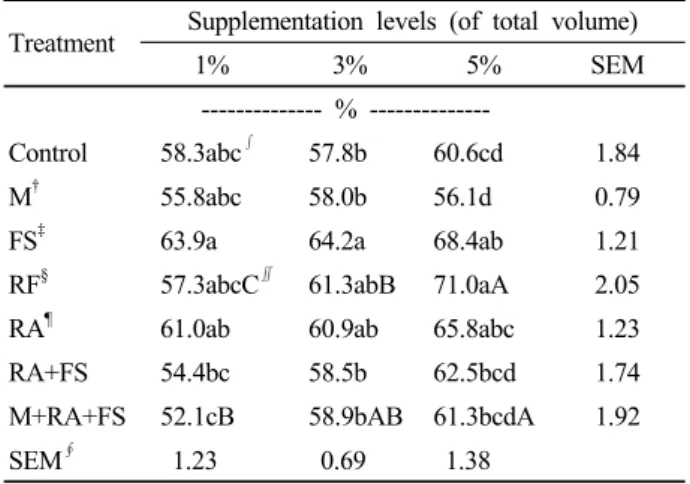
Table 7. Effects of supplementary levels of mixed methanogens and rumen cellulolytic bacteria on volatile solid digestion efficiency (%) in the BMP assy using cellulose as a substrate during an incubation period of 40 days at 38℃.
Treatment Supplementation levels (of total volume)
1% 3% 5% SEM
--- % ---
Control 58.3abc∫ 57.8b 60.6cd 1.84
M† 55.8abc 58.0b 56.1d 0.79
FS‡ 63.9a 64.2a 68.4ab 1.21
RF§ 57.3abcC∬ 61.3abB 71.0aA 2.05
RA¶ 61.0ab 60.9ab 65.8abc 1.23
RA+FS 54.4bc 58.5b 62.5bcd 1.74
M+RA+FS 52.1cB 58.9bAB 61.3bcdA 1.92
SEM∮ 1.23 0.69 1.38
†M, mixed methanogens, ‡FS, Fibrobacter succinogenes, §RF, Ruminococcus flavefaciens, ¶RA, Ruminococcus albus, ∮SEM, standard error of means, ∫Means in the same column with different superscripts differ significantly (p<0.05), ∬Means in the same row with different superscripts differ significantly (p<0.05).
발생량과 비교하였을 때 이러한 분해는 배양 초기에 주로 일어났음을 알 수 있었다.
Table 7에 메탄생성균 및 섬유소분해균 배양액의 첨가 및 첨가수준에 따른 VS분해율을 나타내었다. 전반적으로 VS분해율은 TS분해율과 유사한 경향을 보였다. 먼저, 1%
첨가구에서 FS가 RA+FS 및 M+RA+FS에 대하여 각각 9.5 및 11.8%로 높은 분해율을 나타내었다 (p<0.05). FS가 TS분 해율에서는 M에 대하여 유의적으로 높았으나, VS 분해율은 8.1%의 차이에도 불구하고 유의성이 나타나지는 않았다 (p>0.05). 3%의 미생물 배양액을 첨가하였을 때에도 FS가 가장 높은 VS분해율을 나타내었으며 대조구, M, RA+FS 및 M+RA+FS보다 각각 6.4, 6.2, 5.7 및 5.3%로 유의적으로 높았다 (p<0.05). 5%의 미생물 배양액을 첨가하였을 때 VS 분해율은 RF가 가장 높았으며, FS와는 유의적으로 차이가 없었고, control, M, RA+FS, M+RA+FS보다 높은 VS분해 율을 나타내었다 (p<0.05). 본 BMP시험결과 전체 처리구에 있어 최대 유기물의 분해율은 71.0%로 나타났다.
1970년대 후반부터 in vitro 가스발생량의 측정은 섬유질 의 소화율 및 발효특성을 결정하는 중요한 인자로 알려져 왔다 (Theodorout et al., 1994; Theodorout et al., 1998).
그러므로 TS 및 VS 분해율은 총 바이오가스 발생량과 상관 관계가 있음을 알 수 있다. 본 연구에서도 FS의 높은 가스 발생량은 TS 및 VS 분해율과 관련이 높았지만, 다른 처리구 에서는 일부 경향만 있고 상관성이 높은 편은 아니었다. 특 히 가스생산에는 고형물보다는 유기물이 직접적인 관련이 있기 때문에 유기물 분해율이 총 바이오가스 생산 및 메탄
생산에 관련성이 있을 것으로 생각된다. 하지만 비록 FS에 대하여는 높은 상관관계가 있었지만 다른 처리구에 대하여 가스발생량과 분해율 사이에 높은 상관관계가 나타나지 않 았던 것은 본 실험에서 이용된 순수 cellulose기질보다는 조 사료와 같은 복잡한 화학적 특성을 가진 기질에서의 가스발 생량 측정이 다른 발효특성을 평가하는데 유용한 방법이기 때문으로 생각된다 (Rymer and Givens, 2002).
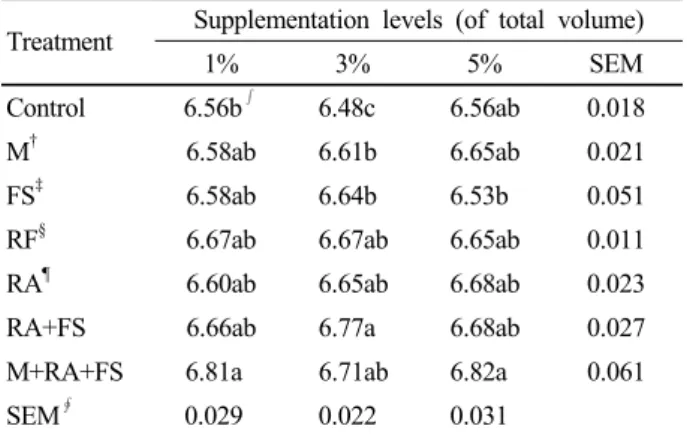
최종 pH 변화 혐기소화 과정에서 pH는 매우 중요한 인자 가 된다. 특히 혐기소화를 통하여 메탄생성균의 점유율을 높이기위해서는 pH 6.0∼8.0 정도를 유지해야 하고, pH 6.0 이하가 되면 메탄생성균에 있어 독성작용을 하는 것으 로 알려져 있다(Speece, 1996). Table 8은 40일 시험종료시 점에서 측정한 각 처리구별 pH를 제시하였다. 1% 배양액 첨 가에서는 M+RA+FS가 6.81로 대조구와 비교하여 유의적으 로 높았으나 (p<0.058), 다른 처리구에 대하여는 차이가 없 었다. 3% 배양액 첨가하였을 때에도 대조구가 가장 낮은 pH 값 (6.48)을 나타내었으며 (p<0.05), M 및 FS는 RA+FS 와 비교하여 유의적으로 낮은 pH 값을 나타내었다 (p<0.05). 5% 첨가구들 중에서는 FS가 M+RA+FS에 비교하 여 유의적으로 낮은 pH를 나타내었다 (p<0.05). 배양액 첨 가수준에 따른 pH변화는 통계적으로 유의한 차이가 나타나 지 않았다. 본 BMP시험에서는 최종 측정된 pH의 범위가 미 생물들의 성장을 억제할 정도로 낮지 않아 과발효가 진행되 지 않았음을 알 수 있었다. BMP시험은 혐기 회분식 반응기 를 이용하여 유기물의 메탄생산량을 측정하는 방법으로 혐 기소화조의 설계, 설치 및 운영 기초자료를 제공해주는 중
Table 8. Effects of supplementary levels of mixed methanogens and rumen cellulolytic bacteria on the final pH in the BMP assay using cellulose as a substrate during an incubation period of 40 days at 38℃.
Treatment Supplementation levels (of total volume)
1% 3% 5% SEM
Control 6.56b∫ 6.48c 6.56ab 0.018
M† 6.58ab 6.61b 6.65ab 0.021
FS‡ 6.58ab 6.64b 6.53b 0.051
RF§ 6.67ab 6.67ab 6.65ab 0.011
RA¶ 6.60ab 6.65ab 6.68ab 0.023
RA+FS 6.66ab 6.77a 6.68ab 0.027
M+RA+FS 6.81a 6.71ab 6.82a 0.061
SEM∮ 0.029 0.022 0.031
†M, mixed methanogens, ‡FS, Fibrobacter succinogenes,
§RF, Ruminococcus flavefaciens, ¶RA, Ruminococcus albus,
∮SEM, standard error of means, ∫Means in the same column with different superscripts differ significantly (p<0.05).
요한 실험이다. 그러나, 기질의 첨가량이 식종제와 비교하 여 지나치게 많을 경우 유기물의 과부화로 인한 적정 메탄 발효과 이루어지지 않고 과발효에 의한 지나친 산생성에 의 해 pH저하로 발효가 중단될 수 있는 경우가 있다. 특히, Chynoweth et al. (1993)은 BMP시험을 통해 초본과 작물 류, 목질계 원료, 도시폐기물을 이용하였을 때 최대의 메탄 생산량을 얻기 위한 기질과 식종제의 비율 (S/I비)이 0.5∼
1.0범위라고 보고하였다. Hashimoto (1989)는 밀짚을 이용 한 BMP시험에서 S/I비를 0.03∼10.91로 하였을 때 4.0이상 에서는 낮은 메탄생산량을 보였다고 하였다. 본 실험에서의 S/I비는 약 1 정도로 앞에서 보고된 것과 비교하였을 때 적 정한 기질첨가량임을 알 수 있어 적정속도의 발효로 pH가 유지되었음을 알 수 있다. 혐기소화시 배양초기에는 휘발성 지방산의 생성에 의해 pH가 감소할 수 있지만 배양시간이 5 일 이상 진행되면 메탄생성균들이 휘발성지방산 특히 acetic acid를 급속히 이용하기 시작하기 때문에 배양액의 pH가 증 가되고 안정화 될 수 있다 (Geradi, 2003). 그래도 메탄생산 을 위한 pH가 적정수준 이상에서 다른 처리구에 비교하여 낮다는 것은 많은 량의 발효산물이 발생되었고 바이오가스 및 메탄발생도 증가하였다는 것을 간접적으로 나타내고 있 다. 본 실험에서도 Table 8의 처리구별 배양종료시점 pH와 Table 4 및 5에서 제시된 총 바이오가스 및 메탄생산량과 비교하였을 때 FS에서 낮은 pH 및 높은 총 바이오가스 발생 량 및 메탄생산량을 나타내어 pH와 가스 생산량과는 높은 상관관계가 있음을 보여주고 있다.
본 실험은 메탄생성균 및 혐기성 섬유소 분해균의 첨가 가 메탄가스의 발생량을 증가시킬 수 있는 지를 조사하고자 수행되었다. 메탄생성의 두 가지 율속단계인 가수분해단계
와 메탄생성단계에 관여하는 미생물들을 첨가하였을 때 메 탄생성에 효과가 있을 것이라는 가설하에 BMP시험이 수행 되었고, 결론적으로 회분식 배양에서는 메탄생성단계보다 는 가수분해단계에서 특히, F. succinogenes 배양액의 첨가 량이 증가할수록 메탄의 생성량을 증가시킴을 알 수 있었 다. 본 연구는 단순한 회분식 배양시험이기 때문에 앞으로 연속 혐기소화과정에서 미생물 첨가의 효과에 대한 연구와 또한 F. succinogenes 배양액내 어떠한 인자가 영향을 미쳤 는지에 대한 추가 연구가 필요할 것으로 생각된다.
요 약
본 연구는 메탄생성에 직접적으로 관여하는 혼합 메탄균 과 셀롤로스 등의 고분자 물질의 가수분해 반응에 활성이 뛰어난 반추위 내 혐기성 섬유소분해균 중에서 대표적인 Fibrobacter succinogenes, Ruminococcus flavefaciens 및 Ruminococcus albus를 biochemical methane potential (BMP) 시험에 첨가하였을 때 메탄 발생에 미치는 영향을 조사하고 자 수행되었다. BMP시험은 멸균증류수를 첨가한 control과 각각의 미생물 배양액을 첨가한 혼합 메탄균 첨가구 (M), F. succinogenes 첨가구 (FS) R. flavefaciens 첨가구 (RF), R. albus 첨가구 (RA) 및 RA+FS 혼합첨가구와 M+RA+FS 혼합 첨가구로 총 7개 처리구로 각 처리구별 3반복으로 진 행되었다. 미생물 배양액의 첨가량은 식종액과 기초혐기배 지 (anaerobic basic medium) 혼합액 50 mL에 1% (0.5 mL), 3% (1.5 mL) 및 5% (2.5 mL) 씩 첨가 하였고 배양을 위한 기질로는 cellulose (2.0 g VS L-1)이 이용되었다. BMP 시험 을 위해 40일간 배양이 지속되었고 중온소화를 위해 38℃의 배양기에서 수행되었다. 실험의 결과 총 바이오가스 및 메 탄 발생량은 5% FS에서 다른 처리구와 비교하여 각각 10.4
∼22.7% 및 17.4∼27.5% 높았다 (p<0.05). 총고형물 (TS) 분해율도 가스발생 결과와 유사하였는데, 전반적으로 FS가 높게 나타났으며, 5% FS에서 64.2%로 가장 높았다. 휘발성 고형물 (VS) 분해율은 5% FS와 5% RF가 각각 68.4 및 71.0%로 가장 높았다. BMP 종료시 배양액내 pH는 모든 처 리구가 6.4이상으로 메탄발효에 큰 영향을 주지 않았음을 알 수 있었다. 결론적으로 본 실험의 결과 혐기소화에 대한 회분식 배양에서는 메탄생성단계보다는 가수분해단계에서 특히, F. succinogenes 배양액의 첨가량이 증가할수록 메탄 의 생성량을 증가시킴을 알 수 있었다.
사 사
본 논문은 농촌진흥청 공동연구사업 (과제번호: PJ0075 02042011)의 지원에 의해 이루어진 것임.
인 용 문 헌
Angelidaki, I. and B.K. Ahring. 2000. Methods for increasing the biogas potential from the recalcitrant organic matter contained in manure. Water Sci. Technol. 41:189-194.
Angelidaki, I., S.P. Petersen, and B.K. Ahring. 1990. Effects of lipids on thermophilic and anaerobic digestion and reduction of lipid inhibition upon addition of bentonite.
Appl. Microbiol. Biotechnolol. 33:469-472.
APHA. 1998. Standard methods for the examination of water and wastewater. (20th ed.) American Public Health Association, Washington, DC, USA.
Beuvink, J.M., S.F. Spoelstra, and R.J. Hogendrop. 1992. An automated method of measuring the time course of gas production of feedstuffs incubated with buffered rumen fluid. Neth. J. Agri. Sci., 40:401-407.
Bonmati A., X. Flotats, L. Mateu, and E. Campos. 2001.
Study of thermal hydrolysis as a pretreatment to mesophilic anaerobic digestion of pig slurry. Water Sci. Technol.
44:109-116.
Bryant, M.P., N. Small, C. Bouma, and I.M. Robinson. 1958.
Studies on the composition of the ruminal flora and fauna of young calves. J. Dairy Sci. 41:1747-1767.
Chynoweth, D.P., C.E. Turick, J.M. Owens, D.E. Jerger, and M.W. Peck. 1993. Biochemical methane potential of biomass and waste feedstocks. Biomass Bioenerg. 5:95-111.
Clemens, J., M. Trimborn, P. Weiland, and B. Amon. 2006.
Mitigation of greenhouse gas emissions by anaerobic digestion of cattle slurry. Agri. Ecosyst. Environ. 112:171-177.
Danish Energy Agency. 1992. Update on centralized biogas plants.
Dehority, B.A. 1963. Isolation and characterization of several cellulolytic bacteria from in vitro rumen fermentations. J.
Dairy Sci. 46:217-222.
Dehority, B.A. 2003. Rumen microbiology. Nottingham University Press, Nottingham, UK.
Duncan, D.B. 1955. Multiple range and multiple F tests.
Biometrics. 11:1.
Gerardi, M.H. 2003. The microbiology of anaerobic digesters.
John Wiley & Sons, Inc., New York, USA.
Gijen, H.J., K.B. Zwart, P.T., van Gelder, and G.D. Vogels.
1986. Continuous cultivation of rumen microorganisms, a system with possible application to the anaerobic degradation of lignocellulosic waste materials, Appl. Micro. Biotech.
25:155-162.
Hashimoto, A.G. 1989. Effect of inoculum/substrate ratio on methane yield and production rate from straw. Biol.
Wastes. 28:247-255.
Hungate, R.E. 1947. Studies on cellulose fermentation. III.
The culture and isolation of cellulose-decomposing bacteria from the rumen of cattle. J. Bacteriol. 53:631-645.
Hungate, R.E. 1950. The anaerobic mesophilic cellulolytic bacteria. Bacteriol. Rev. 14:1-49.
Hungate, R.E. 1963. Polysaccharide storage and growth efficiency in Ruminococcus albus. J. Bacteriol. 86:848-854.
Lawrence, A.W. and P.L. McCarty. 1967. Kinetics of methane fermentation in anaerobic waste treatment. Technical report No. 75. Stanford, Califonia, USA.
Leslie Grady, C.P., G.T. Daigger, and H.C. Lim. 1999.
Biological Wastewater Treatment (2nd ed). p. 599-604.
Marcel Dekker, Inc., NY, USA.
Lettinga, G. 2001. Digestion and degradation, air for life.
Water Sci. Technol. 44: 157-176.
Ministry of Environment. 2009. Environmental white paper.
ISBN 11-1480000-000586-10 (In Korean).
Muller, H.W. and W. Trosch, 1986. Screening of white-rot fungi for biological pretreatment of wheat straw for biogas production. Appl. Micro. Biotech. 24:180-185.
Odenyo, A.A., R.I. Mackie, and B.A. White. 1994. The use of 16S rRNA-targeted oiligonucleotide probes to study competition between ruminal fibrolytic bacteria: pure-culture studies with cellulose and alkaline peroxide-treated wheat straw.
Appl. Environ. Microbiol. 60:3697-3703.
Owen, W.P., D.C. Stuckey, J.B. Healy, L.Y. Young, and P.L.
McCarty. 1979. Bioassay for monitoring biochemical methane potential and anaerobic toxicity. Water Res.
13:485-492.
Rymer, C., and D.I. Givens. 2002. Relationships between patterns of rumen fermentation measured in sheep and in situ degradability and the in vitro gas production profile of the diet. Anim. Feed. Scie. Technol. 101:31-44.
SAS. 1999. Statistical Analysis Systems User’s Guide. (8th ed.) SAS Institute Inc. Raleigh, NC, USA.
Shelton, D.R. and J. Tiedije. 1984. General method for determining anaerobic biodegradation potential. Appl. Environ.
Microbiol., 47:850-857.
Schulman, M.D. and D. Valentino. 1976. Factors influencing rumen fermentation: effect of hydrogen on formation of propionate. J. Dairy. Sci. 59:1444-1451.
Shin, H.S. Y.C. Song, and K.S. Jun. 1992. Pretreatment processes for enhanced anaerobic digestion of food waste. p. 451-454.
In F. Cecchi et al. (ed.) Proceedings of international symposium on anaerobic digestion of solid waste. Venice, Italy.
Speece, R. 1996. Anaerobic biotechnology for industrial wastewaters. p. 29-58. Archae Press, Nashville, TN, USA.
Theodorou, M.K., D.R. Daivies, B.B. Nilsen, M.I.G. Lawrence, and A.P.J. Trinci. 1998. Principles of techniques that rely on gas measurement in ruminant nutrition. p. 55-63. E.R.
Deaville et al. (ed.) In vitro techniques for measuring nutrient supply to ruminants. (Occasional publication, No.
22). British Society of Animal Science, UK.
Theodorou, M.K., B.A. Williams, M.S. Dhanoa, A.B. McAllan,
and J. France. 1994. A simple gas production method using a pressure transducer to determine the fermentation kinetics of ruminant feeds. Anim. Feed. Sci. Technol. 48:185-197.
van Lier J.B., A. Tilche, B.K. Ahring, H. Macarie, R. Moletta, M. Dohanyo, L.W. Hulshoff Pol, P. Lens, and W. Werstraete.
2001. New perspectives in anaerobic digestion. Water Sci.
Techno. 43:1-18.
Williams, A., M. Amat-Marco, and M.D. Collins. 1996.
Pylogenetic analysis of Butyrivibrio strains reveals three distinct groups of species within the Clostridium subphylm of gram-positive bacteria. Int. J. Syst. Bacterol. 46:195-199.