• 검색 결과가 없습니다.

Appropriate Technologies for Municipal Solid Waste Management in Bantayan Island, Philippines

N/A
N/A
Protected

Academic year: 2021

Share "Appropriate Technologies for Municipal Solid Waste Management in Bantayan Island, Philippines"

Copied!
8
0
0

로드 중.... (전체 텍스트 보기)

전체 글

(1)

To whom corresponding should be addressed.

Tel : +82-43-868-3573 E-mail : [email protected]

https://doi.org/10.5855/ENERGY.2017.26.1.054

Appropriate Technologies for Municipal Solid Waste Management in Bantayan Island, Philippines

Kwang Sun Yu

1

, Thenepalli Thriveni

2

, Changsun Jang

3

, Ahn Ji Whan

3†

1

Department of Advanced Materials Technology and Research, Daesung Mining Development Inc., Yeongwol 33058, Korea

2

Hanil Cement, 302 Maepo-gil, Maepo-eup, Danyang-gun, Chungcheongbuk-do, Korea.

3

Green Technology Center Korea(GTC-K) 17th fl. Namsan Square Bldg., 173, Toegye-ro, Jung-gu, Seoul 04554, South Korea.

4
Mineral Resources Research Division, Korea Institute of Geosciences and Mineral Resources (KIGAM), 124, Gwahagno, Yuseong gu, Daejeon-305350, South Korea.

(Received 1 February 2017, Revised 17 February 2017, Accepted 20 February 2017) Abstract

In general, solid waste arises from lots of human activities such as domestic, agricultural, industrial, commercial, waste water treatment, construction, and mining activities etc. If the waste is not properly disposal and treated, it will have a negative impact to the environment, and hygienic conditions in urban areas and pollute the air with greenhouse gases (GHG), ground water, as well as the soil and crops. In this paper, the Carbon Resources Recycling Appropriate Technology Center feasibility studies are reported at Bantayan Island, Philippines on the municipal solid waste management. The present objective of our study is to characterize the municipal solid waste incineration (MSWI) bottom ash and case study of MSWI production status in Bantayan, Philippines. Currently, wide variety of smart technologies available for MSWI management in developed countries. Recycling is the other major alternative process for MSWI landfill issues. In this paper, the feasibility studies of applied appropriate technologies for the municipal solid waste generation in Bantayan Island, Philippines are reported.

Key words : MSWI, production, characteristics, SWM, feasibility study, Bantayan, Philippines

1. Introduction

Solid waste management (SWM) is plays a key role in urban development and sustainable environ- ment and also a safe and a public health to ensure a sustainable economic growth. Rapid industrializa- tion and urbanization growth of the developing coun- tries in Asia has created serious problems of waste disposal due to improper waste management and urbanization

(1)

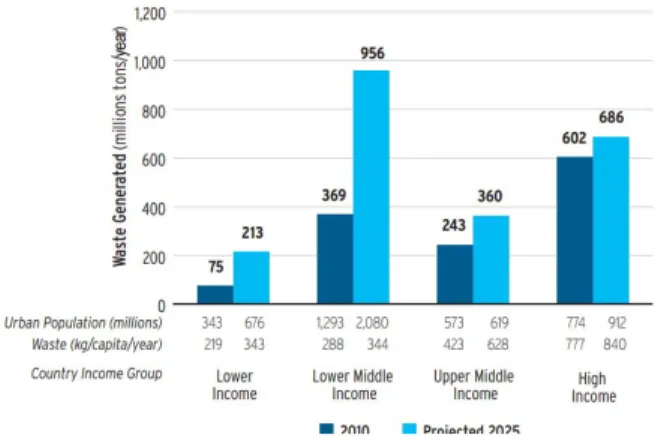
. Currently, global municipal solid waste generation levels are approximately 2.2 billion tons

per year by 2025

(2)

(Fig. 1 and Fig. 2).

Solid Waste (SW) generated in municipalities and their management is becoming an integral part of the urban environmental and planning of the modern infrastructure development and also sustainable eco- nomic development. In developing countries such as China, India, Malaysia, Thailand and Bangladesh severe municipal solid waste management problems are reported

(3-8)

. Waste management is considered a particularly challenging issue for most Asian coun- tries, especially developing countries such as Philip- pines. Cebu is the central Philippines premier destination for both foreign and domestic tourists.

The main overseas markets are Korea, Japan, USA

(2)

Appropriate Technologies for Municipal Solid Waste Management in Bantayan Island, Philippines 55

Fig. 2. Global MSW waste generation per region Fig. 1. Global MSW generation based on economy

status.

and Europe (Germany, UK, Switzerland and France).

Green Technology Center (GTC), from Korea along with the Korea Institute of Geosciences and Mineral Resources (KIGAM) support and facilitate the green technology transfer to Bantayan Islands under green development project (GDP)

(9)

. Many parts of metro Cebu need improvements to their respective physical environments such as sewage, waste water, solid waste, noise and air pollution, traffic, informal settlements, building code violations etc.,

Bantayan island is the major contributor for the nation’s economic development particularly Santa Fe. In this regard, the Promotion of Green Economic

Development (ProGED) project, Department of Trade and Industry (DTI) and the Deutsche Gesellschaft für Internationale Zusammenarbeit (GIZ) GmbH, deci- ded to work jointly on Bantayan Island to develop the solutions for sustainable climate change

(10,11)

.

The detailed review report published Climate Change and Private Sector Development report, it includes methodologies, key policies, instruments in the context of green growth, existent in the Philip- pines

(12)

.

The present study is focused on the feasibility studies of solid waste management in Cebu was presented here. An average of 325 tons of waste is generated in Cebu city a day. This investigation sum- marizes the results of the waste situation assessment and gives recommendations for the improvement of the solid waste management system on Bantayan Island. The increasing urbanization of Cebu city coupled with the need to manage climate change impacts required a systematic and comprehensive ecological solid waste management system to ensure the protection of public health and environment.

2. Sources of Waste in Bantayan Island

Amount of garbage released from nationwide is 36,000 ton/day (5000 trucks), in metro Manila, 8,600 tons/day (1400 trucks) and the total waste generation is 13,000,000 tons/year throughout the Philippines. The amount of garbage per person is from urban 0.60kg/day and from rural is 0.30 kg/day.

The recent studies reveal that the solid waste generation in Bantayan domestic sector from the various sectors during the year 2015. The overall waste generation was estimated that 10,800 tons or 32,600 cubic meter of garbage. The average rate of waste generation is about 0.195kg/capita/day

(9)

.

The waste generated from various sectors such as

institutional, commercial, and tourism etc., compo-

sition were presented in the Fig. 4. This figure

shows the composition of municipal solid waste such

as Biodegradable (63%), Plastics (14%) and Residual

(3)

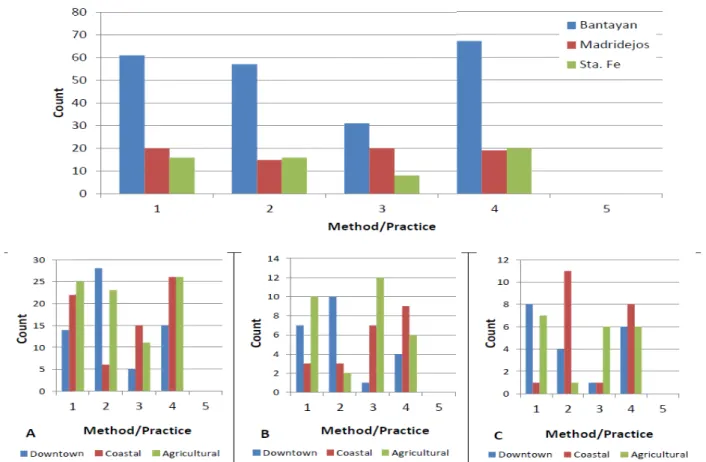
Fig. 3. Methods/Practices of waste disposal of househlds in Bantayan island, Municipality of (A): Bantayan (B) Madridejos, and (C) Santa Fe MSWI (1- I dispose all or some of the waste around the house by landfill or incineration, 2-I keep all or some of the waste, then the local government collects and disposes them, 3- I let food, plant and agricultural wastes rot around the house and use them as compost, 4- I save recyclable materials and sell or hand them over to a recycling company, 5- I do not know.

Fig. 4. The composition of municipal solid waste of Bantayan

(11%) are the largest waste generated segments in Bantayan Island.

2.1 Environmental impact of Solid Waste in Bantayan

There are several environmental impacts of municipal solid waste to the environment. The waste decomposed in the landfills to form methane, a potent greenhouse gas. Change in climate and des- truction of ozone layer due to waste biodegradable.

Garbage disposal, due to waste pollutions, illegal dumping, leaching leads to the solid waste enter into the soil and ground water finally contaminating them.

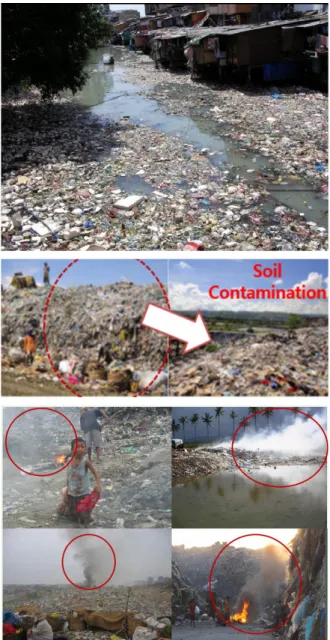
In Philippines, due to improper dumping of waste,

water would be seriously contaminated and

presented in Fig. 5.

(4)

Appropriate Technologies for Municipal Solid Waste Management in Bantayan Island, Philippines 57

Fig. 6. Municipal solid waste treatments Fig. 5. Water, soil contamination and unlimited CO2

emissions due to municipal solid waste improper dumping.

The solid waste collection in Philippines in some areas there is no uniform waste collections systems and treatments it gives highly risk to public health and environment. In Bantayan, the new constructed green hotels are developed under tourism develop- ment projects. According to the most recent report of the International Panel on Climate Change, ex- treme weather events, such as typhoons, and lead to rising sea levels in the Philippines is expected to increase with the high frequency and intensity. Due to this frequent typhoon, the sanitation system was damaged, the waste water overflowed from toilets leads to the drinking water and underground water contamination. Thus, it will be important for Bantayan Island to enhance its resiliency against such events. This can lead to significant health problems. Furthermore, water shortages could occur if the tourism and other water dependent industries will increase the stress on the groundwater level significantly. Solid waste management on Bantayan Island is currently not well organized.

2.2 The functional elements of MSW

Various methodologies are availbale for the treatment of municipal solid waste. The methods are briefly mentioned in the Fig. 6.

There are wide benefits of incineration of muni-

cipal solid waste treatmnt by incineration. Reducing

the amount waste (about 70-80% in mass) and

(80-90% in volume), if compresses (90-95%). This

is very simple process and high thermal efficiency

(90%) suitable for wide range of fuel and mixtures

(5)

Fig. 8. Visiting the real municipal solid waste treatment plant and poultry form Fig. 7. GTC-K and KIGAM collaboration with Bantayan islands, Philippines of fuel (solid waste and sludge).

The overall municipal solid waste recycled rate is 28% only. In 2003, Philippines government establi- shed a new ecological solid waste management act 2000 (RA 9003). It provides the legal framework for the comprehensive, systematic, and ecological solid waste management program, which shall ensure protection of public health and the environment

(13)

.

3. KIGAM-GTC Cooperation with Cebu City Local Government Units, Bantayan Island

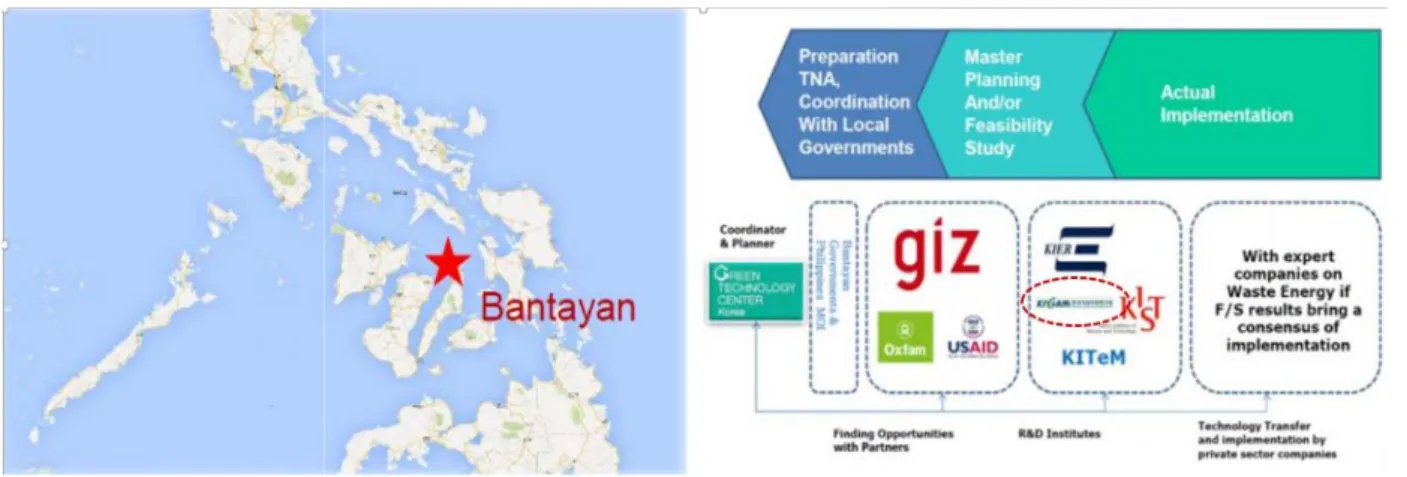
Green Technology Center-Korea and Korea Insti- tute of Geoscience's and Mineral Resources (KIGAM) collaboration with Bantayan local government, Philip- pines (Fig.7).

To improve the municipal solid waste manage- ment in Bantayan Island, GIZ, GTC-K and KIGAM and other associated instituted involved under the development programmes with the three local go- vernment units (LGUs) together planned to seek support from the other international organizations and to organize the municipal solid waste manage- ment for sustainable society.

Carbon resources and recycling appropriate tech- nology center director and other green Technology center researchers visited the real municipal solid waste treatment plant and poultry form and discuss about the technologies for pretreatment.

After visiting Santa Fe city hall and visiting

Bantayan Island, they visited the dumping site of

Santa Fe City and the apartment building area. The

dumping site in Bantayan Island in the Philippines

(6)

Appropriate Technologies for Municipal Solid Waste Management in Bantayan Island, Philippines 59

Fig. 9. Waste treatment process in South Korea Fig. 10. Waste treatment process in South Korea was simple reclamation and simple recycling using

manpower. In addition, due to the damage of the typhoon that occurred in the past, many dumping site waste was lost and the dumping site related infrastructure was also damaged. The next site, Santa Fe City, is being constructed by the City of Santa Fe, and it has been confirmed that most of the infrastructure is lacking.

Due to the lack of facilities and improper solid waste management system in Bantayan islands, the appropriate technologies from KIGAM will be very helpful to the urban solid waste management in Bantayan.

3.1. Sustainable development for developing countries

Generally, due to the climate change variations in Bantayan Island region has been hit by many disa- sters; tropical cyclone and floods. These disasters had devastating impact on the economy and liveli- hoods of local communities. Regarding this pro- blems, the World Bank(WB), GTC-K (Korea), and GIZ (Germany) combined has been helping to the local communities to build their living houses. These organizations are supported the Bantayan Island local government units for sustainable development society.

3.2. MWSI Bottom Ash Treatment in KIGAM, Korea Currently, carbonation process is a significant technology for the capture and utilization of CO2 for the manufacture of highly value added materials and also worldwide trend towards encouraging car- bonation treatment of MSWI bottom ash. Our research results revealed that the carbonation studies using MSWI bottom ash and CO

2

in order to increase the recycling percentage of the ash and reduce the concentration of atmospheric CO

2

in Korea. We established a pilot plant successfully for multi-processing of MSWI ash in South Korea. The capacity of this pilot plant is 200 kg/hour. This pilot plant was the first one in the waste recycling field in Korea and even throughout the Asian countries, this pilot plant have lots of facilities such as heavy metal stabilization, chloride removal, multi-processes of particle separation, and green aggregate/concrete manufacture. The higher capacity 20 tons / hour plant (Fig.9), for all inorganic waste treatment by accelerated carbonation and utilized direct flue gases from landfill sites, for CCS model in South Korea.

3.3. Chloride Removal-KIGAM Technology, Korea

Researchers have suggested that chlorine and its

toxic byproducts may be responsible for an increas-

(7)

(a)

(b)

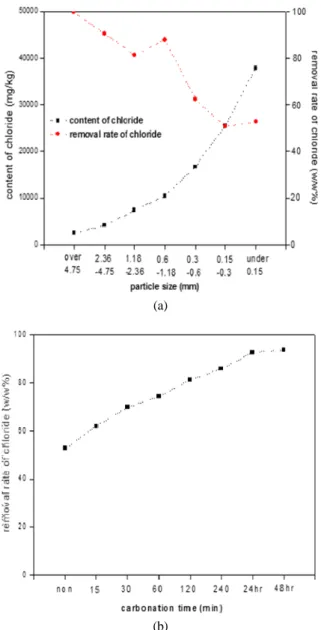
Fig. 11. (a) content and removal rate of chloride from the fresh bottom ash (b). Removal rate chloride from carbonated bottom ash as a reaction time in fraction under 0.15mm.

ed risk of heart disease, allergic reactions and spontaneous abortions. Studies indicate that con- sumption of chlorinated water is linked to signi- ficantly increased rates of bladder, colon and rectal cancer.

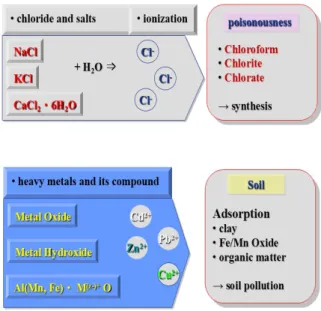
In Fig.10, We showed the chloride various forms formed in the atmosphere and associated with other heavy metals. We applied carbonation process for the removal chloride by using liquid/solid ratio (10)

at the temperature of 20

0

C. Chloride removal is over than 85% within 30 minutes. The residual chloride content of bottom ash is 0.2-0.3% (Fig.11).

4. Conclusions

KIGAM and GTC-K research institutions monito- ring the research and development encourage inter- national networking and establishes a system for mutual assistance in advanced technology develop- ment. The three municipalities of Bantayan Island differ in the level of implementation of their solid waste management program in terms of manpower, infrastructure (dump site and materials recovery facility), documentation (frame works and plans) and monitoring of waste generation. The collection, transportation and disposal of solid waste in Bantayan Island are the responsibility of the local government units (LGUs) and are stipulated in specific ordinances by the respective municipalities.

Acknowledgements

The authors are very grateful to the Korea Ins- titute of Energy Technology Evaluation and Plan- ning through the ETI program, Ministry of Trade, Industry and Energy (Project No. 2013T100100021) for financial support of this research.

References

1. International Solid Waste Association & United Nations Environment Programme (ISWA & UNEP).

Waste Management, ‘Industry as a partner for sustainable development’. ISBN: 92-807-2194-2, 2002.

2. Daniel Hoornweg., Perinaz Bhada Tata., 2012, What a waste: A global review of solid waste generation. World Bank Urban Development series knowledge papers, Vol.15, pp.1-116.

3. Cheng, H., Hu, Y., 2010, Municipal solid waste

(MSW) as a renewable source of energy: current

(8)

Appropriate Technologies for Municipal Solid Waste Management in Bantayan Island, Philippines 61

and future practices in China, Bioresource Tech- nology, Vol.101(11), pp.3816-3824.

4. Singh, R. P., Tyagi, V. V., Allen, T., Ibrahim, M. H., Kothari, R., An overview for exploring the possibilities of energy generation from muni- cipal solid waste (MSW) in Indian scenario, Re- newable and Sustainable Energy Reviews, Vol.15(9), pp.4797-4808.

5. Johari, A., Ahmed, S. I., Hashim, H., Alkali, H., Ramli, M., 2012, Economic and environmental benefits of landfill gas from municipal solid waste in Malaysia, Renewable and Sustainable Energy Reviews, Vol.16(5), 2907-2912.

6. Chiemchaisri, C., Visvanathan, C., 2008, Green- house gas emission potential of the municipal solid waste disposal sites in Thailand, Journal of the Air and Waste Management Association, Vol.58(5), 629-635.

7. Bhuiyan, S. H., 2010, A crisis in governance:

urban solid waste management in Bangladesh, Habitat International, Vol.34(1), pp.125-133.

8. Nazmul Islam, K. M., 2016, Municipal Solid Waste to Energy Generation in Bangladesh: Possi- ble Scenarios to Generate Renewable Electricity in Dhaka and Chittagong City, Journal of Renewable Energy, pp.1-16.

9. Agapay, Engr. Ramelito C., Galindo, Ronald M., Engr. Janice B. Jamora., Engr. Francis L. Mayo., 2016, A survey on the municipal solid waste generation and management system of Bantayan island, pp.1-79.

10. Janto Simon Hess., Interventions on Bantayan Island, promotion of green economic develop- ment (ProGED) project, October 2013-Febrauary 2015, pp.1-54.

11. Paul, J., 2004, Situational Analysis of Solid Waste Management in Bantayan Island, Cebu.

Bais City, Negros Oriental, Philippines: German Development Service (GTZ); Deutscher Entwic- klungsdienst (DED).

12. Finkel, T., Duhaylungsod, N., Bauer, S., 2010, Climate Change and Private Sector Develop- ment: Integrating Green Growth Strategies into

the MSME Development Plan 2010-2016. Manila:

Promotion of Green Economic Development (ProGED) Project, with the support of the German Federal Ministry for Economic Coo- peration and Development (BMZ).

13. Sapuay, Grace P., 2006, Ecological Solid Waste

Management Act of 2000 (RA 9003): A Major

Step to Better Solid Waste Management in the

Philippines, Current Practices and Instruments

Used in Solid Waste, pp.51-86.

수치

Fig. 2. Global MSW waste generation per region Fig. 1. Global MSW generation based on economy
Fig. 3. Methods/Practices of waste disposal of househlds in Bantayan island, Municipality of (A): Bantayan (B)  Madridejos, and (C) Santa Fe MSWI (1- I dispose all or some of the waste around the house by landfill or  incineration, 2-I keep all or some of
Fig. 6. Municipal solid waste treatmentsFig. 5. Water, soil contamination and unlimited CO2
Fig. 8. Visiting the real municipal solid waste treatment plant and poultry formFig. 7
+3

참조

관련 문서

Characteristics of Particle Size Distribution in the Organic Fraction of Municipal Solid Waste by the Reaction of Super-heated Steam.. Ha-Na Jang , Tai-Jin Min*, Seon-Ah Roh*,

In this study, the composition and physico-chemical characteristics of municipal solid waste (MWS) which was treated in national park area kyungnam-do landfill

Leao, S., Bishop, I., Evans, D., “Assessing the demand of solid waste disposal in urban region by urban dy- namics modeling in a GIS environment,” Resources.. Medina, M., “The

ABSTRACT : This research was performed to evaluate the landfilling method of organic sludge from mix of pre-treated organic sludge (OS) and municipal solid waste(MSW).. Organic

Further study is still needed to determine accurate CO 2 emission rates from municipal solid waste incineration facilities and other various combustion facilities by obtaining