강원도 자생 산채 추출물의 α-Amylase, α-Glucosidase, Lipase 효소 저해활성 탐색
⁃
연구노트⁃
김희연1†․임상현1․박유화1․함헌주1․이광재1․박동식2․김경희1․김성문3
1
강원도농업기술원 농산물이용시험장
2
국립농업과학원
3
강원대학교 바이오자원환경학과
Screening of α-Amylase, α-Glucosidase and Lipase Inhibitory Activity with Gangwon-do Wild Plants Extracts
Hee-Yeon Kim1†, Sang-Hyun Lim1, Yu Hwa Park1, Hun Ju Ham1, Kwang-Jae Lee1, Dong Sik Park2, Kyung-Hee Kim1, and Songmun Kim3
1Agriproduct Processing Experiment Station Gangwon-do Agicultural Research and Experiment Services, Gangwon-do, 200-822, Korea
2National Academy of Agricultural Science, Gyeonggi-do, 441-853, Korea
3Dept. of Biological Environment, Kangwon National University, Gangwon-do 200-701, Korea
Abstract
We investigated α-amylase, α-glucosidase and lipase inhibitory activity of extracts collected from wild plants in Gangwon-do. 90 wild plants were collected and their water and ethanol extracts were obtained. Results of measuring α-amylase inhibitory activity indicated more than 80% of activity inhibition in 10 mg/mL concen- tration for ethanol extracts of three plants and water extracts of two plants. For α-glucosidase inhibitory activity, ethanol extracts of thirteen plants and water extracts of three plants showed more than 80% of activity inhibition in 10 mg/mL concentration. In the experiment of inhibiting lipase activity, ethanol extracts of seven plants and water extracts of one plants showed above 80% of activity inhibition in 10 mg/mL concentration. These results suggest that the selected extracts could be potentially used as a resource of bioactive materials for health functional foods.
Key words: wild plants in Gangwon-do, α-amylase inhibitor, α-glucosidase inhibitor, lipase inhibitor
†
Corresponding author. E-mail: [email protected]
†
Phone: 82-33-248-6526, Fax: 82-33-248-6555
서 론
최근 천연자원으로부터 건강유지나 생체리듬조절 효능이 있는 생약, 기능성식품을 개발하고자 하는 연구가 활발히 진행되고 있다(1). 식물성 식용자원에 대한 시각도 변화되어 저공해 채소류와 함께 약리적 기능이 우수한 산채류에 대한 관심이 커지고 있으며, 이에 대한 수요와 공급이 확대되고 있다.
산채는 사람에 의해 개량 육성되어 논밭에서 재배되고 있 는 농작물에 반해 자연 그대로 산야에 자생하는 식물을 말한 다. 우리나라의 산에서 자생하는 식·약용 식물은 대략 120과 350속으로 한국산 관속식물 4,500여종 중에서 약 20%를 차 지하고 있으며, 이중에서 산채는 320여종이 자생하고 있다 (2). 산채류의 영양적인 효능으로는 일반 야채류들보다 비타 민이나 무기질이 많이 함유되어 있고(3), 약리적인 효능으로
는 항돌연변이성(4,5), 암세포에 대한 세포독성(6,7), 간기능 개선(8,9), 항산화(10-12), 항비만(13-15), 항당뇨(16), 항균 (17), 항염(18,19) 효과 등이 우수한 것으로 보고되었다. 산채 의 맛과 영양 그리고 생리활성은 급변하는 소비자의 요구를 충족할 수 있으므로 여러 가지 산채를 이용한 기능성 탐색 및 식품개발이 활발히 진행되고 있다.
2형 당뇨병은 현재 세계적으로 급격히 증가하고 있는 추 세이다(20). 유전, 생활습관 등 여러 가지 발병 요인 가운데 특히, 식생활과 관련이 깊은 만성질환이다. 2형 당뇨병의 치 료는 식이요법 및 약물요법을 적용하는데, 약물의 경우 주로 당분해 관련 효소를 억제하여 혈당의 급격한 상승을 억제하 고 당의 체내 이용을 낮출 수 있는 원리를 이용한다. 그러나 지금까지 개발된 약물의 경우 설사와 복통 등의 부작용을 유발하므로 새로운 치료제 개발이 요구된다(21).
최근 amylase, α-glucosidase 효소 저해 작용 및 지질대사
이상 또는 지방대사 촉진을 통하여 혈당을 조절할 수 있는 천연물에 대한 연구가 진행되고 있다(22-24). 본 연구는 강 원도 자생 산채 90종을 이용하여 α-amylase 저해활성, α- glucosidase 저해활성 및 lipase 저해활성을 검정하여 혈당 강하 및 항비만 활성을 나타낼 수 있는 산채류를 선발하고자 한다.
재료 및 방법
시료 조제
본 실험에 사용한 산채시료는 2008년 산채의 성체 시기(7 월~9월)에 강원도 양구, 평창, 태백에서 수집하였다. 시료는 채취 후 세척하였고, 동결건조(PVTFD10R, Ilshin, Yangju, Korea)하여 사용하였다. 시료 추출 용매는 물과 에탄올을 사용하였다. 물 추출은 산채 분말 시료 20 g에 1차 증류수 200 mL를 첨가하여 60
oC에서 6시간 동안 초음파추출기 (8510R-DTH, Bransonic, Danbury, CT, USA)를 이용하여 2회 추출하였다. 추출물은 여과지(No. 2, Whatman, Maid- stone, England)가 깔려있는 Buchner funnel을 통과시켜 잔 재물을 제거한 후 감압여과 하여 rotary vacuum evaporator (N-21NS, EYELA, Tokyo, Japan)로 완전히 농축하였다. 농 축이 완료된 후 건조물은 증류수 10 mL를 첨가하여 용해시 킨 후, 동결건조 하여 -20
oC의 냉동고에 보관하면서 사용하 였다. 에탄올 추출은 산채 분말 시료 20 g에 에탄올 200 mL 를 첨가하여 상온에서 120 rpm의 진탕기에서 12시간 동안 2회 추출하였다. 농축 후 시료 제조 과정은 상기와 같다.
α -Amylase 저해활성
α -Amylase의 저해활성(25)은 5 g의 agar와 5 g의 가용성 전분을 500 mL 증류수에 녹여 멸균한 후, 15 mL씩 분주하여 plate를 제조하였다. 10 mg/mL 농도의 산채 추출물과 200 Unit/mL 농도의 α-amylase(porcine pancreas, Sigma, St.
Louis, MO, USA)를 혼합하여 항생물질 검정용 여과지 (paper disc, Advantec, Tokyo, Japan) 위에 각각 분주하여 평판배지위에 올려놓고 37
oC에서 3일간 배양한 후, I
2/KI(5 mM I
2in 3% KI) 5 mL를 가하여 15분간 발색시킨 후 면적의 측정은 clear zone의 반지름을 측정하여 πr
2로 계산하여 다 음의 식으로 저해율을 계산하였다(26). 대조구로는 acarbose 를 사용하였으며, 시료와 같은 농도로 제조하여 측정하였다.
저해율(%)= 대조구의 면적-반응구의 면적 대조구의 면적 × 100
α -Glucosidase 저해활성
α -Glucosidase 저해활성(27)은 10 mg/mL 농도의 산채 추 출물과 0.15 U/mL α-glucosidase 효소액 50 μL 및 0.2 M potassium phosphate buffer(pH 6.8) 360 μL를 혼합하여 405 nm에서 흡광도를 측정한 다음, 5분간 실온에서 유지하고 5 mM 4-nitrophenyl-α-D-glucopyranoside(pNPG) 50 μL
를 가하여 실온에서 10분간 더 반응시킨 뒤 동일한 파장에서 흡광도를 측정하였고, 흡광도의 변화로부터 효소 저해활성 을 계산하였다.
Pancreatic lipase 저해능 측정
Lipase 저해활성(28)은 10 mM CaCl
2, 200 mM NaCl이 포함된 5% gum arabic 용액 9 mL에 tributylin 1 mL을 섞어 초음파추출기로 유화시킨 후, 2%(w/v) agar와 혼합하여 고 체평판배지를 제조하였다. 약 5 mm 정도 두께의 고체평판 배지에 지름 6 mm의 구멍을 뚫어 10 mg/mL의 농도로 준비 한 추출물과 pancreatic lipase(Sigma) 용액을 1:1의 비율로 3분간 반응시킨 혼합액을 넣고 24시간 동안 37
oC에서 반응 시킨 후, 효소에 의해 가수분해 되는 저해면적(clear zone)의 크기를 측정하여 pancreatic lipase에 대한 저해활성을 확인 하였다.
결과 및 고찰
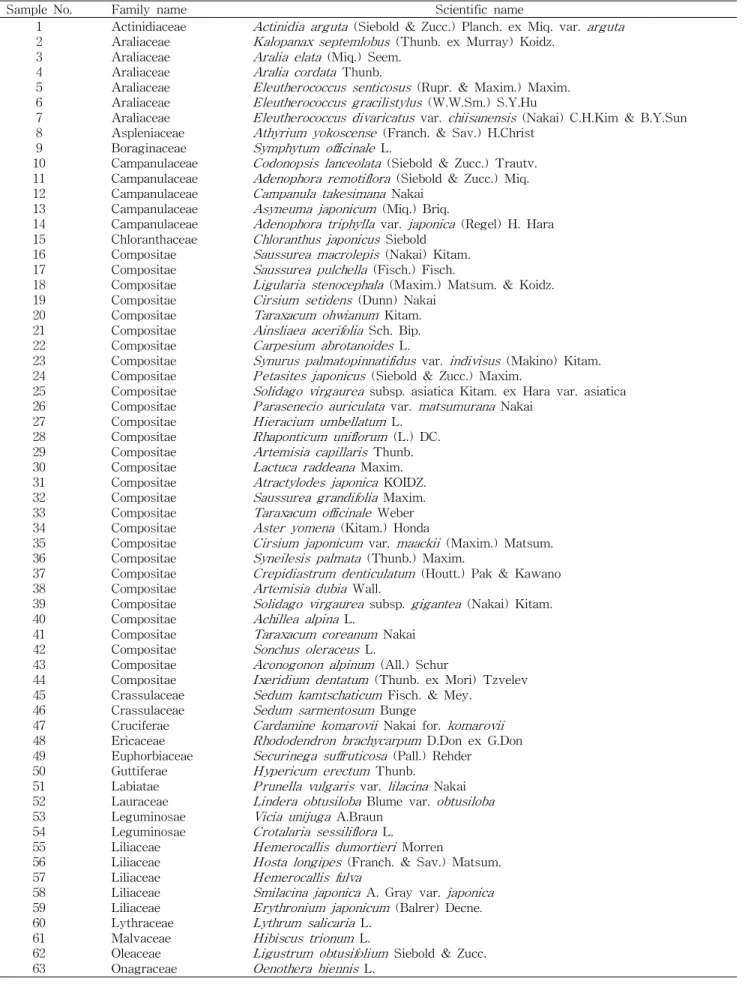
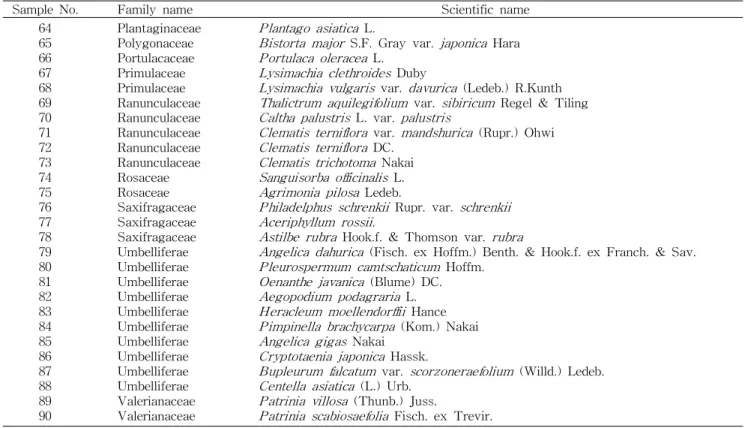
강원도에서 자생하고 있는 산채 29와 90종을 성체시기에 채집하여 동결건조한 후 물과 에탄올로 추출하였다(Table 1). 물과 에탄올 추출물을 대상으로 각각의 산채 추출물은 10 mg/mL의 농도로 추출용매로 재용해해 α-amylase 저해활 성, α-glucosidase 저해활성, lipase 저해활성을 측정하였다.
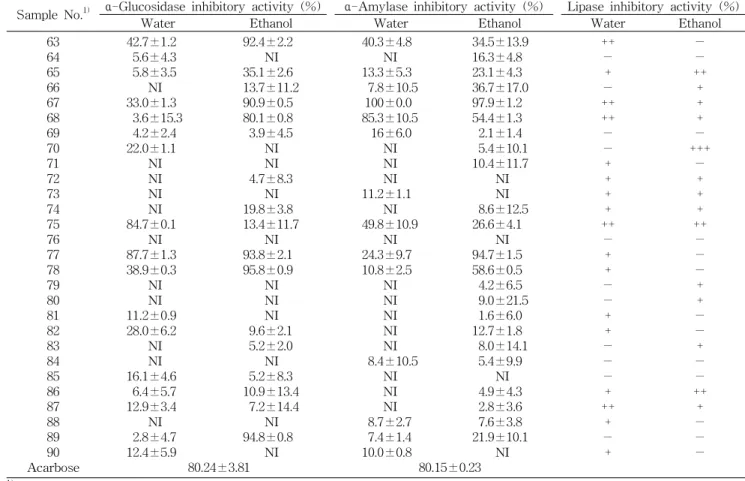
α -Glucosidase는 소장 상피세포의 brush-border mem- brane에 존재하는 효소(29)로서 소장에서 음식물 중의 전분 을 포도당과 같은 단당으로 분해하여 흡수시킨다. α- glucosidase 저해제는 소장점막의 미세융모막에 존재하는 이당류의 분해효소를 가역적으로 억제하여 탄수화물의 흡 수를 지연시키는 역할을 하며, 소장 전체에 포도당이 흡수되 어 식후 혈당 상승을 완만하게 한다. 본 연구에서는 강원도 자생 산채 90종을 대상으로 α-glucosidase 저해활성을 측정 하여 향후 혈당상승 억제제로 활용될 수 있는 소재를 선발 및 탐색하였다. 실험 결과 대조구인 acarbose는 80% 정도의 α -glucosidase 저해활성을 나타내었으며, 이에 산채 90종을 대상으로 제조한 물 또는 에탄올 추출물(10 mg/mL) 소재도 역시 80% 이상의 α-glucosidase 저해활성을 나타내는 소재 들로 선발하게 되었다. 산채 에탄올 추출물 중에서 다래나무 (
Actinidia arguta(Siebold & Zucc.) Planch. ex Miq. var.
arguta
), 싱아(
Aconogonon alpinum(All.) Schur), 기린초 (
Sedum kamtschaticumFisch. & Mey.), 돌나물(
Sedum sarmentosumBunge), 만병초(
Rhododendron brachy- carpumD.Don ex G.Don), 고추나물(
Hypericum erectumThunb.), 털부처꽃(
Lythrum salicariaL.), 달맞이꽃(
Oeno- thera biennisL.), 큰까치수염(
Lysimachia clethroidesDuby), 좁쌀풀(
Lysimachia vulgarisvar.
davurica(Ledeb.) R.Kunth), 짚신나물(
Agrimonia pilosaLedeb.), 돌단풍 (
Aceriphyllum rossii), 노루오줌(
Astilbe rubraHook.f. &
Thomson var.
rubra), 뚝갈(
Patrinia villosa(Thunb.) Juss.)
Table 1. Plants extracts used for experiments
Sample No. Family name Scientific name
1 2 3 4 5 6 7 8 10 9 11 12 13 14 15 16 17 18 19 20 21 22 23 24 25 26 27 28 29 30 31 32 33 34 35 36 37 38 39 40 41 42 43 44 45 46 47 48 49 50 51 52 53 54 55 56 57 58 59 60 61 62 63
Actinidiaceae Araliaceae Araliaceae Araliaceae Araliaceae Araliaceae Araliaceae Aspleniaceae Boraginaceae Campanulaceae Campanulaceae Campanulaceae Campanulaceae Campanulaceae Chloranthaceae Compositae Compositae Compositae Compositae Compositae Compositae Compositae Compositae Compositae Compositae Compositae Compositae Compositae Compositae Compositae Compositae Compositae Compositae Compositae Compositae Compositae Compositae Compositae Compositae Compositae Compositae Compositae Compositae Compositae Crassulaceae Crassulaceae Cruciferae Ericaceae Euphorbiaceae Guttiferae Labiatae Lauraceae Leguminosae Leguminosae Liliaceae Liliaceae Liliaceae Liliaceae Liliaceae Lythraceae Malvaceae Oleaceae Onagraceae
Actinidia arguta (Siebold & Zucc.) Planch. ex Miq. var. arguta Kalopanax septemlobus (Thunb. ex Murray) Koidz.
Aralia elata (Miq.) Seem.
Aralia cordata Thunb.
Eleutherococcus senticosus (Rupr. & Maxim.) Maxim.
Eleutherococcus gracilistylus (W.W.Sm.) S.Y.Hu
Eleutherococcus divaricatus var. chiisanensis (Nakai) C.H.Kim & B.Y.Sun Athyrium yokoscense (Franch. & Sav.) H.Christ
Symphytum officinale L.
Codonopsis lanceolata (Siebold & Zucc.) Trautv.
Adenophora remotiflora (Siebold & Zucc.) Miq.
Campanula takesimana Nakai Asyneuma japonicum (Miq.) Briq.
Adenophora triphylla var. japonica (Regel) H. Hara Chloranthus japonicus Siebold
Saussurea macrolepis (Nakai) Kitam.
Saussurea pulchella (Fisch.) Fisch.
Ligularia stenocephala (Maxim.) Matsum. & Koidz.
Cirsium setidens (Dunn) Nakai Taraxacum ohwianum Kitam.
Ainsliaea acerifolia Sch. Bip.
Carpesium abrotanoides L.
Synurus palmatopinnatifidus var. indivisus (Makino) Kitam.
Petasites japonicus (Siebold & Zucc.) Maxim.
Solidago virgaurea subsp. asiatica Kitam. ex Hara var. asiatica Parasenecio auriculata var. matsumurana Nakai
Hieracium umbellatum L.
Rhaponticum uniflorum (L.) DC.
Artemisia capillaris Thunb.
Lactuca raddeana Maxim.
Atractylodes japonica KOIDZ.
Saussurea grandifolia Maxim.
Taraxacum officinale Weber Aster yomena (Kitam.) Honda
Cirsium japonicum var. maackii (Maxim.) Matsum.
Syneilesis palmata (Thunb.) Maxim.
Crepidiastrum denticulatum (Houtt.) Pak & Kawano Artemisia dubia Wall.
Solidago virgaurea subsp. gigantea (Nakai) Kitam.
Achillea alpina L.
Taraxacum coreanum Nakai Sonchus oleraceus L.
Aconogonon alpinum (All.) Schur
Ixeridium dentatum (Thunb. ex Mori) Tzvelev Sedum kamtschaticum Fisch. & Mey.
Sedum sarmentosum Bunge
Cardamine komarovii Nakai for. komarovii Rhododendron brachycarpum D.Don ex G.Don Securinega suffruticosa (Pall.) Rehder
Hypericum erectum Thunb.
Prunella vulgaris var. lilacina Nakai Lindera obtusiloba Blume var. obtusiloba Vicia unijuga A.Braun
Crotalaria sessiliflora L.
Hemerocallis dumortieri Morren
Hosta longipes (Franch. & Sav.) Matsum.
Hemerocallis fulva
Smilacina japonica A. Gray var. japonica Erythronium japonicum (Balrer) Decne.
Lythrum salicaria L.
Hibiscus trionum L.
Ligustrum obtusifolium Siebold & Zucc.
Oenothera biennis L.
Table 1. Continued
Sample No. Family name Scientific name
64 65 66 67 68 69 70 71 72 73 74 75 76 77 78 79 80 81 82 83 84 85 86 87 88 89 90
Plantaginaceae Polygonaceae Portulacaceae Primulaceae Primulaceae Ranunculaceae Ranunculaceae Ranunculaceae Ranunculaceae Ranunculaceae Rosaceae Rosaceae Saxifragaceae Saxifragaceae Saxifragaceae Umbelliferae Umbelliferae Umbelliferae Umbelliferae Umbelliferae Umbelliferae Umbelliferae Umbelliferae Umbelliferae Umbelliferae Valerianaceae Valerianaceae
Plantago asiatica L.
Bistorta major S.F. Gray var. japonica Hara Portulaca oleracea L.
Lysimachia clethroides Duby
Lysimachia vulgaris var. davurica (Ledeb.) R.Kunth Thalictrum aquilegifolium var. sibiricum Regel & Tiling Caltha palustris L. var. palustris
Clematis terniflora var. mandshurica (Rupr.) Ohwi Clematis terniflora DC.
Clematis trichotoma Nakai Sanguisorba officinalis L.
Agrimonia pilosa Ledeb.
Philadelphus schrenkii Rupr. var. schrenkii Aceriphyllum rossii .
Astilbe rubra Hook.f. & Thomson var. rubra
Angelica dahurica (Fisch. ex Hoffm.) Benth. & Hook.f. ex Franch. & Sav.
Pleurospermum camtschaticum Hoffm.
Oenanthe javanica (Blume) DC.
Aegopodium podagraria L.
Heracleum moellendorffii Hance Pimpinella brachycarpa (Kom.) Nakai Angelica gigas Nakai
Cryptotaenia japonica Hassk.
Bupleurum falcatum var. scorzoneraefolium (Willd.) Ledeb.
Centella asiatica (L.) Urb.
Patrinia villosa (Thunb.) Juss.
Patrinia scabiosaefolia Fisch. ex Trevir.
이 80% 이상의 우수한 α-glucosidase 저해활성을 나타내었 다. 또한 물 추출물에서는 기린초, 짚신나물, 돌단풍이 80%
이상의 우수한 α-glucosidase 저해활성을 나타내었다(Table 2). 기존의 산채로부터 α-glucosidase 저해활성에 관한 연구 로는 산채 17종의 methanol 조추출물 5 mg/mL에서 62%의 저해활성도를 나타낸 비비추(
Hosta longipes)와 30% 이상 저해활성도를 나타낸 개시호(
Bupleurum longeradiatum), 바디나물(
Angelica decursiva)이 보고된 바 있다(30). 식물 추출물로부터 연구된 결과로 두충(
Eucommia ulmoides)으 로부터 quercetin 등 5가지 물질이 분리되었고(31), 갈근으 로부터 활성이 높은 biochanin A, (-)-tuberosin, claycosin, daidzein 등 4개 화합물을 분리하였다(32). 사철쑥의 분획물 인 butanol 층에서의 α-glucosidase 활성이 확인되었고(33), 300여종의 농산물과 자생식물을 대상으로 α-glucosidase 저 해활성을 검정한 결과, 잔대와 산뽕나무의 추출물이 가장 높음이 확인되었다(34). 이번 실험 결과 이미 문헌에 보고된 산채 및 식물 추출물들의 α-glucosidase 저해활성과 유사하 거나 우수한 산채 17종을 선발하였다.
α -Amylase는 탄수화물의 α-D-(1,4)-glucan 결합을 분해 하는 효소이고, α-glucosidase 소장 상피세포의 brush-border membrane에 존재하는 효소(35)로서 소장에서 음식물 중의 전분을 포도당과 같은 단당으로 분해하여 흡수시킨다. 따라 서 소장의 α-amylase와 α-glucosidase를 저해함으로써 포 도당의 흡수를 지연시킬 수 있어 α-amylase와 α-glucosidase 의 저해활성은 혈당수치 상승억제의 지표로써 사용된다(1).
산채 90종의 물과 에탄올 추출물 10 mg/mL의 농도로 대조 구인 acarbose의 저해활성과 같은 α-amylase를 80% 이상 저해한 식물로 싱아, 큰까치수염, 좁쌀풀 에탄올 추출물이 선발되었으며, 물 추출물로 싱아, 큰까치수염, 돌단풍이 선 발되었다. α-Amylase 저해활성에 관한 연구로 제비꽃 aceton 추출물 1 mg/mL 처리 시 100% 저해효과가 확인되 었고(35), 번행초 methanol 추출물에서는 효과가 없었으나 methanol을 순차 분획한 hexane 분획물 1 mg/mL 처리 시 60% 저해효과가 확인되었다(36). 300여종의 농산물과 자생 식물을 대상으로 α-amylase 저해활성을 검정한 결과, 금은 화 삼지구엽초의 추출물이 가장 높음이 확인되었다(34).
식이로 섭취된 지방의 분해와 흡수는 장내 낮은 pH에 의 한 물리․화학적인 지방의 변화와 아울러 여러 가지 효소 작용이 동반되는 매우 복잡한 경로를 거쳐 진행된다(28,37).
이중 췌장 리파아제는 지방의 물질대사에 관여하는 효소로,
지방의 소화를 진행하고 장내 상피세포가 분해산물을 흡수
하도록 돕는다. 이와 같이 지방은 췌장 리파아제에 의해 분
해되어 흡수되기 때문에 리파아제 효소의 활성을 저해할 경
우 혈중의 지방흡수를 저하시킬 수 있다. 리파아제가 부족하
면 중성지방(트리글리세라이드)은 흡수되지 않고 대변으로
나오게 된다(38). 산채 90종의 물과 에탄올 추출물에 대하여
lipase 저해활성을 측정한 결과, 높은 저해활성을 보이는 산
채 추출물로는 홀아비꽃대(
Chloranthus japonicusSiebold),
기린초, 생강나무(
Lindera obtusilobaBlume var.
obtusiloba),
활나물(
Crotalaria sessilifloraL.), 털부처꽃, 동의나물
Table 2. Inhibition of α-glucosidase, α-amylase and lipase activity by solvent extract of wild plant
Sample No.
1)α -Glucosidase inhibitory activity (%) α -Amylase inhibitory activity (%) Lipase inhibitory activity (%)
Water Ethanol Water Ethanol Water Ethanol
1 2 3 4 5 6 7 8 9 10 11 12 13 14 15 16 17 18 19 20 21 22 23 24 25 26 27 28 29 30 31 32 33 34 35 36 37 38 39 40 41 42 43 44 45 46 47 48 49 50 51 52 53 54 55 56 57 58 59 60 61 62
4.1±10.6 NI
3)1.8±4.6 NI
NI NI NI 27.2±7.9
5.6±18.7 NI 47.2±8.2
5.7±8.4 13.3±12.8 12.2±1.9
4.0±8.5 10.4±1.8
NI NI NI 15.9±15.1 14.2±7.3
0.2±10.9 4.5±11.3 23.7±3.1
5.7±3.6 NI NI 11.1±6.2
9.9±4.0 5.2±5.2 8.7±14.4 NI
NI 0.3±14.8 42.9±10.0
NI NI NI 3.9±0.9 13.7±6.9 4.1±0.3 NI 15.0±3.4 11.4±5.3 81.0±2.0 3.2±6.3 69.5±2.9 NI 5.3±16.3 9.3±7.4 37.7±4.4 8.6±12.5 NI 0.5±0.1 NI 11.7±9.6 NI 6.1±3.6 NI 5.4±3.9 12.7±9.3 NI
89.5±0.5 NI NI NI 4.7±22.3 NI
NI 19.2±4.1
0.4±5.0 51.1±1.6 NI 31.4±1.5 15.0±12.4 NI
8.1±1.3 0.2±0.3 NI 3.0±6.6 NI 9.6±3.2 NI 6.4±8.7 2.8±5.3 15.3±9.4 8.5±16.1 2.7±2.4 NI 8.3±1.7 7.9±1.9 0.4±1.2 NI 7.3±12.6
NI 79.5±0.1 NI
4.8±22.8 NI NI 5.8±1.5 0.4±9.2 NI 19.1±0.3 88.8±0.2 94.3±0.6 NI 87.2±1.1 94.1±0.4 NI
NI 92.3±2.2
0.1±2.7 54.1±10.4
NI NI NI NI NI NI NI 88.3±4.1 23.2±6.1
NI
1.9±12.6 NI 6.4±1.3 NI
NI NI 0.9±6.8
NI NI 3.7±7.8 NI
NI NI NI 15.3±9.1
NI NI NI NI 4.9±12.5
NI NI NI 10.1±12.6 NI
NI NI 1.3±15.3 7.9±5.2 NI
NI NI 7.9±6.2
NI NI 7.6±2.3 NI
NI NI NI 5.0±11.3 8.1±11.9 100±0.0
1.6±4.0 NI 4.5±8.6 NI 17.4±10.8
NI 18.1±9.8 NI
6.2±10.5 NI 5.8±4.0
NI NI NI NI 7.1±10.1 62.4±2.8
5.6±1.4 NI
16.3±19.6 0.7±6.7 6.0±14.7
NI NI 11.6±6.6 13.0±9.7 7.5±5.3 1.5±9.2 NI 5.2±12.3 3.9±7.5 14.6±7.9 5.6±9.8 10.0±2.3 NI NI 5.4±27.9 0.9±5.1 6.0±2.5 11.4±7.3 1.9±8.9 8.8±5.5 15.5±6.9 NI 3.1±8.5 5.3±1.3 20.6±3.4 9.3±5.7 10.4±8.2 13.5±3.3 7±3.4 NI 6.4±9.8 16.2±7.2 0.2±2.6 7.1±3.1 NI 6.9±11.7 NI 0.3±1.5 17.9±4.6 90.6±4.0 4.2±9.7 75.1±10.8 64.6±13.4 26.8±5.3 NI
NI 55.1±23.1
4.0±8.3 6.5±19.2 0.5±2.7
NI NI 13.0±10.5
0.2±12.5 17.3±4.8 NI 32.6±18.6
2.3±9.0 11.9±2.6
+
2)-
- -
- -
-
- -
- + +
- +
- +
-
- -
- - ++ +
- -
- -
- +
- -
- +
- + + +
- +++ -
- + + ++ -
- + + +
- +
- +
- +
- +
- +
- + +
++ - + +
- +
- ++ +
- -
- ++ + +++ -
+
- +
- + + +
- +
- -
- -
- +
- + ++ ++
++ -
-
- +
- - +++
+++ +
- +
- - ++ - +++ - +++ +
- -
- - +++ +
-
Table 2. Continued
Sample No.
1)α -Glucosidase inhibitory activity (%) α -Amylase inhibitory activity (%) Lipase inhibitory activity (%)
Water Ethanol Water Ethanol Water Ethanol
63 64 65 66 67 68 69 70 71 72 73 74 75 76 77 78 79 80 81 82 83 84 85 86 87 88 89 Acarbose 90
42.7±1.2 5.6±4.3 5.8±3.5
NI 33.0±1.3
3.6±15.3 4.2±2.4 22.0±1.1
NI NI NI 84.7±0.1 NI 87.7±1.3 NI 38.9±0.3
NI NI 11.2±0.9 28.0±6.2
NI NI 16.1±4.6
6.4±5.7 12.9±3.4 2.8±4.7 NI 12.4±5.9
80.24
92.4±2.2 35.1±2.6 NI 13.7±11.2 90.9±0.5 80.1±0.8 3.9±4.5
NI NI 4.7±8.3 19.8±3.8 NI 13.4±11.7 93.8±2.1 NI 95.8±0.9
NI NI 9.6±2.1 NI 5.2±2.0 5.2±8.3 NI 10.9±13.4
7.2±14.4 94.8±0.8 NI
±3.81 NI
40.3±4.8 13.3±5.3 NI 7.8±10.5 100±0.0 85.3±10.5
16±6.0 NI NI 11.2±1.1 NI 49.8±10.9 NI 24.3±9.7 NI 10.8±2.5
NI NI NI NI 8.4±10.5 NI
NI NI NI 8.7±2.7 7.4±1.4 10.0±0.8
80.15
34.5±13.9 16.3±4.8 23.1±4.3 36.7±17.0 97.9±1.2 54.4±1.3 2.1±1.4 5.4±10.1 10.4±11.7
NI NI 8.6±12.5 26.6±4.1 94.7±1.5 NI 58.6±0.5 4.2±6.5 9.0±21.5 1.6±6.0 12.7±1.8 8.0±14.1 5.4±9.9 4.9±4.3 NI 2.8±3.6 7.6±3.8 21.9±10.1
±0.23 NI
++ -
- + ++ ++
- - + + + ++ +
- +
- +
- + +
- -
- + ++
- + +
- - ++ + + + +++ -
- + + ++ +
- -
- +
- +
-
- + ++ - +
- -
-
1)
Treatment concentration of samples: 10 mg/mL.
2)
Inhibitory activity: ++++, very strong; +++, strong; ++, weak; +, very weak; -, none.
3)
NI: not inhibited.
(
Caltha palustrisL. var.
palustris) 에탄올 추출물이 선발되 었다. 물 추출물 가운데 톱풀(
Achillea alpinaL.)이 우수한 활성을 나타내었다(Table 2). Lipase 저해활성에 관한 연구 로 300여종의 농산물과 자생식물을 이용하여 lipase 저해활 성을 측정한 결과 부채마, 지모, 좁쌀풀, 독활, 머위, 산꼬리 풀, 쥐손이풀, 야콘 메탄올 추출물의 활성이 우수하다고 보 고되었다(34).
이와 같이 식물체에는 탄수화물이나 지방의 소화효소를 억제하는 성분들이 풍부하게 분포되어 있는 것으로 알려져 있다. 현재 체중 조절용 의약품 중 에너지 영양소의 소화 및 흡수를 저해하거나 식욕을 저해하는 기전에 의하여 효능을 발휘하는 약물로는 대표적으로 oristat, acarbose, miglitol, voglibose 등이 있으며, 혈당조절제도 비만억제의 수단으로 개발되어 있다. 천연물로부터 탐색되는 α-glucosidase, α- amylase, lipase 효소 저해제는 비만 및 당뇨치료물질로 그 효능이 우수하지만, oristat는 위장장애, 과민증, 담즙분비장 애, 지용성 비타민 흡수 억제 등의 부작용이 나타나는 것으 로 보고되고 있고(39), acarbose 등의 α-glucosidase, α- amylase 저해제는 설사와 복통 등의 부작용이 보고되고 있 다(21). 이러한 이유로 새로운 α-glucosidase, α-amylase,
lipase 효소 저해물질을 찾아낼 필요성이 있으며 본 실험 결 과 활성이 우수했던 자생식물들은 추가적으로 세포 실험 및 동물실험을 통해 항당뇨 및 항비만 관련 효능 검증을 실시하 고 활성이 검증된 자생식물들은 향후 새로운 의약품개발 및 성인병 예방의 건강기능식품으로 경쟁력을 확보할 수 있을 것으로 기대된다.
요 약
본 연구는 강원도 자생 산채류의 다양한 약리 기능 중 α-
glucosidase, α-amylase, lipase 효소 저해활성이 우수한 식
물소재를 탐색하는데 있다. 강원도 양구, 평창, 태백에서 자
생하고 있는 산채 90종을 채집하여 물과 에탄올로 각각 추출
하였다. 항비만 활성 탐색은 α-amylase, α-glucosidase,
lipase 저해활성을 검정하였다. 그 결과 산채 90종 중 α-
amylase 활성 저해능이 높은 식물로 에탄올 추출물 3종, 물
추출물 2종, α-glucosidase 활성 저해능이 높은 식물로 에탄
올 추출물 13종, 물 추출물 3종, lipase 활성 저해능이 높은
식물로 에탄올 추출물 7종, 물 추출물 1종이 선발되었다. 향
후 본 연구결과는 비만과 당뇨 등 대사성 질환에 대해 예방
혹은 치료 효과가 있는 기능성식품으로 개발하는데 있어 좋 은 기초자료로 활용될 것으로 기대된다.
감사의 글
본 논문은 농촌진흥청에서 시행한 15대 어젠다 농업연구 개발사업(과제번호, 200901AFT143782462)의 지원에 의한 연구결과의 일부로 이에 감사드립니다.
문 헌