• 검색 결과가 없습니다.

A study on the maneuverabilities of the marine research vessel CHARMBADA

N/A
N/A
Protected

Academic year: 2021

Share "A study on the maneuverabilities of the marine research vessel CHARMBADA"

Copied!
14
0
0

로드 중.... (전체 텍스트 보기)

전체 글

(1)

J. Kor. Soc. Fish. Tech., 46 (1), 056 069, 2010 DOI:10.3796/KSFT.2010.46.1.056

A study on the maneuverabilities of the marine research vessel CHARMBADA

Young-Su A N , Gwang-Min B AE *, Choong-Sik J ANG , Yun-Soo J UNG , Il-Kwon K ANG

1

and Bo-Yeon K IM

Institute of Marine Industry, Gyeongsang National University, Tongyeong 650-160, Korea

1

Department of Marine Production System Engineering, Pukyong National University, Busan 608-737, Korea

This study was intended to determine the maneuverability of the vessel CHARMBADA. When the rudder angle was at 10 , 20 and 30 , the maximum advance by slow, half and full ahead were varied in the range of 523.6 131.3m, 528.8 177.2m and 530.6 219.7m, respectively. The maximum transfer was 799.9 181.3m, 792.1 232.8m and 807.7 316.9m, respectively. The turning circle ability was better during starboard turning. When the rudder angle was 10 , 20 and 30 , variation in the maximum advances was 392.0m, 245.0m and 153.0m. The maximum transfer was 528.0m, 339.0m and 218.0m, respectively based on the regression equations. As the rudder angle became bigger, the maximum advance or maximum transfer became smaller by the exponential function. The advance inertia took 127sec, 145sec, 181sec each until the vessel speed was 7.0konts, 12.0konts, 17.0konts. The static inertia took 245sec, 269sec, 300sec each until the vessel speed was under 2.0konts and the advance distance was 114.4m, 181.2m, 197.0m each.

Accordingly, the static inertia was inclined to increase to scale according to the increase in vessel speed. For the CHARMBADA, the smaller the rudder angle was, the much bigger the turning circle became due to adhesion to the skeg, thereby lowering the vessel s turning ability.

Key words: Rudder angle, Maximum advance, Maximum transfer, Turning circle

* Corresponding author: [email protected], Tel 82-55-640-3091, Fax 82-55-648-0710

(2)

, ,

.

, ,

.

,

,

.

, , , ,

. , ,

Kim et al. (1996), Jeong et al. (1998), Park (2001), An et al. (2005) Choi

(2004) ,

Kim and Kim (1996), Chung and Seo (1997, 2004), Kim et al. (2005) Lee (2005)

.

Rudder skeg

(Lee et al., 2004, Park et. al., 2004).

, ,

.

(36ton)

skeg , skeg

. skeg

, RPM (revolution per minute)

. DGPS ,

,

DGPS (Kim

et al., 2005).

DGPS

, ,

( )

.

(36ton) ,

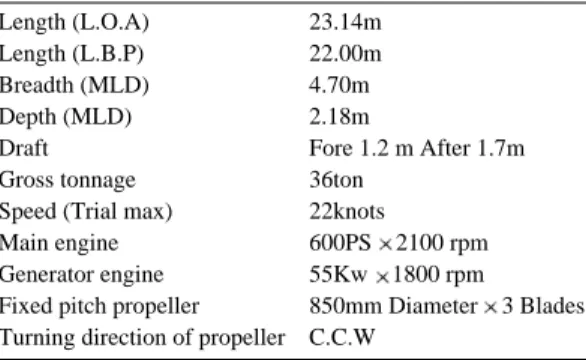
Table 1 ,

Fig. 1 . FRP

(twins rudder/twin propeller) propeller shaft

skeg (29,083.8cm

2

) .

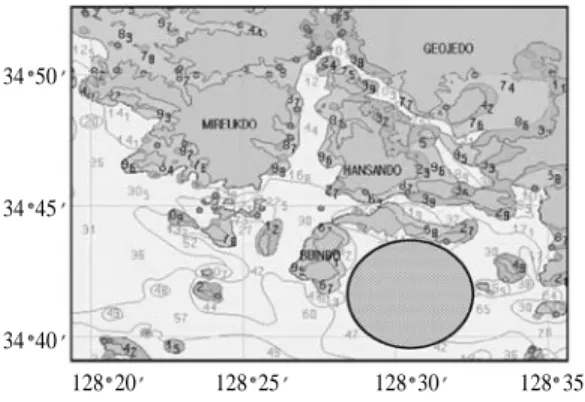
2006 4 27 2009 4

30 (Fig. 2)

(3)

(Table 2) 2 ,

(LS D401HD) , (P/N95A 6007 00)

, .

5 ,

. Table 1. Principal particulars of the marine research

vessel CHARMBADA

Length (L.O.A) 23.14m

Length (L.B.P) 22.00m

Breadth (MLD) 4.70m

Depth (MLD) 2.18m

Draft Fore 1.2 m After 1.7m

Gross tonnage 36ton

Speed (Trial max) 22knots

Main engine 600PS 2100 rpm

Generator engine 55Kw 1800 rpm

Fixed pitch propeller 850mm Diameter 3 Blades Turning direction of propeller C.C.W

Fig. 1. Side view and skeg attached to the rear bottom of the R.V CHARMBADA.

10 15 20

548 Skeg

Unit: cm 433

110 71

72

328 440

102 71

72 247

186

328 105

433

35 Base line

D.L.W.L

Steer gear room

Engine room

Frame space

(4)

DGPS (NAVIS 3700DF, Samyung ENC) GPS

Fig. 3, Table 3 .

DGPS

1 12 GPS

(Navis 3700DF), (Navis

3700DF) (P , socket 478)

.

(RPM 980,

7.0konts), (RPM 1600, 12.0

konts), (RPM 2000, 17.0konts) 3

, 10 ,

20 30 ,

.

DGPS DGPS

1sec personal computer

, , , ,

. Fig. 2. Location of the experimental sea area.

Table 2. Sea condition of the experimental Trial area South sea area of Bijindo

Depth 44m 48m

Wind direction 2006. 4. 27 240 250 2009. 4. 30 230 250 Wind force 2006. 4. 27 2.5m/sec

2009. 4. 30 2.2m/sec Current direction 2006. 4. 27 30 40 2009. 4. 30 30 40 Current speed 2006. 4. 27 0.1 0.3konts

2009. 4. 30 0.1 0.3konts

Weather 2006. 4. 27 cloudy

2009. 4. 30 blue sky 34 50

34 45

34 40

128 20 128 25 128 30 128 35

Fig. 3. Configuration of the DGPS data acquisition system.

Beacon antenna with receiver

COM1 4800 bps

COM1 9600 bps GPS receiver

Personal computer

(P )

GPS antenna

Table 3. Specification of the DGPS receiver and antenna

Item Specifications

DGPS receiver NAVIS 3700DF

Frequency L1, 1575.42 1MHz (C/A code) Channels 12 independent tracking channel Receivie channel &

12 channels & 12 satellites tracking satellite

Receive sensitivity 130dBm

Accuracy velocity 10m RMS (HDOP<2) (SA OFF)/

0.1knots RMS (HDOP<2) (SA OFF)

Table 4. Specifications of the beacon receiver with antenna

Item Specifications

Beacon receiver NAVIS 3700DF

Frequency 283.5 to 325.0kHz

Channel spacing 500Hz

Receive sensitivity 10uV/m

(5)

(RPM 980, 7.0konts), (RPM 1,600,

12.0konts), (RPM 2,000,

17.0konts) 3 , DGPS

1sec personal computer

.

(RPM 980), (RPM 1,600),

(RPM 2,000) 7.0konts,

12.0konts, 17.0konts

, .

(7.0konts), (12.0konts)

(17.0konts) stop engine

2.0konts ,

.

10

, ,

3

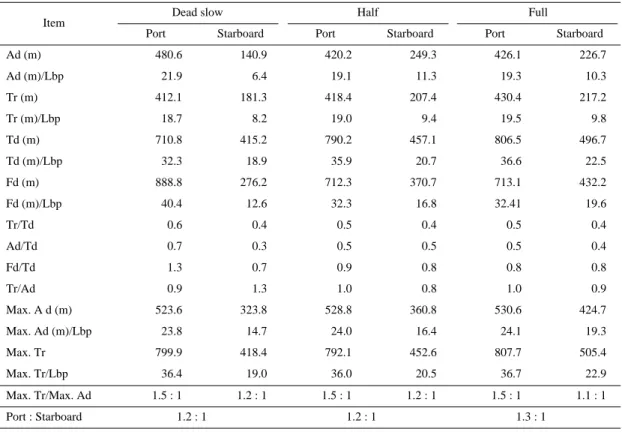
10 Table 5

Fig. 4 .

Table 5 10 ,

523.6m, 528.8m,

Table 5. The size of the turning circle by the rudder angle 10 with dead slow, half and full ahead

Item Ad (m) Ad (m)/Lbp Tr (m) Tr (m)/Lbp Td (m) Td (m)/Lbp Fd (m) Fd (m)/Lbp Tr/Td Ad/Td Fd/Td Tr/Ad Max. A d (m) Max. Ad (m)/Lbp Max. Tr Max. Tr/Lbp Max. Tr/Max. Ad Port : Starboard

1.5 : 1 1.2 : 1 1.5 : 1 1.2 : 1 1.5 : 1 1.1 : 1

1.2 : 1 1.2 : 1 1.3 : 1

Dead slow Half Full

Port Starboard Port Starboard Port Starboard

480.6 21.9 412.1

18.7 710.8

32.3 888.8

40.4 0.6 0.7 1.3 0.9 523.6

23.8 799.9

36.4

140.9 6.4 181.3

8.2 415.2

18.9 276.2

12.6 0.4 0.3 0.7 1.3 323.8

14.7 418.4

19.0

420.2 19.1 418.4

19.0 790.2

35.9 712.3

32.3 0.5 0.5 0.9 1.0 528.8

24.0 792.1

36.0

249.3 11.3 207.4

9.4 457.1

20.7 370.7

16.8 0.4 0.5 0.8 0.8 360.8

16.4 452.6

20.5

426.1 19.3 430.4

19.5 806.5

36.6 713.1 32.41

0.5 0.5 0.8 1.0 530.6

24.1 807.7

36.7

226.7 10.3 217.2

9.8 496.7

22.5 432.2

19.6 0.4 0.4 0.8 0.9 424.7

19.3 505.4

22.9

Ad: Advance, Tr: Transfer, Td: Tactical diameter, Fd: Final diameter,

Lbp: Length between perpendicular, Max. Ad: Max. Advance, Max. Tr: Max. Transfer

(6)

530.6m , 799.9m, 792.1m, 807.7m

.

,

6.4 , 21.9 8.2 , 18.7 18.9 , 32.3 Fig. 4. The size of the turning circle by the rudder angle 10 with dead slow, half and full ahead.

Slow -900 -800 -700 -600 -500 -400 -300 -200 -100 0 100

500

400

300

200

100

0

-100

-200

500

400

300

200

100

0

-100

-200

500

400

300

200

100

0

-100

-200

500

400

300

200

100

0

-100

-200

500

400

300

200

100

0

-100

-200

500

400

300

200

100

0

-100

-200

-100 0 100 200 300 400 500 600 700 800 900

-900 -800 -700 -600 -500 -400 -300 -200 -100 0 100 -100 0 100 200 300 400 500 600 700 800 900

-900 -800 -700 -600 -500 -400 -300 -200 -100 0 100 -100 0 100 200 300 400 500 600 700 800 900 Half

Full

Distance (m)

Turning to port Turning to starboard

(7)

,

11.3 , 19.1 9.4 , 19.0 20.7 , 35.9

,

.

20

, ,

3

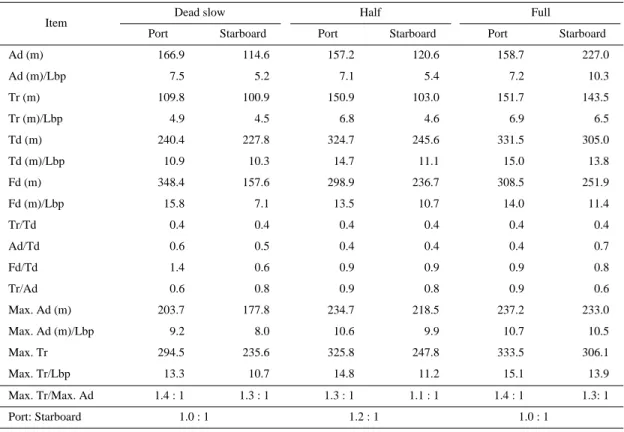
20 Table 6

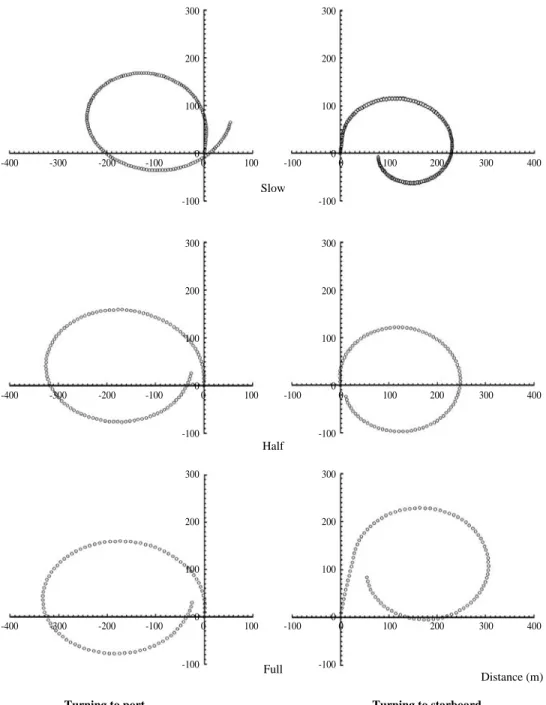
Fig. 5 .

Table 6 20 ,

230.7m,

234.7m, 237.2m ,

294.5m, 325.8m, 333.5m ,

. ,

5.2 , 7.5 4.5 , 4.9 10.3 , 10.9

, 5.4 , 7.1 4.6 ,

6.8 11.1 , 14.7 ,

, ,

20 .

30

, ,

3

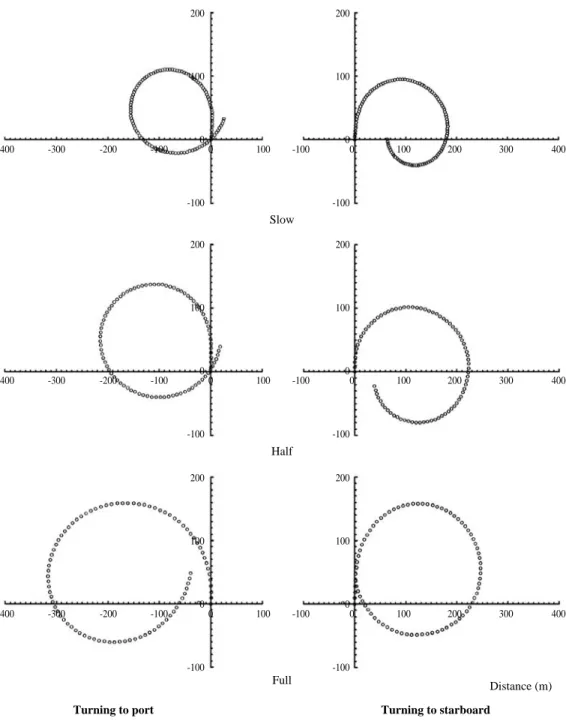
30 Table 7

Fig. 6 .

Table 6. The size of the turning circle by the rudder angle 20 with dead slow, half and full ahead

Item Ad (m) Ad (m)/Lbp Tr (m) Tr (m)/Lbp Td (m) Td (m)/Lbp Fd (m) Fd (m)/Lbp Tr/Td Ad/Td Fd/Td Tr/Ad Max. Ad (m) Max. Ad (m)/Lbp Max. Tr Max. Tr/Lbp Max. Tr/Max. Ad Port: Starboard

1.4 : 1 1.3 : 1 1.3 : 1 1.1 : 1 1.4 : 1 1.3: 1

1.0 : 1 1.2 : 1 1.0 : 1

Dead slow Half Full

Port Starboard Port Starboard Port Starboard

166.9 7.5 109.8

4.9 240.4

10.9 348.4

15.8 0.4 0.6 1.4 0.6 203.7

9.2 294.5

13.3

114.6 5.2 100.9

4.5 227.8

10.3 157.6

7.1 0.4 0.5 0.6 0.8 177.8

8.0 235.6

10.7

157.2 7.1 150.9

6.8 324.7

14.7 298.9

13.5 0.4 0.4 0.9 0.9 234.7

10.6 325.8

14.8

120.6 5.4 103.0

4.6 245.6

11.1 236.7

10.7 0.4 0.4 0.9 0.8 218.5

9.9 247.8

11.2

158.7 7.2 151.7

6.9 331.5

15.0 308.5

14.0 0.4 0.4 0.9 0.9 237.2

10.7 333.5

15.1

227.0 10.3 143.5

6.5 305.0

13.8 251.9

11.4 0.4 0.7 0.8 0.6 233.0

10.5 306.1

13.9

(8)

Table 7 20 , 131.3m,

177.2m, 219.7m , 181.3m,

232.8m, 316.9m ,

. , Fig. 5. The size of the turning circle by the rudder angle 20 with dead slow, half and full ahead.

Slow

-400 -300 -200 -100 0 100 -100 0 100 200 300 400

300

200

100

0

-100

300

200

100

0

-100

-400 -300 -200 -100 0 100 -100 0 100 200 300 400

300

200

100

0

-100

300

200

100

0

-100

-400 -300 -200 -100 0 100 -100 0 100 200 300 400

300

200

100

0

-100

300

200

100

0

-100 Half

Full Distance (m)

Turning to port Turning to starboard

(9)

4.3 , 4.9 3.6 , 2.9 8.1 , 7.0

, 4.5 , 6.1 4.0

, 3.9 10.0 , 9.7 ,

,

20 .

2

Table 8 . Table 8 (x)

10 , 20 , 30 (y)

(y1) (1)

(2) .

y = 628.12e

0.0471x

(1)

y1 = 822.12e

0.0443x

(2)

(1), (2) 0.8422,

0.7376 ,

.

(RPM

980), (RPM 1600), (RPM

2000) 7.0konts, 12.0konts,

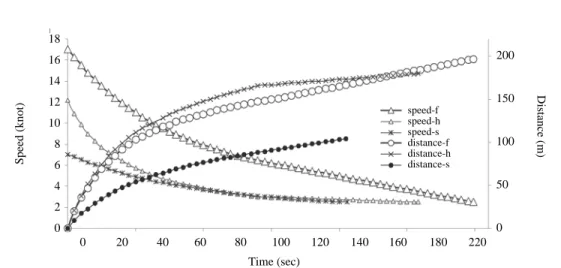
17.0konts ,

Table 9 Fig. 7 . Table 7. The size of the turning circle by the rudder angle 30 with dead slow, half and full ahead

Item Ad (m) Ad (m)/Lbp Tr (m) Tr (m)/Lbp Td (m) Td (m)/Lbp Fd (m) Fd (m)/Lbp Tr/Td Ad/Td Fd/Td Tr/Ad Max. Ad (m) Max. Ad (m)/Lbp Max. Tr Max. Tr/Lbp Max. Tr/Max. Ad Port: Starboard

1.3 : 1 1.3 : 1 1.3: 1 1.2 : 1 1.4 : 1 1.1 : 1

1.0 : 1 1.0 : 1 1.2 : 1

Dead slow Half Full

Port Starboard Port Starboard Port Starboard

109.1 4.9 65.6

2.9 155.6

7.0 206.7

9.4 0.4 0.7 1.3 0.6 131.3

5.9 181.3

8.2

94.5 4.3 79.1

3.6 178.9

8.1 118.3

5.3 0.4 0.5 0.6 0.8 135.8

6.1 182.4

8.2

135.6 6.1 86.1

3.9 213.7

9.7 250.9

11.4 0.4 0.6 1.1 0.6 177.2

8.0 232.8

10.5

100.4 4.5 89.0

4.0 220.8

10.0 183.9

8.3 0.4 0.4 0.8 0.8 181.1

8.2 222.8

10.1

157.6 7.1 139.6

6.3 324.5

14.7 277.5

12.6 0.4 0.4 0.8 0.8 219.7

9.9 316.9

14.4

156.5 7.1 104.5

4.7 245.0

11.1 245.0

11.1 0.4 0.6 1.0 0.6 206.7

9.4 246.9

11.2

(10)

Table 9

7.0konts 127sec

379.8m ,

12konts

145sec 844.6m

. 17konts

Fig. 6. The size of the turning circle by the rudder angle 30 with dead slow, half and full ahead.

Slow

-400 -300 -200 -100 0 100 -100 0 100 200 300 400

200

100

0

-100

200

100

0

-100

-400 -300 -200 -100 0 100 -100 0 100 200 300 400

200

100

0

-100

200

100

0

-100

-400 -300 -200 -100 0 100 -100 0 100 200 300 400

200

100

0

-100

200

100

0

-100 Half

Full Distance (m)

Turning to port Turning to starboard

(11)

Table 8. Variation of maximum advance and transfer according to rudder angle Rudder

angle

10

20

30

Speed slow 45%

half 65%

full 85%

slow 45%

half 65%

full 85%

slow 45%

half 65%

full 85%

Turning side Port Stb d

Port Stb d

Port Stb d

Port Stb d

Port Stb’d Port Stb d

Port Stb’d Port Stb d

Port Stb d

Trial 1 Trial 2 Average Trial 1 Trial 2 Average

523.6 323.8 528.8 360.8 530.6 424.7 203.7 177.8 234.7 218.5 237.2 233.0 131.3 135.8 177.2 181.1 219.7 206.7

424.8 295.0 564.1 367.2 498.7 349.2 170.4 156.9 222.9 215.4 248.2 210.4 130.0 115.7 168.2 158.9 216.5 179.1

474.2 309.4 546.5 364.1 514.7 386.9 187.1 167.4 228.8 216.9 242.7 221.7 130.7 125.8 172.7 170.0 218.1 192.9

799.9 418.4 792.1 452.6 807.7 505.4 294.5 235.6 325.8 247.8 333.5 306.1 181.3 182.4 232.8 222.8 316.9 246.9

693.2 395.1 810.3 463.6 666.4 450.0 244.6 213.2 301.3 270.9 317.6 270.8 176.1 149.5 220.2 201.7 262.8 220.4

746.6 406.8 801.2 458.1 737.1 477.7 269.6 224.4 313.6 259.4 325.6 288.5 178.7 165.9 453.0 212.3 289.9 233.6

Max. Advance Max. Transfer

Table 9. The results of the measured advance inertia test

Item Dead slow Half Full

Distance(m) 379.8 844.6 1,259.8

Time(sec) 127 145 181

Fig. 7. The results of the measured advance inertia test.

18 16 14 12 10 8 6 4 2 0

1,200 1,000 800 600 400 200 0 speed-f speed-h speed-s distance-f distance-h distance-s

0 20 40 60 80 100 120 140 160 180 220

Time (sec)

Speed (knot) Distance (m)

(12)

181sec

1,259.8m (RPM)

.

(7.0konts), (12.0

konts) (17.0konts)

stop engine

2.0konts ,

Table 10

Fig. 8 .

stop engine

, 2.0konts

245sec, 114.4m

, stop engine

, 2.0konts

269sec, 181.2m .

Stop engine

, 2.0konts

300sec, 197.0m

2.0konts

.

,

3 .

Park (2001) (990 , 68.5m)

,

196m, 194m, 190m , Kim et al. (2005) (1,737 , 81.7m)

653m 780m ,

(36 , 23.1m)

, 530.6m,

807.7m, 806.5m

Table 10. The results of the measued static inertia test

Item Dead slow Half Full

Distance(m) 114.4 181.2 197.0

Time(sec) 245 269 300

Fig. 8. The results of the measured static inertia test.

18 16 14 12 10 8 6 4 2 0

200

150

100

50

0 speed-f

speed-h speed-s distance-f distance-h distance-s

0 20 40 60 80 100 120 140 160 180 220

Speed (knot) Distance (m)

Time (sec)

(13)

. FRP

skeg 21

(35.2 , 20.0m)

80m, 86m .

(twin rudder/twin propeller)

skeg (

29,083.7cm

2

) ,

,

. single screw

screw ,

, ,

(An et al., 2005)

. Kim et al. (2005) 10

,

2 ,

20 .

,

(midship, 00 ) ,

,

, 3

. 3

, 10

.

.

, ,

, skeg propeller shaft rudder

post

. skeg

.

10 ,

523.6m, 528.8m, 530.6m , 799.9m, 792.1m, 807.7m

, 20 230.7m,

234.7m, 237.2m ,

294.5m, 325.8m, 333.5m ,

30 131.3m, 177.2m,

219.7m , 181.3m, 232.8m,

316.9m ,

.

. 10 , 20 , 30 2

392.0m, 245.0m, 153.0m , 528.0m, 339.0m,

218.0m (x)

(y) (y1)

. 7.0konts, 12.0konts,

17.0konts

127sec, 145sec, 181sec, 379.8m,

844.6m, 1,259.8m ,

2.0konts

245sec, 269sec, 300sec,

114.4m, 181.2m, 197.0m

(14)

. skeg

.

An, Y.S., I.K. Kang, H.S. Kim, J.C. Kim, M.S. Kim, H.J.

Jo, and C.K. Lee, 2005. A study on the manoeu- vrability of T/S SAEBADA by real sea trials.

J.Korean Soc. Fish. Tech., 41 (4), 289 295.

Chung H.K. and M.S. Seo, 1997. Measuarement of turning circle of M/V HAERIM by the GPS.

Bulletin of the Institute of Fisheries Science, Kunsan National University, 13, 35 42.

Choi, Y.J., 2004. An experimental study on the effect of L/B ratio and stern end form to the resistance characteristics for planing boat. Chosun University Press., 13 18

Chung H.K. and M.S. Seo, 2004. Measuarement of turning circle of M/V HAERIM by the GPS.

Bulletin of the Institute of Fisheries Science, Kunsan National University, 3, 491 498.

Jeong, H.S., K.Y. Kim and M.S. Kim, 1998. A study on the maneuverabilities of the training ship M.S.

GALMAEGI NO.2. J.Korean Soc. Fish. Tech., 34 (4), 366 372.

Kim, Y.J. and J.S. Kim, 1996. A study on the ship s maneuverabilities by turning test. Yosu Nat l Fish.

Univ., 10, 1 11.

Kim, M.S., H.O. Shin, K.M. Kang and M.S. Kim, 2005.

Variation of the Turning circle by the rudder angle and the ship s speed mainly on the training ship KAYA . J.Korean Soc. Fish. Tech., 41 (2), 156 164.

Lee, Y.Y., S.H. Van, C.J. Lee, J.S. Park, and N.J. Park, 2004. Comparison test on the resistance and the self- propulsion performance of single and twin-skeg hull forms. Proceedings of the Annual Autumn Meeting, SNAK, Sancheong, 245 246.

Lee, G.M. and J.S. Oh, 2005. The effect of the speed of a ship on her turning circle. Hong-ik faculty Journal, 15, 509 517.

Park, M.H., 2001. A study on the maneuverabilities of the training ship M.S A-RA, Jeju National University Press., 1 33.

Park, I.R., W.J. Kim, and S.H. Van, 2004. Grid generation and flow analysis around a twin-skeg container ship. Journal of the Society of Naval Architects of Korea, 42 (1), 15 22.

2009 11 5

2010 1 12 1

2010 1 23 2

2010 2 5 3

2010 2 5

수치

Fig. 1. Side view and skeg attached to the rear bottom of the R.V CHARMBADA.
Fig. 3. Configuration of the DGPS data acquisition system. Beacon antennawith receiverCOM14800 bps COM1 9600 bpsGPS receiverPersonalcomputer(P) GPS antenna
Table 5. The size of the turning circle by the rudder angle 10 with dead slow, half and full ahead
Table 6. The size of the turning circle by the rudder angle 20 with dead slow, half and full ahead
+5

참조

관련 문서

14 During that time, hold the White Nights 15 starts in May, lasts for about a month 16 festival, there is, ballet, opera, every night 17 The most popular event

 The Dutch physicist Pieter Zeeman showed the spectral lines emitted by atoms in a magnetic field split into multiple energy levels...  With no magnetic field to align them,

Modern Physics for Scientists and Engineers International Edition,

첫째, UTAUT모형을 이용하여 스마트폰 어플리케이션의 구매에 대해 검정한 결과 독립변수들 (성과기대, 예상노력, 사회적 영향, 유희적 가치,

If both these adjustments are considered, the resulting approach is called a bootstrap-BC a -method (bias- corrected-accelerated). A description of this approach

Five days later, on 15 January 1975, the Portuguese government signed an agreement with the MPLA, FNLA and UNITA providing for Angola to receive its independence on 11

· 50% exemption from tuition fee Ⅱ for the student with a TOPIK score of level 3 or higher or completion of level 4 or higher class of the Korean language program at the

웹 표준을 지원하는 플랫폼에서 큰 수정없이 실행 가능함 패키징을 통해 다양한 기기를 위한 앱을 작성할 수 있음 네이티브 앱과