, ,
(MOMAF, 2003).
1997 , 2001
, 2008 580
J. Kor. Soc. Fish. Tech., 44(4), 345 352, 2008 DOI:10.3796/KSFT.2008.44.4.345
A study on the ecosystem-based resource management system of self-regulatory community fisheries
Hee Won P
ARK* and Chang Ik Z
HANGDivision of marine production system management, Pukyng National University, Busan 608-737, Korea
A self-regulatory community fisheries management program in Korea is designed to enhance fisheries resources, to protect fishing grounds of self-regulatory communities, and to manage their fisheries resources by their own regulations and knowledge. This study explored an applicable ecosystem-based management plan based on the scientific investigation and analysis. This study suggested objectives, indicators and reference points of the ecosystem-based resource management system which are applicable to self- regulatory community fisheries. The objectives of the management system are to maintain sustainable fisheries production, to maintain optimum fishing intensity, to reduce by-catch, to conserve spawning ground and habitat, to maintain optimum habitat environment, to increase/maintain abundance of prey species, to increase/maintain stock biomass, and to conduct stock enhancement on the basis of scientific assessment. The improved methods for the assessment and management are introduced by demonstrating a self-regulatory fishery which targets on hen clam in Dong-li fishing village in Busan.
Key words : Ecosystem-based management, Self-regulatory community fisheries, Objectives, Indicator, Reference point
*
Corresponding author: [email protected], Tel: 82-51-629-5882, Fax: 82-51-629-5885.
(Kim, 2005).
.
,
.
, ,
(Zhang, 2004).
(MOMAF, 2003),
(Lee and Shin, 2004),
(Kim, 2002), (Choi, 2005)
.
.
, .
.
,
.
,
2003 (Macta chinesis)
(Porphyra tenera)
(Fig. 1).
.
, , ,
, .
.
,
.
(ABC)
Fig. 1. Location of the Dong-li self-regulatory community in Busan.
128 54 E Shinholi
KOREA Ulsukdo
Saha-gu
Jangia do
35 02 N
(
___
C )
2 (Table 1).
, 1
ABC, 2
ABC. 1
. 2
ABC
3
.
. (R
Fc)
(R) (A)
, F=0 (R
Fc=0)
(R
Fc)
(SN
opt) .
(SN
opt) 1 .
SNopt SRopteK(tc ts)
(1)
, t
sK von Bertalanffy
, t
c.
,
.
.
, Gislason et al.(2000), FAO(2003) Livingston et al.(2005)
, ,
,
, .
Fig. 2 ,
, 3
(MOMAF, 2003).
, ,
,
,
.
,
, ,
.
Table 1. Scenarios for stock enhancement in the Dong-liself-regulatory community of Busan
Criterion Scenario Stock enhancement
Criterion 1 Not needed
Criterion 2 Scenario 1 Enhanced at(
___
C ABCF40%) Scenario 2 Enhanced at(
___
C ABCF35%) Scenario 3 Enhanced at(
___
C ABCF30%)
Fig. 2. Current self-regulatory fisheries management system in Korea.
TAC
.
,
,
(Glossaulax didyma) 3
. ,
. 11
4 6 .
7cm .
, 7cm
, 5
7cm .
.
( )
.
,
.
. 530M/T , F
40%219M/T, F
30%294M/T (Park and Zhang, 2008).
ABC .
Table 2 2
.
,
(Park and Zhang 2008).
(Fig. 4).
. Park and
Zhang(2008)
6.25cm ,
,
Fig. 3. Current self-regulatory community fisheries
.
management system in the Dong-li community of Busan.Table 2. Stock enhancement of Mactra chinensis for Dong-li self-regulatory community by scenarios
Criterion Scenarios
Criterion 2 Stock enhancement by F40% Increase 311(M/T) Stock enhancement by F30% Increase 236(M/T)
8
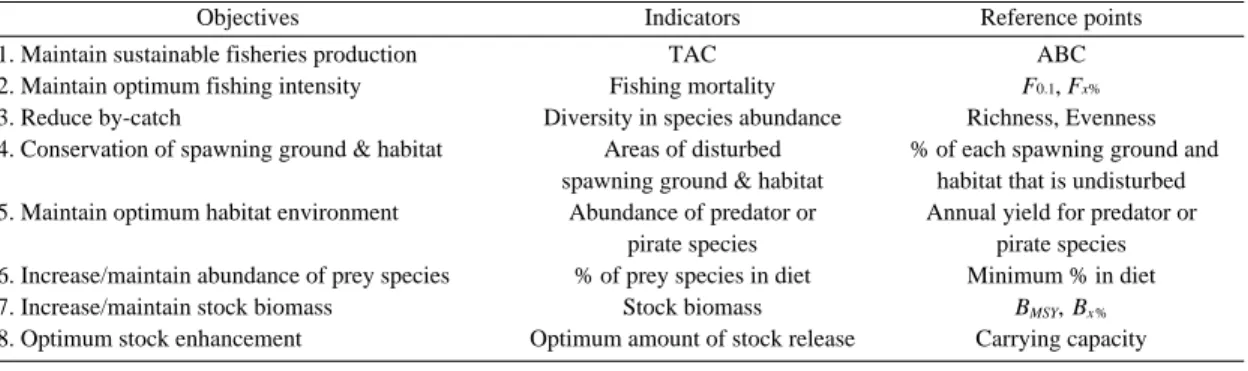
(Objectives), (Indicator), (Reference
point) (Table 3).
.
(ABC)
TAC .
. F
0.1, F
x%.
, Richness Evenness
. .
.
.
.
. . B
MSY, B
x%. .
.
Table 3 8 (Objectives)
(Indicators),
(Reference points) .
8 , ,
.
5 . ,
, , , ,
, ,
/ ,
, .
Table 4
5 .
, .
Ftarget
40% 219M/T .
Fig. 4. Improved self]-regulatory community fisheries management system in the Dong-li community of Busan.
. , .
F0.1 F40%
Park and Zhang(2008) .
, .
, 500kg .
.
, /
. /
BMSY B40%
491M/T 409M/T .
, .
1,174M/T .
14,333,096inds./yr .
,
,
, 7cm 6.25cm
.
,
Table 3. Ecosystem Objectives, Indicators and Reference points for self-regulatory management system
Objectives Indicators Reference points
1. Maintain sustainable fisheries production 2. Maintain optimum fishing intensity 3. Reduce by-catch
4. Conservation of spawning ground & habitat
5. Maintain optimum habitat environment
6. Increase/maintain abundance of prey species 7. Increase/maintain stock biomass
8. Optimum stock enhancement
TAC Fishing mortality Diversity in species abundance
Areas of disturbed spawning ground & habitat
Abundance of predator or pirate species
% of prey species in diet Stock biomass Optimum amount of stock release
ABC F0.1, Fx%
Richness, Evenness
% of each spawning ground and habitat that is undisturbed Annual yield for predator or
pirate species Minimum % in diet
BMSY, Bx %
Carrying capacity
Table 4. Applied parameter ecosystem objectives, indicators and reference points for self-regulatory management system
Objectives Reference points Management scheme in Dong-li
1. Maintain sustainable fisheries production 2. Maintain optimum fishing intensity
3. Maintain optimum habitat environment 4. Increase/maintain stock biomass
5. Optimum stock enhancement
ABC F0.1, Fx%
Annual yield for pirate species BMSY, Bx%
Carrying capacity
260 369 M/T
F0.1 0.250/yr
F40% 0.418/yr
500 kg
BMSY 491 M/T
Bx% 409 M/T
1,174 M/T
.
.
.
,
.
.
.
, ,
.
.
. , , ,
, ,
.
.
.
.
.
.
.
.
,
. Park and Zhang(2008)
ABC .
MEY .
.
.
.
.
.
,
.
8
(Objectives) (Indicators),
(Reference points) .
5 .
, ,
, ,
, / ,
, .
5 ,
,
.
Choi, Y.S., 2005. A comparison of community-based resource management fisheries policy between Korea and Japan. MS Thesis, University of Hokkaido, Hakodate, Japan, pp. 97.
FAO(Food and Agriculture Organizations), 2003.
Technical guidelines for responsible fisheries- fisheries management : 2. The ecosystem approach to fisheries. pp. 112.
Gislason, H., M. Sinclair, K. Sainsbury and R. O Boyle, 2000. Symposium overview : incorporating eco-
system objectives within fisheries management.
ICES Journal of Marine Science. 57, 468 475.
Kim, S.H., 2002. A study on self-fisheries management of costal fisheries. MS Thesis, Pukyong National University, Busan, Korea. pp. 44.
Kim, T.G., 2005. The status and promotion plan of self- regulatory fisheries management. Proceedings of workshop on ecosystem-based fisheries manage- ment, Busan, Korea. 38 48.
Lee, S.G and Y.M. Shin, 2004. A study on the self regulatory management model of costal fisheries in Korea. The Journal of Fisheries Business Administr- ation, 35(1), 87 115.
Livingston, P.A., K. Aydin, J. Boldt, J. Ianelli and J.
Jurado-Molina, 2005. A framework for ecosystem impacts assessment using and indicator approach.
ICES Journal of Marine Science, 62 , 592 597.
MOMAF(Ministry of Maritime Affairs and Fisheries), 2003. A study for successful settlement of self- regulatory fisheries management-final report. pp.
247.
Park, H.W. and C.I. Zhang, 2008. A population ecological study of the hen clam(Mactra chinensis) in the Dong-li self-regulatory community of Busan.
J. Kor. Soc. Fish. Tech., 44(2), 129 140.
Zhang, C.I, 2004. Prospect of ecosystem-based fisheries resource management. J. Korean Soc. Fish. Res., 5, 73 90.


![Fig. 4. Improved self]-regulatory community fisheries management system in the Dong-li community of Busan.](https://thumb-ap.123doks.com/thumbv2/123dokinfo/4849212.527834/5.918.152.438.118.354/improved-regulatory-community-fisheries-management-dong-community-busan.webp)