CORROSION SCIENCE AND TECHNOLOGY, Vol.10, No.3(2011), pp.77~79
77
Investigation on the Recent Research Trend
in the Corrosion Behaviour of Stainless Steel Weldment
Hwan Tae Kim1, Sang Cheol Kil2,†, and Woon Suk Hwang3
1ReSeat Program, Korea Institute of Science and Technology Information, 66, Hoegi-ro, Dongdaemun-gu, Seoul, 130-741, Korea
2Information Analysis Center, Korea Institute of Science and Technology Information, 66, Hoegi-ro, Dongdaemun-gu, Seoul, Korea, 130-741, Korea
3School of Materials Science & Engineering, Inha University, Yong hyun-dong 253, Nam-gu, Incheon, Korea (Received March 18, 2011; Revised May 2, 2011; Accepted May 4, 2011)
The research trend in the corrosion behaviour of stainless steel weldment has been reviewed. The welding technology plays an important role in the fabrication of structure such as chemical plant, power plant, because welding can influence various factors in the performance of plant and equipment. This has led to an increasing attention towards the corrosion behaviour of weldment which has been one of the major issues for both welding and corrosion research engineers. The aim of this paper is to give a short survey of the recent technical trends of welding and corrosion including the electrochemical corrosion, stress corrosion cracking, and corrosion fatigue in connection with the welding materials, welding process, and welding fabrication.
This study covers the corrosion behaviour of stainless steel weldment collected from the COMPENDEX DB analysis of published papers, research subject and research institutes.
Keywords : stainless steel, welding, electrochemical corrosion, stress corrosion cracking, corrosion fatigue
†Corresponding author: [email protected]
1. Introduction
It is well known that welding technology plays an im- portant role in the fabrication of high alloy steel including the stainless steel, duplex stainless steel structures such as chemical plant, power plant, etc., because welding can influence various factors including high level mechanical and physical properties in the performance of plant and equipment. However welding process introduces many chemical, mechanical and metallurgical conditions in a fabricated weld structure and the weld joint is very suscep- tible zone of localized aggressive attack like corrosion as it is characterized by chemical and microstructural in- homogeneities. This has led to an increasing attention to- wards the corrosion behaviour of weldment which has been one of the major issues for both welding and corro- sion research engineers. Recently the number of research programs with regarding to subjects on the corrosion prop- erties of the stainless steel welding technologies, such as corrosion behaviour of laser arc hybrid welds, friction stir welds, direct laser melting surface treatment, are carried out, and many reports or papers are published.
This study was investigated with corrosion, stress corro- sion cracking, and corrosion fatigue behaviour of the weld- ing zone when the stainless steel is welded with arc weld- ing, laser-arc hybrid welding of the high quality advanced joining technology and, which is based on the published research works for the corrosion behaviour of stainless steel weldment obtained from the KISTI's database, COMPENDEX DATA BASE SYSTEM, including the de- tailed background data of the corrosion behaviour of stain- less steel weldment.
2. Characteristics and trend of the corrosion research of stainless steel weldment
The use of duplex stainless steel increases steadily worldwide and the fluctuations of the nickel price in the recent years have contributed to its further growth. If the laser welding (without filler) is associated with high ferrite fractions, the ductility and corrosion performance of the weldment is reduced. Nd:YAG, CO2 and fiber laser weld- ing has been performed with and without filler wire and as laser hybrid welding(Fig. 1, 2) with gas tungsten arc (GTA) and gas metal arc (GMA). Laser-arc hybrid weld- ing, which combines or couples the laser beam welding
HWAN TAE KIM, SANG CHEOL KIL, AND WOON SUK HWANG
78 CORROSION SCIENCE AND TECHNOLOGY Vol.10, No.3, 2011
Fig. 1. Laser-GTA Hybrid Welding System.
Fig. 2. Comparision of the Penetration of the Laser-GTA Hybrid Welding, Laser Welding and GTA Welding.
with the arc welding process. The austenite formation in autogenous laser weldment is not sufficient to completely avoid chromium nitride precipitation and furthermore, pit- ting corrosion is easy to occur at the weld metal zone.
In particular, this tendencty is often observed in fiber laser welding. Use of filler wire in Nd:YAG laser welding and Nd:YAG laser-GTA hybrid welding with or without filler wire, and nitrogen additions to the GTA shielding gas enhanced the austenite formation and the pitting resistance. CO2 laser and CO2 laser-GMA hybrid welding exhibited predominantly the large amount of austenite for- mation and relatively showed the highest pitting resistance of all laser welds.
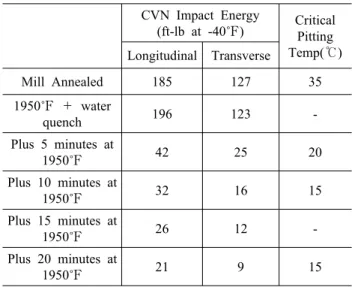
Both crevice and pitting corrosion are commonly in- volved in the types of localized corrosion, which can occur easily in the welding zone of the stainless steel. In addi- tion, crevice corrosion typically occurs where a crevice has been formed under corrosive environment. Therefore, We have to appreciate the characteristics of all types of welding methods in order to avoid the unacceptable weld profiles and control the crevice corrosion. When sigma formation occurs in the stainless steel weld joint, the corro- sion properties and the toughness are degraded. Table 1 shows the effect of sigma formation.
To avoid the loss of corrosion properties, stainless steel welding procedures must be designed to minimize time at temperature.
The crevices are generally formed at the places such
Table 1. The Effect of Sigma Formation on 2205 Duplex Stainless Steel
CVN Impact Energy
(ft-lb at -40℉) Critical Pitting Temp(℃) Longitudinal Transverse
Mill Annealed 185 127 35
1950℉ + water
quench 196 123 -
Plus 5 minutes at
1950℉ 42 25 20
Plus 10 minutes at
1950℉ 32 16 15
Plus 15 minutes at
1950℉ 26 12 -
Plus 20 minutes at
1950℉ 21 9 15
as the incomplete fusion and joint penetration, porosity, weld spatter, arc strikes, rough weld ripples and overlap.
Pitting corrosion typically occurs because of a small lo- calized anode formed at the substrate due to depletion of component having the corrosion resistance. The pitting and crevice corrosion resistance of stainless steels, especially in the environments of chloride ion, can be improved appa- rentially by the addition of molybdenum and nickel.
3. Technical information analysis
COMPENDEX** covers the trend of the volume of an- nually published papers concerning corrosion behaviour of stainless steel weldment including the contents of those papers which were mainly experimental and theoretical.
Search query and information analyzing process is shown in Fig. 3.
The trends of the volume of annually published papers concerning corrosion behaviour of stainless steel weldment are shown in Fig. 4, and it is observed that the number of papers has markedly increased in 2008.
Fig. 3. Search query and information analyzing process.
INVESTIGATION ON THE RECENT RESEARCH TREND IN THE CORROSION BEHAVIOUR OF STAINLESS STEEL WELDMENT
CORROSION SCIENCE AND TECHNOLOGY Vol.10, No.3, 2011 79
11 7 7 9 10
26 42
125
47 45
11 18 25 34 44
70 112
237 284
329
0 50 100 150 200 250 300 350
0 20 40 60 80 100 120 140
2001 2002 2003 2004 2005 2006 2007 2008 2009 2010
The Number of Papers The Number of Papers
The Number of Papers The Accumulated Number of Papers
Fig. 4. Comparison of the Published Papers (Year).
Japan, 57
United States, 44 China, 45
India, 31 Brazil, 18 United Kingdom, 15
Spain, 14 Sweden, 12
Finland, 8 Canada, 7Australia, 6
Germany, 6 Taiwan, 6
Italy, 5 Egypt, 4
Korea, 4 Turkey,
4
Argentina, 3 France, 3 Mexico, 3
South Africa, 3 The Others, 31
Fig. 5. Comparison of the Published Papers (Country).
2 1
4 4
3 3
5 25
5 5
4 5
8 12
4 11
2 1 1
3 7
18
8
5
2 1 1 2 2
1 14
6
1 1 1 1 2
6 6
1 2 2
6
2 4
2 2
7
2 1
1
4 3
2 2
0 5 10 15 20 25 30
2001 2002 2003 2004 2005 2006 2007 2008 2009 2010 The Number of Papers
Japan United States China India Brazil United Kingdom Spain Sweden
Fig. 6. Comparison of the Published Papers (Country/Year).
Fig 5 shows the country's research trends of corrosion behaviour of stainless steel weldment, and shows that Japan, China and U.S.A. ranks top in publishing the papers.
Fig. 6 shows the detailed analysis of the country/year research trends of corrosion behaviour of stainless steel weldment and it reveals that Japan(25), China(18), and India(14) published many papers especially in 2008.
4. Conclusions
In this study, investigation was carried out to study the recent research & technical trends of corrosion behaviour of stainless steel weldment including the electrochemical corrosion, stress corrosion cracking, and corrosion fatigue.
Corrosion behaviour of stainless steel weldment were ex- tensively studied in 2008, and the application of the ad- vanced welding processes such as laser-arc hybrid weld- ing, friction stir welding will be expected for the corro- sion-resistant weld joint and structure in near future.
References
1. Westin, Elin M, J. Laser Appl., 22, 150 (2010).
2. Ravi Menon and Jack Wallin, Weld. J., 87, 31 (2008).
3. James A. Mcmaster, Weld. J., 87, 40 (2008).
4. Richard D. Campbell, Weld. J., 86, 56 (2007).
5. Cui Y, Lundin C.D. Hariharan V., Corros. Eng. Sci.
Technol., 41, 87 (2006).
6. Arthur H. Tuthill, Weld. J., 84, 36 (2005).
7. C. Meadows, Weld. J., 84, 26 (2005).
8. A. Turnbull and A. Griffiths, Corros. Eng. Sci. Technol., 38, 21 (2003).