1. INTRODUCTION
Currently, the number of self-employed workers has in- creased because of changing social and personal values and growing interest in business. According to the statistics re- garding the economically active population, there were 5,570 self-employed out of 26,235 employed workers in 2016.
Moreover, the people who want to start a restaurant business were 21.1 percent in self-employed (The National Statistical Office in Korea, 2016; The National Statistical Office in Korea,
2016). While increasing interest in the restaurant business, in- creasing restaurant closer is becoming serious social problem.
Thus, there have been many studies about prep-entrepreneurs and entrepreneurs. Kwon (2016) focused on the psychological characteristics and background traits of prep-entrepreneur, and Kwon (2013) studied prep-entrepreneur's sprit and cha- racteristics. Furthermore, Oh (2015) studied the relationships between entrepreneurs’ psychological traits such as desire to accomplish, control location, sensitivity, and preference in type of business. As a result, this study showed a lower prefer- Information available at the Culinary Society of Korea (http://www.culinary.re.kr/)
Culinary Science & Hospitality Research
Journal & Article Management System: https://cshr.jams.or.kr/
http://dx.doi.org/10.20878/cshr.2017.23.6.013
The Effects of Personality Factors of the Prep Entrepreneurs in Food Service Industry on Entrepreneurial Intention:
Focusing on the Risk Sensitivity
Cheol-Woo Park* and Gumkwang Bae
Dept. of Restaurant & Foodservice Management, Dong-eui University, Korea
KEYWORDS ABSTRACT
Entrepreneur, Personality factor, Risk sensitivity,
Entrepreneurial intention.
The purposes of this study were to estimate the relationship between Big 5 personality factors of prep-entrepreneur and entrepreneurial intention, and to identify the moderating effects of risk sensitivity on the relationship. There is a total of 181 questionnaire surveys distributed and 152 data were used for analysis with erasing incomplete responses. The data analysis was conducted to uti- lize frequency analysis and regression analysis with SPSS WIN 22.0. The results of this study de- monstrated that there are only 2 factors, neuroticism and extraversion, significantly influence on entrepreneurial intention, while conscientiousness, agreeableness and openness to experience do not have significant impacts on entrepreneurial intention. Furthermore, risk sensitivity effects on the relationship between Big-5 personality factor and entrepreneurial intention. This study may contri- bute to help prep-entrepreneur by using baseline data. Prep- entrepreneur could know their person- ality factor and confirm their consideration about entrepreneurial intention. Meanwhile, for the market-oriented implication, this study suggested that it is instrumental and significant for knowing prep-entrepreneur’s personality factor and their entrepreneurial intention before starting foodservice business.
*
Undergraduate student, Dept. of Restaurant & Foodservice Management, Dong eui University.
Corresponding author: Gumkwang Bae, Dept. of Restaurant & Foodservice Management, Dong eui University, Busan 47340, South Korea, Tel.
+82-51-890-2098/1401, Fax. +82-505-182-6863, E-mail: [email protected]
ence for franchise businesses. Besides, another study showed that entrepreneurs who have a higher personality factor such as desire to accomplish and risk sensitivity results in better performance (Cheong & Ha, 2012).
In addition, an entrepreneur is a person who has generated ideas so that successful business could be realizable through effect, luck, and genius, and the personality factors of en- trepreneur could explain differences in each individual acti- vities and behavioral intention(Kim, 2005; Park & Ko, 2012).
Therefore, persons who have both a restaurant business plan within 5 years and a major related to food management were defined as entrepreneurs and prep-entrepreneur for this study. Moreover, personality factors of prep entrepreneurs measure by using the Big 5 personality factors. Entrepreneu- rial intention consists of an earnest heart, strong trust, hope- fulness, and realizing confidence or business outcome in in- dividual activity and startups (Shapero & Sokol, 1982).
While previous studies have focused on characteristic fac- tors of prep-restaurant entrepreneurs, this study focuses on the reasons why prep restaurant entrepreneurs have failed in their business. Moreover, it assesses the relationships between characteristic factors of prep restaurant entrepreneurs and en- trepreneurial intention (Kwon, 2016; Lee, 2012). Furthermore, personality factors of prep-restaurant entrepreneurs are im- portant to know their entrepreneurial intention also, this study uses Big-5 personality factors so that it can divide five kinds of personality factors of them.
Meanwhile, risk sensitivity is defined as a tendency to try to overcome risks and achieve goals, when people are given a chance in business situation and environment (Kim, 2007) and this conception also has been employed with studies fo- cusing on entrepreneurship because food restaurant business is very uncertain so, many people think If whoever would like to start business, they should endure many risk. In addition, many studies focused on relationship between risk sensitivity and startups (Jung, 2012; Oh, 2015).
Even though many studies have found the importance of risk sensitivity on startups, there are few studies in regards with the relationship between risk sensitivity and prep-en- trepreneur in the hospitality management (Oh, 2015; Park, Shim, & Jung, 2016). Therefore, this study focuses on the mo- derating effects of risk sensitivity on the relationship between personality factors of prep-entrepreneurs and entrepreneurial intention.
Through these measurements, this study aims to estimate
the effects of the prep restaurant business venture's person- ality factors on entrepreneurial intention. Personality factors will be estimated with Big 5 personality factors such as Extra- version, Conscientiousness, Agreeableness, Openness to expe- rience and Neuroticism. In these relationships, moderator vari- able is risk sensitivity, and the study will investigate how to change entrepreneurial intention according to risk sensitivity.
Moreover, this study aims to help the prep-entrepreneur to know about their personality factors before they start up, and to offer information about business and startups to not only prep-entrepreneurs, but also other entrepreneurs. In addition, this study intends to provide information to startups educa- tors so that they can reduce the risks and burdens of startups.
2. LITERATURE REVIEW
2.1. Entrepreneur
Entrepreneur's origin of word is called Entrepreneur origi- nated from Entreprendre of France Verb and this have a meaning called 'accomplish' and 'conduct' (Park, 2013). More- over, Entrepreneur has defied as "After establish company for the first time, starting business is Entrepreneur" by The Natio- nal Institute of the Korean Language. On the other opinions, meaning of Entrepreneur was called a person who generated ideas so that successful business could be realizable through effect, luck and genius (Park, 2009).
Given the definitions of Entrepreneur, trends in the hospi- tality industry show that proportion of restaurant businesses have increased gradually among the startups according to the tendency of startups in 2013. Furthermore, according to the information of the national statistical office in Korea by 2016, the number of the restaurant and bar more increased in 2013 than the number of them by 10.2 percent in 2006 also, private business has increase for years continually (The National Statistical Office in Korea, 2016. 6).
With the increase of Entrepreneurs, substantial studies have
dealt with (Kwon, 2013; Oh, 2015; Kwon, 2016). For instance,
Kwon (2013) showed that How much Prep-Entrepreneur's
characteristic such as risk sensitivity, autonomy and adven-
turous effected both franchise business and private business
of type of business, and Oh (2015) studied personality factor
of entrepreneur affected type of startups. Moreover, result of
this study was that Entrepreneur who have the higher person-
ality factor such as risk sensitivity prefer to choice franchise
business type. Furthermore, Kwon (2016) showed that rela-
tionships between prep- entrepreneur’s personality factors (risk sensitivity and desire of accomplish) and background fac- tor (financial preparation and personal relationship).
In this study, persons who have both restaurant startups plan within 5 years and major related food management will define Entrepreneur and Prep-Entrepreneur and will research.
2.1.1. Big-5 Personality Factor
Personality psychologist was interested in knowing charac- teristic of personality factor that showed difference and activi- ty of individual also, personality could explain traits (Kim, 2005). On the other hand, researchers who studied traits of personality invested many times to search traits of personality which explained difference of individual. Thus, many studies about Big-5 personality factor have dealt with many studies of researchers (Goldberg, 1990).
On the previous studies, it formulated psychological hy- pothesis to know that how to develop Big-5 personality factor.
As a result, it showed that the best high common and fre- quency factor is extraversion (Lee, 1994). Moreover, according to Lee (2011)’s study, the higher extraversion of Big-5 person- ality of hotel bakery workers in Seoul and Kyeongki area is the more performance their work. On the research of recently within 3years, Big-5 personality factor of tourism major uni- versity students changed their attitude of thinking career (Yun, 2016). Given the theoretical background, this study as- sumes that Big-5 personality factors influence on entrepre- neurial intention.
2.2. Entrepreneurial Intention
Entrepreneurial intention is when anyone start business, they have trust regarding their potential business ability (Shapero & Sokol, 1982). Furthermore, entrepreneurial inten- tion is important to entrepreneur and prep-entrepreneur who start business because recognizing entrepreneurial intention of prep-entrepreneur is first step. In addition, understanding concept of entrepreneurial intention is essential activity about knowing relationship between startups and entrepre- neurial intention (Krueger & Carsrud, 1993; Kim, Eum, & Byun, 2009).
On the previous studies, psychological trait of prep en- trepreneur such as risk sensitivity, desire of accomplish posi- tively affected entrepreneur intention (Jung, 2012). In addi- tion, the other previous studies showed whether psycho-
logical traits of prep entrepreneurs and education of en- trepreneur have an influenced on entrepreneurial intention, and it showed that most of psychological traits positively af- fected on the entrepreneurial intention (Park, 2016). Thus, this study estimates that relationships between entrepreneurial in- tention and personality factor of prep restaurant entrepre- neur.
2.2.1. Risk Sensitivity
When entrepreneurs have plan to start business, they did not avoid risk of situation of business. However, if they want to get good result, they could solve risk of many problems by using reasonable ways (Jung, 2012). Furthermore, when they have great any chance, although there were many risk of business, they wanted to catch chance. Entrepreneurs who have high risk sensitivity wanted to catch chance more than the lower entrepreneurs also, people who have the lower risk sensitivity had sensitive decision (Kim, 2007).
Moreover, Risk sensitivity shows that this factor related to startups because startups is difficult to predict the future so, risk sensitivity is essential factor to entrepreneur who want to start business, and the higher risk sensitivity of entrepreneur help to find good chance in business situation (Herbert & Link, 1988).
On the previous studies have processed for many years. To explain, the higher risk sensitivity of psychological factors of entrepreneur chose franchise type of business also, the lower risk sensitivity of psychological factors of entrepreneur chose private business type (Oh, 2015). On the other research, there were many relationships with risk sensitivity, activity about startups and tendency (Park et al., 2016). Therefore, this study assumes that risk sensitivity influences on the relationship be- tween personality factor and entrepreneurial intention.
3. METHODOLOGY
3.1. Research Instrument
The questionnaire was developed based on a review of re-
lated research, and 25 questions asking about Big-5 perso-
nality factor were adopted from Park (2016)’s and McCrae and
Costa (1985)’s study. In addition, 4 questions of entrepre-
neurial intention were adopted from Song (2014)’s study and,
and 4 questions of risk sensitivity were adopted from Ho
(2016)’s study.
Fig. 1. Research model.
3.1.1. Data and Sample
A total of 181 people planning to start business related res- taurant were recruited from a university located in Busan to be served as subjects. Participants were instructed to take an off-line survey from April to May in 2017. 29 questionnaires were removed due to incomplete responses. As a result, 152 samples were finally used to conduct this study. This study uses SPSS WIN 22.0 and verify hypotheses thorough re- gression analysis.
3.1.2 Research Model and Hypothesis
In oder to achieve the purposes of this study, the research model and hypotheses were developed as follow.
H1: Big-5 personality factors will influence on entrepre- neurial intention.
H1-1: Neuroticism of Big-5 personality will influence on entrepreneurial intention.
H1-2: Agreeableness of Big-5 personality will influence on entrepreneurial intention.
H1-3: Conscientiousness of Big-5 personality will influ- ence on entrepreneurial intention.
H1-4: Extraversion of Big-5 personality will influence on entrepreneurial intention.
H1-5: Openness to experience of Big-5 personality will in- fluence on entrepreneurial intention.
H2: Risk sensitivity will influence on the relationship be- tween Big-5 personality factors and entrepreneurial intention.
H2-1: Risk sensitivity will influence on the relationship be- tween neuroticism and entrepreneurial intention.
H2-2: Risk sensitivity will influence on the relationship be- tween agreeableness and entrepreneurial intention.
H2-3: Risk sensitivity will influence on the relationship be- tween conscientiousness and entrepreneurial in-
tention.
H2-4: Risk sensitivity will influence on the relationship be- tween extraversion and entrepreneurial intention.
H2-5: Risk sensitivity will influence on the relationship be- tween openness to Experience and entrepreneurial intention.
4. RESULTS
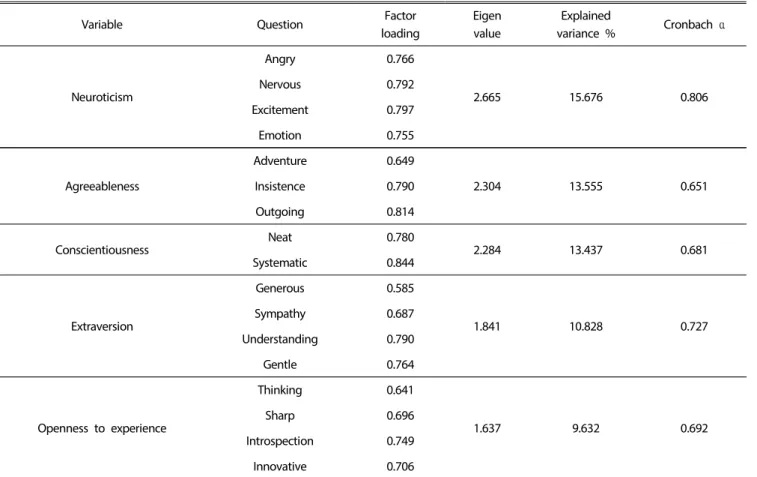
In order to validity verification, this study conducts factor analysis and reliability analysis. Each variables of Big -5 per- sonality factors has eigenvalue greater than 1.0 and, factor loading value is over 0.50. The Table 1 shows that KMO of Big -5 personality factors is 0.709. In addition, Cronbach α of Big-5 personality factors is over 0.6. Therefore, this study has validity and reliability of Big-5 personality factors.
Each variables of risk sensitivity has eigenvalue greater than 1.0 and a factor loading of 0.50 or greater. The Table 2 shows that KMO of risk sensitivity factor is 0.744 and, KMO of en- trepreneurial intention is 0.776. In addition, reliability of risk sensitivity have Cronbach α greater than 0.6. and, reliability of entrepreneurial intention have Cronbach α greater than 0.6. Therefore, this study has enough validity and reliability estimating risk sensitivity and entrepreneurial intention.
This study assumes that neuroticism of Big-5 personality factors of prep entrepreneur significantly influence on en- trepreneurial intention, and risk sensitivity influence on the re- lationship between neuroticism and entrepreneurial intention.
The Table 3 shows main effects of neuroticism(adjusted R square=0.029 and F=4.479) and risk sensitivity (adjusted R square=0.447 and F=127.051). On the other hand, the table did not show the moderating effect of risk sensitivity on the relationship between neuroticism and entrepreneurial inten- tion(adjusted R square=0.000, F=0.005).
This study assumes that agreeableness of Big-5 personality
factors of prep entrepreneur significantly influence on en-
Variable Question Factor loading
Eigen value
Explained
variance % Cronbach α
Risk sensitivity
Challenge 0.777
2.378 59.462 0.772
Overcome 0.716
Endure 0.841
Sacrifice 0.745
Entrepreneurial intention
Plan 0.846
2.868 71.694 0.865
Wish 0.879
Chance 0.774
New 0.884
Risk sensitivity: KMO=0.744, Approx-χ
2=159.327, df=6, p=.000.
Entrepreneurial intention: KMO=0.776, Approx-χ
2=314.496, df=6, p=.000.
Table 2. Risk sensitivity and entrepreneurial intention -Factor analysis and reliability analysis
Variable Question Factor
loading
Eigen value
Explained
variance % Cronbach α
Neuroticism
Angry 0.766
2.665 15.676 0.806
Nervous 0.792
Excitement 0.797
Emotion 0.755
Agreeableness
Adventure 0.649
2.304 13.555 0.651
Insistence 0.790
Outgoing 0.814
Conscientiousness
Neat 0.780
2.284 13.437 0.681
Systematic 0.844
Extraversion
Generous 0.585
1.841 10.828 0.727
Sympathy 0.687
Understanding 0.790
Gentle 0.764
Openness to experience
Thinking 0.641
1.637 9.632 0.692
Sharp 0.696
Introspection 0.749
Innovative 0.706 KMO=0.709, Approx-χ
2=756.318, df=136, p=.000.
Table 1. Big-5 personality factor-Factor analysis and reliability analysis
trepreneurial intention, and risk sensitivity influence on the re- lationship between agreeableness and entrepreneurial inten- tion. The Table 4 did not show the main effect of agree- ableness(adjusted R square=0.008 and F=1.241). On the other
hand, the Table shows the main effect of risk sensitivity
(adjusted R square=0.467 and F=132.708), and the moderating
effect of risk sensitivity on the relationship between agree-
ableness and entrepreneurial intention(adjusted R square=
1 2 3
B β B β B β
Conscientiousness .051 .051 .023 .023 .026 .026
Risk sensitivity .690 .688 .699 .696
Conscientiousness
Risk sensitivity .095 .096
F
.386 133.849
***2.634
R
.003 .472 .009
R
.003 .475 .484
***
p<0.001.
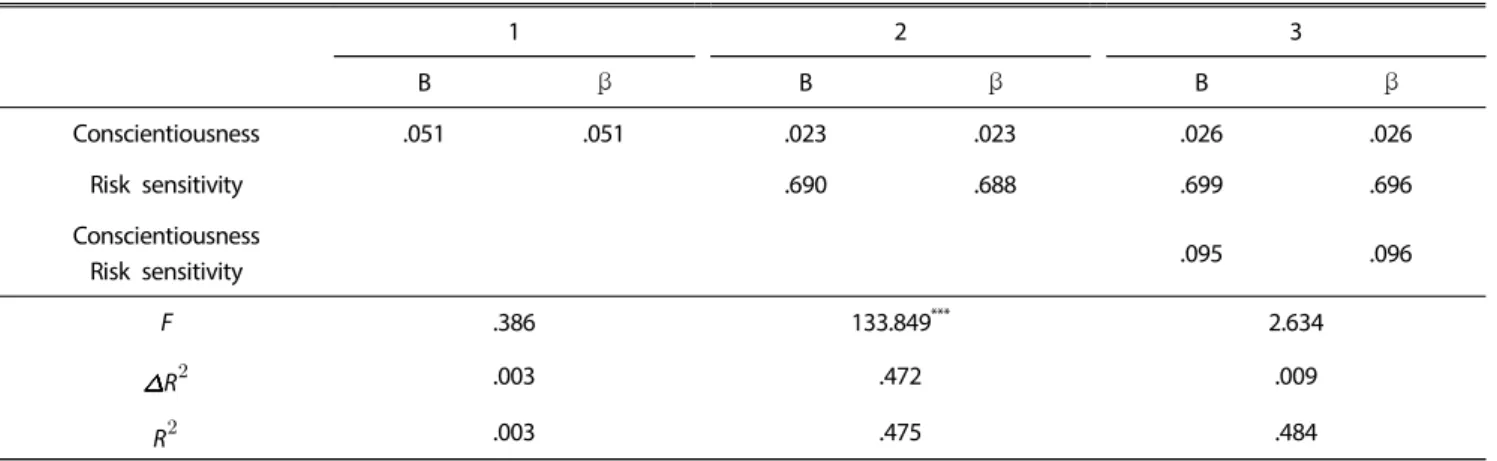
Table 5. Conscientiousness and risk sensitivity
1 2 3
B β B β B β
Neuroticism .170 .170 .044 .044 .044 .044
Risk sensitivity .683 .680 .683 .680
Neuroticism
risk sensitivity .004 .004
F
4.479
*127.051
***.005
R
.029 .447 .000
R
.029 .476 .476
*
p<0.05,
***p<0.001.
Table 3. Neuroticism and risk sensitivity
1 2 3
B β B β B β
Agreeableness .091 .091 .037 .037 .046 .046
Risk sensitivity .688 .686 .696 .693
Agreeableness
risk sensitivity .098 .091
F
1.241 132.708
***2.336
R
.008 .467 .008
R
.008 .475 .484
***
p<0.001.
Table 4. Agreeableness and Risk sensitivity
0.008, F=2.336).
This study assumes that conscientiousness of Big-5 person- ality factors of prep entrepreneur significantly influence on en- trepreneurial intention, and risk sensitivity influence on the re-
lationship between conscientiousness and entrepreneurial
intention. The Table 5 did not show the main effect of con-
scientiousness(adjusted R square=0.003 and F=0.386). On the
other hand, the table shows the main effect of risk sensitivity
1 2 3
B β B β B β
Openness to experience .054 .054 .004 .004 .004 .004
Risk sensitivity .690 .688 .692 .690
Openness to experience
risk sensitivity .022 .024
F
.438 133.482
***.161
R
.003 .471 .001
R
.003 .474 .475
***
p<0.001.
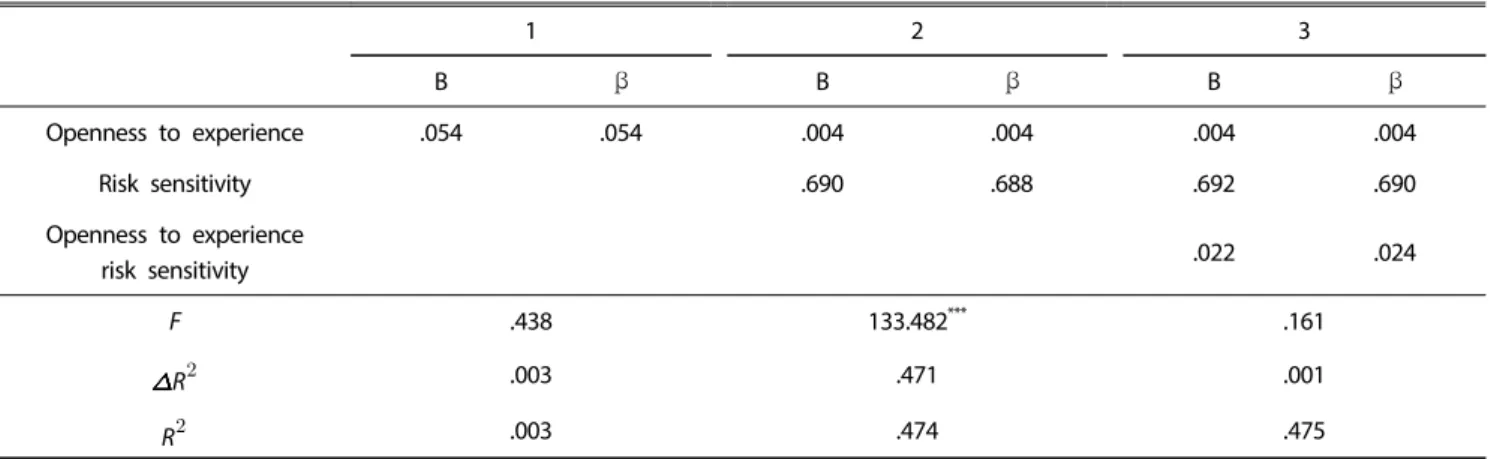
Table 7. Openness to experience and risk sensitivity
1 2 3
B β B β B β
Extraversion .249 .249 .012 .012 .021 .021
Risk sensitivity .686 .684 .667 .665
Extraversion
risk sensitivity .067 .073
F
9.957
**116.734
***1.430
R
.062 .412 .005
R
.062 .474 .479
**