INTRODUCTION
Coffee is one of the most widely consumed and popular beverage in the world (Taylor & Demmig- Adams 2007). Nearly 500 billion cups of coffee are consumed annually throughout the world (Bidel &
Tuomilehto 2013). The size of the coffee industry has increased significantly over the past decades. Based on Kalidas & Zeeshan (2014), more people are drink- ing coffee in Malaysia and this phenomenon has brought in a lot of both international and local mer- chants to invest in a high-quality coffee shop. Coffee sales were RM37.28 million in year 2011 and is estimated an increase to RM42.90 million in year 2016.
The term ‘servicescape’ is define as a physical, manmade environment which different from a natu- ral or social environment (Rosenbaum & Massiah 2011), it is then categorised into three types of di- mensions by Bitner (1992) of the physical surround- ing which is ‘ambient conditions’, ‘space and func- tions’ and ‘sign, symbols and artifacts’. Servicescape is one of the most critical elements that greatly af- fect customers’ emotions which lead to customer satisfaction and behavioral intention while utilizing the products or services in the food service industry.
For example, one of the servicescape dimension, music is able to influence customers’ spending pow- er in a restaurant setting (Caldwell & Hibbert 1999).
Moreover, servicescape is a significant factor that in- Culinary Science and Hospitality Research (October 2015)
Vol. 21, No. 5, pp. 129-138
Servicescape and Customer Behavioral Intention: The Impact of Servicescape on Customer Emotion Responses towards Customer Satisfaction and Behavioral Intention in Local Coffee Shops in Kuala Lumpur, Malaysia
Sang-Hyeop Lee
1, Liew KharKhiaw
1and Dong-Ho Kim
2¶1
Centre for Tourism, Hospitality, and Culinary Management, Sunway University
2
Department of Baking Technology, Hyejeon College
ABSTRACT: There are limited resources on how servicescape influence customer emotions and respond towards customer satisfaction and behavioral intention. Hence, this research investigates how service- scape influence customer behavioral intention in local coffee shops in Kuala Lumpur by using Multiple Regression analysis. This study mainly focus on three environmental dimensions, which are the facility aesthetics, music and layout accessibility. Based on the result, it shows that both music and layout accessi- bility are significant factors that greatly influence customer satisfaction and behavioral intention. Overall, this research indicates that managers should realise thatmusic and layout accessibility play an important role to influence customers eating out at coffee shops.
Keywords: servicescape, satisfaction, behavioral intention, emotion responses
¶ Corresponding Author: Dong-Ho Kim, Department of Baking Technology, Hyejeon College, 25, Daehakgil Hongsung Eup,
Hongsung Gun, Chung Nam, 32244, South Korea, Tel : +82-10-5413-7761, Fax : +82-41-630-5299, E-mail: [email protected]
fluence customers’ behavioral intentions in leisure service settings (Wakefield & Blodgett 1996). Service- scape is an influential factor determining how cus- tomers respond in a service industry, therefore re- search can be conduct to study how servicescape af- fect the customers’ emotions and behavioral in- tentions in local coffee shops setting.
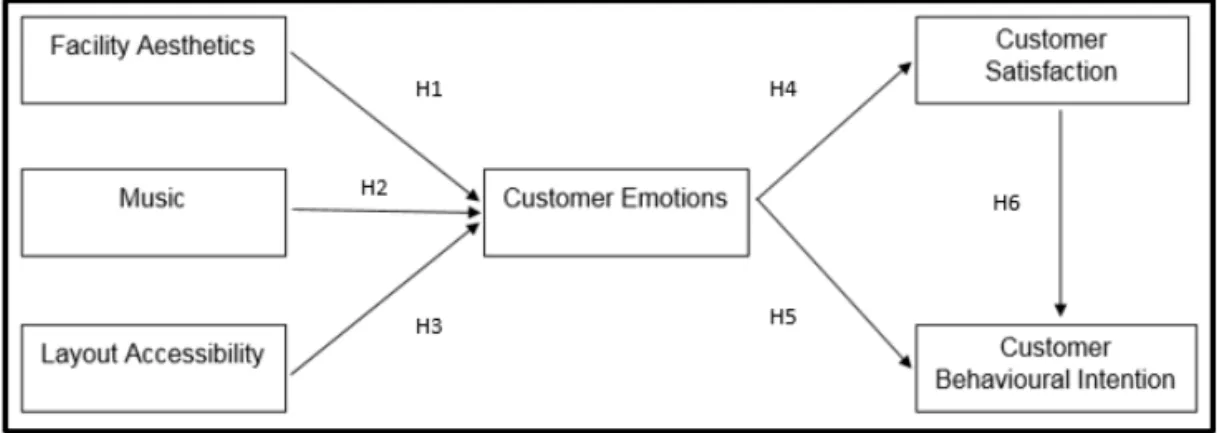
The purpose of this study were (1) To study the relationship between the facility aesthetics and cus- tomer emotions, (2) To investigate the relationship between the music and customer emotions, (3) To explore the relationship between the layout accessi- bility and customer emotions, (4) To test the rela- tionship between customer emotions and customer satisfaction, (5) To examine the relationship between customer emotions and behavioral intention, (6) To identify the effect of customer satisfaction on behavi- oral intention in local coffee shop in Kuala Lumpur.
BACKGROUND AND HYPOTHESES
Facility Aesthetics
Facility aesthetics is considered to be one of the most important factors in various service settings (Ryu & Han 2010). Facility aesthetics are the func- tions of the architectural design, artwork and deco- rative items plus the interior design, which influence the appeal of the servicescape (Wakefield & Blo- dgett 1996). Firm uses architectural designs, artifacts, drawings and decorative items to build aesthetic im- pression (Zeithaml et al 2006) in order to let custom- ers to understand the theme of the place. For in- stance, Olive garden chain restaurant uses Italian- themed artifacts to enhance customers feeling of entering an Italian restaurant or Italy itself. Once cus- tomers entered to a firm which provide service facili- ties like restaurants, they are more likely to observe (consciously and subconsciously) the designs and décor of the facility that would affect their percep- tions towards the service facility (Ryu & Jang 2007).
Previous scholars found that physical environment of various service settings have a significant effect on customers’ perception of the facilities; the reason is because customers would make judgement based on the atmospheric elements in the facilities (Jang
& Namkung 2009).
Music
Music has been studied and proved to be a sig- nificant impact as one of the ambient condition vari- ables to customer behavioral intentions in shopping mall and restaurants (Caldwell & Hibbert 1999). It would be a great help to the service managers if they are able to understand the effects of music on customers (Morrison et al 2011). The reason is it is cheap and easy to control as compare to other ele- ments of the environment. Numerical studies have showed that music tempo in shopping mall would affect the pace of shopping, the time span of stay- ing, and the amount of money spent (Bitner, 1992).
A research has done in a wine cellar by playing clas- sical music and top-forty music to examine the im- pact of the background music on purchasing beha- viour (Areni & Kim 1993). The result was not sig- nificant in terms of bottle sold but more expensive wine were sold when classical music is played com- pare to top-forty music.
Layout Accessibility
Layout accessibility is very important in service settings as it affect significantly towards customers’
emotions and behavioral intention in the facilities (Lee et al 2014). Besides, a layout might have a sig- nificant impact on customers’ quality perception to- wards the facilities, excitement levels, and indirectly on the desire to return (Ryu & Jang 2007). As sup- ported by some scholars said that people have a strong need to know where they are or able to find their way in an unfamiliar environments (Lucas 2012).
Layout accessibility define as the way items (e.g., equipment, machinery and furniture), service areas and corridors are arranged within an environment (Bitner 1992). Studies have done and proved that the spatial layout of the environment would show significant effect to the customers in the service set- tings as space is necessary for moving around and comfortable sitting environment (Han & Ryu 2009), thus a functional layout accessibility would prevent the customers in the restaurant feeling crowded.
Customer Emotions
Customer emotions have been identified to be an
important key contributor to the service industry
(Ryu & Jang 2007). Defining the MR model (Mehra- bian & Russel, 1974), customers emotions are influ- enced by the degree of exposure towards particular stimuli physical environment of the facility (Kim &
Moon 2009). The effect is significant enough for the customers on the selection of service provider, per- ception towards service quality, the possibility of re- peat customer and development of brand loyalty (Barsky & Nash 2002). Emotions are often define as two independent dimension which is positive and negative affect. However there is research proved that different emotions would lead to vary beha- vioral intentions (Mattila & Ro 2008). Moreover, emo- tions have great effect on customer satisfaction and found that positive emotions would lead to positive customer satisfaction (Lee et al 2014).
Customer Satisfaction
Customer satisfaction is a crucial factor in restau- rant settings as it is proved to be a major contri- butor to a company’s success in terms of customer retention, loyalty, positive word-of-mouth, long-term profitability (Ryu et al 2008). Moreover, customer satisfaction is an essential factor for organizations to build a long term relationship with their customers
`because it is cheaper to keep existing customers than recruit new customers (Amoako et al 2012).
There are several ways in defining customer satisfac- tion based on previous scholars. According to Lee et al (2013), satisfaction is defined as an overall deci- sion process of the perceived differences between previous expectation and the actual quality of usage.
Another approach is based on disconfirmation theo- ry, satisfaction can be define as the end result of an evaluation between the consumers’ expectations of the product or service and their actual experience (Clemes et al 2010). Constantly provide quality pro- ducts and services that satisfy customers would re- sult in more frequent purchase, greater volume and purchase other services and products offered by the organization (Reichheld & Sasser 1989).
Behavioral Intention
Behavioral intention considered to be one of the key factors to the service industry as the construct is closely related with customer repurchase inten- tion, loyalty and customer retention (Hu et al 2009).
The positive intention to return back to the same service facility would result in reduce marketing costs, brand loyalty, and promote favourable word of mouth communication (Clemes et al 2010). On the other hand, undesirable behavioral intention will outcome negative customer responses. For example, complaint behaviour and switching (Lobo et al 2007). It is defined as the degree to which a person has developed conscious ideas to carry out or not carry out some specified future behaviour (Namkung
& Jang 2010). Even though arguments about the lev- el of correlation between the behavioral intention and the actual action are still occurring, but ge- nerally agree that behavioral intention is a feasible variable for studying future behaviour (Liu & Jang 2009). Over the past decades, there are numerous research have been done on behavioral intention in different service context. One of the scholars study on repurchase intentions (behavioral intention) and result show that there is a positive relationship exist between customer satisfactions, service quality and repurchase intention (Cronin & Taylor 1992).
METHODOLOGY Survey and Sampling
1) Measure
A survey form was developed based on related
literatures of the research by previous scholars. The
self-administrated questionnaire included twenty
nine items divided into seven sections: (a) Demo-
graphic questions; (b) Facility Aesthetics (five items)
based on Wakefield & Blodgett (1996); (c) Music
(three items) adopted from Baker’s (1986) and
North & Hargreaves (1998); (d) Layout Accessibility
(four items) adopted from Kim & Moon (2009); (e)
Customer Emotions (three items) adopted from
Mehrabian and Russell (1974). The Mehrabian and
Russell measurement was modified to adapt coffee
shop context. Items for emotions was separated in-
to 2 parts: pleasure and arousal. Pleasure com-
prises of 2 items which is unhappy- happy and an-
noyed- pleased. Arousal comprises of 1 item which
is depressed-cheerful. (f) Customer Satisfaction (two
items) adopted from Oliver (1997); (g) Behavioral
Intention (three items) based on Zeithaml et al (1996). Respondents were asked to rate what they thought about the characteristics of the environ- ment when they are in the coffee shop. They rate each items using 5-point Likert scale, (1=strongly disagree; 5=strongly agree). The reliability of mea- surements was used by Cronbach’s alpha. It show- ed that the alpha values exceeded the conven- tional cut-off point of 0.70 (Nunnally 1978).
2) Data Collection
A self-developed survey forms was distributed directly confronting to 308 respondents over twel- ve days in January 2015 at 8 coffee shops in Kuala Lumpur area of Malaysia. All the respondents were briefed through the meaning of each measure- ment items. Each respondent was requested to an- swer the questions in the survey form based on his or her own experience in that particular café.
Out of 308 returned questionnaires, 302 remained after removing 6 questionnaires that found miss- ing information.
RESULTS
Demographic Profile of the Sample
The sample (n=302) was 45.7% male (n=138) and 54.3% female (n=164). The age of respondents were ranged from 18 to over 60 years. Majority of the respondents aged between 18 to 29 years (41.1%), second were 30 to 39 years (28.8%). As for annual income, most of them were less than RM20, 000 (38.7%), followed by earning RM20, 000 to
RM40, 000 (26.2%). Majority of the respondents’
education level were at Diploma (39.4%), next was Degree (30.5%). Most of the respondents visited the café once a week (45.4%), followed by 2 to 4 times a week (37.4%). Many of them stayed at the café for 1 to 3 hours (49.4%), followed by spending less than 1 hour at café (27.5%).
Correlation Analysis
A correlation matrix of the variables was utilised to test the discriminant and convergent validity of the acquired measures. This matrix analyse the re- lationship between two variables, it can have po- sitive or negative, little or no relationship between the variables (Taylor, 1990). A correlation coeffici- ent that is near to +1 signifies a positive relation- ship between the variables, whereas a correlation coefficient that is near to
—1 shows a negative rela- tionship between the two variables (Taylor, 1990).
This study shows the correlation pattern within in- dices are not the same compare with the correla- tion patterns between indices. The correlations wi- thin indices are unusually greater than those be- tween indices.
Regression Analysis
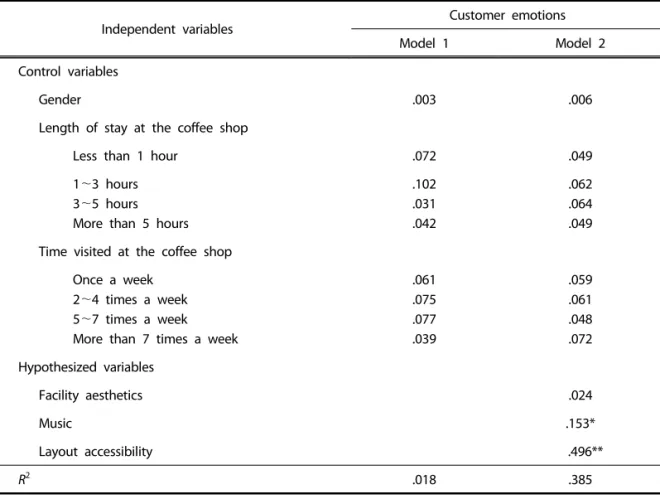
Multiple regression was utilised to test the sig- nificance of the dependant variables and the sig- nificance level between the hypotheses (Stolzen- berg, 2004). Table 1 illustrates the relationship of customer emotions and other selected variables.
The regression analysis shows that Music (t=2.352, p<.05) and Layout Accessibility (t=5.136, p<.01) had
Figure 1. Conceptual model.
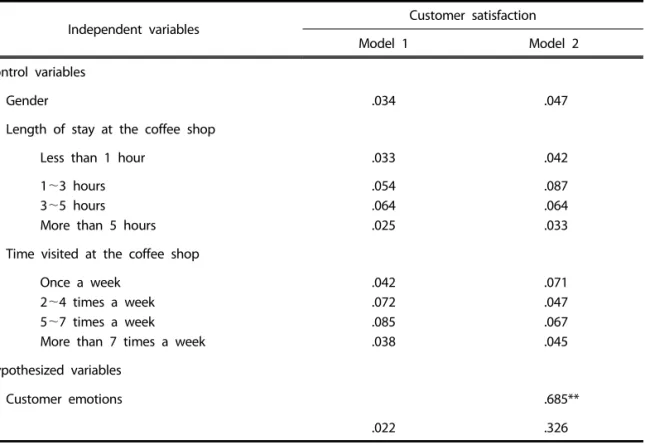
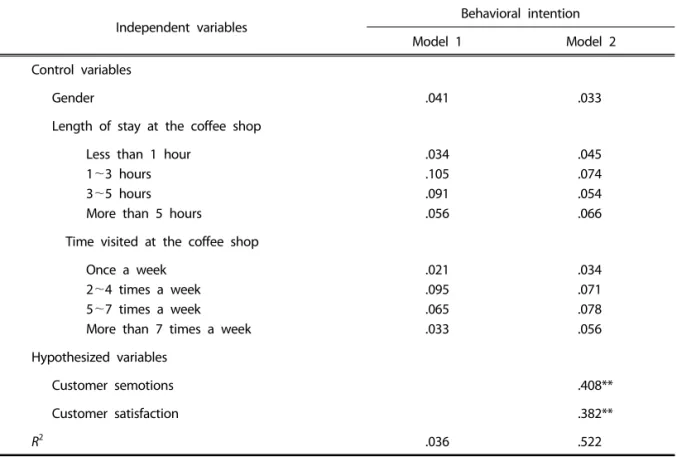
a significant effect on customer emotions. Hence, hypothesis 2 and 3 were supported. Music, Layout Accessibility and control variable (i.e., gender, leng- th of stay at the coffee shop, time visited at the coffee shop) described 38.5% of variance in cus- tomer emotions. Table 2 shows the relationship between customer satisfaction and customer emo- tions. The regression analysis shows that customer satisfaction had a significant effect on customer emotions (t=17.574, p<.01), hence hypothesis 4 is supported. Customer emotions and control vari- ables indicated 32.6% of variance in customer satisfaction. Table 3 shows the relationship among behavioral intention, customer emotions and cus- tomer satisfaction. The regression analysis indicates that customer emotions (t=11.604, p<.01) and cus- tomer satisfaction (t=9.306, p<.01) had a significant influence on behavioral intention. Hence, support- ing hypothesis 5 and 6. Customer emotions, cus- tomer satisfaction and control variables explained
52.2% of variance behavioral intention.
CONCLUSION
Due to the rising numbers of café opened in Ma- laysia, people are paying more attention into ser- vicescape, customer emotions, customer satisfaction and behavioral intention. Based on Bitner’s (1992) conceptual framework, it stated that physical envi- ronment in service industry plays an important role in influencing human behaviour and emotional sta- tus. This study verified that the physical settings do impact on customers’ emotion, satisfaction and be- havioral intention in the context of local coffee shop.
The result of this study showed that there was no significant impact towards facility aesthetics on cus- tomer emotions. The attractiveness of the coffee shop does not affect much on customer emotions mainly due to most of the local coffee shops in Ma- laysia do not emphasize on the exterior but focus Independent variables
Customer emotions
Model 1 Model 2
Control variables
Gender .003 .006
Length of stay at the coffee shop
Less than 1 hour .072 .049
1~3 hours
3~5 hours More than 5 hours
.102 .031 .042
.062 .064 .049 Time visited at the coffee shop
Once a week 2~4 times a week 5~7 times a week More than 7 times a week
.061 .075 .077 .039
.059 .061 .048 .072 Hypothesized variables
Facility aesthetics .024
Music .153*
Layout accessibility .496**
R
2.018 .385
* p<.05, ** p<.01.
Table 1. Standardized regression coefficients predicting customer emotions
more on the food. Based on Wakefield & Blodgett (1996), the appearance is just a first impression for the customers to judge about the café. On the other hand, the result showed that music and layout ac- cessibility play an important role affecting customer emotions. Besides, customer emotions prove to be important in affecting customer satisfaction. In addi- tion, both customer emotions and customer satisfac- tion have a significant impact on behavioral inten- tion. Customer satisfaction is an important factor that affects customers’ revisit intention and positive word-of-mouth (Ryu & Han 2010).
This study provides meaningful theoretical and managerial implications. From the theoretical point of view, this study offers information about custo- mers’ emotion, satisfaction and behavioral intentions of the local coffee industry in Kuala Lumpur. This study showed that music and layout accessibility have a significant impact on customer emotions and positive customer emotion and satisfaction would lead to positive behavioral intention, for instance positive word-of-mouth and revisit intention. It also
suggested that administrators should look into mu- sic and layout accessibility whenever evaluating cus- tomers’ emotion and satisfaction on local coffee shop in Kuala Lumpur.
As for managerial point of view, the result of this study aid managers to have a better understanding that music and layout accessibility would contribute either positive or negative customer emotions that would eventually affect customers’ satisfaction and behavioral intentions. Managers that effectively im- prove on the music selection and layout accessibility of the coffee shop would expect high level of be- havioral intentions (e.g., intention to stay longer, in- tention of revisiting and intention of spreading po- sitive word-of-mouth). Hence, improving customers’
emotion and satisfaction is the key to succeed in the coffee shop business.
In such a competitive industry where consumers have many choices due to the booming of coffee industry over the past few years in Malaysia, given that consumers have high level of positive emotions and satisfaction is crucial for business to get to the Independent variables
Customer satisfaction
Model 1 Model 2
Control variables
Gender .034 .047
Length of stay at the coffee shop
Less than 1 hour .033 .042
1~3 hours
3~5 hours More than 5 hours
.054 .064 .025
.087 .064 .033 Time visited at the coffee shop
Once a week 2~4 times a week 5~7 times a week More than 7 times a week
.042 .072 .085 .038
.071 .047 .067 .045 Hypothesized variables
Customer emotions .685**
R
2.022 .326
* p<.05, ** p<.01.
Table 2. Standardized regression coefficients predicting customer satisfaction
top. Managers should take meticulous care in terms of choosing types of music to play in the coffee shops. Slow tempo music would influence customers to stay longer and spend more (Morrison et al 2011).
In addition, managers should understand the im- portance of the layout accessibility that has a sig- nificant impact on customers’ emotions. Based on the findings of this study in local coffee shops, music and layout accessibility are more significant than fa- cility aesthetics. Improvements on music selection and layout accessibility would lead to high level of customer satisfaction, as a result high level of cus- tomer retention and long term profitability (Ryu et al 2008).
There are several limitations in this study; (a) the results of this study may not be generalized to the population of all local coffee shops in Malaysia due to the data were collected utilizing convenience sampling method. All the data was collected at local coffee shops in Kuala Lumpur area. Hence, the find- ings may be generalized to areas that have similar
demographic, (b) the conceptual framework can be extended to other elements of servicescape, which have not been study (e.g., sign, symbol and artifacts, ambient conditions and space/function).
A few future studies have emerged as the end re- sult of this research. Future researchers could ex- plore different service context (e.g., dessert shops and bakery café). Also, future studies may look into other constructs that were not included in this re- search, which are the ‘ambient conditions’, ‘space and functions’ and ‘sign, symbols and artifacts’. The reason is because this research only explored on three physical environment dimensions hence it might not reflect the entire features of the physical setting in a local coffee shop setting. By applying different servicescape dimensions would contribute an overall completeness of the Malaysia local coffee industry. Future research on local coffee shop could investigate in other states of Malaysia (e.g., Malacca, Johor, and Sabah).
Independent variables
Behavioral intention
Model 1 Model 2
Control variables
Gender .041 .033
Length of stay at the coffee shop Less than 1 hour
1~3 hours 3~5 hours More than 5 hours
.034 .105 .091 .056
.045 .074 .054 .066 Time visited at the coffee shop
Once a week 2~4 times a week 5~7 times a week More than 7 times a week
.021 .095 .065 .033
.034 .071 .078 .056 Hypothesized variables
Customer semotions .408**
Customer satisfaction .382**
R
2.036 .522
* p<.05, ** p<.01.
Table 3. Standardized regression coefficients predicting behavioral intention
REFERENCES
Amoako GK, Arthur E, Bandoh C, Katah RK (2012).
The impact of effective customer rela tionship management (CRM) on repurchase: A case study of (GOLDEN TULIP) hotel (ACCRA-GHANA). Afri- can Journal of Marketing Management 4(1):17-29.
Areni CS, Kim D (1993). The influence of back gro- und music on shopping behavior: classical ver sus top-forty music in a wine store. Advances in Consumer Research 20(1):336-340.
Baker JM (1986). The Music of Alexander Scriabin.
Yale University Press.
Bidel S, Tuomilehto J (2013). The emerging health benefits of coffee with an emphasis on type 2 diabetes and cardiovascular disease. European Endocrinology 9(2).
Bitner MJ (1992). Servicescapes: The impact of phys- ical surroundings on customers and employees.
The Journal of Marketing, 57-71.
Barsky J, Nash L (2002). Evoking emotion: affec tive keys to hotel loyalty. The Cornell Hotel and Res- taurant Administration Quarterly 43(1):39-46.
Clemes MD, Gan C, Ren M (2010). Synthesizing the effects of service quality, value, and customer satisfaction on behavioral intentions in the mo- tel industry: An empirical analysis. Journal of Hospitality & Tourism Research 35(4):530-568.
Cronin Jr JJ, Taylor SA (1992). Measuring service quality: Areexamination and extension. The Jour- nal of Marketing, 55-68.
Caldwell C, Hibbert SA (1999). Play that one again:
The effect of music tempo on consumer be ha- viour in a restaurant. European Advances in Con- sumer Research 4:58-62.
Hu HH, Kandampully J, Juwaheer TD (2009). Rela- tionships and impacts of service quality, per ceived value, customer satisfaction, and image:
An empirical study. The Service Industries Journal 29(2):111-125.
Han H, Ryu K (2009). The roles of the physical envi- ronment, price perception, and customer sat is- faction in determining customer loyalty in the restaurant industry. Journal of Hospitality & Tour- ism Research 33(4):487-510.
Jang SS, Namkung Y (2009). Perceived quality, emo- tions, and behavioral intentions: Application of
an extended Mehrabian–Russell model to re- staurants. Journal of Business Research 62(4):451- 460.
Kalidas V, Zeeshan M (2014). Personality as a Mode- rator of SOR Model.
Kim WG, Moon YJ (2009). Customers’ cognitive, emo- tional, and actionable response to the service- scape: A test of the moderating effect of the res- taurant type. International Journal of Hospitality Management 28(1):144-156.
Lee S, Chua B, Kim H (2014). A model of ante ce- dents of word-of-mouth and psychological com mitment: Focusing on the impacts of service- scape and quality perception. Journal of Korea Service Management Society 15(1):107-136.
Liu Y, Jang SS (2009). Perceptions of Chinese restau- rants in the US: What affects customer sat isfac- tion and behavioral intentions? International Jour- nal of Hospitality Management 28(3):338-348.
Lucas AF (2012). The determinants and effects of slot servicescape satisfaction in a Las Vegas hotel casino. UNLV Gaming Research & Review Journal 7(1):1-19.
Lobo A, Maritz A, Mehta S (2007). Enhancing Singa- pore travel agencies' customer loyalty: an em pirical investigation of customers' behavioural in tentions and zones of tolerance. International Journal of Tourism Research 9(6):485-495.
Mattila AS, Ro H (2008). Discrete negative emotions and customer dissatisfaction responses in a cas- ual restaurant setting. Journal of Hospitality &
Tourism Research 32(1):89-107.
Morrison M, Gan S, Dubelaar C, Oppewal H (2011).
In-store music and aroma influences on shopper behavior and satisfaction. Journal of Business Re- search 64(6):558-564.
Mehrabian A, Russell JA (1974). An Approach to Environmental Psychology. the MIT Press.
Namkung Y, Jang SC (2010). Effects of per ceived service fairness on emotions, and behavioral in- tentions in restaurants. European Journal of Mar- keting 44(9/10):1233-1259.
Nunnally J (1978) Psychometric Theory. New York:
McGraw-Hill.
North AC, Hargreaves DJ (1998). The effect of music
on atmosphere and purchase intentions in a
cafeteria. Journal of Applied Social Psychology 28
(24):2254-2273.
Oliver RL (1997). Satisfaction: A Behavioral per Spec- tive on the Customer. New York.
Frederick FR, Sasser WE (1990). Zero de fections:
Quality comes to services. Harvard Business Re- view 68(5):105-111.
Ryu K, Han H (2010). Influence of the quality of food, service, and physical environment on cus tomer satisfaction and behavioral intention in quick- casual restaurants: Moderating role of per ceived price. Journal of Hospitality & Tourism Research 34(3):310-329.
Ryu K, Jang SS (2007). The effect of environ mental perceptions on behavioral intentions through emotions: The case of upscale restaurants. Jour- nal of Hospitality & Tourism Research 31(1):56-72.
Ryu K, Han H, Kim TH (2008). The relation ships among overall quick-casual restaurant image, per- ceived value, customer satisfaction, and behav ioral intentions. International Journal of Hospit- ality Management 27(3):459-469.
Rosenbaum MS, Massiah C (2011). An expanded
servicescape perspective. Journal of Service Ma- nagement 22(4):471-490.
Stolzenberg RM (2004). Multiple regression analysis.
Handbook of Data Analysis 165-208.
Taylor R (1990). Interpretation of the correlation co efficient: A basic review. Journal of Diagnostic Medical Sonography 6(1):35-39.
Taylor SR, Demmig-Adams B (2007). To sip or not to sip: The potential health risks and bene fits of coffee drinking. Nutrition & Food Science 37(6):
406-418.
Wakefield KL, Blodgett JG (1996). The effect of the servicescape on customers' behavioral in ten- tions in leisure service settings. Journal of Ser- vices Marketing 10(6):45-61.
Zeithaml VA, Bitner MJ, Gremler DD (2006). Services marketing: Integrating customer focus across the firm.
Received: 18 September, 2015
Revised: 9 October, 2015
Accepted: 20 October, 2015
말레이시아 쿠알라룸프에 위치한 로컬 커피숍의 서비스 스케이프가 고객의 감정, 만족도, 향후 행동의도에 미치는 영향
이상협
1)
Liew KharKhiaw1)
김동호2)
1)
Centre for Tourism, Hospitality, and Culinary Management, Sunway University
2)
혜전대학교 제과제빵과
국문초록