Kor. J. Hort. Sci. Technol. 29(3):201-210, 2011
Changes in Physico-chemical Properties of Moss Peat Based Root Media and Growth of Potted Chrysanthemums as Influenced by Blending Ratios of Root Media in a C-channel Mat Irrigation System
Seung Won Kang
1,2, Jong Won Hong
2, Gung Pyo Lee
1, Sang Gyu Seo
3, and Chun Ho Pak
2*1Department of Applied Plant Science, Chung-Ang University, Ansung 456-756, Korea
2Division of Biotechnology, Korea University, Seoul 136-713, Korea
3Natural Science Research Institute, University of Seoul, Seoul 130-743, Korea
Abstract. This experiment was conducted to investigate physical and chemical characteristics by volume fractions of root media using peatmoss, perlite, and vermiculite, along with effects on the growth of pot chrysanthemums (Dendranthema × grandiflorum ‘Vemini’) in a C-channel mat irrigation system. To evaluate the physico-chemical properties of 20 root media, the bulk density, particle density, total pore space, pore space, ash content, organic matter, pH, and electrical conductivity were measured and data were analyzed using principal component analysis (PCA). PCA scores revealed that physico-chemical properties changed by the blending of peatmoss, perlite, and vermiculite. The 20 root media were divided into three main groups by hierarchical cluster analysis. At the end of the experiment, the pH and EC of the root media were measured from media divided into four layers. The pH of root media without plants showed a strong linear relationship and the pH of root media with plants increased exponentially. The change of EC in the root medium was indicated as a hyperbolic curve. Plant growth characteristics according to growth in the 20 root media were analyzed by PCA. It was found that the mixing ratios of the root media affected plant growth characteristics.
Therefore, mixing ratio is an important factor for pot-plant production in a subirrigation system.
Additional key words: peatmoss, perlite, principal component analysis, subirrigation, vermiculite
*Corresponding author: [email protected]
※ Received 4 April 2011; Accepted 11 April 2011.
Introduction
During the past decades, reducing water and nutrient runoff has been the main subject in greenhouse production. To increase water use efficiency, various soilless production systems have been proposed for nurseries, such as drip irrigation, ebb and flow, capillary mat, trough, benches, flood floors, etc. Subirrigation, a good alternative to overhead irrigation, reduces labor and contamination of ground water by recirculation of nutrient solutions (Lieth, 1996; Molitor, 1990).
Capillarity is the main principle by which water or nutrient solution can be supplied to a pot in a subirrigation system (Nelson, 2003). C-channel subirrigation using the capillarity of wicks has been introduced (Pak et al., 1999). Two methods of cultivation are available in a C-channel subirrigation system (Kang et al., 2009). One is the wick irrigation method in which a wick is incorporated into the bottom of a pot and directly connected to the nutrient solution in the C-channel.
Another is mat irrigation where pots are placed on flat-topped
benches covered with an absorbent mat covered with a porous black film. The mat is watered, and the water moves into the pots by capillary action. Nutrient solution is supplied by an electric pump to the C-channel on a table via the reservoir controlling water height in the C-channel. The nutrient solution then moves into the mat by wicks immersed in the water and connected to the mat. A mat on the C-channel is moistened by the process described above. Pots are placed on mats covered with a thin porous black film to protect the mats from algae formation and the evaporation of water.
The amount of moisture in the substrate of pots is determined or maintained by porosity, porosity of the mat, absorption by plants, and evaporation from the surface (Snow and Tingey, 1985).
The root environment is a mix of physical, chemical, and biological properties that are inter-related (Nelson, 2003).
Media characteristics affect plant growth in pots more than
in the field due to the restriction of the root zone. Physical
properties include bulk density, water holding capacity, and
porosity, and chemical properties include pH, soluble salts,
cation exchange capacity, etc. (Jarvis et al., 1996). In green-
house production, root media for pot or container plants are
required to have adequate pore space and increase water holding capacity (Choi, 1998). A good structure is necessary as it promotes good aeration, drainage, and water adsorption by the soil, thus creating a more favorable physical environ- ment for plant growth. It also facilitates the transport and availability of nutrients, especially trace metals (Taha and De Boodt, 1985). The physical properties of peat are of primary importance for use in horticulture and for studies in peat hydrology (Milks et al., 1989a, 1989b, 1989c).
A C-channel subirrigation system can be considered an economical cultivating system without the leaching of nutrient solution. Although C-channel subirrigation systems have been applied to grow various potted plants, there have only been empirical growing methods, and little has been done in terms of scientific research on the control of water or nutrient solution and the substrate for pot plant production. Therefore, in this experiment, the physico-chemical properties of root media were studied and the relationships between these pro- perties and growth of potted chrysanthemums (Dendranthema
× grandiflorum ‘Vemini’) were evaluated for optimum pot plant production in a C-channel mat irrigation system.
Materials and Methods
Root Media Composition and Preparation
A series of 20 mixtures were prepared according to Kang and Pak (2007). The root media were blended by volume according to the bulk density of peatmoss, perlite, and vermi- culite, respectively, and then 10 L was prepared for each root medium. The total volume fraction of each substrate was fixed to 1. The peatmoss and perlite were passed through a 3 mm-sieve for uniformity of particle size. Peatmoss sieved under 3 mm and perlite over 3 mm in size were used. The vermiculite was sieved carefully because it was likely to break into thin fragments.
Plant Materials and Cultivation
Young chrysanthemum (Dendranthema × grandiflorum
‘Vemini’) plants were obtained from MK Farm located in Gyeonggi Province. On Aug. 20, 2004, shoots from the apical meristem were cut to 7 cm in length and planted into a 105-cell-plug tray to induce roots. The rooted cuttings were planted on Sept. 3, 2004 into 8 cm tall × 9 cm diameter (320 mL) plastic pots filled with one of 20 root media or peatmoss only (Sun Gro Horticulture, Canada), and placed on the C-channel mat irrigation system. The plants were pinched one time after one week from the beginning of the experiment. A 1.5 g・L
-1of commercial fertilizer (20N-8.8P- 16.6K, Sun Gro Horticulture, U.S.A.) was sub-irrigated con- tinuously to the pot via the C-channel mat irrigation system
during the experiment (Kang et al., 2009). Here, 300 mg・L
-1of nitrogen was supplied, and 11.5% of the total nitrogen source was NO
3corresponding to 39.1 mg・L
-1and 8.5%
was NH
4corresponding to 99.6 mg・L
-1. The pH and EC of the fertilizer solution were maintained at 5.68 and 2.04 dS・m
-1, respectively, until the end of the experiment. The experiment was conducted in an automated glass greenhouse at Korea University, Seoul.
Plant samples were collected on Nov. 30, 2004, when over half of the flower buds had bloomed. The number of flowers, fresh and dry weight, total leaf area, total leaf length, total leaf width, number of leaves, average leaf area, average leaf length, average leaf width, and plant height were measured from collected plant samples to identify the effects of 21 root media on the chrysanthemums grown on the C-channel mat irrigation system.
Digital image analysis was conducted to measure the growth parameters (VideoTest 5.0, Silicon Graphics, Russia). The leaves and stems of samples were placed on the scanner (ScanJet6100C, Hewlett Packard, U.S.A.) and scanned at 150 dpi using Photoshop 7.0 (Adobe, U.S.A.) with TWAIN. The scanned images were saved as a tagged image file format (TIFF). The TIFF-images were used to measure the total leaf area, total leaf length, total leaf width, number of leaves, average leaf area, average leaf length, and average leaf width using an image analyzing program. To transform the pixel values of images into SI unit, graph paper with 1 mm units was scanned and calibrated. The calibrated value of a pixel corresponded to 0.004255 cm.
Analysis of Physico-chemical Properties of Root Media Each mixed root medium was packed into a core of 250 cm
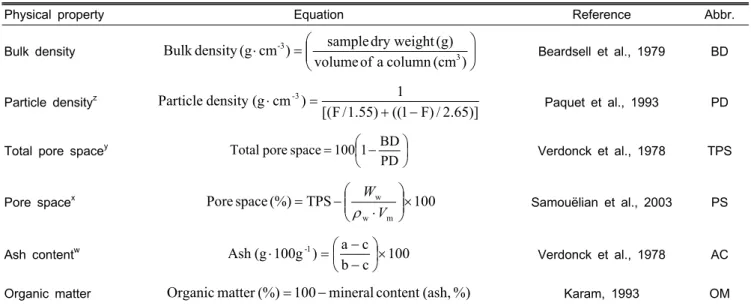
3in volume and then saturated by placing the core in water to the level of the soil surface for 48 hr (Beardsell et al., 1979). To prevent evaporation, each core was covered by a lid. Next, the samples were oven dried at 105℃ over 48 hours and then weighed. Initial bulk density (BD, Beardsell et al., 1979), particle density (PD, Paquet et al., 1993), total pore space (TPS, Verdonck et al., 1978), and pore space (PS) were measured using the equations in Table 1. To analyze the particle size distribution of the root media, 100 g of each sample was passed through a stack of sieves of 2.00, 1.00, 0.5, and 0.1 mm and shaken for five minutes. The medium of each sieve was weighed and recorded. Finally, the weight of each part was converted to a percentage (Sheldrick and Wang, 1993).
Samples of peatmoss, perlite, vermiculite, and root media
were extracted using a 1:5-dilution method (Lang, 1996) and
pH and electrical conductivity were measured with a multi-
parameter analyzer (C535, Consort, Belgium) for the initial
Table 1. Equation used for analysis of physical characteristics of root medium.
Physical property Equation Reference Abbr.
Bulk density ⎟⎟⎠
⎜⎜ ⎞
⎝
=⎛
⋅ volumeofacolumn (cm ) (g) dry weight sample
) cm (g density
Bulk -3 3 Beardsell et al., 1979 BD
Particle densityz
)]
65 . 2 / ) F 1 ((
) 55 . 1 / F [(
) 1 cm (g density
Particle -3
−
= +
⋅ Paquet et al., 1993 PD
Total pore spacey ⎟
⎠
⎜ ⎞
⎝⎛ −
= PD
1 BD 100 space pore
Total Verdonck et al., 1978 TPS
Pore spacex Porespace(%) TPS 100
m w
w ⎟⎟⎠×
⎜⎜ ⎞
⎝
⎛
− ⋅
= V
W
ρ
Samouëlian et al., 2003 PSAsh contentw 100
c b
c ) a 100g (g
Ash -1 ⎟×
⎠
⎜ ⎞
⎝
⎛
−
= −
⋅ Verdonck et al., 1978 AC
Organic matter Organicmatter (%)=100−mineralcontent (ash,%) Karam, 1993 OM
zF is the ratio of Organic matter (%) to Ash content (%). Constants, 1.55 and 2.65, are the specific gravity of organic fraction and minerals, respectively (Verdonck et al., 1978).
yBD is bulk density and PD is particle density.
xTPS is total pores space, Ww is the weight of water, ρw is the density of water (1g・cm-3) at 20℃, and the Vm is the volume of root media.
wa is the final weight (g) of a crucible and ash, b is the weight (g) of crucible and sample after oven-drying at 105℃, and c is the weight (g) of an empty crucible.
8 cm 7 cm 1 cm 2 cm
2 cm
2 cm
0.5 cm
2.0 cm
4.0 cm
6.0 cm
Fig. 1. Schematic diagram of four layers to analyze the variation of pH and EC in root media. To measure the pH and EC, root media samples were collected. The plastic pot was 8 cm tall × 9 cm long in diameter (320 mL), the substrate was separated into 4-layers from the medium surface to the bottom (the depth of root media in the pot was 7 cm) and was sliced using a thin sharp metal plate. The first layer from the top was 1 cm deep and the depth of the other three layers was 2 cm. For regression analysis, medium depth of each layer was selected as an independent variant.
parameters of the root media.
To measure the pH and EC changes at the end of the experiment, root media samples were collected from pots with plants and without plants. During the sampling, the substrate of each treatment was separated into 4-layers from the medium surface to the bottom (the depth of root media in the pot was 7 cm) of the pot and was sliced using a thin sharp metal plate. The first layer from the top was 1 cm deep and the depth of the other three layers was 2 cm (Fig. 1). The pH and EC of the collected samples were extracted and measured as described above. For the ease of regression analysis, the middle point of each layer, 0.5, 2.0, 4.0, and 6.0 cm respectively, was set as the standard depth for each layer. Organic matter content was measured using the loss on ignition (Karam, 1993). An empty crucible was weighed, and 2 g of each sample was weighed and put into a crucible. Then, the samples were placed in a drying oven at 105℃ for 48 hours to remove the remaining water in the medium. The oven-dried samples were weighed and placed in a muffle furnace (Model-L3/C6, Naberthern, Germany).
The temperature in the furnace was gradually brought to 375℃ and this temperature was maintained for one hour.
Subsequently, the temperature was brought to 600℃ and was maintained for six hours. The samples in the furnace were removed and kept in a desiccator to prevent exposure to humidity until they became cool. Finally, the weight of a crucible with substrate was measured and ash content and
organic matter were calculated using the equations in Table
1. Organic matter was calculated by subtracting the ash content
from 100.
Table 2. Physical property of peatmoss, perlite, and vermiculite before blending.
Root media Bulk density (g・cm-3) Particle density (g・cm-3) Total pore space (%) Pore space (%)
Peatmoss 0.098 ± 0.001z 0.30 ± 0.09 66.48 ± 2.79 20.34 ± 0.21
Perlite 0.106 ± 0.001 2.63 ± 0.00 95.95 ± 0.03 40.4 ± 0.43
Vermiculite 0.101 ± 0.002 2.61 ± 0.01 96.13 ± 0.02 59.8 ± 0.56
zStandard error (n = 5).
Table 3. Chemical property of peatmoss, perlite, and vermiculite before blending.
Root media pH EC (dS・m-1) Organic matter (%) Ash content (%)
Peatmoss 5.68 ± 0.02z 0.189 ± 9.4×10⁻³ 91.8 ± 0.78 8.21 ± 0.77
Perlite 5.98 ± 0.04 0.050 ± 1.3×10⁻³ 1.3 ± 0.02 97.81 ± 0.27
Vermiculite 6.23 ± 0.03 0.059 ± 2.4×10⁻³ 2.2 ± 0.27 98.68 ± 0.02
zStandard error (n = 5).
Statistical Analysis
The treatments were arranged as a randomized complete block design with 21 root media, two types of pots with plants (MP) or without plants (MWP), two blocks, and five plants per block for a total of 420 pots. At the end of the experiment, root media and plant samples were collected and measured. The data were analyzed by analysis of variance (ANOVA) or the general linear model (GLM) procedure for regression analysis using SAS 9.13 (SAS Institute, 2004).
Principal component analysis (PCA) and hierarchical cluster analysis (HCA) were conducted to evaluate correlations among physico-chemical properties using the R Statistics Package (Ver. 2.12.2, http://www.r-project.org/). In addition, PCA was performed to evaluate plant growth characteristics in 20 root media.
Results
Physico-chemical Properties of Peatmoss, Perlite, and Vermiculite before Blending
The physico-chemical properties of each root medium were evaluated before blending (Table 2). The BD of perlite and vermiculite were slightly higher than that of peatmoss.
In addition, their PD, TPS, and PS were higher than those of peatmoss. The PD of peatmoss was about nine times smaller due to higher organic matter in peatmoss (Table 3). The higher TPS of perlite and vermiculite were due to higher PD resulting in a reduced BD/PD ratio according to the equation in Table 1. This higher TPS also affected the higher PS of perlite and vermiculite. Because the weight and density of water were constant for the 20 samples, and the volume of each root medium the same, TPS could be a key factor for the pore space of root media.
Initial pH, EC, organic matter, and ash content of the peatmoss, perlite, and vermiculites were evaluated before
blending (Table 3). pH values were determined as 5.68 ± 0.02 for peatmoss, 5.98 ± 0.04 for perlite, and 6.23 ± 0.03 for vermiculite. The electric conductivity of each substrate was 0.1890 ± 9.4 × 10
-3dS・m
-1for peatmoss, 0.0501 ± 1.3
× 10
-3dS・m
-1for perlite, and 0.0593 ± 2.4 × 10
-3dS・m
-1for vermiculite. Organic matter contents were 91.8 ± 0.78, 1.3 ± 0.02, and 2.2 ± 0.27%, and ash contents were 8.21
± 0.77, 97.81 ± 0.27, and 98.68 ± 0.02%, for peatmoss, perlite, and vermiculite, respectively.
Relationship between Mixed Ratio and Physico-chemical Properties
Because a number of physical and chemical properties
exist in a root medium and are related as described in Table
1, it is difficult to set up an equation comprehending such
factors. Therefore, we attempted to divide 20 root media
using principal component analysis. BD, PD, TPS, PS, AC,
OM, pH, and EC were regarded as independent factors and
PCA was conducted using an unbiased correlation coefficient
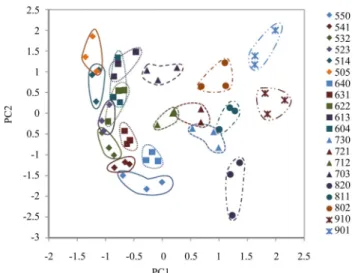
matrix. PCA scores revealed that physico-chemical properties
changed by the blending of peatmoss, perlite, and vermiculite
(Fig. 2). The first principal component (PC1), explaining
75.3% of the total variability, was clearly separated according
to peatmoss content in the root media. The root media con-
taining 0.5 or 0.6 volumes of peatmoss were located on the
negative side and the others on the positive side. When
peatmoss content increased, PC1 tended to move from negative
to positive points. The second principal component (PC2),
which explained 12.9% of the total variability, moved from
the negative to positive side according to volume ratio of
decreasing perlite to increasing vermiculite. This result impli-
cates that peatmoss content largely affected the physico-
chemical properties of the root media. In addition, the 20
root media were divided largely into three groups by hierar-
chical cluster analysis (Fig. 3). The first group was root media
Fig. 2. Principal component analysis of physico-chemical pro- perties of 20 root media. PC1 is the first principal component and it explains 75.3% of the total variability. PC1 moves to positive side when the volume fraction of peatmoss increased in root media.
PC2 is the second principal component explaining 12.9% of the total variety. PC2 moves to positive side according to increa- sing volume of perlite and vermiculite in root media. Numbers in legend represent mixing ratio of peatmoss, perlite, and vermiculites. For example, 550 means 5 volume of peatmoss, 5 volume of perlite, and 0 volume of vermiculite, respectively.
Fig. 3. Hierarchical cluster analysis of 20 root media. Root media were divided into three groups according to physico- chemical properties. The first group includes root media containing 0.5 volumes of peatmoss. The second root media group contains 0.6 or 0.7 volumes of peatmoss. The third group includes root media containing 0.8 or 0.9 volumes of peatmoss. Numbers in the legend represent mixing ratio of peatmoss, perlite, and vermiculite. For example, 550 means 5 volume of peatmoss, 5 volume of perlite, and 0 volume of vermiculite, respectively.
containing 0.5 volumes of peatmoss. The second group of root media contained 0.6 or 0.7 volumes of peatmoss. Finally, the third group of root media contained 0.8 or 0.9 volumes of peatmoss.
Particle Size Distribution of Root Media
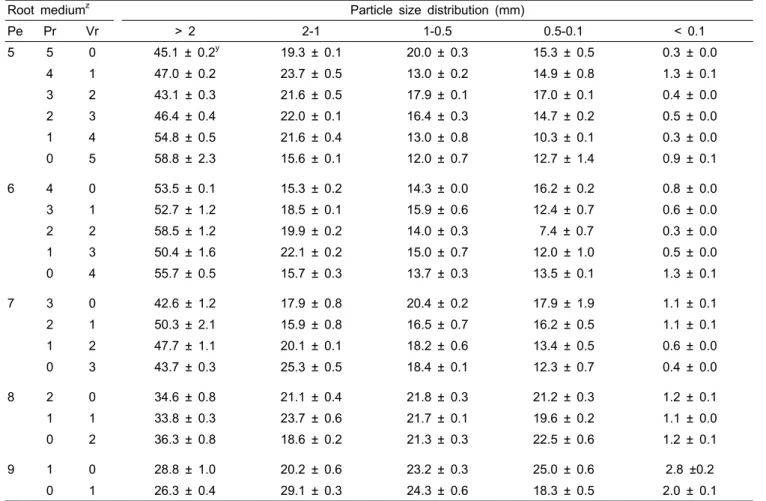
The particle size distributions (PSD) of the 20 root media were analyzed (Table 4). The PSD of the root media ranged
from 26.3 to 58.8% for particles over 2.0 mm, 15.3 to 29.1%
for those 1.0 to 2.0 mm, 12.0 to 24.3% for those 1 to 0.5 mm, 7.4 to 25.0% for those 0.1 to 0.5 mm, and 0.3 to 2.9% for particles under 0.1 mm. In the case of root media containing under 0.7 volumes of peatmoss, over 40% of the volume was occupied by particles over 2.0 mm. However, root media with over 0.8 volumes of peatmoss showed that only one-third or a quarter of the volume was occupied by particles over 2.0 mm. In all five groups of particle size ranges in this experiment, statistical significance was observed at P < 0.001.
This indicates that the mixing ratio of the three mediums used had an influence on the PSD of the root media. More- over, this result means that various physical characteristics can be determined by mixing different mediums with each other, because particle size distribution may affect the bulk density, pore space, and water or air holding capacity (Wilson, 1984). Root media containing below 0.7 volumes of peatmoss showed more large-size particles. Therefore, the percent of small particles was relatively low and showed a drastic decrease in small particles. However, root media with over 0.8 volumes of peatmoss showed uniform distributions in four of the ranges.
As a result, the particle size distributions of root media containing below 0.7 volumes of peatmoss with particles between 0.1 to 2.0 mm was relatively smaller than those of root media containing over 0.8 volumes of peatmoss.
pH and EC Distribution of Root Media According to Pot Depth
At the end of the experiment, pH and EC were measured in the four layers of root media with plants (MP) or without plants (MWP). Changes in pH or EC in the 20 root media according to depth were plotted by regression analysis (Figs.
4A and B). A good linear relationship appeared between pH and depth in the pot for each substrate, varying the coefficient of determination from 0.604* to 0.995** (Fig.
4A). The pH of 20 MWP tended to increase gradually from the surface to the bottom layer.
pH = a + b・D
where a and b are parameters by regression analysis and D
pis the depth in the pot.
In the case of the pH of MP, the pH of the surface layer was lower than that of the other three layers and the pH values of these three layers were maintained at a similar level. The relationship between pH and pot-depth resulted in an ex- ponential rather than linear form. Therefore, a non-linear curve fitting method was applied.
) 1 ( b a
pH = + − e
−cDpTable 4. Particle size distribution of root medium.
Root mediumz Particle size distribution (mm)
Pe Pr Vr > 2 2-1 1-0.5 0.5-0.1 < 0.1
5 5 0 45.1 ± 0.2y 19.3 ± 0.1 20.0 ± 0.3 15.3 ± 0.5 0.3 ± 0.0
4 1 47.0 ± 0.2 23.7 ± 0.5 13.0 ± 0.2 14.9 ± 0.8 1.3 ± 0.1
3 2 43.1 ± 0.3 21.6 ± 0.5 17.9 ± 0.1 17.0 ± 0.1 0.4 ± 0.0
2 3 46.4 ± 0.4 22.0 ± 0.1 16.4 ± 0.3 14.7 ± 0.2 0.5 ± 0.0
1 4 54.8 ± 0.5 21.6 ± 0.4 13.0 ± 0.8 10.3 ± 0.1 0.3 ± 0.0
0 5 58.8 ± 2.3 15.6 ± 0.1 12.0 ± 0.7 12.7 ± 1.4 0.9 ± 0.1
6 4 0 53.5 ± 0.1 15.3 ± 0.2 14.3 ± 0.0 16.2 ± 0.2 0.8 ± 0.0
3 1 52.7 ± 1.2 18.5 ± 0.1 15.9 ± 0.6 12.4 ± 0.7 0.6 ± 0.0
2 2 58.5 ± 1.2 19.9 ± 0.2 14.0 ± 0.3 7.4 ± 0.7 0.3 ± 0.0
1 3 50.4 ± 1.6 22.1 ± 0.2 15.0 ± 0.7 12.0 ± 1.0 0.5 ± 0.0
0 4 55.7 ± 0.5 15.7 ± 0.3 13.7 ± 0.3 13.5 ± 0.1 1.3 ± 0.1
7 3 0 42.6 ± 1.2 17.9 ± 0.8 20.4 ± 0.2 17.9 ± 1.9 1.1 ± 0.1
2 1 50.3 ± 2.1 15.9 ± 0.8 16.5 ± 0.7 16.2 ± 0.5 1.1 ± 0.1
1 2 47.7 ± 1.1 20.1 ± 0.1 18.2 ± 0.6 13.4 ± 0.5 0.6 ± 0.0
0 3 43.7 ± 0.3 25.3 ± 0.5 18.4 ± 0.1 12.3 ± 0.7 0.4 ± 0.0
8 2 0 34.6 ± 0.8 21.1 ± 0.4 21.8 ± 0.3 21.2 ± 0.3 1.2 ± 0.1
1 1 33.8 ± 0.3 23.7 ± 0.6 21.7 ± 0.1 19.6 ± 0.2 1.1 ± 0.0
0 2 36.3 ± 0.8 18.6 ± 0.2 21.3 ± 0.3 22.5 ± 0.6 1.2 ± 0.1
9 1 0 28.8 ± 1.0 20.2 ± 0.6 23.2 ± 0.3 25.0 ± 0.6 2.8 ±0.2
0 1 26.3 ± 0.4 29.1 ± 0.3 24.3 ± 0.6 18.3 ± 0.5 2.0 ± 0.1
zPe is peatmoss, Pr is perlite, and Vr is vermiculite.
yStandard error (n = 5).
A
B
・
Fig. 4. Regression analysis of pH (A) and EC (B) in root media with plants (○ with dashed line) and without plants (● with solid line) as the depth in the pot. Parameters, a, b, and c were obtained from regression analysis and Dp is the depth in the pot.
where a, b, and c are the parameters determined by regression analysis, e is the natural log, and D
pis the depth in the pot.
Change in EC according to root media depth in the pot was investigated, and the changes in EC of MP and MWP
were compared (Fig. 4B). The EC of both MP and MWP
increased significantly in the surface layer. From the second
layer through the bottom layer, EC decreased slightly. Hyper-
bolic curves were derived by regression analysis according
to the depth in the pot, and this relationship can be expressed
Fig. 5. Principal component analysis of plant growth characteristics grown in 20 root media using C-channel mat irrigation system.
PC1, explaining 36.1% of the total variability, was separated according to peatmoss content. PC2 which explained 16%
of the total variability moved from the negative to positive side according to the mixing ratio between perlite and vermiculite.
This result suggests the mixing volume affects plant growth and it is an important factor for pot-plant production in sub- irrigation system. Numbers in the legend represent mixing ratio of peatmoss, perlite, and vermiculite. For example, 550 means 5 volume of peatmoss, 5 volume of perlite, and 0 volume of vermiculite, respectively.
as follows:
p 1
-
D b 1 a ) m (dS
EC ⋅ = + ⋅
where a and b are the parameters by regression analysis and D
pis the substrate-depth in the pot.
A strong relationship was found between EC and root media depth, with coefficients of determination ranging from 0.711* to 0.999*** and 0.984** to 0.998*** for MP and MWP, respectively. The EC values of the first layers of MP samples were recorded as 5.4 to 8.38 dS・m
-1for the 20 root media, because salts tend to accumulate at the surface of root media in a closed cultivation system (Argo and Biernbaum, 1994; Molitor, 1990). Because the C-channel mat-irrigation system is a type of closed cultivation system, salts tended to accumulate on the root media surface.
The EC values of root media of planted pots were higher than in pots without plants (Blom and Piott, 1992). In this experiment, a significant difference in EC between MP and MWP appeared at the surface layer, and the EC values of the other three layers of MP were slightly higher than those of MWP. The considerably higher EC at the surface did not affect plant growth, because nutrients in the top layer have minimal influence on root-zone nutrient concentrations and plant uptake in subirrigation (Argo and Biernbaum, 1996).
Plant Growth Characteristics in 20 Root media
This experiment was conducted to identify the effects of mixing volume fractions of peatmoss, perlite, and vermiculite on the growth of pot-mums (Dendranthema × grandiflorum
‘Vemini’). The number of flowers, fresh and dry weight, total leaf area, total leaf length, total leaf width, number of leaves, average leaf area, average leaf length, average leaf width, and plant height were measured. The growth characteristics were analyzed using PCA with an unbiased correlation coefficient matrix (Fig. 5). It was found that the mixing ratios of the root media affected plant growth. PC1, explaining 36.1% of the total variability, was separated according to peatmoss content of the root media except for root media containing 0.6 volumes of peatmoss, and PC2 which explained 16% of the total variability moved from the negative to positive side according to decreasing volume of perlite and increasing volume of vermiculite. This result clearly indicates that the mixing volume of root media can affect plant growth and it is an important factor for pot-plant production in a subirrigation system. When the volume ratio of peatmoss increased, both PC1 and PC2 tended to move from the positive to negative side simultaneously. Root media containing 0.5 volumes of peatmoss were located on the
negative side and the others were on the positive side. When peatmoss content increased, PC1 tended to move from negative to positive points. In addition, peatmoss, which is widely used as an organic root medium, affects to a large extent not only the physico-chemical properties of root media but also plant growth characteristics. A relatively high amount of perlite should be used to improve air capacity in root media (Choi et al., 1997) and adding humic substances can enhance the fertility of soils by improving the physical pro- perties and maintenance of good soil aggregates (Taha and De Boodt, 1986).
Discussion
Because various materials are used as root media, their
physico-chemical properties are important factors for pot plant
production (Gabriëls et al., 1986). These properties are likely
to change as a consequence of biological (decomposition of
organic matter and root activity) and mechanical (compaction
and aggregation, swelling and shrinkage due to wetting and
drying) degradation of the substrates, and depend on the
mixing fractions of various root media types. As a result, the
water holding capacity and transporting capacity of nutrients
change (Argo and Biernbaum, 1994, 1996). Substrate structure
is also important because it affects aeration, drainage, and
water adsorption by root media, thus it creates a physical environment for plant growth (Taha and De Boodt, 1985).
In the present experiment, peatmoss, perlite, and vermiculite were mixed as root media by volume fractions. Changes in the physico-chemical properties of 20 root media were observed according to mixing fractions. In addition, the results of principal component analysis revealed that the volume fraction of peatmoss was the main factor for changes in physico-chemical properties. It was found that the mixing ratios of perlite and vermiculite affected these changes (Fig. 2).
Bulk density, particle density, total pore space, and pore space were considered as physical properties. Bulk density is an important factor to maintain the stability of container- grown plants and it is affected by moisture content, degree of compaction, shrinkage, and particle size distribution (Rawls et al., 1982). Bulk density offers information about the com- paction state, and is used for the calculation of total pore space (De Boodt et al., 1974). Compaction increases bulk density and the mechanical impedance of soil, and reduces soil conductivity, permeability, and diffusivity to water and air (Vepraskas, 1994). Highly compacted root media restrict root growth resulting in decreased shoot growth, leaf area development, dry matter production, stomatal conductance, and yield in many plants (Andrade et al., 1993). An increase in particle density indicates consumption (decomposition) of organic compounds by micro-organisms (Michiels et al., 1993).
Good aeration is one of the important physical properties for growing plants (Bunt, 1961). Minimum aeration is 5.0%
for various pot plants and the optimum range is known to be 11.3 to 20.0% for root media (Bugbee and Frink, 1986).
Total pore space declines during production due to the shrinkage of root media in containers (Blom and Piott, 1992). An important factor in determining the pore space of a potting medium is pot size (Meyer and Cunliffe, 2004). Also, porosity is a significant factor for plant growth (Jarvis et al., 1996).
In general, total pore space decreases as bulk density increases or with decomposition of the root media (Michiels et al., 1993). Wetted root media increase the drainable pore space, because more drainable macro-pores are created resulting in reduced container capacity (Blom and Piott, 1992; Milks et al., 1989b). Pores affect the total pore space of perlite.
Changes in total pore space of root media are more affected by particle density than by bulk density (Michiels et al., 1993).
It is well known that the growth and yield of horticultural crops can be greatly improved by optimizing the nutritional status of the root environment, along with routine monitoring during production (Wilson, 1984). The main chemical properties of root media are pH, EC, chemical composition, C/N ratio, and CEC (Lee and Ryu, 1996; Ryu and Lee, 1996). It is important to maintain an optimum pH for plant growth. The
optimum pH in a root medium is between 5.0 and 6.0 for most crops (Voogt, 1995). In this experiment, regression analysis was applied to evaluate pH and EC changes of root media according to depth (Figs. 4A and B). The pH of root media with plants was maintained at an optimal pH range in the root zone area. However, the pH of root media without plants was below 5.0. A subirrigation system may lead to decreased pH in the lower layer of the pot. This is caused by nitrifying bacteria and promoted by the high ammonium content of compound fertilizers. The pH of the growing medium is not significantly affected by irrigation or level of compaction but decreases during the growing period with top irrigation and subirrigation systems (ebb and flow) (Blom and Piott, 1992). The supplied nutrient solution is recirculated to a solution tank and any excess solution in pots is leached in an ebb and flow system. This process causes soil compaction in pots. Although a C-channel mat irrigation system adopts the subirrigation method by capillarity, the system supplies nutrient solution constantly upward from the C-channel to pots. Therefore, it does not affect soil com- paction and may contribute to maintaining an optimum pH (5.5 to 5.6) during plant production (Lang and Elliott, 1991).
Excess salts accumulate in the nutrient solution in a closed irrigation system. Moreover, subirrigation leads to salt accu- mulation in the upper medium layer of a pot. Recycling of drain water leads to the accumulation of salt in the circulating solution (Molitor, 1990). Salt accumulation was found on the root media surface in this experiment. However, salt accumulation on the top layer of root media does not damage the plants because there are few active roots growing in the top layer (Reed, 1996). Water stress is induced by salinity causing low osmotic potential of soil solution (Greenway and Munns, 1980). Relatively high salinity increases water use efficiency by plants while it decreases the water potential of plants (Marcelis and Van Hooijdonk, 1999).
A humic substance plays a key role in the formation and maintenance of good soil aggregates through the binding of mineral particles by organic polymers or through the physical enmeshment of particles by fine roots or fungi (Dorioz et al., 1993). As a result, the fertility of the soil is enhanced (Angers and Mehuis, 1989). Organic matter content and bulk density tend to be negatively correlated (Rawls et al., 2005).
A similar result was found in this experiment by PCA analysis.
In addition, this causes the formation of water-soluble or water-insoluble complexes with metal ions so that organic matter is considered a safe sink for toxic inorganic and organic chemicals (Taha and De Boodt, 1985). It also facilitates transport and availability of nutrients. Therefore, humic sub- stances are considered soil conditioners, stabilizers, and fertilizers.
Even the organic matter in root media affects soil moisture
retention and hydraulic conductivity (Nemes et al., 2005).
It is not easy to evaluate relationships between physico- chemical properties of root media and plant growth charac- teristics. However, we attempted to evaluate such relationships by applying statistical approaches: regression analysis, principal component analysis, and hierarchical cluster analysis. We obtained satisfactory results suggesting the importance of blending various root media as well as the relationships with plant growth characteristics. And the water absorption properties of 20 root media were already defined in our previous studies (Kang and Pak, 2007; Kang et al., 2010). Thus, this infor- mation would be helpful to growers in selecting root media for pot plant production. In addition, if further organic and inorganic root media are considered, more standardized data will be obtained.
Literature Cited
Andrade, A., D.W. Wolfe, and E. Fereres. 1993. Leaf expansion, photosynthesis and water relations of sunflower plants grown in compacted soil. Plant Soil 149:274-184.
Angers, D.A. and G.R. Mehuis. 1989. Effects of cropping on carbohydrate content and water stable aggregation of a clay soil. Can. J. Soil Sci. 69:373-380.
Argo, W.R. and J.A. Biernbaum. 1994. Irrigation requirements, root-medium pH, and nutrient concentration of Easter lilies grown in five peat-based media with and without an evaporation barrier. J. Amer. Soc. Hort. Sci. 119:1151-1156.
Argo, W.R. and J.A. Biernbaum. 1996. Effect of lime, irrigation- water-source, and water-soluble fertilizer on pH and macro- nutrient management of peat-based root media with impatiens.
J. Amer. Soc. Hort. Sci. 121:442-452.
Beardsell, D.V., D.G. Nichols, and D.L. Jones. 1979. Physical properties of nursery potting-mixtures. Sci. Hort. 11:1-8.
Blom, T.J. and B.D. Piott. 1992. Preplant moisture content and compaction of peatwool using two irrigation techniques on potted chrysanthemums. J. Amer. Soc. Hort. Sci. 117:220-223.
Bugbee, G.J. and C.R. Frink. 1986. Aeration of potting media and plant growth. Soil Sci. 141:438-441.
Bunt, A.C. 1961. Some physical properties of pot plant composts and their effect on plant growth: 2. Air capacity of substrates.
Plant Soil 15:13-24.
Choi, J.M., J.W. Ahn, H.J. Ku, and Y.B. Lee. 1997. Effect of medium composition on physical properties of soil and seedling growth of red-pepper in plug system. J. Kor. Soc. Hort. Sci.
38:618-624.
Choi, J.M. 1998. Substrate and nutrition of plug production of floral crops. Kor. J. Hort. Sci. Tech. 16:279-281.
De Boot, M., O. Verdonck, and I. Cappaert. 1974. Method for measuring the water release curve of organic substrates. Acta Hort. 37:2054-2062.
Dorioz, J.M., M. Robert, and C. Chenu. 1993. The role of roots, fungi and bacteria, on clay particle organization: An experimental approach. Geoderma 56:179-194.
Gabriëls, R., O. Verdonck, and O. Mekers. 1986. Substrate require-
ments for pot plants in recirculating water culture. Acta Hort.
178:93-99.
Greenway, H. and R. Munns. 1980. Mechanisms of salt tolerance in nonhalophytes. Ann. Rev. Plant Physiol. 31:139-190.
Jarvis, B., J.B. Calkins, and B.T. Swanson. 1996. Compost and rubber tire chips as peat substitutes in nursery container media:
Effects on chemical and physical media properties. J. Environ.
Hort. 14:122-129.
Kang, S.W. and C.H. Pak. 2007. Estimation of soil moisture characterization curves of root media using dew point poten- tiometer. Hort. Environ. Biotechnol. 48:320-324.
Kang, S.W., S.G. Seo, and C.H. Pak. 2009. Capillary wick width and water level in channel affects water absorption properties of growing media and growth of chrysanthemum and poinsettia cultured in c-channel subirrigation System. Kor. J. Hort. Sci.
Technol. 27:86-92.
Kang, S.W., S.G. Seo, G.P. Lee, and C.H. Pak. 2010. Estimation of soil moisture curves of mixed media using a dielectric moisture sensor. Hort. Environ. Biotechnol. 51:28-32.
Karam, A. 1993. Chemical properties of organic soils. In: M.R.
Carter (ed.). Soil sampling and methods of analysis. Lewis Publishers, Boca Raton, FL.
Lang, H.J. 1996. Growing media testing and interpretation. p.
123-139. In: D.W. Reed (ed.). A grower’s guide to water, media, and nutrition for greenhouse crops. Ball Publishing, Batavia, IL.
Lang, H.J. and G.C. Elliott. 1991. Influence of ammonium: nitrate ratio and nitrogen concentration on nitrification activity in soilless potting media. J. Amer. Soc. Hort. Sci. 116:642-645.
Lee, J.S. and B.Y. Ryu. 1996. Effects of pH, EC and physical properties in the mixed media made of organic materials on the growth of Euphorbia pulcherrima W. J. Kor. Soc. Hort.
Sci. 37:810-814.
Lieth, J.H. 1996. Irrigation systems. p. 1-29. In: D.W. Reed (ed.).
A grower’s guide to water, media, and nutrition for green- house crops. Ball Publishing, IL.
Marcelis, L.F.M. and J. Van Hooijdonk. 1999. Effect of salinity on growth, water use and nutrient use in radish (Raphanus sativus L.). Plant Soil 215:57-64.
Meyer, M.H. and B.A. Cunliffe. 2004. Effects of media porosity and container size on overwintering and growth of ornamental grasses. HortScience 39:248-250.
Michiels, P., R. Hartman, and C. Coussens. 1993. Physical properties of peat substrates in an ebb/flood irrigation system. Acta Hort. 342:205-219.
Milks, R.R., W.C. Fonteno, and R. Larson. 1989a. Hydrology of horticultural substrates: I. Mathematical models for moisture characteristics of horticultural container media. J. Amer. Soc.
Hort. Sci. 144:48-52.
Milks, R.R., W.C. Fonteno, and R. Larson. 1989b. Hydrology of horticultural substrates: II. Predicting physical properties of substrate in containers. J. Amer. Soc. Hort. Sci. 114:53-56.
Milks, R.R., W.C. Fonteno, and R. Larson. 1989c. Hydrology of horticultural substrates: III. Predicting air and water content of limited volume plug cells. J. Amer. Soc. Hort. Sci. 114:57-61.
Molitor, H.D. 1990. The European perspective with emphasis on subirrigation and recirculation of water and nutrients. Acta Hort. 272:165-173.
Nelson, P.V. 2003. Greenhouse operation and management 6th Ed. Prentice Hall, Upper Saddle River, NJ.
Nemes, A., W.J. Rawls, and Y.A. Pachepsky. 2005. Influence of organic matter on the estimation of saturated hydraulic conductivity. Soil Sci. Soc. Amer. J. 69:1330-1337.
Pak, C.H., J.A. Baik, S.W. Kang, and M.R. Huh. 1999. High quality pot flower production by wick irrigation in C-channel system. J. Kor. Flower Res. 8:37-42.
Paquet, J.M., J. Caron, and O. Banton. 1993. In situ determination of the water desorption characteristics of peat substrates. Can.
J. Soil Sci. 73:329-339.
Rawls, W.J., D.L. Brakensiek, and K.E. Saxton. 1982. Estimation of soil water properties. Trans. ASAE 25:1316-1320.
Rawls, W.J., A. Nemes, and Y.A. Pachepsky. 2005. Effect of soil organic matter on soil hydraulic properties. p. 95-114.
In: Y.A. Pachepsky and W.J. Rawls (eds.). Development of pedotransfer functions in soil hydrology. Elsevier, Amsterdam.
Reed, D.W. 1996. Closed production systems for containerized crops: Recirculating subirrigation and zero-leach systems. p.
221-245. In: D.W. Reed (ed.). A grower’s guide to water, media, and nutrition for greenhouse crops. Ball Publishing, IL.
Ryu, B.Y. and J.S. Lee. 1996. Property changes in mixed media for pot flower made of several organic materials. J. Kor. Soc.
Hort. Sci. 37:127-135.
Samouëlian, A., I. Cousin, G. Richard, A. Tabbagh, and A.
Bruand. 2003. Electrical resistivity imaging for detecting soil cracking at the centimetric scale. Soil Sci. Soc. Amer. J.
67:1319-1326.
Sheldrick, B.H. and C. Wang. 1993. Particle size distribution.
p. 499-511. In: M.R. Carter (ed.). Soil sampling and methods of analysis. Can. Soc. Soil Sci. Lewis Publishers, Ann Arbor.
Snow, M.D. and D.T. Tingey. 1985. Evaluation of a system for the imposition of plant water stress. Plant Physiol. 77:602-607.
Taha, T.A. and M. De Boodt. 1985. Characterization of organic materials from different origins. Acta Hort. 172:125-132.
Vepraskas, M.J. 1994. Plant response mechanisms to soil com- paction. Chap. 9. In: R.E. Wilkinson (ed.). Plant response mechanisms to the environment. Marcel Dekker Publ. Co., New York.
Verdonck, O.F., T.M. Cappaert, and M.F. De Boodt. 1978. Physical characterization of horticultural substrates. Acta Hort. 82:191- 200.
Voogt, W. 1995. Effect of the pH on rockwool grown carnation (Dianthus caryophyllus). Acta Hort. 401:327-336.
Wilson, G.C.S. 1984. The physico-chemical and physical properties of horticultural substrates. Acta Hort. 150:19-32.