Kor. J. Hort. Sci. Technol. 31(3):359-365, 2013 DOI http://dx.doi.org/10.7235/hort.2013.12219
국화 화색 돌연변이 품종 ‘ARTI-purple’ 및 ‘ARTI-queen’ 꽃잎 조직의 재분화와 신초형성에 미치는 식물생장호르몬의 영향
이유미1ㆍ강은정2ㆍ성상엽1ㆍ김상훈1ㆍ하보근1ㆍ김동섭1ㆍ김진백1ㆍ강시용1*
1한국원자력연구원 첨단방사선연구소, 2한국생명공학연구원 연구안전관리지원센터
The Effects of Plant Growth Regulators on Plant Regeneration and Direct Shoots Formation of Petal Explants of Chrysanthemum Flower
Color Mutants Varieties, ‘ARTI-purple’ and ‘ARTI-queen’
Yu-Mi Lee
1, Eun Jeong Kang
2, Sang Yeop Sung
1, Sang Hoon Kim
1, Bo-Keun Ha
1, Dong Sub Kim
1, Jin-Baek Kim
1, and Si-Yong Kang
1*1
Advanced Radiation Technology Institute, Korea Atomic Energy Research Institute, Jeongeup 580-185, Korea
2
Research Safety Management Center, Korea Research Institute of Bioscience and Biotechnology, Ochang 363-883, Korea
Abstract. Chrysanthemum is one of the most popular ornamental plants worldwide. Recently, lots of new and novel chrysanthemum varieties have been developed using mutagenesis. However, there was no study for comparison of tissue culture condition among the mutant varieties derived from one original variety, until now. This study was conducted to compare the efficient regeneration condition of the two chrysanthemum mutant varieties, ‘ARTI-purple’ and ‘ARTI-queen’. Two different flower parts (disk and ray florets) at the unopened and early blooming stages were used for comparison of regeneration condition on MS medium supplemented with combinations of three growth regulators (BA, NAA, and IAA). The highest regeneration rate was identified on the NAA and BA combination when the disk florets at unopened blooming stage are used. The best optimum combinations of growth regulators were identified as NAA 1.0 mg・L
-1and BA 0.5 mg・L
-1at ‘ARTI-purple’, which displayed 47.9% regeneration. However, regeneration of ‘ARTI-queen’
was the highest as 25.6% at NAA 2.0 mg・L
-1and BA 1.0 mg・L
-1. There results indicate that there is a difference for the optimum regeneration condition between the mutant varieties derived from one original variety. These results will be useful for construction of efficient regeneration system of diverse chrysanthemum mutants developed by mutation breeding.
Additional key words: auxin, cytokinin, disk floret, radiation, ray floret
*Corresponding author: [email protected]
※ Received 21 November 2012; Revised 22 February 2013; Accepted 3 March 2013. 본 연구는 교육과학기술부 지원 한국원자력연구원 주요사 업 및 원자력연구개발사업에 의해 수행되었으며 이에 감사드립니다.
서 언
국화는 세계 시장에서 화훼작물 중 장미 다음으로 중요한 부분을 차지하고 있으며, 절화 및 분화 작물로 많이 이용되 고 있다(Jaime and Silva, 2003; Kumar et al., 2006;). 국내 에서도 재배 면적 및 생산액이 국내 1-2위를 차지하고 있는 중요 화훼작물로서, 현재까지 품종 육성은 주로 교배육종에 의존하고 있다(Kang et al., 2011). 반면, 네덜란드 등의 화훼 선진국은 교배육종을 통해 육성한 우수품종을 돌연변이육
종을 통해 시리즈화하여 상품가치를 극대화하고 있으며 , 품 종육성 또한 주로 민간회사 중심으로 이뤄지고 있다. 이러 한 돌연변이육종법이 국화 등의 화훼류 육종에 최근 많이 시도되고 있으며(Kumar et al., 2012; Park et al., 2007a;
Yamaguchi et al., 2008), 국화에서는 방사선을 이용하여 화 색, 화형, 및 꽃의 크기 등의 형질을 개선한 보고가 있다 (Broertjes, 1996; Datta et al., 2001; Mandal and Datta, 2005).
국내에서는 2005년 한국원자력연구원에서 아네모네형
A B
C D
Fig. 1. Stages of chrysanthemum florets used for tissue culture. (A) unopened flower stage of ‘ARTI-queen’, S1; (B) early blooming stage of ‘ARTI-queen’, S2; (C) unopened flower stage of ‘ARTI-purple’, S1; (D) early blooming stage of ‘ARTI-purple’, S2.
스프레이 국화 ‘Argus’의 줄기배양 유식물체에 각각 30Gy, 40Gy를 조사하여 2009년 11월에 원품종보다 설상화의 색 상이 선명하고 진해진 ‘ARTI-queen’과, 설상화와 통상화가 모두 적자색으로 변한 ‘ARTI-purple’을 육성하였다.
국화의 방사선 돌연변이 육종은 삽수나 어린 식물체에 방 사선을 조사하여 방사선 처리당대인 M
1세대에서 변이체의 선발을 하게 된다. 이러한 돌연변이체의 발생은 고정된 형 태의 돌연변이체(solid type)가 발생하기도 하지만 적지 않 게 꽃의 일부에서 돌연변이가 발생하는 주연구분 키메라 (mericlinal chimera)나 구분 키메라(sectorial chimera)가 발 생하기도 한다. 이러한 키메라 돌연변이체의 경우 삽목을 하게되면 다음 세대에서 분리가 일어나거나 변이가 소실될 수 있기 때문에 꽃잎배양법을 통해 돌연변이체를 고정된 계 통으로 육성한다.
국화의 조직배양은 잎(Himstedt et al., 2001), 꽃자루 또 는 꽃(Mandal and Datta, 2005; Petty et al., 2003), 원형질체 (Malaure et al., 1989; Sauvadet et al., 1990), 정아(Waseem et al., 2009; Zalewska et al., 2007)와 줄기(Annadana et al., 2000; Himstedt et al., 2001; Jevremović and Radojević, 2004; Park et al., 2007a) 등 다양한 조직들에 대한 연구가 이루어졌다. 또한 조직배양 시 사용되는 식물생장호르몬은 사용한 품종과 조직에 따라 상당한 차이를 보이고 있다 (Hoque et al., 1998; Tripepi, 1997). 특히 국화 꽃잎배양의 경우 NAA와 BAP의 혼용처리에서 높은 재분화율이 보고되 었다(Chakarbarty et al., 2000; Nahid et al., 2007). 하지만 하나의 국화 품종에서 유래한 돌연변이 품종 간의 배양조건
이나 원품종과 돌연변이 품종 간의 배양조건에 대한 보고는 전무한 실정이다.
따라서 본 연구는 국화 ‘Argus’에서 유래한 화색변이 품 종 ‘ARTI-purple’과 ‘ARTI-queen’의 최적 꽃잎배양조건을 탐색하고 품종 간의 차이 유무를 검증하기 위해 수행되었다.
재료 및 방법
실험 재료
한국원자력연구원 첨단방사선연구소 시험포장에 재배중 인 스프레이 국화 화색 돌연변이 품종인 ‘ARTI-purple’과
‘ARTI-queen’의 꽃잎을 채취하여 흐르는 수돗물에 깨끗하 게 수세한 다음 증류수로 1차 세척을 하였다. 이후 70%(v/v) 에탄올에 20초간 침지 후 멸균수로 1-2회 수세하였고, Tween 20을 첨가한 치아염소산나트륨(NaOCl) 0.2%에서 20분 소 독한 후 멸균수로 4회 세척하였다. 세척된 조직은 멸균된 필터페이퍼를 이용하여 물기를 완전히 제거한 후 꽃잎의 아 래쪽을 배지에 밀착시켜 치상하였다. 적절한 배양 부위를 정하기 위하여 배양재료는 꽃잎의 설상화와 통상화를 구분 하였고, 개화시기는 꽃봉오리 시기(S1 단계)와 통상화 개화 이전 시기(S2 단계)로 구분하여 사용하였다(Fig. 1).
재분화 배양조건
배지 조성은 MS(Murashige and Skoog, 1962) 기본배지
에 3% sucrose 및 0.3% gelrite, 식물생장호르몬을 혼용하
였으며, pH는 5.8로 조정하였다. 식물생장호르몬이 국화
재분화에 미치는 영향을 알아보기 위해 auxin 계열인 NAA, IAA와 cytokinin 계열인 BA를 혼용으로 처리하였고, 각각 0.5-2.0mg・L
-1농도로 첨가되었다. 또한 배지는 직경 100mm 높이 15mm 일회용 petri-dish에 40mL씩 분주하였으며, 꽃 잎은 petri-dish당 16개씩 3반복으로 수행하여 8주간 배양 하였다. 배양 4주마다 재분화율을 조사하였고, Duncan 다 중검정법을 이용하여 통계적 유의성을 검정하였다. 기내 배양 조건은 온도 25 ± 1°C, 일장주기 16/8시간(명/암), 광도 27μmol
-2・s
-1형광조명을 유지해 주면서 실험을 수행하였다.
발근 및 순화
배양 10주 후 재분화된 신초는 1/2 MS 배지로 옮겨 신초 의 신장과 발근을 유도하였다. 성공적으로 발근된 소식물체 는 인공토양(Vermiculite:Perlite = 1:1)이 들어있는 분에 정 식하여 플라스틱 필름으로 덮어 습도를 유지하면서 생육시 켰으며, 상대습도를 점진적으로 낮추면서 기외 순화시켰다.
결과 및 고찰
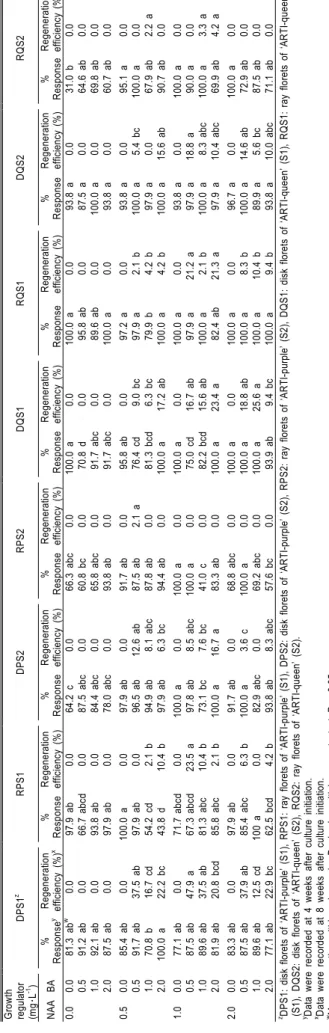
국화 ‘ARTI-purple’ 및 ‘ARTI-queen’의 꽃잎 절편체로부 터 재분화를 유도하기 위해 IAA와 BA를 혼합하여 농도별 로 처리하여 배양한 후 4주와 8주 후에 각각 재분화율을 조 사하였다. 그 결과 ‘ARTI-purple’의 경우 설상화, 통상화 모 두 개화시기 S1, S2 단계에서 배양 4주에는 높은 재분화 초 기반응률을 보였으나, 8주 후에는 대부분 고사하였다(Table 1). ‘ARTI-queen’의 경우 ‘ARTI-purple’과 동일하게 배양 4 주에는 개화시기 S1, S2 단계의 설상화, 통상화 모두 높은 재분화 초기반응률을 보였으나, 배양 8주 후에는 대부분 고 사하였다. IAA와 BA 혼합처리에서 정상적인 식물체가 유 기되는 가장 높은 재분화율은 ‘ARTI-queen’의 S1 단계 통 상화를 배양하였을 때 IAA 1.0mg・L
-1, BA 1.0mg・L
-1조합 에서 6.3%로 확인되었으나 적정 재분화 조건은 아닌 것으 로 판단된다(Table 1). 이러한 결과는 IAA를 단일 처리하였 을 때 재분화가 이루어지지 않았고, BA를 단일 처리하였을 때는 대부분의 품종에서 재분화율이 저조하였다는 기존 연 구 결과와 유사하다(Song et al., 2011). 그러나 cytokinin과 auxin의 혼합처리는 국화 조직배양 시 재분화에 효과적이라 는 여러 연구 보고가 있다(Jeong et al., 2002; Seiichi et al., 1995; Tanaka et al., 2000; Waseem et al., 2009). 특히 국화 품종 ‘Klondike’와 ‘Orlando’의 꽃잎 배양에서 IAA 57μM, BA 44μM, kinetin 0.4μM을 혼합하여 처리하였을 때 가장 높은 재분화율을 보인 연구 보고가 있다(Park et al., 2007b).
그러나 본 연구 결과에서는 IAA와 BA를 혼합한 호르몬을
처리하였을 때 4주까지는 비교적 높은 재분화 초기반응률을 보였지만, 8주 후에는 대부분 고사하여 ‘ARTI-purple’과
‘ARTI-queen’의 경우 IAA와 BA 혼합조합은 재분화 조건 에 적합하지 않은 것으로 판단된다. 본 연구에 사용된 두 개 품종의 원품종인 ‘Argus’의 경우 잎과 절간을 사용하여 IAA 0.5mg・L
-1와 BAP 1.0mg・L
-1를 혼용 처리한 1/2 MS 배지에 배양한 결과 잎과 절간 모두 재분화가 이루어지지 않았다 (Han et al., 2009). 본 연구 결과를 통해 원품종인 ‘Argus’와 유래 돌연변이 품종 ‘ARTI-purple’과 ‘ARTI-queen’ 모두 IAA와 BA의 혼합조합은 재분화 조건으로 적합하지 않은 것으로 판단된다.
다른 식물호르몬 조합을 사용하여 국화 두 품종의 꽃잎 절편체로부터 재분화를 유도하기 위해 NAA와 BA를 혼합 하여 농도 별로 처리하여 배양한 후 4주와 8주 후에 각각 재분화율을 조사하였다. 그 결과 두 품종의 S1, S2 단계 설 상화, 통상화 모두 IAA, BA 혼합 처리 시와 유사하게 배양 4주에는 높은 재분화 초기반응률을 보였으나, 8주에는 큰 차이를 보였다. 배양 후 8주에 ‘ARTI-purple’의 경우 개화시 기 S1 단계의 통상화 및 설상화 모두 NAA 1.0mg・L
-1, BA 0.5mg・L
-1혼합 처리구에서 각각 47.9%와 23.5%로 가장 높 은 재분화율을 보였다(Table 2). 그러나 개화시기 S2 단계에 서는 통상화의 경우 NAA 1.0mg・L
-1, BA 2.0mg・L
-1처리구 에서 16.7%의 재분화율을 보였고, 설상화의 경우 대부분 고사 하였다. 반면 배양 후 8주에 ‘ARTI-queen’의 경우 S1 단계의 통상화에서 NAA 2.0mg・L
-1와 BA 1.0mg・L
-1의 혼합 처리 시 25.6%, 설상화의 경우 NAA 1.0mg・L
-1, BA 2.0mg・L
-1처리 구에서 21.3%의 재분화율을 보였다. 개화시기 S2 단계에서 는 통상화의 경우 NAA 1.0mg・L
-1, BA 0.5mg・L
-1처리구에 서 18.8%의 재분화율을 보였고, 설상화의 경우 대부분 고사 하였으나 NAA 1.0mg・L
-1, BA 2.0mg・L
-1처리구에서 4.2%
의 재분화율을 보였다 . 국화 ‘ARTI-purple’, ‘ARTI-queen’ 두
품종의 개화시기에 따른 재분화율을 비교한 결과 각각의 호
르몬 조건에서 S1 단계의 조직이 S2 단계에 비해 상대적으
로 더 높은 재분화율을 보였고, S2 단계의 설상화의 경우
상대적으로 낮게 확인되었다 . 따라서 본 연구에서는 ‘ARTI-
purple’의 경우 개화시기 S1 단계에서 NAA 1.0mg・L
-1과
BA 0.5mg・L
-1의 혼용처리를 하였을 때 가장 높은 재분화율
을 보이는 것을 확인할 수 있었으며, ‘ARTI-queen’의 경우에
도 개화시기 S1 단계에서 NAA 2.0mg・L
-1과 BA 1.0mg・L
-1의 혼용처리 시 가장 좋은 재분화율을 확인할 수 있었다 . 본
연구에서 사용된 2개 품종의 원품종인 ‘Argus’의 경우 줄기
를 사용하여 shoot의 증식 정도를 관찰해 본 결과 NAA
0.2mg・L
-1와 BA 0.1mg・L
-1에서는 신초가 형성되고, NAA
Table 1.
Effect of growth regu lator co m binati on (I A A and B A) on rege neration of petal florets of chrysan th emu m ‘ART I-purpl e’ a nd ‘ A RT I-q ue en’ at 4 and 8 weeks after tissu e cul ture.
Growth regulator (mg・L-1 )DPS1z RPS1DPS2RPS2DQS1RQS1DQS2RQS2 IAABA% ResponseyRegeneration efficiency (%)x% ResponseRegeneration efficiency (%)% ResponseRegeneration efficiency (%)% ResponseRegeneration efficiency (%)% ResponseRegeneration efficiency (%)% ResponseRegeneration efficiency (%)% ResponseRegeneration efficiency (%)% ResponseRegeneration efficiency (%) 0.00.081.3 abw0.097.9 a0.064.2 ab0.066.3 a0.0100.0 a0.0100.0 a0.093.8 ab0.031.0 bc0.0 0.576.5 ab0.072.9 cd0.079.2 a0.071.3 a0.085.4 abc0.068.2 abcdef0.070.8 cde0.077.1 ab0.0 1.070.3 b0.093.8 ab0.070.5 ab0.065.8 a0.054.2 ef0.039.6 ef0.083.3 abcd0.069.8 abc0.0 2.067.8 b0.088.1 abc0.077.1 a0.066.0 a0.050.0 f0.084.8 ab0.085.4 abcd0.060.7 abc0.0 0.50.081.3 ab0.085.4 abc0.077.0 a0.0100.0 a0.081.3 abc0.090.6 ab0.0100.0 a0.090.6 a0.0 0.579.2 ab0.080.8 abcd0.045.8 bc0.064.4 a0.068.8 cde0.047.9 def0.093.8 ab0.028.3 c0.0 1.039.6 c0.092.5 ab0.072.9 ab0.079.1 a0.079.2 bcd0.097.6 a0.091.7 ab0.089.3 a0.0 2.031.3 c0.077.1 bcd0.064.6 ab0.088.4 a0.083.1 abc2.2 b71.1 abcde0.085.4 abcd0.092.9 a0.0 1.00.083.3 ab0.078.1 bcd0.069.3 ab0.072.6 a0.092.5 ab0.082.6 abc0.097.9 a0.086.7 a0.0 0.575.0 ab0.091.7 abc0.064.6 ab0.088.2 a2.1 a81.3 abc0.037.5 f0.093.8 ab0.096.7 a0.0 1.089.6 a0.080.6 abcd0.049.1 abc2.0 a79.0 a0.072.9 cd6.3 a50.7 cdef0.070.8 cde0.091.7 a0.0 2.031.3 c0.077.1 bcd0.056.3 abc0.0100.0 a2.1 a61.7 def0.085.0 ab0.060.6 e0.085.4 abc0.0 2.00.081.3 ab0.095.8 ab0.076.0 ab0.091.9 a0.085.4 abc0.087.1 ab0.089.6 abc0.071.7 abc0.0 0.579.2 ab0.095.8 ab0.080.1 a0.097.2 a0.054.5 ef0.076.8 abcd0.075.8 bcde0.087.5 a0.0 1.072.9 ab0.085.4 abc0.033.3 c0.0100.0 a0.054.2 ef0.063.7 bcdef0.039.6 f0.095.8 a0.0 2.043.8 c0.062.7 d0.062.1 abc0.0100.0 a0.075.0 bcd0.083.8 ab0.068.2 de0.070.0 abc0.0 zDPS1: disk florets of ‘ARTI-purple’ (S1), RPS1: ray florets of ‘ARTI-purple’ (S1), DPS2: disk florets of ‘ARTI-purple’ (S2), RPS2: ray florets of ‘ARTI-purple’ (S2), DQS1: disk florets of ‘ARTI-queen’ (S1), RQS1: ray florets of ‘ARTI-queen’ (S1), DQS2: disk florets of ‘ARTI-queen’ (S2), RQS2: ray florets of ‘ARTI-queen’ (S2). yData were recorded at 4 weeks after culture initiation. xData were recorded at 8 weeks after culture initiation. wMean separation within columns by Dunkan’s multiple range test at P = 0.05. Table 2.E ffec t of gro w th reg ulato r c om binatio n (N A A an d B A ) o n re gen erat io n of p etal flore ts o f c hrys anth em um ‘A R T I-p urple ’ a nd ‘A R T I-q ue en’ at 4 and 8 w eek s after tissu e cu lture .
Growth regulator (mg・L-1)DPS1zRPS1DPS2RPS2DQS1RQS1DQS2RQS2 NAABA% ResponseyRegeneration efficiency (%)x% ResponseRegeneration efficiency (%)% ResponseRegeneration efficiency (%)% ResponseRegeneration efficiency (%)% ResponseRegeneration efficiency (%)% ResponseRegeneration efficiency (%)% ResponseRegeneration efficiency (%)% ResponseRegeneration efficiency (%) 0.00.081.3 abw0.097.9 ab0.064.2 c0.066.3 abc0.0100.0 a0.0100.0 a0.093.8 a0.031.0 b0.0 0.591.2 ab0.066.7 abcd0.087.5 abc0.060.8 bc0.070.8 d0.095.8 ab0.087.5 a0.064.6 ab0.0 1.092.1 ab0.093.8 ab0.084.4 abc0.065.8 abc0.091.7 abc0.089.6 ab0.0100.0 a0.069.8 ab0.0 2.087.5 ab0.097.9 ab0.078.0 abc0.093.8 ab0.091.7 abc0.0100.0 a0.093.8 a0.060.7 ab0.0 0.50.085.4 ab0.0100.0 a0.097.9 ab0.091.7 ab0.095.8 ab0.097.2 a0.093.8 a0.095.1 a0.0 0.591.7 ab37.5 ab97.9 ab0.096.5 ab12.6 ab87.5 ab2.1 a76.4 cd9.0 bc97.9 a2.1 b100.0 a5.4 bc100.0 a0.0 1.070.8 b16.7 cd54.2 cd2.1 b94.9 ab8.1 abc87.8 ab0.081.3 bcd6.3 bc79.9 b4.2 b97.9 a0.067.9 ab2.2 a 2.0100.0 a22.2 bc43.8 d10.4 b97.9 ab6.3 bc94.4 ab0.0100.0 a17.2 ab100.0 a4.2 b100.0 a15.6 ab90.7 ab0.0 1.00.077.1 ab0.071.7 abcd0.0100.0 a0.0100.0 a0.0100.0 a0.0100.0 a0.093.8 a0.0100.0 a0.0 0.587.5 ab47.9 a67.3 abcd23.5 a97.8 ab8.5 abc100.0 a0.075.0 cd16.7 ab97.9 a21.2 a97.9 a18.8 a90.0 a0.0 1.089.6 ab37.5 ab81.3 abc10.4 b73.1 bc7.6 bc41.0 c0.082.2 bcd15.6 ab100.0 a2.1 b100.0 a8.3 abc100.0 a3.3 a 2.081.9 ab20.8 bcd85.8 abc2.1 b100.0 a16.7 a83.3 ab0.0100.0 a23.4 a82.4 ab21.3 a97.9 a10.4 abc69.9 ab4.2 a 2.00.083.3 ab0.097.9 ab0.091.7 ab0.068.8 abc0.0100.0 a0.0100.0 a0.096.7 a0.0100.0 a0.0 0.587.5 ab37.9 ab85.4 abc6.3 b100.0 a3.6 c100.0 a0.0100.0 a18.8 ab100.0 a8.3 b100.0 a14.6 ab72.9 ab0.0 1.089.6 ab12.5 cd100 a0.082.9 abc0.069.2 abc0.0100.0 a25.6 a100.0 a10.4 b89.9 a5.6 bc87.5 ab0.0 2.077.1 ab22.9 bc62.5 bcd4.2 b93.8 ab8.3 abc57.6 bc0.093.9 ab9.4 bc100.0 a9.4 b93.8 a10.0 abc71.1 ab0.0 z DPS1: disk florets of ‘ARTI-purple’ (S1), RPS1: ray florets of ‘ARTI-purple’ (S1), DPS2: disk florets of ‘ARTI-purple’ (S2), RPS2: ray florets of ‘ARTI-purple’ (S2), DQS1: disk florets of ‘ARTI-queen’ (S1), RQS1: ray florets of ‘ARTI-queen’ (S1), DQS2: disk florets of ‘ARTI-queen’ (S2), RQS2: ray florets of ‘ARTI-queen’ (S2). y Data were recorded at 4 weeks after culture initiation. xData were recorded at 8 weeks after culture initiation. wMean separation within columns by Dunkan’s multiple range test at P = 0.05.A B
C D
E F
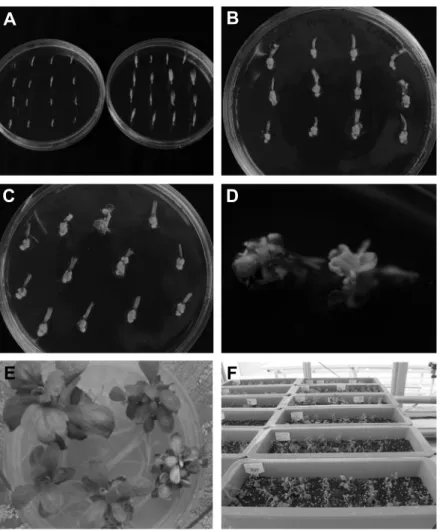
Fig. 2. The process of shoot regeneration and acclimation using disk and ray florets of chrysanthemum ‘ARTI-queen’. (A) culture initiation; (B) adventitious shoot formation from petal segments; (C) shoot regeneration; (D) shoot elongation; (E) rooting; (F) acclimation.
0.2mg・L
-1와 BA 1.0mg・L
-1에서는 줄기 생장이 이루어진다 고 보고하였다(Park et al., 2007a). 개화시기에 따른 배양조 건의 재분화율을 비교한 결과 최적 NAA, BA 호르몬 조합 에서 ‘ARTI-purple’의 경우 S1 단계가 S2 단계에 비해 최 대 3배 정도의 재분화율 차이(47.9:16.7)를 보이고 있으며,
‘ARTI-queen’의 경우 S1 단계가 S2 단계에 비해 다소 높은 것으로(25.6:18.8) 확인되었다(Table 2). 기존 연구에서는 개 화시기에 따라 설상화 만개 전 2-3일과 통상화 개화 7-8일로 나누어 비교한 결과 설상화 만개 전 2-3일에 꽃잎에서 더 많은 재분화 식물체를 얻을 수 있었다(Park et al., 2007b).
또한 발육단계에 있는 조직을 사용하였을 때 체세포배 발 생과 부정지를 유도하는데 유리하다는 연구 보고도 있다 (Gilissen et al., 1996; Lu et al., 1982). 이러한 결과는 세포 변화가 왕성히 일어나는 어린 조직이 재분화에 유리한 것으 로 추정된다.
꽃잎의 조직(설상화, 통상화)에 따른 재분화율을 비교한 결과 최적 NAA, BA 호르몬 조합에서 ‘ARTI-purple’의 경우 통상화가 설상화에 비해 2배 이상의 재분화율 차이
(47.9:23.5)를 보이고 있으며, ‘ARTI-queen’의 경우 통상화 가 설상화에 비해 다소 높은 것으로(25.6:21.3) 확인되었다 (Table 2). 본 실험에서 8주간 배양한 후에 재분화된 신초는 1/2 MS 배지로 옮겨 신초의 신장과 발근을 유도하였고(Fig.
2E), 성공적으로 발근된 소식물체는 인공토양(Vermiculite:
Perlite = 1:1)이 들어 있는 분에 정식하여 온실에서 순화처 리하여 정상적인 식물체를 획득할 수 있었다 (Fig. 2F). 결론 적으로 ‘ARTI-purple’, ‘ARTI-queen’ 모두 꽃잎 배양에는 S1 단계의 통상화를 NAA, BA를 혼용하여 사용하는 것이 재분화에 유리한 것으로 판단되며, 비록 두 품종이 동일한
‘Argus’에서 유래되었으나, 최적 재분화 조건에는 다소 차 이가 있음을 확인할 수 있었다. 이는 국화 방사선 돌연변이 육종 시 최초 변이체 선발 및 변이체 고정에 중요한 정보를 제공할 것으로 기대된다.
초 록
국화는 전 세계적으로 가장 대중적인 화훼류 중의 하나로
써, 최근 새로운 국화 품종들이 돌연변이육종을 통해 개발 되고 있다. 그러나 현재까지 하나의 국화 원품종에서 유래 한 돌연변이 품종들 간의 조직배양 조건 차이에 대한 보고는 전무하다. 따라서 본 연구에서는 2개의 국화 화색 돌연변이 품종 ‘ARTI-purple’과 ‘ARTI-queen’의 효율적인 재분화 조 건을 비교하기 위해 수행되었다. 실험재료로 꽃봉오리 시기 와 통상화 개화 이전 시기의 꽃잎을 이용하였고, 꽃의 조직 에 따른 차이를 확인하기 위해 통상화 및 설상화를 구분하 여 실험을 수행하였다. 국화 재분화를 위한 식물생장호르몬 의 적정 조합을 찾기 위해 3% sucrose, 0.3% gelrite를 포함 한 MS 배지에 BA, NAA, IAA 중 2가지 호르몬을 조합별로 첨가하여 실험을 수행하였다. 절편체는 일장 16시간, 온도 25 ± 1°C 조건으로 배양하였으며, 재분화율 조사는 배양 후 4주 및 8주차에 실시하였다. 결과적으로, 가장 높은 재분화 율은 두 품종 모두 최적 NAA와 BA의 호르몬 조합에서 꽃봉 오리 시기의 통상화를 사용할 시 가장 높게 확인되었다. 재 분화를 위한 식물생장호르몬의 최적 조합은 ‘ARTI-purple’
의 경우 NAA 1.0mg・L
-1와 BA 0.5mg・L
-1로 47.9%의 재분 화 효율을 보였으며, ‘ARTI-queen’의 경우 NAA 2.0mg・L
-1와 BA 1.0mg・L
-1로 25.6%의 재분화 효율을 나타내었다. 재 분화된 지상부는 1/2 MS배지에서 발근시켰으며, 기내 소식 물체는 유리온실에서 성공적으로 순화되었다. 본 연구결과 는 감마선을 사용한 돌연변이육종법에 의해 개발된 다양한 국화품종의 효율적인 재분화 시스템을 구축하는데 유용한 정보를 제공할 것이다.
추가 주요어 : 옥신, 사이토키닌, 통상화, 방사선, 설상화
인용문헌