껍질째 먹는 배 ‘조이스킨’ 육성
김윤경1* · 강삼석2 · 조광식1 · 원경호1 · 신일섭1 · 김명수1 · 마경복1 · 이인복1
1국립원예특작과학원 배연구소, 2농촌진흥청 연구운영과
Breeding of ‘Joyskin’ Pear as fruit for Eating with the Skin
Yoon-Kyeong Kim1*, Sam-Seok Kang2, Kwang-Sik Cho1, Kyung-Ho Won1, Il-Sheob Shin1, Myung-Su Kim1, Kyeong-Bok Ma1, and In Bog Lee1
1Pear Research Institute, National Institute of Horticultural and Herbal Science, Rural Development Administration, Naju Jeonnam 58216, Korea
2R&D Coordination Division, Rural Development Administration, Jeonju, Jeonbuk 54875, Korea
*Corresponding author: [email protected]
Abstract
In 1994, a new cultivar ‘Joyskin’ was created from a cross between the cultivars ‘Whangkeumbae’
and ‘Waseaka’ at the Pear Research Institute of the National Institute of Horticultural and Herbal Science, Rural Development Administration. In 2006, the ‘Joyskin’ was selected from among the 317 seedlings resulting from the cross for its skin and taste qualities. Regional adaptation tests were conducted in nine regions and in ten experimental plots from 2006 to 2011. The cultivar was named in 2011. ‘Joyskin’ showed a vigorous growth habit and semi-spread characteristics similar to ‘Whangkeumbae’. The average full bloom date for ‘Joyskin’ was April 21st, which was also similar to ‘Whangkeumbae’. The optimum fruit ripening time was September 6-8th, which was six or eight days earlier than ‘Whangkeumbae’. The fruit was round in shape and the skin was a golden yellow color at maturity. The average fruit weight was 320 g and the flesh firmness was 2.5 kg/8mmφ. The firmness of the fruit skin determined by a blade-type plunger of texture analyzer was 22.9 N, which was significantly different from that of ‘Whangkeumbae’ 29.9N.
Stone cell analysis of ‘Joyskin’ by phloroglucinol-HCl, showed that ‘Joyskin’ stone cells were small in size and few in numbers cpmpared to those of cultivars of was ‘Manpungbae’, ‘Niitaka’, and ‘Whangkeumbae’. The patent application for ‘Joyskin’ was submitted in April, 2012 (Grant No. 2012-337). In 2016, ‘Joyskin’ (Grant No. 5895) was registered as a separate record, with uniformity and stability per Korean Seed Industry Law.
Additional key words: crossing breeding, fruit, Pyrus pyrifolia, self-incompatibility, stone cell
서 언
최근 소비자들의 과일 선호도를 바탕으로 분석한 소비행태는 맛, 건강 기능성, 색깔, 모양 등의 품질과
Received: April 21, 2016 Revised: June 14, 2016 Accepted: July 6, 2016
Copyrightⓒ2016 Korean Society for Horticultural Science.
This is an Open-Access article distributed under the terms of the Creative Commons Attribution NonCommercial License which permits unrestricted non- commercial use, distribution, and reproduction in any medium, provided the original work is properly cited.
본 연구는 농촌진흥청 기본연구사업(PJ00689401) 의 지원에 의해 수행되었음
Korean J. Hortic. Sci. Technol. 34(6):959-965, 2016 https://doi.org/10.12972/kjhst.20160098
pISSN : 1226-8763 eISSN : 2465-8588
OPEN ACCESS
취급 및 섭취 시 간편성 등을 기준으로 이루어지고 있다. 그러나, 수박, 참외, 배, 단감 등은 껍질을 깎아먹어야 한다는 점에서 간 편성이 낮은 품목으로 평가되어 소비가 감소하고 있다(KREI, 2014).
씨방과 함께 화탁이 비대 발달하여 위과(Pseudocarp)로 분류되는 배는 과육(꽃받침통, hypanthium)과 과피에 다양한 생리 활성 물질이 포함되어 있음이 보고되고 있다(Jangetal., 2013; Minetal., 2013). 폴리페놀과 플라보노이드 성분이 주로 기여하 는 배의 항산화능은 폴리페놀류 함량 및 DPPH 라디칼 제거능이 과육보다 과피 부분에서 더 높다(Choietal., 2013; Leontowicz etal., 2003). 특히, 쿼세틴이나 루테올린과 같은 기능성 물질은 대부분 과피 부분에 축적되기 때문에 과실 섭취를 통한 건강 기 능성 증진을 위해서는 껍질째 먹는 것이 가장 좋다. 하지만, 배는 과피에 거친 석세포와 떫은맛, 쓴맛 등 직접 섭취하기에는 다 소 부담스러운 특성을 가지고 있어 껍질까지 먹는 것이 어려운 과종 중 하나이기도 하다. 현재, 우리나라 배의 재배면적은 2000 년 26,206ha를 정점으로 2014년 13,127ha까지 감소하였으나(KATI, 2015) 추후, 미래소비 트렌드는 일정 수준 이상의 당도 와 적당한 산도, 혼자서도 먹을 수 있는 중소과 크기이거나 껍질 분리 및 섭취가 쉽고, 건강기능성 등의 조건을 갖춘 배가 주도 할 것으로 전망되고 있다.
따라서, 편리함을 추구하는 젊은 세대의 요구와 껍질을 깎아먹는 문화에 익숙하지 않은 외국인에게도 적합한 껍질째 먹는 배 품종을 육성하고자 국립원예특작과학원 배연구소에서는 1994년 국내에서 육성한 최초의 선황색 품종으로 품질이 우수하 여 수출용으로 각광받고 있는 ‘황금배’(Kimetal., 1985)와 ‘조생적’을 교배한 실생 중 과피 두께가 얇고 쉽게 부서지면서 껍질 특유의 이취가 없어 껍질째 먹을 수 있는 ‘조이스킨’을 육성하였다.
육성 경위
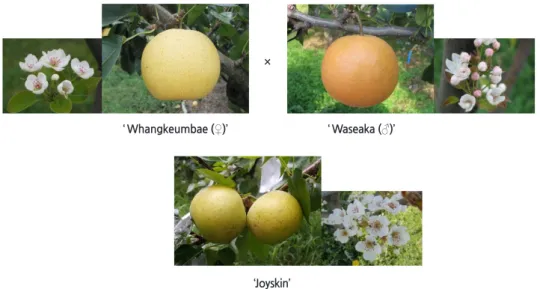
국립원예특작과학원 배연구소에서는 만생 고품질 품종육성을 위해 1994년 ‘황금배’와 ‘조생적’을 교배하였다(Fig. 1). 1995 년 649립의 교배종자를 파종하여 317주의 교배실생을 획득하고, 이를 육종포장에 정식하였다. 이들 교배계통에 대한 생육 및 과실 특성은 농촌진흥청 농사시험연구 조사기준(RDA, 1995, 2003)에 따라 조사하여 교배실생 중에서 식미가 우수한 ‘17- 04-53’을 1차 선발하였다(Fig. 2). 껍질째 먹는 배를 원하는 최근의 소비 트렌드를 반영하기 위해 그 동안 껍질째 먹을 수 있 었던 사과와 단감의 과피 특성을 분석하여 껍질째 먹을 수 있는 과피에 대한 기준을 설정하고 1차 선발한 계통을 대상으로 과피 특성을 정밀평가 한 결과, 교배목표인 만생종과는 다소 거리가 멀지만 조생종이며 식미가 우수하고 껍질째 먹어도 이
‘ Whangkeumbae (♀)’ ‘ Waseaka (♂)’
×
‘Joyskin’
Fig. 1. Appearance of the fruit and flower of parents and ‘Joyskin’
물감이 적고 선호도가 높았다. 또한, 2006년부터 2011년까지 5년간 9개 지역 10개소에서 ‘원교나-53호’라는 이름으로 지역적 응성을 검토한 결과, 품질의 우수성이 인정되어 2011년 껍질째 먹는 중소과 품종으로 최종 선발한 후 ‘조이스킨’으로 명명하 였다.
품종의 구별성
‘조이스킨’의 수세는 다소 강하고 수자는 반개장형으로 교배양친인 ‘황금배’, ‘조생적’과 유사한 경향을 보였다(Table1). 신 초발생이 잘 되고 검은무늬병(blackleafspot; Alternaria kikuchiana)에는 강하고, ‘황금배’와 ‘조생적’이 검은별무늬병(scab, Venturia nashicola)에는 약한 것에 비해 중간 특성을 보였다.
‘조이스킨’의 1년생 가지 길이와 굵기, 절간장은 ‘황금배’와 유사하였으나 액화아는 1.6개로 ‘황금배’ 4.6개, ‘조생적’ 9.8개 보다 다소 적은 경향을 보였고, 피목의 수는 ‘황금배’가 ‘중간’, ‘조이스킨’과 ‘조생적’은 ‘많음’에 해당하여 모본인 ‘황금배’와 는 구분되었다(Table2). ‘조이스킨’의 만개기는 ‘황금배’보다 1일 정도 늦고, ‘조생적’보다 3일이 빠르며 화서의 꽃 수, 수술의 수, 화관크기 등이 ‘황금배’와 유사하였다(Table3).
‘조이스킨’은 나주에서 3년 평균 숙기가 9월 6-8일로 ‘황금배’보다 7-8일, ‘조생적’보다 20일 이상 빠른 조생종이며, 과피색 은 선황색이고(Table4), 동녹이 발생할 수 있다. 배 과실 성숙의 조만은 양적형질로 다수 유전자에 의해 지배되며 교배조합 별 실생의 숙기분포는 정규분포를 보인다(Abeetal., 1993a). Shinetal.(2015)은 교배조합에 따라 양친의 숙기 범위를 크게 벗 어난 실생의 분포에 대해 언급하였는데 ‘조이스킨’은 정규분포의 바깥쪽에 해당하는 계통이 선발된 것으로 보여진다. 과중 은 320g 내외이고, 과형은 ‘원형’으로 ‘황금배’, ‘조생적’과 유사하였다. 또한, 과실의 체와와 경와의 깊이, 폭은 ‘황금배’와 유
Table 1. Tree characteristics of ‘Joyskin’ in Naju from 2009 to 2011.
Cultivar Tree vigor Tree form Spur Disease resistance
formation Scab Black leaf spot
Joyskin Vigorous Semi spreading Good Medium Resistant
Whangkeumbae Vigorous Semi spreading Good Susceptible Resistant
Waseaka Vigorous Semi spreading Good Susceptible Resistant
Fig. 2. Pedigree diagram of ‘Joyskin’ pear.
Produce Cross Seedlings Regional Final
planting selection 1st-3rd adaptability test selection
Year 1994 1995 2001-2005 2006-2011 2011
Whangkeumbae (♀) 17-4-1
: 9 regions
× 17-4-53 (10 plots) ‘Joyskin’
: Wonkyo Na-53
Waseaka (♂) 17-4-317
No. of
lines 100 flowers 317 1 1 1
의한 차이를 보여 구분되었다(data 미제시). ‘조이스킨’의 과육경도는 2.5kg/8mmφ로 ‘조생적’ 3.3kg/8mmφ보다 연하고, ‘황금 배’와 유사하였다.
품종의 농업적 특성
‘조이스킨’의 주요 형질에 대한 지역간 발현특성을 조사한 결과, 지역적응 시험지의 평균 과중은 382g으로 수원에서 274g 으로 가장 작았고, 대구에서 446g으로 가장 크게 나타났다. 당도는 춘천에서 가장 낮고, 나주에서는 14.5°Brix로 가장 높았으 며, 그 외 지역에서는 12.5-14.5°Brix로 지역에 따른 편차 없이 비교적 안정적인 발현을 보였다(Table5). 과육의 질감은 대부 분의 지역에서 부드럽고, 특히 석세포가 적어 종합적인 품질은 우수한 것으로 평가되었다.
껍질째 먹는 배 품종의 기준 수립을 위한 시험결과, ‘조이스킨’과 ‘황금배’는 과피색과 껍질째 먹었을 때 입 안에서 느껴지 는 이물감이 없어 선호도가 매우 높았다(data 미제시). 특히, 과피의 경도를 비교하기 위해 껍질째 먹을 때 앞 이(齒)로 베어 무는 힘을 측정할 수 있도록 경도계에 bladetype의 plunger를 부착하여 그 차이를 비교하였다. ‘조이스킨’의 과피경도는 22.9 N으로 껍질째 먹을 때 큰 거부감이 없는 사과 24.1N, 감 38.7N보다 경도가 유의하게 낮았으며 모본인 ‘황금배’ 와도 유의한 차이를 보였다(data 미제시).
plunger와 접촉하는 배 단면조직의 구조와 견고성이 과실의 경도를 결정하는 요인이 되며, 배의 석세포는 경도 증가, 자당 Table 2. One-year-old shoot characteristics of ‘Joyskin’ at Naju in 2011.
Cultivar Length Thickness Axillary flower Internode length Lenticel
(cm) (mm) bud number (cm) numberz
Joyskin 81.2 ± 16.0y 11.0 ± 1.9 1.6 ± 1.3 3.9 ± 0.5 Many
Whangkeumbae 88.6 ± 11.7 11.1 ± 1.1 4.6 ± 3.3 3.8 ± 0.3 Medium
Waseaka 72.7 ± 6.7 8.6 ± 0.6 9.8 ± 3.3 4.5 ± 0.5 Many
zLenticel number was compared with example cultivars. Many, Shinko; medium, Kosui.
yMeans±SD.
Table 3. One-year-old shoot characteristics of ‘Joyskin’ at Naju in 2011.
Cultivar Full bloom date Number of
Number of
Stamens Size of
corolla Pollen
(mg/100flowers) flowers per
inflorescence
Joyskin Apr. 21 7.7 ± 0.5z 21.3 ± 1.9 Medium None
Whangkeumbae Apr. 20 8.3 ± 0.9 24.4 ± 3.6 Medium None
Waseaka Apr. 24 6.4 ± 0.5 24.9 ± 3.0 Medium 105
zMeans±SD.
Table 4. Fruit characteristics of ‘Joyskin’ at Naju from 2009 to 2011.
Cultivar Harvest Fruit weight
(g) Fruit
shape
Soluble solid Firmnessy
contents Flesh Skin
(°Bx) (kg/8mmφ) x(N)
Joyskin Sept. 8 322 ± 65z Round 15.2 ± 0.5 2.5 ± 0.2 22.7 ± 2.6
Whangkeumbae Sept. 14 475 ± 10 Round 12.3 ± 0.2 2.4 ± 0.1 30.2 ± 4.0
Waseaka Oct. 1 357 ± 19 Round 11.1 ± 0.6 3.3 ± 0.6 -
zMeans±SD.; -: no data
yFirmness of the flesh and skin was evaluated by 8mmφ plunger (plat tip) in the flesh and blade-type plunger in the skin of texture analyzre in 2015.
함량 감소를 유도하여 궁극적으로 과실 품질에 부정적인 영향을 미치고 특히, 석세포의 크기는 입안에서 껄끄러운 감촉에 영향한다(Choietal., 2007; Paolettietal., 1993). 따라서, ChoiandLee(2013) 방법에 의해 3% phloroglucinol-HCl 을 이용하여 ‘조 이스킨’, ‘황금배’, ‘만풍배’, ‘신고’의 과피를 포함한 과육의 단면을 염색한 후 과피 부분의 석세포를 중심으로 비교하였다
(Fig. 3). ‘황금배’는 과피 주변으로 크기가 작은 석세포가 다량 분포한 반면, ‘조이스킨’은 과피 주변과 과육에 크기가 작은 석
Table 5. Characteristics of ‘Joyskin’ in various regions.
Region
Full Ripening
date
Fruit Soluble
Flesh
texture Grittiness
bloom weight solid content
date (g) (°Bx)
Cheongwon Apr. 24 Sept. 6 357 ± 60z 13.5 ± 0.4 Soft Negligible
Chuncheon Apr. 24 Sept. 16 440 ± 36 12.5 ± 1.4 Soft Negligible
Daegu Apr. 16 Sept. 6 446 ± 55 14.2 ± 1.0 Soft Negligible
Hwaseong Apr. 24 Sept. 11 414 ± 81 12.9 ± 0.6 Soft Negligible
Iksan Apr. 20 Sept. 6 344 ± 13 13.3 ± 0.1 Soft Negligible
Jinju Apr. 14 Sept. 6 411 ± 15 14.1 ± 0.8 Soft Negligible
Najuy Apr. 16 Sept. 6 363 ± 64 14.5 ± 0.8 Soft Negligible
Suwon - Sept. 16 274 ± 50 13.0 ± 0.2 Soft Negligible
Yesan Apr. 23 Sept. 17 391 ± 38 12.9 ± 0.3 Soft Negligible
zMeans±SD.; -: no data
yData in Naju were calculated as the average from two experimental plots.
Fig. 3. Comparison of stone cells by 3% phloroglucinol-HCl dye in the flesh of ‘Joyskin’ (A), ‘Niitaka’ (B), ‘Manpungbae’ (C), and
‘Whangkeumbae’ (D) pear using a microscope (x40) at ripening time.
A B
C
SC SC
SC
SC
1mm 1mm 1mm
1mm
CC
CC
D
세포가 드물게, ‘만풍배’와 ‘신고’는 과피 주변으로 크기가 큰 석세포가 치밀하게 분포해 있었다. 크기가 작은 석세포가 드물 게 분포하고 있었던 ‘조이스킨’을 껍질째 먹었을 때 이물감이 느껴지지 않은 이유가 여기에서 비롯되었음을 추정할 수 있었다.
신품종의 재배 및 번식상의 유의점
단과지 형성 및 유지성이 좋아 연차가 다른 꽃눈이 혼재하면 과실의 균일도가 떨어질 수 있으므로 적절한 꽃눈정리로 균 일한 꽃눈을 확보해야 한다. 과피에 동녹이 발생하므로 황금배 전용봉지를 조기에 씌워 동녹발생을 방지하는 것이 좋다. 꽃 가루가 없으므로 개화기가 유사하며 꽃가루가 풍부한 ‘만황’, ‘추황배’, ‘금촌추’ 등을 수분수 및 보조 수분수로 재식하여 안정 적인 결실 및 정형과 생산을 도모하여야 한다.
신품종의 등록 및 이용정보
2012년 4월 19일에 국립종자원에 2012-311로 품종보호를 출원하였으며, 2016년 2월 품종등록(grantnumber, 5895) 되었다.
초 록
껍질째 먹는 배 ‘조이스킨’은 1994년 국립원예특작과학원 배연구소에서 ‘황금배’와 ‘조생적’을 교배하였다. 317개 교배실 생 중 식미가 우수하고 껍질을 벗기지 않고 먹을 수 있는 ‘17-04-53’을 2006년 최초로 선발하고 2006년부터 2011년까지 9개 지역, 10개 장소에서 지역적응 시험을 거친 후, 최종 선발하여 ‘조이스킨’으로 명명하였다. ‘조이스킨’은 ‘황금배’와 마찬가지 로 수세가 강하고, 반개장형이다. ‘조이스킨’의 평균 만개기는 4월 21일로 ‘황금배’와 유사하며 숙기는 9월 6-8일로 ‘황금배’
보다 7-8일 이상 빠르고 과형은 원형, 성숙기에는 선황색을 띈다. 평균과중은 320g 내외, 과육경도는 2.5kg/8mmφ로 ‘황금 배’와 유사하였다. bladetype으로 측정한 ‘조이스킨’의 과피경도는 22.9N으로 ‘황금배’ 29.9N과 유의한 차이를 보였다. ‘만풍 배’, ‘신고’, ‘황금배’, ‘조이스킨’의 과피 석세포를 phloroglucinol-HCl로 염색하여 조사한 결과, ‘조이스킨’은 석세포의 크기가 작고 개수도 적은 경향을 보였다. ‘조이스킨’은 2012년 4월 19일에 국립종자원에 2012-311로 품종보호를 출원하였으며, 2016 년 2월 품종등록(grantnumber, 5895) 되었다.
추가 주요어 : 교배육종, 과수, Pyrus pyrifolia, 자가불화합, 석세포
Literature Cited
Abe K, Sato Y, Kurihara A, Kotobuki K (1993). Inheritance of ripening time of fruit of Japanese pear (Pyrus pyrifolia Nakai). Jpn. J.
Breed. 43:289-298
Choi JH, Lee SH (2013). Distribution of stone cell in Asian, Chinese, and European pear fruit and its morphological changes. Journal of Applied Botany and Food Quality 86: 185-189
Choi JH, Choi JJ, Hong KH, Kim WS, Lee SH (2007) Cultivar differences of stone cells in pear flesh and their effects on fruit quality.
Hortic. Environ. Biotechnol. 48:27-31
Choi JJ, Yim SH, Choi JH, Park JH, Nam SH, Lee HC (2013). Antioxidant activity of Pyrus pyrifolia fruit in different cultivars and parts.
Korean J Food Preserv. 20:222-226
Halasz J, Hegedus A (2006) A critical evaluation of methods used for S-genotyping: from trees to DNA level. International Journal of Horticultural Science. 12:19-29
Jang IT, Kim YH, Na KC, Lee JS (2013) Physiological functionality of fermented pear fruitlet product made by mixed fermentation of Saccharomyces cerevisiae, Kluyveromyces fragilis, and Lactobacillus plantarum. Kor. J. Mycol. 41:33-37
Kim HT, Shin DY, Hwang HS, Hwang JH, Shin YU, Hirayta Y, Nou IS (2002) Determination of S-genotype of Korean-bred Pyrus
pyrifolia strains based on PCR-CAPS. J. Kor. Soc. Hort. Sci. 43:113-119
Kim YS, Kim WC, Jong KH, Kim JB, Lee UJ, Hong SB, Kim JH, Kim YK, Moon JY et al. (1985) A new mid-season pear cultivar,
‘Whangkeumbae’ with high soluble solids content and beautiful appearance. Res. Rept. RDA 27:103-106
Korea Agro-Fisheries & Food Trade Corporation (KATI) (2015) Export status of agriculture, forest, fishery and food in Korea.
www.kati.net/statistic/tradestat
Korea Rural Economic Institute (KREI) (2014) Analysis of changes in fruits consumption patterns and their reasons: focused on the effects of imported fruits. pp.78-80
Leontowicz M, Gorinstein S, Leontowicz H, Krzeminski R, Lojek A, Katrich E (2003) Apple and pear peel and pulp and their influence on plasma lipids and antioxidant potentials in rats fed cholesterol-containing diets. J. Agri Food Chem. 51, 5780–5785
Min TS, Park MJ, Moon JH, Kim WS, Lee SH, Cho YD, Park SH (2013) Bio-active substances and physiological activity of pears. J. Appl Biol Chem. 56:83 87
Paoletti, F, Monneta E , Bertone A, Sinesio F. (1993) Mechanical properties and sensory evaluation of selected apple cultivars. LWT- Food Science and Technology. 26:264-270
Rural Development Administration (RDA) (1995) Manual for agricultural investigation. RDA, Suwon Rural Development Administration (RDA) (2003) Manual for agricultural investigation. RDA, Suwon
Hwang HS, Byeon JK, Kim WC, Shin IS (2015) Inheritance of fruit ripening time in oriental pear (Pyrus pyrifolia var. culta Nakai). Kor. J.
Hortic. Sci. Technol. 33, 712-721