Kor. J. Hort. Sci. Technol. 29(6):645-650, 2011
조생종 고품질 녹백색 배 ‘슈퍼골드’
강삼석1*ㆍ김윤경1ㆍ조광식1ㆍ정상복3ㆍ황해성2ㆍ김명수1ㆍ신일섭2ㆍ신용억2ㆍ원경호1ㆍ최장전1
1국립원예특작과학원 배시험장, 2국립원예특작과학원 과수과, 3농업기술실용화재단
Early Matured Pear Cultivar ‘Supergold’ with High Quality and Greenish-white Skin for Overseas Trade
Sam-Seok Kang1*, Yoon-Kyeong Kim1, Kwang-Sik Cho1, Sang-Bouk Jeong3, Hea Seong Hwang2, Myung-Su Kim1, Il-Sheob Shin2, Yong-Uk Shin2, Kyeong-Ho Won1, and Jang-Jeon Choi1
1Pear Research Station, National Institute of Horticultural & Herbal Science, Naju 520-821, Korea
2Fruit Research Division, National Institute of Horticultural & Herbal Science, Suwon 440-706, Korea
3Foundation of Agricultural Technology Commercialization & Transfer, Suwon 441-100, Korea
Abstract. Pear cultivar ‘Supergold’ (Pyrus pyrifolia var. culta Nakai) was originated from the cross between
‘Chuwhangbae’ and ‘Manpungbae’ with the aims of improving the fruit quality of ‘Chuwhangbae’ cultivar at Pear Research Station of National Institute of Horticultural & Herbal Science, Rural Development Administration in 1994. ‘Supergold’ was preliminarily selected in 2002 and named in 2008. The tree shows a vigorous growth habit and semi-spread characters like as ‘Manpungbae’. Furthermore, it has sufficient flowers and carries abundant pollen grains, so it can also be used as a pollinator. ‘Supergold’ is highly resistant to black leaf spot (Alternaria kikuchiana) in the field condition. The optimum harvest time is around Sep. 11th, which is ahead of ‘Whangkeumbae’ about 5 days in the harvest period. The fruit shape is oblate and fruit skin color is greenish-white at harvesting time. The average weight of fruit is 570 g, and the soluble solids content is 13.6 °Brix. The flesh is very soft and juicy, and renders good eating quality. Shelf life is about 6 months under the cold storage condition. To determine the self-incompatibility (SI) genotype of ‘Supergold’
pear cultivar, it was crossed with other cultivars of which SI genotypes have already known. The result of cross-pollinations of ‘Supergold’ with other cultivars showed relatively high rates of fruit set from 64.5%
to 91.0%, except for the cross with pollens of ‘Nijisseiki’ that represented only 28.8% of fruiting rate. Although sometimes the stigma of ‘Supergold’ crossed with ‘Hayatama’, ‘Chojuro’, and ‘Nijisseiki’ showed malformed pollen tube tips, ‘Supergold’ is generally supposed to have cross-compatibility with all other pollen donor cultivars. It is considered that the S-allele of ‘Supergold’ is S3S4, which is based on the result of PCR-RFLP.
Additional key words: cross breeding, disease resistance, fruit breeding, Pyrus pyrifolia, self-incompatible
*Corresponding author: [email protected]
※ Received 20 July 2011; Accepted 28 September 2011.
서 언
한국배는 수확 즉시 먹을 수 있으며 풍부한 과즙과 달콤 한 맛, 아삭아삭한 육질 등이 서양배와 뚜렷한 차이를 보이 고 있어 미국이나 유럽에서는 새로운 과실로 인정되고 있다.
‘신고’, ‘장십랑’, ‘금촌추’ 등 황갈색 배가 우리나라 배 생산 현장에서 주류를 이루고 있던 1984년 황금색 과피를 가진 품종으로 ‘황금배’(Kim et al., 1985)가 육성 보급되면서 새 로운 소비시장을 개척하였고, 특히 미국, 캐나다 등으로 수
출되어 각광을 받게 되었다. 농촌진흥청 국립원예특작과학원 에서는 녹색 과피의 배 품종으로 ‘신고’의 과피색 돌연변이 품종인 ‘수정배’를 선발한 이래 ‘황금배’, ‘조생황금’(Hwang et al., 2005), ‘녹수’(Kang et al., 2008) 등을 육성하여 생산 현장에 보급하고 있다. 대부분의 소비자에게 배는 황갈색 과피를 가진 것으로 인지되고 있기 때문에 녹색계열의 배 품종은 새로운 상품 개발을 위한 좋은 소재로 활용될 수 있 어 다양한 맛과 수확기를 가진 새로운 품종에 대한 요구가 점차 늘어나고 있다. 특히 ‘황금배’ 단일 품종을 중심으로 한 생과 수출은 수확 시기가 한정되어 있고, 저장기간이 제 약조건이 되어 유통에 한계가 있기 때문에 다양한 시기에
Table 1. Tree characteristics of ‘Supergold’ in Naju from 2006 to 2008.
Cultivar Sprouting Tree vigor Tree form Spur
formation
Disease resistance (Black leaf spot)
Supergold Mar. 29 Vigorous Semi-spreading Good Resistant
Chuwhangbae Mar. 28 Vigorous Upright-spreading Very good Resistant
Manpungbae Apr. 1 Vigorous Semi-spreading Poor Resistant
Table 2. Leaf chlorophyll fluorescence of sweet pepper plants grown under supplemental lighting and natural light only from 10:40 a.m. till 13:50 p.m.
Cultivar No. of pistils Anther Petal
Anthesis
Color Number Pollen Color Number
Supergold 5.0 ± 0.1z Deep pink 26.0 ± 2.8 Abundant White 6.9 ± 1.5 Apr. 20
Chuwhangbae 5.0 ± 0.2 Dark red 22.9 ± 2.4 Abundant White 5.9 ± 1.3 Apr. 17
Manpungbae 5.0 ± 0.1 Deep pink 29.0 ± 3.1 Abundant White 5.2 ± 1.2 Apr. 20
zMean ± SE (n = 3).
Fig. 1. Pedigree of ‘Supergold’ pear. The parenthesis indicated the type of self-incompatibility.
과실을 원하는 수요자들의 구매요구를 충족시키는 데 부족 한 부분이 있다. 따라서 ‘황금배’ 보다 조생종이면서 품질이 우수한 녹색 과피의 배에 대한 시장의 요구를 충족하기 위 하여 9월 상순에 수확할 수 있는 조생종으로 녹색 과피인 배를 생산할 목적으로 품종을 육성하게 되었다.
육성 경위
‘추황배’(Kim et al., 1986) 품종은 만생종으로 식미가 뛰 어나고 저장력이 좋으며 꽃가루가 풍부하여 수분수로 활용 중이지만 과실 크기가 작고, 석세포가 있는 단점을 가지고 있다. 이를 보완하기 위하여 국립원예특작과학원 배시험장 (당시 과수연구소 나주배연구소)에서 대과이며 육질이 부드 럽고 과즙이 풍부한 ‘만풍배’(Cho et al., 2003) 꽃가루를 이 용하여 1994년 교배하였다(Fig. 1). 1995년에 488립의 종자 를 파종하여 214주의 실생을 획득하고, 이를 1996년에 교배 육종 포장에 정식하였다. 이들 교배계통에 대한 생육 및 과 실 특성을 농촌진흥청 농사시험연구 조사기준(RDA, 1995, 2003)에 따라 조사하였고, 시험은 단구제로 수행하였다. 교 배 6년차에 첫 결실되어 과실에 대한 특성 평가를 개시하였으
며, 2002년부터 2003년까지 품질이 안정적으로 발현되어 2 차 선발하였다. 2004년부터 2008년까지 5년간 ‘원교나-41호’
로 수원(국립원예특작과학원), 나주(국립원예특작과학원 배 시험장, 전라남도농업기술원), 화성(경기도농업기술원), 춘천 (강원도농업기술원), 청원(충청북도농업기술원), 예산(충청 남도농업기술원), 완주(전라북도농업기술원), 대구(경상북 도농업기술원), 진주(경상남도농업기술원) 등 9개 지역 10 개소에서 지역적응성을 검토한 결과, 품질의 우수성이 인정 되어 2008년 최종선발하여 ‘슈퍼골드’로 명명하였다.
주요특성
수체 및 과실 특성
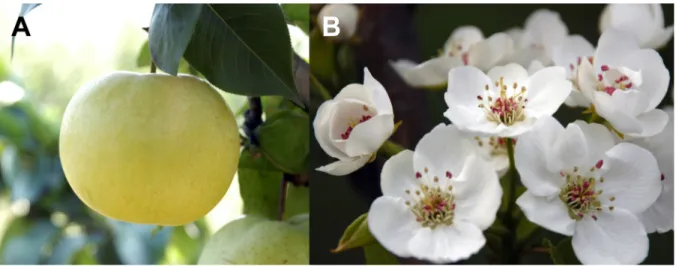
‘슈퍼골드’의 강한 수세와 반개장성 수자는 화분친인 ‘만 풍배’와 유사한 특성을 보였다(Table 1). 포장에서 달관조사 한 결과 검은무늬병에 대해서는 저항성을 보였다. 발아기는 3월 29일 경이며, 단과지 형성이 잘되고, 단과지 유지성도 좋아 결과지 확보가 용이한 편이다. 개화 직전의 꽃잎은 백 색이고, 꽃의 크기는 보통이며, 꽃잎 수가 6.9개로 다소 많은 편이다. 만개기는 4월 20일로 화분친인 ‘만풍배’와 비슷하 며, 종자친으로 개화기가 빠른 ‘추황배’에 비하여 3일정도 늦은 편이다. 약색은 진분홍이며, 약수는 26.0개이고, 꽃가루 가 풍부하여 수분수로 활용이 가능하다. 암술 수는 5.0개로 전형적인 재배종의 형태를 보이고 있다(Table 2 and Fig. 2).
잎의 형태는 타원형이며, 선단은 예두형, 기부는 예저형 으로 종자친인 ‘추황배’와 유사한 특성을 보이고 있다(Table 3). 숙기는 9월 11일 전후로 양친의 평균 숙기 보다 약 1개 월 이상 빨랐다(Table 4). 수확기의 과피색은 양친이 모두 갈색배 계통인데 반하여 전혀 다른 녹색배 계통으로 광 투 과도가 비교적 높은 백색봉지를 씌워서 재배할 경우 녹백색
Fig. 2. Fruit (A) bagging with white paper bag at harvest and flower cluster (B) of ‘Supergold’ pear.
Table 3. Leaf characteristics of ‘Supergold’ in Naju from 2006 to 2008.
Cultivar Shape Apex Base Margin
Supergold Elliptical Acute Acute Dentate
Chuwhangbae Elliptical Acute Acute Dentate
Manpungbae Narrow elliptical Acute Rounded Dentate
Table 4. Fruit characteristics of ‘Supergold’ in Naju from 2006 to 2008.
Cultivar Maturity Fruit Soluble solids
content (°Bx) Juiciness Grittiness
Weight (g) Shape
Supergold Sept. 11 569 ± 58.4z Oblate 13.6 ± 0.9 Juicy Negligible
Chuwhangbae Oct. 20 461 ± 85.7 Round 13.4 ± 0.6 Juicy A little
Manpungbae Sept. 25 768 ± 95.2 Oblate 13.1 ± 0.5 Very Juicy Negligible
Cultivar Skin Flesh Cold storage
life (month) Quality
Color Blackening Texture Color Mealiness
Supergold Greenish white None Soft White None 6 Very good
Chuwhangbae Yellowish brown A little Soft White None 8 Good
Manpungbae Greenish brown None Very soft White None 6 Very good
zMean ± SE (n = 10).
을 나타냈으며(Fig. 2), 성숙이 진행되면서 녹황색에서 황색 으로 착색이 진행되었다. 과피가 황색으로 변한 과실은 과 숙 상태가 되기 때문에 과육선숙형 품종으로 판단된다. 과 형은 편원형으로 육질이 유연하고 과즙이 풍부하며, 석세포 가 적은 특성은 화분친인 ‘만풍배’와 유사하였지만 종자친 인 ‘추황배’의 신맛이 남아 있어 ‘만풍배’에 비하여 더 진한 식미를 느낄 수 있다. 평균 과중은 569g으로 중과종이며, 당 도는 13.6°Brix로 비교적 높은 편이다.
자가불화합 유전자형
‘슈퍼골드’의 자가불화합 유전자형을 구명하기 위해 2009
년 개화기에 양친인 ‘추황배’와 ‘만풍배’를 포함하여 자가불 화합 유전자형이 알려져 있는 8개 품종을 화분친으로 하여 종자친인 ‘슈퍼골드’에 교배하였다. 착과율은 교배 후 30일 에 나무에 착과된 과실을 조사하여 산출하였다. 교배에 사 용한 꽃가루의 발아율은 ‘조옥’과 ‘이십세기’에서 각각 47.2%
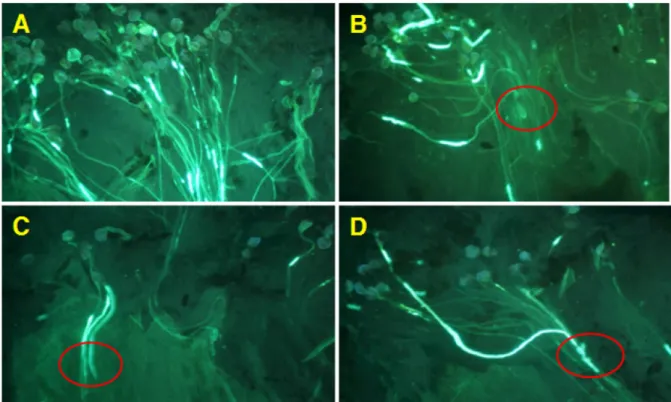
와 49.0%로 다소 낮은 경향을 보였다(Table 5). 교배결과 착 과율은 28.8%로 가장 낮은 ‘이십세기’를 제외한 대부분의 교배조합에서 64.3%(만삼길)에서 91.0%(조옥)로 높은 착과 율을 나타내어 교배친화성이 있는 것으로 판단되었다. 암술 대에서의 화분관 신장양상도 대부분의 조합에서 정상적인 모습을 보였다. ‘조옥’, ‘장십랑’, ‘이십세기’ 조합에서는 일
Table 5. Pollen germination and fruit set in ‘Supergold’ pear cultivar after cross-pollination with some pollen parents.
Seed parent Pollen parent Genotype of
self-incompatibility % of pollen germination % of fruit set
Supergold Chuwhangbae S4S6 63.6 ± 4.2z 79.1 ± 9.1
Manpungbae S3S? 80.4 ± 2.2 83.3 ± 3.3
Hayatama S1S2 81.5 ± 3.0 91.0 ± 2.4
Yakumo S1S4 47.2 ± 3.1 75.9 ± 2.7
Chojuro S2S3 60.7 ± 4.1 72.1 ± 3.2
Nijisseiki S2S4 49.0 ± 0.4 28.8 ± 7.2
Manwhang S5S6 81.7 ± 2.3 77.9 ± 1.8
Okusankichi S5S7 65.8 ± 4.5 64.3 ± 5.6
zMean ± SE (n = 3)
Fig. 3. Pollen tube growth in the squashed styles of ‘Supergold’ pear cultivar Cross-pollinated with ‘Okusankichi’ (A), ‘Chojuro’ (B), ‘Tama’
(C), and ‘Nijisseiki (D). The circle shows abnormal pollen tube tip which is stoped to growth
부 화분관 선단이 비대하면서 신장을 멈춘 것을 확인할 수 있었으며(Fig. 3), 이러한 현상은 자가불화합 유전자형이 일 치한 화분관의 신장이 억제될 때 나타나는 것으로 알려져 있다(Hiratsuka et al., 1991). 자가불화합 유전자를 확인하기 위해 유엽에서 genomic DNA를 plant DNA prep kits (Quiagen)를 이용하여 추출하고 PCR-RFLP(Takasaki et al., 2004)를 수행하여 agarose gel 상에 나타난 밴드를 확인하였 다. ‘슈퍼골드’와 ‘황금배’의 S-allele을 분석한 결과 S3와 S4
에 특이적인 제한효소 Nde 1과 PpuM 1에서 각각 절단되어 자가불화합 유전자형은 S3S4로 판단되었다(Fig. 4).
지역적응성
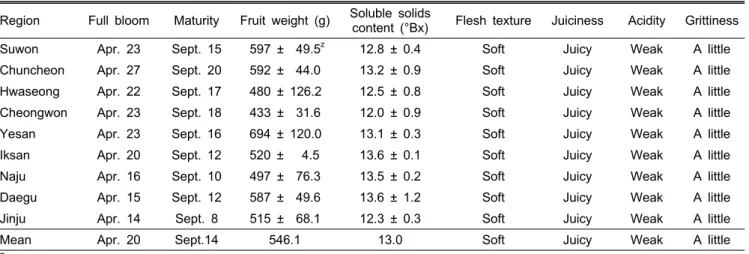
지역적응성을 검토한 결과(Table 6), 만개기는 4월 14일 (진주)에서 4월 27일(춘천)까지로 위도에 따라 다르게 나타 났다. 숙기는 9월 8일(진주)에서 9월 20일(춘천) 사이로 지 역간에 12일의 차이를 보였으며, 개화기와 마찬가지로 시험 지역의 남북 배치와 일치하는 경향을 보였다. 지역적응 시 험지의 평균 과중은 546g으로 나타났으며, 청원에서 433g 으로 가장 작았고, 예산에서 694g으로 가장 크게 나타났다.
당도는 예산과 진주에서 비교적 낮게 나타났으며 그 외 지 역에서는 13°Brix 전후로 높은 당도를 보였다. 과육의 물리 적 특성에 있어서는 지역간 차이를 보이지 않았으며, 대부
Fig. 4. Analysis of the PCR fragment digests with restriction enzyme. In each gel, the lanes from left to right showed the commercial molecular markers, indicating S3 and S4, digestion products with AlwN 1, Nde 1, PpuM1, HinC II, and BstB1, respectively. The fragments were electrophoresed on 2% agarose gel.
Table 6. Characteristics of ‘Supergold’ in various regions (Regional adaptability tests, from 2006 to 2008) Region Full bloom Maturity Fruit weight (g) Soluble solids
content (°Bx) Flesh texture Juiciness Acidity Grittiness
Suwon Apr. 23 Sept. 15 597 ± 49.5z 12.8 ± 0.4 Soft Juicy Weak A little
Chuncheon Apr. 27 Sept. 20 592 ± 44.0 13.2 ± 0.9 Soft Juicy Weak A little
Hwaseong Apr. 22 Sept. 17 480 ± 126.2 12.5 ± 0.8 Soft Juicy Weak A little
Cheongwon Apr. 23 Sept. 18 433 ± 31.6 12.0 ± 0.9 Soft Juicy Weak A little
Yesan Apr. 23 Sept. 16 694 ± 120.0 13.1 ± 0.3 Soft Juicy Weak A little
Iksan Apr. 20 Sept. 12 520 ± 4.5 13.6 ± 0.1 Soft Juicy Weak A little
Naju Apr. 16 Sept. 10 497 ± 76.3 13.5 ± 0.2 Soft Juicy Weak A little
Daegu Apr. 15 Sept. 12 587 ± 49.6 13.6 ± 1.2 Soft Juicy Weak A little
Jinju Apr. 14 Sept. 8 515 ± 68.1 12.3 ± 0.3 Soft Juicy Weak A little
Mean Apr. 20 Sept.14 546.1 13.0 Soft Juicy Weak A little
ZMean ± SE (n = 10).
분의 지역에서 품질이 우수한 것으로 평가되었다.
재배상 유의점
수세가 강하고, 신초 발생이 많기 때문에 솎음전정과 유 인을 철저히 하여야 한다. 단과지 형성 및 유지성이 좋아 지 나치게 오래된 꽃눈은 충실도가 저하되어 과실의 균일도가 떨어질 수 있으므로 꽃눈전정을 적극적으로 실시하여 균일 한 꽃눈을 확보할 수 있도록 수체관리에 유의한다. 꽃가루 가 많아 수분수 및 꽃가루 채취용 품종으로 이용할 수 있지 만 자가불화합 유전자형이 동일한 ‘황금배’, ‘진황’, ‘녹수’,
‘조생황금’, ‘한아름’ 등의 품종에는 활용할 수 없다. 과피에 동녹이 발생할 수 있으므로 ‘황금배’ 전용봉지를 일찍 씌워 이를 방지해야 한다. 검은무늬병에는 저항성이지만 검은별 무늬병에는 다소 약하므로 방제를 철저히 해야 한다.
유용성
2009년 1월 4일에 본 품종에 대한 품종보호권을 출원(품 종보호출원번호: 출원2009-0012, 품종명칭출원번호: 명칭 2009-0014)하였고, 2009년부터 2010년까지 재배심사를 실 시하여 종자산업법 제 55조에 의해 2011년 7월 5일에 ‘슈퍼 골드’로 최종 등록(품종보호: 제3576호)되었다.
초 록
‘슈퍼골드’ 품종은 농촌진흥청 국립원예특작과학원 배시 험장에서 1994년에 ‘추황배’의 품질을 개선하기 위하여 ‘추 황배’에 ‘만풍배’를 교배하였다. 2002년에 1차 선발하고 2008년에 최종선발하였다. 화분친인 ‘만풍배’와 같이 수세 는 강하고, 수자는 반개장성이다. 꽃이 풍부하고, 꽃가루도 많아 수분수로 이용할 수 있다. ‘슈퍼골드’는 검은무늬병
(Alternaria kikuchiana)에 포장 저항성을 나타내었다. 수확 기는 9월 11일 전후로 황금배보다 5일 빨리 수확할 수 있다.
과형은 편원형이며 과피색은 수확기에 녹백색이다. 평균과 중 570g이고, 당도는 13.6°Brix이다. 육질은 부드럽고 과즙 이 풍부하여 식미가 우수하다. 저온 보구력은 6개월 정도이 다. 자가불화합 유전자형을 확인하기 위해 유전자형이 알려 진 품종의 꽃가루로 교배를 한 결과 28.8%로 낮은 착과율을 보인 이십세기 조합을 제외한 모든 조합에서 64.5%에서 91.0%로 비교적 높은 착과를 보였다. ‘조옥’, ‘장십랑’, ‘이 십세기’와의 교배에서 화분관 선단이 이상비대하는 현상을 보였지만 교배에 이용한 모든 화분친 품종과 교배화합성을 보였다. PCR-RFLP 결과 ‘슈퍼골드’의 자가불화합 유전자 형은 S3S4로 확인되었다.
추가 주요어 : 교배육종, 병해저항성, 과수육종, Pyrus pyrifolia, 자가불화합성
인용문헌
Cho, K.S., S.S. Kang, H.M. Cho, G.C. Koh, K.H. Hong, D.S.
Son, W.C. Kim, and K.Y. Kim. 2003. Breeding of a very soft, juicy, large size, and high quality mid-season pear cultivar
‘Manpungbae’. Kor. J. Hort. Sci. Technol. 21:25-28.
Hiratuska, S., Y. Kitoh, and J. Matsushima. 1991. Induction of deformed pollen tube tips and their morphological characteristics
in self-incompatible Japanese pear. J. Japan Soc. Hort. Sci.
60:257-265.
Hwang, H.S., W.C. Kim, I.S. Shin, H.M. Cho, Y.U. Shin, D.K.
Lee, and S.S. Hong. 2005. Breeding of a new yellow green pear cultivar ‘Josengwhangkeum’ (Pyrus pyrifolia Nakai) with high quality for summer season. Kor. J. Hort. Sci. Technol.
23:56-59.
Kang, S.S., K.S. Cho, J.H. Song, Y.K. Kim, S.B. Jeong, D.S.
Son, H.M. Cho, K.H. Hong, M.S. Kim, I.S. Shin, Y.U. Shin, W.C. Kim, and G.C. Koh. 2008. ‘Noksu’, a new late summer season pear cultivar with high fruit quality and green skin.
Kor. J. Hort. Sci. Technol. 26(Suppl. II):31-35.
Kim, Y.S., K.H. Hong, J.B. Kim, M.S. Yiem, U.J. Lee, W.C.
Kim, J.H. Kim, S.B. Hong, S.B. Kim, J.Y. Moon, K.Y. Kim, M.D. Cho, and D.K. Lee. 1986. A new late-season pear cultivar, ‘Chuwhangbae’. Res. Rpt. RDA (Hort.) 28:57-61.
Kim, Y.S., W.C. Kim, K.H. Hong, J.B. Kim, U.J. Kim, S.B. Hong, J.H. Kim, Y.K. Kim, J.Y. Moon, K.Y. Kim, M.D. Cho, D.K.
Lee, and D.M. Park. 1985. A new mid-season pear cultivar,
‘Whangkeumbae’ with high soluble solids content and beautiful appearance. Res. Rpt. RDA (Hort.) 27:103-106.
Rural Development Administration (RDA). 1995. Manual for agricultural investigation. RDA, Suwon.
Rural Development Administration (RDA). 2003. Manual for agricultural investigation. RDA, Suwon.
Takasaki, T., K. Okada, C. Castillo, Y. Moriya, T. Saito, Y.
Sawamura, N. Norioka, S. Norioka, and T. Nakanishi. 2004.
Sequence of the S9-RNase cDNA and PCR-RFLP system for discriminating S1- to S9-allele in Japanese pear. Euphytica.
135:157-167.