Effects of Hibiscus syriacus Extracts on Antioxidant Activities and Blood Circulation Improvement
Yu-Bin Shin and Bae-Jin Ha*
Department of Pharmaceutical Engineering and College of Medical Life Science, Silla University, 1-1 San, Gwaebup-dong, Sasang-gu, Busan 617-736, Korea
Received Octobeer 7, 2016 /Revised December 8, 2016 /Accepted December 13, 2016
This study was worked to investigate the antioxidant activity and the blood circulation improvement effect of two Hibiscus syriacus extracts divided into fermented H. syriacus extract and non-fermented H. syriacus extract. As the results of in vitro experiment, both of fermented H. syriacus extract and non-fermented H. syriacus extract had the DPPH free radical scavenging effect and the high contents of polyphenol and flavonoid known as antioxidant components in dose-dependent manner. Six weeks female C57BL/6 mice were divide into four groups and fed high diets for 28 days. Also fermented H. syriacus extract and non-fermented H. syriacus extract was daily intraperitoneal administration for 28 days at 2 mg/kg of body weight of mice. In vivo C57BL/6 mice experiment of normal diet group (NOR), high-fat diet group (CON), high-fat diet plus fermented H. syriacus extract group (FHS) and high-fat diet plus non-fermented H. syriacus extract group (NFHS), each of total cholesterol, trigly- ceride and low density lipoprotein (LDL) was decreased in both of FHS and NFHS groups, meanwhile high density lipoprotein (HDL) was increased (p<0.01). Conclusion, the results confirmed that H. syria- cus containing the high contents of the antioxidant activity components had the significant effects of blood circulation improvement.
Key words : Antioxidant activity, blood circulation improvement, C57BL/6 mice, fermentation, Hibiscus syriacus
*Corresponding author
Tel : +82-999-5337, Fax : +82-999-5684 E-mail : [email protected]
This is an Open-Access article distributed under the terms of the Creative Commons Attribution Non-Commercial License (http://creativecommons.org/licenses/by-nc/3.0) which permits unrestricted non-commercial use, distribution, and reproduction in any medium, provided the original work is properly cited.
Journal of Life Science 2016 Vol. 26. No. 12. 1415~1421 DOI : http://dx.doi.org/10.5352/JLS.2016.26.12.1415
서 론
최근 우리나라는 운동 부족, 불규칙한 식습관 및 식생활의 서구화 등에 따른 생활양식의 변화로 인한 고혈압, 당뇨와 인 간의 수명이 연장되면서 노화 및 혈행과 관련된 심혈 질환 등 생활 습관병(lifestyle related disease)이 급증하고 있는 추 세이다[8, 9]. 2011년 한국인의 주요 사망원인의 통계를 보게 되면 암에 이어서 수위를 차지하는 뇌혈관질환, 심장질환, 당 뇨병의 심혈관계 질환에 의한 사망률이 23.8% 이상이며 심혈 관계 질환을 유발하는 원인은 식습관, 생활방식, 유전적인 요 인 등 여러 가지가 보고되어 있다[11, 15]. 또한 체내에서 다른 물질과 반응하여 연쇄적으로 산화 작용을 일으켜 체내 신진대 사를 방해하고, 세포에 손상을 입혀 노화 및 심혈관계질환, 뇌혈관계질환과 암 등과 같은 여러 가지 만성 질병의 원인이 되며 생체 내 과잉의 free radical 축적, 내피세포의 lipoxygenase 및 과산화지질을 축적함으로 생체 기능이 저하되어 심혈관계
질환 및 노화를 초래하게 된다. 심혈관질환 환자의 혈소판 내 에서 산소 유리 라디칼(free radical) 생성과 지질과산화의 증 가 및 항산화 영양소 상태 저하로 인한 혈소판 응집능 증가는 동맥경화의 진행을 촉진 시켜 동맥질환의 위험도를 증가시킬 수 있는 가능성으로 제시되고 있다[7, 15]. Macrophage에서 생성된 free radical, 내피세포의 lipoxygenase 및 과산화지질 에 의하여 쉽게 지질 과산화 반응을 일으켜 동맥벽에 과산화 지질을 증가시키는 기전에 free radical이 작용하므로 이에 방 어 효과를 나타내는 것으로 알려진 항산화 영양소들이 동맥경 화증 예방에 효과가 있다고 보고되고 있다[14].
무궁화(Hibiscus syriacus)는 아욱과(Malvaceae) 무궁화 속 에 속하는 낙엽활엽관목으로써, 한국, 인도, 시베리아 등지에 널리 분포하고, 무궁화는 현재 세계적으로 약 200여종이 있는 것으로 알려져 있으며 우리나라에는 약 150여종이 육성되고 있다[6]. 우리나라의 무궁화는 목본성으로 내한성이 강한 것이 특징이고 형태적으로 꽃이 홑꽃으로서 잎은 난형으로 밑은 쐐기 모양이고 간혹 3갈래로 갈라지며 가장자리에 거친 톱니 가 있으며 중심부는 붉은색을 띄고, 꽃잎의 끝부분은 엷은 분 홍색이나 흰색을 띈다[1, 19]. 무궁화의 약용학적 이용에 관하 여 ‘동의보감’에는 줄기와 꽃을 다려서 마시거나 차로 이용하 면 장풍과 사혈 등에 효과가 있는 것으로 기록되어 있고 줄기 의 껍질은 피부, 이뇨에 효과가 있으며, 종자는 두통약, 뿌리는 위장에 효험이 있는 것으로 알려져 있다[18]. 또 무궁화의 근피
성분에는 몇몇 항균활성 물질이 존재하는 것으로 밝혀졌으나 이들의 정확한 성분분석에 관한 연구는 미비하며 그 외에도 무궁화의 잎 및 꽃눈으로부터의 다당체에 관한 연구가 수행된 바 있다. 무궁화에 관련된 연구는 대부분 수피와 근피에 관한 연구이며, 목근피의 성분 및 생리활성, 무궁화 꽃 추출물의 생리활성에 관련된 연구가 보고 되고 있으며[15, 17], 현재 무 궁화 성분을 활용한 혈행 개선 가능성에 대한 연구는 알려진 바가 없다. 한편 발효법은 역사상 가장 오래된 기술로써 식품, 약품과 화장품 등에서 다양한 분야로 활용되고 있으며, 미생 물을 이용해 독성물질을 제거하고 생리활성물질의 생산을 증 가시키는 다양한 효과를 가지는 것으로 보고되고 있다. 유산 균은 병원성 세균의 생육억제, 콜레스테롤 저하작용, 항암작 용 등 다양한 질병을 예방하고 치료 할 수 있다고 알려져 있다 [10, 16]. 따라서 본 연구는 유산균인 락토바실러스람노수스 (Lactobacillus rhamnosus)와 스트렙토코커스써모필러스(Strep- tococcusthermophilus)를 이용함으로써 무궁화 성분의 분해 와 용출을 쉽게 하기 위해 1차 발효와 2차 발효하였다. 이에 비만 유도 생쥐에서 발효 무궁화의 항산화 활성과 혈행 개선 효과를 연구하였다.
재료 및 방법
실험재료
발효 무궁화 원료와 비발효 무궁화 원료는 ㈜헤어그린(부 산시 북구 만덕1로, 대한민국)에서 받았으며 채취한 꽃, 잎, 줄기, 나무껍질, 뿌리를 포함한 것으로 이들은 제각기 분리하 고 정선하여 준비하였다. 이 무궁화 원료는 주로 줄기를 사용 하였으며, 수거 시기는 이른 봄 3~4월에 채취하여 원료 수거 장소는 자체 묘목 시험장, 관공서에서 채취하였다. 추출을 용 이하기 위해서 일차적으로 살균하여 자연 상태에서 말리거나 열풍을 이용하여 건조하였다. 열풍 온도는 30~40℃로 하여, 비발효 무궁화 원료는 정제수와 무궁화 원료를 70:30으로 혼 합하여 구연산을 첨가하여 pH를 6.0~7.0 pH로 조절하였다.
정제수를 혼합한 원료들은 15~20℃에서 2일간 그대로 두어 원료들이 습윤 되게 하였다. 습윤된 비발효 무궁화 원료를 진 공저압 방식으로 4시간 동안 1차 가열한 후 2일간 실온에서 1차 숙성시킨 뒤 동일한 조건으로 2차 가열 및 2차 숙성시켰 다. 발효 무궁화는 비발효 무궁화 방법과 같이 2차 숙성 시킨 뒤 락토바실러스람노수스(Lactobacillus rhamnosus)를 접종 하여 24시간 20℃에서 1차 발효시켰다. 습윤된 원료를 60 RPM 으로 원심분리시켜 유효성분을 추출한 뒤 4시간 동안 진공저 압 방식으로 4시간 동안 90℃로 가열시켰다. 가열 시킨 발효 무궁화 원료를 스트렙토코커스써모필러스(Streptococcusth ermophilus)를 접종 한 후 진공상태에서 45℃로 24시간 동안 2차 발효시켰다.
생리활성 평가
발효된 무궁화와 비발효 무궁화의 생리활성을 평가하기 위 해서 DPPH 라디칼 소거활성, 총 polyphenol 함량, 총 fla- vonoid 함량 실험을 진행하였다.
DPPH radical 소거활성 측정
DPPH radical 소거활성(DPPH radical scavenging activ- ity)은 Bios [2]의 방법을 변형하여 DPPH (1,1-diphenyl-2-hy- drazyl) radical에 대한 소거능을 측정하였다. 즉 발효 무궁화 와 비발효 무궁화 추출물을 농도별로 멸균된 증류수에 희석하 여 시료 용액 50 ul에 0.15 mM DPPH 용액 및 에탄올 150 μL을 혼합하여 총액의 부피가 200 ul가 되도록 하였다. 반응액 을 실온(25℃)에서 30분간 암실에서 반응시킨 후 517 nm에서 흡광도를 측정하였다. 계산식은 아래와 같은 식으로 DPPH radical 소거율을 계산하였고 양성 대조군은 3,5-di-tert-4-bu- tylhydroxy-toluene (BHT, Sigma, USA)를 사용하였다.
DPPH radical scavenging activity (%)={1-(S-SB)/
(C-CB)} ×100 S : Absorbance of sample SB : Absorbance of sample blank C : Absorbance of ethanol CB : Absorbance of ethanol blank Total polyphenol 함량 측정
총 폴리페놀 함량은 Folin-Denis법[4]을 응용하여 멸균된 증류수에 농도별로 희석한 후 시료 용액 500 μl와 1 N Folin-ciocalteu's phenol reagent (Sigma, USA) 500 ul를 혼합 하여 실온(25℃)에서 3분간 방치하였다. 3분 후 10% sodium carbonate (10% Na2CO3) 500 ul를 첨가하여 실온에서 1시간 동안 암실에서 반응시킨 후 725 nm에서 흡광도를 측정하였다.
이때 표준검량곡선은 Gallic acid (Sigma, USA)를 이용하여 최종 농도가 0, 12.5, 25, 50, 100, 200 ug/ml이 되도록 작성하여 함량을 구하였다.
Total flavonoid 함량 측정
총 플라보노이드 함량은 Davis법[3]을 변형하여 측정하였 다. 멸균된 증류수에 농도별로 희석한 후 시료 용액 100 ul에 diethylene glycol 1 ml과 1 N NaOH 10 uL를 혼합하여 37℃
항온 수조에서 1시간 동안 반응시킨 후 420 nm에서 흡광도를 측정하였다. 이때 표준검량곡선은 naringin (Sigma, USA)를 이용하여 최종 농도가 0, 12.5, 25, 50, 100, 20 ug/ml이 되도록 작성하여 함량을 구하였다.
실험동물 사육
실험에 사용된 동물은 6주령의 수컷 C57BL/6 생쥐는 ㈜샘 타코코리아로부터(경기도 오산시, 대한민국) 20 마리를 구입 하였고, 실험이 시작되기 전에 1 주일 동안 주변 환경에 적응 시켰으며 실험동물은 매일 24시간 동안 온도 20~24℃, 습도는
Table 1. Experimental design of mice Experimental
group
Day 8-28 Day 8-28
Food intake Dose of sample
NOR (5) CON (5) FHS (5) NFHS (5)
20 g/day of Normal diet intake 20 g/day of High-fat diet intake 20 g/day of High-fat diet intake 20 g/day of High-fat diet intake
2 mg/kg of water- intraperitoneal administration 2 mg/kg of water-intraperitoneal administration 2 mg/kg of FHS- intraperitoneal administration 2 mg/kg of NFHS- intraperitoneal administration NOR : Normal control group
CON : High fat diet treated group
FHS : Fermented Hibiscus syriacus extracts and high fat dietary group NFHS : Non fermented Hibiscus syriacus extracts and high fat dietary group
Table 2. Formulation of high-fat diet
Product mg % kcal %
Protein Carbohydrate
Fat Total kcal/gm
26.2 26.3 34.9
55.24
20 20 60
100
Ingredient mg kcal
Caseun, 80 Mesh L-Cystine Corn Starch Maltodextrin 10
Sucrose Cellulose, BW200
Soybean Oil Lard
Mineral Mix S10026 10 0 DjCalcium Phosphate
Calcium Carbonate Potassium Citrate, 1 H2O
Vitamin Mix V10001 Choline Bitartrate
200 3 0 125 68.8 50 25 245
10 13 5.5 16.5
10 2
800 12
0 500 275.2
0 225 2205
0 0 0 0 40
0
Total 773.85 4057
Formulated by E.A, Ulman, Ph.D. Research Diet, Inc.
Typical analysis of cholesterol in lard = 0.95 mg/g Cholesterol (mg)/4057 = 232.8
Cholesterol (mg)/kg = 300.8 55~60%가 유지되도록 하였고 실험동물은 난괴법(randomized
complet block design)에 의해 각 4 군으로 5 마리로 분배하여 실험하였다(신라대학교 동물윤리위원회에서 인증받음.
SUACAC-2015-010).
각각 그룹은 정상군(NOR : 일반식이+물 복강투여), 대조군 (CON : 지방식이+물 복강투여), 발효 무궁화 추출물 섭취군 (FHS : High fat diet+발효 무궁화 추출물 원료의 2% 복강투 여), 비발효 무궁화 추출물 섭취군(NFHS : 60 % High fat diet+
비발효 무궁화 원료의 2% 복강투여) 으로 표기하여 4주간 실 험하였다(Table 1).
고지방 식이 투여
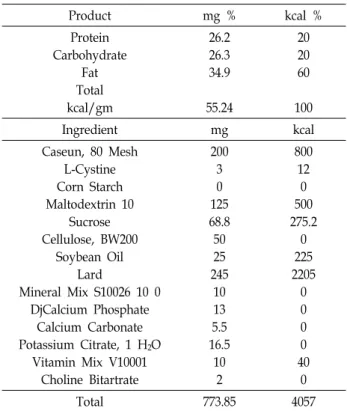
(주)샘타코 (경기도 오산시, 대한민국)에서 고지방 식이를 구입 하였으며 식이의 조성은 Table 2와 같다.
실험동물의 혈액 채취
총 4주간의 사육시간이 종료한 후, 희생시키기 전 18시간 동안 절식시키고 CO2로 마취시켜 개복하여 하대정맥에서 혈 액을 채취하였다.
실험동물의 Total Cholesterol, Triglycerides 함량 분석 Total cholesterol(TC)양은 검체, 표준시약, blank에 각각 시 료 0.02 ml씩 취한 다음 효소 시액 3.0 ml씩을 첨가하여 잘 혼합한 뒤 37℃에서 5분간 방치한 다음 blank를 대조로 하여 60분 이내에 파장 500nm에서 흡광도를 측정하였다.
Triglycerides (TG)양은 Trinder법에 의해 조제된 kittldir을 사용하여 측정하였다. 검체, 맹검, 표준시약에 각각의 피검재 료 혈청, 물, 기준액을 각각 0.02 ml 씩 넣은 후 효소 시약 3.0 ml을 넣고 혼합한 후 37℃ 수조에서 10분간 작용시킨 후 1시간 이내에 맹검을 대조로 하여 검체 및 표준의 흡광도를 측정하 여 계산하였다.
실험동물의 혈중 high density lipoprotein cholesterol, low density lipoprotein cholesterol 함량 분석
High density lipoprotein양은 검체, 맹검, 표준액에 각각
피검재료 혈청, 물, 기준액을 0.02 ml씩 넣은 후 효소 용액을 3.0 ml을 넣은 뒤 혼합한 후 37℃ 수조에서 15분간 반응시킨 후 1시간 이내에 맹검을 대조로 하여 검체 및 표준의 흡광도를 측정하여 계산하였다.
LDL-콜레스테롤은 Friedewald 식에 의하여 계산하였다[5].
{Total cholesterol-(HDL+ )}
통계적 분석
본 실험에 대한 모든 결과는 평균치±표준편차(SD)로 나타 내었으며, 통계적 유의성은 SPSS 12.0 (SPSS Inc, Chicago, IL,
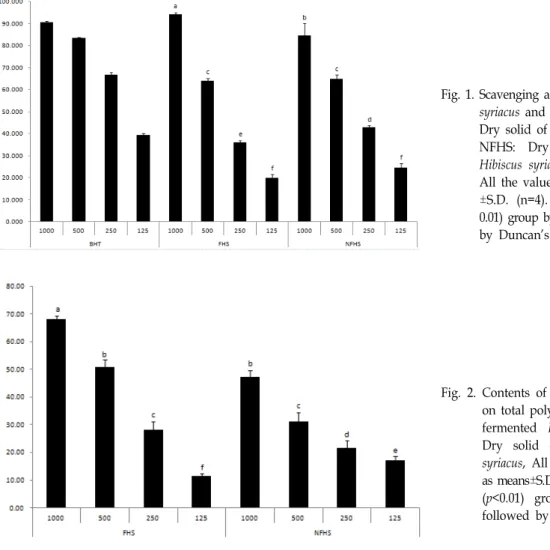
Fig. 1. Scavenging activity of fermented Hibiscus syriacus and BHT on free radical. FHS : Dry solid of fermented Hibiscus syriacus, NFHS: Dry solid of non-fermented Hibiscus syriacus, BHT: positive control, All the values were expressed as means
±S.D. (n=4). a,b,c,d,e are different (p<
0.01) group by one-way ANOVA followed by Duncan’s post hoc test.
Fig. 2. Contents of fermented Hibiscus syriacus on total polyphenol. FHS : Dry solid of fermented Hibiscus syriacus, NFHS : Dry solid of non-fermented Hibiscus syriacus, All the values were expressed as means±S.D. (n=4). a,b,c,d,e are different (p<0.01) group by one-way ANOVA followed by Duncan’s post hoc test.
USA)를 이용한 one-way ANOVA로 검정하였으며, 사후 검정 을 위해 Duncan’s post hoc test를 실시하였고 유의성은 p<
0.01 수준에서 검증하였다.
결과 및 고찰 DPPH radical 소거 활성
발효 무궁화 추출물의 DPPH radical 소거효과 결과는 Fig.
1과 같다. 발효 무궁화 추출물의 DPPH radical 소거 활성 효과 는 농도별로 각각 94.34±0.74%, 64.13±1.06%, 36.13±0.82%, 20.01±1.60%이며, 비발효 무궁화 추출물은 농도별로 각각 84.68±5.56%, 64.92±1.87%, 42.85±0.89%, 24.52±1.97%로, 발효 무궁화 추출물이 비발효 무궁화 추출물 보다 DPPH radical 소거효과가 높았으며, 농도 의존적으로 감소하였다. 오[13] 등 의 연구에 따르면 등나무 꽃 물 추출물은 가장 높은 1,000 ug/
ml 농도에서 보라색 꽃과 흰색 꽃은 각각 58.21%, 74.52%로, 본 연구에서 사용된 발효 무궁화 추출물과 비발효 무궁화 추 출물 모두 등나무 꽃 보다 높은 전자공여능을 나타냈다. 따라 서 본 연구에서는 발효한 무궁화 추출물이 비발효 무궁화 추 출물보다 높은 활성을 나타내어 발효에 따른 항산화 활성이
높아지는 것을 확인하였다.
Total polyphenol 및 Total flavonoid 함량
발효 무궁화 추출물의 총 폴리페놀 함량을 측정하는 결과는 Fig. 2, 3와 같다. 발효 무궁화 추출물의 총 폴리페놀 함량은 농도별로 각각 68.22±1.07 ug/ml, 50.90±2.73 ug/ml, 28.24±
2.97 ug/ml, 11.49±0.15 ug/ml이며, 비발효 무궁화 추출물의 총 폴리페놀 함량은 농도별로 각각 47.38±0.37 ug/ml, 31.34±
3.04 ug/ml, 21.80±2.61 ug/ml, 17.14±1.49 ug/ml로 발효 무궁 화 추출물이 비발효 무궁화 추출물보다 폴리페놀의 함량이 더 높았으며, 농도가 높을수록 폴리페놀 함량이 높았다.
발효 무궁화 추출물의 총 플라보노이드 함량은 농도별로 각각 71.11±1.80 ug/ml, 59.81±2.81 ug/ml, 35.76±1.30 ug/
ml, 24.54±2.00 ug/ml이며, 비발효 무궁화 추출물의 총 플라보 노이드 함량은 농도별로 각각 57.06±1.58 μg/ml, 39.42±1.66 ug/ml, 22.83±2.59 ug/ml, 12.35±1.69 ug/ml로 발효 무궁화 추출물이 비발효 무궁화 추출물보다 총 플라보노이드 함량이 더 높았으며, 농도가 높을수록 플라보노이드 함량이 높았다.
이[12]등의 연구에 따르면 흰 무궁화의 총 폴리페놀 함량은 잎(3.19%), 줄기(2.20%), 꽃(2.18%) 순으로 나타났으며 총 플라
Fig. 3. Contents of fermented Hibiscus syriacus on total flavonoid. FHS : Dry solid of fermented Hibiscus syriacus, NFHS : Dry solid of non-fermented Hibiscus syriacus, All the values were expressed as means ± S.D. (n=4). a,b,c,d,e are different (p<0.01) group by one-way ANOVA followed by Duncan’s post hoc test.
Fig. 4. Effect of fermented Hibiscus syriacus on TC levels in serum. NOR: Normal control group, CON:
High fat diet treated group, FHS: Dry solid of fer- mented Hibiscus syriacus and high fat dietary group (2%), 0.1g/kg of fermented Hibiscus syria- cus, NFHS: Dry solid of non-fermented Hibiscus syriacus and high fat dietary group (2%), 0.1g/kg of non-fermented Hibiscus syriacus, All the values were expressed as means ± S.D. (n=5). a,b,c are different (p<0.01) group by one-way ANOVA fol- lowed by Duncan’s post hoc test.
보노이드 함량은 잎(1.88%), 꽃(1.40%), 줄기(0.36%) 순으로 나 타났다고 알려져 있다. Yoo 등[9]은 무궁화 품종의 성분 중 플라보노이드를 13종 함유하고 있어 항산화 활성이 높을 것으 로 예상하였다.
혈중 TC 함량
TC는 혈장에 포함된 콜레스테롤의 총량으로 약 1/3이 유리 콜레스테롤에 존재하고 나머지는 콜레스테롤 에스테르로서 존재한다. 혈액에서의 TC 수치 측정을 Fig. 4에 나타내었다.
혈액 내의 TC는 정상군이 76.67±3.11 mg/dl, 대조군이 98.33±
4.71 mg/dl, 발효 무궁화 추출물을 섭취군은 79.00±2.99 mg/
dl, 비발효 무궁화 추출물 섭취군은 84.50±2.38 mg/dl로, 발효 무궁화 추출물을 섭취군이 대조군에 비해 낮은 수치를 나타냈 으며, 발효 무궁화 추출물 섭취군은 대조군보다 89.24% 감소 하였다. 발효 무궁화 추출물 섭취군이 비발효 무궁화 추출물 섭취군보다 낮은 수치를 나타내고 있지만 유의한 차이는 나지 않았다. 따라서 본 연구에서는 발효 무궁화 추출물은 혈행 흐 름 개선 및 혈중 중성 지질을 개선시키는데 도움을 주는 것으 로 사료된다.
혈중 TG 함량
중성지방으로 알려진 TG는 생체 내에서 에너지 저장 형태
로 존재하며, 현대 혈액순환 문제의 원인이 되는 물질로 인식 되고 있다. 혈액에서의 TG 수치 측정을 Fig. 5에 나타내었다.
혈액 내의 TG는 정상군이 44.50±1.91 mg/dl, 대조군이 61.00±
3.46 mg/dl, 발효 무궁화 추출물 섭취군이 48.33±2.08 mg/dl, 비발효 무궁화 추출물 섭취군이 49.50±0.58 mg/dl로 발효 무 궁화 추출물 섭취군이 비발효 무궁화 추출물 섭취군보다 낮은 수치를 나타내고 있으나 유의한 차이는 나지 않았다. 발효 무 궁화 추출물 섭취군이 대조군보다 낮은 수치를 나타내고 있으 며 대조군에 비해 76.79% 감소하였다. 본 연구의 결과에 따르 면, 발효 무궁화 추출물이 혈중중성지질을 개선시켜 혈행 개 선뿐만 아니라 지질대사 이상에 의한 성인병에 효과가 있는 것으로 사료된다.
혈중 콜레스테롤 수치 변화
혈액에서의 콜레스테롤 수치 측정을 Fig. 6에 나타내었다.
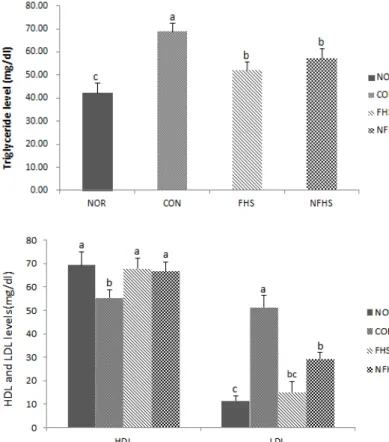
혈액내의 HDL은 정상군이 69.25±5.6 mg/dl, 대조군이 55.50±
3.1 mg/dl, 발효 무궁화 추출물 섭취군이 68.00±4.3 mg/dl, 비발효 무궁화 추출물 섭취군이 66.67±4.0 mg/dl로, 발효 무 궁화 추출물 섭취군이 대조군보다 90.90% 증가하여 정상군과 가까운 수치를 나타냈다. LDL은 정상군이 14.67±6.39 mg/dl, 대조군이 55.20±2.77 mg/dl, 발효 무궁화 추출물 섭취군이 19.53±0.81 mg/dl, 비발효 무궁화 추출물 섭취군이 30.33±1.01
Fig. 5. Effect of fermented Hibiscus syriacus on TG levels in serum. NOR: Normal control group, CON:
High fat diet treated group, FHS: Dry solid of fermented Hibiscus syriacus and high fat dietary group (2%), 0.1g/kg of fermented Hibiscus syria- cus, NFHS: Extract of water-insoluble non-fer- mented Hibiscus syriacus and high fat dietary group (2%), 0.1g/kg of non-fermented Hibiscus syriacus, All the values were expressed as means
± S.D. (n=5). a,b,c are different (p<0.01) group by one-way ANOVA followed by Duncan’s post hoc test.
Fig. 6. Effect of fermented Hibiscus syriacus on HDL and LDL levels in serum. NOR: Normal control group, CON: High fat diet treated group, FHS : Dry solid of fermented Hibiscus syriacus and high fat dietary group (2%), 0.1g/kg of fer- mented Hibiscus syriacus, NFHS: Extract of wa- ter-insoluble non-fermented Hibiscus syriacus and high fat dietary group (2%), 0.1g/kg of non-fer- mented Hibiscus syriacus, All the values were ex- pressed as means ± S.D. (n=5). a,b,c are different (p<0.01) group by one-way ANOVA followed by Duncan’s post hoc test.
mg/dl로, 발효 무궁화 추출물 섭취군이 대조군에 비해 낮은 수치를 나타냈으며, 발효 무궁화 추출물 섭취군은 대조군보다 80.00% 감소하여 정상군에 가까운 수치를 나타냈다. 본 연구 의 결과로 미루어 볼 때, 발효 무궁화 추출물이 비발효 무궁화 추출물 보다 혈중 콜레스테롤 조성을 개선시키는 효과가 있는 것으로 사료된다. 따라서 발효 무궁화는 심혈관 질환을 예방 하여 혈행 개선시킬 수 있을 것으로 예상된다.
감사의 글
본 논문은 2016년도 부산광역시의 재원(Brain Busan 21)으 로 지원 받아 수행되었음. 2015년도 산업통상자원부의 ‘창의 산업융합 특성화 인재양성사업’의 지원을 받아 수행됨에 감사 드립니다(과제번호 N0000717).
References
1. Bae, S. H. 2013. Morphological characteristics and cytoge- netic basic research in Hibiscus syriacus genetic resources.
M. S Thesis. Kyungpook National University. Daegu. Kor.
2. Blois, M. S. 1958. Antioxidant determination by the use of a stable free radical. Nature 26, 1199-1200.
3. Davis, W. B. 1947. Determination of flavanones in citrus fruits. Anal. Chem. 19, 476-478.
4. Folin, A. D. and Denis, W. 1915. A colorimetric method for the determination of phenols (and phenolderivatives) in
urine. J. Biol. Chem. 22, 305-308.
5. Friedwald, W. T., Levy, R. I. and Fredrickson, D. S. 1972.
Estimation of the concentration of low density lipoprotein cholesterol in plasma, without used of the preparative ultracentrifuge. Clin. Chem. 18, 499-508.
6. Jang, A. R. 2012. A study on cosmetic physiological and skin cell activity of Hibiscus syriacus extracts. M. S Thesis.
Hannam University. Daejeon. Kor.
7. Jung, Y. G. 2001. Effect of powders of chestunt and acorn on lipid metabolism antioxidative capacity and antithrom- botic capacity in rats. M. S Thesis. Ewha Womans Univeristy.
Seoul. Kor.
8. Kang, H. J., Kim, H. S., Jeon, I. H., Mok, J. Y., Han, K. S and Jang, S. I. 2013. Effect of Antioxidant and blood flow improvement of grape leaf extract and resveratrol from vitis romaneti. J. Kor. Soc. Food Sci. Nutr. 42, 1736-1743.
9. Kim, M. A. 2014. Influences of feral haw (Crataegus pinnatifi- da Bunge) on the antioxidative activities and lipid metabo- lism functional improvement in dyslipidemic rats. M. S Thesis. Pusan National University. Pusan. Kor.
10. Kim, Y. M., Jeong, H. J., Chung, H. S., Seong, J. H., Kim, H. S., Kim, D. S and Lee, Y. G. 2016. Anti-oxidative actvity of the extracts from Houttuynia cordata Thunb. fermented by aactic acid bacteria. J. Life Sci. 26, 468-474.
11. Ko, D. O. 2014. Antioxdant and antithrombotic effects of the mixture extracts from Aalone Viscera and oriental medicines. M. S Thesis. Mokpo National University. Mokpo.
Kor.
12. Lee, H. J., Lee, S. W., Park, C. G., Ahn, Y. S., Kim, J. S.,
초록:무궁화 추출물의 항산화 활성 및 혈액 순환 개선에 미치는 효과 신유빈․하배진*
(신라대학교 그린화학융합공학과)
본 연구는 발효 무궁화 추출물과 비발효 무궁화 추출물로 나누어 발효하였을 때, 무궁화 추출물의 항산화 활성 과 혈액순환 개선에 미치는 효과가 비발효 무궁화 추출물보다 더 높은지 조사하려고 진행되었다. In vitro 실험에 서 항산화 활성을 분석하기 위해서 항산화의 생리활성 물질인 polyphenol과 flavonoid의 함량을 비롯한 DPPH radical 소거효능을 측정한 결과 발효 무궁화 추출물과 비발효 무궁화 추출물 모두에서 polyphenol과 flavonoid의 함량이 농도 의존적으로 높았으며 DPPH radical 소거효능도 역시 농도 의존적으로 높게 나타났다. In vivo 생쥐 실험에서는 보통식이군(NOR), 고지방식이군(CON), 고지방식이+발효 무궁화 추출물 섭취군(FHS), 고지방식이+
비발효 무궁화 추출물 섭취군(NFHS)으로 나누어 총콜레스테롤(total cholesterol), 중성지질(triglyceride), 고밀도 지질단백질(HDL cholesterol), 저밀도 지질단백질(LDL cholesterol)을 측정한 결과 발효 무궁화 추출물과 비발효 무궁화 추출물은 총콜레스테롤, 저밀도 지질단백질, 중성지질을 저하시키는 효과가 있는 반면 고밀도 지질단백질 을 상승시키는 효과가 있었다. 결론적으로 발효 무궁화는 항산화 생리활성 물질을 많이 함유하고 있어 항산화 효과가 있고 혈액순환을 개선하는데 상당한 효과가 있는 것으로 확인되었다.
Bang, M. S., Oh, C. H and Kim, C. T. 2015. Effect of white Habiscus syriacus L. flower extracts on antioxidant activity and bone resorption inhibition. Kor. J. Med. Crop. Sci. 23, 190-197.
13. Oh, W. G., Jang, I. C., Jeon, G. I., Park, E. J., Park, H. R.
and Lee, S. C. 2008. Antioxidative activity of extracts from Wisteria floribunda flowers. J. Kor. Soc. Food Sci. Nutr. 37, 677-683.
14. Park, Y. S. 2010. Antioxidant effect and improvement of lip- id metabolism of Acanthopanacis cortex water extract in rats Fed High Fat Diet. J. East Asian Soc. Dietary Life 20, 37-45.
15. Son, H. K., Kang, S. T and Lee, J. J. 2014. Effect of Peucedanum japonicum Thunb. on lipid metabolism and antioxidative activities in rat fed a high-fat/high-cholesterol Diet. J. Kor.
Soc. Food Sci. Nutr. 43, 641-649.
16. Yang, H. S., Choi, Y. J., Oh, H. H., Moon, J. S., Jung, H.
K., Kim, K. J., Choi, B. S., Lee, J. W and Huh, C. K. 2014.
Antionxidative activity of mushroom water extracts fer- mented by lactic bacteria. J. Kor. Soc. Food Sci. Nutr. 43, 80-85.
17. Yoo, I. D., Lee, I. K., Ryoo, I. J., Choung, D. H., Han, K.
H. and Yun, B. S. 1997. Studies on the constituents of Hibiscus syriacus (1). Kor. J. Pharmacogn. 28, 112-116.
18. Yoo, K. O., Lim, H. T. and Kim, J. H. 1996. Studies on the flavonoids of the Hibiscus syriacus L. complex. Kor. J. Plant.
Res. 9, 224-229.
19. Yoon, S. W. Effect of absolute from Hibiscus syriacus L. flower on skin regeneration and wound healing in keratinocyte.
M. S Thesis. Hoseo University. Asan. Chungnam. Republic of Kor.