Print ISSN: 2288-4637 / Online ISSN 2288-4645
doi:10.13106/jafeb.2020.vol7.no5.269
1 First Author. Associate Professor, Ho Chi Minh City Open
University, Vietnam. Email: [email protected]
2 Corresponding Author. Lecturer, Ho Chi Minh City Open University,
Vietnam [Postal Address: No. 35-37, Ho Hao Hon Street, Co
Giang Ward, District 1, Ho Chi Minh City, 710000, Vietnam]
Email: [email protected]
© Copyright: The Author(s)
This is an Open Access article distributed under the terms of the Creative Commons
Attribution Non-Commercial License (https://creativecommons.org/licenses/by-nc/4.0/)
which permits unrestricted non-commercial use, distribution, and reproduction in any
medium, provided the original work is properly cited.
Psychological Capital, Organizational Commitment and Job Performance: A Case in Vietnam
Ha Minh NGUYEN
1, Trung Thanh NGO
2
Received: February 24, 2020 Revised: March 08, 2020 Accepted: April 03, 2020
Abstract
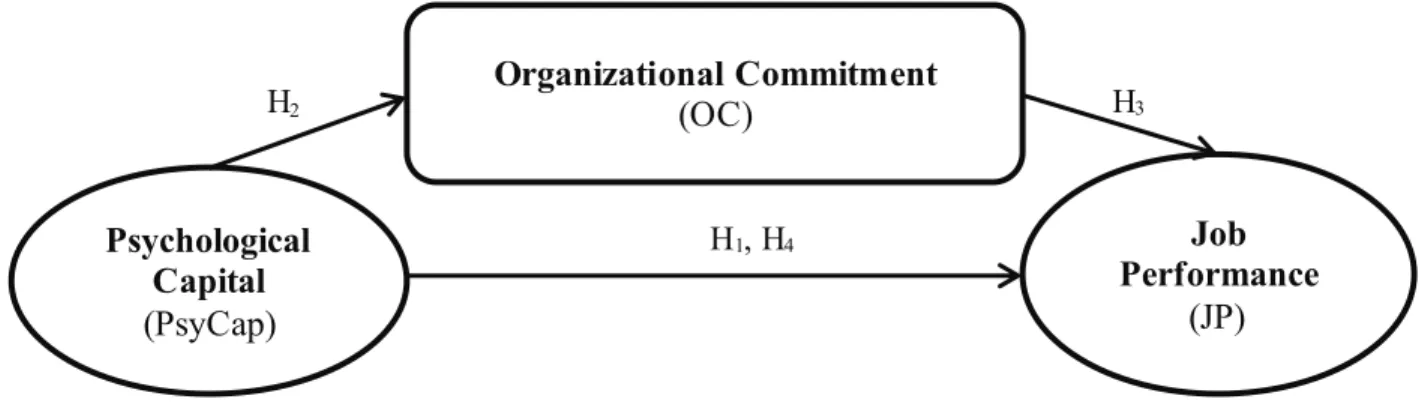
The purpose of this study is to explore the relationship between employee’s psychological capital, organizational commitment and job performance in Vietnam. In this study, psychological capital and overall organizational commitment are considered as two second- order constructs. Psychological capital includes four different components: self-efficacy, optimism, hope and resiliency. Organizational commitment comprises three different components: affective commitment, continuance commitment and normative commitment. The study uses the combination of quantitative research method and qualitative research method. Qualitative research method (based on the experts’ opinions) is used to design the official questionnaire, while relationship between concepts is estimated by quantitative research method, which is inclusive of the methods of descriptive statistics, Cronbach’s Alpha, EFA, CFA and CB-SEM. The survey is conducted in two ways: face-to-face and via email. Data are collected from 848 employees across provinces and cities in Vietnam. The findings show that psychological capital and job performance have a positive relationship, organizational commitment has positive influence on job performance, and psychological capital is also related to organizational commitment. All relationship between psychological capital, organizational commitment and job performance of employee are statistically significant. In addition, organizational commitment also plays the mediating role in the positive relationship between psychological capital and employee’s performance.
Keywords: Psychological Capital, Organizational Commitment, Job Performance.
JEL Classification Code: M12, M54, D91.
1. Introduction
In recent years, psychological capital has received a lot of attention in organization’s psychology. Psychological capital has been considered as the newest resource that can become an advantage in organization’s competition activity.
It lies beyond social capital and human capital to achieve competitive advantage through investment or development in “who you are” (Luthans, Luthans, & Luthans, 2004).
Psychological capital is used for improving employee’s job performance (Luthans & Youssef, 2004). Employee’s job performance has been considered as a set of behaviors
that have the relation with the goals of the organization he works under (Murphy & Kroeker, 1988). In addition, in psychological theory, employee’s behaviors are led by their attitudes. Organizational commitment is an employee’s specific attitude towards his job.
Organizational commitment is an attraction with the nature, which is attitude towards an organization, and the goal of this attitude is toward the organization in general, not a characteristic or role of a particular job (Hulin, 1991).
The relationship between psychological capital and job performance has been shown by theories and previous empirical studies (Nolzen, 2018; Newman, Ucbasaran, Zhu, & Hirst, 2014; Nguyen & Nguyen, 2012; Luthans &
Jensen, 2005; Larson & Luthans, 2006; Newman et al., 2014; and Aminikhah, Khaneghah, & Naghdian, 2016) also confirmed that psychological capital is a significantly related to organizational commitment. On the contrary, results of previous empirical studies regarding the effect of organizational commitment on job performance are not consistent (Wright & Bonett, 2002).
This study aims to explore the relationship between em-
ployee’s psychological capital, organizational commitment,