Print ISSN: 2288-4637 / Online ISSN 2288-4645 doi:10.13106/jafeb.2021.vol8.no8.0259
The Impact of Extrinsic Work Factors on Job Satisfaction and Organizational Commitment at
Higher Education Institutions in Vietnam*
Phuong Ngoc Duy NGUYEN
1, Linh Le Khanh NGUYEN
2, Dong Nguyen Thanh LE
3Received: April 10, 2021 Revised: June 26, 2021 Accepted: July 04, 2021
Abstract
The purpose of this study is to explore the link between job satisfaction and organizational commitment at higher education institutions (HEIs) in emerging countries such as Vietnam and to determine extrinsic work factors that influence job satisfaction. Higher education is critical for socio-economic growth and the overall development of each country. Hence, an understanding of what motivates employees’
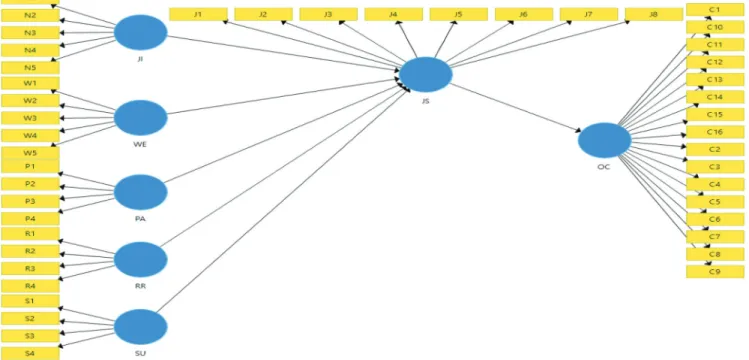
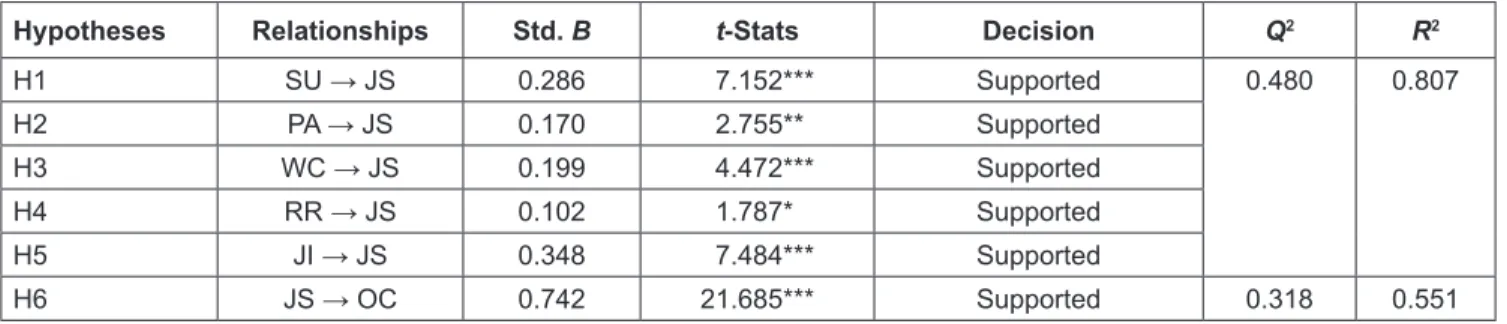
actions and attitudes should be obtained before determining the extent of employee satisfaction. The conceptual model was developed by incorporating job satisfaction-related variables, their relationships, and the impact of job satisfaction on organizational commitment. An empirical study was conducted on a study sample of public and private universities, with 316 academics and non-academic employees surveyed. The current study employed the partial least squares structural equation modeling to test the proposed hypotheses. The results reveal a positive and significant relationship between job satisfaction and organizational commitment. The findings confirm that extrinsic work factors (job itself, supervision, working conditions, payment, and reward and recognition) have a positive and significant relationship with job satisfaction. Furthermore, the study indicates that employees at HEIs who have a high level of ability utilization and supervisor support are more likely to be satisfied with their jobs.
Keywords: Job Satisfaction, Organizational Commitment, Extrinsic Work Factors, Higher Education Institutions, Vietnam JEL Classification Code: M10, M12, M54
prepared to deal with any changes. To adapt to the present market, organizations should regard human resource management as a primary concern. A well-managed human resource base should enable the organization’s activities to operate efficiently and effectively. However, most companies today face a significant challenge to have competent and committed workers (O’Malley, 2000). The priority placed on human capital quality is the crucial factor contributing significantly to a successful organization (Shea, 2001). A talented workforce is essential in the development and maintenance of companies to ensure their long-term viability. The research indicates that the greater the sense of purpose and enthusiasm employees have, the higher an organization’s ability to achieve optimum profitability (Saari & Judge, 2004).
Although a high correlation between satisfaction and commitment has been shown, most research has been undertaken in profitable industrial and service organizations (Testa, 2001). Benkhoff (1997) claims that attitude towards the job and how an employee perceives job satisfaction significantly affects a person’s intention to continue or quit and
*Acknowledgements:
This research is funded by Vietnam National University Ho Chi Minh City (VNU-HCM) under grant number C2020-28-05.
1
First Author and Corresponding Author. School of Business, International University - Vietnam National University Ho Chi Minh City (VNU-HCM), Vietnam [Postal Address: Quarter 6, Linh Trung Ward, Thu Duc City, Ho Chi Minh City, 700000, Vietnam]
Email: [email protected]
2
School of Business, International University - Vietnam National University Ho Chi Minh City (VNU-HCM), Vietnam.
3
School of Business, International University - Vietnam National University Ho Chi Minh City (VNU-HCM), Vietnam.
© Copyright: The Author(s)
This is an Open Access article distributed under the terms of the Creative Commons Attribution Non-Commercial License (https://creativecommons.org/licenses/by-nc/4.0/) which permits unrestricted non-commercial use, distribution, and reproduction in any medium, provided the original work is properly cited.