ACE Inhibitory Lignan Glycosides Isolated from Eucommia ulmoides Oliver
Ok Soo Joo and Sang Hae Nam*
Department of Food science, Jinju National University, Jinju 660-758, Korea Received February 24, 2009 /Accepted May 22, 2009
To evaluate a potential possibility ofEucommia ulmoides Oliver as a functional food, ACE (angiotensin converting enzyme) inhibitory activities of leaf, bark, stem and 4 compounds isolated fromE. ulmoides were tested. The 4 compounds were isolated and purified by silica gel column chromatography, thin layer chromatography and reverse phase column chromatography. Compound I was pinoresinol-4,4'- di-O-β-D-glucoside (PG) and compound Ⅱ was dehydrodiconiferyl alcohol 4,γ'-di-O-β-D-glucopyrano- side (DAG) originating fromEucommial Cortex. The highest amount of PG was present at raw and roasted bark as 135.13 mg% and 163.67 mg%, and the highest amount of DAG was present at raw and roasted leaf as 117.93 mg% and 133.93 mg% respectively. In an ACE inhibition test, 10 mg/ml of roasted leaf, raw and roasted bark extracts of E. ulmoides Oliver were 77.49%, 75.72% and 75.36%
respectively, and 10mg/ml of PG and DAG were shown to be 78.51 and 81.20% respectively. IC50val- ues of PG and DAG were 0.6±0.2 and 0.5±0.2 mg/ml respectively.
Key words : Eucommia ulmoides Oliver, antihypertension, angiotensin converting enzyme (ACE), pinoresinol-4,4'-di-O-β-D-glucoside (PG), dehydrodiconiferyl alcohol 4,γ'-di-O-β-D- glucopyranoside (DAG)
*Corresponding author
*Tel:+82-55-751-3274, Fax:+82-55-751-3279
*E-mail : [email protected]
Introduction
Hypertension is one of the most typical diseases of adult- hood, and it is the origin of various circulatory system disorders. As the senior citizen population increases, the in- cidence of hypertension also tends to increase. Hypertension is one of the three major causes of death along with cancer and heart disorder because when it develops a complication along with cerebral hemorrhage, heart disorder or kidney disorder, it results in a high fatality rate. Causes of hyper- tension are usually unknown, and this primary (or sponta- neous) hypertension requires medicinal therapy [30]. For hu- mans, social and cultural factors contribute to the occurrence of primary hypertension along with environmental factors such as amount of salt in one's diet, physical activity, obe- sity, and stress [32]. It has been known that re- nin-angiotensin system plays an important role in the cause of hypertension, with the participation of an enzyme named angiotensin I converting enzyme [EC 3.4.15.1, ACE: pepti- dyldipeptide hydrolase] [12]. The inactive angiotensin I that exists in living body is converted to angiotensin II as the dipeptide is detached by ACE. Angiotensin II, which has a contraction function of blood vessel walls, inactivates the
hypotensive factor bradykinin, and thus causes the blood pressure to rise. In particular, vital regulation functions in herbal medicines and foods are being studied prevalently for they are recognized to be an impediment to ACE [18,23].
As inhibitors of ACE, chemical compounds such as EnalaprilⓇand CaptoprilⓇhave been developed for usage.
However, due to various side effects, naturally induced ACE inhibitors are being demanded [15]. Until now, majority of natural ACE inhibitors are known to be peptides and poly- phenolic substances [11,14,39].
Physiologically active substances contained in plants are mostly secondary metabolites, such as flavonoid, alkaloid, coumarin and plant sterol. These physiologically active sub- stances are of the polyphenols commonly found in fruits, grains, and herbs, inducing physiological activity with very small amount [2,13,17]. Especially, plant-originated ACE in- hibitors are expected to become useful as a preventive func- tional food because they exist in the food that we can intake in our daily.
Recent researches regarding natural food resources that show anti-hypertension activity have mostly been about soy- bean, soybean paste and casein hydrolysates [20,33,37], mackerel and fish proteins, peptides of animal protein in- cluding milk casein [8,9], plant resource including tea, garlic [11,14,22] and Hovenia dulcis [28], Rhemannia Radix [1], Epimedii herba [4], Panax ginseng [5,7] and various medicinal
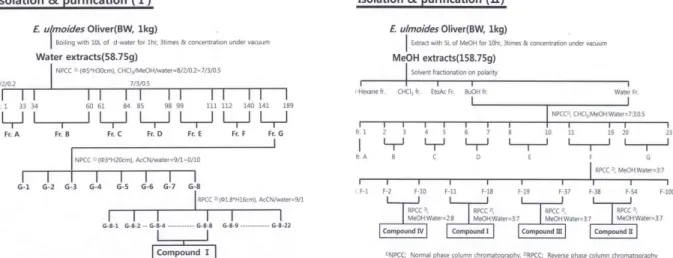
Fig. 1. The isolation procedures of effective substances from water extracts (Ⅰ) and methanol extracts (Ⅱ) inEucommia ulmoides Oliver.
herbs [3,19]. Some others include germinated-buckwheat [26], chitosan oligosaccharides [16], some marine algae in- cluding Ecklonia cava [15,25], Pini folium and Leonuri herba [31] and Phellius ribis [36].
Eucommia ulmoides Oliver is an arbor that falls under Eucommial species. Its place of origin is known to be China, and has been introduced to Korea in 1926. Because E. ul- moides is used for medicinal purposes, it is planted as a crop for special uses in farms over the country. It is medicinally effective as a tonic, sedative, alleviant for pain [35] and hypo- tensive drug [6,34]. It is known to prevent hypertension and scientific researches of some functions have been conducted, but the researches about its effective substances are still incomplete.
In this research, we separated and identified anti-hyper- tension substances, examined the contents of effective sub- stances in each part ofE. ulmoides and ACE inhibitory activ- ity to evaluate the usefulness ofE. ulmoides as a functional food.
Materials and Methods Preparation of E. ulmoides Oliver
The E. ulmoides used in this research were provided by the Sancheonggun research fund for medicinal herb development. More specifically, 10 kg of naturally driedE.
ulmoides such as leaves, bark, and stems were provided and 5 kg of each were roasted in oven prior to research. Samples were categorized as LW; raw leaf, LT; roasted leaf, BW; raw bark, BT; roasted bark, SW; raw stem and ST; roasted stem.
Chemicals and instruments
In this research, instruments such as HPLC (Shimadzu LC10-AD, Japan) and microplate reader (BioTek, USA), ro- tary vacuum evaporator, MPLC, UV-VIS spectrometer (Shimadzu UV-1201, Japan) were used. Reagents and refer- ence standards were all of the special grade, purchased from Sigma or Aldrich co.
Isolation and purification of effective substances
To determine the quantity of anti-hypertensive substances by different parts of E. ulmoides, isolation and purification were done as in Fig. 1. To separate the anti-hypertensive sub- stances and its derivatives, as shown in Fig. 1(I) (isolation method started hot water extracts), 1 kg of naturally dried raw bark was boiled with 10 liter of water for 1 hour, and was extracted repeatedly for three times. The concentration under vacuum of these extracts produced 58.75 g of water extract. Next, as shown in Fig. 1(II) (isolation method started methanol extracts), 1 kg of naturally dried raw bark was boiled with 5 liter of methanol for 10 hr, and was repeatedly extracted for three times. The concentration under vacuum of the extracts resulted in 158.75 g of methanol extracts. After isolation and purification using methods such as TLC and column chromatography, four compounds (Compound I~
IV) were obtained. Detailed explanation of isolation and puri- fication process is listed along with Fig. 1.
Identification of chemical structure
The Identification of chemical structure of separated sub- stances was processed using instruments such as NMR spec-
troscopy, UV/VIS spectrophotometer, GC-MS, LC-MS, ele- ment analyzer, and FT-IR.
Analysis of effective substances
Using HPLC, we examined the contents of effective sub- stances in different parts ofE. ulmoides. The process of filtrat- ing 10 g of grinded E. ulmoides from different parts with 100 ml of distilled water was repeated three times to gather samples. After completely concentrating the water extracts, we dissolved the extract in 10 ml of distilled water again, filtrated by using 0.2 μm membrane filter, and then analyzed using HPLC.
The column used in the analysis was ODS-C18 (Ф3.9×300 mm), mobile phase was acetonitrile / water=70 / 30, de- tector was UV 254 nm, flow rate was 1 ml/min, and injection volume was 10 μl.
Assay for ACE inhibitory activity
ACE inhibitory activity was measured by the method of Cushman and Cheung [7] with slight modifications im- plemented by Kim et al. [21]. ACE crude enzyme solution was obtained from 1 g of rabbit lung acetone powder (Sigma, USA), with 20 ml of 100 mM sodium borate buf- fer (pH 8.3) containing 300 mM NaCl and placed at 4oC for 2 hr and then by taking the supernatants after cen- trifugation at 4,000 rpm for 40 min. 25 mg of HHL (hippuryl-histidyl-leucine) was dissolved in 5 ml of 100 mM sodium borate buffer (pH 8.3) containing 300 mM NaCl. A 200 μl of HHL solution was mixed with 80 μl of sample solution followed by pre-incubation for 5 min at 37oC. The reaction was started by adding of 100 μl of crude ACE solution, and the reaction mixture was in- cubated for 30 min at 37oC. The reaction was stopped by adding 300 μl of 1 M HCl, and the liberated hippuric acid was extracted with 1 ml of ethyl acetate. After cen- trifugation (5,000 rpm, 10 min), 0.5 ml of the supernatants was transferred into a test tube and evaporated at room temperature for 2 hr under vacuum. The dried hippuric acid was dissolved in 2 ml of distilled water, and the ab- sorbance was measured at 228 nm using an UV/VIS spec- trophotometer (UV-1201, Shimadzu, Japan).
ACE inhibitory activities were calculated using the for- mula below. The ACE inhibitory effects were compared with each sample and positive controls, Captopril®(Dongkwang pharm. co.) and Enalapril®(Boryoung pharm. co.). All experi- ments of this study were performed in triplicate.
×
C; control absorbance, S; sample absorbance B; blank absorbance Statistical analysis
All statistical analyses were performed using one way analysis of variance (ANOVA) followed by Duncan's multi- ple range test. All values were expressed as mean±SD (n=3) and P<0.05 was considered statistically significant.
Results and Discussion Chemical structure of effective substances
Among the four substances that were isolated from E. ul- moides, the chemical structure of compound I and II were analyzed using NMR, MS, and UV/VIS spectrometer.
Compound I was found out to be C32H43O16, lignan glycoside of M.W. 683, and Compound II was found out as C32H42O16, lignan glycoside of M.W. 682 (Fig. 2).
Compound I (Pinoresinol-4,4'-di-O-β-D-glucoside, PG) C32H43O16, M.W. 683, mp 230oC, 1H-NMR (400 MHz, CDCl3) δ 3.11 (2H, m, H-8/H-8'), 3.89 (6H, 3, 3'-OMe), 4.24 (4H, dd, J=6.8, 8.8 Hz, H-9/H-9'), 4.75 (2H, d, J=4.0 Hz, H-7/H-7'), 4.87 (2H, d,J=7.6 Hz, glc H-1''/H-1'''), 6.91 (2H, dd,J=8.4, 2.0 Hz, H-6/H-6'), 7.02 (2H, d, J=1.6 Hz, H-2/H-2'), 7.14 (2H, d,J=8.4 Hz, H-5/H-5');13C-NMR (100 MHz, CDCl3) δ 55.7 (C-8/C-8'), 56.9 (C-3/C-3'-OMe), 62.6 (C-6''/C-6'''), 71.5 (C-4''/C-4'''), 72.9 (C-9/C-9'), 75.1 (C-2''/C-2'''), 78.0 (C-3''/C-3'''), 78.3 (C-5''/C-5'''), 87.2 (C-7/C-7'), 103.0 (C-1'' /C-1'''), 111.8 (C-2/C-2'), 118.2 (C-5/C-5'), 119.9 (C-6/C-6'), 137.6 (C-1/C-1'), 147.7 (C-4/C-4'), 151.1 (C-3/C-3').
Compound Ⅱ (Dehydrodiconiferyl alcohol 4,γ'-di-O-β- D-glucopyranoside, DAG)
C32H42O16, M.W. 682,1H-NMR (400 MHz, CD3OD) δ: 3.23 (1H, t,J=8.0 Hz, H-2'''), 3.28 (2H, m, H-5''/H-4'''), 3.39 (3H, m, H-3''/H-3'''/H-4''), 3.46 (1H, m, H-5'''), 3.47 (1H, t,J=8.0 Hz, H-2''), 3.68 (1H, dd,J=4.0, 12.0 Hz, H-6''), 3.77 (1H, dd, J=7.2, 10.8 Hz, H-9), 3.82 (3H, s, 3-OMe), 3.84 (1H, m, H-9), 3.86 (1H, m, H-6''), 3.87 (3H, s, 3'-OMe), 3.88 (1H, m, H-6'''), 4.31 (1H, dd,J = 6.4, 13.2 Hz, H-9'), 4.37 (1H, d, J=7.6 Hz, H-1'''), 4.50 (1H, dd,J=6.4, 13.2 Hz, H-9'), 4.89 (1H, d, J=7.6 Hz, H-1''), 5.59 (1H, d,J=6.0 Hz, H-7), 6.22 (1H, m, H-8'), 6.63 (1H, d, J=16.0 Hz, H-7'), 6.92 (1H, dd, J=2.0, 8.4 Hz, H-6), 6.96 (2H, s, H-2'/H-6'), 7.02 (1H, s, H-2), 7.15 (1H, d, J=8.4 Hz, H-5). 13C-NMR (100 MHz, CD3OD) δ: 56.860
O
O O
O
OMe
OMe
glc
glc
1
3 4
1' 3'
4'
7 8 9
7'
8' 9'
Pinoresinol-4,4'-di-O-β-D-glucoside (PG) [A]
O
O MeO
O OMe
HO O HO
OH
OH
O
OH
HO OH OH
3 1 7 8 9
1'
4'
5' 9'
1''
HO 1'''
Dehydrodiconiferyl alcohol 4,γ'-di-O-β-D-glucopyranoside (DAG) [B]
Fig. 2. Chemical structure of Compound Ⅰ [A] and Compound Ⅱ [B] isolated from E. ulmoides Oliver.
(3-OMe), 56.914 (3'-OMe), 62.6 (C-6''), 64.0 (C-6'''), 65.1 (C-9), 71.1 (C-9'), 71.5 (C-4''), 71.8 (C-4'''), 75.0 (C-2''), 75.3 (C-2'''), 78.0 (C-5'''), 78.1 (C-5''), 78.267 (C-3''), 78.313 (C-3'''), 89.0 (C-7), 102.9 (C-1''), 103.3 (C-1'''), 111.3 (C-2), 112.4 (C-6'), 116.8 (C-2'), 118.1 (C-5), 119.5 (C-6), 124.5 (C-8'), 130.2 (C-5'), 132.6 (C-1'), 134.3 (C-7'), 138.2 (C-1), 145.7 (C-3'), 147.8 (C-4), 149.5 (C-4'), 151.1 (C-3).
Contents of effective substances
Table 1 shows the result of analyzing contents of pinor- esinol-4,4'-di-O-β-D-glucoside (PG) and dehydrodiconiferyl alcohol 4,γ'-di-O-β-D-glucopyranoside (DAG), separated in this research by using HPLC. In the case of PG, content was 135.12 and 163.94 mg%, for naturally dried bark and roasted bark respectively. This result showed highest amount com- pared to those of leaves and stems. Naturally dried leaves showed 85.13 mg%, which means that the bark contains 1.59 times that of the leaves. Also, the naturally dried stem showed 70.49 mg%, meaning that the bark contains 1.92
Table 1. Pinoresinol-4,4’-di-O-β-D-glucoside (PG) and dehy- drodiconiferyl alcohol 4,γ'-di-O-b-D-glucopyranoside (DAG) contents in different parts ofE. ulmoidesOliver analyzed by HPLC
Samples1) Yield of water extracts (%, w/w)
Contents (mg%, w/w) Compound I
(PG) Compound II (DAG) LWLT
BW SWBT ST
5.36±0.0092)c3) 5.87±0.030b 5.26±0.011d 6.01±0.011a 5.02±0.014f 5.22±0.024e
85.13±0.018d 69.19±0.457f 135.12±0.025b 163.94±0.352a 70.49±0.016e 106.33±0.206c
117.43±2.116b 133.93±2.076a 57.79±1.924d 70.77±2.010c 37.86±1.230e 39.95±1.562e
1)LW; Raw leaf, LT; Roasted leaf, BW; Raw bark, BT; Roasted bark, SW; Raw stem, ST; Roasted stem.2)Values are given as mean±SD (n=3). 3)Means with the different letters are sig- nificantly different (p<0.05) by Duncan's multiple range test.
times that of the stems. For roasted bark, it contained 2.35 times that of the roasted leaves (69.19 mg%) and 1.54 times that of roasted stems (106.33 mg%).
In the case of DAG, naturally dried leaves and roasted leaves showed 117.43 and 133.93 mg% respectively, which were relatively high compared to those of bark and stem.
Overall, effective substances were increased by roasting.
Takamuraet al. [38] said that notable natural substances of green leaves ofE. ulmoides were geniposidic (2.53%), aucu- bin (2.99%), and chlorogenic acid (0.16%), and they show higher content in green leaves compared to those of roasted leaves. In this research, PG of roasted leaves decreased in small amount, but in general, PG and DAG both tended to increase through the roasting process.
ACE inhibition activities of E. ulmoides extracts
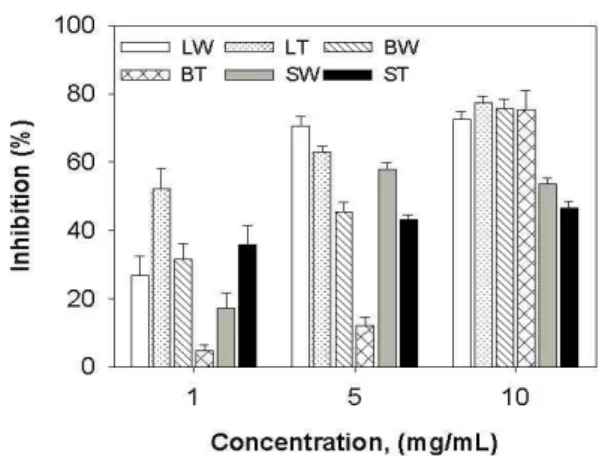
The result of analyzing anti-hypertension activity of ex- tracts from different parts is as shown in Fig. 3. The ACE inhibition activities by treated concentration indicated sim- ilar activities when treated in 10 mg/ml, 72.70~77.56% for leaves and 75.68~75.73% for bark, while the leaves showed relatively low inhibition activity by 46.80~53.19%.
When treated in 5 mg/ml, there were no indicative dif- ferences in leaves and stems, but ACE inhibition activity decreased significantly in bark. As seen from the result, ACE inhibition activities ofE. ulmoides were high for leaves and bark in 10 mg/ml, and were relatively low for stems.
In this case, the data was somewhat inconsistent with the content of PG, which is also one of the most important hy- potensive substances ofE. ulmoides. In leaves of E. ulmoides, there are other flavonoids, alkaloids, and glycosides aside from PG [24,29], indicating relatively high anti-hyper- tension activity. Also, according to reported experiment re- sults of medicinal herbs, the ACE inhibition activities of water extracts of Hovenia dulcis and ethanol extracts of
Fig. 3. ACE inhibition effects of extracts from the raw and roast- edE. ulmoidesOliver leaf, bark and stem. LW; Raw leaf, LT; Roasted leaf, BW; Raw bark, BT; Roasted bark, SW;
Raw stem, ST; Roasted stem. Values are given as mean±SD (n=3).
Rehmannia radix were 75.8% at the concentration of 4 mg/ml and 55.24% at the concentration of 1 mg/ml respectively [1,25]. And ACE inhibition activity ofPsoralea corylifolia was reported as 65.2% at the concentration of 10 mg/ml [9].
ACE inhibition activities of lignan glycosides isolated fromE. ulmoides
The ACE inhibition activities of four compounds, Compound I (PG), Compound II (DAG), Compound III and Compound IV that were isolated fromE. ulmoides, were ana- lyzed and compared with two kinds of medication that are currently prescribed and sold on the market. The ACE in- hibition activity of the four compounds along with Captopril®(Dongkwang pharm. co.) and Enalapril®(Boryoung pharm. co.) are compared in Fig. 4.
The concentrations of samples were divided into three categories: 10, 5 and 1 mg/ml. Captopril®, which was used as a positive control, showed 95.20, 85.41, and 75.61% of ACE inhibition activities according to the concentration, and Enalapril®showed a bit higher inhibition activity, of 96.16, 91.15, and 85.29%. Compound I (PG) showed 81.20, 77.82, and 71.94% of inhibition activity by each concentration and the results of Compound II (DAG) were similar, as 78.51, 74.78, and 74.15%. Compound III and IV showed similar in- hibition activity, between 67.71 and 85.25%. And the IC50val- ues of PG, DAG, Compound III and IV were indicated as 0.6±0.2, 0.5±0.2, 0.6±0.2 and 0.5±0.2 mg/ml and those of Captopril®and Enalapril®were 0.4±0.06 and 0.2±0.04 mg/
ml respectively (Table 2).
The four compounds that were separated fromE. ulmoides
Fig. 4. Comparisons of ACE inhibition activities between pos- itive controls and PG, DAG, compound III & IV isolated from E. ulmoidesOliver. Antihypertensive drugs from Boryoung (Captopril®) and Dongkwang (Enalapril®) pharm. Co. Ltd., PG, DAG, Com III & IV were isolated Eucommia ulmoidesOliver in this study. Values are given as mean±SD (n=3).
Table 2. IC50values of positive controls and PG, DAG, com- pound III & IV isolated fromE. ulmoidesOliver by ACE inhibition test
Samples1) IC50 values2) (mg/ml) DAGPG
Compound III Compound IV
Captopril Enalapril
0.6±0.2 0.5±0.2 0.6±0.2 0.5±0.2 0.4±0.06 0.2±0.04
1)PG, DAG, Com III & IV were isolated fromEucommia ulmoides Oliver in this study. and antihypertensive drugs from Boryoung (Captopril®) and Dongkwang (Enalapril®) pharm.
Co. Ltd.
2)IC50value is the concentration of sample required for 50%
inhibition. Each value is expressed as mean±SD (n=3).
are thought to be glycosides of lignan, and because they have similar structures, the anti-hypertension activities are also expected to be similar.
Acknowledgement
This work was supported by the Sancheong-gun research fund for medicinal herb development in 2007.
References
1. Ahn, S. W., Y. G. Kim, M. H. Kim, H. Y. Lee, H. Y. Lee, and N. S. Seong. 1999. Comparison of biological activities on Rehmannia radix and R. radix Preparata produced in
Korea. Korean J. Medicinal Corp. Sci. 7, 257-262.
2. Ayres, H. M., D. N. Payne, J. R. Furr, and A. D. Russel.
1998. Use of Malthus-AT system to asses the efficacy of per- meabilizing agents on the activity of antibacterial agents Pseudomonas aeruginosa. Lett. Appl. Microbiol. 26, 422-426.
3. Choi, G. P., B. H. Chung, D. I. Lee, J. H. Lee, and J. D.
Kim. 2002. Screening of inhibitory activities on angiotensin converting enzyme from medicinal plants. Korean J.
Medicinal Corp. Sci. 10, 399-402.
4. Choi, H. I., S. I. Lee, D. K. Ahn, and H. C. Kim. 1997. A study on the antihypertensive effect of Epimedii herba. J.
Herbology 12, 35-44.
5. Choi, H. J., Y. B. Zhang, B. J. An, and C. Choi. 2002.
Identification of biologically active compounds frompanax ginsengC.A. Meyer.Korean J. Food Sci. Technol.34, 493-497.
6. Chung, M. H. and C. W. Park. 1975. Influence ofEucommial Cortex of korea on the blood pressure response of rabbits.
Korean J. Pharmacogn. 6, 39-42.
7. Cushman, D. W. and H. S. Cheung. 1971. Spectrophotometric assay and properties of the angiotensin converting enzyme of rabbit lung. Biochem. Pharmacol. 20, 1637-1648.
8. Do, J. R. 2000. Separation and purification of angiotensin I-converting enzyme inhibitory peptide from mackerel. J.
Korean Fish Soc. 33, 153-157.
9. Do, J. R., I. S. Heo, J. H. Jo, D. S. Kim, H. K. Kim, S. S.
Kim, and C. K. Han. 2006. Effect of antihypertensive pep- tides originated from various marine proteins on ACE in- hibitory activity and systolic blood pressure in sponta- neously hypertensive rats. Korean J. Food Sci. Technol. 38, 567-570.
10. Do, J. R., K. J. Kim, J. H. Jo, Y. M. Kim, B. S. Kim, H. K.
Kim, S. D. Lim, and S. W. Lee. 2005. Antimicrobial, anti- microbial, antihypertensive and anticancer activities of me- dicinal herbs. Korean J. Food Sci. Technol. 37, 206-213.
11. Do, J. R., S. B. Kim, Y. H. Park, and D. S. Kim. 1993.
Angiotensin-1-converting enzyme inhibitory activity by the components of traditional tea materials.Korean J. Food Sci.
Technol. 25, 456-460.
12. Erdos, E. G. 1975. Angiotensin converting enzyme.
Circulation Research36, 247-255.
13. Golovinsky, E. V., L. S. Maneva, I. I. Angelov, K. D.
Veljanova, D. J. Sniker, and E. K. Stankevich. 1976.
Antibacterial and antitumor activity of some derivatives of ureidosuccinic acid. Neoplasma 23, 43-46.
14. Hara, Y., M. Matsuzakai, and T. Suzuki. 1987. Angiotensin -1-converting enzyme inhibiting activity of tea components.
Nippon Negeikagaku Kaishi 61, 803-808.
15. Hong, J. H., B. S. Son, B. K. Kim, H. Y. Chee, K. S. Song, B. H. Lee, H. C. Shin, and K. B. Lee. 2006. Antihypertensive effect of Ecklonia cava extract. Korean J. Pharmacogn. 37, 200-205.
16. Hong, S. P., M. H. Kim, and S. W. Oh. 1998. ACE inhibitory and antihypertensive effect of chitosan oligosaccharides in SHR. Korean J. Food Sci. Technol. 30, 1476-1479.
17. Huang, Y., A. Zhang, C. W. Lau, and Z. Y. Chen. 1998.
Vasorelaxant effects of purified green tea epicatechin de-
rivatives in rat mesenteric artery.Life Sci. 63, 257-283.
18. Kannel, W. B., T. R. Dawber, and P. Sorlic.1976.
Components of blood pressure and risk of athrothrombotic brain infarction.Stroke7, 327-331.
19. Kim, H. C., J. Y. Park, and D. K. Ahn. 2006. Anti-hyper- tensive effects of expelling pathogenic wind-heat drugs.
Korean J. Herbology14, 141-147.
20. Kim, H. S., Y. M. In, S. G. Jeong, and J. S. Ham. 2002.
Antihypertensive effects of casein hydrolysate in sponta- neously hypertensive rats.J. Anim. Sci. Technol.44, 483-490.
21. Kim, H. Y. 2000. Hypocholesterolemic and hypertensive ac- tivities ofEucommina ulmoidesOliver. Food Industry Nutr.
5, 27-28.
22. Kim, K. J., J. R. Do, and H. K. Kim. 2005, Antimicrobial, antihypertensive and anticancer activities of Garlic extracts.
Korean J. Food Sci. Technol.37, 228-232.
23. Kirkendall, W. M. and G. A. Nottebohm. 1977.Hypertension physiopathology and treatment. PP. 674-692, McGraw-Hill, New-York, USA.
24. Kawasaki, T., K. Uezono, and Y. Nakazawa. 2000.
Antihypertensive mechanism of food for specified health use: ‘Eucommialeaf glycoside’ and its clinical application.
J. Health Sci. 22, 29-36.
25. Lee, H. O., D. S. Kim, J. R. Do, and Y. S. Ko. 1999.
Angiotensin-1 converting enzyme inhibitory activity of algae. J. Korean Fish Soc.32, 427-431.
26. Lee, J. S., S. J. Park, K. S. Sung, C. K. Han, M. H. Lee, C.
W. Jung, and T. B. Kwon. 2000. Effect of germinated-buck- wheat on blood pressure, plasma glucose and lipid levels of spontaneously hypertensive rats. Korean J. Food Sci.
Technol. 32, 206-211.
27. Lee, S. E., N. S. Seong, J. G. Bang, S. W. Kang, S. U. Lee, and T. Y. Jeong. 2003. Inhibitory effect against angio- tensin-converting enzyme and antioxidant activity ofPanax ginsengC.A. Meyer extracts. Korean J. Medicinal Corp. Sci.
11, 236-245.
28. Lee, S. E., J. G. Bang, and N. S. Seong. 2004. Inhibitory activ- ity on angiotensin converting enzyme and antioxidant activ- ity of Hovenia dulcis Thumb. Cortex extract. Korean J.
Medicinal Corp. Sci. 12, 79-84.
29. Lee, S. Y. 2003. Development of mixedEucommia ulmoides beverage and analysis of volatile flavor compounds. MS Thesis. Duksung Women’s Univ. Seoul, Korea.
30. Nakamura, T., Y. Nakazawa, S. Onizuka, S. Satoh, A. Chiba, K. Sekihashi, A. Miura, N. Yasugahara, and Y. Sasaki. 1997.
Antimutagenecity of Tochu tea: 1. The clastogen-suppress- ing effect of Tochu tea in CHO cells and mice.Mutat. Res.
388, 7-20.
31. Park, K. K., J. W. Ryu, E. K. Choi, and H. S. Ro. 2000.
Anti-hypertensive effects ofPini foliumandLeonuri herbaex- tract on spontaneously hypertensive rat (SHR). Korean J.
Medicinal Corp. Sci. 8, 27-31.
32. Sasaki, Y., S. Satoh, A. Chiba, M. Murakami, K. Sekihashi, M. Tanaka, N. Moribayashi, C. Kudou, Y. Hara, Y.
Nakazawa, T. Nakamura, and O. Onizuka. 1996.
Antimutagenecity of Tochu tea: 2. Suppressing effect of
Tochu tea. Mutat. Res. 387, 203-214.
33. Shin, Z. I., C. W. Ahn, S. H. Nam, H. J. Lee, and T. H.
Moon. 1995. Fractionation of angiotensin-converting en- zyme (ACE) inhibitory peptides from soybean paste.Korean J. Food Sci. Technol. 27, 230-234.
34. Shon, M. Y. and S. H. Nam. 2007. Inhibitory effects on Eucommia ulmoidesextract on angiotensin converting enzyme.
J. Korean Soc. Food Sci. Nutr. 36, 1511-1516.
35. Soka, T. 1985. Encyclopedia of Chinese Drugs. Shanghai Science & Technology Press, Shogakukan, Tyoko, Japan 3, 1964-1966.
36. Song, J. H., H. S. Lee, J. K. Hwang, T. Y. Chung, S. R. Hong,
and K. M. Park. 2003. Physiological activities ofPhellinus ribisextracts. Korean J. Food Sci. Technol. 35, 690-695.
37. Suh, H. J., Y. S. Kim, S. H. Chung, Y. S. Kim, and S. Lee.
1996. Functionality and inhibitory effect of soybean hydro- lysate on angiotensin-converting enzyme. Korean J. Food Nutrition9, 176-175.
38. Takamura, C., T. Hirata, Y. Yamaguchi, M. Ono, H.
Miyashita, T. Ikeda, and T. Nohara. 2007. Studies on the chemical constituents of green leaves ofEucommia ulmoides Oliver.J. Nat. Med. 61, 220-221.
39. Yamamoto, N. 1997. Antihypertensive peptides derived from food proteins.Biopolymer 43, 129-134.
초록:두충으로부터 분리한 lignan glycoside의 ACE 활성 억제 주옥수․남상해*
(진주산업대학교 식품과학과)
두충(Eucommia ulmoides Oliver)으로부터 항고혈압 활성을 가진 유효물질을 분리하였으며, 두충의 잎, 껍질 및 줄기를 건조한 것과, 건조한 후 볶은 것에 대하여 ACE (angiotensin converting enzyme) 저해활성을 실험하였다.
두충으로부터 분리한 유효물질은 pinoresinol-4,4'-di-O-β-D-glucoside (PG)와 dehydrodiconiferyl alcohol 4,γ’-di-O- β-D-glucoside (DAG)였으며, 이들은 각각 껍질과 잎에 많이 함유되어 있었다. 즉 pinoresinol-4,4'-di-O-β-D-gluco- side (PG)는 자연 건조한 껍질에 135.12 mg%, 볶은 껍질에 163.94 mg%로 가장 많이 함유되어 있었으며, dehy- drodiconiferyl alcohol 4,γ’-di-O-β-D-glucoside (DAG)는 자연 건조한 잎에 117.43 mg%, 볶은 잎에 133.93 mg%로 비교적 많이 함유되어 있었다. ACE 억제활성은 볶은 잎, 말린 껍질 및 볶은 껍질을 10 mg/ml씩 처리하였을 때, 각각 77.49, 75.52 및 75.36%의 억제효과를 나타내었으며, 두충으로부터 분리한 화합물인 pinoresinol-4,4'-di-O-β -D-glucoside (PG)와 dehydrodiconiferyl alcohol 4,γ’-di-O-β-D-glucoside (DAG)를 1~10 mg/ml 처리하였을 때에 는 67.1~85.25%의 억제활성을 나타내었으며, IC50값은 각각 0.6±0.2, 0.5±0.2 mg/ml 였다. 이것은 PG와 DAG가 두충에서 분리한 천연물임을 감안하면 매우 높은 활성을 가지고 있다고 할 수 있다.
![Fig. 2. Chemical structure of Compound Ⅰ [A] and Compound Ⅱ [B] isolated from E. ulmoides Oliver.](https://thumb-ap.123doks.com/thumbv2/123dokinfo/5028971.552110/4.892.102.802.133.338/fig-chemical-structure-compound-compound-isolated-ulmoides-oliver.webp)