Aerobic Exercise Ameliorated High Fat Diet-induced Endoplasmic Reticulum Stress More Than Polyphenol Supplementation in Skeletal Muscle of Obese Mice
Jong-Gu Park1, Yong-An Kim2, Hee-Geun Park1 and Wang-Lok Lee1*
1Department of Sport Science, Chungnam National University, Daejeon 305-764, Korea
2Institute of Biotechnology, Chungnam National University, Daejeon 305-764, Korea Received June 4, 2018 /Revised October 8, 2018 /Accepted October 24, 2018
The purpose of this study was to compare the effects of either aerobic exercise or polyphenols supple- mentation on mRNA expression of endoplasmic reticulum stress in skeletal muscle of high fat diet-in- duced obese mice. In the study, mice were divided into five groups: (1) NC (normal diet for 16 weeks as a control, n=10), (2) HC (high fat diet for 16 weeks as a control, n=10), (3) H-Re (high fat diet with resveratrol 25 mg/kg supplementation for 16 weeks, n=10), (4) H-Ch (high fat diet with chrysin 50 mg/kg supplementation for 16 weeks, n=10), and (5) HE (high fat diet with aerobic exercise for 16 weeks, n=10). Aerobic exercise was performed on a treadmill for 40~60 min/day at 10~14 m/min, 0%
grade, four days/week for 16 weeks. Endoplasmic reticulum stress related genes were measured by real-time polymerase chain reaction. ATF6, PERK, IRE1α, and BIP/GRP78 mRNA were significantly decreased in HE compared with those in HC (p<0.05). Also, ATF6, IRE1α, and BIP/GRP78 mRNA were significantly decreased in H-Re compared with those in HC (p<0.05). ATF6 mRNA was sig- nificantly decreased in H-Ch compared with that in HC (p<0.05). These findings suggest that aerobic exercise, resveratrol, and chrysin supplementation changed ER stress markers. However, aerobic ex- ercise was most effective on ameliorating the high fat diet induced ER stress markers. Thus, it seems that aerobic exercise might have a more positive effect on skeletal muscle endoplasmic reticulum stress compared with polyphenol supplementation in high fat diet-induced obese mice.
Key words : Aerobic exercise, chrysin, endoplasmic reticulum, high fat diet induced obese, resveratrol
*Corresponding author
*Tel : +82-42-821-6458, Fax : +82-42-823-0387
*E-mail : [email protected].
This is an Open-Access article distributed under the terms of the Creative Commons Attribution Non-Commercial License (http://creativecommons.org/licenses/by-nc/3.0) which permits unrestricted non-commercial use, distribution, and reproduction in any medium, provided the original work is properly cited.
Journal of Life Science 2018 Vol. 28. No. 10. 1186~1192 DOI : https://doi.org/10.5352/JLS.2018.28.10.1186
Introduction
Endoplasmic reticulum (ER) is a place of protein synthesis necessary for maintaining homeostasis mainly in the body, not only participates in the synthesis of lipids like cholester- ol, it also regulates intracellular calcium concentration has been done [2-4].
Miss folding protein that does not have a complete struc- ture flows into the ER, failure of the function of the endo- plasmic reticulum occurs, which is called ER stress. It is known that the reaction to ER stress involves a system of unfolded protein response (UPR) and activates as a compen- sation mechanism for protecting the environment of the cell [8]. The signal transduction reaction of ER stress has recently
been drawing attention as a major mediator of obesity and metabolic diseases related to diabetes [9-11]. Obesity caused by high-fat diets is easy to increase the accumulation of fat in adipose tissues, skeletal muscle and liver. Also, obesity makes hypoxic status and viral infections. Accumulation of fat in the tissues can not only cause insulin resistance and hyper-insulinemia, but also cause chronic mal-function of endoplasmic reticulum with inflammatory response that promotes apoptosis [1]. Adjustment of UPR is started by BIP and is connected to ATF 6, PERK and IRE in the membrane of the ER.
Polyphenols such as quercetin, resveratrol and chrysin is a type of chemical found in plants as a multifold bioactive compound. Polyphenols have been shown to be a protective antioxidant against the oxidative stress. It promotes DNA repair system, cellular constituents proteins and enzymes.
Consequently, it reduces the risk for various diseases.
Polyphenols administration has been reported to affect the accumulation of unfolded proteins, autophagy and apopto- sis [14, 15, 21-24]. Single bout of exercise induced the ex- pression of ER stress signal factor in skeletal muscle [20],
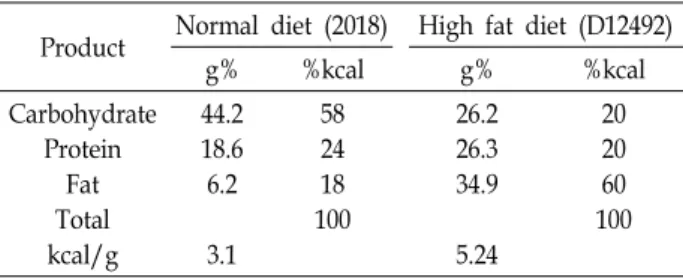
Table 1. Formulas of rodent feed
Product Normal diet (2018) High fat diet (D12492)
g% %kcal g% %kcal
Carbohydrate Protein
Fat Total kcal/g
44.2 18.6 6.2 3.1
58 24 18 100
26.2 26.3 34.9 5.24
20 20 60 100 but chronic exercise was reported to be able to reduce ER stress in various tissues [25]. However, there is no studies that compare the effect of polyphenols and exercise on ER stress. Therefore, we aimed to compare the effects of aerobic exercise, resveratrol and chrysin administration for 16 weeks on ER stress related protein ATF6, PERK, IRE1alpha, BIP/GRP78 and CHOP.
Materials and Methods
Animal and diet
Male C57BL/6 mice (5-weeks-old) were purchased from Raonbio (Seoul, Korea) and hosed in standard cages placed in a room at 22±2.0℃, 55±10℃ relative humidity, and a 12 hr-light/12 hr-dark cycle. All mice consumed a commercial diet and tap water ad libitum for 1 week. The experiments were approved by the animal care and use committee at the chungnam national university (CNU-00494). Mice were ran- domly assigned to five group: 1) normal chow diet group for 16 weeks as the control (NC, n=16) and 2) high fat diet group by 60% high fat diet chow for 16 weeks (HC, n=16) (Table 1). 3) High fat diet with resveratrol supplementation group for 16 weeks (H-Re, n=10), 4) high fat diet with chrys- in supplementation group for 16 weeks (H-Ch, n=10), or 5) high fat diet with aerobic exercise group for 16 weeks (HE, n=10). The mice were weighed every weeks during the ex- periment period. Commercially available dried resveratrol and chrysin (Sigma Aldrich, St Louis, MO) was used, dis- solved in dimethyl sulfoxide. The group of supplement, H-Re and H-Ch group were orally administered with 100 ul of dimethyl sulfoxide as a vehicle. This dose is similar to the amount that humans consume from natural or func- tional foods. Each treatment was administered once per day, 4days/week for 16 weeks.
Exercise protocol
Exercise training was performed on a motor treadmill at moderate intensity for 16 weeks, 5 days/week for 30-60
min/day during the dark cycle. 1 week of adaptation was employed for treadmill running (with the speed of 8 m/min). Warm-up for all exercise was conducted for 5-10 minutes at the speed 8-10 m/min and the main exercise was performed at the speed of 10-22 m/min for 30-60 minutes, following the principle of cumulative overload. This exercise intensity corresponds to 65-70% of maximal oxygen uptake [22]. To control for any stress associated with the training protocol, animals in the control, resveratrol and chrysin sup- plement group were exposed to the same noise and handling as the exercise groups.
Tissue preparation
The animals were sacrificed 24 hr after the 16th week of exercise training. Skeletal muscle (gastrocnemius muscle) tis- sue was stored at -70℃ until analysis. This study used the gastrocnemius muscle because it was determined that aero- bic exercise for 8 weeks can affect the muscles.
Statistical methods
The data was analyzed using SPSS ver. 20.0 (SPSS, Inc., Chicago, IL, USA) to obtain means standard deviations. To investigate the effects of moderate exercise, resveratrol and chrysin intake on body weight, inflammation, and ER stress related gene in skeletal muscle, all the groups were com- pared by a one-way ANOVA. The differences were consid- ered statistically significant at a=0.05.
Result
Body weight and muscle mass
Fig. 1 shows body weight and muscle mass after 16 weeks of high fat diet in the NC, H-Re, H-Ch and HE groups. The body weight of HC was significantly increase compared with NC, H-Re, H-Ch and HE (p<0.05). The muscle mass of HE was significantly increase compared with NC, HC, H-Re and H-Ch (p<0.05).
Change of food and calorie intake
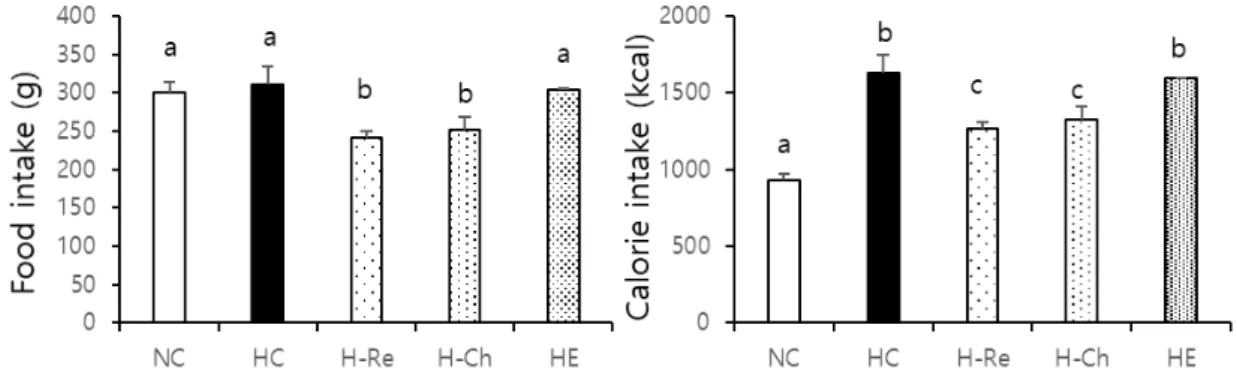
Fig. 2 shows feed intake and calorie intake after 16 weeks of high fat diet in the NC, H-Re, H-Ch and HE groups. The feed volume of H-Re and H-Ch group was significantly low- er than NC, HC and HE (p<0.05). The calorie intake of NC was significantly increase compared with H-Re, H-Ch and HE (p<0.05). Notably, the calorie intake of H-Re and H-Ch was significantly lower than HC and HE (p<0.05).
Fig. 1. The body weight and muscle mass among group. Values represent Mean ± SD. NC, normal diet control; HC, high fat diet control: H-Re, high fat diet with resveratrol: H-Ch, high fat diet with chrysin supplementation; HE, high fat diet with exercise. Different alphabet shows significantly different (p<0.05).
Fig. 2. The food and calroie intake among group. Values represent Mean±SD. NC, normal diet control; HC, high fat diet control:
H-Re, high fat diet with resveratrol: H-Ch, high fat diet with chrysin supplementation; HE, high fat diet with exercise. Different alphabet shows significantly different (p<0.05).
Fig. 3. mRNA expression of ATF6. Values represent Mean ± SD.
NC, normal diet control; HC, high fat diet control: H-Re, high fat diet with resveratrol: H-Ch, high fat diet with chrysin supplementation; HE, high fat diet with exercise.
Different alphabet shows significantly different (p<0.05).
Fig. 4. mRNA expression of PERK. Values represent Mean ± SD.
NC, normal diet control; HC, high fat diet control: H-Re, high fat diet with resveratrol: H-Ch, high fat diet with chrysin supplementation; HE, high fat diet with exercise.
Different alphabet shows significantly different (p<0.05).
ER stress relate gene expression
To evaluate the potential ability of aerobic exercise and polyphenol supplementation on effect of anti-obese mice, we examined ER stress related gene. ATF6 in the gastrocnemius muscle of HC group was significantly increased compared to NC, H-Re, H-Ch and HE group (p<0.05) (Fig 3). PERK in the gastrocnemius muscle of HC group was significantly
increased compared to NC and HE group (p<.005) (Fig 4).
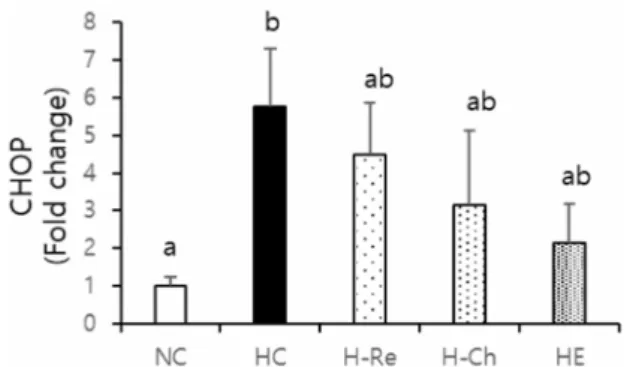
Also, IRE1alpha in the gastrocnemius muscle of HC group was significantly increased compared to NC, H-Re and HE group (p<0.05) (Fig 5). The marker of chaperon in ER, the BIP/GRP78 in the gastrocnemius muscle of HC group was significantly higher than NC and H-Re groups (p<0.05) (Fig 6). CHOP in the gastrocnemius muscle of HC was not
Fig. 5. mRNA expression of IRE1 alpha. Values represent Mean
± SD. NC, normal diet control; HC, high fat diet control:
H-Re, high fat diet with resveratrol: H-Ch, high fat diet with chrysin supplementation; HE, high fat diet with exercise. Different alphabet shows significantly different (p<0.05).
Fig. 6. mRNA expression of BIP/GRP78. Values represent Mean
± SD. NC, normal diet control; HC, high fat diet control:
H-Re, high fat diet with resveratrol: H-Ch, high fat diet with chrysin supplementation; HE, high fat diet with exercise. Different alphabet shows significantly different (p<0.05).
Fig. 7. mRNA expression of CHOP. Values represent Mean ± SD.
NC, normal diet control; HC, high fat diet control: H-Re, high fat diet with resveratrol: H-Ch, high fat diet with chrysin supplementation; HE, high fat diet with exercise.
Different alphabet shows significantly different (p<0.05).
change compared to H-Re, H-Cr and HE group (Fig 7).
Discussion
In this study, we aimed to investigate the changes of ER stress in the skeletal muscle of high fat diet-induced obese mice by aerobic exercise and polyphenol administration.
However, the effect of polyphenols, resveratrol and cry- sin, for weight loss is not clear.
It is well known that regular exercise is effective for weight loss [17-19]. In this study, body weight was de- creased in the exercise and resveratrol administration group.
Muscle mass was increase in the exercise group. Thus, pos- itive changes in body composition, exercise is more effective than polyphenol intake.
ATF6, PERK, IRE1 and CHOP mRNA expression was sig-
nificantly increased by 60% in high fat diet group (HC) com- pared to the control group (NC). This result is in consistency with the report the factors associated with the endoplasmic reticulum stress response were increased significantly in diet induces obesity (DIO model) and diabetes [6, 7, 11, 18]. It was also consistent with the report that 6 weeks of 70% high fat diet significantly increased the ER markers in the soleus muscle of the animals [5]. In addition, when obesity is in- duced, it is consistent with a report that ATF6, PERK and IRE1 mRNA increases not only by the expression of miss folding or unfolding protein in muscle tissue, but also in- creases apoptosis [3, 9-12]. Therefore, in this study, it was suggesting that obesity increases unfolding protein and in- creased expression of ATF6, PERK and IRE1 mRNA.
According to Hong Seung Min (2014) research, it was re- ported that the endurance exercise for 8 weeks decreased the level of ATF6 and PERK, after 22-week-old SD rats had been fed the high fat diet for 16 weeks. In this study, re- vealed that the expression of ATF6, PERK, IRE1 alpha was significantly decreased in the HE group treated with exercise compared to the HC group. The results are consistent with the results of a decrease in the unfolding protein response in the skeletal muscle of obese rats with treadmill exercise for 16 weeks [16], and Gregor (2009) was used for 5 weeks of high-fat diet in rats, the results are consistent with the reported decrease in expression of the ATF6 and eIF2 alpha [9].
It is well known that polyphenol decrease ER stress through effects of antioxidant and anti-inflammatory17. In re- lation to polyphenols, resveratrol administration confirmed the decrease of ATF6 and IRE1 compared with HC group in this study. Crysin administration was decrease only ATF6
compared with HC group. Therefore, in this study, suggest that exercise group with high fat diet have more positive effect in skeletal muscle endoplasmic reticulum stress com- pared with polyphenol supplementation in high fat diet-in- duced obese mice.
Accumulation of unfolding or miss folding protein in the endoplasmic reticulum triggers the ER stress. In the defense system of ER stress, ATF6, IRE1α, PERK mRNA is increased, and the expression of chaperone, such as BIP/GRP78, which turns unfolding protein into a folding protein, increases with these activities [16]. This help the protein folding within the endoplasmic reticulum [10].
In order to get more explain into the mechanisms of ex- ercise and polyphenol administration effect on high fat diet induced obesity, we measured BIP/GRP78 and CHOP in skeletal muscle. The level of BIP/GRP78 and CHOP was in- creased significantly in HC group compared to NC group.
These results are consistent with the findings that ER stress factors such as BIP/GRP78, PERK, and eIF2a increase in skeletal muscle, adipose and liver tissue of animals fed a chronic high fat diet. This suggests that the stress caused by the unfolding protein in the ER has increased the chaper- one in order to turn the unfolded protein into a folding pro- tein16. In this study, revealed that the expression of BIP/
GRP78 was significantly decreased in the HE group treated with exercise compared to the HC group. The results are consistent with the results of a decrease in the unfolding protein response-related variables such as BIP/GRP78 in the skeletal muscle of obese rats with treadmill exercise for 5 weeks [2], and Li et al (2011) was used for 8 weeks of high-fat diet in rats, the results are consistent with the re- ported decrease in expression of the chaperonin BIP [24].
To investigate the effect of polyphenol on ER stress, re- sveratrol and chrysin were administered to obese animals.
In the resveratrol group, BIP/GRP78 was a significant de- crease compared with the HC group. In the chrysin treated group, BIP/GRP78 was no significant decrease compared to the HC group, but it was decreased by 30%. Previous studies have demonstrated that Chrysin (5,7-dihydroxyflavone) pos- sesses potent anti-inflammatory and anti-oxidnat properties [26, 27].
Also, exercise and polyphenol were tested to determine if they suppress ER stress induced apoptosis. The HE group in aerobic exercise showed no significant difference in CHOP expression compared to HC group, but showed a tendency to decrease by 63%. The H-Re group did not show a sig-
nificant decrease compared with the HC group, but it tended to decrease by 22%. The H-Ch group did not show a sig- nificant decrease compared to the HC group but showed a tendency to decrease by 45%. This is consistent with the report that the expression of CHOP inducing apoptosis de- creases and the ER stress marker decreases when resveratrol is administered in retinal ischemic state [13], and chrysin was shown to inhibit apoptosis by degrading caspases asso- ciated with apoptosis in ER stress [23].
Taken together, these findings suggest that aerobic ex- ercise has changed ER markers more than polyphenol supplementation. Thus, it seems that aerobic exercise might have more positive effect on skeletal muscle endoplasmic reticulum stress compared with polyphenol supplementa- tion in high fat diet-induced obese mice
Acknowledgement
This work was supported by the Research Foundation of Chungnam National University (CNU).
References
1. Borg, M. L., Omran, S. F., Weir, J., Meikle, P. J. and Watt, M. J. 2012. Consumption of a high-fat diet, but not regular endurance exercise training, regulates hypothalamic lipid accumulation in mice. J. Physiol. 590, 4377-4389.
2. Chapados, N. A. and Lavoie, J. M. 2010. Exercise training increases hepatic endoplasmic reticulum (er) stress protein expression in MTP-inhibited high-fat fed rats. Cell Biochem.
Funct. 28, 202-210.
3. Cnop, M., Foufelle, F. and Velloso, L. A. 2012. Endoplasmic reticulum stress, obesity and diabetes. Trends Mol. Med. 18, 59-68.
4. Dekker, M. J., Su, Q., Baker, C., Rutledge, A. C. and Adeli, K. 2010. Fructose: a highly lipogenic nutrient implicated in insulin resistance, hepatic steatosis, and the metabolic syn- drome. American journal of physiology. Am. J. Physiol.
Endocrinol. Metab. 299, E685-E694.
5. Deldicque, L., Bertrand, L., Patton, A., Francaux, M. and Baar, K. 2011. ER stress induces anabolic resistance in mus- cle cells through PKB-induced blockade of mTORC1. PLoS One 6, e20993.
6. Deldicque, L., Hespel, P. and Francaux, M. 2012. Endoplas- mic reticulum stress in skeletal muscle: origin and metabolic consequences. Exerc. Sport Sci. Rev. 40, 43-49.
7. Fonseca, S. G., Gromada, J. and Urano, F. 2011. Endoplasmic reticulum stress and pancreatic beta-cell death. Trends En- docrinol. Metab. 22, 266-274.
8. Fribley, A., Zhang, K. and Kaufman, R. J. 2009. Regulation of apoptosis by the unfolded protein response. Methods Mol.
Biol. 559, 191-204.
9. Gregor, M. F., Yang, L., Fabbrini, E., Mohammed, B. S. and Eagon, J. C. 2009. Endoplasmic reticulum stress is reduced in tissues of obese subjects after weight loss. Diabetes 58, 693-700.
10. Hendershot, L. M. 2004. The ER function BiP is a master regulator of ER function. Mt Sinai J. Med. 71, 289-297.
11. Hotamisligil, G. S. 2010. Endoplasmic reticulum stress and the inflammatory basis of metabolic disease. Cell 140, 900- 917.
12. Jiao, P., Ma, J., Feng, B., Zhang, H. and Diehl, J. A. 2011.
FFA-induced adipocyte inflammation and insulin resistance:
involvement of ER stress and IKKbeta pathways. Obesity (Silver Spring) 19, 483-491.
13. Li, Y., Xu, S., Giles, A., Nakamura, K. and Lee, J. W. 2011.
Hepatic overexpression of SIRT1 in mice attenuates endo- plasmic reticulum stress and insulin resistance in the liver.
FASEB J. 25, 1664-1679.
14. Mauthe, M., Jacob, A., Freiberger, S., Hentschel, K. and Stierhof, Y. D. 2011. Resveratrol-mediated autophagy re- quires WIPI-1-regulated LC3 lipidation in the absence of in- duced phagophore formation. Autophagy 7, 1448-1461.
15. Mikula, M., Dzwonek, A., Hennig, E. E. and Ostrowski, J.
2005. Increased mitochondrial gene expression during L6 cell myogenesis is accelerated by insulin. Int. J. Biochem. Cell Biol. 37, 1815-1828.
16. Ozcan, U., Cao, Q., Yilmaz, E., Lee, A. H. and Iwakoshi, N. N. 2004. Endoplasmic reticulum stress links obesity, in- sulin action, and type 2 diabetes. Science 306, 457-461.
17. Pan, Q. R., Ren, Y. L., Liu, W. X., Hu, Y. J. and Zheng, J. S. 2015. Resveratrol prevents hepatic steatosis and endo- plasmic reticulum stress and regulates the expression of genes involved in lipid metabolism, insulin resistance, and inflammation in rats. Nutr. Res. 35, 576-84.
18. Pierre, N., Deldicque, L., Barbe, C., Naslain, D., Cani, P. D.
and Francaux, M. 2013. Toll-like receptor 4 knockout mice are protected against endoplasmic reticulum stress induced
by a high-fat diet. PLoS One 8, e65061.
19. Rodriguez, J., Gilson, H., Jamart, C., Naslain, D. and Pierre, N. 2015. Pomegranate and green tea extracts protect against ER stress induced by a high-fat diet in skeletal muscle of mice. Eur. J. Nutr. 54, 377-389.
20. Rothe, U., Muller, G., Schwarz, P. E., Seifert, M. and Kunath, H. 2008. Evaluation of a diabetes management system based on practice guidelines, integrated care, and continuous qual- ity management in a Federal State of Germany: a pop- ulation-based approach to health care research. Diabetes Care 31, 863-868.
21. Scarlatti, F., Sala, G., Somenzi, G., Signorelli, P., Sacchi, N.
and Ghidoni, R. 2003. Resveratrol induces growth inhibition and apoptosis in metastatic breast cancer cells via de novo ceramide signaling. FASEB J. 17, 2339-2341.
22. Schefer, V. and Talan, M. I. 1996. Oxygen consumption in adult and AGED C57BL/6J mice during acute treadmill ex- ercise of different intensity. Exp. Gerontol. 31, 387-392.
23. Sun, X., Huo, X., Luo, T., Li, M., Yin, Y. and Jiang, Y. 2011.
The anticancer flavonoid chrysin induces the unfolded pro- tein response in hepatoma cells. J. Cell Mol. Med. 15, 2389- 2398.
24. Wang, F. M., Galson, D. L., Roodman, G. D. and Ouyang, H. 2011. Resveratrol triggers the pro-apoptotic endoplasmic reticulum stress response and represses pro-survival XBP1 signaling in human multiple myeloma cells. Exp. Hematol.
39, 999-1006.
25. Wu, J., Ruas, J. L., Estall, J. L., Rasbach, K. A. and Choi, J. H. 2011. The unfolded protein response mediates adapta- tion to exercise in skeletal muscle through a PGC-1alpha/
ATF6alpha complex. Cell Metab. 13, 160-169.
26. Lapidot, T., Walker M. D. and Kanner, J. 2002. Antioxidant and prooxidant effects of phenolics on pancreatic beta-cells in vitro. J. Agric Food Chem. 52, 7220-7225.
27. Cho, H., Yun, C. W. and Park, W. K. 2004. Modulation of the activity of pro-inflammatory enzymes, COX-2 and iNOS, by chrysin derivatives. Pharmacol. Res. 49, 37-43.
초록:비만에 의해 유도된 근형질세망 스트레스에서 유산소 운동에 의한 감소효과
박종구1․김용안2․박희근1․이왕록1*
(1충남대학교 스포츠과학과, 2충남대학교 생물공학연구소)
비만에 의한 근형질세망 스트레스(Endoplasmic stress, ER stress) 발생은 비접힙 단백질의 축적으로 근육내 대 사와 근기능 저하를 초래한다. 유산소 운동과 폴리페놀은 비만에 유도된 염증성 사이토카인과 ER stress를 감소시 키는 것으로 잘 알려졌다. 그러나 신체활동과 약물에 의한 염증성 사이토카인과 ER stress 변인들의 변화에 선택 적인 반응이 있는지에 대한 연구는 이루어지지 않았다. 따라서, 이 연구의 목적은 유산소 운동과 폴리페놀섭취에 따른 골격근내 ER stress 관련 변인에 우선적인 효과가 있는지 비교분석하고자 하였다. 이 연구의 목적을 위해 (1) 정상식이 그룹, (2) 60% 고지방식이 그룹, (3) 고지방식와 레스베라트롤 25 mg/kg 그룹, (4) 고지방식이와 크리 신 50 mg/kg 투여 그룹, (5) 고지방식이와 운동 그룹으로 나누어 실시하였다. 레스베라트롤과 크리신 그룹은 16주 간 경구 투여 하였고, 운동 그룹은 1일 40-60분간 10-14 m/min의 속도로 주 4일, 총 16주간 트레드밀 운동을 수행 하였다. 운동그룹에서 IRE1α, BIP/GRP78는 고지방 식이 그룹과 비교하여 유의하게 낮아졌다(p<0.05). 고지방식이 와 레스베라트롤 투여 그룹에서 ATF6, IRE1α, BIP/GRP78는 고지방식이 그룹과 비교하여 유의하게 낮아졌다 (p<0.05). 고지방식이와 크리신 투여 그룹은 고지방식이 그룹과 비교하여 ATF6가 유의하게 낮아졌다(p<0.05). 이 러한 결과는 유산소 운동과 레스베라트롤, 크리신 섭취에 의해 ER stress 관련 변인을 조절할 수 있다. 그러나 유 산소 운동은 고지방 식이에 의해 유도되는 ER stress 개선이 더욱 효과적인 것으로 나타났다.