Research on the Diversity of Intestinal Microbial Communities of Red tilefish (Branchiostegus japonicus) by 16S rDNA Sequence Analysis
Min-Seon Kim
1, Seung-Jong Lee
1* and Moon-Soo Heo
21Jeju Fisheries Research Institute, National Institute of Fisheries Science, Jeju 63068, Korea
2Major of Aquatic Life Medicine, Faculty of Marine Biomedical Sciences, Jeju National University, Jeju 63243, Korea
Received October 30, 2017 /Revised November 27, 2017 /Accepted November 28, 2017
This study investigated the diversity of communities of intestinal microorganisms, separated from the intestinal organs of Red tilefish (Branchiostegus japonicas), collected on the Jeju Coast. First, in the iso- lation of 1.5% BHIA, MA, TSA and R2A Agar on the medium, there were most colonies in 1.5%
BHIA. The results of aerobic culture and anaerobic culture were 1.7X10
6CFU/g
-1and 1.1X10
5cfu/g
-1, respectively, on average, and 147 pure colonies were separated in total. In 16S rDNA sequencing, there were 58 genera and 74 species, showing 95-100% similarity with the basic strain. They were divided broadly into 5 phyla, and as the main phyletic group, Proteobacteria phylum comprised 50% with 9 families, 35 genera and 35 species of Moraxellaceae, Rhodobacteraceae, Shewanellae, Halomondaceae, Enterob- acteriaceae, Vibrionaceae, Hahellaceae, Pseudomonadaceae, and Erythrobacteraceae, with the highest index of dominance. Actinobacteria phylum comprised 24% with 8 families, 11 genera and 17 species of Micro- bacteriaceae, Intrasporangiaceae, Dietziaceae, Dermabacteraceae, Dermacoccaceae, Nocardiodaceae, Brevibacteriaceae and Propionobacteriacea; Firmicutes phylum, 16% with 6 families, 8 genera and 17 species of Bacillaceae, Staphylcoccaceae, Planococcaceae, Streptococcaceae, Paenibacillaceae and Clostridiaceae; Bacteroidetes phylum, 6% with 2 families, 3 genera and 4 species of Cyclobacteriaceae and Flavobacteriaceae; and Deinococcus- Thermus phylum, 4% with 1 family, 1 genus and 1 species of Deinococcaceae.
Key words : Branchiostegus japonicus, intestinal microorganism, marine bacteria, Red tilefish
*Corresponding author
*Tel : +82-64-750-4370, Fax : +82-64-743-5884
*E-mail : [email protected]
This is an Open-Access article distributed under the terms of the Creative Commons Attribution Non-Commercial License (http://creativecommons.org/licenses/by-nc/3.0) which permits unrestricted non-commercial use, distribution, and reproduction in any medium, provided the original work is properly cited.
Journal of Life Science 2018 Vol. 28. No. 3. 361~368 DOI : https://doi.org/10.5352/JLS.2018.28.3.361
서 론
장내에는 다양한 미생물이 서식하며, 이를 장내 미생물 (Intestinal microorganism)이라고 한다. 장내미생물은 다양한 대사활성을 통해 숙주의 면역, 신진대사, 신경계 등 건강에 관여하며, 숙주의 질병과도 연관성을 지닌다[18]. 이처럼 숙주 와 장내미생물의 상관관계가 입증되면서 최근 장내미생물의 연구가 꾸준히 이루어지고 있다. 그 중에서도 수많은 장내 미 생물의 군집, 분포가 큰 관심의 대상이 되고있다. 장내미생물 은 해당 숙주의 서식지, 온도, 먹이 등 주변환경에 영향을 많이 받기 때문에 개체마다 매우 다양한 장내세균군이 서식하며, 이는 해당 생물의 생활사 파악 또는 생태계의 지표가 되기도 한다[9].
한국은 식량농업기구 FAQ (The Food and Agriculture Organization) 가입 24개국 중 수산물 섭취량 세계 1위이다 [23]. 이는 양식업의 활성화 및 생활수준의 개선에 따른 건강식
품 선호도의 증가로 인한 것으로, 수산물은 필수 아미노산과 단백질, 무기질, 오메가3 등 영양성분이 풍부하여 건강증진에 도움이되며 제2의 식자원으로 각광받고 있다. 이에 따라 수요 와 섭취가 증가함과 동시에 해양생물 유래 유해균으로부터 노출도 또한 높아지며, 이는 식품 위생학적인 관점에서 매우 중요한 문제라 할 수 있다.
옥돔(Branchiostegus japonicas)은 농어목(Percifomes) 옥돔과 (Malacanthidae)에 속하는 경골어류로서 최대 45 cm까지 성장 하며, 산란시기는 수온이 18℃ 전후인 6~10월경이다. 연근해 를 중심으로 수심 30~200 m 내외의 깊은 바다 속에서 서식하 며 주로 한국남해, 일본 남부, 동중국해, 남중국해 등 열대해역 에 분포한다[14]. 이처럼 한정된 채집장소와 뛰어난 맛에 제주 도에서 가장 고급어종으로 취급되어 선호도가 높다. 그러나 제주도 주요 양식 어종들에 비해 옥돔의 관한 연구는 비교적 미비한 실정이다. 지금까지 옥돔의 연구사례는 생식주기와 성 장 등 생활사 관련에 대하여 보고된 바 있으나[5], 아직 옥돔의 장내세균의 다양성에 대하여 보고된 사례는 없다. 사실상 옥 돔 뿐 만이 아닌 수중유래생물의 장내 미생물의 연구가 드문 편이다. 최근 해양유래생물로부터 장내미생물 분리연구 사례 는 다음과 같다. 무지개송어, 넙치, 볼락, 감성돔, 참돔, 자리돔 독가시치, 청어 및 불가사리 등이 보고되었다[6, 8, 9, 11, 15, 21, 22, 24].
최근 붉은 멍게의 장에서 분리한 신종 미생물에서 새로운
- Note -
항생물질이 발견되어 보고된 바 있다[16]. 이처럼 육상과는 전 혀 다른 환경에 서식하는 해양생물의 장내미생물은 종류도 매우 다양한 반면, 연구사례가 미비하여 잠재력이 무한하며 연구가치가 높다[4].
본 연구에서는 옥돔 장내에 서식하는 장내세균군집의 다양 성에 대하여 연구하였다. 이러한 연구는 최근 꾸준히 양식시 도가 이루어지고 있는 옥돔의 상품성 가치를 위한 원활한 성 장, 먹이, 질병예방 등 다양한 연구방면에 있어 필요한 기초 자료로 활용될 것으로 기대된다.
재료 및 방법
실험어 채취
본 실험에 사용된 시료어는 제주특별자치도 서귀포시 대정 읍 태흥리 인근 연안에서 연안연승어획 방법으로 채집된 옥돔 5마리를 사용하였다. 채집한 옥돔은 바로 4℃에 보관 운송 하 였다. 본 연구에 사용된 옥돔은 평균체장 24.5±1.0 cm, 평균체 중 230±10 g의 어체를 사용하였다. 장내 음식물은 발견되지 않았다.
장내미생물 분리 및 배양
옥돔으로부터 장내세균의 분리를 위해 내장을 척출하여 내 용물을 제거한 후 멸균된 증류수에 세척한 뒤 멸균된 0.85%
생리식염수에 현탁하였다. 그 뒤 homogenizer로 균질화하여 잘 현탁되도록 voltexing 해준 뒤 1 g을 넣고 10
-1~10
-5배로 단계희석 하였다. 그 뒤 일반 증식배지로 사용되는 Brain Heart Infusion Agar에 해산어인 옥돔을 고려하여, 1.5% Sodium chloride를 첨가하였고, 다른 영양성분의 증식배지 Tryptic Soy Agar, 해양미생물 전용배지 Marine Agar, 빈영양세균 증 식배지인 R2A Agar (BHIA, TSA, MA, R2A, Difco, USA)에 평판 도말법을 이용하여 25℃에서 7일간 Incubator (JSGI- 100T, JSR, Korea)에서 일반 배양을, CO2 Incubator (MC5- 15AC, Sanyo, Japan)에서 혐기배양하였다. 그 뒤 배지상에 나 타나는 균의 크기, 모양, 색깔 등 형태학적 모습을 관찰하여 순수분리 하였으며, 옥돔의 장내 균체수는 CFU/g-
1단위로 환산하였다. 각각 분리된 균주의 균체를 24%(v/v) glycerol에 현탁 한 뒤, -85℃에 보관 하였다.
분자생물학적 동정(16S rDNA 염기서열 계통분석) 옥돔의 내장으로부터 분리된 균주의 분자생물학적 동정을 위해 Genomic DNA Extraction kit (Bioneer, USA)를 사용하 여 protocol에 따라 수행하여 DNA를 추출하였다. 추출된 균 주의 16S rDNA유전자 증폭을 위해 primer는 27 Forward pri- mer (5’-AGAGTTTGATCMTGGCTCAG-3’)와 1492 Reverse primer (5’-TACGGYTACCTTGTTACGACTT-3’)를 사용하였 다. PCR 조건은 95℃에서 초기 변성 4분, 94℃에서 변성 1분간
수행하였고, 55℃에서 1분간 결합단계를 지나, 72℃에서 합성 1분으로 총 30회 반복하였으며, 72℃에서 5분간 최종 합성을 수행하여 PCR (US/MYGein32, MJ RESEARCH, USA)을 실 시하였다. 증폭된 PCR 산물은 1.5% agarose가 첨가된 Gel에 0.5 μg/ml ethidium bromide (EtBr)로 염색한 후 전기영동하 여 band를 확인하였다.
염기서열 분석 및 계통도 작성
증폭된 16S rDNA는 ㈜제노텍(Daejeon, Korea)에 분석의뢰 하였다. 도출된 염기서열은 미국 국립생물정보센터 NCBI (National Center for Biotechnology Information)의 BLAST (Basic Local Alignment Search Tool) search program에서 Genbank database와 Ezbiocloud (https://www.ezbiocloud.
net/)의 database를 이용하여 염기서열의 quality를 비교한 후 각 균주마다 가장 근연속 또는 종으로 나타나는 서열을 확인 하였다. 결정된 염기서열과 database에서 확인한 표준 미생물 염기서열을 ClustalW software로 multiple alignment를 수행 하고 Mega 6.0 software 프로그램을 이용하여 Alignment 수 행 후 Neighbor joining phylogenetic tree를 작성하였다.
결과 및 고찰
옥돔 장내세균 분리
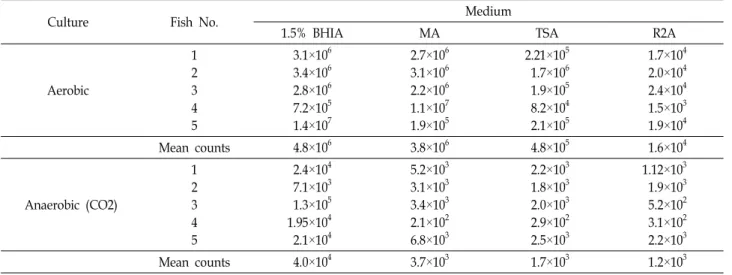
본 논문에서는 옥돔의 장내세균의 다양성에 관하여 연구를 하였다. 1차 적으로 평판배지상 colony의 모양, 색깔 등 형태학 적 특징을 육안으로 구분하여 옥돔의 장내로부터 분리된 col- ony의 수는 다음과 같이 나타났다(Table 1). 1.5% BHIA배지에 서는 4.8×10
6CFU/g-
1으로 가장 높은 colony 수를 나타냈고, 그 외 MA 3.8×10
6CFU/g-
1, TSA 4.8×10
5CFU/g-
1및 R2A 1.6×10
4CFU/g-
1로 나타났다. 배지마다 colony 개수 차이는 있었으나 균 종류가 크게 다르지 않고 유사성이 높았다.
장 내부 환경은 절대혐기성 또는 편성혐기성으로 CO
2혐기 배양 colony 개수 결과 1.5% BHIA배지에서 4.0×10
4CFU/g-
1의 가장 많은 colony 개수를 나타냈으며, MA 3.7×10
3CFU/g-
1. TSA 1.7×10
3CFU/g-
1및 R2A 1.2×10
3CFU/g-
1로 나타났다.
배양 환경 조성의 차이에서 colony 개수는 호기배양이 더 높게 나타났으나, 혐기배양에는 비교적 다양한 균주가 배양되는 차 이를 보였다.
다른 두 배양 조건 모두 일반 증식배지인 1.5% BHIA에서
가장 많은 colony 개수가 나타났다. 이런 결과는 이전 연구결
과 넙치, 볼락, 송어 등 어류로부터 독립영양세균인 Pseudomo-
nas, Achromobacter 등 MA배지에서 많은 colony 개수가 관찰
된 사례와는 다르다[9, 11-14]. 해양미생물 증식에 최적화된
주요성분이 무기염으로 이루어진 MA보다 다양한 영양분이
필요한 장내환경에 따라 Glucose, Peptone, Animals tissue 등
고영양분이 많은 1.5% BHIA가 더 많은 colony 계수를 나타냈
Table 1. Intestinal microbial flora isolated from the red tilefish (Branchiostegus japonicus)
Culture Fish No. Medium
1.5% BHIA MA TSA R2A
Aerobic
1 2 3 4 5
3.1×10⁶ 3.4×10⁶ 2.8×10⁶ 7.2×10⁵ 1.4×10⁷
2.7×10⁶ 3.1×10⁶ 2.2×10⁶ 1.1×10⁷ 1.9×10⁵
2.21×10⁵ 1.7×10⁶ 1.9×10⁵ 8.2×10⁴ 2.1×10⁵
1.7×10⁴ 2.0×10⁴ 2.4×10⁴ 1.5×10³ 1.9×10⁴
Mean counts 4.8×10⁶ 3.8×10⁶ 4.8×10⁵ 1.6×10⁴
Anaerobic (CO2)
1 2 3 4 5
2.4×10⁴ 7.1×10³ 1.3×10⁵ 1.95×10⁴ 2.1×10⁴
5.2×10³ 3.1×10³ 3.4×10³ 2.1×10² 6.8×10³
2.2×10³ 1.8×10³ 2.0×10³ 2.9×10² 2.5×10³
1.12×10³ 1.9×10³ 5.2×10² 3.1×10² 2.2×10³
Mean counts 4.0×10⁴ 3.7×10³ 1.7×10³ 1.2×10³
다. 이는 종속영양세균인 장내세균의 특성을 나타내는 결과로 사료된다. 이로써, 옥돔의 장내세균의 분리 및 다양성 연구에 있어 배지의 구성성분이 어느정도 영향을 미치는 것으로 사료 되며, 최적의 배지는 1.5% Sodium chloride가 첨가된 BHIA로 나타났다.
16S rDNA 염기서열의 계통학적 분석
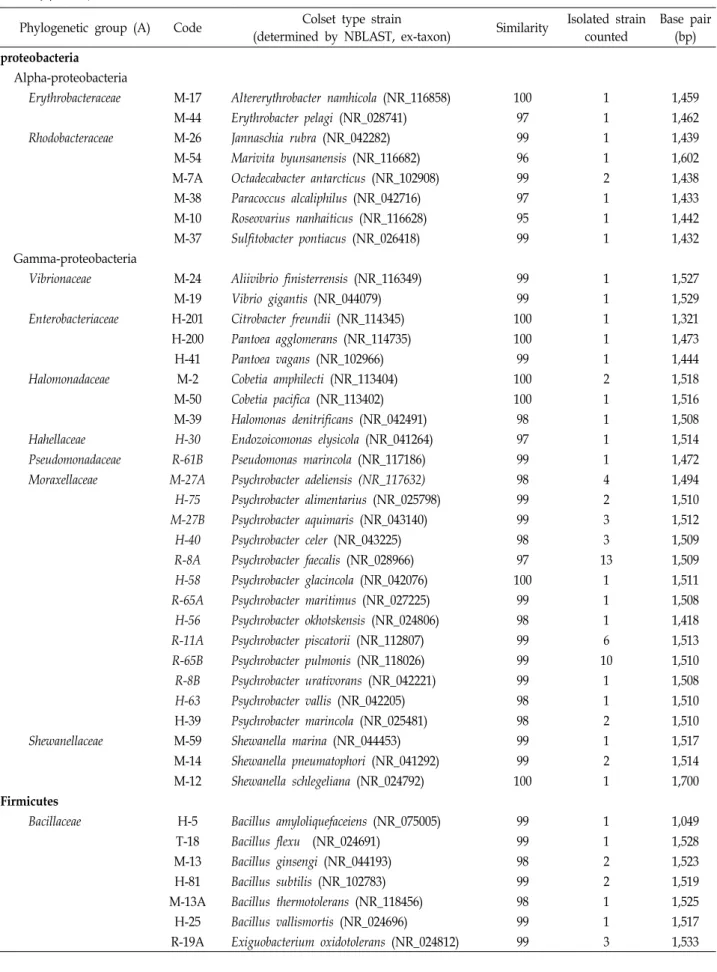
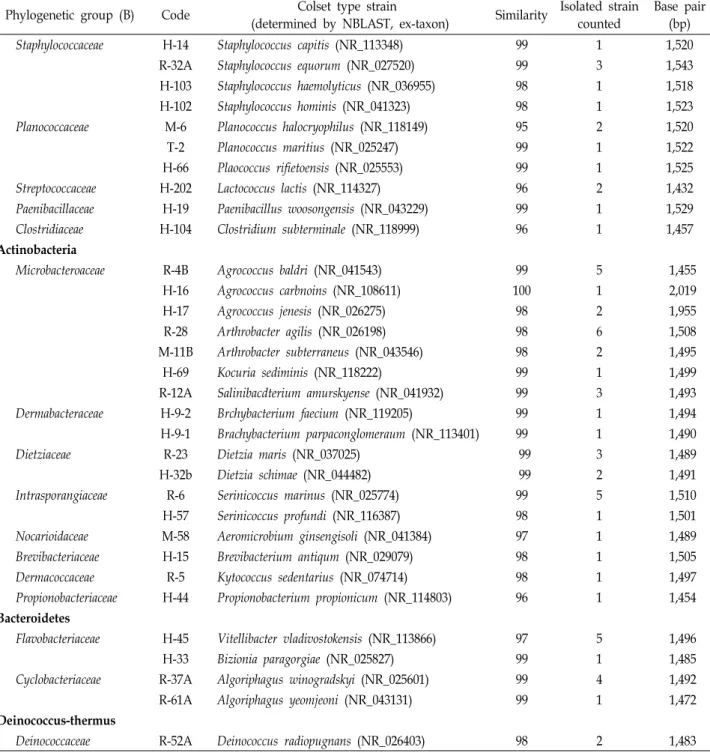
옥돔의 장내로부터 순수분리된 147 colony의 16S rDNA Sequence을 바탕으로 NBLAST program, Ezbiocloud를 분석 하여 도출한 결과 크게 5문 58속 73종으로 나타났다(Table 2).
가장 근연속 또는 종으로 나타난 서열을 다음과 같이 계통수 로 나타내었다(Fig. 1).
Proteobacteria (Alpha-proteobacteria, Gamma-proteobac- teria)가 50%로 가장 우점도가 높았고, Actinobaceria 24%, Fir- micutes 16%, Bacteroides 6% 및 Deinococcus-thermus 4%로 각 각 나타났다.
Proteobacteria문은 95-100%의 상동성을 나타내었다. Alpha- proteobacteria 그룹은 Rhodobacteraceae 87.5%, Erythrobacter- aceae 12.5%로 구성되었으며, 총 2과로 8속 8종으로 분리되었 다. Gamma-proteobacteria 그룹은 97-100%의 상동성을 나타 내었으며, Moraxellaceae 76%, Shewanellae 8%, Halomondacea, Enterobacteriaceae이 각각 6%, Vibrionaceae 2%, Hahellaceae, Pseudomonadceae이 각각 1%로 구성되었으며, 총 7과로 27속 27종이 분리되었다. 그 중 Moraxellaceae 속의 Psychrobacter 종 이 가장 높은 우점도를 나타냈으며 잉어류, 연어류, 대구 및 넙치의 장의 주요 우점균 결과와 일치한다[7, 9, 10, 17]. 이는 해양유래 프로바이오틱 균주로 어류의 장에 서식하며 성장률 과 면역능 증가에 도움이 되는 것으로도 보고되었다[28].
Hahellaceae과의 Halomonas 종은 주로 먹이가 갑각류인 성어의 내장에서 분리된다[27]. 혐기배양 조건 하 분리 및 분석된 염기 서열은 Citriobacter, Endozoicomonas, Shewanella 종으로 나타났
다. 모두 통성혐기성균으로 넙치, 고등어 내장에서 분리되었 으며, 프로바이오틱 균주로의 가능성도 보고되었다[30]. Acti- nobateria 문 분류군은 96-100%의 상동성을 나타냈다. 주요 우 점 과로 Microbacteriaceae 54%, Intrasporangiaceae 16%, Dietzia- ceae 13%, Dermabacteraceae 5%, Dermacoccaceae, Nocardioidaceae, Brevibacteriaceae, Propionobacteriaceae이 각각 3%로 나타났으 며, 총 8과 11속 17종이 분리되었다. 그 중 Microbacteriaceae과 의 Arthrobacter 속이 8균주로 가장 높은 우점도를 나타냈다.
해양퇴적층 또는 수중에 널리 퍼져있으며, 대다수의 해양생물 로부터 기본적으로 분리되는 균군 중 하나이다[8, 11, 12, 27, 28]. Firmicutes문 분류군은 95-99%의 상동성을 나타냈다. 주 요 우점과로 Bacillaceae 44%, Staphylcoccaceae 24%, Planococca- ceae 16%, Streptococcaceae 8%, Paenibacillaceae, Clostridiaceae이 각각 4%로 나타났으며, 총 6과로 8속 17종이 분리되었다. 그 중 Bacillus 속이 가장 높은 우점도를 나타냈으며, B. amyloli- quefaciens (99%)는 육상생물의 성장, 면역능 및 장내건강을 담 당하는 균주로 보고되었다[1]. 혐기배양의 경우 Clostridium subterminale (99%), Lactococcus lactis (99%)가 분리되었으며, L. lactis의 경우 산을 생성하여 병원균으로부터 장을 보호하는 역할을 하며[2], 참돔(Pagrus major)을 비롯한 도미과, 연어류 의 성장에 관여하는 것으로 나타났다[20].
Bacteroide문 분류군은 97-99%의 상동성을 나타냈으며, Cyclobacteriaceae 60%, Flavobacteriaceae 40%로 나타났다. 총 2 과로 3속 3종으로 분리되었다. Deinococcus-themus문 분류군은 유사도가 98%로 나타났으며 단독 Deinococcaceae 1과 1속 1종 의 균주가 분리되었다. Deinococcaceae 속은 저온, 건조 및 방사 선에 내성을 갖고있는 균주로 다양한 환경에 분포하나, 어류 의 장내유래 분리 연구결과는 거의 희박하다[26].
이전 보고된 해수어, 담수어 장내세균의 연구결과 대부분이
Proteobacteria 문이 우점하였다. Proteobacteria 중 대부분의
해산어는 Moraxellaceae, 담수어는 Aeromonadaceae가 비중이 높
Fig. 1. Neighbour-joining phylogenetic tree determined from the 16S rDNA sequences of bacteria from the intestine of red tilefish (Branchiostegus japonicus). Bootstrap values calculated (from 1,000 replications).
Table 2. Representative sequences of 16S rDNA gene sequence library isolated from the intestinal tract of red tilefish (Branchiostegus japonicus)
Phylogenetic group (A) Code Colset type strain
(determined by NBLAST, ex-taxon) Similarity Isolated strain counted
Base pair (bp) proteobacteria
Alpha-proteobacteria
Erythrobacteraceae M-17 Altererythrobacter namhicola (NR_116858) 100 1 1,459
M-44 Erythrobacter pelagi (NR_028741) 97 1 1,462
Rhodobacteraceae M-26 Jannaschia rubra (NR_042282) 99 1 1,439
M-54 Marivita byunsanensis (NR_116682) 96 1 1,602
M-7A Octadecabacter antarcticus (NR_102908) 99 2 1,438
M-38 Paracoccus alcaliphilus (NR_042716) 97 1 1,433
M-10 Roseovarius nanhaiticus (NR_116628) 95 1 1,442
M-37 Sulfitobacter pontiacus (NR_026418) 99 1 1,432
Gamma-proteobacteria
Vibrionaceae M-24 Aliivibrio finisterrensis (NR_116349) 99 1 1,527
M-19 Vibrio gigantis (NR_044079) 99 1 1,529
Enterobacteriaceae H-201 Citrobacter freundii (NR_114345) 100 1 1,321
H-200 Pantoea agglomerans (NR_114735) 100 1 1,473
H-41 Pantoea vagans (NR_102966) 99 1 1,444
Halomonadaceae M-2 Cobetia amphilecti (NR_113404) 100 2 1,518
M-50 Cobetia pacifica (NR_113402) 100 1 1,516
M-39 Halomonas denitrificans (NR_042491) 98 1 1,508
Hahellaceae H-30 Endozoicomonas elysicola (NR_041264) 97 1 1,514
Pseudomonadaceae R-61B Pseudomonas marincola (NR_117186) 99 1 1,472
Moraxellaceae M-27A Psychrobacter adeliensis (NR_117632) 98 4 1,494
H-75 Psychrobacter alimentarius (NR_025798) 99 2 1,510
M-27B Psychrobacter aquimaris (NR_043140) 99 3 1,512
H-40 Psychrobacter celer (NR_043225) 98 3 1,509
R-8A Psychrobacter faecalis (NR_028966) 97 13 1,509
H-58 Psychrobacter glacincola (NR_042076) 100 1 1,511
R-65A Psychrobacter maritimus (NR_027225) 99 1 1,508
H-56 Psychrobacter okhotskensis (NR_024806) 98 1 1,418
R-11A Psychrobacter piscatorii (NR_112807) 99 6 1,513
R-65B Psychrobacter pulmonis (NR_118026) 99 10 1,510
R-8B Psychrobacter urativorans (NR_042221) 99 1 1,508
H-63 Psychrobacter vallis (NR_042205) 98 1 1,510
H-39 Psychrobacter marincola (NR_025481) 98 2 1,510
Shewanellaceae M-59 Shewanella marina (NR_044453) 99 1 1,517
M-14 Shewanella pneumatophori (NR_041292) 99 2 1,514
M-12 Shewanella schlegeliana (NR_024792) 100 1 1,700
Firmicutes
Bacillaceae H-5 Bacillus amyloliquefaceiens (NR_075005) 99 99 1 1,049
T-18 Bacillus flexu (NR_024691) 99 99 1 1,528
M-13 Bacillus ginsengi (NR_044193) 99 98 2 1,523
H-81 Bacillus subtilis (NR_102783) 99 99 2 1,519
M-13A Bacillus thermotolerans (NR_118456) 96 98 1 1,525
H-25 Bacillus vallismortis (NR_024696) 99 99 1 1,517
R-19A Exiguobacterium oxidotolerans (NR_024812) 99 99 3 1,533
Table 2. Continued
Phylogenetic group (B) Code Colset type strain
(determined by NBLAST, ex-taxon) Similarity Isolated strain counted
Base pair (bp)
Staphylococcaceae H-14 Staphylococcus capitis (NR_113348) 99 1 1,520
R-32A Staphylococcus equorum (NR_027520) 99 3 1,543
H-103 Staphylococcus haemolyticus (NR_036955) 98 1 1,518
H-102 Staphylococcus hominis (NR_041323) 98 1 1,523
Planococcaceae M-6 Planococcus halocryophilus (NR_118149) 95 2 1,520
T-2 Planococcus maritius (NR_025247) 99 1 1,522
H-66 Plaococcus rifietoensis (NR_025553) 99 1 1,525
Streptococcaceae H-202 Lactococcus lactis (NR_114327) 96 2 1,432
Paenibacillaceae H-19 Paenibacillus woosongensis (NR_043229) 99 1 1,529
Clostridiaceae H-104 Clostridium subterminale (NR_118999) 96 1 1,457
Actinobacteria
Microbacteroaceae R-4B Agrococcus baldri (NR_041543) 99 5 1,455
H-16 Agrococcus carbnoins (NR_108611) 100 1 2,019
H-17 Agrococcus jenesis (NR_026275) 98 2 1,955
R-28 Arthrobacter agilis (NR_026198) 98 6 1,508
M-11B Arthrobacter subterraneus (NR_043546) 98 2 1,495
H-69 Kocuria sediminis (NR_118222) 99 1 1,499
R-12A Salinibacdterium amurskyense (NR_041932) 99 3 1,493
Dermabacteraceae H-9-2 Brchybacterium faecium (NR_119205) 99 1 1,494
H-9-1 Brachybacterium parpaconglomeraum (NR_113401) 99 1 1,490
Dietziaceae R-23 Dietzia maris (NR_037025) 99 3 1,489
H-32b Dietzia schimae (NR_044482) 99 2 1,491
Intrasporangiaceae R-6 Serinicoccus marinus (NR_025774) 99 5 1,510
H-57 Serinicoccus profundi (NR_116387) 98 1 1,501
Nocarioidaceae M-58 Aeromicrobium ginsengisoli (NR_041384) 97 1 1,489
Brevibacteriaceae H-15 Brevibacterium antiqum (NR_029079) 98 1 1,505
Dermacoccaceae R-5 Kytococcus sedentarius (NR_074714) 98 1 1,497
Propionobacteriaceae H-44 Propionobacterium propionicum (NR_114803) 96 1 1,454
Bacteroidetes
Flavobacteriaceae H-45 Vitellibacter vladivostokensis (NR_113866) 97 5 1,496
H-33 Bizionia paragorgiae (NR_025827) 99 1 1,485
Cyclobacteriaceae R-37A Algoriphagus winogradskyi (NR_025601) 99 4 1,492
R-61A Algoriphagus yeomjeoni (NR_043131) 99 1 1,472
Deinococcus-thermus
Deinococcaceae R-52A Deinococcus radiopugnans (NR_026403) 98 2 1,483
(A group) Proteobacteria, (B group) Firmicutes, Actinobacteria, Bacteroide, Deinococcus-thermus.
게 나타났다[11-13, 15, 17, 21, 22, 24, 29, 31, 32]. 본 연구결과 옥돔에서도 주요 우점 문이 Proteobacteria로 동일하게 나타났 다. 같은 도미과인 자리돔의 경우 Gamma-proteobacteria 문이 가장 큰 비중을 차지하였으며, Moraxellaceae, Rhodobacteraceae, Vibrionaceae, Hahellaceae, Shewanellaceae 등 대부분의 과가 옥 돔과 유사하게 나타났다[24]. 이는 모래질이나 암초지대 등 서 식환경과 먹이습성의 공통점으로 인한 결과라 사료된다. 반 면, 독가시치(Siganus fuscescens)는 Desulfovibrionaceae, Syne-
chococcaceae과, 청어(Clupea pallasii)는 Pseudomonadaceae, Alter- omonadaceae 과가 주요 우점으로 전혀 다른 결과를 나타냈다 [8, 22]. 이와 같은 결과는 장내미생물은 생활환경, 방식 등 여 러 요인에 따라 다양한 차이를 나타내는 것을 알 수 있다.
또한 이번 옥돔에서 분리된 그 외 균주 중 환경유해성 내성
균주, 수중세균, 방선균, 유산균 등을 다양한 균을 확인 할 수
있었으며, 이와 같은 결과는 환경과 배양조건에 따라 옥돔의
장내 세균군이 다양하게 분포하는 것을 나타낸다.
일부 연구자들은 어류의 장내 미생물은 먹이로 인한 미생물 보다는 수중, 퇴적물에 의한 미생물에 더 가깝다고 주장한다 [10, 31]. 하지만 숙주의 먹이습성은 장내미생물의 분류학적 구성에 큰 영향을 미치는 요인이라 할 수 있다. 분리된 염기서 열 중 대부분이 해양퇴적층, 수중, 또는 심해에서 분리되는 해양유래미생물로 나타났지만, 이 또한 옥돔의 조개류, 게류, 갯지렁이류 등 저서생물을 먹이로 하는 습성으로 인한 영향이 라고 사료된다.
Staphylococcus, Vibrio 속과 같은 어류병원체 균주도 일부 분리되었는데 대부분의 해산어 장내기관에서 분리되었다[7, 12, 15, 21]. 그 중 V. gigantis는 아직 어류에서 병원성이 보고된 적은 없으나 조개류, 복류를 비롯한 무척추 동물에서 분리 및 보고되었다[4, 19]. 이런 병원체 균주는 먹이와 함께 체내로 들어와 장내에서 잠복했다가 숙주어의 면역력이 저하되면 기 회감염을 일으키는 것으로 사료된다.
장내미생물은 매우 광범위하고 배양조건이 까다롭기 때문 에 분리에 한계가 있지만 본 연구에서는 옥돔에서 분리된 장 내세균군의 일부분이라도 유전적 자원의 다양성 확보 차원에 서 의의를 두고 기초자료로 활용되길 바라며 본 실험을 진행 하였다. 그 결과, 연구를 통해 얻은 장내세균군 중 일부 속은 프로바이오틱 균주로서의 효과 및 항균기능에 대하여 보고된 바 있으며[1, 3, 20, 30], 또한 기존 어류 장내세균군 연구에서 비교적 보고가 적었던 Cyclobacteriaceae, Deinococcaceae 가 분리 됨으로써 앞으로 옥돔의 장내세균으로부터 신균주의 가능성 과 기능 및 여러 가능성에 대하여 추가적인 연구가 이뤄져야 할 것이다.
감사의 글
이 논문은 2018년도 국립수산과학원 수산과학연구사업
「제주주변 연근해어업 및 환경생태 조사(R2018031)」의 지원 으로 수행된 연구입니다.
References
1. Ahmed, S. T., Islam, M. M., Mun, H. S., Sim, H. J., Kim, Y. J. and Yang, C. J. 2014. Effects of Bacillus amyloliquefaciens as a probiotic strain on growth performance, cecal micro- flora, and fecal noxious gas emissions of broiler chickens.
Poult. Sci. 93, 1963-1971.
2. Balcazar, P. T., Peix, A., Valverde, A., Velazques, E., Blas, L. D. and Ruiz-Zarzbeela, I. 2001. Lactocccus lactis sub sp.
Tructae sub sp. nov. isolated from the intestinal mucus of brown trout (Salmo trutta) and rainbow trout (Oncorhynchus mykiss). Int. J. Syst. Evol. Microbiol. 61, 1894-1898.
3. Belenva, I. A. and Kukhlevskii, A. D. 2010. Characterization of Vibrio gigantis and Vibrio pomeroyi isolated from in- vertebrates of Peter Great Bay, Sea of Japan. Microbiologia 79, 402-407.
4. Choi, Y. S. 1987. A Study on the Enteric Bacteria Isolation and Antibiotic Susceptibility test from Fishes. Ph. M. dis- sertation, Jo seon University, Gwangju, Korea.
5. Choi, J. K., Kim, H. J., Park, C. B., Lee, C. H., Song, Y. B., Lee, K. J., Yeo, I. K., Lee, J. U., Chang, D. S., Ha, D. S. and Lee, Y. D. 2004. Annual Reproductive Cycle and Sexual Characteristics of Horeshead, Branchiostegus japonicus. Kor.
J. Ichthyol. 16, 282-294.
6. Choi, G. G., Lee, O. H. and Lee, G. H. 2003. The Diversity of Heterotrophic Bacteria Isolated from Intestine of Starfish (Asterias amurensis) by Analysis of 16S rDNA Sequence. J.
Ecol. Field. Boil. 26, 307-312.
7. Einar, R. G., Sigmund, S., Reider, M. B., Stale, R. and Ashild, K. 2006. Characterisation of the microbiota associated with intestine of Atlantic cod (Gadus morhua L.): The effect of fish meal, standard soybean meal and a bioprocessed soybean meal. Aquaculture 261, 829-841.
8. Hasen, G. H., Strom, E. and Olafsen, J. A. 1992. Effect of Different Holding Regimens on the Intestinal Microflora of Herring (Clupea harengus) Larvae, Appl. Environ. Microbiol.
58, 461-470.
9. Huber, I. 2004. Phylogenetic analysis and in situ identi- fication of the intestinal microbial community of rainbow trout (Oncorhynchus mykiss, Walbaum). J. Appl. Microbiol. 96, 117-132.
10. Kashinskaya, E. N., Belkova, N. L., Izvekova, G. I., Simonov, E. P., Andree, K. B., Glupov, V. V., Baturina, O. A., Kabilov, M. R. and Solovyev, M. M. 2015. A comparative study on microbiota from the intestine of Prussian carp (Carassius gi- belio) and their aquatic environmental compartments, using different molecular methods. Appl. Environ. Microbiol. 65, 2343-2353.
11. Kim, A. R. and Kim, D. H. 2015. Diversity of cultured and uncultured bacteria in the gut of olive founder Paralichthys olivaceus. Fish Aquat. Sci. 48, 447-453.
12. Kim, D. H. and Kim, D. Y. 2013. Microbial diversity in the intestine of olive flounder (Paralichthys olivaceus). Aquacul- ture 414-415.
13. Kim, D. H., Brunt, J. and Austin, B. 2007. Microbial diversity of intestinal countents and mucus in rainbow trout (Onco- rhynchus mykiss). J. Appl. Microbiol. 102, 1654-1664.
14. Kim, J. C., Kang, I. K., Kim, D. S. and Lee, J. H. 2006. The fishery and fishing ground environment for red horsehead (Branchiostegus japonicas) on the adjacent seas of Jeju Island.
J. Kor. Soc. Fish. Tech. 42, 19-29.
15. Kim, S. R., Jung, S. J. and Oh, M. J. 2007. Bacterial flora and antibiotics resistance of intestinal bacteria in the wild and cultured black rockfish Sebastes inermis. J. Fish. Pathol.
20, 221-227.
16. Kim, Y. O., Nam, B. H., Kim, D. G., An, C. M., Lee, J. S.
and Kim, W. J. 2016. Novel microorganism having anti- bacterial activity and method for producing pseudane using same. Korea patent 10-2015-0056985.
17. Kristiansen, M., Merrifield, D. L., Gonzalez Vecino, J. L., Myklebust, R. and Ringo, E. 20l1. Evaluation of prebiotic and probiotic effects on the intestinal gut microbiota and
초록:16S rDNA 염기서열 분석에 의한 옥돔(
Branchiostegus japonicus)의 장내미생물 군집의 다양성 조사
김민선
1․이승종
1*․허문수
2(1
국립수산과학원 제주수산연구소,
2제주대학교 해양과학대학 수산생명의학과
)본 연구는 제주연안에서 채집한 옥돔(Branchiostegus japonicus)의 장내기관으로부터 장내미생물의 분리하여 다 양성을 조사하였다. 1차로 1.5% BHIA, MA, TSA 및 R2A agar 배지상 순수분리한 결과, 1.5% BHIA에서 가장 많은 colony개수를 나타냈다. 호기성, 혐기배양은 평균 1.7×10
6CFU/g
-1, 1.1×10
5CFU/g
-1로 나타났으며 총 147개 의 순수 colony가 분리되었다. 16S rDNA염기서열 분석결과 58속 74종으로 나타났으며 기본균주와 95-100%의 유 사도를 나타내었다. 크게 5문(Phylum)으로 나뉘었으며, 주요 계통군으로 Proteobacteria 문이 50%로 Moraxella- ceae, Rhodobacteraceae, Shewanellae, Halomondaceae, Enterobacteriaceae, Vibrionaceae, Hahellaceae, Pseudomonadaceae, Erythrobacteraceae 총 9과 35속 35종으로 우점도가 제일 높게 나타났다. Actinobacteria문은 24%, Microbacteriaceae, Intrasporangiaceae, Dietziaceae, Dermabacteraceae, Dermacoccaceae, Nocardiodaceae, Brevibacteriaceae, Propionobacteriacea 총 8과 11속 17종, Frimicutes문은 16%, Bacillaceae, Staphylcoccaceae, Planococcaceae, Streptococcaceae, Paenibacillaceae, Clostridiaceae 총 6과 8속 17종, bacteroidetes문은 6%, Cyclobacteriaceae, Flavobacteriaceae 총 2과 3속 4종을, Deinococcus- thermus문은 4%로 Deinococcaceae 단일 1과 1속 1종으로 나타났다.
histology of Atlantic salmon (Salmo salar L.). J. Aquac. Res.
Development 7, 1-9.
18. Lee, W. G. 1993. Health food and intestinal microorganisms.
Kor. J. Microbiol. 19, 33-37.
19. Loux, F. L., Goubet, A., Thompson, F. L., Faury, N., Gay, M., Swings, J. and Saulier, D. 2005. Vibrio gigantis sp. Nov., isolated from the haemolymph of cultured oyster (Crassos- trea gigas). Int. J. Syst. Evol. Micr. 55, 2251-2255.
20. Mahmoud, A. D., Shunsuke, K., Manabu, I., Saichiro, Y., Mohammed, F. E. B., Sakhawat, H., Truong, H. N., Serge, D. and Amina, S. M. 2016. Effects of dietary supplementa- tion of Lactobacillus rhamnosus or/and Lactococcus lactis on the growth, gut microbiota and immune responses of red bream, Pagrus major. Fish. Shellfish. Immun. 49, 275-285.
21. Muroga, K., Higashi, M. and Keioku, H. 1987. The isolation of intestinal microflora of farmed red seabream (Pagrus ma- jor) and black seabream (Acanthopagrus schlegeli) at larval and juvenile stages. Aquaculture 65, 79-88.
22. Nielsen, S.,Walburn, J. W., Verges, A., Thomas, T. and Egan, S. 2017. Microbiome patterns across the gastrointestinal tract of the rabbitfish siganus fuscescens. 2017. PeerJ 5, e3317.
23. Norwegian Seafood Council. 2017. Norwegian Seafood Council, pp. 1-7., 1th ed., Norwegian Seafood Councill Press : Yongsangu, Seoul, Korea.
24. Parris, D. J., Brooker, R. M., Morgan, M. A., Dixson, D. L.
and Swtewart, F. J. 2016. Whole gut microbiome composi- tion of damselfish and cardinalfish before and after settle- ment. PeerJ 4, e2412.
25. Pilar, G. P., Alberto, C., Meseguer, J. and Angeles, E. 2011.
Marine microorganisms: the world also changes, pp. 1282- 1292. 3th ed., Microbiology Book Series press: spain.
26. Ravindranath, S. and Jayant, R. B. 2009. Deinococcus piscis sp. Nov., a radiation-resistant bacterium isolated from a ma- rine fish. Int. J. Syst. Evol. Microbiol. 59, 2714-2717.
27. Ringo, E. and Birkbeck, T. H. 1999. Intestinal microflora of fish larvae and fry. Aquaculture 30, 73-93.
28. Sun, Y. Z., Yang, H. L., Ma, R. L., Zhang, C. X. and Lin, W. Y 2010. Effect of dietary administration of Psychrobacter sp. On the growth, feed utilization, digestive enzymes and immune responses of grouper Epinephelus coioides. Aquac. Nutr.
3, 733-740.
29. Sugita, H., Shibuya, K., Shimooka, H. and Deguchi, Y. 1996.
Antibacterial abilities of intestinal bacteria in freshwater cul- tured fish. Aquaculture 145, 195-203.
30. T, M. J., Nes, I. F. and Chikindas, M. L. 2001. Bacteriocins:
safe, natural antimicrobials for food preservation. Int. J. Food Microbiol. 71, 1-20.
31. Yanyu, L., Zhang, T., Zhang, C. Y., Zhu, Y., Ding, J. F. and Ma, Y. X. 2015. Bacterial diversity in the intestine of young farmed puffer fish Takifugu rubripes. Chin. J. Oceanol. Limnol.
33, 913-918.
32. Yoon, S. J. 2016. Characterization of microbial diversity in guts of Pseudobagrus fulvidraco, Cyprinus carpio, Parasilurus asotus. Ph.M. dissertation, Kang won University, Kangwon, Korea.