796
Copyright © 2014 The Korean Society of Fisheries and Aquatic Science pISSN:0374-8111, eISSN:2287-8815
서 론
우리나라의해산어류양식산업은넙치와조피볼락위주로 발전되어왔다(Lee, 2002; Cho et al., 2006). 이들의양식생산
량이총해산양식어류생산량의 80% 전후를차지하고있기때
문에소비자의다양한기호성에대한어종제한, 판매시가격하 락등여러문제점이잠재되어있다(Kang et al., 1998). 패류의 경우, 굴이나바지락등이양식되고있지만, 이들먹이는자연에 의존하고있다. 패류인전복은해상가두리나육상수조에서미 역이나배합사료를공급하면서양식하여왔다(Lee, 2004). 하 지만양어가들은전복을양성하기위해배합사료보다미역이 나다시마를주로공급하고있어(Lee and Lee, 2004; Lee et al.,
2004), 먹이로사용되고있는해조류의공급이나가격불안정
등의문제점이잠재되어있다. 이러한문제들을해결하기위해 서는부가가치가높은양식대상어종및양식기술개발이시 급한실정이다.
최근에고부가가치의양식대상종을모색해오던양식업계
에서는기존전복양식업에서사용되는종묘생산및양성시설 을해삼양식에이용하는시도가있었다. 해삼은한국, 중국, 일 본및러시아등에서중요한수산자원으로자리잡고있으며, 국 내에서는물론중국및일본에서도비교적고가로유통되고있 다. 우리나라에서는돌기해삼(Apostichopus japonicas)이상업 적으로중요한양식대상종에해당한다. 중국과일본등지에서 해삼종묘생산및양식기술이개발되고있으며, 배합사료는일 부양식업자들의경험으로제조되어해삼양식장에서사용되 고있는실정이다. 국내에서도해삼양식에필요한양식기술에 관한연구(Kang et al., 2003; Seo et al., 2009)와배합사료개발 위한영양소요구(Choi et al., 2009; Choi et al., 2013; Seo and Lee, 2011; Seo et al., 2010; Seo et al., 2011a, 2011b )에관한 연구들이제한적으로수행되고있으나, 보다체계적인연구가 필요한실정이다.
해삼은박테리아, 원생생물및규조류등의동식물들에서유 래된유기퇴적물들을섭취하거나(Zhang et al., 1995), 다른동 물이섭취하고남은부스러기나배설물등을먹이로섭취한다
해삼( Apostichopus japonicus)과 전복(Haliotis discus hannai) 또는 해삼과 조피볼락( Sebastes schlegeli)과의 복합양식에 따른 해삼의 성장
최진·이상민*
강릉원주대학교 해양생물공학과
Growth of Juvenile Sea Cucumber Apostichopus japonicus in Integrated Culture with Rockfish Sebastes schlegeli or Abalone Haliotis discus
hannai
Jin Choi and Sang-Min Lee*
Department of Marine Bioscience and Technology, Gangneung-Wonju National University, Gangneung 210-702, Korea A feeding trial was conducted to investigate the growth and body composition of juvenile sea cucumber Aposticho- pus japonicus in integrated culture with abalone Haliotis discus hannai or rockfish Sebastes schlegeli. Triplicate groups of sea cucumber averaging 1.2±0.05 g were cultured alone or with abalone or rockfish for 12 weeks. Survival of sea cucumber was not affected by co-culturing (P>0.05). Weight gain of sea cucumber cultured with rockfish was significantly higher than that of sea cucumber cultured alone (P<0.05), and did not differ from that of those cultured with abalone (P>0.05). These findings indicate that co-culturing sea cucumber with rockfish effectively improves the growth of sea cucumber.
Key words: Sea cucumber, Apostichopus japonicus, Co-culture, Rockfish, Abalone
This is an Open Access article distributed under the terms of the Creative Commons Attribution Non-Commercial Licens (http://creativecommons.org/licenses/by-nc/3.0/)which permits unrestricted non-commercial use, distribution, and reproduction in any medium, provided the original work is properly cited.
http://dx.doi.org/10.5657/KFAS.2014.0796 Kor J Fish Aquat Sci 47(6) 796-800, December 2014
Received 17 November 2014; Revised 15 December 2014; Accepted 15 December 2014
*Corresponding author: Tel: +82. 33. 640. 2414 Fax: +82. 33. 640. 2955 E-mail address: [email protected]
(Yang et al., 2000; Yang et al., 2001). 이처럼모래나펄에함유 된유기물을섭취하는해삼의먹이습성을고려해보면, 해삼의
사료섭취와성장은사육 system이나환경에따라서달라질가
능성이매우높다. 따라서이에대한연구를수행하여적합한사 육환경과사료섭취에대한연구가필요하다.
우리나라의수산양식은고밀도양식이대부분이며, 해양수 산부에서육상수조에서배출되는배출수나가두리양식장주 변수질에대해감시를하고있지만, 양식장주변의수질변화 에대한우려는여전히남아있다. 어류양식장에서나오는분 이나섭취되지못한사료찌꺼기가수중으로유실되면수질오 염원이증가되므로, 환경친화적인양식기술개발에대한연구 가필요하다. 이러한관점에서볼때, 복합양식은어류양식장 바닥에오염원을제거할수있어양식장주변수질개선에도도 움이될것으로전망된다. 조피볼락및전복과같은주요양식 어패류와해삼의복합양식가능성이제시될수있다면, 어류양 식장의수질개선효과와함께해삼의생산단가를낮출수있 을것으로전망된다. 그래서본연구는조피볼락또는전복을해 삼과복합양식하였을때의효과를성장실험을통하여알아보 고자수행되었다.
재료 및 방법 실험사료
해삼, 전복및조피볼락의실험사료조성을 Table 1에나타내 었다. 해삼및전복의배합사료제조는펠렛제조기로압출성형 한후, 실온에서 24시간건조후사용하였다. 조피볼락사료는 설계된원료들을분말형태로잘혼합하고 Extruder Pellet Mill (Kahl OEE 08 extruder, Germany)을사용하여 EP를제조하였 다. 제조조건으로 extruder 속도는 60 HZ, 압력은 75-80 bar,
사출구온도는 80-90℃의조건으로하여사료를성형하였으며,
50℃의열풍건조기에서건조후사용하였다. 이렇게제조된사
료를 -30℃에보관하면서실험수조에공급하였다.
실험어 및 사육관리
본실험에사용된해삼은전라남도완도에서종묘생산된어 린해삼을구입한후, 강릉원주대학교해양생물연구교육센터 로수송하여 FRP 사각수조(2 ton)에서해삼용상품사료를 2일 1회공급하면서 2주간적응시켰다. 해삼단독실험구(S)에는외 형적으로건강한어린해삼(평균체중: 1.2 g) 40마리, 해삼과전 복복합실험구(A-S-S)에는해삼 40마리와전복(평균체중: 3 g) 15마리, 해삼과조피볼락복합실험구(R-S-S)에는해삼 40 마리와조피볼락(평균체중: 6 g) 10마리를각실험구마다 3반
복으로각각의사육수조(50 L 사각수조)에수용하였다. 사료
공급방법은다음과같다. 해삼단독실험구(S)의경우해삼용 배합사료를체중의 5%씩 2일 1회(17:00 h), 해삼과전복복합
실험구(A-S-S)의경우전복용배합사료를전복체중의 5%씩 2
일 1회(17:00 h), 해삼과조피볼락복합실험구(R-S-S)의경우 조피볼락용배합사료를 1일 1회(17:00 h) 만복으로공급하면서 12주간사육하였다. 이때복합사육실험구의해삼의먹이는별
도로공급하지않았다. 사육실험기간동안수온은평균 15℃,
비중은 1.025이였으며, 각수조마다고압모래여과해수를 1 L/
min로조절하여흘려주었다. 샘플채취 및 성분분석
실험 종료시에 각 실험수조에 생존한 해삼을 성분분석용
으로 샘플하여 -75℃에 보관하였다. AOAC (1995)의 방법
에따라조단백질(N×6.25)은 Auto Kjeldahl System (Buchi B-324/435/412, Switzerland)를사용하여분석하였고, 조지방 은 ether를사용하여추출하였으며, 수분은 105℃의 dry oven 에서 6시간동안건조후측정하였다. 회분은 600℃ 회화로에서
4시간동안태운후정량하였다.
통계처리
결과의통계처리는 SPSS version 20.0 (SPSS Inc., Chicago, IL, USA)을사용하였다. 측정치는 ANOVA-test를실시한후, Duncan's multiple range test (Duncan, 1955)로평균간의유의 성(P<0.05)을검정하였다.
결과 및 고찰
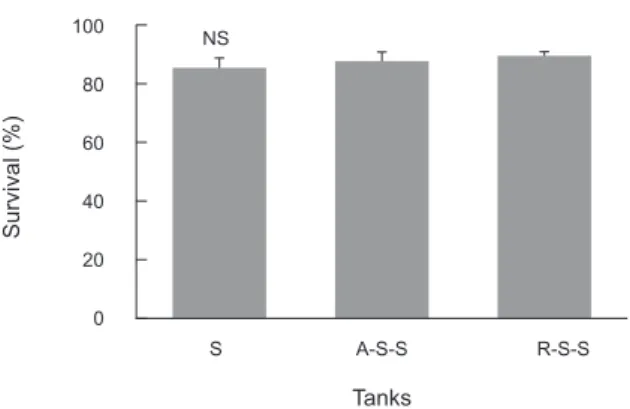
12주간사육실험종료후, 해삼의생존율을 Fig. 1에나타내
다. 모든실험구간에서 80% 이상의높은생존율값을보이면서
유의한차이를보이지않았다(P>0.05). 본연구에서해삼과복
합양식을한전복이나조피볼락은해삼을공격하거나먹이로 섭취하는현상은없었다. 이러한현상은복합양식한종들간에 먹이섭취를위한영역다툼은없었기때문으로판단된다. 본연 Table 1. Ingredient and proximate composition of experimental
diets for sea cucumber Apostichopus japonicus, abalone Haliotis discus hannai and rockfish Sebastes schlegeli
Ingredients (%) Target species
Sea cucumber Abalone Rockfish
Fish meal - 5.0 60.0
Soybean meal 40.0 41.0 -
Wheat flour 42.0 45.0 23.0
Corn gluten meal - - 5.0
Undaria powder 10.0 - -
Fish oil 2.0 3.0 6.0
Others1 6.0 6.0 6.0
Proximate analysis (%, dry matter basis)
Crude protein 30.1 35.1 51.6
Crude lipid 3.6 5.3 10.6
1Mixture of beer yeast, vitamins and minerals.
구의실험수조에서전복이나조피볼락을별도가두리로수용 하지않았지만, 양식현장에서전복이나조피볼락을양식할때 에는가두리로가두어사육하기때문에복합양식종이해삼을 공격하는현상은없을것이다. 북방전복과해삼의복합사육시 배합사료와건다시마를공급한연구(Jin et al., 2011)에서, 전복 배합사료와건다시마혼합공급구가건다시마단독공급구보 다생존율이높았다는보고도있어, 사료의종류나공급방법에 따른차이도있을것으로판단되므로앞으로다양한연구가수 행되어야할것이다.
12주간의사육한해삼의증중율을 Fig. 2에나타내었다. 조
피볼락과복합양식한 R-S-S 실험구의해삼증중율이가장높 은 값을보였다. 복합양식한 R-S-S 실험구의 해삼증중율은 해삼을단독으로수용한 S 실험구보다 유의적으로높았으며
(P<0.05), 전복과복합양식한 A-S-S 실험구와는유의한차이
를보이지않았다(P>0.05). 사육실험후의해삼전어체의일
반성분분석결과는 Table 2에나타내었다. S 실험구의수분함
량은 A-S-S 및 R-S-S 실험구들보다높았으나(P<0.05), 복합실 험구간(A-S-S와 R-S-S)에서는유의차가 없었다(P>0.05). 조
지방함량은 R-S-S 실험구가 S 실험구보다높게나타났으나
(P<0.05), R-S-S와 A-S-S 실험구, S와 A-S-S 실험구간에는차
이가없었다(P>0.05). 조단백질과조회분함량은모든실험구
간유의적인차이는없었다(P>0.05).
본연구에서해삼단독으로사육하는것보다조피볼락과함 께해삼을복합양식하는것이더높은증체율을보였는데, 이는 해삼의먹이습성때문으로판단된다. 해저의모래나암반에있 는유기물이나해조류를섭취하는해삼의특성을고려하여보 면, 어류가배설한분과같은부드러운유기물이해삼먹으로서 의기능이더높다는것을알수있다(Hauksson, 1979; Michio et al., 2003; Ramofafia et al., 1997). 이러한해삼의서식및먹 이섭취방법때문에다른종들과복합적으로양식할수있는가 능성이높을것으로판단되며, 패류인전복과복합양식에대한 연구도수행된바있다(Kang et al., 2003). 본연구에서도전복 과해삼의복합실험구의해삼성장이조피볼락과해삼복합실 험구의해삼성장과유의한차이없이양호한결과를보여전복 과의복합양식가능성도있음을암시하고있다. 반면에전복과 해삼의복합실험구의해삼성장이해삼단독사육실험구와비 교하여유의차가없는것으로나타나, 해삼은전복과같은패류 보다는조피볼락과같은어류와복합양식하는것이더효율적 일것으로판단된다. 이러한복합양식대상종에따른해삼의성 장차이는대상동물의서식형태에의한것때문으로보인다. 전복의경우는해삼처럼바닥에서기어다니기때문에서식공 간경쟁이나먹이경쟁이나타날수있는반면에유영하는조피 볼락과는이러한공간이나먹이경쟁이없거나적기때문에해 삼양식에는전복보다는조피볼락이더좋은복합양식대상종 이될수있을것이다. 또한전복용배합사료보다조피볼락용배 합사료의단백질등의필수영양소함량이높아조피볼락의배 설물에존재하는영양소가해삼성장에더도움이되었을수도 있을것이다.
Table 2. Proximate composition (%) of the whole body of juvenile sea cucumber Apostichopus japonicus fed the diets for 12 weeks1
Tanks Moisture Crude protein Crude lipid Ash
S 91.7a 35.2ns 0.59a 46.3ns
A-S-S 92.2b 37.0 1.33ab 46.6
R-S-S 92.2b 36.9 2.15b 50.5
1 Values are means from triplicate groups of sea cucumber where the means in each column with a different superscript are signifi- cantly different (P<0.05).
S, cultured sea cucumber alone; A-S-S, sea cucumber cultured with abalone; R-S-S, sea cucumber cultured with rockfish.
Survival (%)
0
S NS
A-S-S Tanks
R-S-S 40
20 60 80 100
Weight gain (%)
0
S a
ab b
A-S-S Tanks
R-S-S 20.0
40.0 60.0 80.0
Fig. 1. Survival of juvenile sea cucumber Apostichopus japonicus when cultured with abalone Haliotis discus hannai and rockfish Sebastes schlegeli for 12 weeks. S, cultured sea cucumber alone;
A-S-S, sea cucumber cultured with abalone; R-S-S, sea cucumber cultured with rockfish.
Fig. 2. Weight gain of juvenile sea cucumber Apostichopus japoni- cus when cultured with abalone Haliotis discus hannai and rockfish Sebastes schlegeli for 12 weeks. Bars having different superscripts (a-b) are significantly different (P<0.05) among group. S, cultured sea cucumber alone; A-S-S, sea cucumber cultured with abalone;
R-S-S, sea cucumber cultured with rockfish.
Survival (%)
0
S NS
A-S-S Tanks
R-S-S 40
20 60 80 100
Weight gain (%)
0
S a
ab b
A-S-S Tanks
R-S-S 20.0
40.0 60.0 80.0
복합양식의효과는다양한데, 섭취되지않은먹이나배설된 분의영양소를재이용하여환경오염원의수중배출을감소 시킬수있다. 양식장주변의수질오염은양식동물에공급되 는사료에서유래되는것이대부분이기때문에양식동물에게
공급되는사료의품질과사료공급방법이매우중요하다(Kim
et al., 1998; Lee, 1998; Lee and Pham, 2010, 2011; Lee et al.,
1999). 어패류가섭취하지못하고남은사료나배설된배설물
은수질오염원으로작용할수있으므로, 조피볼락이나전복과 같은주요양식어패류와해삼의복합양식가능성을제시할수 있다면, 어류양식장의수질개선효과와함께해삼의생산단 가를낮출수있어보다효율적인해삼양식이가능할수있을 것이다. Kang et al. (2003)의연구에서도복합양식실험구수 조의암모니아농도가대조구보다낮음을확인하였다. 그리고 동일한사육공간을두종이동시에사용함으로써경제적인사 육시스템이될수있을것이다 (Mou et al., 2000; Kang et al., 2003; Michio et al., 2003; Pitt et al., 2004; Zhou et al., 2006).
이상의결과에서, 다른어종과해삼의복합양식은여러면에 서긍정적인정보들을제공할수있을것으로판단된다. 특히, 본연구의해삼은전복보다는조피볼락과의복합양식이더유 리한것으로나타났다. 복합양식은제한된공간에서두어종을 동시에생산할수있을뿐만아니라유실되는사료및배설물을 이용한다는환경친화적인면에서매우긍정적으로검토되어 야할것이다. 다양한어종과의복합양식, 방양밀도등에대한 연구가지속된다면양식장을보다입체적으로사용하고어민의 소득을향상시킬것으로전망된다.
사 사
본연구는중소기업청에서지원하는 2010년도산학연공동기 술개발사업(과제번호 00042312)에의해 수행되었으며, 이에 감사드립니다.
References
AOAC (Association of Official Analytical Chemists). 1995.
Official Methods of Analysis of the Association of Official Analytical Chemists. 16th ed. Association of Official Ana- lytical Chemists, Arlington, VA, USA.
Cho SH, Lee SM, Park BH and Lee SM. 2006. Effect of feed- ing ratio on growth and body composition of juvenile olive flounder Paralichthys olivaceus fed extruded pellets during the summer season. Aquaculture 251, 78-84.
Choi J, Seo JY and Lee SM. 2009. Effects of sources and levels of dietary carbohydrate on growth and body composition of juvenile sea cucumbers, Apostichopus japonicus. Fish Aquat Sci 12, 203-208.
Choi J, Rahman MM and Lee SM. 2013. Distillers dried grain from makgeolli by-product is useful as a dietary ingredient for growth of juvenile sea cucumber, Apostichopus japoni-
cus. Fish Aquat Sci 16, 279-283. http://dx.doi.org/10.5657/
FAS.2013.0279.
Duncan DB. 1955. Multiple range and multiple F-tests. Biomet- rics 11, 1-42
Kang KH, Kwon JY and Kim YM. 2003. A beneficial coculture:
charm abalone Haliotis discus hannai and sea cucumber Stichopus japonicus. Aquaculture 216, 87-93.
Kang YJ, Lee SM, Hwang HK and Bai SC. 1998. Optimum dietary protein and lipid levels on growth in parrot fish Ople- gnathus fasciatus. J Aquacult 11, 1-10.
Kim JW, Lee SM, Han SJ, Kim BH and Park SR. 1998. Effects of experimental diet, commercial diets and algae (Undaria) on growth and body composition among juvenile abalones (Haliotis discus, Haliotis sieboldii and Haliotis discus han- nai). J Aquacult 11, 505-512.
Hauksson E. 1979. Feeding biology of stichopus tremulus, a de- posit feeding holothurian. Sarsia 64, 155-160.
Jin YG, Oh BS, Park MW, Cho JK, Jung CK and Kim TI. 2011.
Survival and growth of the abalone, Haliotis discus hannai and sea cucumber, Stichopus japonicas Co-cultured in in- door tank. Korean J Malacol 27, 331-336
Lee SM. 1998. Evaluation of economical feed formulations for abalone (Haliotis discus hannai). J Aquacult 11, 159-166.
Lee SM. 2002. Apparent digestibility coefficients of various feed ingredients for juvenile and grower rockfish (Sebastes schlegeli). Aquaculture 207, 79-95.
Lee SM. 2004. Utilization of dietary protein, lipid and carbohy- drate by abalone Haliotis discus hannai: a review. J Shellfish Res 23, 1027-1030.
Lee SM and Lee JH. 2004. Effect of dietary glucose, dextrin and starch on growth and body composition of juvenile starry flounder Platichthys stellatus. Fish Sci 70, 53-58.
Lee SM, Kim KD and Kim TJ. 2004. Utilization of fermented skipjack tuna viscera as a dietary protein source replacing fish meal or soybean meal for juvenile abalone Haliotis dis- cus hannai. J Shellfish Res 23, 1059-1063.
Lee SM and Pham MA. 2010. Effects of feeding frequency and feed type on growth, feed utilization and body composition of juvenile olive flounder, Paralichthys olivaceus. Aquacult Res 41, e166-e171.
Lee SM and Pham MA. 2011. Effects of carbohydrate and water temperature on nutrient and energy digestibility of juvenile and grower rockfish, Sebastes schlegeli. Asian-Aust J Anim Sci 24, 1615-1622.
Lee SM, Park CS and Go TS. 1999. Effects of formulated diet and macroalgae (Undaria) on growth and body composi- tion of juvenile abalone (Haliotis discus hannai) cultured in different shelter type and water temperature. J Kor Fish Soc 32, 284-289.
Mou SD, Li YS, Liu G and Wang Y. 2000. A review of hatch- ing, rearing and propagation technologies of sea cucumber, Apostichopus japonicus, in Shandong Province. Tran Ocean
Lim 2, 63-65.
Michio K, Kengo K, Yasunori K, Hitoshi M, Takayuki Y, Hideaki Y and Hiroshi S. 2003. Effects of deposit feeder Stichopus japonicus on algal bloom and organic matter con- tents of bottoms ediments of the enclosed sea. Mar Pollution Bull 47, 118-125.
Ramofafia C, Foyle TP and Bell JD. 1997. Growth of juvenile Actinopyga mauritiana (Holothuroidea) in captivity. Aqua- culture 152, 119-128.
Pitt R, Duy NDQ, Duy TV and Long HTC. 2004. Sandfish, Ho- lothuria scabra, with shrimp, Penaeus monodon, co-culture tankt rials. SPC Beche-de-mer Inform Bull 20, 12-22.
Seo JY and Lee SM. 2011. Optimum dietary protein and lipid levels for growth of juvenile sea cucumber Apostichopus japonicus. Aquacult Nutr 17, e56-e61.
Seo JY, Shin IS and Lee SM. 2011a. Effect of various protein sources in formulated diets on growth and body composition of juvenile sea cucumber Apostichopus japonicus (Selenka).
Aquacult Res 42, 623-627.
Seo JY, Shin IS and Lee SM. 2011b. Effect of dietary inclusion of various plant ingredients as an alternative for Sargassum thunbergii on growth and body composition of juvenile sea cucumber Apostichopus japonicus. Aquacult Nutr 17, 549- Seo JY, Kim DG, Kim GU, Cho SS, Park HG and Lee SM. 556.
2009. Effect of different substrates in the rearing tank on growth and body composition of juvenile sea cucumber Apostichopus japonicus. J Aquacult 22, 118-121.
Seo JY, Choi J and Lee SM. 2010. Influences of dietary lipid source on the growth and fatty acid composition of juvenile sea cucumber Apostichopus japonicus. Fish Aqua Sci 13, 127-132.
Yang H, Wang J, Zhou Y, Zhang T, Wang P, He Y and Zhang F. 2000. Comparison of efficiencies of different culture sys- tems in shallow sea along Yantai. J Fish China 24, 140-145.
Yang H, Zhou Y, Wang J, Zhang T, Wang P, He Y and Zhang F. 2001. A modeling estimation of carrying capacities for Chlamys farreri, Laminaria japonicus and Apostichopus ja- ponicus in Sishiliwan Bay, Yantai. J Fish Sci China 7, 27-31.
Zhang B, Sun D and Wu Y. 1995. Preliminary analysis on the feeding habit of Apostichopus japonicus in the rocky coast waters off Lingshan Island. Mar Sci 3, 11-13.
Zhou Y, Yang H, Liu S, Yuan XT, Mao Y, Liu Y, Xu WL and Zhang F. 2006. Feeding and growth on bivalve biodeposits by the deposit feeder Stichopus japonicus Selenka (Echino- dermata: Holothuroidea) co-cultured in lantern nets. Aqua- culture 256, 510-520.