518
Copyright © 2018 The Korean Society of Fisheries and Aquatic Science pISSN:0374-8111, eISSN:2287-8815
서 론
국내의연간 1인당수산물소비량은 2010년 51.3 kg, 2012년 54.9 kg, 2014년 58.9 kg 그리고 2015년에는 59.9 kg으로지 속적으로증가하고있다(Statistics Korea, 2017; Kwon et al., 2017). 해양수산부의자료에따르면 2013년-2015년의 1인당 연간수산물소비량은 58.4 kg로주요국중 1위에해당한다. 우 리나라뿐만아니라전세계적으로수산물의소비량이증가하고 있는상황이며, 1인당연간수산물소비량은 1960년도의 9.9 kg와비교하면 2013-2015년 3년간평균 20.2 kg으로나타났다 (FAO, 2016; Kwon et al., 2017). 수산물에는우리몸에유익한 단백질과불포화지방산, 약리기능성분이많이함유되어있으 며, 국민소득의향상과건강에대한사회전반의관심이높아짐 에따라수산물이건강식품으로서소비자의선호가높아졌기
때문으로볼수있다(MOF, 2016).
수산업 중 수산물 가공 산업은 국내에서 생산된 수산물의 90% 이상을소비하고있으며, 이중단순가공품이차지하는비 중은 75.9%, 고차가공품이차지하는비중은 24.1%이다(MOF, 2016). 2013년단순가공품생산량은 1,293천톤으로 2005년 대비 4.0% 증가하였다(MOF, 2016). 이에따라수산업의유통 및가공에대한중요성이부각되고있으며, 어업중심의 1차산 업에서벗어나유통, 가공등을포괄하는식품공급산업으로서 의역할이증대되고있다(MOF, 2016). 하지만, 단순가공수산 물의경우에는축산가공품및일반식품에비교하여상대적으 로식품위생안전성측면에서취약하다고보고되고있다(Kang et al., 2017; Kwon et al., 2017; Kwon et al., 2018; Kim et al.,
2018). 단순가공수산물의식품위생안전성에대한연구는패류
단순가공수산물에대한미생물학적및이화학적위해요소분
단순가공 어류 수산물 제조 공정 중의 식품학적 위해요소 분석
정민철·강민균·장유미·이도하·박슬기·신일식
1·김영목*
부경대학교 식품공학과, 1강릉원주대학교 해양식품공학과
Hazard Analysis of Food Safety in Processing Process of Simple-pro- cessed Fishery Products
Min-Chul Jeong, Min-Gyun Kang, Yu-Mi Jang, Do-Ha Lee, Seul-Ki Park, Il-Shik Shin1 and Young- Mog Kim*
Department of Food Science and Technology, Pukyong National University, Busan 48513, Korea
1Department of Marine Food Science and Technology, Gangneung-Wonju National University, Gangneung 25457, Korea
This study analyzed the food safety in processing process of simple-processed fishery products. A total of 88 samples analyzed for the presence of pathogenic bacteria and physicochemical hazards. No major foodborne pathogenic bacteria, such as
Salmonella
sp.,Listeria monocytogenes
andEscherichia coli
O157:H7, were detected in any of the samples. However,Bacillus cereus
(12 samples, 13.6%) andStaphylococcus aureus
(15 samples, 17.0%) were frequently detected in both the intermediate processing stages and the final products, although cell populations were not high. Very small amounts of heavy metals and histamine were detected in some samples, in quantities that did not exceed the safe guidelines according to Korean Government regulations. Similarly, no other physical hazards such as foreign material were observed in any of the samples. We concluded that there are no significant pathogenic bacteria or physicochemical food hazards in simply processed fish products from Korea. The present study strongly suggests that increased food sanitation measures should be implemented to decrease the prevalence ofS. aureus
in simple-processed fishery products.
Key words: Fishery product, Food safety, Hazard analysis, Processing process, Simple-processed
This is an Open Access article distributed under the terms of the Creative Commons Attribution Non-Commercial Licens (http://creativecommons.org/licenses/by-nc/3.0/) which permits unrestricted non-commercial use, distribution, and reproduction in any medium, provided the original work is properly cited.
https://doi.org/10.5657/KFAS.2018.0518 Korean J Fish Aquat Sci 51(5), 518-523, October 2018
Received 16 August 2018; Revised 14 September 2018; Accepted 19 September 2018
*Corresponding author: Tel: +82. 51. 629. 5832 Fax: +82. 51. 629. 5824 E-mail address: [email protected]
석(Kwon et al, 2017), 유통중의패류단순가공품의세균학적 위해요소분석(Kim et al., 2018), 생멸치와시판마른멸치의이 화학적및미생물학적특성(Yoon et al., 2017) 생식용굴작업 장의위생안전성에대한모니터링(Kang et al., 2017), 꽁치와 고등어등에대한연구들이보고되고있다(Yoon et al., 2009).
하지만, 생산공정중의공정중에서발생할수있는식품위해요 소들에대해서체계적으로분석한결과는미미하다.
이에본연구에서단순가공어류제품중에서생산및유통비 중이상대적으로높은과메기, 마른멸치, 염장굴비의 3종을대 상으로이들제조공장에서가공공정중시료를채취하였다. 본 연구에서얻어진제조공정별미생물학적및이화학적위해요 소들에대해분석은상대적으로연구가부족한단순가공어류 제품의가공공정중에서의식품위해요소를분석하고이를저 감화할수있는기초연구자료로이용될수있을것이다.
재료 및 방법
가공업체 및 검체
어류단순가공수산물중과메기(Guamegi Clupea pallasii)는 경상북도포항시에소재한 5곳의업체에서채취하였다. 마른멸 치(Dried anchovy Engraulis japonicus)는경상남도통영시와 경남사천시및경남거제시에소재한 5곳의업체에서채취하 였다. 염장굴비(Salted yellow croaker Larimichthys polyactis) 는전라북도영광군에소재한 2곳의업체에서채취하였다. 업
체에서채취한시료는모두멸균된시료팩(Whirl-Pak® bags;
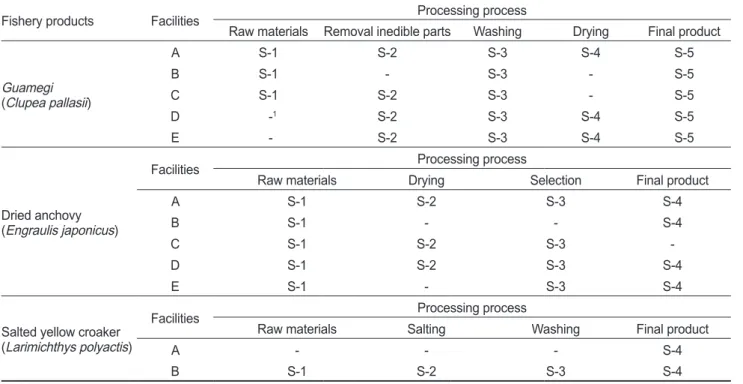
Nasco, Fort Atkinson, WI, USA)에채취하였으며, 시료는냉 장온도(4℃ 이하)에서보관, 운반하여 8 시간이내에실험을 진행하였다. 업체별공정에따른시료는 Table 1에요약하였다.
일반세균수, 대장균군 및 대장균 분석
일반세균수, 대장균군및대장균의분석은 Kwon et al. (2017)
의방법을참고하여식품공전(MFDS, 2017)의일반시험법중
미생물시험법에준하는방법으로진행하였다. 채취한어류의 가공공정의시료(25 g)에 0.85% 멸균된생리식염수 225 mL 로 10배희석한후, 120초간 Stomacher (BagMixer 400VW;
Interscience, Saint Nom, France)를이용하여 균질화하였다.
일반세균수는균질액 1 mL를취하여 0.85% 멸균생리식염
수 9 mL에단계별로희석하였다. 각단계희석액을 plate count agar (PCA; Difco, Detroit, MI, USA)에분주하여접종한후,
35±1℃에 48±2시간동안배양한후생성된집락수를측정
하였다. 대장균군및대장균은최확수법으로진행하였으며, 추 정시험의 경우 LST (lauryl sulfate tryptose), 확정시험의 경 우 BGLB (brilliant green lactose bile 2% broth)를사용하여 35±1℃, 24-48시간배양하였다. 대장균은 EC broth를사용하
여 44.5±1℃, 24시간배양하였으며, 대장균군과대장균에사
용된 BGLB, EC 배지가혼탁해지거나발효관(durham tube)
에가스가발생한것을양성으로판정하고, 이를최확수(most
probable number, MPN/100 g)로나타내었다.
Table 1. Processing process of simple-processed fishery products and sampling scheme
Fishery products Facilities Processing process
Raw materials Removal inedible parts Washing Drying Final product
Guamegi (Clupea pallasii)
A S-1 S-2 S-3 S-4 S-5
B S-1 - S-3 - S-5
C S-1 S-2 S-3 - S-5
D -1 S-2 S-3 S-4 S-5
E - S-2 S-3 S-4 S-5
Dried anchovy (Engraulis japonicus)
Facilities Processing process
Raw materials Drying Selection Final product
A S-1 S-2 S-3 S-4
B S-1 - - S-4
C S-1 S-2 S-3 -
D S-1 S-2 S-3 S-4
E S-1 - S-3 S-4
Salted yellow croaker (Larimichthys polyactis)
Facilities Processing process
Raw materials Salting Washing Final product
A - - - S-4
B S-1 S-2 S-3 S-4
1Sample was not available.
식중독 세균 분석
병원성미생물중주요식중독원인균인 Staphylococcus au- reus, Vibrio parahaemolyticus, Clostridium perfringens, Ba- cillus cereus, Salmonella sp., Escherichia coli O157:H7, 그리 고 Listeria monocytogenes 등총 7 종에대한분석을진행하였 다. 마른멸치의경우 Clostridium botulinum에대한분석을별 도로진행하였다. 모든미생물분석은식품공전(MFDS, 2017) 의시험법에따라실험을진행하였다. S. aureus, V. parahaemo- lyticus, C. perfringens 및 B. cereus는정량실험을진행하였으 며, Salmonella sp., E. coli O157:H7, L. monocytogenes 및 C.
botulinum는정성실험을진행하였다.
이화학적 위해요소 분석
중금속은 Kwon et al. (2017)의 분석법과동일하게 진행하 였으며, 단순가공 어류 수산물의 완제품에 한하여 실시되었 다. 가식부위의수은(Hg), 납(Pb)과카드뮴(Cd)의함량에대 해분석하였다. 중금속분석은부경대학교부경푸드바이오센 터에 의뢰하여 유도플라스마 질량분석기(Optima 3300XL;
PerkinElmer, Waltham, USA)를 이용하여 분석을 진행하였 다. 히스타민분석은부경대학교부경푸드바이오센터에의뢰 하여 HPLC (Agilent 1100 series; Agilent Technologies, Wald- bronn, Germany)를이용하여분석을진행하였다. 이물은육안 검사를통하여최종제품에서연질및경질이물을검사하였다.
결과 및 고찰
어류 단순 가공 업체의 가공 공정 중의 일반세균 및 위 생지표세균 위해요소 분석
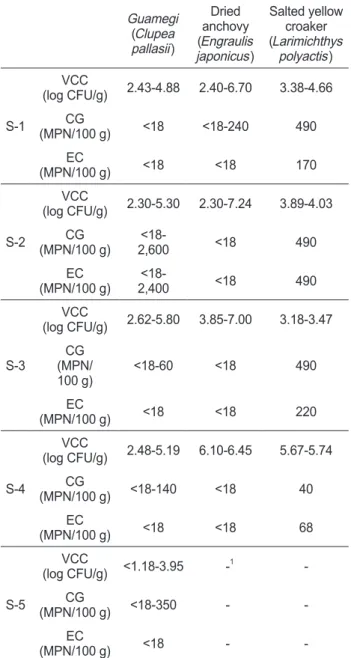
어류가공품중냉장및냉동으로유통되는제품(과메기, 마른 멸치및염장굴비)의원료부터최종완제품생산까지의공정별 일반세균수, 대장균군및대장균을분석하였다(Table 2). 냉장 및냉동으로유통되는어류가공품에서일반세균수는 <1.18- 7.24 log CFU/g, 대장균군은 <18-2,600 MPN/100 g이며대장 균은 <18-2,400 MPN/100 g으로나타났다. 이중과메기의경 우, 최종완제품의 일반세균수는 <1.18-3.95 log CFU/g으로 나타나위생학적으로양호하다고판단되었고, 원료부터 최종 완제품까지의공정별시료분석결과 모든시료가 <18-2,400 MPN/100 g으로내장제거공정(S-2)에서다소높은수치로검 출되었으나최종완제품에서는 <18 MPN/100 g으로나타났다. 이는 Yoon et al. (2009)의보고된유통중인과메기에대한시 료보다가공공장의공정중시료의경우일반세균수와대장균 군모두낮은수치로분석되었다. 따라서, 공정상건포류기준 인 n=5, c=2, m=0, M=10 이하로분석되어식품위생학적으로 큰우려가없는것으로나타났다(MFDS, 2017). 마른멸치의경 우, 최종완제품의일반세균수는 6.10-6.45 log CFU/g으로나 타나 Yoon et al. (2017)의보고와비슷한수치의일반세균수가
Table 2. Bacteriological levels on intermediates and final products obtained in the processing process of simple-processed fishery products
Guamegi (Clupea pallasii)
Dried anchovy (Engraulis japonicus)
Salted yellow croaker (Larimichthys
polyactis)
S-1
(log CFU/g)VCC 2.43-4.88 2.40-6.70 3.38-4.66
(MPN/100 g)CG <18 <18-240 490 (MPN/100 g)EC <18 <18 170
S-2
(log CFU/g)VCC 2.30-5.30 2.30-7.24 3.89-4.03
(MPN/100 g)CG <18-
2,600 <18 490
(MPN/100 g)EC <18-
2,400 <18 490
S-3
(log CFU/g)VCC 2.62-5.80 3.85-7.00 3.18-3.47
(MPN/CG
100 g) <18-60 <18 490
(MPN/100 g)EC <18 <18 220
S-4
(log CFU/g)VCC 2.48-5.19 6.10-6.45 5.67-5.74
(MPN/100 g)CG <18-140 <18 40
(MPN/100 g)EC <18 <18 68
S-5
(log CFU/g) <1.18-3.95VCC -1 -
(MPN/100 g)CG <18-350 - -
(MPN/100 g)EC <18 - -
VCC, Viable cell counts; CG, Coliform group; EC, Escherichia coli. 1Sample was not available.
검출되었다. 또한, 염장굴비의경우, 최종완제품의일반세균 수는 5.67-5.74 CFU/g으로마른멸치와비슷한수치로검출이 되었다. 마른멸치와염장굴비의경우가공공정이진행되면서 일반세균수가증가하는경향이나타나고있는데이는공정중 의종사자또는장비등에의한교차오염이주된원인으로판단 된다. 마른멸치와염장굴비의경우최종제품에서일반세균수
가 5 log CFU/g 이상으로나타났지만대부분가열조리하여섭
취하는제품의특성을고려하면미생물학적문제점은없는것
으로사료된다(MFDS, 2017).
어류 단순 가공 업체의 가공 공정 중의 식중독 세균 위 해요소 분석
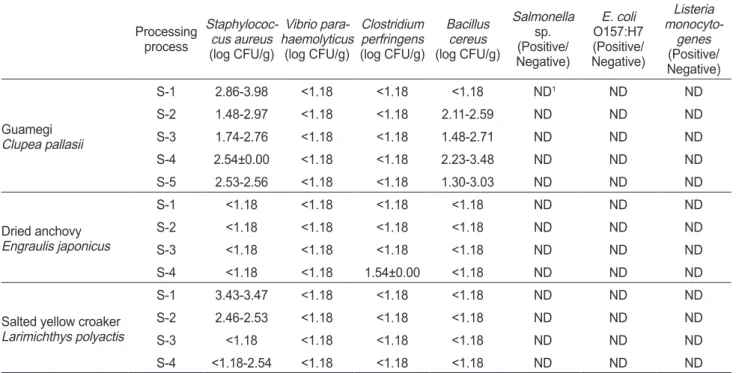
단순가공어류수산물의가공공정중의시료에대한주요식 중독세균(S. aureus, B. cereus, C. perfringens, C. botulinum, V. parahaemolyticus, Salmonella sp., E. coli O157:H7, L.
monocytogenes)의분석결과는 Table 3에나타냈다. 모든시 료에서위해도가높은주요식중독세균인 Salmonella sp., L.
monocytogenes, E. coli O157:H7 과 C. botulinum (마른멸치 에서만) 검출되지않았다. 하지만, 일부시료에서 B. cereus 와 S. aureus는의검출빈도가상대적으로높게나타났다(Table 3).
B. cereus는단순가공어류수산물중과메기에서만검출되는
것으로분석되었다. 공정별로원물(S-1)에서 <1.18 log CFU/g, 내장제거공정(S-2)에서 2.11-2.59 log CFU/g, 세척공정(S-3) 에서 1.48-2.71 log CFU/g, 건조공정(S-4)에서 2.23-3.48 log CFU/g으로나타났으며 포장공정(S-5)에서는 1.30-3.03 log
CFU/g으로분석되었다. 식품공전중에과메기에대한기준은
없지만즉석섭취가가능한과메기의특성을고려하여즉석섭 취·편의식품류에대한 B. cereus 기준(<1,000 CFU/g)과비교 하였을때과메기공정시료중에서 1개의시료(전체 40건)에 서기준을초과하였다(MFDS, 2017). B. cereus의경우낮은 pH에서도생존이가능한독소물질에의한식중독을일으키는
구토형식중독과 cereulide를형성하여구토를일으키는설사
형식중독으로나뉠수있다(Granum and Lund, 1997; Chang
et al., 2009). 또한, B. cereus의영양세포의경우열처리에의해 쉽게파괴되지만포자는열에대한저항성이있다고알려져있 으며, 포자형성능력때문에조리의모든단계는물론레트로트 식품에서도균의생존이가능하다(Fricker et al., 2007; Chang et al., 2009). Kim et al. (2009)이보고한바와같이 B. cereus의 경우어류수산물의내장제거공정및염장공정등껍질을까 는공정을거치는동안작업자및작업환경중에교차오염된것 으로분석된다. 따라서, 과메기제조공정및최종포장제품에 서 3 log CFU/g이상의수치로 B. cereus가검출되는경우는거 의없지만, B. cereus가검출되는빈도가높기때문에가공공정 및종사자들에대한위생관리강화가필요한것으로사료된다.
S. aureus는단순가공어류수산물중과메기및염장굴비에
서 검출되는 것으로분석되었다. 과메기의 경우 원물(S-1)에 서 2.87-3.98 log CFU/g, 내장제거공정(S-2)에서 1.48-2.97 log CFU/g, 세척 공정(S-3)에서 1.74-2.76 log CFU/g, 건조 공정(S-4) 2.54 log CFU/g으로나타났으며포장공정(S-5)에 서 2.53-2.56 log CFU/g이었다. 식품공전중의기준은없지만 즉석섭취가가능한과메기의특성을고려하여식품일반의기 준및규격과비교하였을때, 일부의시료가제조공정단계에 서기준을초과하여, 향후공정개선이필요한것으로사료된 다(MFDS, 2017). 하지만, 과메기에오염되어있는 S. aureus 의오염도는식중독위해도, 섭취빈도, 섭취량과섭취시기등 을고려하였을때주요식품학적위해요소는아닌것으로판단 된다(Park et al., 2013; Kwon et al., 2017). 또한, 염장굴비의 경우원물공정(S-1)에서 3.43-3.47 log CFU/g, 염장공정(S-2)
Table 3. Pathogenic bacterial level on intermediates and final products obtained in simple-processed fishery products
Processing process
Staphylococ- cus aureus (log CFU/g)
Vibrio para- haemolyticus
(log CFU/g)
Clostridium perfringens (log CFU/g)
Bacillus cereus (log CFU/g)
Salmonella (Positive/sp.
Negative)
E. coli O157:H7 (Positive/
Negative)
Listeria monocyto-
genes (Positive/
Negative)
Guamegi Clupea pallasii
S-1 2.86-3.98 <1.18 <1.18 <1.18 ND1 ND ND
S-2 1.48-2.97 <1.18 <1.18 2.11-2.59 ND ND ND
S-3 1.74-2.76 <1.18 <1.18 1.48-2.71 ND ND ND
S-4 2.54±0.00 <1.18 <1.18 2.23-3.48 ND ND ND
S-5 2.53-2.56 <1.18 <1.18 1.30-3.03 ND ND ND
Dried anchovy Engraulis japonicus
S-1 <1.18 <1.18 <1.18 <1.18 ND ND ND
S-2 <1.18 <1.18 <1.18 <1.18 ND ND ND
S-3 <1.18 <1.18 <1.18 <1.18 ND ND ND
S-4 <1.18 <1.18 1.54±0.00 <1.18 ND ND ND
Salted yellow croaker Larimichthys polyactis
S-1 3.43-3.47 <1.18 <1.18 <1.18 ND ND ND
S-2 2.46-2.53 <1.18 <1.18 <1.18 ND ND ND
S-3 <1.18 <1.18 <1.18 <1.18 ND ND ND
S-4 <1.18-2.54 <1.18 <1.18 <1.18 ND ND ND
1Not detected. Clostridium botulinum was not detected in the samples of dried anchovy.
에서 2.46-2.53 log CFU/g, 세척공정(S-3)에서S. aureus 가 1.47 log CFU/g으로검출되었으며포장공정(S-4)에서 1.70- 2.54 log CFU/g으로검출되었다. 염장굴비는가열하여섭취하
는식품으로 S. aureus 오염으로인한식품학적위해요소는없
는것으로판단된다.
이상의결과를종합해보면, 과메기가공공정및염장굴비가 공공정의경우모든공정이작업자들의수작업으로이루어지 고있어작업자손에의한잠재적인교차오염에대한위험성이 있는것으로분석되었다. Martin et al. (2004)은작업자가식품 의취급시미생물을포함한위해인자를주변환경이나여러오 염원으로부터식품으로옮기는매개역할을하고, 특히손은식 품중병원성미생물의오염에있어서직접또는간접적인주요 경로가되어식중독발생원인의큰부분을차지하고있기때문 에식품을취급하는현장에서의작업자개인위생관리는매우 중요하다고제시하였다. 그리고, Kjolen and Amdersen (1992) 도일반적인손세척은일반세균수가감소되나균의효과적인 제거가불충분하여, 반드시소독이병행되어야한다고보고한 바있다. 또한, Bae (2006)은가열조리된닭볶음탕, 잡채, 비빔 밥, 콩나물무침에서 S. aureus가검출되었다고보고하였다. 이 러한결과들은종업원의손, 재료를손질한도마등에의한것 으로판단되며, 내장제거, 세척, 염장, 포장공정을필히거치게 되는단순가공어류수산물또한가공특성상가공공장의작업 자들의손, 칼, 도마, 세척대등에의해오염이발생할가능성이 높다고생각된다. 이에작업자들의개인위생관리는매우중요 하며, 수작업으로진행되고있는단순가공수산물의경우원료 의오염방지와함께제품원재료보관시 10℃이하의저온보 관이이루어져야한다(Im et al., 2007). 또한, 작업자들의개인 위생관리강화가필요한것으로판단된다(Kwon et al., 2017).
어류 단순 가공 업체의 가공 공정 중의 이화학적 위해 요소 분석
단순가공어류수산물의최종완제품에서의중금속함량을분 석하기위하여납, 카드뮴그리고총수은함량에대하여분석하 였으며추가적으로이물분석및히스타민함량분석도진행하 였다. 모든단순가공어류수산물에서납은 ND (not detected, 불검출)-0.3 mg/kg, 카드뮴은 ND-0.2 mg/kg, 그리고총수은은 ND-0.1 mg/kg으로분석되어식품공전(MFDS, 2017) 중어류 의중금속기준(납 0.5 mg 이하/kg; 카드뮴 0.2 mg 이하/kg; 총 수은 0.5 mg 이하/kg)을초과하는시료는없었다. 또한최종완 제품중의이물은검출되지않았다. 최종완제품에대한히스타
민은 ND-0.1 mg/kg으로분석되어식품공전중수산물의히스
타민기준[냉동어류, 염장어류, 통조림, 건조또는절단등단 순처리한것(어육, 필렛, 건멸치등): 200 mg/kg 이하(고등어, 다랑어류, 연어, 꽁치, 청어, 멸치, 삼치, 정어리, 몽치다래, 물치 다래에한한다)]을초과하는시료는없었다(MFDS, 2017). 이 처럼단순가공어류수산물의최종완제품중기준치를초과하
는시료는없었지만, 중금속의경우제조공정중제어가불가능 하기때문에원료입고단계에서보다철저한원료관리가필요 한것으로판단된다.
본연구에서는단순가공어류수산물의종류별식품위생안전 성확보를위해원료에서부터최종완제품가공공정전반에걸 쳐일반세균수, 대장균군, 식중독세균, 중금속, 이물및히스 타민등의미생물학적ㆍ이화학적위해요소를분석하였다. 이 를위해주요어류가공품인과메기, 마른멸치그리고염장굴 비제조업체 12곳을방문하고각가공공정별시료및환경분 석시료를채취하였으며, 각공정별로식품위해요소를분석하 였다. 일반세균수등의위생지표세균에대한미생물학적오염 도는제품별로다소차이가있는것으로분석되었다. 주요식 중독세균은 Salmonella sp., L. monocytogenes 그리고 E. coli
O157:H7 등과같은위해도가높은주요식중독균은검출되지
않았지만상대적으로저위해도의 S. aureus의검출율이높았다 (Kwon et al., 2017; Kim et al., 2017; MFDS, 2017). 그외에중 금속등의이화학적위해요소의경우모든단순가공어류수산 물이식품공전의식품기준및규격을충족하는것으로나타났 다(MFDS, 2017). 하지만, 종업원및가공공정중의작업자의 손에의한교차오염으로추정되는 S. aureus가높은빈도로단 순가공어류수산물최종제품에서검출되고있는것을분석할 수있었다. 따라서, 단순가공어류수산물의미생물학적위해요 소를줄이기위해서는보다적극적인종업원의위생교육과가 공공정중의기구및설비에대하여세척및소독등의체계적 인위생관리가필요하다고판단된다.
사 사
이논문은 2018년도식품의약품안전처에서시행한용역연구
개발과제의연구개발비지원(16162수산물601)에의해수행되 었습니다.
References
Bae HJ. 2006. Analysis of contamination of bacteria from raw materials, utensils and workers’ hands to prepared foods in foodservice operations. Korean Soc Food Sci Nutr 35, 655- 660. https://doi.org/10.3746/jkfn.2006.35.5.655.
Chang HJ and Lee JH. 2009. Prevalence of bacillus cereus from fried rice dishes and monitoring guidelines for risk manage- ment. Korean J Food Cookery Sci 25, 45-54.
FAO (Food and Agriculture Organization of the United Na- tions). 2016. The state of world fisheries and aquaculture 2016. Retrieved from http://www.fao.org/publications/ so- fia/2016/en/?platform= on Jun 2, 2018.
Fricker M, Messelhӓuβer U, Busch U, Scherer S and Ehling- Schulz M. 2007. Diagnostic real-time PCR assays for the detection of emetic Bacillus cereus strains in foods and recent food-borne outbreaks. Appl Environ Microbiol 73,
1892-1898.
Granum PE and Lund T. 1997. Bacillus cereus and it's food poi- soning toxins. FEMS Microbiol Lett 157, 223-228.
Im MN, Lee SJ and Lee KG. 2007. Quantitative risk assess- ment modeling for Staphylococcus aureus in sushi. Food Eng Prog 11, 77-83.
Kang KT, Park SY, Choi JD, Kim MJ, Heu MS and Kim JS.
2017. Safety monitoring of a processing plant for prepar- ing raw oysters Crassostrea gigas for consumption. Korean J Fish Aquat Sci 50, 120-129. http://dx.doi.org/10.5657/
KFAS.2017.0120.
Kwon KO, Ryu DG, Jeong MC, Kang EH, Shin IS and Kim YM. 2017. Microbiological and physicochemical hazard analysis in processing process of simple-processed shellfish products. Korean J Fish Aquat Sci 50, 352-358. https://doi.
org/10.5657/KFAS.2017.0352.
Kwon KO, Ryu DG, Jeong MC, Kang EH, Jang YM, Kwon JY, Kim JM, Shin IS and Kim YM. 2018. Analysis of micro- bial contaminants and microbial changes during dried-laver processing. Korean J Fish Aquat Sci 51, 8-14. https://doi.
org/10.5657/KFAS.2018.0008.
Kim HJ, Lee DS, Lee JM, Kim YM and Shin IS. 2018. Bacte- riological hazard analysis in minimally processed shellfish products purchased from Korean seafood retail outlets. Ko- rean J Fish Aquat Sci 51, 121-126.
Kim YH, Ryu K and Lee YK. 2009. Microbiological safety dur- ing delivering of food ingredients supplied to elementary school food services in daegu and gyeongbuk provinces -seafood, meat and frozen processing food. Korean J Food Preserv 16, 2, 276-285.
Kjolen H and Amdersen BM. 1992. Hand washing and disinfec- tion of heavily contaminated hands-effective or ineffective.
J Hospital Infect 21, 61-71.
Martin MC, Fueyo JM, Gonzalez-Hevia MA and Mendoza MC.
2004. Generic procedures for identification of enterotoxi- genic strains of staphylococcus aureus from three food poi- soning outbreaks. Int J Food Microbiol 94, 279286. http://
dx.doi.org/ 10.1016/j.ijfoodmicro.2004.01.011.
MOF (Ministry of Oceans and Fisheries). 2016. Statistical year- book of fisheries production. Retrieved from http://www.
fips.go.kr/jsp/sf/ss/ss_kind_law_list.jsp?menuDepth=
070104 on Jun 1, 2017.
MFDS (Ministry of Food and Drug Safety). 2017. Korean food standards codex. Retrieved from http://www.foodsafe- tykorea.go.kr/foodcode/01_01.jsp on Jul 13, 2018.
Park HJ, Min KJ, Park NY, Cho JI, Lee SH, Hwang IG, Heo JJ and Yoon KS. 2013. Estimation on the consumption patterns of potentially hazardous foods with high consumer risk per- ception. Korean J Food Thechnol 45, 59-69. http://dx.doi.
org/10.9721/KJFST.2013.45.1.59.
Statistics Korea. 2017. Seafood consumption, the fishery pro- duction statistics. Retrieved from http://www.index.go.kr/
potal/main/EachDtlPageDetail.do?idx_cd=1317 on Jun 3, 2018.
Yoon HJ, Ham IT, Kim JS and Choi JD. 2017. Physicochemi- cal and microbiological characteristics of raw anchovies and boiled-dried anchovies on the market. JFMSE, 29, 1945- 1955. http://dx.doi.org/10.13000/JFMSE.2017.29.6.1945.
Yoon MS, Kim HJ, Park KH, Shin JH, Jung IN, Heu MS and Kim JS. 2009. Biogenic amine content and hygienic qual- ity characterization of commercial kwamegi. Korean J Fish Aquat Sci 42, 403-410.