Convergent Influence of Ego-Resilience, Nunchi and
Self-Leadership on Communication Competency among Students in Health Majors in Studying for TOEIC
Soomi Hong, Sang-Yun Bae
*Professor, Dept. of Health Administration, Vision University of Jeonju
TOEIC을 학습하는 보건계열 일부 대학생의 자아탄력성, 눈치 및 셀프리더쉽이 의사소통능력에 미치는 융복합적인
영향
홍수미, 배상윤
*전주비전대학교 보건행정학과 교수
Abstract This study investigated the relationship between ego-resilience, Nunchi, self-leadership, and communication competency of Health Majors Students in Studying for TOEIC(HMSST) and analyzed the convergent influence on communication competency. For collection data, this study distributed self-administered questionnaires from November 1 to November 30, 2018 and the questionnaires were distributed to randomly selected 280 health majors students in TOEIC class from colleges located in J area.
The survey showed that the communication competency was positively correlated with ego-resilience, Nunchi and self-leadership. The covariance structure analysis showed that the higher ego-resilience, the higher Nunchi and the higher self-leadership tend to increase communication competency. The results of the study indicate that the efforts to increase ego-resilience, Nunchi and self-leadership will improve communication competency of HMSST. These results are expected to be utilized in educational support and mediation to enhance the communication competency among HMSST. In the following study, the research on the additional factors which may influence on communication competency will be needed.
Key Words : Convergence, Students in health majors, TOEIC, Ego-resilience, Nunchi, Self-leadership, Communication competency
요 약 본 연구는 토익을 학습하는 보건계열 일부 대학생의 자아탄력성, 눈치 및 셀프리더쉽과 의사소통능력의 관련성 을 파악하고 의사소통능력에 미치는 융복합적 영향을 분석하였다. 자료수집은 2018년 11월 1일부터 2018년 11월 30일까지 자기기입식 설문지를 사용하였으며, 조사대상은 임의로 선정된 J지역 소재 대학의 보건계열 토익학습반에 참여하는 대학생 280명으로 하였다. 의사소통능력은 자아탄력성, 눈치 및 셀프리더쉽과 양의 상관관계를 보였다. 공분 산 구조분석 결과, 자아탄력성이 높아질수록, 눈치가 높아질수록, 셀프리더쉽 이 높아질수록 의사소통능력을 증가시키는 것 으로 나타났다. 이러한 결과를 볼 때, 토익을 학습하는 보건계열 대학생의 의사소통능력을 높이기 위해서는 자아탄력성, 눈치 및 셀프리더쉽을 높이는 노력이 필요하다. 이러한 결과는 토익을 학습하는 보건계열 대학생의 의사소통능력을 높이는 교육 지원 및 중재 노력에 활용이 기대된다. 향후연구에서는 의사소통능력에 영향을 미치는 추가요인에 대한 조사가 필요하다.
주제어 : 융복합, 보건계열대학생, 토익, 자아탄력성, 눈치, 셀프리더쉽, 의사소통능력
*Corresponding Author : Sang-Yun Bae([email protected])
Received March 1, 2019 Revised March 31, 2019
Accepted June 20, 2019 Published June 28, 2019
1. Introduction
Hospitals have been repeated external growth continuously due to the change of population structure, economic growth, urbanization, expansion of medical care insurance, keynote change of the health focusing on primary prevention, and social demand of high quality medical service[1]. In addition, progress of medical device, development and spread of new diagnosis and treatment, expansion of customer interaction for various medical service, and the demand on high job level for hospital workers is offering a foundation that hospitals could sustain its growth internally by leading the innovation of hospital management, supervision of medical quality, and labour productivity increase[2]. The internal and external growth of hospital raises demand for international medical service[3], the change of medical system to meet the demand and the necessity of manpower which is possible to communicate with foreign patients is increasing[4].
The hospital duty is a labor intensive manpower system focusing on the human resource, and it has trouble to deal with unhealthy and unstable patients or urgent and busy guardians in the customer interaction[1].
The communication competency which is to understand the thought, emotions, languages, behaviors, and words of Korean patients is needed for long term training and professionalism. Furthermore, it could add to the communication difficulty while dealing with foreign visitors who speak foreign language, especially English as a global official language[2]. As the international medical service is been expanded, the communication competency reinforcement of students in health majors is a demand as a mission of the time[5]. The English communication competency could increase the academic burden but it could offer new opportunity to university students as a leading role in future who conducts a hospital duty[1].
To enhance the English communication competency of students in health majors, the usage of TOEIC(Test Of English for International Communication) education program focusing on the working level English is expected[2]. TOEIC is a English evaluation test as a foreign language, and it tests daily and working level English. Its use is expending such as entrance examination, recruitment, and performance ability enhancement in public and private factors[3]. Universities open TOEIC learning class in regular and special curriculum to support the improvement of English communication competency for students which could enhance the capability of field business[2].
Students in health majors could improve its field capability to conduct a job as international hospital service and become a customized manpower for international medical environment by using TOEIC education[3].
The communication competency is a capability
to express own intention or coordinate its
opinions with others[6], it is a necessary capability
that students in health majors who are completing
the curriculum to serve hospital customers
should have. The communication competency in
hospital is a necessary factor to conduct quality
medical service by creating an effective
interaction while serving patients and offering
treatments and building a mutual trust to
cooperate with colleagues[7]. The communication
competency is a core capability of business
practice for students in health majors to conduct
hospital job in the problem solve and mutual
cooperation relationship[7,8]. The communication
competency is an important tool to create a
relationship through trust[7], and it is related to
a capability to manage own emotions suitably by
dealing with the situation smoothly[7]. It also
bears on the psychological perspective which
adjusts the level of tensions and patience and
conducts demands occurring by situation
successfully[8]. Nunchi[9,10] which understands
situations and act suitably is related to the
capability to communicate with customers and colleagues in hospital[11]. It assumes that successful reaction, creative action, and the best fulfillment as features of self-leadership[12] has an effect on the communication competency directly.
To set up a causality model to influence the communication competency of students in health majors who study TOEIC to prepare a performance competency of international medical service, existing studies have been investigated, and the result showed that ego-resilience, Nunchi, and self-leadership showed a correlation. It was reported that the ego-resilience as a suitable self control in situation change and flexible response has an effect on the communication competency[7,8], Nunchi as to understand own situation and others’ mind and act suitably is related to the communication competency[10,11], and self-leadership as to conduct tasks successfully with creative and optimum ability is related to the communication competency[12]. These existing researches analyzed individual factors which is related to the communication competency and partial correlation with the communication competency, but there is limitation that the inter-connectivity and the effect of Nunchi and self-leadership were not analyzed in the existing researches. Therefore, this research considered that the capability to control the emotions by responding to the situation flexibly, the capability of the situational understanding and to act suitably, and the capability to complete tasks creatively and optimally are related mutually and the communication competency could increase by influencing each other. This study is aiming to suggest a structural model of the relations among factors based on the existing studies, and attempt to convergence approach to analyze the comparative importance and mutual influence among ego-resilience, Nunchi, self-leadership, and communication competency.
The purpose of this study is to offer basic standards for usage of education supports and
arbitration effect to increase the communication competency of students in health majors by analyzing the structural model and investigating ego-resilience, Nunchi, self-leadership, and communication competency of students in health majors who study TOEIC and understanding convergent influence to be affected the factors and the communication competency.
2. Study method
2.1 Subject of survey
The subjects were randomly selected college students in health majors and participate in TOEIC learning class in the college located in J district. The period of survey was from November 1 to 30 in 2018. According to the existing studies[13] which suggested the calculation of moderate number of samples for a structural equation model analysis, Jöreskog and Söbom said that the sample size shall be about 200 when the number of observational variable is under 12 while the sample size of shall be about 1.5×number of observational variable×(number of observational variable+1) when there are more than 12 observational variables. On the other hand, Bentler and Chou suggested that the sample size shall be 5 times higher than the number of error variable and path coefficient.
Also, Mitchell claimed that the sample size shall
be 10 to 20 times higher for each variable. In
consideration of the existing studies, this study
estimated the sample size over 200 subjects and
randomly selected 350 subjects considering the
drop rate. The survey result showed that 326
answers were collected(93.1%) and 280 were used
and 46 poor responses were eliminated. To
follow research ethics, researchers visited TOEIC
learning class personally and explained the
purpose and contents of the study, the right to
refuse, the protection and fill-in method of
Scale
Sub-domains No. Range Mean±SD
Normality Validity Reliability
Min Max Skewness Kurtosis λ
>.5
CMIN/DF
<3 p
>.05 NFI
>.9 CFI
>.9 TLI
>.9 RMSEA
<.08
Cronbach'α (%)
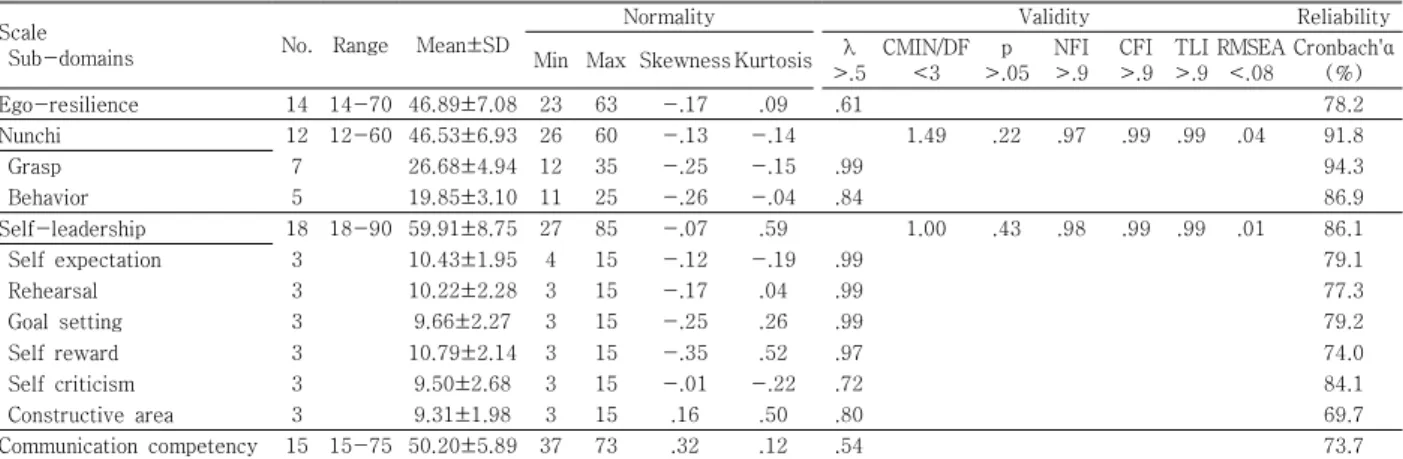
Ego-resilience 14 14-70 46.89±7.08 23 63 -.17 .09 .61 78.2
Nunchi 12 12-60 46.53±6.93 26 60 -.13 -.14 1.49 .22 .97 .99 .99 .04 91.8
Grasp 7 26.68±4.94 12 35 -.25 -.15 .99 94.3
Behavior 5 19.85±3.10 11 25 -.26 -.04 .84 86.9
Self-leadership 18 18-90 59.91±8.75 27 85 -.07 .59 1.00 .43 .98 .99 .99 .01 86.1
Self expectation 3 10.43±1.95 4 15 -.12 -.19 .99 79.1
Rehearsal 3 10.22±2.28 3 15 -.17 .04 .99 77.3
Goal setting 3 9.66±2.27 3 15 -.25 .26 .99 79.2
Self reward 3 10.79±2.14 3 15 -.35 .52 .97 74.0
Self criticism 3 9.50±2.68 3 15 -.01 -.22 .72 84.1
Constructive area 3 9.31±1.98 3 15 .16 .50 .80 69.7
Communication competency 15 15-75 50.20±5.89 37 73 .32 .12 .54 73.7
Table 1. The normality, validity and reliability of used scale survey. The target of study received the structured anonymous self-administered questionnaire and the survey was filled in by self enumeration method and collected.
2.2 Survey tool
The survey consisted of ego-resilience, Nunchi, self-leadership, and communication competency.
The ego-resilience is an index[15] to verify the validity by translating and modifying a measurement tool of Block and Kremen[14], and the index means that the higher point is, the higher ego-resilience it is. In regard to the Cronbach’s α figure indicating the internal reliability, the figure was 0.880 in the existing study while the figure 0.782 in this study. Although the Cronbach’s α figure was relatively lower, the existing study[7] on nursing university students indicated the figure of 0.810. Thus, this study's reliability is acceptable.
Nunchi is a measurement tool developed by Heo Jaehong et al.[10], and it means that the higher point is, the more Nunchi it has. Its subdomain consists of grasp factor and behavior factor. The self-leadership is an index to prove the validity by modifying and complementing a measurement tool developed by Manz[16], and the index means that the higher point is, the higher self-leadership is. Its subdomain consists of self expectation, rehearsal, goal setting, self reward, self criticism, and constructive area. The communication competency is an index[18] to suggest the validity by modifying and
complementing ICC(Interpersonal communication Competence)[6] of Rubin, and the index means that the higher point is, the higher communication competency is. Cronbach’s α figure indicating the internal reliability was 0.720 in the existing study and 0.737 in this study.
Table 1 showed the number of index question, range of point, average, standard deviation, normality, validity, and reliability to measure ego-resilience, Nunchi, self-leadership, and communication competency. The value of investigated index has been verified its normality because its skewness and kutosis does not over the absolute value 2. To verify the validity of used index, confirmatory factor analysis was conducted, and the result showed that standard factor loadings(λ), χ
2/df, p, NFI(Normed Fit Index), CFI(Comparative Fit Index), TLI(Tucker-Lewis Index), the value of RMSEA(Root Mean Square Error of Approximation) met the standard, that means it made sure of the validity. The value of Cronbach’s α as an inner reliability for used index showed the acceptable level.
2.3 Data treatment
Pearson coefficient of correlation of ego-resilience,
Nunchi, self-leadership, and communication competency had
been calculated. The structural equation modeling(SEM)
estimated parameters based on the maximum-likelihood
classification, and used variables had selected component
of each model as latent variable and variables of
each component as observed variable. When selecting variables, they should have a significant relation in the individual simplicity analysis for each route, support a theoretical model, and compose suitable model for the model fit. The exogenous latent variable incorporated the ego-resilience into the SEM and the endogenous latent variable incorporated Nunchi, self-leadership, and communication competency into the SEM. Each path coefficient marked significant result in the path diagram. Every significance level of statistics was p<.05.
3. Study result
3.1 Demographic factors of subjects
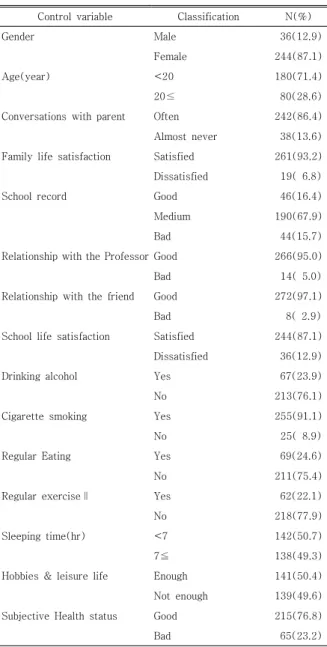
Table 2 was the demographic characteristics of targets: female students are 87.1%, male students are 12.9%, less than 20 years old is 71.4%, more than 20 years old is 28.6%, frequent conversation with parents is 86.4%, unfrequent conversation with parents is 13.6%, 93.2% of family life satisfaction and 6.8% of family life dissatisfaction, 16.4% of good school record, 67.9% of normal school record, 15.7% of bad school record, 95.0% of good relationship with professor and 5.0% of bad relationship with professor, 97.1% of good friendship and 2.9% of bad friendship, 87.1% of school life satisfaction and 12.9% of school life dissatisfaction, 23.9% of drinking habit, 76.1% of non drinking habit, 91.1% of smoking habit and 8.9% of non smoking habit, 24.6% of regular meal and 75.4% of irregular meal, 22.1% of regular exercise and 77.9% of irregular exercise, less than 7 hours sleeping is 50.7% and more than 7 hours sleeping is 49.3%, 50.4% of having enough hobby and leisure life and 49.6% of having deficient hobby and leisure life, 76.8% of good subjective health condition and 23.2% of bad subjective health condition.
Control variable Classification N(%)
Gender Male 36(12.9)
Female 244(87.1)
Age(year) <20 180(71.4)
20≤ 80(28.6)
Conversations with parent Often 242(86.4) Almost never 38(13.6) Family life satisfaction Satisfied 261(93.2) Dissatisfied 19( 6.8)
School record Good 46(16.4)
Medium 190(67.9)
Bad 44(15.7)
Relationship with the Professor Good 266(95.0)
Bad 14( 5.0)
Relationship with the friend Good 272(97.1)
Bad 8( 2.9)
School life satisfaction Satisfied 244(87.1) Dissatisfied 36(12.9)
Drinking alcohol Yes 67(23.9)
No 213(76.1)
Cigarette smoking Yes 255(91.1)
No 25( 8.9)
Regular Eating Yes 69(24.6)
No 211(75.4)
Regular exercise∥ Yes 62(22.1)
No 218(77.9)
Sleeping time(hr) <7 142(50.7)
7≦ 138(49.3)
Hobbies & leisure life Enough 141(50.4)
Not enough 139(49.6)
Subjective Health status Good 215(76.8)
Bad 65(23.2)
∥: At least three times a week, more than 30 minutes at a time.
Table 2. Demographic factor of subjects (n=280)
3.2 Correlation between communication competency and relevant variables
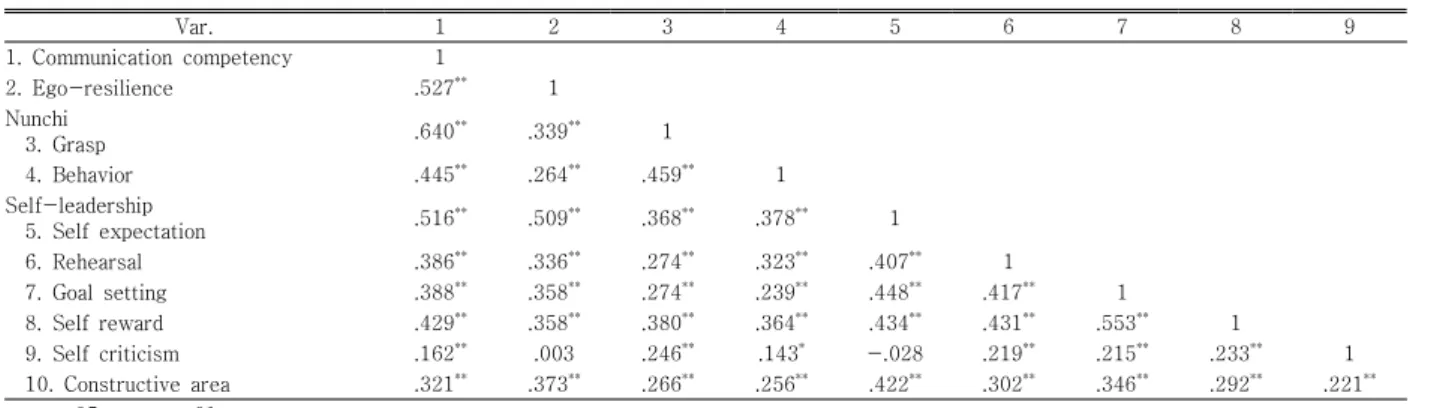
Table 3 showed that the communication
competency has significant positive correlation
with ego-resilience, grasp and behavior as a
subdomain of Nunchi, and self expectation,
rehearsal, goal setting, self reward, self criticism
and constructive area as a subdomain of
self-leadership.
Var. 1 2 3 4 5 6 7 8 9
1. Communication competency 1
2. Ego-resilience .527** 1
Nunchi
3. Grasp .640** .339** 1
4. Behavior .445** .264** .459** 1
Self-leadership
5. Self expectation .516** .509** .368** .378** 1
6. Rehearsal .386** .336** .274** .323** .407** 1
7. Goal setting .388** .358** .274** .239** .448** .417** 1
8. Self reward .429** .358** .380** .364** .434** .431** .553** 1
9. Self criticism .162** .003 .246** .143* -.028 .219** .215** .233** 1
10. Constructive area .321** .373** .266** .256** .422** .302** .346** .292** .221**
* : p<.05, ** : p<.01.
Table 3. Correlation coefficients between model factors
3.3 Result of covariance structure analysis The model had been built with one exogenous concept(ego-resilience) and two endogenous concepts(Nunchi, self-leadership and communication competency) as a theoretical variable. The observed variables of theoretical variable were ego-resilience, grasp and behavior as a subdomain of Nunchi, self expectation, rehearsal, goal setting, self reward, self criticism and constructive area as a subdomain of self-leadership. These were mentioned in 2.2 Survey tool.
Table 4 showed that the model suitability was χ
2= 24.439(df=25) in absolute fit index and its standard value of judgment was less than 3 as χ
2
/df=.977. The significance probability was p=.494 as more than .05 of standard value of judgment and root mean square residual(RMR) was .027 as less than .05. The goodness of fit index(GFI) was .983 as more than .9, and the adjusted goodness of fit index(AGFI) was .962 as more than .9. The root mean square error of approximation(RMSEA) was .0001 as less than .08.
In the increment fit index, the normed fit index(NFI) was .973 as more than .9, Tucker-Lewis index(TLI) was .999 as more than .9, and comparative fit index was .999 as more than .9. The result showed that it was good model.
Model Fit
Absolute fit index
χ2 = 24.439(df = 25), χ2/df = .977, p = .494 RMR(Root Mean square Residual) = .027 GFI(Goodness of Fit Index) = .983
AGFI(Adjusted Goodness of Fit Index) = .962 RMSEA(Root Mean Square Error of Approximation) = .001
Incremental fit index
NFI(Normed Fit Index) = .973 TLI(Tucker-Lewis Index) = .999 CFI(Comparative Fit Index) = .999
Table 4. Model identification
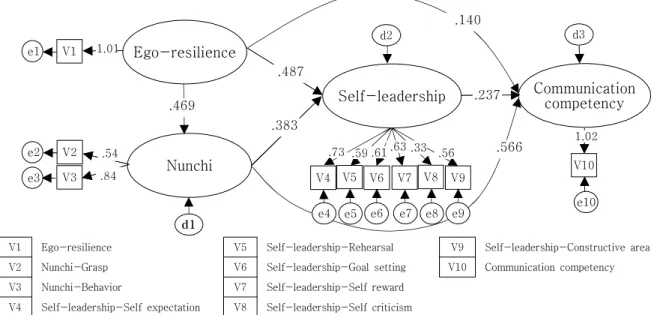
Table 5 and Fig. 1 showed that when the effect
of exogeneous latent variable on endogenous
latent variable has been showed through the
standard path coefficient, the ego-resilience has
a positive effect directly on Nunchi with .469,
self-leadership with .487, and communication
competency with .140. In the standard path
coefficient of the effect between endogenous
variables, Nunchi has a positive effect on
self-leadership directly with .566, and the
self-leadership has a positive effect on
communication competency directly with .237. In
addition, the rate to explain dependent variables
by independent variables(SMC) showed that the
ego-resilience explained 22.0% of Nunchi,
ego-resilience and Nunchi explained 55.9% of
self-leadership, and ego-resilience, Nunchi and
self-leadership explained 67.9% of communication
competency. The path coefficient of ego-resilience and
self-leader on communication competency was 5% and
other path coefficients were significant within 1% level.
Endogenous variable Exogenous variable Error Coefficient of determination
Nunchi Self-leadership Ego-resilience Z SMC
Nunchi .469** .012 .220
Self-leadership (.383**)∥ .487** .008 .559
Communication
competency .566** .237* .140** .057 .679
* : p<.05 , ** : p<.01, ¶ : Squared Multiple Correlations(SMC), ∥ : Standardized Regression Weights
Table 5. Structural model of endogenous and exogenous variables
V1 Ego-resilience V5 Self-leadership-Rehearsal V9 Self-leadership-Constructive area
V2 Nunchi-Grasp V6 Self-leadership-Goal setting V10 Communication competency
V3 Nunchi-Behavior V7 Self-leadership-Self reward
V4 Self-leadership-Self expectation V8 Self-leadership-Self criticism