[논 문] 한국재료학회지 http://dx.doi.org/10.3740/MRSK.2014.24.12.700 Korean J. Mater. Res.
Vol. 24, No. 12 (2014)
700
Synthesis of Calcium Phosphate Minerals from Biowaste Clam Shells Using Microwave Heating
Sachin Bramhe 1,2 , Jae-Kyung Ryu 5 , Min Cheol Chu 1,3 , Avinash Balakrishnan 4 and Taik Nam Kim 2†
1Centre for New Functional Materials Metrology, KRISS, Daejeon, Korea
2Department of Material Science and Engineering, Pai Chai University, Daejeon, Korea
3University of Science and Technology, Daejeon, Korea
4Nanosolar Division, Amrita Centre for Nanosciences and Molecular Medicine, Ponekkara, Kochi, India
5Department of Dental Technology and Science, ShinHan University
(Received November 4, 2014 : Received in revised form November 24, 2014 : Accepted December 2, 2014)
Abstract
Calcium phosphate minerals are biologically important because of their application in the fields of orthopaedics and dentistry. Herein we have tried to synthesize calcium phosphate minerals from biowaste clam shells. A simple microwave method was used to synthesize a mixture of calcium phosphate minerals such as hydroxyapatite, tri-calcium phosphate, and monetite. The microwave induces vibration of the dipole ions in the reagent. The heating and rearrangement of ions and atoms occurs during the process. The phases obtained in the final powder were ascertained by X-ray diffraction; the morphology of each sample was checked using a scanning electron microscope. We were able to obtain a mixture of calcium phosphate minerals using the microwave method; the calcined powder showed a brick like morphology, which is different from the rod shape morphology of the hydroxyapatite obtained using the hydrothermal process.Key words
biowaste, hydroxyapatite, tri-calcium phosphate, microwave.1. Introduction
Calcium phosphate based ceramics have been of interest for medical uses due to their unique properties.
1)Hydro- xyapatite [HA, Ca
10(PO
4)
6(OH)
2] and tricalcium phosphate [TCP( α, β), Ca
3(PO4)
2] have found many applications as a biomaterial.
2)Calcium phosphate ceramics, especially HA, forms a real bond with surrounding bone tissue which has led to its application in orthopaedics and also in dentistry. HA is biocompatible, osteoconductive and can easily be processed to matrices scaffold with inter- connecting pores to allow for bone ingrowth.
3)These calcium phosphate minerals can be produced chemically or from natural resources like corals, bovine bones, egg shells, cuttlefish shells, etc.
4-7)These biowaste are rich sources of calcium carbonate and calcium oxide.
One of such biowastes is clam shells. Annually 63,000 tonnes of shell fish waste are generated world-wide. The
clam shell represents ~70 % of the total weight of a shell fish and is composed of calcium carbonate.
8)Being cheap and abundant in nature, conversion of these clam shells into HA/TCP can be highly advantageous The Ca/P ratio and synthesis environment such as pH, concentration, surfactant, temperature determines the type of calcium phosphate mineral which will be formed. The critical Ca/
P ratio for which pure HA is obtained is 1.67. There are numerous chemical methods for the production of HA such as precipitation, solid-state synthesis, hydrolysis, hy- drothermal and sol-gel methods.
9-13)Whereas, TCP is generally synthesized via solid state reaction or thermal decomposition.
14-16)However these methods are generally time consuming and tedious. Microwave heating is a rapid way of heating the media completely in short time thereby giving a fast reaction. It was also shown as a method providing high yield, excellent reproducibility, narrow particle distribution and highly efficient energy
†
Corresponding author
E-Mail : [email protected] (T. N. Kim, Pai Chai Univ.)
© Materials Research Society of Korea, All rights reserved.
This is an Open-Access article distributed under the terms of the Creative Commons Attribution Non-Commercial License (http://creative-
commons.org/licenses/by-nc/3.0) which permits unrestricted non-commercial use, distribution, and reproduction in any medium, provided the
original work is properly cited.
Synthesis of Calcium Phosphate Minerals from Biowaste Clam Shells Using Microwave Heating 701
transformation.
17,18)By using the microwave thermal heating Jingbing Liu et.al. have successfully synthesized nano-rods, bowknot like and flower like morphologies by changing the pH of the precursor solution.
19)By using the microwave-hydrothermal method Jae-Kil Han were able to synthesize needle like and spherical morphology.
20)In this study, we are using the biowaste clam shells to synthesize HA/TCP using microwave heating. This method is cheap because of the use of biowaste precursor and also rapid due to use of microwave heating and we are able to synthesize controlled brick like morphology.
2. Experiment Method
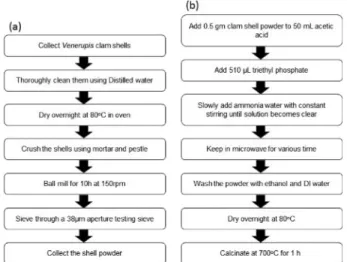
All the reagent used in the present study were obtained from Junsei Chemicals, South Korea. Firstly, biowaste clam shells(species: V. philippinarum) were thoroughly cleaned using distilled water and dried in air at 80
oC for 4 h. These shells were ball milled(SH-Ball 300-2, Sam- heung Instruments, S. Korea) for 10 h to obtain fine powders. 0.5 g of these ball-milled powders was completely dissolved in 50 mL acetic acid under stirring condition.
To this solution, 510 μL of triethyl phosphate was added such that the molar ratio of Ca:P was kept constant at 1.67. The pH of the solution was maintained at pH = 7~8 by addition of ammonia. This solution was then put in a microwave(Magic, Model: MWO-20M8 1,100W, South Korea) and heating was allowed at highest power for various amount of time. The solution was kept in an open vessel so during the heating the solution evaporates completely and only powder remained. The obtained powder was washed and filtered with ethanol and distilled water followed by drying at 80
oC before subsequently calcinating at 700
oC for 1 h. Morphology of the synthe-
sized powder was determined using Field emission scanning electron microscopy(FE-SEM, Hitachi, Model No:S-4800). The X-ray diffraction(XRD) pattern of the synthesized powder was done with Cu K α radiation(λ = 1.5406 A
o) on a SmartLab X-ray diffractometer(Rigaku).
3. Results and Discussion
Calcium phosphate minerals were synthesized by micro- wave heating. Microwave heating is a simple technique courtesy of which we can get controlled morphology of the minerals.
19,20)Clam shell powder, which consists only of calcium carbonate phase, is insoluble in water. How- ever it is soluble in acetic acid at higher pH. Hence we have used acetic acid as the solvent in our study. Fig. 2.
shows the XRD of the powder resulting from the micro- wave treatment for various amount of time. As can be seen the powder shows amorphous morphology when heated for 30 mins. However, the crystallinity increases with increase in heating time. Only amorphous tri- calcium phosphate phase is obtained in sample heated for 30 mins. Whereas, when the time increases, we are able to find peaks pertaining to other calcium phosphate minerals like hydroxyapatite, tri-calcium phosphate and monetite.
These amorphous powders were then calcined at 700
oC for 1 h. As can be seen from Fig. 3, crystalline peaks are observed in all three samples. The 30 min microwaved powder shows hydroxyapatite and tri-calcium phosphate phase. It is interesting to note that uncalcined powder only showed tri-calcium phosphate phase. This might be due to amorphous nature of the powder which hides the peaks related to hydroxyapatite in uncalcined powder.
The 60 min microwaved powder showed a mixture of
Fig. 1. Schematic representation of steps followed for procurement of clam shell powder from Venerupis clams (a); synthesis of hydro- xyapatite using microwave heating.
Fig. 2. XRD profile of calcium phosphate powder synthesized after
microwave treatment of 30 mins; 60 mins and 120 mins showing
tri-calcium phosphate, hydroxyapatite and monetite phase.
702 Sachin Bramhe, Jae-Kyung Ryu, Min Cheol Chu, Avinash Balakrishnan and Taik Nam Kim
hydroxyapatite and tri-calcium phosphate whereas 90 min microwaved powder showed a mixture of hydro- xyapatite, tri-calcium phosphate and monetite phase.
Next we checked the morphology of each sample after calcination at 700
oC for 1hr. Here we are able to get a brick like morphology at all the times. When the pre- cursor solution is put in microwave, as the temperature increases nucleation takes place and OH
−ions in the solution surrounds the entire nucleus. In our earlier report on hydrothermal synthesis of hydroxyapatite nanowires
we have noted that selective orientation of these OH
−ions helps for the growth of nucleus in only one direction which results in the formation of nanowires.
7)But at higher temperature and in absence of any pressure and these OH
−ions surround the nucleus completely and there is only slight preference in direction of growth. Hence we observe formation of brick like structure. Powder synthesized after 30 min microwave treatment and sub- sequent calcination shows the brick shaped particles as observed in Fig. 4a. With increase in time we see growth of these bricks. Sample synthesized after 60 min micro- wave and subsequent calcination showed near perfect morphology of bricks, with the length of each brick being ~1 μm. The 90 mins microwave treated sample also showed brick like morphology but the random bricks appear to aggregate together. This might be because of absence of any surfactant. These brick like morphology could be put to use in the bone grafts. This would increase the strength of the bone graft. These could also be used in cosmetics industry. Titanium oxide nanoparticles could be attached to these calcium phosphate bricks and used in sunscreen creams. Titanium oxide particles could absorb the UV radiation whereas the calcium phosphate minerals could provide the wrinkle free skin.
4. Conclusion
The synthesis of calcium phosphate minerals from biowaste clam shells using a simple microwave heating Fig. 3. XRD profile of shell powder showing aragonite phase and
calcium phosphate powder synthesized after microwave treatment of 30 mins; 60 mins and 120 mins and subsequent calcination at 700
oC for 1 h.
Fig. 4. FE-SEM images of ball milled clam shell powder (a); and powder calcined at 700
oC for 1 hr after microwave treatment of 30
min (b); 60 min (c); and 120 min (d).
Synthesis of Calcium Phosphate Minerals from Biowaste Clam Shells Using Microwave Heating 703
was investigated. Brick like morphology was obtained in all the checked samples. However, due to absence of any surfactant, the bricks aggregated at higher temperature.
We were able to get bricks of length ~1 μm after 60 min microwave heating and then calcination at 700
oC for 1 h.
These brick shaped morphology could find application in orthopaedics and cosmetics.
References
1. C. P Yogan and, V. Selvarajan, Junshu Wu and Dongfeng Xue, Vacuum, 83, 319 (2009).
2. S. H. Kwon, Y. K. Jun, S. H. Hong and H. E. Kim, J. Eur.
Ceram. Soc., 23, 1039 (2003).
3. S. Joschek, B. Nies, R. Krotz and A. Gopferich, Biomaterials, 21, 1645 (2000).
4. K. P. Sanosh, M. C. Chu, A. Balakrishnan, T. N. Kim and S. J. Cho, Mater. Lett. 63, 2100 (2009).
5. R. Murugan and K. P. Rao, Trends Biomater. Artif.
Organs, 16, 43 (2002).
6. J. H. G. Rocha, A. F. Lemos, S. Agathopoulos, P. Valerio, S. Kannan and F.N. Oktar, Bone, 37, 850 (2005).
7. M. Kurkcu, M. E. Benlidayi, B. Cam and Y. Sertdemir, J. Oral Implantol., 38, 519 (2012).
8. A. Wassila, A. Leila, A. Lydia and A. Abdeltif, Food
Technol Biotechnol., 51, 12 (2013).
9. R. Kumar, K. H. Prakash, P. Cheang and K. A. Khor, Langmuir, 20, 5196 (2004).
10. M. H. Fathi, and A. Hanifi, Mater. Lett., 61, 3978 (2007).
11. Z. H. Zhou, P. L. Zhou, S. P Yang, X. B. Yu and L. Z.
Yang, Mater. Res. Bull., 42, 1611 (2007).
12. S. Bramhe, T. N. Kim, A. Balakrishnan and M. C. Chu, Mater. Lett., 135, 195 (2014).
13. S. H. Rhee, Biomaterials, 23, 1147 (2002).
14. X. Yang and Z. Wang, J. Mater. Chem., 8, 2233 (1998).
15. J. C. Elliott, Structure and Chemistry of the Apatites and other Calcium Orthophosphates. Elsevier, Amsterdam, Netherlands, 1994.
16. T. Kanazawa, Inorganic Phosphate Materials, Kondansha Ltd, Tokyo, Japan, 1989.
17. Y. B. Khollam, A. S. Deshpande, A. J. Patil, H. S.
Potdar, S. B. Deshpande and S. K. Date, Mater. Chem.
Phys., 71, 304 (2001).
18. X. Xu, Y. Bao, C. Song, W. Yang, J. Lin and L. Lin, Micropor. Mesopor. Mater, 75, 173 (2004).
19. J. Liu, K. Li, H. Wang, M. Zhu and H. Yan, Chem.
Phys. Lett., 396, 429 (2004).
20. J. K. Han H.Y. Song, F. Saito and B.T Lee, Mater. Chem.
Phys., 99, 235 (2006).