DOI:http://dx.doi.org/10.5389/KSAE.2012.54.2.147
Water-saving Effect by Rotational Irrigation Scheduling System (RISS) in the Dongwha Dam
윤환관개모형 (RISS)에 의한 절수효과 분석 (동화 댐 사례)
Kim, Tai Cheol*
․Moon, Duck Young
*․Lee, Jae Myun
**․Moon, Jong Pil
***,†김태철․문덕영․이재면․문종필
ABSTRACT
가뭄강도와 지속기간을 고려하여 관개구역을 몇 개의 관개블록으로 나누어 순차적으로 제한하여 급수함으로써 관개용수를 절약하고 관개기간을 연장하여 가뭄을 극복하는 윤환관개모형 (RISS)을 제안한 바 있다. 이 RISS는 작물생육기별 관개저수지 저수율별 급수구역 과 제한 급수율을 제시함으로써 가뭄기간에 저수지 운영자가 언제, 얼마나 제한하여 급수할 것인지 제시해주는 모형으로 전북 남원군 동화댐의 물 관리시스템 자동화 프로그램에 2004년 설치하여 운용되도록 하였다. 이 연구에서는 2004년부터 2009년까지 동화 댐 저수 위 관측기록과 급수실적을 분석하여 RISS의 절수효과를 평가하고자 하였다. 그러나 실제로는 동화댐의 물 관리시스템 자동화 프로그램 이 계획대로 운용되지 않고 있었다. 따라서 이 RISS의 절수효과와 효용성을 입증하여 계획대로 자동화시스템을 유용하게 활용하도록 하기 위해서 급수실적 및 저수위 관측기록과 RISS로 모의 발생한 저수위 결과를 비교 평가하였다. 모의발생 평가결과 가뭄이 극심했던 2007년에는 3.8백만 m3을 절수하여 관개기간을 23일 연장하고 2009년에는 3.3백만 m3을 절수하여 관개기간을 13일 연장하여 가뭄이 극심한 해에는 RISS 모형의 효용성이 크다는 것을 알 수 있었다.
Keywords: Operation rule curve; Paddy irrigation; Rotational irrigation; Software for automation; Water saving
I. INTRODUCTION*
Telemetering and telecontrol (TM/TC) technology is used to conserve irrigation water through systematic water management of an irrigation reservoir. In Korea, TM/TC projects have been undertaken to provide on-off control of water gates in irrigation reservoirs for conventional irrigation methods, but not to save irrigation water through control of a reservoir’s gate for restricted irrigation methods during a drought season, such as a rotational irrigation method (Kim et al. 1999, 2003, 2006). presented a new
* Department of Agricultural and Rural Engineering, Chungnam National University, Daejeon, Korea
** Department of Irrigation Facilities O & M, Korea Rural Community Corporation, Asan, Korea
*** Department of Agricultural Engineering, National Academy of Agricultural Science, Suwon, Korea
† Corresponding author Tel.: +82-42-821-5797 Fax: +82-42-821-8877
E-mail: [email protected] 2012년 2월 22일 투고
2012년 3월 21일 심사완료 2012년 3월 27일 게재확정
system, rotational irrigation scheduling system (RISS), which considered water depth in the reservoir, weather forecasting from the internet, soil moisture conditions in the watershed of the reservoir, and drought scenarios for the short-term future. From the present storage ratio of the reservoir and an operation rule curve (ORC) as a guideline for releasing irrigation water, reservoir operators could determine the appropriate time when the irrigation water supply should be restricted, including methods on how to calculate the deficient amount of irrigation water.
RISS applied to real irrigation district, the Donghwa dam area in Korea, in order to control the release amount of the irrigation water during a drought season, not to open and close the water gate just automatically and remotely without reasonable rule for releasing irrigation water. Thus, it is necessary to verify the effectiveness of the new system and test the applicability of rotational irrigation methods using several scenarios. The purpose of this study is to apply the RISS practically in a paddy field with the ORC for the irrigation reservoir, Donghwa dam district.
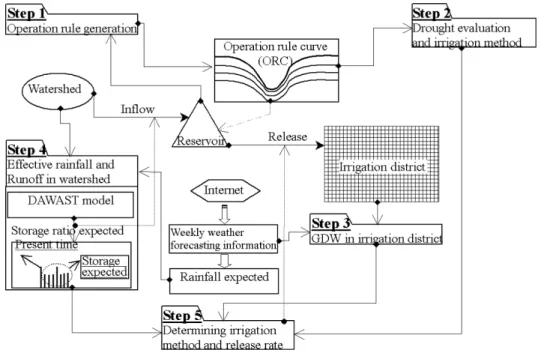
Fig. 1 Conceptual diagram of the RISS
II. CONCEPT OF RISS
1. General Concept of RISS
An irrigation reservoir has generally two components, a watershed and an irrigation district, as shown in Fig. 1, so that reservoir operators have to consider simultaneously both the inflow from the watershed and the release to the irrigation district, in order to effectively manage the storage water in the reservoir during drought season. In the three-component model, which includes the reservoir, several researchers have developed rainfall-runoff models for watersheds, reservoir operation models for reservoirs, and water requirement models for irrigation districts (Kim, 1999; Senga, 1989; Votruba and Broza, 1989).
The general concept of RISS used in this study was shown in Fig. 1. The diagram consists of five steps: Step 1 for operation rule generation in an irrigation reservoir, Step 2 for drought evaluation and definition of irrigation methods in each drought state, Step 3 for gross duty of water (GDW) in an irrigation district that considers weather forecasting information, Step 4 for effective rainfall and runoff in the watershed, taking into consideration expected rainfall, and Step 5 for determining the irrigation method and release rate by interfacing the operation rule curve,
GDW, and storage ratio expected (Kim et al., 2003; Lee, 2005; Moon, 2011).
2. Generation of Operation Rule Curve (ORC)
The ORC, including a reference storage curve and a restricted release curve, provides a guideline for the time schedule for when to restrict the water supply and for the calculation methods for how to decide the optimum release amount of deficient irrigation water (Kim et al., 2003; Lee, 2005; Moon, 2011).
3. Reference Storage Curve (RSC)
The amount of deficit or surplus water in either a day or period in Equation (1) can be calculated by subtracting the gross duty of water from the inflow (Senga, 1989).
Let us consider that the reservoir on the last day of the irrigation season will be empty if the reservoir can be operated in the most effective manner. The storage volume needed to meet the water deficit can be added up from the end to the beginning of the irrigation season in a reverse order as shown in Equation (2). In this case, the storage volume is assumed to be “0” if it is below “0”
(Equation (3)). In this manner, the daily sequence data
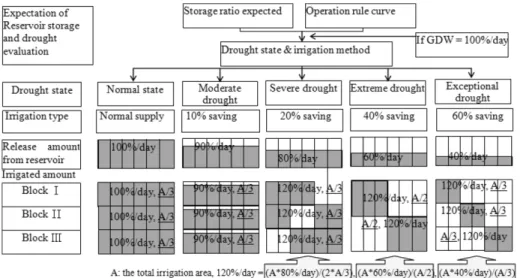
Fig. 2 Detailed process of the RISS for each irrigation method in Step 5
(
STV(1)
10STV(i)
10…STV(n)
10, where subscripts refer to the return period andn
denotes the last day of the irrigation season) of storage volume for a certain return period (which herein is 10 years) can be obtained by frequency analysis from available data series (STV(i)
1…STV(i)
30, where su- perscripts indicate each year) for the last 30 years, as shown specifically in Step 1 of Fig. 2. Thus, each irrigation reservoir can have a reference storage curve connecting values of daily reference storage volume, which has 10-year frequency value for every day (Kim et al., 2003; Lee, 2005;Moon, 2011).
DEF_SUR(i)=INF(i)-GDW(i)
(1)STV(i)=STV(i+1)-DEF_SUR(i)
(2)if STV(i)<0, then STV(i)=0
(3)where
i
denotes time (day),INF
is the inflow (m3),GDW
is the gross duty of water (m3),DEF_SUR
is the deficit or surplus water (m3), andSTV
is the storage volume (m3).4. Restricted Release Curve (RRC)
The water supply in a day should be restricted if the reservoir storage value of the day is less than the reference storage volume, in order to maintain adequate water levels in the reservoir during the irrigation season. The ratio of
restriction (S) can be determined by present reservoir storage volume and the water requirements in an irrigation district with regard to the rice growing stage. Thus, Eq- uation (1) can be written as Equation (4) if the restricted release ratio, S. Then, the Equations (2) and (3) can also be derived as Equations (5) and (6):
(Kim et al., 2003; Lee, 2005; Moon, 2011).
DEFS(i)=INF(i)-(1-S) GDW(i)
(4)STV(i)=STV(i+1)-DEFS(i)
(5)if STV(i)<0, then STV(i)=0
(6)where
DEFS
meansDEF_SUR
with a restricted release ratio,S
.5. Determining Irrigation Method and Release Rate
In Step 5 of Fig. 1, reservoir operators can compare the RSC with the storage ratio from Step 4 and evaluate the drought state for the next 6 days by considering the forecasted rainfall, GDW, and effective rainfall in the paddy.
As the next step, operators can also select an irrigation method according to the drought state, as shown in Fig.
2, which shows that an irrigation method for each drought state has a time schedule of release and irrigation amount for the irrigation district. If GDW in the paddy is 100 %/day
in Fig. 2, the restricted irrigation methods to save water in the reservoir means that the reservoir supply water will be below 100 %/day, such as 90 %/day, 80 %/day, 60 %/day, and 40 %/day, as the unit irrigation rate for the total area must be maintained in order to save water of 10 %, 20 %, 40 %, and 60 %. The irrigation blocks of the “on” irrigation state receive 120 %/day for all rotational irrigation methods of the severe, extreme, and exceptional drought states, as shown in the calculation method of Fig 2. The rest of the water 20 %/day (120 %/day-100 %/day) can be considered for various purposes, such as the surge effect in the irrigation canal at the drought state, or as retention water for the day before and after the “on” irri- gation. In these restricted irrigation methods, it is assumed that there is no damage to the paddy due to deficient irrigation water (Kim et al., 2003; Lee, 2005).
III. WATER-SAVING EFFECT BY RISS IN IRRIGATION RESERVOIR
1. Description of test area
This study attempted to apply RISS to the Donghwa dam
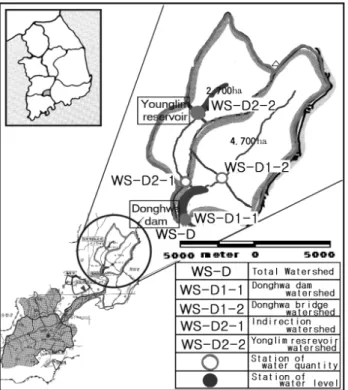
Fig. 3 Watershed and irrigation area of Donghwa dam
Table 2 Characteristics of Donghwa dam
Items Unit Value Items Unit Value
Watershed area ha 7,400 Watershed : B.A - 2.47:1 Total storage 103 m3 32,348 Domes. & Indus. m3/day 30,000 Effective storage 103 m3 32,242 In-stream flow m3/sec ‐
Surface area ha 127 Flood control V. 103 m3 1,256 Proposed irrigation area ha 3,000 Design flood m3/s 751 Actual irrigation area ha 2,947 Design discharge m3/s 7.54
district, which is located in Jangsoo-county, Cheonbuk- province, Korea, as shown in Fig. 3. The data set of Donghwa dam and its corresponding irrigation district are shown in Table 2. According to the data set, the ratio of watershed to irrigation area is 2.47:1, which means that the water storage in the reservoir is not sufficient compared to the general irrigation reservoir (about 5:1). Thus, this district needs to apply RISS in order to save the irrigation water against drought season.
2. Application of RISS
A. Optimization of model parameters
This study optimized the parameters of the rainfall-runoff model, DAWAST, with the observed daily data set of the watershed at monitoring station WS-D1-2 as shown in Fig. 3. Its simulated runoff at the station shows a good fit with the observed actual runoff, as indicated in Fig. 4. As Step 1 of Fig. 1, the runoff was simulated for 23 years from 1981 to 2003, in order to generate the ORC curve, so that the results have 1402.3 mm of average annual
Fig. 4 Comparison of observed and estimated stream flow
rainfall and 832.0 mm of annual effective runoff, which indicates a direct runoff rate of 59.3 %.
B. Separation of sub-district for RISS
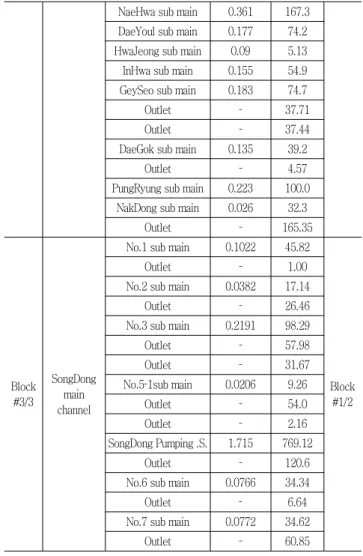
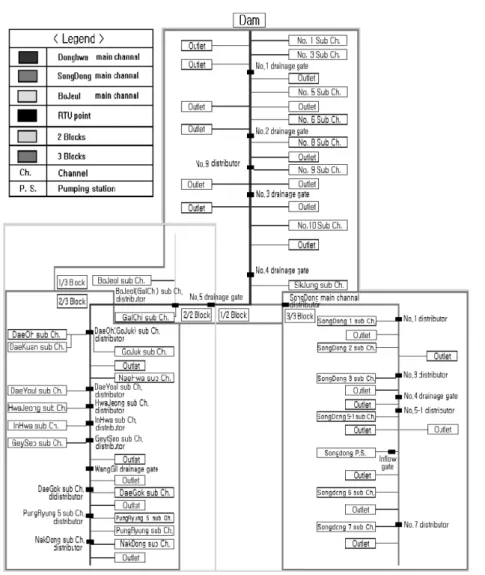
The Donghwa irrigation district has three main channels, the Donghwa, Songdong, and Bojeul, and also 23 RTU (Remote Terminal Unit) points, which receive the monitoring data from sensors and sends them to the main system, as shown in Fig. 5. This study divided the irrigation network into two- and three-block systems-the two-block system consist of 1/2 and 2/2 blocks and the three-block system consists of 1/3, 2/3, and 3/3 blocks. Fig. 5 also takes into consideration the RTU points, three kinds of main channels, an irrigation area, and a control probability remotely (Table 3).
Table 3 Irrigation channel system of Donghwa district 3 Block
system Main channel Irrigation channel Discharge (m3/s)
Irrigated area (ha)
2 Block system
Block
#1/3
Donghwa main channel
No.1 sub main 0.69 2.3
Block
#1/2
Outlet ‐ 3.03
No.2 sub main 0.107 16.48
Outlet ‐ 7.80
Outlet ‐ 32.43
No.5 sub main 0.0465 20.7
Outlet ‐ 2.16
Outlet ‐ 3.85
No.6 sub main 0.08 35.86
Outlet ‐ 0.94
No.8 sub main 0.0393 17.53
Outlet ‐ 14.54
No.9 sub main 0.625 280.27
Outlet ‐ 2.94
Outlet ‐ 20.05
No.10 sub main 0.0942 42.25
Outlet ‐ 0.98
SikJung sub main 0.018 72.8 GalChi sub main 0.0112 21.4
Block
#2/2 BoJeol main
channel BoJeol sub main 0.1696 281.4
Block
#2/3
Donghwa main channel
DaeOh sub main 0.611 239.9 DaeKuan sub main 0.487 238.9 GoJuk sub main 0.107 17.72
Outlet ‐ 0.79
Outlet ‐ 36.11
NaeHwa sub main 0.361 167.3 DaeYoul sub main 0.177 74.2 HwaJeong sub main 0.09 5.13 InHwa sub main 0.155 54.9 GeySeo sub main 0.183 74.7
Outlet ‐ 37.71
Outlet ‐ 37.44
DaeGok sub main 0.135 39.2
Outlet ‐ 4.57
PungRyung sub main 0.223 100.0 NakDong sub main 0.026 32.3
Outlet ‐ 165.35
Block
#3/3
SongDong main channel
No.1 sub main 0.1022 45.82
Block
#1/2
Outlet ‐ 1.00
No.2 sub main 0.0382 17.14
Outlet ‐ 26.46
No.3 sub main 0.2191 98.29
Outlet ‐ 57.98
Outlet ‐ 31.67
No.5‐1sub main 0.0206 9.26
Outlet ‐ 54.0
Outlet ‐ 2.16
SongDong Pumping .S. 1.715 769.12
Outlet ‐ 120.6
No.6 sub main 0.0766 34.34
Outlet ‐ 6.64
No.7 sub main 0.0772 34.62
Outlet ‐ 60.85
C. Simulation of restrict release
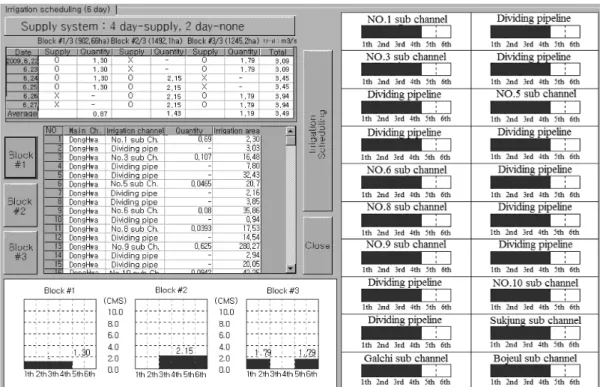
In order to test the system, this study used on June 22 as the starting day for irrigation scheduling. As shown in Fig. 6, weather conditions were no rainfall, temperature 22.1 °C, pan evaporation 4.6 mm, relative humidity 72.9 %, wind speed 2.3 m/s, and 8.6 hours of sunshine. Using these parameters, the water requirement was calculated to be 4.36 m3/s. The reservoir conditions were a storage rate that was 68.57 % with a water elevation of +313.8 m, higher than the 45.3 %, which was the bottom line of the normal range in ORC, as shown in Fig. 8. From these analysis results, RISS displays “normal supply” for whole irrigation area for irrigation scheduling during 6 days, which irrigated the area at a rate of 4.36 m3/s from the reservoir.
This study simulated irrigation scheduling for a “severe drought” condition on the same day. If the reservoir had a severe condition of water elevation of +305 m, a storage
Fig. 5 Irrigation system of Donghwa dam
rate of 43.6 %, lower than the bottom line at 45.3 % of normal supply, then the reservoir would be in a “severe”
state, as shown in Fig. 8, and RISS would indicate “4 days-on, 2 days-off” for the three-block system. The three blocks have varying irrigation areas. Taking into conside- ration the irrigation area, RISS displays the irrigation rate for each block as 1.30 m3/s from 22 to 25 June for the 1/3 Block, 2.15 m3/s from 24 to 27 June for the 2/3 Block, and 1.79 m3/s from 22 to 23 June and from 26 to June 27 for the 3/3 Block, as shown in Fig. 9.
D. Simulation of storage rate in reservoir
The RISS model was installed when the irrigation system of Donghwa dam was automated at the Namwon branch
office of Korea Rural Community Corporation in mid-July Fig. 6 Input screen
Fig. 9 Daily schedule of 4 days-on and 2 days-off irrigation system and canal discharge from 22 to 27 June at the Donghwa dam
Fig. 7 Restricted release quantity and rotational irrigation system
2004. Unfortunately, there was no practical application of the RISS after that due to the uncertain reason and actual data of the reservoir operation are not available, and so the impact of saving water could not be evaluated. Hence, it is important to encourage and accelerate the practical application of the RISS by comparing the reservoir water
Fig. 8 Restricted release quantity and rotational irrigation system
level by rotational irrigation with one by customary irrigation and evaluating the water savings. Therefore, the daily storage ratio in the reservoir has been simulated to evaluate the impact of saving water using RISS under the current requirement to supply of 15,000 m3/day for domestic and industrial use and 0.1 m3/s for in-stream flow and irrigation
Fig. 10 Comparison of daily storage ratio by customary and rotational irrigation
Table 4 Irrigation period extended and water volume saved by the RISS model Year Rainfall
(mm)
Evaporation (mm)
Dry up date by customary
Dry up date by RISS
Extended by RISS (days)
Water saved by RISS (×103 m3)
Saving rate of gross duty water (%)
2004 1,453.0 1,052.8 July 22 July 25 3 742 2.7
2005 1,305.7 989.1 July 11 July 14 3 585 2.5
2006 1,522.6 1,018.4 June 19 June 24 5 1,388 5.2
2007 1,689.6 939.1 June 20 July 13 23 3,829 17.3
2008 1,303.5 1,046.6 July 11 July 15 4 1,534 6.5
2009 1,491.3 1,092.1 May 23 June 5 13 3,251 12.4
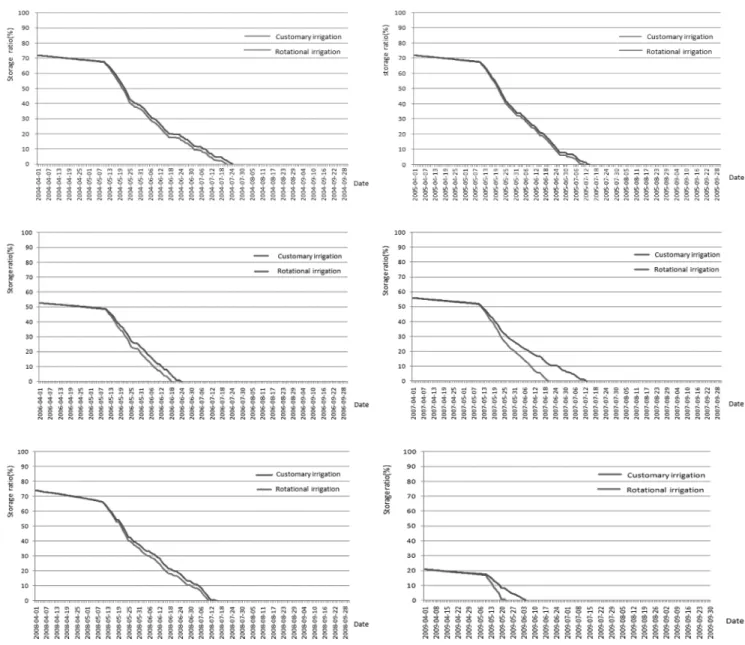
water for 3,000 ha of paddy fields from 2004 to 2009, as shown in Fig. 10.
The daily storage ratio by RISS has been simulated from
2004 to 2009 and compared with the daily storage ratio by the customary irrigation method, and the water-saving effect has been evaluated as follows and in Table 4.
In 2004, if RISS had been applied, 742×103 m3 of water could be saved and so irrigation reservoir would have dried up on July 25 instead of on July 22 when the customary irrigation method was used.
In 2005, 585×103 m3 of water could be saved and so irrigation reservoir dried up on July 14 by applying RISS instead of July 11 by customary irrigation method.
In 2006, 1.39×10⁶ m3 of water could be saved and so irrigation reservoir dried up on June 24 by applying RISS instead of June 19 by customary irrigation method.
In 2007, 3.83×10⁶ m3 of water could be saved and so irrigation reservoir dried up on July 13 by applying RISS instead of June 20 by customary irrigation method.
In 2008, 1.53×10⁶ m3 of water could be saved and so irrigation reservoir dried up on July 15 by applying RISS instead of July 11 by customary irrigation method.
In 2009, 3.25×10⁶ m3 of water could be saved and so irrigation reservoir dried up on June 5 by applying RISS instead of May 23 by customary irrigation method.
It was shown that 3.83×10⁶ m3 of water could be saved and so irrigation period could be extended up to 23 days longer than the customary irrigation method in 2007, and 3.25×10⁶ m3 of water could be saved and so irrigation period could be extended up to 13 days longer than the customary irrigation method by applying the RISS. The impact on water saving by the RISS model was more pronounced in the drought year than the normal year.
V. SUMMARY AND CONCLUSION
This study attempted to apply the rotational irrigation scheduling system (RISS) for the Donghwa dam district in an effort to encourage and accelerate the practical appli- cation of the RISS by comparing the reservoir water level obtained by applying rotational irrigation with the one obtained by applying customary irrigation and by evaluating the water-saving effect. Thus, the RISS model can extend the irrigation period longer against severe drought than the customary method. As a final result, 3.83 million m3 of irrigation water could have been saved in 2007 and 3.25 million m3 of irrigation water could have been saved in 2009 through the application of the RISS model. It was confirmed that the RISS model is more effectively applicable
in a severe drought year. Irrigation water could be saved by the RISS, especially in the severe drought season, and the RISS could be incorporated with TM/TC technology for the automation of paddy irrigation.
This study was financially supported by Research fund of Chungnam National University in 2009.
REFERENCES
1. ICID, 2008, Water saving in Agriculture, ICID Publication 95, 64.
2. Kim, T. C., J. M. Lee, and S. H. Lee, 2001. Rotational irrigation scheduling in rice paddy with the operation rule curve of irrigation reservoir. In
the Proceedings of the 1st Asian Regional Conference.
ICID, Seoul, Korea.3. Kim, T. C., J. M. Lee, and D. J. Lee, 2003. A rotational irrigation scheduling for an irrigated paddy blocks with operation rule curve,
Journal of Korean Society of Agricultural Engineering
45(5): 67-76 (in Korean) 4. Kim, T. C., J. M. Lee, and D. S. Kim, 2003. Decisionsupport system for reservoir operation considering rotational supply over irrigation blocks.
Journal of the International Society of Paddy and Water Environment Engineering
1(3): 139-147.5. Kim, T. C., J. M. Lee, D. S. Kim, and J. P. Moon., 2006.
Practical application of rotational irrigation scheduling system (RISS) for water saving to Dongwha irrigation district in Korea. In
the Proceedings of the International Workshop on Water Saving Practice in Rice Paddy Cultivation,
WG-CROP ICID, 83-99.6. Korea Rural corporation and community, 2003, Program development for the automated water supply and gate operation system in the Dongwha dam,
Report of Chungnam National Univ.,
231 (in Korean).7. Lee, J. M., 1995. Rotational irrigation scheduling model for drought restoration and saving water. Ph.D. diss., Chungnam National Univ. (in Korean).
8. Ministry of Agriculture, 1999, Management rules of irrigation reservoir for drought and flood control,
Report
of Chungnam National Univ.,
311 (in Korean).9. Moon, D. Y., 2011. Analyzing the Water-Saving Effect of the Donghwa Dam District Using Rotational Irrigation Scheduling System. M.S. thesis, Chungnam National Univ. (in Korean).
10. Senga, Y. 1989. Soft Science of Water Resources.
Tokyo, Japan: Sika Sima Publication Co., 45-75. (in Japanese).
11. Votruba L, Broza V. 1989. Water Management in Reservoirs. Elsevier, 330-340.