Treatment for Class II Division I Malocclusion Using Cervical Headgear and Hotz Appliance:
A Case Report
Yongjae Cho, Seonmi Kim, Namki Choi
Department of Pediatric Dentistry, School of Dentistry, Chonnam National University
Many types of orthopedic appliances have been developed and used for the treatment of class II malocclusion in pediatric dentistry. Headgear is one of the extraoral appliances, which is used for the purpose of preventing the overgrowth of maxilla. Hotz appliance is used in couple with a cervical headgear for the expansion of maxilla and retraction of maxillary incisors.
This case report is about the orthodontic treatment of three patients with class II division I malocclusion.
These young patients were given orthopedic treatment in combination with a cervical headgear and Hotz appliance.
After the treatment using these extraoral and intraoral appliances, succeeding treatments were practiced considering individual needs as follows: fixed orthodontic appliance for mandibular anterior crowding, Class II activator for retention and additory orthopedic treatment and the retention with Hotz appliance.
Young patients with Class II division I malocclusion reported in this study received the orthodontic treatment using a cervical headgear and Hotz appliance as well as appropriate succeeding treatment afterward. All patients received improved convex profiles and lip protrusions by retracting maxilla and maxillary incisors.
Key words :Cervical headgear, Hotz appliance, Class II malocclusion, Orthodontic treatment Abstract
Ⅰ. Introduction
People’s higher expectation for their physical appear- ance leads to the early orthodontic treatment. Increasing number of young patients who begin orthodontic treat- ment in their childhood and juvenile period has been re- ported1,2). And the percentage of orthodontic treatment in pediatric dentistry is also increasing. Parents of young patients with skeletal class II malocclusion tend to easily perceive such as lip protrusion and convex profile in their children and feel the need for orthodontic treat- ment.
Skeletal class II malocclusion occurs as a result of skeletal disharmony, arising from overgrowth of maxilla or undergrowth of mandible or the combination of both.
Class II malocclusion can be divided into division I and division II, according to the level of inclination of maxil- lary incisors. Class II division I occurs when maxillary incisors are proclined, while Class II division II is catego- rized as the maxillary incisors are retroclined3).
Many of the orthodontic patients in both pediatric and orthodontic department fall into the category of Class II division I. According to Yang et al.4), class II division I malocclusion accounts for 34.6% of the orthodontic
Corresponding author : Namki Choi
Department of Pediatric Dentistry, School of Dentistry, Chonnam National University, 77, Yongbong-ro, Buk-gu, Gwangju, 61186, Korea Tel: +82-62-530-5668 / Fax: +82-62-530-5669 / E-mail: [email protected]
Received October 2, 2014 / Revised January 13, 2015 / Accepted January 2, 2015
treatment cases among the patients who visited chon- nam national university pediatric dental hospital. Jung MH5) reported that patients, who visited orthodontic dental clinic found that Class II division I patients ac- counted for 34.8% of all the malocclusion patients.
It is very important to diagnose the accurate cause of class II malocclusion whether malocclusion was caused by the overgrowth of maxilla, or the undergrowth of mandible, since the method and timing of treatment can be changed depending on the cause6). Precise analysis of patient’s profile and lateral cephalograms is very impor- tant for accurate orthodontic diagnosis. Early treatment for class II malocclusion is recommended to relieve so- ciopsychological problem, although the effectiveness of the early treatment is still controversial7).
In the department of pediatric dentistry of chonnam national university, except for the undergrowth of the mandible cases, skeletal class II division I patients in the juvenile period are usually treated with cervical headgear and Hotz appliance, and successful improve- ments were observed(Fig. 1). Three cases which were given different succeeding treatment respectively will be introduced in the following part.
Ⅱ. Case Reports 1. Case 1
A 10-year-old female patient visited the hospital with the complaint of upper incisor protrusion and lower an- terior crowding. Profile and cephalometric analysis was conducted for diagnosis. Her cephalometric radiographs showed that she had U1 to SN of 113.5�, which meant upper incisor labioversion and the arch length discrepan- cy of mandible was +5 mm. It was also found that she had large ANB (4.5�) and overjet (5 mm). She was di- agnosed with class II division I malocclusion caused by maxillary overgrowth. It was decided to use a cervical headgear and Hotz appliance for primary treatment. She was instructed to wear a headgear 14 hours a day and to wear Hotz appliance all day except during the meals.
The force applied on the appliance at the beginning of the treatment was 300 gm for each side, which is rela- tively weak pressure, and was increased to 400-450 gm afterward. She put on the headgear an average of 12 hours a day and showed high level of cooperation. As a result of 7-months treatment, U1 to SN decreased from
Fig.1. Hotz appliance (A, B) and Cervical headgear (C).
C
113.5�to 104�, overjet from 5 mm to 1 mm, and ANB from 4.5�to 2.5�. Meanwhile, vertical growth pattern was intensified as FMA increased from 35�to 37.5�, SN to MP from 43�to 45.5�(Fig. 2). Both upper incisor pro- trusion and skeletal class II malocclusion were improved through the primary orthopedic treatment, but the lower anterior crowding still remained. To solve this problem, fixed orthodontic treatment started.
2. Case 2
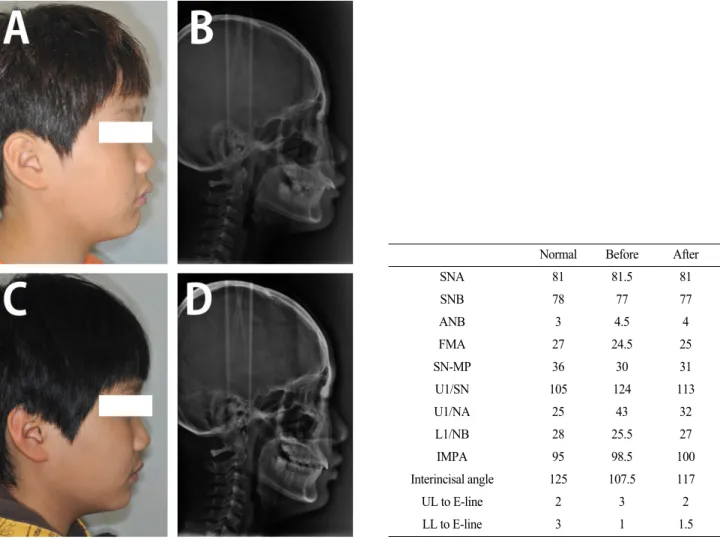
A 10-year-old male patient visited the hospital with the complaint of upper incisor labioversion and eruption disturbance of lower left second premolar. Cephalometric analysis showed that he had U1 to SN of 124�, which indicated labioversion. He also had overjet of 10 mm and overbite of 4 mm, which were quite large. He also had
eruption problem because of lack of space for lower left second premolar. He was diagnosed with Class II divi- sion I malocclusion with severe protrusion of maxillary incisors. We started treatment using a cervical appliance and Hotz appliance. Distal screw appliance was applied to mandible to gain a space for lower second premolar.
During the treatment, he frequently changed appoint- ments. Also, appliance was often fractured and not fitted well, so it had to be re-produced. Even the facebow was fractured twice. He was not very compliable to our in- struction to wear a headgear 14 hours a day, leading to prolonged treatment. Writing a headgear calender proved to have low effects on him. As a result of 12- months treatment, U1 to SN was decreased from 124�
to 113�, overjet from 10 mm to 5 mm, and ANB from 4.5�to 4�. Lower second premolar erupted as the space was successfully gained(Fig. 3, 4). The patient was co- Fig. 2. Profile and lateral cephalogram comparison before (A, B) and after (C, D) the treatment of case 1.
Normal Before After
SNA 81 80.5 78.5
SNB 78 76 76
ANB 3 4.5 2.5
FMA 27 35 37
SN-MP 36 43 45
U1/SN 105 113.5 104
U1/NA 25 32.5 26
L1/NB 28 30.5 30
IMPA 95 91 88.5
Interincisal angle 125 113.5 122
UL to E-line 2 0.5 -0.5
LL to E-line 3 3.5 1
Fig. 3. Profile and lateral cephalogram comparison before (A, B) and after (C, D) the treatment of case 2.
Normal Before After
SNA 81 81.5 81
SNB 78 77 77
ANB 3 4.5 4
FMA 27 24.5 25
SN-MP 36 30 31
U1/SN 105 124 113
U1/NA 25 43 32
L1/NB 28 25.5 27
IMPA 95 98.5 100
Interincisal angle 125 107.5 117
UL to E-line 2 3 2
LL to E-line 3 1 1.5
Fig. 4. Intra-oral view before (A, B) and after (C, D) the treatment of case 2.
operative when the treatment procedure began.
However, as the treatment proceeded, he became not much cooperative. He did not apply the appliance as in- structed, and began to break the treatment appoint- ments. And during the last three months, he never showed up. Upper incisor labioversion and skeletal class II malocclusion was somewhat improved, but still in need of continuing treatment. Therefore, we decided to stop using a cervical headgear and Hotz appliance, and began to use class II activator for retention and additory orthopedic treatment, which is much more wearable.
3. Case 3
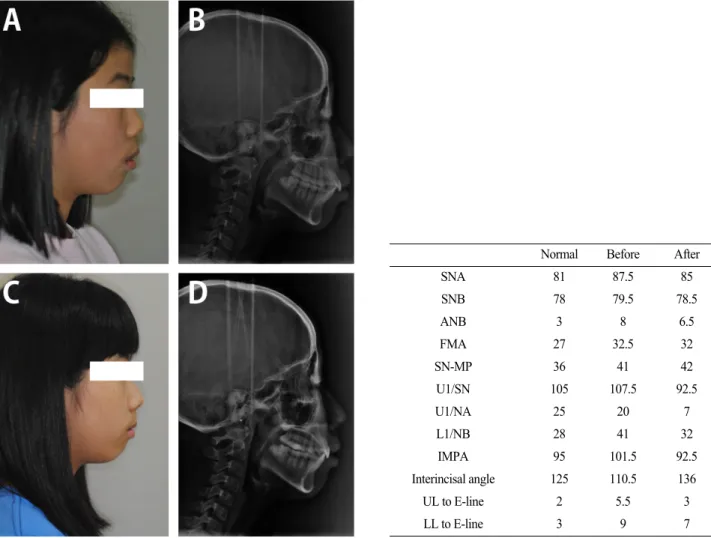
A 12-year-old female patient had upper anterior crowding and bruxism. Cephalometric analysis showed that she had ANB of 8�, which meant she had severe skeletal class II malocclusion. Both upper and lower lip
was protruded, as UL to EL was +5.5 mm, while LL to EL was +9 mm. She also had a convex profile.
However, she is different from the previous cases, as she has U1 to SN of 107.5�, which falls into a normal range.
Considering her young age, a cervical headgear and Hotz appliance was used. Hotz appliance was expected to solve the problem of upper anterior crowding, since it is able to expand maxilla. She was instructed to wear a Hotz appliance for more than 20 hours a day and a headgear for 14 hours a day. 400-450 gm of force was applied to each side of the headgear. The treatment was wrapped up in 6 months due to high level of cooperation from the patient. After treatment, U1 to SN was de- creased from 107.5�to 92.5, overjet from 6 mm to 2 mm, and ANB from 8�to 6.5�. Upper anterior crowding and a large overjet was improved, but the problem of disharmony between maxilla and mandible, and upper and lower lip protrusion were still remained(Fig. 5, 6).
Fig. 5. Profile and lateral cephalogram comparison before (A, B) and after (C, D) the treatment of case 3.
Normal Before After
SNA 81 87.5 85
SNB 78 79.5 78.5
ANB 3 8 6.5
FMA 27 32.5 32
SN-MP 36 41 42
U1/SN 105 107.5 92.5
U1/NA 25 20 7
L1/NB 28 41 32
IMPA 95 101.5 92.5
Interincisal angle 125 110.5 136
UL to E-line 2 5.5 3
LL to E-line 3 9 7
Further treatment was recommended, but the patient and her parents were satisfied with the present condi- tion and did not want to receive succeeding treatment.
Therefore, we finished the primary treatment by apply- ing Hotz appliance as a retainer. It seems that, for this case, extraction orthodontic treatment was not avoid- able, if appropriate treatment was not given in the grow- ing phase of the patient.
Ⅲ. Discussion
Headgear is an extraoral device which is used for Class II malocclusion cases with protrusion of maxilla for the purpose of preventing overgrowth of maxilla.
Headgear is more appropriate for Class II malocclusion with maxillary overgrowth, compared to other intraoral devices such as twin block appliance and activator, be- cause it is able to move maxilla backward using extrao- ral force. Headgear can be divided into three types, high pull headgear, straight pull headgear and cervical head- gear, according to the direction of force. Since high pull headgear prevents upper molar extrusion, and cervical headgear extrudes it, it is important to select an appro- priate appliance, considering the projection of vertical growth and the level of overbite8,9). However, as the ef- fects on retraction of maxilla by high pull headgear are
weaker than those of cervical headgear, it is recom- mended to use a cervical headgear first, and then use high pull headgear, in case disharmony between mandible and maxilla is big10). A cervical headgear should not be used in cases with openbite, since it can extrude maxillary molar9).
Hotz appliance is usually used in combination with a cervical headgear for the treatment of class II division I malocclusion. Hotz appliance is similar with Schwarz appliance in that it comes with a expansion screw, but it is distinguished from Schwarz expander because it is produced after a band is applied to maxillary first molar.
It is difficult to retain the appliance using adams clasp since the band is attached, so buccal extension arm is used for retention(Fig. 1). When Hotz appliance is used in combination with a headgear, the skeletal effects of a headgear are enhanced and the proclined upper incisors are retracted by labial bow activation. In addition, max- illary expansion can be achieved if necessary. If maxil- lary arch is not expanded when maxillary teeth is re- tracted, posterior cross-bite may occur11).
When a headgear is used alone, overall skeletal effects are not remarkable, and the force is focused only on first molars. Currently, at pediatric department of chonnam national university dental hospital, a headgear is used for the Class II division I patients in combination with a Fig. 6. Intra-oral view before (A, B) and after (C, D) the treatment of case 3.
Hotz appliance. It is considered that this treatment scheme has optimum effects when given during late mixed dentition and early permanent dentition. It is rec- ommended to begin the treatment before maxillary sec- ond molar begins to erupt12). As in the case 3, this treat- ment can be used as camouflage treatment, even in the case U1 to SN is in the normal range. When crowding is accompanied on the mandible, Schwartz appliance or lingual arch are recommended to use along with a head- gear and Hotz appliance.
When using removable orthopedic appliances like Hotz appliance and headgear, it is very important to gain co- operation from patients, because their cooperation is de- creased as the period of treatment is increased. To solve this problem, a number of studies are performed to find ways to strengthen patients’cooperation for treatment using headgear13-15). According to Clemmer et al.14), fe- males are more cooperative than males, and the possi- bility of better cooperation is increased when patients are deeply conscious of their status of malocclusion.
Carleton et al.15) reported that patients tend to believe they wear the appliances for longer hours than actually they wear. So, it was recommended to use a headgear calender. Our hospital also recommends patients who show low level of cooperation to write the hours on the calender to enhance patient’s cooperation and to check the hours of application. In this way, patients feel more obligated for timely treatment and they can get instant feedback, leading to better cooperation. Therefore, a headgear calender may be used as an useful tool for or- thopedic treatments using removable appliance including headgear. The second patient in this study showed de- creasing cooperation with wearing a headgear, and did not visit the clinic for regular check-up during the last three months of the treatment phase. Writing a head- gear calender did not work on this patient. However, he became cooperative after appliance is changed from a headgear to Class II activator. Changing type of appli- ance may be one way to recoup patients’cooperation when their cooperation level falls.
The effect of early treatment of skeletal class II maloc- clusion has been debated and studied steadily. In many studies, it was revealed that the ideal age for class II malocclusion is the late mixed dentition or the right be- fore adolescent growth spurt. Also, it was found out that the two-phase treatment scheme did not make signifi- cant influence on the result of the treatment, and did not show noticeable advantages when compared with the
one-phase treatment16-20). But it is important to consider psychological needs from patients and their parents be- fore beginning the treatment. Parents may feel serious and anxious on the dental condition of their child when they have a protruded anterior teeth or serious skeletal disharmony, because they may be bullied for these rea- sons. O’Brien et al.7) stated that children in their early mixed dentition showed improved self-concept and social acceptance after the treatment. Since it is required for a good pediatric dentist to consider psychological advan- tages as well as physical aspects, it is recommended to introduce early orthodontic treatment if there is the pos- sibility of sociopsychological problems caused by skeletal class II malocclusion.
Class II division I malocclusion treatment using Hotz appliance and cervical headgear is categorized as the first phase orthodontic treatment. Types of succeeding treatment depends on the result of the first phase treat- ment. Patients may satisfy with the result of the first phase treatment, but in most cases, they need to receive succeeding treatment using fixed appliance. Or, high pull headgear or functional appliance such as class II ac- tivator need to be applied. The cases introduced in this study were aimed at improving disharmony between maxilla and mandible, class II molar relation, and pro- truded maxillary incisor. The problem of skeletal dishar- mony, crowding, deep overbite, and lack of cooperation may remain after the first phase treatment, and appro- priate succeeding treatments need to be followed, ac- cording to patient’s needs and dental status. A close at- tention is required during treatment process since molar relation can be shifted to Class III if excessive force is applied or the treatment is not terminated within an op- timal period. Also, proper screw turn is required for the expansion of the maxilla, depending on individual needs.
It requires continuous effort on the part of practitioners to earn high level of cooperation from patients.
Ⅳ . Summary
This case report is about three class II division I mal- occlusion patients with overgrown maxilla and protruded maxillary incisor. They began orthodontic treatment uti- lizing cervical headgear and Hotz appliance in growth phase. The results of the first phase treatment are as follows. 1. Their SNA and ANB were decreased. 2.
Upper incisors were retracted. 3. Lip protrusion was re- duced. 4. FMA was increased. After the first phase
treatment using cervical headgear and Hotz appliance, succeeding treatment was followed according to the needs of patients as follows. 1. fixed orthodontic appli- ance for mandibular anterior crowding 2. Class II activa- tor for the improvement of class II malocclusion. 3.
Retention using Hotz appliance.
References
1. Choi EJ, Jung TR, Kim CC, Kim YJ : The changes in practice pattern and patient distribution for the last 5 years (2000-2005) in the department of pedi- atric dentistry at seoul national university dental hospital. J Korean Acad Pediatr Dent, 33:673-677, 2006.
2. Son YJ, Hyun HK, Kim YJ, Kim JY : The changes in practice patterns for the last 8 years (2001-2008) in the department of pediatric dentistry, seoul national university dental hospital. J Korean Acad Pediatr Dent, 37:97-101, 2010.
3. Park KT : Practical approaches in early orthodontic treatment. 1st ed. DaehanNarae Publishing, Inc.
267, 2009.
4. Yang KH, Choi NK : The study on the orthodontic patients who visited department of pediatric den- tistry, chonnam national university hospital. J Korean Acad Pediatr Dent, 27:113-121, 2000.
5. Jung MH : Current trends in orthodontic patients in private orthodontic clinics. Korean J Orthod, 39:36- 42, 2009.
6. Park KT : Practical approaches in early orthodontic treatment. 1st ed. DaehanNarae Publishing, Inc.
267-270, 2009.
7. O’Brien K : Is early treatment for Class II malocclu- sion effective? Results from a randomized controlled trial. Am J Orthod Dentofacial Orthop, 129:S64-65, 2006.
8. Firouz M, Zernik J, Nanda R : Dental and orthope- dic effects of high-pull headgear in treatment of Class II division 1 malocclusion. Am J Orthod Dentofacial Orthop, 102:197-205, 1992.
9. Godt A, Berneburg M, Kalwitzki M, Göz G : Cephalometric analysis of molar and anterior tooth
movement during cervical headgear treatment in relation to growth patterns. J Orofac Orthop, 69:
189-200, 2008.
10. Gautam P, Valiathan A, Adhikari R : Craniofacial displacement in response to varying headgear forces evaluated biomechanically with finite element analy- sis. Am J Orthod Dentofacial Orthop, 135:507-515, 2009.
11. Park KT : Practical approaches in early orthodontic treatment. 1st ed. DaehanNarae Publishing, Inc.
334-337, 2009.
12. Shpack N, Brosh T, Mazor Y et al. : Long- and short-term effects of headgear traction with and without the maxillary second molars. Am J Orthod Dentofacial Orthop, 146:467-476, 2014.
13. Gabriel HF : Motivation of the headgear patient.
Angle Orthod, 38:129-135, 1968.
14. Clemmer EJ, Hayes EW : Patient cooperation in wearing orthodontic headgear. Am J Orthod, 75:
517-524, 1979.
15. Carleton SL, Regennitter FJ, Yancey JM : The role of the headgear calendar in headgear compliance.
Am J Orthod Dentofacial Orthop, 104:387-394, 1993.
16. Proffit WR : The timing of early treatment: an overview. Am J Orthod Dentofacial Orthop, 129:
S47-49, 2006.
17. Dolce C, McGorray SP, Wheeler TT : Timing of Class II treatment: skeletal changes comparing 1- phase and 2-phase treatment. Am J Orthod Dentofacial Orthop, 132:481-489, 2007.
18. Cançado RH, Pinzan A, Canuto CE : Occlusal out- comes and efficiency of 1- and 2-phase protocols in the treatment of Class II Division 1 malocclusion.
Am J Orthod Dentofacial Orthop, 133:245-253, 2008.
19. von Bremen J, Pancherz H : Efficiency of early and late Class II Division 1 treatment. Am J Orthod Dentofacial Orthop, 121:31-37, 2002.
20. Tulloch JF, Phillips C, Proffit WR : Benefit of early Class II treatment: progress report of a two-phase randomized clinical trial. Am J Orthod Dentofacial Orthop, 113:62-72, 1998.
Cervical Headgear와 Hotz 장치를 이용한 II급 I류 부정교합의 치료 : 증례 보고
조용제∙김선미∙최남기 전남대학교 치과대학 소아치과학교실
성장기 아동의 II급 부정교합의 치료에는 많은 악정형장치가 사용되어 왔으며 다양한 형태로 변화하여 발전되어 왔다.
Headgear는 II급 부정교합 중 상악이 과성장된 경우 상악골의 성장 억제를 목적으로 사용하는 구외장치이다. Hotz 장치는 주로 II급 I류 부정교합 환자에서 cervical headgear와 함께 사용한다.
이 증례 보고는 상악의 과성장과 상악전치의 전향을 가진 3명의 II급 I류 부정교합 환자들에 관한 것이다. 모두 cervical headgear와 Hotz 장치를 이용하여 성장기에 악정형 치료를 시작하였다. cervical headgear와 Hotz 장치를 이용하여 치료 한 후, 각 환자의 상황에 맞는 후속 치료를 다음과 같이 시행하였다: 고정식 교정장치, 유지 및 계속적 악정형 치료를 위한 class II activator, 기존의 Hotz 장치를 이용한 유지.
환자들을 악정형 치료하고 각각의 상황에 맞는 후속 치료를 하였으며 돌출된 안모와 상악전치 전향의 개선, 전치부 총생의 개선, 상악골 성장 억제 등 양호한 결과를 얻을 수 있었다.
주요어: 경부 헤드기어, Hotz 장치, II급 부정교합, 교정 치료 국문초록