이 논문은 2012년 3월 10일 접수하여 2012년 8월 24일 채택되었음.
책임저자:이호연, 서울아산병원 방사선종양학과 Tel: 02)3010-4417, Fax: 02)3010-6950 E-mail: [email protected]
두경부암 방사선 치료 시 Aquaplastic Mask가 환자 고정에 미치는 영향
서울아산병원 방사선종양학과
이호연ㆍ배선명ㆍ김진산ㆍ강태영ㆍ곽정원ㆍ백금문
목 적: Exactrac 6D couch system을 이용한 2D/2D 정합 결과를 분석하여 두경부암 환자의 방사선 치료 시 사용되는 Aqua- plastic mask가 실제 임상에서 환자 위치 고정에 어떠한 영향을 미치는지 분석하고자 한다.
대상 및 방법: 본원에서 2010년 6월에서 2011년 6월까지 방사선치료를 받은 두경부암 환자 14명을 대상으로 Exactrac 6D couch system을 이용하여 2D/2D 정합을 통한 영상유도를 실시하였다. 영상 유도 후 획득한 6D 보정 결과 값들을 이용하여 각 값들의 상호 관계 연관성에 대하여 환자에 관련된 부분과 환자에 관련되지 않은 부분으로 나누어 분석하였다.
결 과: 전체 14명의 각 환자에 대한 보정 값들의 환자와 관련된 연관성 분석에서는 Longitudinal 방향과 Pitch 방향의 결정계수 (R2)값이 0.76, Longitudinal 방향과 Yaw 방향은 0.48, Pitch 방향과 Yaw 방향은 0.42로 나타났으나 환자의 의존도를 제외한 분 석에서는 위의 인자들에 대하여 0.03 이하의 값을 나타내었다.
결 론: Aquaplastic mask를 이용한 환자의 고정은 환자와 관련된 여러 가지 인자들로부터 영향을 받는 부분도 있지만 근본적 인 mask 자체의 요인도 있음을 확인 할 수 있었다. 이에 대한 보정이 이루어질 경우 두경부암 환자의 치료에 있어 좀 더 정 확한 치료가 이루어질 수 있으리라고 사료된다.
핵심용어: aquaplastic mask, exactrac system, 2D/2D 정합, 영상유도 방사선치료
서 론
방사선 치료를 행하는 데 있어서 사용하는 환자고정용구 는 환자의 자세를 고정, 유지하고 정확하게 재현하여 방사선 치료의 정확성과 정밀성을 향상시키기 위하여 사용되고 있 으며, 고정 방법에 따라 치료계획 용적과 임상적인 용적을 설정하는 데에 결정적인 영향을 미치기도 한다.1)
두경부암 환자에 대한 방사선 치료에서는 Aquaplastic mask 을 이용한 환자 고정 방법을 널리 사용하는데 특히 세기변조 방사선치료(Intensity-modulated radiation therapy, IMRT)를 이용한 두경부암의 치료에서는 기존의 입체조형치료(3 Di- mensional Conformal Radiation Therapy, 3D CRT)보다 급격 히 공간적인 Dose변화를 유도하기 때문에 좀 더 확실한 환자 의 위치 보정과 고정이 요구된다.2) 본 연구에서는 14명의 두 경부암 환자의 고정용구로 Civco사의 Type-sTM Standard per- forated Head, Neck & Shoulders Mask (Aquaplastic Mask)를 사용하였고, 각각의 치료를 위한 목표에 대하여 5 mm의 치 료 Margin을 두고 치료를 행하였다. 이에 각 환자에 맞추어
제작하여 사용하는 고정 용구인 Aquaplastic Mask가 매 치료 시 환자에 적용이 될 때 정확히 환자에 착용이 되고 있는지 에 대해 환자의 영상유도 정보를 이용하여 분석해 보고자 하 였다.
대상 및 방법
본원에 2010년 6월에서 2011년 6월까지 방사선치료를 위 해 내원한 두경부암 환자 중에서 Exactrac (BrainLab, Inc, Germany)이 설치된 선형가속기 Clinac 21EX (Varian, USA) 를 이용하여 Civco사의 Type-sTM Standard perforated Head, Neck & Shoulders Mask (Fig. 1)로 고정을 하고 치료를 받은 14명의 환자의 영상유도 정보를 이용하였다.
14명의 환자의 자세는 앙와위(Supine)로 하였고, 치료계획 용 3차원 영상을 얻기 전에 Aquaplastic mask를 환자에 맞추 어 제작을 하였다. 제작할 때 환자의 접촉면이 잘 맞게 돌출 부위를 균등한 힘으로 압박, 냉각하여 mask를 고형, 제작하 였다. 제작된 mask를 환자에 착용하는 반복을 통하여 재현성 있게 환자에게 적용이 되는지를 확인하였고 이후 다시 환자 에게 착용 후 CT 영상을 취득하여 mask 표면에 Gammex la- ser를 이용하여 중심이 되는 부분을 표시하였다. 이후 1주일
Fig. 1. Type-STM head, neck & shoulders thermoplastics (Civco).
Fig. 2. The Mean of shift value for 14 patients.
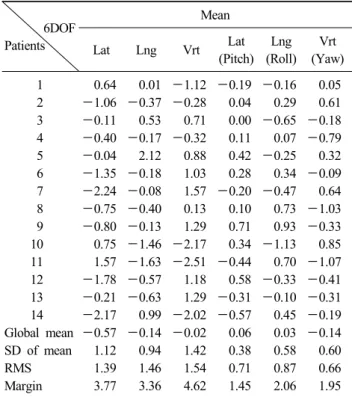
Table 1. The shift value for 14 patients 6D guide (unit: mm & o)
6DOF Patients
Mean
Lat Lng Vrt Lat
(Pitch) Lng (Roll)
Vrt (Yaw) 1 0.64 0.01 -1.12 -0.19 -0.16 0.05 2 -1.06 -0.37 -0.28 0.04 0.29 0.61 3 -0.11 0.53 0.71 0.00 -0.65 -0.18 4 -0.40 -0.17 -0.32 0.11 0.07 -0.79 5 -0.04 2.12 0.88 0.42 -0.25 0.32 6 -1.35 -0.18 1.03 0.28 0.34 -0.09 7 -2.24 -0.08 1.57 -0.20 -0.47 0.64 8 -0.75 -0.40 0.13 0.10 0.73 -1.03 9 -0.80 -0.13 1.29 0.71 0.93 -0.33 10 0.75 -1.46 -2.17 0.34 -1.13 0.85 11 1.57 -1.63 -2.51 -0.44 0.70 -1.07 12 -1.78 -0.57 1.18 0.58 -0.33 -0.41 13 -0.21 -0.63 1.29 -0.31 -0.10 -0.31 14 -2.17 0.99 -2.02 -0.57 0.45 -0.19 Global mean -0.57 -0.14 -0.02 0.06 0.03 -0.14 SD of mean 1.12 0.94 1.42 0.38 0.58 0.60 RMS 1.39 1.46 1.54 0.71 0.87 0.66 Margin 3.77 3.36 4.62 1.45 2.06 1.95 동안 치료계획 수립, 이에 대한 QA를 실시하고 분석하여 담
당 의사와 의학물리학자에 의한 치료 승인 작업을 거쳐 치료 준비를 완료하였다. 14명의 환자에 대하여 평균 23번의 분할 치료를 하였고 치료마다 BrainLAB사의 Exactrac System을 이용해 영상유도 방사선 치료를 실시하였다. 매회 치료를 시 작하기 전 환자에게 mask를 착용할 때 반드시 치료 방사선 사 2인이 양쪽으로 동시에 균일한 힘을 주어서 착용하여 모 의치료 시 때와 최대한 동일하게 하였고 환자의 느낌을 물어 다르게 착용이 되었는지를 확인하였다. 이후 환자의 Aqua- plastic mask에 그려진 표시를 이용하여 환자의 치료 위치를 모의 치료와 같게 맞추고 Exactrac system을 이용한 2D/2D 정합을 통하여 치료 목표의 위치를 기존의 CT영상을 이용하 여 만들어진 DRR영상과 비교하여 그 차이를 6D couch sys- tem을 이용하여 보정을 한 이후에 치료를 실시하였다. 14명
에 대한 총 326번의 치료에 대해 6차원의 위치보정 값들을 획득하였고 이후 따로 위치확인을 실시하거나 치료 이후에 위치에 대한 변화를 확인하지는 않았다.
얻어진 6DOF (X축, Y축, Z축, Pitch, Roll, Yaw)방향에 대 한 Shift 값을 이용하여 얻은 이 값들의 상호 연관성에 대해 Microsoft사의 Excel 2007을 이용하여 분석하였다.
결 과
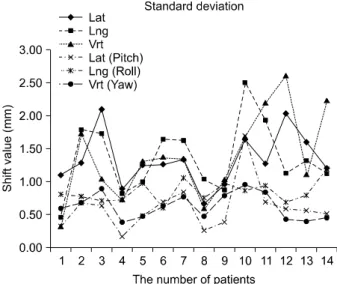
Aquaplastic mask를 사용한 두경부암 환자에 대해 Exactrac 6D couch system을 이용한 2D/2D 정합을 통한 영상유도를 실시하여 6DOF (Lateral, Vertical, Longitudinal, Pitch, Roll, Yaw) 방향에 관한 보정 값을 얻었다. 전체 14명에 관해 얻은 보정 값들의 전체 평균값은 각 방향에서 -0.57 mm, -0.14 mm, -0.02 mm, 0.06o, 0.03o, -0.14o로 나타났고(Table 1, Fig. 2), 이들 전체 평균에 대한 표준편차(Standard deviation of Group mean)값은 1.12 mm, 0.94 mm, 1.42 mm, 0.38o, 0.58o, 0.60o로 나타났다(Table 1).
전체 14명의 각 환자에 대한 6D 보정 결과 값들을 Micro- soft사 Excel 2007의 Scatter plot을 이용하여 15개 인자의 상 호연관성을 분석한 결과(Table 2, 3, Fig. 3) Longitudinal 방 향과 Pitch 방향 간에 약 0.76 (Fig. 4), Longitudinal 방향과
Table 3. The linkage of standard deviation value for 14 patients 6D guide
N=14 Lat Lng Vrt Lat (Pitch) Lng (Roll) Vrt (Yaw)
R2 (SD) Lat 0.21 0.23 0.24 0.04 0.08
Lng 0.21 0.76 0.00 0.48
Vrt 0.17 0.06 0.01
Lat (Pitch) 0.01 0.42
Lng (Roll) 0.02
Vrt (Yaw)
Table 2. The standard deviation of 14 patients 6D guide (unit:
mm & o)
6DOF Patients
Standard deviation
Lat Lng Vrt Lat
(Pitch) Lng (Roll)
Vrt (Yaw)
1 1.10 0.48 0.35 0.33 0.81 0.60
2 1.29 1.79 1.76 0.76 0.78 0.69
3 2.09 1.74 1.07 0.65 0.73 0.90
4 0.89 0.83 0.78 0.17 0.72 0.39
5 1.27 0.99 1.33 0.52 0.98 0.47
6 1.27 1.65 1.41 0.70 0.62 0.63
7 1.35 1.64 1.37 0.85 1.06 0.79
8 0.68 1.05 0.61 0.26 0.76 0.48
9 1.00 0.90 1.08 0.38 0.98 0.79
10 1.65 2.51 1.69 1.69 0.87 0.96
11 1.27 1.93 2.23 0.70 0.94 0.86
12 2.04 1.14 2.62 0.60 0.68 0.44
13 1.60 1.31 1.14 0.56 0.81 0.40
14 1.21 1.14 2.26 0.51 1.19 0.47 Fig. 4. The linkage of Longitudinal shift value & Pitch shift value in 14 patients.
Fig. 3. The standard deviation of group mean for 14 patients.
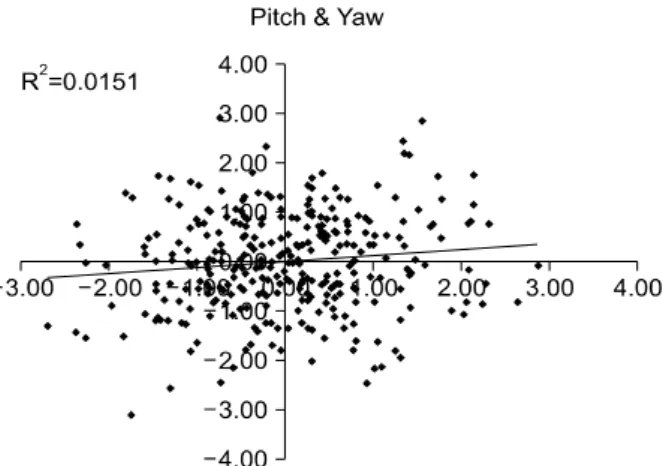
Yaw 방향 간에 0.48 (Fig. 5), Pitch 방향과 Yaw 방향 간에 0.42의(Fig. 6) 결정계수값(R2)을 나타내었다.
전체 14명의 환자에 대해 치료 전 획득한 총 326번의 보정 값들을 각각의 보정 값에서 그 환자에 해당하는 평균값을 뺀 후 이를 다시 표준편차로 나눈 값들을 이용하여 15개의 인자 의 대한 연관성을 분석한 결과(Table 4) Longitudinal 방향과 Pitch 방향 간에 약 0.03 (Fig. 7), Longitudinal 방향과 Yaw 방향 약 0.01 (Fig. 8), Pitch 방향과 Yaw 방향 간에서 약 0.02 값을 나타내었다(Fig. 9).
고안 및 결론
Aquaplastic mask를 이용하여 치료부위를 고정하고 영상 유도 방사선 치료(Image-Guided Radiation Therapy, IGRT)와 함께 세기변조방사선치료(IMRT)를 적용하는 두경부암 치료 에서의 Setup의 정확성과 고정용구의 사용은 매우 중요한 요
소이다.
BrainLAB사의 Exactrac System의 사용은 2D/2D 정합 시 3D 방향에서만 머무르는 것이 아니라 X축을 기준으로 하는 회전인 Pitch, Y축을 기준으로 하는 Roll, Z축을 기준으로 하
Fig. 7. The linkage of Longitudinal shift value & Pitch shift value in 326 case.
Fig. 8. The linkage of Longitudinal shift value & Yaw shift value in 326 case.
Table 4. The linkage of 326 case for 14 patients 6D guide
N=326 Lat Lng Vrt Lat (Pitch) Lng (Roll) Vrt (Yaw)
R2 Lat 0.01 0.02 0.00 0.03 0.19
Lng 0.03 0.03 0.00 0.01
Vrt 0.19 0.00 0.02
Lat (Pitch) 0.06 0.02
Lng (Roll) 0.20
Vrt (Yaw)
Fig. 5. The linkage of Longitudinal shift value & Yaw shift value in 14 patients.
Fig. 6. The linkage of Pitch shift value & Yaw shift value in 14 patients.
는 Yaw의 6D 방향으로의 Shift 값을 얻을 수 있어 Setup의 정확성을 향상 시키고 고정용구의 보정 값들에 대한 상호연 관성 분석을 가능하게 할 수 있었다.
전체 14명의 모든 환자에 대한 6D 보정 결과 값들의 평균 과 표준편차를 구하였다. 그 중 표준편차의 Longitudinal 방 향과 Pitch 방향, Longitudinal 방향과 Yaw 방향, Pitch 방향
과 Yaw 방향 간에서 특히 다른 인자보다 결정계수(R2) 값이 높아 비교적 서로 경향성이 있는 것으로 나타났다. 즉 환자 에 관련된 부분에서 각각의 표준편차들에 대한 연관성은 환 자의 특정방향에서의 고정의 정확성은 다른방향에서의 정확 성에 연관을 주는 것으로 평가가 되었다. 그러나 환자의 특 성을 제외시킨 pooled distribution에서의 Aquaplastic mask 자
Fig. 9. The linkage of Pitch shift value & Yaw shift valuein in 326 case.
체만의 고정효과에 대한 특성을 나타내는 분석에서는 각 환 자들 간에 대해 연관성을 가졌던 Longitudinal 방향과 Pitch
& Yaw 방향, Pitch 방향과 Yaw 방향 간에서는 0.03 이하 값 을 나타내 어떠한 인과관계도 없다는 것을 보여주었다. 이는 환자마다의 다른 구조적인 부분에 대한 정확성에 영향을 미 치는 요소가 있다는 부분이고 이에 따른 Aquaplastic mask를 이용한 고정에 대한 일반적인 경향과는 상관이 없다고 평가 되었다. Pooled distribution에서의 경향성은 어떠한 방향에서 의 오차는 다른 방향에서의 오차를 유도한다는 경향이 통계 적으로 보이지는 않으나 환자에 대한 표준편차에서 분명한 경향성을 보인다는 점은 환자마다의 Aquaplastic mask가 만 들어지는 정확성의 차이나 환자의 상태변화가 위치 정확성 에 미치는 영향성이라고 평가 되었다. Mask와 환자가 잘 밀 착이 안되는 경우 마스크를 씌울 때마다 위치의 정확성에 영 향을 주었고 이러한 정확성의 차이는 환자마다의 표준편차 의 차이로 나타났고 이러한 경향은 한쪽 방향뿐만이 아니라 여러 방향에서 같은 경향으로 나타나게 된 것이다.
치료 전 영상유도를 위해 2D/2D 정합을 실시한 6D 보정 값들의 각 방향 간에서 일반적인 mask 그 자체만의 특성을 분석한 결과에서는 어떠한 방향에서도 특별한 인과관계가 보이지 않았으나 특정 환자에 대한 분석에서는 Aquaplastic mask가 각 인자간의 어떠한 경향성을 띄며 환자를 정확하게 고정하지 못한다는 점을 알 수 있었다. 이렇게 mask의 사용 으로도 Setup에 대한 오차가 발생한다는 것을 염두하고 이를 조금 더 보정할 수 있는 방법을 고민해 볼 의미가 있다고 사 료된다.
참고문헌
1. Clemens F. Hess, Rolf-D. Kortmann, Ralf Jany, Andreas Hamberger, et al.: Accuracy of field alignment in radio- therapy of head and neck cancer utilizing individualized face mask immobilization-a retrospective analysis of clinical practice. Radiotherapy and Oncology 1995;34:69-72
2. Antonetta C. Houweling, Skadi van der Meer, Edwin van der Wal, et al.: Improved immobilization using an individual head support in head and neck cancer patients. Radiotherapy and Oncology 2010;96:100-103
3. Kazuhiro Ohtakara, Shinya Hayashi, Hidekazu Tanaka, et al.: Clinical comparison of positionalaccuracy and stability between dedicated versus conventional masks for immobili- zation in cranial stereotactic radiotherapy using 6-degree-of- freedom image guidance system-integrated platform. Radio- therapy and Oncology 2012;102:198-205
4. Marcel van Herk: Errors and margins in radiotherapy.
Seminars in Radiation Oncology 2004;14:52-64
5. Robert B. Den, Anthony Doemer, Greg Kubicek, et al.:
Daily image guidance with cone-beam computed tomography for head-and-neck cancer intensity-modulated radiotherapy: a prospective study. International Journal of Radiation Oncolo- gy Biology Physics 2010;76:1353-1359
6. Jen-San Tsai, Mark J. Engler, Marilyn N. Ling, et al.: A non-invasive immobilization system and related quality as- surance for dynamic intensity modulated radiation therapy of intracranial and head and neck disease. International Journal of Radiation Oncology Biology Physics 1999;43:455-467 7. Tryggestad E, Christian M, Ford E, et al.: Inter- and intra-
fraction patient positioning uncertainties for intracranial ra- diotherapy: a study of four frameless, thermoplastic mask- based immobilization strategies using daily cone-beam CT.
International Journal of Radiation Oncology Biology Physics 2011;80:281-290
8. Lena Sharp, Freddi Lewin, Hemming Johansson, et al.:
Randomized trial on two types of thermoplastic masks for patient immobilization during radiation therapy for head-and- neck cancer. International Journal of Radiation Oncology Biology Physics 2005;61:250-256
9. S. Bieri, R. Miralbell, P. Nouet, et al.: Reproducibility of conformal radiation therapy in localized carcinoma of the prostate without rigid immobilization. Radiotherapy and On- cology 1996;38:223-230
10. Hans C.J. de Boer, John R. van Sörnsen de Koste, Carien L.
Creutzberg, et al.: Assessment of three-dimensional set-up errors in conventional head and neck radiotherapy using electronic portal imaging device. Radiotherapy and Oncology 2001;61:299-308
11. Mandy Humphreys, M. Teressa Guerrero Urbano, Cefas Mubata, et al.: Assessment of a customised immobilisation system for head and neck IMRT using electronic portal
imaging. Radiotherapy and Oncology 2005;77:39-44 12. Siyong Kim, Hilary C Akpati, Jonathan G Li, et al.: An im-
mobilization system for claustrophobic patients in head-and- neck intensity-modulated radiation therapy. International Jour- nal of Radiation Oncology Biology Physics 2004;59:1531-1539 13. Cheng B Saw, Richard Yakoob, Charles A Enke, et al.:
Immobilization devices for intensity-modulated radiation the- rapy. Medical Dosimetry 2009;34:228-232
14. B. Robison, R. Seibert, C.R. Ramsey: Evaluation of head and neck patient setup and immobilization errors. Internatio- nal Journal of Radiation Oncology Biology Physics 2007;69:
S667-S668
15. Anna Samuelsson, Claes Mercke, Karl-Axel Johansson: Sys- tematic set-up errors for IMRT in the head and neck region:
effect on dose distribution. Radiotherapy and Oncology 2003;
66:303-311
16. Chris Beltran, Matthew J. Krasin, Thomas E. Merchant:
Inter- and intrafractional positional uncertainties in pediatric radiotherapy patients with brain and head and neck tumors.
International Journal of Radiation Oncology Biology Physics 2011;79:1266-1274
17. Zheng Chang, Zhiheng Wang, Jinli Ma, et al.: 6D image guidance for spinal non-invasive stereotactic body radiation therapy: Comparison between Exactrac X-ray 6D with kilo- voltage cone-beam CT. Radiotherapy and Oncology 2010;
95:116-121
18. Coen W Hurkmans, Peter Remeijer, Joos V Lebesque, et al.:
Set-up verification using portal imaging; review of current clinical practice. Radiotherapy and Oncology 2001;58:105-120 19. Martin Fuss, Bill J Salter, Dennis Cheek, et al.: Repositio- ningaccuracy of acommercially available thermoplastic mask system. Radiotherapy and Oncology 2004;71:339-345 20. Leah Lord, Sharon May, Michael Bailey, et al.: Is one head
and neck immobilization system as good as another?
Onecenter’s experience. Medical Dosimetry 2003:28:39-43 21. Gale AA, Serago CF, Ko SJ, et al.: Analysis of the un-
certainty of daily stereoscopic kV imaging registration pro- cess and thermoplastic mask immobilization for head and neck patients. International Journal of Radiation Oncology Biology Physics 2009;75:S607
22. Robert B. Den, Anthony Doemer, Greg Kubicek, et al.:
Daily image guidance with cone-beam computed tomography for head-and-neck cancer intensity-modulated radiotherapy: a prospective study. International Journal of Radiation Oncolo- gy Biology Physics 2010;76:1353-1359
23. Michael Velec, John N. Waldron, Brian O’Sullivan, et al.:
Cone-beam CT assessment of interfraction and intrafraction setup error of two head-and-neck cancer thermoplastic masks.
International Journal of Radiation Oncology Biology Physics 2010;76:949-955
Abstract
Influence of Aquaplastic Mask Immobilization on Patient Positioning in Head & Neck Radiotherapy
Ho Yeon Lee, Sun Myung Bae, Jin San Kim, Tae Young Kang, Jung Won Kwak, Geum Mun Back Department of Radiation Oncology, Asan Medical Center, Seoul, Korea
Purpose: This study aimed to analyze the influence of aquaplastic mask which is used for the radiotherapy for patients with head and neck cancer on patient positioning by analyzing the results of 2D/2D matching with the use of Exactrac 6D couch system.
Materials and Methods: 2D/2D matching-based Image guidance was performed with the use of Exactrac 6D couch system on a total of 14 patients with head and neck cancer who received radiotherapy at this hospital in a period from June 2010 to June 2011. The adjusted 6D values obtained after the image guidance were classified into values related with patients and values not related with patients as to the correlation between the results.
Results: In the analysis of the relation of each adjusted value to patients, the coefficient of determination (R2) of longitudinal and pitch direction was 0.76, of longitudinal and yaw direction was 0.48, and of pitch and yaw direction was 0.42 although the coefficient of determination for above factors was 0.03 or less when the dependency of patients was excluded.
Conclusion: It was demonstrated that intrinsic factors of aquaplastic mask had influence on the immobilization of patients by aquaplastic mask although various factors related with patients had influence on the immobilization of patients. It is believed that if these factors are adjusted, the treatment of patients with head and neck cancer can be more accurate.
Key words: aquaplastic mask, exactrac system, 2D/2D matching, Image-guide radiotherapy