Journal of the Korea Institute of Building Construction, Vol. 14, No. 2
http://dx.doi.org/10.5345/JKIBC.2014.14.2.127 www.jkibc.org
내화성 경량 무기 발포보드를 이용한 커튼월 시스템의 시공성능에 관한 연구
A Study on the Construction Performance of Curtain Wall Systems Using Fire-Resistant & Light-Weight Inorganic Composite Foam Board
구 영 아
1)김 성 은 오 창 원
*Koo, Young-Ah Kim, Seong-Eun Oh, Chang-Won*
R& D Center, Hyundai Development Company, Tanbul-Dong, Gwangju-Si, Gyeonggi-Do, 464-100, Korea
Abstract
This study had the goal of analyzing the economic feasibility and constructability of a fire resistant curtain wall system using Light-weight Inorganic Composite Foam Board(LI-CFB). LI-CFBs, new materials with excellent fire resistance are being developed for use as the back panel of curtain wall and their fire resistance has already been analyzed through actual tests in earlier studies. In this study, a mock-up test involving the installation of the fire resistant curtain wall system on an actual building was conducted, and the system was compared with a common curtain wall system. This system is applied in the same way as a common curtain wall system. But the cutting LI-CFBs, which are brought from a factory, are used in the system and attached on the frame (mullion and transom).
Even though the system requires more working time than the existing system, the LI-CFBs back panels are easy to cut and do not produce dust. Also, the panels are able to be assured the quality by checking damaged parts easily.
Besides having a high level of fire resistance, the system’s economic feasibility and constructability meets or exceeds those of the existing system.
Keywords : fire-resistant & light-weight inorganic composite foam board, curtain wall system, construction performance
1. 서 론
건축물이 고층화, 대형화됨에 따라 다양한 기능성을 만 족할 수 있는 커튼월 개발에 대한 필요성이 대두되고 있다.
특히, 지난 2010년 해운대 우신골든스위트 화재 사건을 계 기로 언론을 통해 고층건물 커튼월의 화재 안정성에 관한 문제가 꾸준히 제기되고 있으며, 이를 해결하기위해 정부 에서는 불연 및 내화 성능을 갖는 단열재 및 마감재를 사용 하고, 층간방화구획을 설계 하도록 하고 있다. 커튼월의 내
Received : June 27, 2013
Revision received : February 11, 2014 Accepted : February 13, 2014
* Corresponding author: Oh, Chang-Won
[Tel: 82-31-766-8590, E-mail: [email protected]]
ⓒ2014 The Korea Institute of Building Construction, All rights reserved.
화성능 확보를 위해 해외에서는 유럽 EN code와 독일 DIN code에 따라 사전에 커튼월의 내화성능을 평가하도록 하고 있지만[1], 국내 내화구조의 인정 및 관리기준(국토해 양부 고시 제2012 - 552호)[2]에는 현재 층간방화 외에 커튼월 시스템에 대한 정확한 내화 기준이 명기되어 있지 않은 현황이다. 또한 내화 구조임을 인정받기 위한 시험 방 법인 한국산업규격 KSF 2257-8(건축 부재의 내화시험방 법-수직 비내력벽 구획 부재의 성능 조건)을 비내력벽인 커튼월에 적용하려해도 ‘커튼월이나 문 또는 유리를 포함 하고 있는 벽의 내화 시험에는 적용하지 않는다’고 명시되 어[3] 그대로 적용할 수 없다. 따라서 국내 커튼월의 내화 성능에 관한 평가 기준은 커튼월 전체에 관한 평가가 아닌 층간방화에만 국한되어 있다고 할 수 있다.
본 연구는 시스템 자체가 내화성능을 갖는 경량 무기 발
A Study on the Construction Performance of Curtain Wall Systems Using Fire-Resistant & Light-Weight Inorganic Composite Foam Board
포보드를 이용한 내화 커튼월 시스템을 제안하고, 시공법 및 경제성을 검토하고자 한다. 이를 위해 불연성능 및 내화 성능시험을 실시하였으며, 내화성능시험은 유럽 EN code 의 시험방법에 따라 「건축물의 피난ㆍ방화구조 등의 기준 에 관한 규칙(국토교통부령 제1호)」, 비내력벽의 내화구 조 성능기준인 30분을[4] 만족하는지 확인하였다. 또한 mock-up 시공을 통해 이 시스템에 대한 시공성 및 현장 적용성을 분석하고, 원가계산을 통해 기존 시스템과의 경 제성을 비교검토하였다.
2. 내화 커튼월 시스템
커튼월 건물의 스팬드럴(Spandrel)파트는 커튼박스 상 단부터 비젼(Vision)파트의 하단부로, 모듈 상 비젼파트에 비해 수평재의 간격이 좁고 유리의 하중 또한 작게 작용하 는 것이 상례이다. 스팬드럴 파트는 미관 상 내부 시설물이 보이지 않아야 하는 부분으로 외부 건물 디자인의 중요한 요소가 된다. 또한 외기나 내부, 층간 및 단열을 담당하는 중요한 요소로서 단열재를 포함한 백패널(Back Panel)로 구성하며, 층간에는 단열재를 시공하여 열교를 방지하고 건물 외피의 에너지 성능을 향상시킨다.
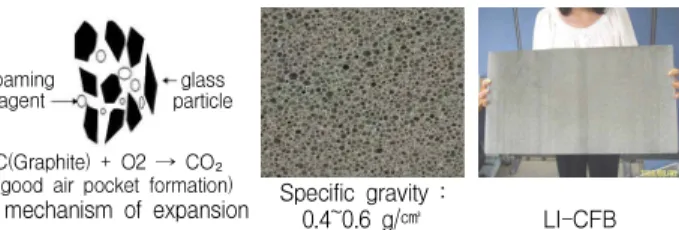
일반적으로 커튼월 스팬드럴 구간에 적용되는 백패널 내 부에 미네라울, 글라스울과 같은 무기계 섬유를 사용하여 내화성능을 높이고 있으나, 무기섬유의 특성상 수분에 취 약하고 뭉침 및 처짐현상 등이 발생하여 단열성능이 떨어 진다는 단점이 있다. 폴리에스테르와 같은 유기계 소재는 화재에 취약하여 일산화탄소 발생에 의한 인체 유해성 등 의 문제로 건물적용에 그 한계가 있다. 반면, 폐기물인 폐 유리분말(Cullet)과 화력발전소 부산물인 석탄비산회(Coal Fly ash)를 주원료로 1000℃ 이상 고온에서 발포시킨 무 기발포소재는 수분에 취약하지 않아 장기간 동일한 단열성 능을 유지할 수 있으면서 내화성 또한 모두 갖춘 소재이다 [5]. Figure 1은 소재의 조성 및 이를 이용하여 제작한 내 화성 경량 무기 발포보드 제품(LI-CFB)을 보여준다.
일반적으로 커튼월 시스템은 화재가 발생하면 Figure 2 와 같은 경로로 화재가 확산된다. 커튼월의 주자재인 알루 미늄은 화염에 노출되면, 그 연화점이 660℃라 이론적으 로 7여분 정도가 지나면 녹기 시작한다. 또한 스팬드럴 구 간에 사용되는 글라스울 경우도 불연재이긴 하나, 시공 시
훼손되는 경우가 많아 이를 통해 화염이 확산된다. 더불어 실내 측 마감재가 파손될 경우 파손된 부위를 통해 습윤한 실내공기가 단열재 내부로 투습되고 단열성능 저하 및 내 부 결로를 야기한다.
따라서 본 연구에서 제안하는 커튼월 시스템은 Figure 3와 같이 경량 무기 발포보드로 스팬드럴 구간의 알루미늄 바를 감싸 화염으로부터 바를 보호하고, 백패널로 사용되 는 글라스울 대신 내수성에 강한 발포보드를 취부하여 시 공 시 훼손됨을 방지하며 기존 단열재가 가지는 문제점을 보완한 시스템이다. 또한 글라스울을 이용한 백패널과 유 사한 열성능을 갖으면서도[6] 내화성능을 향상시킨 내화 커튼월 시스템이다.
glass particle foaming
agent
C(Graphite) + O2 → CO₂ (good air pocket formation)
A mechanism of expansion Specific gravity :
0.4~0.6 g/㎤ LI-CFB
Figure 1. Light-weight Inorganic composite foam board(LI-CFB)
② ①
Indoor Outdoor
Spandrel
Glazing Glazing
Slab
Joint
Figure 2. Fire spreading of curtain wall (image source(right) : yonhapnews)
Back Panel Framing Cover
for Fire ExposureProtection
Mechanical
Attachment/
Sealant
Reinforcing Angle for Bending
Prevention Fire Protection Putty or Sealant
Firestop
Material
( : LI-CFB installation)
Figure 3. Fire-resistant curtain wall
3.1 불연성능시험
흔히 불연재로 사용하는 글라스울, 미네라울과 대비하여 무기발포보드의 내화성능을 간단한 시험으로 비교해 보았 다(Table 1). 글라스울에 30초정도 토치(1000℃)로 가열하 거나, 가열로 600℃에서 30분간 가열하였을 시 타서 완전 히 용융되었으며, 미네랄울인 경우도 토치를 사용한 고온에 서는 타고, 가열로에서는 체적이 수축하였다. 그 수축율이 26%이상일 뿐만 아니라 만졌을 경우에는 부스러졌다. 무기 발포보드인 경우 표면에 아주 미세한 균열이 보였으나, 이 는 표면에 함습되어진 습기가 고온에서 갑자기 건조되면서 수축하여 미세한 균열이 발생된 것으로 보여지며, 이는 물 성자체에 변화를 초래하지 않는 것으로 확인되었다. 이 결 과는 화재발생 시 글라스울과 미네랄울에 비해 경량무기발 포보드가 화재확산 방지에 더 유리함을 보여준다.
Insulation Original
condition Heat treating with a torch
600℃/30min.
(electric
furnace) TG-DSC
Glass wool
completely melted and agglomerated
Mineral wool
contraction percentage 26%, be easy to break
Inorganic Composite
Foam Board
contracted a little bit and cracked Table 1. Heat resistance of insulation
3.2 내화성능시험
EN 1364-3「커튼월 전체시스템의 내화시험방법」은 패널, 유리, 구조체, 선형조인트 충전시스템, 확산 등 커튼 월 시스템에서 요구되는 내화성능을 함께 판단할 수 있는 자세한 시험방법 및 평가 기준을 제시하고 있다[7]. 경량 무기발포 패널을 이용한 내화 커튼월 시스템에 대한 내화 성능을 고찰하고자 커튼월 전체 시스템의 내화시험 방법인 EN 1364-3의 시험방법에 따라 시험을 수행하였다[8].
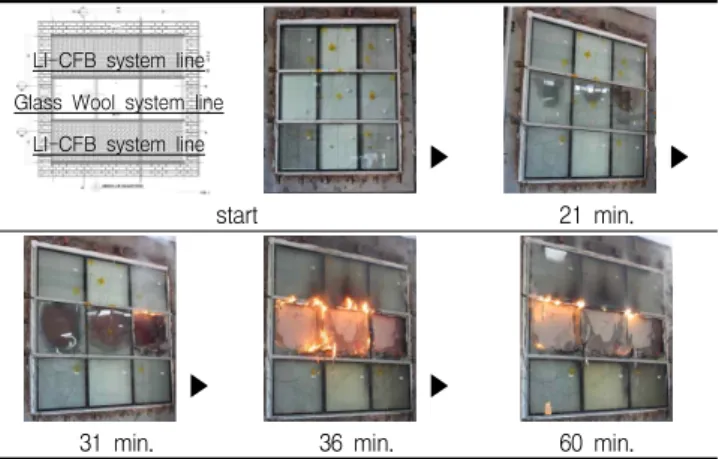
차염성 시험 결과, Figure 4와 같이 유리가 깨지고 착화가 발생한 시점은 기존의 글라스울 백패널을 이용한 부위의 경우 6분이 경과하였을 때이며, 21분이 지났을 때 눈에 띄 게 유리에 변형이 일어났다. 반면 경량 무기 발포보드 백패 널을 이용한 내화 커튼월 시스템은 31분에 착화가 발생하 였으나 60분이 경과될 때까지 유리에 큰 변형이 일어나지 않았다.
초기온도로부터 평균온도 140℃ 또는 최고온도 180℃
증가하는 시점으로 평가되는 차열성 및 복사열에 대한 평 가 결과는 기존 시스템, 내화 커튼월 시스템 모두 최고 온 도에 도달하기 전에 유리가 깨졌으므로 이 후 급격한 온도 상승을 보였다. 따라서 두 시스템의 내화성능은 차염성 시 험결과에 따라 각각 6분, 31분이라고 할 수 있다. 즉, 두 시스템 중 제안된 시스템만이 비내력벽의 내화구조 성능기 준인 30분을 만족할 수 있었다.
LI-CFB system line Glass Wool system line
LI-CFB system line
▶ ▶
start 21 min.
▶ ▶
31 min. 36 min. 60 min.
Figure 4. Fire resistance test
4. Mock-up을 통한 시공성능 분석
4.1 Mock-up 개요
경기도 광주시 H 연구소 건물을 대상으로 내화커튼월 시스템을 mock-up 시공하였다(Table 2). 기존의 알루미 늄 커튼월을 철거하고, 경량 무기 발포보드를 이용한 내화 커튼월 시스템을 2012년 12월부터 2013년 1월까지 약 3 개월 간 시공하였다. 커튼월이 설치된 곳은 홀 구간의 3개 층으로써 홀 구간의 건물의 전․후면 커튼월을 철거 후 내화 커튼월 시스템으로 교체 시공하였다. 내화 커튼월 시스템 은 경량 무기 발포보드로 기존의 글라스울 백패널을 대체
A Study on the Construction Performance of Curtain Wall Systems Using Fire-Resistant & Light-Weight Inorganic Composite Foam Board
하고, 알루미늄 프레임에 취부함으로써 내결로성, 단열성 능은 물론 내화성능을 확보한 시스템으로 이 시스템에 대 한 작업 용이성, 공사 기간, 안전성 분석을 통해 시공성능 을 종합적으로 평가하였다.
4.2 내화 커튼월 시스템 시공순서 및 시공
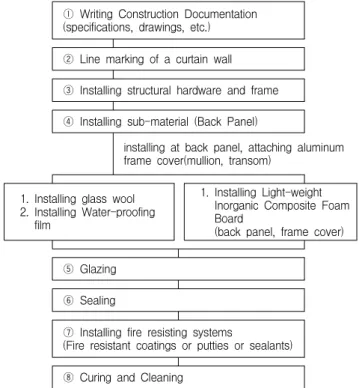
커튼월 시공은 Figure 5와 같이 ‘도면 및 시방서 작성- 기준 먹메김-부착철물 및 프레임 설치-부속재료(백패널) 의 설치-유리 설치-실링(Seal) 공사-화연방지층의 시공- 보양 및 청소’의 과정을 거친다. 내화 커튼월도 일반적인 커튼월의 시공순서를 따르는데, ‘부속재료(백패널)의 설치’
에서 기존의 글라스울 및 아연도강판 설치 대신 공장에서 미리 제단되어 온 경량무기발포보드를 백패널로 설치하고, 더불어 내화성능을 향상시키기 위해서 커튼월 프레임에 추 가적으로 경량발포보드를 취부한다는 점에 차이가 있다.
다시 말해 기존 백패널의 시공은 Figure 6와 같이 ‘부착 철물 설치-백패널 설치(아연도강판+글라스울)-실링 공 사’ 순으로 진행되지만, 내화성 커튼월은 ‘부착철물 설치- 백패널 설치(경량무기발포보드)-실링공사-프레임 커버 설치(경량무기발포보드)’ 순으로 시공된다.
Building R&D Center Location Gwangju-Si, Gyeonggi-Do
Site area 1,071㎡
Floor area 797㎡
Floor B1 ~ F3
facilities Main laboratory, office, 3 housing models
Floor plan
Fire-resistant curtain wall, Insulation installation
Details
Section of Hall front view back view Table 2. Mock-up summary
① Writing Construction Documentation (specifications, drawings, etc.)
② Line marking of a curtain wall
③ Installing structural hardware and frame
④ Installing sub-material (Back Panel)
installing at back panel, attaching aluminum frame cover(mullion, transom)
1. Installing glass wool 2. Installing Water-proofing
film
1. Installing Light-weight Inorganic Composite Foam Board
(back panel, frame cover)
⑤ Glazing
⑥ Sealing
⑦ Installing fire resisting systems
(Fire resistant coatings or putties or sealants)
⑧ Curing and Cleaning
Figure 5. Curtain wall installation sequence Existing back panel(Glass wool)
① Attaching L-type
angle to the curtain wall ② Screwing the back
panel to the wall ③ Sealing and Installing fire resisting systems LI-CFBs back panel
① Attaching L-type
angle to the curtain wall ② Screwing the back
panel to the wall ③ Sealing and Installing fire resisting systems
④ Attaching to the frame ⑤ completion Figure 6. Installation procedure for back panel
4.3 시공 시 장점 및 공사기간
기존 백패널은 현장에서 직접 아연도강판 및 글라스울을 제단하여 설치하는 경우가 많다. 이때 발생하는 유리분진
이나 외력에 의해서 Figure 7과 같이 훼손되는 경우가 많 아 품질확보에 어려움이 있다.
Damage during
construction Internal
condensation Damage during
shipment Different color / wave Figure 7. Construction defect of back panel
반면 경량 무기 발포보드는 Figure 8과 같이 공장에서부 터 Cutting기를 이용하여 제작치수에 맞게 제단 되어져 현 장으로 반입되며, 2차 가공 없이 이를 바로 시공할 수 있다.
제단이 용이하므로 Figure 9와 같이 시공 시 수정 작업도 가능하다. 또한 단단한 보드로서 적재 시 눌림 발생이 없고, 파손여부를 바로 확인할 수 있어 품질확보가 용이하다.
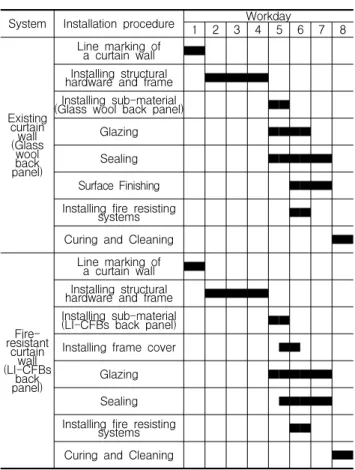
커튼월의 총 공사일수는 일반적으로 8일 정도이다. 내화 커튼월 시스템은 기존 커튼월과 비교하여 프레임 커버 설 치 공정이 추가되지만 경량 무기 발포보드 백패널 설치와 연속하여 이루어지므로 전체 공사기간에 영향을 주지 않는 다. 각 커튼월 시스템의 공사기간은 Table 3과 같다.
Existing back panel(Glass wool) Developed Board
① Manufacturing a
galvanized steel sheet ② Cutting a glass
wool and attaching ① Cutting
③ Finishing ④ Packing and
shipment to site ② Packing and shipment to site Figure 8. Manufacturing procedure for back panel
Figure 9. Workability improvement of developed board
System Installation procedure Workday
1 2 3 4 5 6 7 8
Existing curtain (Glass wall wool back panel)
Line marking of a curtain wall Installing structural hardware and frame Installing sub-material (Glass wool back panel)
Glazing Sealing Surface Finishing Installing fire resisting systems
Curing and Cleaning
Fire- resistant
curtain (LI-CFBs wall
panel) back
Line marking of a curtain wall Installing structural hardware and frame Installing sub-material (LI-CFBs back panel) Installing frame cover
Glazing Sealing Installing fire resisting systems
Curing and Cleaning
5. 경제성 분석
Figure 10과 같이 H 연구소에 시공한 전면부 내화 커튼 월 시스템(3,240mm×6,470mm)을 기준으로 기존 백패 널 시공비와 내화커튼월 시스템에 사용된 백패널 시공비를 비교하였다. 나머지 커튼월 공정에서는 동일한 금액이라고 보고 백패널 시공비만을 비교하였으며, 인건비 및 자재 단 가는 표준 품셈을 참고하였다.
계산 결과는 Table 4, Table 5와 같이 글라스울을 이용 한 백패널은 69,990원/㎡, 경량 무기 발포보드를 이용한 백 패널은 64,910원/㎡으로 내화 커튼월 시스템이 기존 커튼 월 시스템보다 내화성능이 향상되면서도 약 7%의 비용절감 이 가능한 것으로 나타났다. 기존 백패널의 주재료인 아연도 강판과 글라스울은 226,716원, 경량무기발포보드는 백패널 과 프레임용을 모두 합쳐 219,315원으로 유사하나 기존 백 패널은 일반적으로 아연도강판 위에 페인트 작업을 함으로 51,119원의 추가 비용이 발생하지만 발포 보드는 석재질감 으로 별도의 페인트 작업이 필요 없어 그 비용이 절감된다.
A Study on the Construction Performance of Curtain Wall Systems Using Fire-Resistant & Light-Weight Inorganic Composite Foam Board
existing back panel
Units Quantity unit cost(Korea Won) total cost(Quantity×unit cost)(Korea Won)
item sizes and types material
cost labor cost equipment costs material
cost labor cost equipment costs total
galvanized steel sheet 1.2T kg 111.7 1,426 159,284 159,284
1) ready mixed paint twice on steel sheet,
first grade
ready mixed paint ℓ 1.382 5,333 7,370 7,370
thinner ℓ 0.067 2,333 156 156
putty kg 0.666 812 540 540
sandpaper sheet 0.833 230 191 191
tool rent fee 2% of labor costs set 1 840 840 840
painter man 0.383 109,720 42,022 42,022
2) insulation(Glass Wool)
glass wool density 48kg/㎡, thickness
75mm m
28.325 8,100 67,432 67,432
post pin piece 42 97 4,074 4,074
L-type angle piece 36 160 5,760 5,760
screw piece piece 108 12 1,296 1,296
other sub-materials 5% of steel sheet and
glazing cost set 1 6,801 6,801 6,801
3) joint
silicon 4.68m/㎡ m 28.65 1,750 50,137 50,137
caulker man 0.86 111,902 96,235 96,235
4) installation of back panel
sash worker installation of back panel man 0.167 117,090 19,554 19,554
Labor cutting steel sheet man 0.749 81,443 61,000 61,000
Labor attaching insulations man 0.333 81,443 27,120 27,120
Labor installation of back panel man 0.25 81,443 20,360 20,360
pavement m
28.325 500 4,162 4,162
shipping charge m
28.325 1,000 8,325 8,325
Total 308,043 266,291 8,325 582,659
(69,990won/㎡) Table 4. Construction cost of existing back panel(Glass wool)
developed board
Units Quantity unit cost(Korea Won) total cost(Quantity×unit cost)(Korea Won)
item sizes and types material
cost labor cost equipment costs material
cost labor cost equipment costs total Light-weight Inorganic
Composite Foam Board 50T m
28.325 23,000 191,475 191,475
Light-weight Inorganic
Composite Foam Board 30T m
21.74 16,000 27,840 27,840
L-type angle piece 36 160 5,760 5,760
screw piece piece 228 12 2,736 2,736
other sub-materials 3% of material
cost set 1 6,579 6,579 6,579
1) joint
silicon m 28.65 1,750 50,137 50,137
caulker man 0.86 111,902 96,235 96,235
2) installation of back panel
sash worker man 0.604 117,090 70,722 70,722
Labor man 0.906 81,443 73,787 73,787
pavement m
210.065 500 5,032 5,032
shipping charge m
210.065 1,000 10,065 10,065
Total 289,559 240,744 10,065 540,368
(64,910won/㎡)
Table 5. Construction cost of Developed Light-weight Inorganic Composite Foam Board
Attachment location of back panel and frame
Size Quantity Location Note 990*1325 3 AW-3 Back panel 990*1430 3 AW-3 Back panel 996*1325 3 AW-2 Back panel 996*1430 3 AW-2 Back panel 120*1425 8 AW-2,3 Mullion 120*1500 8 AW-2,3 Mullion
120*1000 3 AW-2 Transom
90*1000 9 AW-2 Transom
120*1006 3 AW-3 Transom
90*1006 9 AW-3 Transom
Completion Input of developed board
Horizontal section Vertical section Figure 10. Summary of Fire-resistant curtain wall
6. 결 론
본 연구는 경량 무기 발포보드를 기존 커튼월에 적용한 내화 커튼월 시스템을 제안하고, 내화성능을 분석하였다.
또한 Mock-up 시공을 통해 이 시스템의 시공성 및 경제 성을 검토하였으며, 그 연구 결과를 정리하면 다음과 같다.
1) 경량무기발포보드를 이용한 커튼월 시스템의 내화성 능을 알아보기 위해 불연성능시험과 내화성능시험을 실시하였다. 불연성능시험 결과, 글라스울이나 미네 랄울은 그을림, 용융, 체적 수축이 발생한 반면 경량 무기 발포보드의 경우 미세 균열을 제외하고 거의 변 화가 없었다. 내화성능은 유럽 EN code의 시험방법 에 따라 시험한 결과, 기존 시스템은 6분, 내화 커튼 월 시스템은 31분으로 「건축물의 피난ㆍ방화구조 등의 기준에 관한 규칙(국토교통부령 제1호)」, 비내 력벽 내화구조 성능기준인 30분을 만족하였다.
2) 내화 커튼월 시스템은 기존 커튼월 시공과정과 동일 하며, 단지 기존 백패널 설치 대신 경량무기 발포보 드를 설치하고 커튼월프레임에 경량 무기 발포보드 를 취부하여 내화성을 향상시킨 공법으로 공사기간
시 아연도강판 및 글라스울을 제단하고 부착하는 일 련의 작업이 수작업으로 진행되는 것과 달리 치수대 로 제단되어 온 보드를 바로 시공할 수 있어 더 간편 하다는 장점이 있다. 또한 유리 분진에 의한 인체유 해성이 적고, 적재 또는 운반 시 훼손이 적고 공장생 산으로 균일한 품질확보가 용이하다.
3) 내화 커튼월 시스템을 기존 시스템과의 시공비용을 비교 검토한 결과, 우수한 내화성능을 확보하면서도 기존 시스템 대비 약 4%의 절감효과를 볼 수 있었다.
내화 커튼월 시스템은 경량 무기 발포보드를 백패널로 이용하고 프레임에 취부하여 내화성을 향상시킨 시스템으 로, 커튼월 설치 공정에 영향을 주지 않고 시공이 간편하지 만 내화성능기준을 만족하는 시스템이다. 건축물의 방재에 관해 지속적인 관심이 집중되고 있는 시점에서 앞으로 이 러한 내화 커튼월 시스템의 개발 및 적용은 화재를 미연에 방지하고 그에 따른 경제적 손실을 저감할 수 있을 것으로 기대된다.
요 약
본 연구는 경량 무기 발포보드를 이용한 커튼월시스템의 시공성 및 경제성 분석에 관한 연구로, 내화성 경량 무기 발포보드는 커튼월의 백패널로 이용하기 위해 개발된 신소 재로 내화성능은 선행연구를 통해 실물 내화시험을 실시하 여 이미 분석한 바 있다. 본 연구에서는 실제 건물에 내화 성 커튼월 시스템을 설치하여 Mock-up test를 수행하고 일반적인 커튼월 시스템과 비교 검토하였다. 이 시스템은 기존의 커튼월 시스템과 동일한 방법으로 시공되는데, 다 만 내화성능 확보를 위해 공장에서 제단되어 온 경량무기 발포보드 사용하고, 이를 커튼월 프레임에 취부한다. 비록 기존 커튼월 대비 프레임에 부착해야하는 추가 작업이 발 생하나, 경량 무기 발포보드를 이용한 백패널은 커팅만으 로 제작이 간편하고, 분진발생이 없어 인체에 무해하며, 파 손여부를 바로 확인할 수 있어 품질확보가 용이하다. 따라 서 이 시스템은 높은 수준의 내화성을 확보하면서도 시공 성과 경제성면에서도 기존 커튼월 시스템과 동등이상임으 로 판단된다.
A Study on the Construction Performance of Curtain Wall Systems Using Fire-Resistant & Light-Weight Inorganic Composite Foam Board
키워드 : 내화성 경량 무기 발포보드, 커튼월 시스템, 시공성능
Acknowledgement
This research was supported by a grant(Code# ’10 R&D C04) from Cutting-edge Urban Development Program funded by Ministry of Land, Infrastructure and Transport of Korean government.