노인의 전산화 신경인지 검사와 만족도, 컴퓨터 이용경험 사이의 연관성
Association between the Computerized Neurocognitive Function Test, Computer Experience, and Satisfaction in the Elderly
문종훈*, 양승범**, 전민재*
국립재활원 재활연구소 건강보건연구과*, 원광보건대학교 의무부사관과**
Jong-Hoon Moon([email protected])*, Seung-Bum Yang([email protected])**, Min-Jae Jeon([email protected])*
요약
본 연구는 노인의 전산화 신경인지 검사와 만족도, 컴퓨터 이용경험 사이의 연관성을 알아보고자 하였다.
본 연구에 건강한 노인 52명(남자 25명, 여자 27명)이 참여하였다. 대상자는 전산화 신경인지 검사(정확도, 반응시간)를 수행하였으며, 컴퓨터 이용경험, 전산화 신경인지 검사 이용 만족도를 평가하였다. 통계분석은 독 립 t 검정과 피어슨 상관분석을 수행하였다. 컴퓨터 이용경험이 없는 노인은 이용경험이 있는 노인에 비해 나 이가 많았으며(p<.05), 교육수준이 낮았다(p<.05). 컴퓨터 이용경험이 있는 노인은 이용경험이 없는 노인보다 전산화 신경인지 검사의 정확도는 높았고 반응시간이 빨랐으며, 만족도는 높았다(p<.05). 상관분석에서, 나이 가 많을수록, 교육수준이 낮을수록 전산화 신경인지 검사 정확도는 낮았으며, 반응속도는 빨랐다(p<.05). 만족 도는 나이와 음의 상관을 나타냈고, 교육수준과는 정적 상관을 보였다(p<.05). 노인의 전산화 신경인지 검사 만족도는 교육수준과 컴퓨터 이용경험과 연관성이 성립될 수 있다.
■ 중심어 :∣노인∣인지∣만족도∣컴퓨터∣
Abstract
The purpose of this study was to examine the relationship between the neurocognitive function test (CN Test), computer experience, and satisfaction in the elderly. We recruited 52 healthy elderly persons (25 males and 27 females) for this study. The subjects did the CN Test (accuracy, response time) and evaluated their computer experience and satisfaction with the CN Test. We used the independent t test and Pearson correlations for statistical analysis. The elderly without computer experience were older than the elderly with computer experience (p < .05) and education level was lower (p < .05). The elderly with computer experience were higher the satisfaction than the elderly without computer experience, the CN Test was more accurate, and response time was faster (p < .05). In the correlation analysis, the higher the age and the lower the education level, the lower the accuracy of the CN Test and the faster the response time (p < .05). Satisfaction was negatively correlated with age, and was statistically correlated with education level (p < .05). The satisfaction level with the CN Test by the elderly has a moderate relationship with the level of education and computer experience.
■ keyword :∣Cognition∣Computer∣Elderly∣Satisfaction∣
접수일자 : 2019년 07월 25일
수정일자 : 2019년 08월 22일 심사완료일 : 2019년 09월 02일
교신저자 : 전민재, e-mail : [email protected]
I. Introduction
The population of elderly people in Korea is about 14.9% of the total population in 2019 and is estimated to be 47.7% in 2045[1]. Although the elderly population is increasing rapidly, its health span is declining[2]. This reduction in the healthy elderly population will increase the social and economic costs of the government.
The mental health of the elderly is an important variable for predicting future health, and various management methods have been suggested.
In Korea, the aging of the population is growing at a rapid pace, and computer-related technology is also increasingly dependent on it[3]. The rates at which elderly people utilize digital devices are lower than that of younger people, but the elderly are one of the groups that have recently begun using computers[4]. To meet this trend, more attention is being paid to the use of computers by the elderly.
There were several studies on computer use and cognitive function. The researches have shown that cognitive function is not consistent between computer users and non-users[5][6]. Ball et al.[5] suggested that computer use by the elderly can be an activity that stimulates cognitive function, which is helpful for improving cognitive ability. On the other hand, Salthouse et al.[6] argued that people with a high level of cognitive ability or education have more experience with computer use, and that computer uses not improve the cognitive function directly. Recent studies have shown that cognitive functions tend to be higher with greater experience with computer use[7].
However, this result not clearly demonstrates the causality.
In cognitive function evaluation, paper
screening tests were introduced in the rehabilitation area. These tools have the inconvenience that the Assessor and the subject should be measured on a one-to-one basis and complain of difficulties in illiteracy[8].
The Computerized Neurocognitive Function Test (CN Test) was developed to identify the relationship between human brain functions and behavior and to measure cognitive deficits after a physical disorder, such as brain injury or dementia[8][9]. The CN Test has many advantages, such as minimizing the influence of the attitude of the inspector and the measuring environment, measures the response time accurately, and manages the results. It also has the advantage of accurate and rapid analysis of results, thus saving the cost and time of testing[10]. However, the penetration rate of computerized neurocognitive tests used in Korea is still insignificant[11].
Although the use of computers by the elderly is on the rise, they have a less positive attitude toward computers and less experience with computers[12][13]. These poor experiences may be related to socio-economic factors (sex, education, income) as well as to lack of interest[14]. Computer experience of the elderly can potentially be related to the performance on the CN Test. Researches are needed to clarify the relationship between computer use by the elderly population and the CN Test score and satisfaction.
Therefore, we investigated the relationships between the CN Test, computer use, and satisfaction by the elderly. The followings are specific research questions.
First, is there any difference between the CN
Test score and the satisfaction of elderly people
using computers?
Second, is there a correlation between the elderly's CN Test score and satisfaction?
Ⅱ. Methods 1. Subjects
This study was conducted on 52 elderly people, aged 65 or older, residing in Gwangju city through convenience sampling. We recruited people who did not have any discomfort in intellectual ability or activities of daily living.
People with brain or psychiatric history were excluded from the study. All subjects voluntarily agreed to participate in the study after hearing a sufficient explanation for participating in the research. After the written consent, the study proceeded.
2. Measurements
2.1 Computerized neurocognitive test
The CN Test (Cybermedic Co., Korea) was used to evaluate the cognitive function of the subjects[15]. The software is divided into four areas: attention, memory, sensory and motor coordination ability, and problem-solving ability using a touch-screen computer. In this study, only attention test was used. The six items of attention test were visual continuity performance test (VCPT), auditory continuous performance test (ACPT), visual vigilance test (VVT), hearing screening test, auditory vigilance test (AVT), word-color (WC) test, and trail-making test (TMT). The reliability of the test retest for the six items of attention test was 0.42-0.82[15]. The CN Test can calculate accuracy and response time;
accuracy is the correct response rate (%), and response time is expressed in seconds. The accuracy is presented for five items, excluding
TMT, and the response time is presented for six items.
2.2 Visual analog satisfaction scale
We used the visual analog satisfaction scale (VASS) to measure the overall satisfaction with the CN Test. VASS is an assessment tool used to quantify the level of satisfaction with a particular event[16]. The score is from 0 to 10;
the higher the score, the higher the satisfaction.
3. Procedures
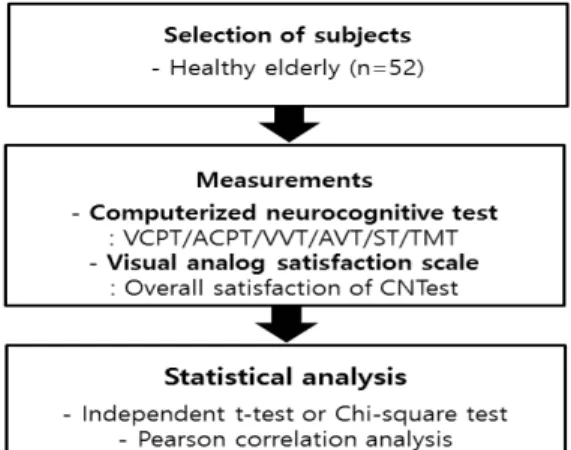
After written consent, a questionnaire was conducted on the general characteristics of the subjects. The subjects were asked to answer 'yes' or 'no' about their computer experience. After the questionnaire was completed, the subjects did the CN Test. The test was conducted in a quiet room. The evaluator fully explained the test to the subject. All subjects underwent six attention tests in program order, and two minutes were provided between each test. The evaluator allowed the subjects to take a rest if they complained of fatigue. After the test, the overall satisfaction with the CN Test was measured[Figure 1].
Figure 1. Flow diagram of this study
4. Statistical analysis
All collected data were analyzed with SPSS 21.
Statistical significance was set at alpha = 0.05.
The measurement data of the subjects were confirmed by frequency analysis. Differences in computer experience were analyzed by a chi-square test or independent t-test. The correlations between age, education level, satisfaction, and the CN Test scores were analyzed by using Pearson correlations.
Ⅲ. Results
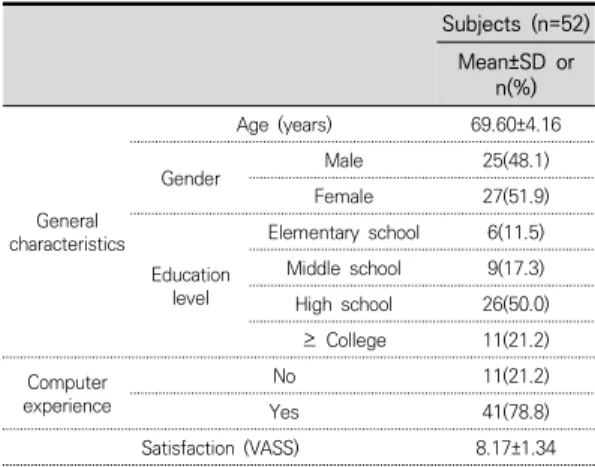
1. General characteristics, computerized neurocognitive function test, computer experience, and satisfaction in the elderly The mean age of the subjects was 69.60 ± 4.16 years, and the number of women (51.9%) was slightly higher than that of men. The education level was the highest at 50% for high school.
Computer experience was 'No' with 21.2%. The accuracy and response time for the CN Test are shown in [Table 1].
2. Comparison of general characteristics, computerized neurocognitive function test and satisfaction according to computer experience in the elderly
The elderly without computer experience were older than the elderly with computer experience (p < .05) and education level was lower (p < .05). The elderly with computer experience had higher CN Test accuracy, faster response time, and higher satisfaction than did the elderly without computer experience (p <
.05) [Table 2].
Table 1. General characteristics, computerized neurocognitive function test, computer experience, and satisfaction in elderly
Subjects (n=52) Mean±SD or
n(%)
General characteristics
Age (years) 69.60±4.16
Gender Male 25(48.1)
Female 27(51.9)
Education level
Elementary school 6(11.5) Middle school 9(17.3) High school 26(50.0)
≥ College 11(21.2) Computer
experience
No 11(21.2)
Yes 41(78.8)
Satisfaction (VASS) 8.17±1.34
CNT
Accuracy (percentile)
VCPT 93.77±4.05
ACPT 95.50±3.15
VVT 93.50±3.54
AVT 94.23±3.64
ST 90.31±5.01
Response times (second)
VCPT 0.96±0.44
ACPT 0.74±0.28
VVT 1.14±0.30
AVT 1.30±0.43
ST 2.27±0.82
TMT 1.30±0.57
VASS: Visual Analog Satisfaction Scale; CNT: Computerized neurocognitive function test; VCPT=Visual Continuity Performance Test; ACPT: Auditory Continuous Performance Test; VVT: Visual Vigilance Test; AVT: Auditory Visual Vigilance Test; ST: Stroop Test;
TMT: Trail-Making Test.
Table 2. Comparison of general characteristics, computerized neurocognitive function test and satisfaction according to computer experience in elderly
No (n=11) Yes
(n=41) p
Mean±SD
or n(%) Mean±SD or n(%)
General character istics
Age (years) 72.36±4.57 68.85±3.76 .025* Gender FemaleMale 5(45.5)6(54.5) 20(48.8)21(51.2) .845 Education
level
Elementary 3(27.3) 3(7.3) .003**
Middle 5(45.5) 4(9.8) High 3(27.3) 23(56.1)
≥ College 0 11(26.8)
Satisfaction (VASS) 7.45±1.51 8.37±1.24 .044* CNT Accuracy
(percentile) VCPT 91.27±4.31 94.44±3.76 .020* ACPT 93.82±3.76 95.95±2.85 .045*
3. Correlations between age, education level, satisfaction, and computerized neurocognitive function test in the elderly The correlation analysis showed that the higher the age and the lower the education level, the lower the accuracy of the CN Test and the faster the response time (p < .05). Satisfaction was found to be higher with older age and higher education level (p < .05) [Table 3].
Ⅳ. Discussion
Our study explored the association between the CN Test (accuracy and response time), computer experience, and satisfaction with the CN Test in the elderly. We found that the elderly without computer experience were older than the elderly with computer experience, and their education level was lower. The elderly with computer experience showed more positive results in accuracy and response time and in satisfaction with the CN Test than did the elderly without computer experience.
In the study of Fazeli et al.[17], the computer experience showed a significant correlation between education level, sex, and age. In this study, education level and age, except for gender, showed a difference according to computer-use experience. There were significant differences in the accuracy, response time, and satisfaction with the CN Test according to computer experience. This supports the theory of "Use it or Lose it"[18]. In other words, the more experiences with computer-related activities, the more computer-use abilities increase and become familiar, resulting in better performances during the computer-based CN Test[19].
In the correlation analysis, the older the elderly or the lower the education level, the lower the accuracy of the CN Test and the faster the response time. These results are consistent with previous studies[20][21]. After the age of 65, the decline in cognitive function due to aging is rapidly progressing[18][22], which is associated with the occurrence of neurological disorders that lead to cognitive declines. In particular, the incidence of dementia is significantly associated with lower levels of education[23].
Table 3. Correlation relationship between age, education level, satisfaction, and
computerized neurocognitive function test in elderly (N=52)
Age Education
level Satisfaction (VASS)
Age 1.000
Education level -.281* 1.000
Satisfaction (VASS) -.294* .383** 1.000
CNT Accuracy (percentile)
VCPT -.483** .345* .289* ACPT -.425** .322* .277*
VVT -.467** .323* .259
AVT -.430** .322** .269
ST -.435** .349* .290*
Response times (second)
VCPT .444** -.345* -.261
ACPT .473** -.363** -.209
VVT .456** -.368** -.206
AVT .514** -.393** -.232
ST .504** -.339* -.257
TMT .501** -.374** -.229
VASS: Visual Analog Satisfaction Scale; CNT: Computerized neurocognitive function test; VCPT=Visual Continuity Performance Test; ACPT: Auditory Continuous Performance Test; VVT: Visual Vigilance Test; AVT: Auditory Visual Vigilance Test; ST: Stroop Test; TMT: Trail-Making Test.
*p<.05, **p<.01
VVT 91.45±3.91 94.05±3.27 .029* AVT 92.00±3.44 94.83±3.50 .021* ST 87.36±5.37 91.10±4.66 .027* Response
times (second)
VCPT 1.21±0.47 0.89±0.41 .028* ACPT 0.92±0.36 0.69±0.24 .015* VVT 1.67±0.46 1.00±0.23 .012* AVT 1.61±0.60 1.21±0.33 .005**
ST 2.79±1.03 2.13±0.71 .016 TMT 1.71±0.80 1.20±0.45 .007**
VASS: Visual Analog Satisfaction Scale; CNT: Computerized neurocognitive function test; VCPT=Visual Continuity Performance Test;
ACPT: Auditory Continuous Performance Test; VVT: Visual Vigilance Test; AVT: Auditory Visual Vigilance Test; ST: Stroop Test; TMT:
Trail-Making Test.
*p<.05, **p<.01, ***p<.001
Satisfaction level was higher as the age of the elderly was lower and the level of education was higher. This suggests that elders among the elderly were less friendly to the CN Test than were younger ones. The older elderly had a lower educational level than did the younger elderly and had reduced cognitive function[24].
According to Kim and Chang[25], factors affecting satisfaction are very diverse, including sociodemographic characteristics, self-rated status, and internal and external environments.
Thus, future researches should focus on the factors that influence the satisfaction.
The limitations of this study are as follows:
First, the number of subjects was limited to 52.
Second, because it is a cross-sectional study, interpretation as a causal relationship is difficult.
Third, we recruited only people living in a specific city. It is possible that socio-demographic characteristics may have affected the outcome of our study. Future studies should be supplemented in terms of this point.
Ⅴ. Conclusion
Our study examined the relationship between the CN Test, computer experience, and satisfaction in the elderly. The results are as follows.
First, the elderly without computer experience were older than those with computer experience, and their education level was lower.
Second, the elderly with computer experience were higher than the elderly without computer experience were in the accuracy of the CN Test, and had higher response time and satisfaction.
Third, the accuracy of the CN Test was lower as the age was higher and educational level was
lower, and the response time was faster.
Fourth, satisfaction with the CN Test was higher when the elderly were younger and the education level was higher.
Hence we suggest that the CN Test satisfaction of the elderly is related to the educational level and computer-use experience.
참 고 문 헌
[1] http://kosis.kr/statHtml/statHtml.do?orgId=101
&tblId=DT_1BPA002&conn_path=I2, 2019.07.02 [2] T. Monma, F. Takeda, H. Noguchi, and N.
Tamiya, “Age and sex differences of risk factors of activity limitations in Japanese older adults,”
Geriatrics & gerontology international, Vol.16, No.6, pp.670-678, 2016.
[3] S. H. Lee and D. W. Lee, “On Issue and Outlook of wearable Computer based on Technology in Convergence,” Journal of the Korea Convergence Society, Vol.6, No.3, pp.73-78, 2015.
[4] Y. S. Yoo and H. J. Son, “Research on Relationships between Internet Use and the Elderlys Life Quality,” The Journal of the Korea Contents Association, Vol.12, No.4, pp.235-244, 2012.
[5] K. Ball, D. B. Berch, K. F. Helmers, J. B. Jobe, M.
D. Leveck, M. Marsiske, and S. L. Willis, “Effects of cognitive training interven- tions with older adults. A randomized controlled trial,” The Journal of the American Medical Association, Vol.288, pp.2271–2281, 2002.
[6] T. A. Salthouse, D. E. Berish, and J. D. Miles,
“The role of cognitive stimulation on the relations between age and cognitive functioning,” Psychology & Aging, Vol.17, No.4, pp.548–557, 2002.
[7] P. A. Tun and M. E. Lachman, “The association
between computer use and cognition across
adulthood: Use it so you won’t lose it?,”
Psychology & Aging, Vol.25, No.3, pp.560–568, 2010.
[8] A. Collie, D. Darby, and P. Maruff,
“Computerised cognitive assessment of athletes with sports related head injury,” British journal of sports medicine, Vol.35, No.5, pp.297-302, 2001.
[9] K. Wild, D. Howieson, F. Webbe, A. Seelye, and J. Kaye, “Status of computerized cognitive testing in aging: a systematic review,”
Alzheimer's & Dementia, Vol.4, No.6, pp.428-437, 2008.
[10] J. Fredrickson, P. Maruff, M. Woodward, L.
Moore, A. Fredrickson, J. Sach, and D. Darby,
“Evaluation of the usability of a brief computerized cognitive screening test in older people for epidemiological studies,”
Neuroepidemiology, Vol.34, No.2, pp.65-75, 2010.
[11] J. H. Park, M. Jung, J. Kim, H. Y. Park, J. R.
Kim, and J. H. Park, “Validity of a novel computerized screening test system for mild cognitive impairment,” International Psychogeriatrics, Vol.30, No.10, pp.1455-1463, 2018.
[12] S. J. Czaja and J. Sharit, “Age differences in attitudes toward computers,” The Journals of Gerontology, Series B: Psychological Sciences and Social Sciences, Vol.53, No.5, pp.329–340, 1998.
[13] H. Yoon, Y. Jang, and B. Xie, “Computer use and computer anxiety in older Korean Americans,” Journal of Applied Gerontology, Vol.35, No.9, pp.1000-1010, 2016.
[14] S. J. Cutler, J. Hendricks, and A. Guyer, “Age differences in home computer availability and use,” The Journals of Gerontology, Series B:
Social Sciences, Vol.58, No.5, pp.271–280, 2003.
[15] H. S. Park, N. Y. Yang, J. H. Moon, C. Yu, and S. M. Jeong, “The Validity of Reliability of Computerized Comprehensive Neurocognitive Function Test in the Elderly,” Journal of
Rehabilitation Welfare Engineering & Assistive Technology, Vol.11, No.4, pp.339-348, 2017.
[16] J. Singer, “Determination of the minimal clinically significant difference on a patient visual analog satisfaction scale,” Academic Emergency Medicine, Vol.5, No.10, pp.1007-1011, 1998.
[17] P. L. Fazeli, L. A. Ross, D. E. Vance, and K. Ball,
“The relationship between computer experience and computerized cognitive test performance among older adults,” Journals of Gerontology Series B: Psychological Sciences and Social Sciences, Vol.68, No.3, pp.337-346, 2012.
[18] D. F. Hultsch, C. Hertzog, B. J. Small, and R. A.
Dixon, “Use it or lose it: Engaged lifestyle as a buffer of cognitive decline in aging?,”
Psychology & Aging, Vol.14, No.2, pp.245–263, 1999.
[19] M. Bonenberger, M. Aikins, P. Akweongo, and K. Wyss, “The effects of health worker motivation and job satisfaction on turnover intention in Ghana: a cross-sectional study,”
Human resources for health, Vol.12, No.1, p.43, 2014.
[20] S. K. Inouye, M. S. Albert, R. Mohs, K. Sun, and L. F. Berkman, “Cognitive performance in a high-functioning community-dwelling elderly population,” The Journals of Gerontology:
Medical Sciences, Vol.48, No.4, pp.M146–M151, 1993.
[21] R. H. Paul, J. Lawrence, L. M. Williams, C. C.
Richard, N. Cooper, and E. Gordon,
“Preliminary validity of “integneuroTM”: A new computerized battery of neurocognitive tests,”
International Journal of Neuroscience, Vol.115, No.11, pp.1549-1567, 2005.
[22] J. Persson, L. Nyberg, J. Lind, A. Larsson, L. G.
Nilsson, M. Ingvar, and R. L. Buckner,
“Structure–function correlates of cognitive decline in aging,” Cerebral cortex, Vol.16, No.7, pp.907-915, 2005.
[23] C. B. Hall, C. Derby, A. LeValley, M. J. Katz, J.
Verghese, and R. B. Lipton, “Education delays accelerated decline on a memory test in persons who develop dementia,” Neurology, Vol.69, No.17, pp.1657-1664, 2007.
[24] I. J. Lee, “Comparison of level and correlates of depression among the young old, the older old, and the oldest old : focused on moderating role of psychosocial resources on the effect of worry,” Korean Journal of Social Welfare Education, Vol.38, pp.1-24, 2017.
[25] J. S. Kim and Y. J. Chang, “Satisfaction Determinants of Rehabilitation Care Group Inpatients in Rehabilitation Long-term Care Hospitals,” The Korean Journal of Health Service Management, Vol.10, No.4, pp.61-73, 2016.
저 자 소 개
문 종 훈(Jong-Hoon Moon) 정회원
▪ 2017년 8월 : 가천대학교 작업치료 학(석사)
▪ 2018년 2월 ∼ 현재 : 가천대학교 물리치료학(박사과정)
▪ 2018년 5월 ∼ 현재 : 국립재활원 재활연구소 건강보건연구과 <관심분야> : 건강증진, 인지기능
양 승 범(Seung-Bum Yang) 정회원
▪ 2006년 6월 : 남경중의약대학 침구 추나학(임상의학) 석사
▪ 2009년 6월 : 남경중의약대학 침구 추나학(임상의학) 박사
▪ 2014년 2월 : 원광대학교 한의과대 학 한의학 박사
▪ 2010년 3월 ∼ 현재 : NJ 중의학연 구소 소장
▪ 2015년 3월 ∼ 현재 : 원광보건대학교 의무부사관과 교수 <관심분야> : 헬스케어, 인지기능, 응급의학, 경혈학
전 민 재(Min-Jae Jeon) 정회원