신경재활치료과학 제5 권 제2 호
Therapeutic Science for Neurorehabilitation Vol. 5, No. 2, 2016.
노인의 인지기능과 상지기능의 관련성에 관한 체계적 고찰
문미숙*, 정민예**
*국민건강보험공단
**연세대학교 보건과학대학 작업치료학과
국문초록
목적: 본 연구는 노인의 인지기능과 상지기능의 관련성을 알아보고자 하며, 근거 자료들을 P.I.C.O. 방법 에 따라 제시하였다.
연구방법: 2015년 11월부터 2016년 1월까지 연구를 진행하였으며 2000년 1월부터 2015년 10월까지 국외 학술지에 개재된 논문을 Medline과 PubMed를 통하여 검색하였다. 검색용어로는 elderly, dementia, Alzheimer’s disease, Mild cognitive impairment, age-related, aging, cognitive, upper extremity function, hand function, hand-grip strength, grip force, complex motor function, bimanual, dexterity, UE performance, coordination을 사용하였다.
연구결과: 본 고찰에 포함된 총 8개의 연구 중 7개의 연구에서 상지기능이 노화에 따라 영향을 받는다는 것으로 나타났고, 1개의 연구에서는 노화에는 영향을 받지 않으나, 쥐기 힘 및 성별에 의해 물건조작능 력에 영향을 받는 것으로 나타났다. 연구 분석 결과 노인 및 치매환자의 인지기능이 상지기능에 영향을 미치며 상호 관련성을 보였다.
결론: 본 연구는 노인을 대상으로 인지기능이 상지기능에 미치는 영향 및 관련성을 알아보고자 하였으며, 인지기능 정도에 따른 작업치료 적용 및 중재기법을 선택하는데 근거 자료로 활용될 수 있을 것으로 사료된다. 향후 국내 연구에서는 다양한 평가도구를 사용하고 질적 수준이 높은 연구들이 체계적으로 이루어져야 할 것이다.
주제어: 인지기능, 상지기능, 손 기능, 노인, 체계적 고찰
교신저자 : 정민예([email protected]) || 접수일: 2016. 2. 19 || 심사일: 2016. 7. 28
|| 게재승인일: 2015. 8. 8
Ⅰ. 서 론
최근 생활수준 향상과 의료기술의 발달로 평균수명 이 현저히 연장되었으며, 노인인구도 급격히 증가하 게 되었다. 이러한 상황에서 급격히 부각되는 문제로
고령인구의 급속한 확대와 그에 따른 치매 노인수의 증가는 심각한 사회문제로 인식되는 실정이다(Kim, Chang, & Park, 2005). 인간은 노화가 진행될수록 신체적, 심리적, 사회적 기능저하를 경험하게 된다.
특히 인지기능과 신체기능의 저하로 인해 일상생활활
동 제한 및 사회적 활동이 위축되므로 인지 및 신체 기능은 노인에게 중요한 요소이다(Kim, 2012).
선행연구를 통해 높은 수준의 상지기능이 노화 및 치 매에 따른 인지기능과 밀접한 관련성이 있다는 것이 강 조되어 왔다(Ehrsson, Fagergren, & Forssberg, 2001; Goldman, Baty, Buckles, Sahrmann, & Morris, 1999; Morgan et al., 1994).
인지기능은 일반적으로 자신과 주위환경에 대한 정 보의 입수, 처리, 저장 및 검색 등에 관여하는 광범위 한 지적 능력을 지칭하며, 이런 기능에는 기억, 주의 집중, 추상력, 지능, 판단력, 학습력, 계산력, 공간 지각능력 및 이해력 등이 포함된다(McAllister, 1981).
이러한 노화에 따른 인지기능 저하는 상지기능에 영 향을 미침으로 독립적 일상생활 및 삶의 질 저하로 나타난다(Hwang, Lim & Lee, 2009).
노인에게 있어 상지기능은 먹기, 옷입기, 쓰기, 씻기 등과 같은 섬세한 일상생활과제 수행을 위한 기본 바탕 이 되며, 수단적 일상생활활동과 같은 복잡한 과제에 있어서도 중요한 역할을 하고 있다(Shumway-Cook
& Woollacott, 2007). 손을 포함한 상지의 수행은 신 체활동 중 가장 상위 인지단계에 의한 수행으로 일상 생활의 많은 부분을 차지하고 있고 복잡할 활동수행 을 위해 중요한 역할을 하고 있다(Rovio et al., 2005). 즉, 상지기능은 노인에게 있어 매우 중요하 며, 독립적 일상생활의 유지를 위해 중요하게 다루어 져야 할 요소이다(Cahn-Weiner, Boyle, & Malloy, 2002; Shiffman, 1992). 따라서 상지기능의 손상은 노인의 일상생활활동과 과제수행에 심각한 장애를 초 래하므로 노화에 따라 적절한 중재가 이루어져야 한 다(Giampaoli et al., 1999; Scherder, Dekker, &
Eggermont, 2008).
인지기능과 상지기능의 관련성을 알아보기 위해 일 반 노인과 경도인지장애(MCI) 및 치매노인의 상지기 능을 비교한 결과 상지기능 평가에서 인지 저하를 가 진 경도인지장애(MCI) 및 치매노인이 일반 노인의 상 지기능보다 유의하게 낮은 결과를 나타냈으며 (Aggarwal, Wilson, Beck, Bienias, & Bennett, 2006; Camarda et al., 2007), Jang(2007)과 Kim
& Jung(2001)의 연구 결과 인지기능이 높을수록 상 지기능 수준이 높은 것을 알 수 있었다. 인지 및 상지 기능이 일상생활 및 수단적 일상생활활동 수행에 영 향을 미치므로 노화 및 치매에 따른 인지기능의 저하 를 적절하게 파악하고 상지기능 유지를 위한 중재가 필요하다.
또한 감각정보의 능동적인 처리를 요구하는 구조화 된 상지 운동이 대뇌피질의 운동영역 뿐만 아니라 인 지관련 영역의 효율적인 활성화를 유도할 수 있으며, 손 기능 및 활동에 따라 대뇌피질의 활성화 수준이 달라질 수 있다고 하였다(Swinnen & Wenderoth, 2004; Walsh, Small, Chen, & Solodkin, 2008). 이 를 통해 인지기능과 상지기능은 서로 관련성이 있음 을 예측할 수 있으며, 노화에 따른 상지기능의 저하 를 쇠퇴현상으로만 인식할 것이 아니라, 기능의 상실 을 최소화하고 독립적인 일상생활활동을 유지하기 위 해 적절한 중재를 제공하도록 노력해야 한다.
하지만 선행연구들을 통해 인지기능이 상지기능에 미치는 영향을 알아보기 위한 연구가 다양하게 이루 어져 왔지만, 실질적인 상지기능을 측정하는데 있어 기능적인 상지 움직임 평가를 이용하기 보다는 주로 장악력, 관절가동범위, 도수근력검사, 수행속도와 같 은 양적인 자료만을 사용하여 그 효과를 분석하는 제 한점이 있었다(Buchman, Wilson, Boyle, Bienias, &
Bennett, 2007; Christensen et al., 2000; Taekema, Gussekloo, Maier, Westendorp, & de Craen, 2010).
따라서 본 연구는 노인의 독립적이고 삶의 질을 높 이는데 필요한 기초적인 중요 개념의 관계를 파악하 고 인지기능이 상지기능에 어떤 영향을 미치는지 확 인하여 변수간의 관계를 밝힘으로 노인의 지속적 독 립적 일상생활활동 및 삶의 질 향상을 위한 작업치료 의 정보 및 근거를 제공하고자 한다.
Ⅱ. 연구 방법 1. 연구 설계
본 연구는 노인 및 치매의 인지기능이 상지기능에
Evidence level Definition Frequency(%)
I
Systematic reviews Meta-analyses
Radomized controlled trials
1(12.5)
Ⅱ Two group nonrandomized studies 6(75)
Ⅲ One group nonrandomized studies 1(12.5)
Ⅳ Single-subject designs
Surveys 0
Ⅴ
Case reports
Narrative literature reviews Qualitative research
0 Table 1. Level of Evidence for Studies
미치는 영향 및 관련성에 관한 연구 결과들을 체계적 인 고찰을 통해 분석하였다.
2. 자료수집 및 분석대상
노인 및 치매환자를 대상으로 인지기능과 상지기능 의 관련성 연구동향을 분석하기 위해 2000년1월부터 2015년 12월까지 학회지에 게재된 논문을 수집하였 다. 검색도구로는 전자 데이터 베이스인 Medline, Science Direct, PubMed를 통하여 검색하였다. 주 요 검색용어는 elderly, dementia, Alzheimer’s disease, Mild cognitive impairment, age-related, aging, cognitive, upper extremity function, hand function, hand-grip strength, grip force, complex motor function, bimanual, dexterity, UE performance, coordination을 검색용어로 사용하였으며 총 51개의 논문이 검색되었다. 그 중 연구자가 본 연구의 선정 기준과 배제기준을 적용하여 총 8개의 논문을 분석하 였다.
1) 선정기준
(1) 노화 및 치매에 따른 인지기능과 상지기능의 관련 성을 보고한 연구
(2) 대상자가 노인 및 치매환자인 연구 (3) 논문이 영어로 쓰여진 경우 (4) 전문보기가 가능한 연구
2) 배제기준
(1) 인지기능과 상지기능의 관련성 연구가 아닌 논문 (2) 노인 및 치매환자가 아닌 대상자가 포함된 연구 (3) 전문보기가 가능하지 않은 연구
(4) 책, 학위논문, 논평, 비 출판자료 및 인터넷자료 제외
3. 연구근거의 질적 수준
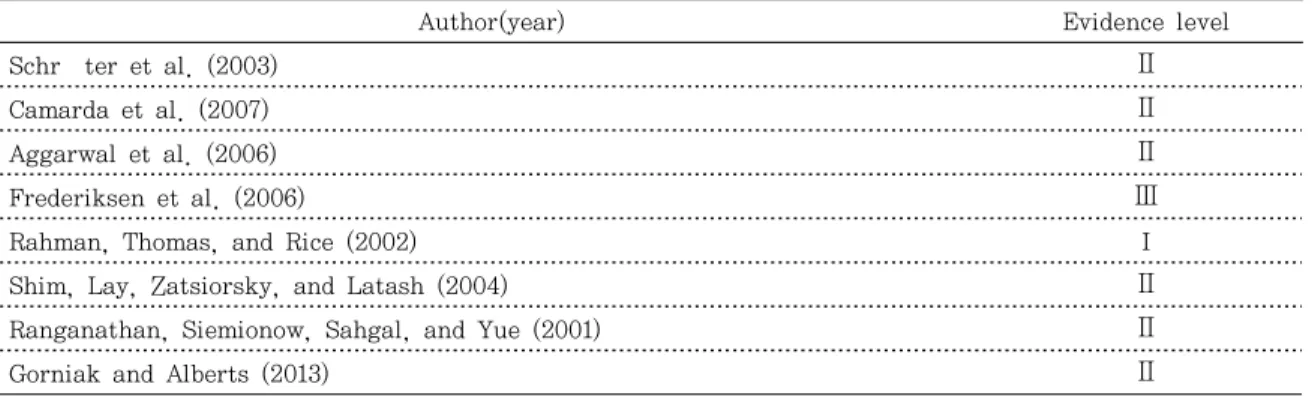
최종적으로 선정된 연구들의 질적 평가를 위해 근 거를 기반으로 한 연구의 수준(hierarchy of levels of evidence for evidence-based practice) 분류를 사용하였다(Table 1). 이 분류기준은 1등급에서 5등 급으로 분류하며 Arbesman, Scheer와 Liberman (2008)에 의해 개발되어 널리 사용되고 있다(Table 2).
4. 근거제시방법
본 연구에 포함된 연구들은 P.I.C.O.(Patient, Intervention, Comparison, Outcome; P.I.C.O.) 방 법을 사용하여, 대상자(Patient), 방법(Intervention), 대조법(Comparison), 결과(Outcome)의 틀로 제시하 였다. P.I.C.O. 방법은 임상적인 질문에 대하여 찾은 근거들을 정리하는데 널리 사용되고 있으며, 체계적 이고 명백하게 근거를 제시할 수 있다(Law &
MacDermid, 2008).
Author(year) Evidence level
Schröter et al. (2003) Ⅱ
Camarda et al. (2007) Ⅱ
Aggarwal et al. (2006) Ⅱ
Frederiksen et al. (2006) Ⅲ
Rahman, Thomas, and Rice (2002) I
Shim, Lay, Zatsiorsky, and Latash (2004) Ⅱ
Ranganathan, Siemionow, Sahgal, and Yue (2001) Ⅱ
Gorniak and Alberts (2013) Ⅱ
Table 2. Evidence level of the analyzed studies
Ⅲ. 연구 결과
1. 대상 연구의 근거에 대한 질적 수준
Rahman et al. (2002)는 근거수준이 I 에 해당하 였고, Frederiksen et al. (2006)는 근거수준 에 해당하였다. 나머지 6개의 연구는 근거수준 에 해 당하여 75% 이었다.
2. 연구대상자에 관한 일반적 특성
2000년부터 2015년까지의 모두 8편의 논문이 본 연구의 선정기준에 적합하여 결과분석에 사용되었다.
각 연구에서는 10명에서부터 8342명의 대상자가 각 그룹에 포함되었으며 일반노인과 성인 및 경도인지장 애(MCI), 치매(AD)로 다양하게 나누어져 연구되었 다. 연구 대상자들은 여자가 남자보다 많았으며, 연 령은 노인 65세 이상, 성인 25-64로 이루어졌다. 연 구 대상자에 대한 일반적 특성은 Table 3과 같다.
3. 노화 및 치매에 의한 인지기능 저하가 상지기능에 미치는 영향
횡단연구(Cross-sectional study) 및 종단연구 (Longitudinal study)를 통해 노화 및 치매에 따른 상지기능 변화를 제시한 8개 연구를 분석하여 노화 및 치매에 의한 인지기능 저하가 상지기능에 미치는
영향에 대하여 알아보았다. 총 8개의 연구 중 4개의 연구에서 상지기능이 노화에 따라 영향을 받는다는 것으로 나타났고, 1개의 연구에서는 노화에는 영향을 받지 않으나, 쥐기 힘 및 성별에 의해 물건조작능력에 영향을 받는 것으로 나타났다. 또한 3개의 연구에서 일반노인, 경도인지장애, 치매를 대상으로 연구한 결 과 인지기능이 저하될수록 상지기능의 손상이 큰 것 을 확인할 수 있었다. 분석에 이용된 주요 결과측정 도구로는 상지기능을 평가하는 Hand dynamometer, Purdue pegboard test, Two-point discrimination, Hand writing(원 그리기) 및 기능적 움직임을 위한 도구와 과제를 사용하였다. 노화 및 치매에 의한 상 지기능의 영향을 분석한 내용은 Table 4와 같다.
Ⅳ. 고찰
인지기능의 감소는 노인의 일상적인 삶을 위협하는 치매와 같은 정신장애와 밀접한 관련이 있으며 노인 들의 일상생활 및 심리사회적 건강 문제를 야기하는 중요한 요소이다(Eggermont, Knol, Hol, Swaab, &
Scherder, 2009).
선행연구들에 의하면 인지기능은 신체활동을 처리 하는데 필수적이며 신체활동을 수행함으로써 인지기 능을 유지하거나 향상시킨다(Desrosiers, Höbert, Bravo, & Rochette, 1999).
또한 노화가 진행됨에 따라 나타나는 손 기능의 변 화는 일상생활의 장애를 초래할 뿐만 아니라 손 기능
의 감소로 인해 손을 이용하는 작업 수행의 감소가 인지기능의 저하로도 이어지는 것으로 나타났다. 손 의 감각자극 운동과 소근육에 대한 근력, 잡기, 힘 조 절 등이 포함된 운동을 결합한 손 기능 운동프로그램 이 노인 및 치매노인의 인지기능 향상에 긍정적 영향 나타냈고, 지속적인 손의 감각자극 및 상지운동은 고 위중추인 대뇌피질의 활동과 다른 신경계와의 상호작 용에 영향을 미쳐 더욱 향상된 감각정보를 기억하고 해석하여 운동기능 및 인지기능의 향상에 도움이 됨 을 알 수 있었다. 이러한 결과를 통해 인지기능과 상지 기능은 상호 영향을 미치는 것이 확인되었다(Alfaro- Acha et al., 2006; Burton et al., 1999; Heyn, Abreu, & Ottenbacher, 2004).
이에 본 연구에서는 노인 및 치매환자의 인지 저하 가 상지기능에 미치는 영향을 알아보고자 체계적 고 찰을 진행하였으며 연구대상자의 특성과 인지기능과 상지기능의 관련성에 대해 알아보았다. 연구의 선정 기준과 배제기준에 의해 총 8개의 연구가 선정되었고 각 연구의 근거수준, 측정방법, 적용 도구 및 노인의 인지기능과 상지기능의 관련성에 대해 분석하였다.
체계적 고찰을 위해 P.I.C.O. 방법을 사용하였고 연 령 및 성별과 같은 변수를 추가로 기입하였다. 본 연 구 결과 종단연구(Longitudinal study) 3개, 횡단연 구 5개로 그룹간 비교 및 그룹 내 변화를 측정한 결과 역시 노화 및 인지수준에 따른 상지기능의 변화가 유 의함을 나타냈다.
사용된 평가도구는 상지기능의 양적을 측정을 위한 Purdue pegboard test, hand dynamometer를 사용 한 연구가 6개, 질적인 측정을 위한 도구로 hand writing task, pointing and touching illuminated targets 방법이 각각 1개씩 사용되어 상지기능에 대 한 양적인 분석이 주로 이루어졌음을 알 수 있었으 며, 노인과 치매환자에게 기능적 상지기능을 측정하 기 위한 표준화된 평가도구를 이용하여 체계적 연구 가 필요하다.
하지만 기존의 선행연구들이 상지기능과 인지기능 의 관계를 살펴보았으나 주로 상지기능의 양적영역에 관해 단순 상관관계를 제시하거나 인지기능에 영향을
미칠 수 있는 통제변수들이 고려되지 못한 분석이라 는 한계점을 가지고 있어 상지기능의 양적인 측면 뿐 만 아니라 기능적인 면을 포함하여 더욱 체계적으로 연구될 필요가 있다(Kim, 2000).
이번 연구에서의 체계적 고찰을 통해 노인 및 치매 노인을 위한 작업치료영역에서 노인의 손 기능 및 상 지기능이 인지기능의 예측요인으로 활용될 수 있다는 점을 보여주고 중재에 활용될 수 있는 기초자료로 삼 고자 하였다. 이러한 결과는 노인에게 있어 인지기능 의 저하에 대한 중재방법으로서 인지에 국한되는 방 법이 아닌 상지기능의 유지 및 운동을 통한 상지기능 및 손 기능의 향상이 인지기능에 긍정적 영향을 미칠 수 있음을 보여주며, 연령의 증가 및 치매에 대한 인 지기능의 감소가 나타나더라도 상지기능의 기능적 움 직임에의 참여기회를 확장시키기 위한 작업치료적 노 력의 필요성을 알 수 있다.
Ⅴ. 결론
본 연구는 노인 및 치매환자의 인지기능이 상자기 능에 미치는 영향 및 관련성에 대해 체계적 고찰을 통해 연구대상자의 특성과 영향 및 관련성에 대해 알 아보고자 국외 문헌을 대상으로 연구하였다. 비록 무 작위 대조군 실험설계를 사용한 1편의 논문만이 본 연구에 포함되었지만 노인 및 치매환자의 인지기능과 상지기능의 영향과 관련성을 알 수 있었고, 사용된 평가도구와 성별 및 연령에 대한 다양성에 대한 차이 점을 파악할 수 있었다. 특히, 노인 및 치매환자의 양 적인 상지기능 수준은 대부분의 연구에서 유의한 차 이점을 나타냈으며, 향후 연구에서 기능적 수준을 포 함하여 더욱 체계적인 연구를 통해 살펴볼 필요가 있다.
이와 같은 결과는 향후 노인 및 치매환자의 증가에 따른 작업치료의 다양한 중재방법의 적용을 기대하 며, 다양한 중재방법을 통한 인지기능 및 상지기능에 대한 효과를 극대화 할 수 있는 효과적인 중재 접근 법을 알려주는데 도움이 될 것으로 사료된다.
References
Aggarwal, N. T., Wilson, R. S., Beck, T. L., Bienias, J. L., & Bennett, D. A. (2006). Motor Dysfunction in Mild Cognitive Impairment and the Risk of Incident Alzheimer Disease.
Archives of Neurology, 63(12), 1763-1769.
doi:10.1001/archneur.63.12.1763
Alfaro-Acha, A., Al Snih, S., Raji, M. A., Kuo, Y.-F., Markides, K. S., & Ottenbacher, K. J.
(2006). Handgrip strength and cognitive decline in older Mexican Americans. The Journals of Gerontology Series A: Biological Sciences and Medical Sciences, 61(8), 859-865.
Arbesman, M., Scheer, J., & Lieberman, D.
(2008). Using AOTA’s critically appraised topic (CAT) and critically appraised paper (CAP) series to link evidence to practice. OT PRACTICE, 13(5), 18.
Buchman, A. S., Wilson, R. S., Boyle, P. A., Bienias, J. L., & Bennett, D. A. (2007). Grip strength and the risk of incident Alzheimer’s disease. Neuroepidemiology, 29(1-2), 66-73.
doi: 10.1159/000109498
Burton, H., Abend, N., MacLeod, A.-M., Sinclair, R., Snyder, A., & Raichle, M. (1999). Tactile attention tasks enhance activation in so- matosensory regions of parietal cortex: a posi- tron emission tomography study. Cerebral Cortex, 9(7), 662-674. doi: 10.1093/cercor/
9.7.662
Cahn-Weiner, D. A., Boyle, P. A., & Malloy, P.
F. (2002). Tests of executive function predict instrumental activities of daily living in community-dwelling older individuals. Applied neuropsychology, 9(3), 187-191. doi: 10.1207/
S15324826AN0903_8
Camarda, R., Camarda, C., Monastero, R., Grimaldi,
S., Camarda, L. K., Pipia, C., … Gangitano, M. (2007). Movements execution in amnestic mild cognitive impairment and Alzheimer’s disease. Behavioural neurology, 18(3), 135-142.
doi: 10.1155/2007/845914
Christensen, H., Korten, A., Mackinnon, A., Jorm, A., Henderson, A., & Rodgers, B. (2000).
Are changes in sensory disability, reaction time, and grip strength associated with changes in memory and crystallized intelligence?.
Gerontology, 46(5), 276-292. doi: 10.1159/
000022172
Desrosiers, J., Höbert, R., Bravo, G., & Rochette, A. (1999). Age-related changes in upper extremity performance of elderly people: a longitudinal study. Experimental gerontology, 34(3), 393-405.
doi: 10.1016/S0531-5565(99)00018-2
Eggermont, L. H., Knol, D. L., Hol, E. M., Swaab, D. F., & Scherder, E. J. (2009). Hand motor activity, cognition, mood, and the rest –activity rhythm in dementia: a clustered RCT. Behavioural brain research, 196(2), 271-278. doi: 10.1016/j.bbr.2008.09.012 Ehrsson, H. H., Fagergren, A., & Forssberg, H.
(2001). Differential fronto-parietal activation depending on force used in a precision grip task: an fMRI study. Journal of Neurophysiology, 85(6), 2613-2623. doi: 0022-3077/01
Frederiksen, H., Hjelmborg, J., Mortensen, J., Mcgue, M., Vaupel, J. W., & Christensen, K.
(2006). Age trajectories of grip strength:
cross-sectional and longitudinal data among 8,342 Danes aged 46 to 102. Annals of epi- demiology, 16(7), 554-562. doi: 10.1016/j.an nepidem.2005.10.006
Giampaoli, S., Ferrucci, L., Cecchi, F., Noce, C.
L., Poce, A., Dima, F., ... Menotti, A. (1999).
Hand-grip strength predicts incident disability
in non-disabled older men. Age and ageing, 28(3), 283-288. doi: 10.1093/ageing/28.3.283 Goldman, W., Baty, J., Buckles, V., Sahrmann,
S., & Morris, J. C. (1999). Motor dysfunction in mildly demented AD individuals without extrapyramidal signs. Neurology, 53(5), 956- 956. doi: http:/ / dx. doi. org/ 10. 1212/ WNL. 53.
5. 956
Gorniak, S. L., & Alberts, J. L. (2013). Effects of aging on force coordination in bimanual task performance. Experimental brain research, 229(2), 273-284.
Heyn, P., Abreu, B. C., & Ottenbacher, K. J.
(2004). The effects of exercise training on elderly persons with cognitive impairment and dementia: a meta-analysis. Archives of physical medicine and rehabilitation, 85(10), 1694-1704. doi: 10.1016/j.apmr.2004.03.019 Hwang, R, I., Lim. J. Y., & Lee. Y. W., (2009).
A Comparison of the Factors Influencing the Life Satisfaction of the Elderly According to their Cognitive Impairment Level. Journal of Korean Academic Nursing, 39(5), 622-631.
Jang, H. (2007). SOC strategies and life-satisfaction in middle and later adulthood. Korean Journal of Psychology, 20(2), 131-144.
Kim, Y. S., (2000). The Relationship between Physical Fitness and Cognitive Functioning in Older Adults. The Korea Journal of Sport, 11(2), 151-165.
Kim, J., & Jung, Y. (2001). A study on the health age, activity daily of living and cognitive function of the elderly. Journal of Korean Gerontological Nursing, 13(1), 22-31.
Kim. K. M., Chang, M. Y., & Park, M. H., (2005). The Analysis of the Difficult Activities and the Important Activities in the Daily Living at Home for Elderly People. The
Journal of Korean Society of Occupational Therapy, 13(3), 1-14.
Kim. S. I., (2012). The Analysis of the Difficult Activities and the Important Activities in the Daily Living at Home for Elderly People. The Korean Journal of Physical Education-Humanities and social sciences, 51(1), 333-344.
Law, M. C., & MacDermid, J. (Eds.). (2002).
Evidence-based rehabilitation: A guide to practice (pp. 98-107). Thorofare, NJ: Slack.
McAllister, T. W. (1981). Cognitive functioning in the affective disorders. Comprehensive Psychiatry, 22(6), 572-586.
Morgan, M., Bradshaw, J. L., Phillips, J. G., Mattingley, J. B., Iansek, R., & Bradshaw, J. A. (1994). Effects of hand and age upon abductive and adductive movements: A kine- matic analysis. Brain and cognition, 25(2), 194-206. doi: 10.1006/brcg.1994.1030
Rahman, N., Thomas, J. J., & Rice, M. S. (2002).
The relationship between hand strength and the forces used to access containers by well elderly persons. American Journal of Occupational Therapy, 56(1), 78-85. doi: 10.5014/ajot.56.1.78 Ranganathan, V. K., Siemionow, V., Sahgal, V.,
& Yue, G. H. (2001). Effects of aging on hand function. Journal of the American Geriatrics Society, 49(11), 1478-1484. doi:
10.1046/j.1532-5415.2001.4911240.x
Rovio, S., Köreholt, I., Helkala, E.-L., Viitanen, M., Winblad, B., Tuomilehto, J., … Kivipelto, M. (2005). Leisure-time physical activity at mid- life and the risk of dementia and Alzheimer’s disease. The Lancet Neurology, 4(11), 705- 711.doi:10.1016/S1474 -4422(05)70198-8 Scherder, E., Dekker, W., & Eggermont, L.
(2008). Higher-level hand motor function in aging and (preclinical) dementia: its rela-
tionship with (instrumental) activities of daily life–a mini-review. Gerontology, 54(6), 333-341. doi: 10.1159/000168203
Schröter, A., Mergl, R., Börger, K., Hampel, H., Möller, H.-J., & Hegerl, U. (2003).
Kinematic analysis of handwriting movements in patients with Alzheimer’s disease, mild cognitive impairment, depression and healthy subjects. Dementia and geriatric cognitive disorders, 15(3), 132-142. doi: 10.1159/000068484 Shiffman, L. M. (1992). Effects of aging on
adult hand function. American Journal of Occupational Therapy, 46(9), 785-792. doi:10.
5014 /ajot.46.9.785
Shim, J. K., Lay, B. S., Zatsiorsky, V. M., &
Latash, M. L. (2004). Age-related changes in finger coordination in static prehension tasks. Journal of Applied Physiology, 97(1), 213-224. doi: 10.1152/japplphysiol.00045.2004
Shumway-Cook, A., & Woollacott, M. H. (2007).
Motor control: translating research into clinical practice: Lippincott Williams & Wilkins.
Swinnen, S. P., & Wenderoth, N. (2004). Two hands, one brain: cognitive neuroscience of bimanual skill. Trends in cognitive sciences, 8(1), 18-25. doi:10.1016/j.tics.2003.10.017 Taekema, D. G., Gussekloo, J., Maier, A. B.,
Westendorp, R. G., & de Craen, A. J. (2010).
Handgrip strength as a predictor of functional, psychological and social health. A prospective population-based study among the oldest old.
Age and ageing, 39(3), 331-337. doi: 10.1093 /ageing/afq022
Walsh, R., Small, S., Chen, E., & Solodkin, A.
(2008). Network activation during bimanual movements in humans. Neuroimage, 43(3), 540-553. doi: 10.1016/j.neuroimage.2008.07.019
Th era peu tic Sc ie nce fo r N eu ror eha bilit at io n V ol . 5, N o, 2, 20 16 . 31
e 3. G e n e ral C har a c te ri st ic s of t h e S u b ject s Au th or (y ea r)
Subj ec ts Se x( m en/ w om en) A g e E x p eri m en ta l g ro u p (A D /M C I) Co nt ro l gr oup Ex p er im ent al g ro u p Co n tr ol gr oup Ex p er im ent al g ro u p Co nt ro l gr oup rö te r et a l. (2 0 0 3) 74 (3 5/ 39 ) 4 0 34 /4 0 17 /2 3 AD 7 0 .6 ± 11. 2 MC I 60 .6 ± 11.1 65. 6 ± 7. 9 ard a et a l. ( 20 0 7) 22 (11/11) 11 - - AD 7 0 .8 ± 6. 4 M C I 69. 7 ± 7. 8 69. 7 ± 9. 1 ar w al e t al . (2 00 6) 258( 19 8/ 60) 558 65 /1 33 19 /4 1 AD 81 .9 MC I 78 .7 74. 6 e t al . (2 0 0 4 ) 12 12 6/ 6 6/6 2 6.5 ± 3. 1 86. 7 ± 9. 6 g anat h an et a l. ( 20 01 ) 2 7 28 12/ 16 13 /1 4 2 0 - 35 65- 79 ia k a n d A lb ert s (2 0 13 ) 10 10 2 /8 7/3 28 ± 56 6 ± 8 ik se n e t al . (2006) 8342 - 45- 98 m an e t al . (2 002) 51 9/ 4 2 60- 84
Th era peu tic Sc ie nce fo r N eu ror eha bilit at io n V ol . 5, N o, 2, 20 16 .
e 4. P IC O of t h e a nal yz e d st u d ie s A u th or (y ear ) Sub je ct s St udy d es ign C og n it iv e fu n cti on
U p p er ex tr em it y fu n ct io n Ex pe ri m en ta l gr oup Co n tr ol gr oup A sse ssm en t to ol s R esu lt ö te r et a l. ( 2 0 0 3) MC I AD El d er ly L on g it u d in al st u d y MMS E 2 3- 30 MMS E 1 5- 30
1. D ra w a c irc le 2 . D ra w a c ir cl e d u ri n g t h e anot h er t as k
S p eed ↓ S p eed c h an g e ↑ M ovem en t d ir ec ti on c h ange ↑ ar d a et a l. ( 20 0 7) MC I AD El d er ly C ro ss- sect io n al st u d y CD R 0 .5 MMS E 1 7- 2 4 P oi n ti ng to th e li gh t of ta rg et
R eac ti on T im e ↓ S p eed ↓ M ov em ent d ir ec ti on c h ange t im e ↑ w al e t al . (2 00 6) MC I AD El d er ly L on g it u d in al st u d y
C og n it iv e im p air m en t cause d b y De m en ti a
P u rd u e p eg b oa rd A D < M C I < E ld er ly ik se n e t al . (2006) E ld er ly A d ul t C oh or t st udy C og n it iv e im p air m en t ca u sed b y A g in g han d d yn am om et er gr ip s tr en gt h El d er ly < Ad u lt m an e t al . (2 002) E ld er ly A d ul t C ro ss- sect io n al st u d y
C og n it iv e im p air m en t ca u sed b y A g in g Li d o p en in g fo rc e m ea su rem en t( g ri p , p in ch ) u si n g t h e d yn amo me te r
gr ip , pi nch st re n g th ↓ coor di n at ion ↓ m e t al . (2 004) E lde rl y A dul t C ro ss- sect io n al st u d y
C og n it iv e im p air m en t ca u sed b y A g in g M eas ur in g gr ip s tr en g th an d coor di nat ion w it h s p ec ia l tool
gr ip , pi nch st re n g th ↓ coor di n at ion ↓ h an e t al . (2001 ) E ld er ly A d u lt C ro ss- sect io n al st u d y
C og n it iv e im p air m en t ca u sed b y A g in g g ri p a n d p in ch s tr en g th , pegboar d t es t, t w o- p oi n t di scr im inat ion gr ip , pi nch st re n g th ↓ S p eed ↓ tw o- p oi n t d is cri m in ati on ↓ ia k a n d A lb erts (2 01 3) El d er ly A d u lt C ro ss- sect io n al st u d y
C og n it iv e im p air m en t ca u sed b y A g in g
M eas u ri n g coor di n at ion th ro u g h tw o bi la te ra l ex erci se
gr ip , pi nch st re n g th ↓ S p eed ↓ coor di n at ion ↓
Abstract
A Systematic Review on the Association between Cognitive Function and Upper Extremity Function in the Elderly
Moon, Mi-Sook, B.H.Sc., O.T.*, Jung, Min-Ye, Ph.D., O.T.**
*National Health Insurance Service
**Dept. of Occupational Therapy, Yonsei University
Objectives: The aim of this study was to investigate the association between cognitive function and upper extremity function in the elderly. The articles were analyzed based on patient, intervention, comparison, and outcome using the P.I.C.O. principle.
Methods: We systematically examined papers from January, 2000 to November, 2015 published papers through the foreign journals which were Medline & Pubmed for three months. mainly used key words were elderly, dementia, Alzheimer’s disease, Mild cognitive impairment, age-related, aging, cognitive, upper extremity function, hand function, hand-grip strength, grip force, complex motor function, bimanual, dexterity, UE performance, and coordination.
Results: The number of discovered outcomes for association between cognitive function and up- per extremity function in the elderly was 7; grip strength & sex are impact on manipulation object, 1. The results show that cognitive function is associated with upper extremity function in the elderly.
Conclusion: This study is expected to help selecting intervention, assessment tools according to the individual’s degree of cognitive level and upper extremity function. In future domestic research, variety assessment tools need to be used and more qualitative level experiment will be carried out.
Key Words: cognitive function, elderly, hand function, systemic review, upper extremity function