• 검색 결과가 없습니다.

Critically Ill Patients with Pandemic Influenza A/H1N1 2009 at a Medical Center in Korea

N/A
N/A
Protected

Academic year: 2021

Share "Critically Ill Patients with Pandemic Influenza A/H1N1 2009 at a Medical Center in Korea"

Copied!
8
0
0

로드 중.... (전체 텍스트 보기)

전체 글

(1)

Tuberc Respir Dis 2011;70:28-35

CopyrightⒸ2011. The Korean Academy of Tuberculosis and Respiratory Diseases. All rights reserved.

Critically Ill Patients with Pandemic Influenza A/H1N1 2009 at a Medical Center in Korea

Eun Young Choi, M.D.

1

, Jin Won Huh, M.D., Ph.D.

1

, Chae-Man Lim, M.D., Ph.D.

1

, Younsuck Koh, M.D., Ph.D.

1

, Sung-Han Kim, M.D., Ph.D.

2

, Sang-Ho Choi, M.D., Ph.D.

2

, Won Young Kim, M.D., Ph.D.

3

, Won Kim, M.D., Ph.D.

3

, Mi-Na Kim, M.D., Ph.D.

4

, Sang-Bum Hong, M.D., Ph.D.

1

Departments of

1

Respiratory and Critical Care Medicine,

2

Infectious Diseases,

3

Emergency Medicine,

4

Laboratory Medicine, Asan Medical Center, University of Ulsan College of Medicine, Seoul, Korea

Background: The aim of the study was to describe the characteristics, treatments, and outcomes of critically ill patients with pandemic Influenza A/H1N1 2009 at a major medical center in Korea.

Methods: This retrospective observational study examined critically ill adult patients with pandemic Influenza A/H1N1 2009, who were admitted to the AMC between August and December 2009.

Results: 27 patients with confirmed pandemic Influenza A/H1N1 2009 were admitted to the intensive care unit (ICU) at the Asan Medical Center (AMC). The median age (IQR) was 59 years (41∼67), and 66.7% of the patients were older than 51 years. A total of 81.5% of the patients had 2 or more co-morbidities. The median time (IQR) from symptom onset to presentation was 2 days (1∼4), and the median time from presentation to ICU admission was 0 days (0∼1.5). All patients received oseltamivir (300 mg/day) and 13 patients received triple combination therapy (oseltamivir, amantadine, ribavirin). Twelve patients required mechanical ventilation on the first day of ICU admission. A total of 6 patients (22.2%) died within 28 days of admission. The patients who died had significantly higher acute physiology and chronic health evaluation (APACHE) II and sequential organ failure assessment (SOFA) scores at presentation. There were no significant differences in age, co-morbidities, or antiviral regimens between survivors and non-survivors.

Conclusion: Critical illness related to pandemic Influenza A/H1N1 2009 was common in elderly patients with chronic co-morbidities. All patients were given high-dose oseltamivir or triple combination antiviral therapy. Nonetheless, patients with critical illnesses associated with pandemic Influenza A/H1N1 2009 had a death rate of 22.2%.

Key Words: Influenza A Virus, H1N1 Subtype; Pandemics; Critical Illness; Mortality

Address for correspondence: Sang-Bum Hong, M.D., Ph.D.

Division of Pulmonary and Critical Care Medicine, Asan Medical Center, University of Ulsan College of Medicine, 388-1, Pungnap 2-dong, Songpa-gu, Seoul 138-736, Korea Phone: 82-2-3010-3893, Fax: 82-2-3010-6968

E-mail: [email protected] Received: Jul. 20, 2010 Accepted: Sep. 20, 2010

Introduction

In early April 2009, there were reports of human in- fection with Influenza A/H1N1 2009 in southern California and Mexico, and by late April the virus had spread to other regions of the world

1

. On June 11, 2009, the 2009 H1N1 pandemic led the World Health Organization to declare the first phase-6 global influen-

za pandemic of the century

2

.

In Korea, the first case of pandemic Influenza

A/H1N1 2009 was documented on May 2, 2009. Since

then, confirmed Korean cases were reported mainly in

overseas travelers or those who had direct contact with

infected people. By October, 2009, the incidence of

pandemic Influenza A/H1N1 2009 was significantly

greater, and by April 17, 2010, there were about 750,000

Korean patients with confirmed pandemic Influenza

A/H1N1 2009, 252 of whom had died

3

. Several coun-

tries of the northern and southern hemispheres that ex-

perienced pandemic Influenza A/H1N1 2009 have re-

ported the clinical features and disease course of crit-

ically ill patients

4-7

. However, there is little information

(2)

available on Korean patients who were critically ill with pandemic Influenza A/H1N1 2009.

Here, we describe the characteristics, clinical features, treatments, and outcomes of Korean patients who were critically ill with pandemic Influenza A/H1N1 2009. We expect that this information may be helpful in the estab- lishment of public health policies, identification of crit- ically ill patients, and for comparisons with other geo- graphical regions and races.

Materials and Methods

We retrospectively reviewed the records of all pa- tients with confirmed pandemic Influenza A/H1N1 2009 related critical illnesses from August 26 to December 31, 2009 who were treated at the Asan Medical Center (AMC), a 2,800-bed, tertiary referral hospital in Seoul, Korea. This study was approved by the Institutional Review Board. Informed consent was not necessary be- cause this was not an interventional study.

All eligible patients were aged at least 15 years, were critically ill, and were admitted to our hospital with con- firmed pandemic Influenza A/H1N1 2009. Confirmation was determined by a positive result from a probe-based reverse-transcriptase polymerase-chain-reaction (RT-PCR) for 2009 H1N1 virus from a nasopharyngeal swab or broncho-alveolar lavage (BAL). Critically ill patients were defined as those who 1) were admitted to the ICU or required mechanical ventilation (invasive or non- invasive); 2) had a ratio of partial pressure of oxygen in arterial blood (PaO

2

) to inspired fraction of oxygen (FIO

2

) less than 300 mm Hg; or 3) required intravenous infusion of an inotropic or vasopressor medication.

We reviewed the medical records and recorded the following data: dates of admission to the hospital and ICU, age, sex, weight and height (for calculation of body mass index [BMI]), date of first symptoms, pres- ence and type of influenza syndrome, laboratory data, radiographic findings, and comorbidities. Severity of ill- ness was assessed using the acute physiology and chronic health evaluation (APACHE) II and the sequen- tial organ failure assessment (SOFA) scores on the day

of admission.

1. Statistical analysis

Continuous variables are presented as medians and interquartile ranges (IQRs). For categorical variables, the percentage of patients in each category is given. To test for the significance of differences in baseline char- acteristics between survivors and non-survivors, the Mann-Whitney test was used for continuous variables and the χ

2

test or Fisher's exact test was used for dis- crete variables. A p value less than 0.05 was considered to indicate statistical significance. All analyses were per- formed with SPSS for Windows release 12.0 (SPSS Inc., Chicago, IL, USA).

Results 1. Characteristics of study patients

At the AMC, the first critically ill patient with pan- demic Influenza A/H1N1 2009 was identified on August 26, 2009. Subsequently, there were 3 cases in Septem- ber, 5 in October, 12 in November, and 6 in December.

Median patient age was 59 years and 70.4% of patients were male. Table 1 shows additional characteristics of the 27 study patients. Three cases were due to nosoco- mial transmission, none of these patients were health- care workers. At initial presentation, the median (IQR) APACHE II score was 17.0 (11.5∼24.0). Twenty-two (81.5%) patients had two or more comorbidities. The median number of comorbid conditions was 2 (IQR, 1

∼3). The most common comorbidities were smoking (44.4%), malignancy (40.7%), chronic lung disease (25.9%), hypertension (25.9%), and diabetes (22.2%).

The median BMI (IQR) was 23.3 (20.3∼24.8), and 3

patients (11.1%) were obese (BMI >30). None of our

patients were pregnant. The most common presenting

symptoms were respiratory symptoms such as cough

(81.5%), sputum production (63.0%), shortness of

breath (70.4%), and fever (77.8%). Leukocytosis was

present in 44.4% of patients and lymphopenia was pres-

ent in 81.5% of patients (Table 2). Based on chest ra-

diography at presentation, 20 patients (74.1%) had bi-

(3)

Table 1. Demographic characteristics of critically ill pa- tients with confirmed pandemic Influenza A/H1N1 2009

Variable Value

Age, median (IQR), yr 59 (41∼67)

Male 19 (70.4)

BMI, median (IQR) 23.3 (20.3∼24.8)

Health care worker 0 (0)

Nosocomial acquisition 3 (11.1) APACHE II score, median (IQR) 17.0 (11.5∼24.0) No. of comorbidities, median (IQR) 2 (1∼3)

Any cormobidity 22 (81.5)

Chronic lung disease

Asthma 2 (7.4)

COPD 3 (11.1)

Other 2 (7.4)

Malignancy

Solid cancer 7 (25.9)

Hematologic malignancy 4 (14.8)

Ever smoker 12 (44.4)

Hypertension 7 (25.9)

Type 1 or 2 diabetes 6 (22.2) Obesity

BMI >25 6 (22.2)

BMI >30 3 (11.1)

Cardiac disease

Ischemic heart disease 1 (3.7) Congestive heart failure 3 (11.1) Chronic alcoholism 3 (11.1) Postoperation state 3 (11.1) Cerebrovascular disease 1 (3.7) Chronic renal insufficiency 1 (3.7)

Liver cirrhosis 1 (3.7)

Autoimmune disease 1 (3.7)

Hypercholesterolemia 1 (3.7) Values are presented as number (%) unless otherwise indicated.

IQR: interquartile range; APACHE II: acute physiology and chronic health evaluation II; BMI: body mass index; COPD:

chronic obstructive pulmonary disease.

Table 2. Laboratory and radiographic findings on admis- sion of critically ill patients with confirmed pandemic Influenza A/H1N1 2009

Variable Value

Leukocyte count

Median count (IQR), /mm

3

9.500 (6.200∼12.800)

<4,000/mm

3

4 (14.8)

>10,000/mm

3

12 (44.4)

Lymphocyte count

Median count (IQR), /mm

3

884 (415∼1.358)

<1,500/mm

3

22 (81.5)

Hemoglobin, median (IQR), g/dL 12.3 (10.4∼14.6) Platelet count, median (IQR), /mm

3

168 (102∼214) Ratio of PaO2 to FIO2, mm Hg

PaO

2

/FiO

2

, median (IQR) 175.0 (131.4∼255.4) PaO

2

/FiO

2

<200 14 (51.9) 200≤ PaO

2

/FiO

2

<300 13 (48.1) PaCO

2

, median (IQR), mmHg 41.0 (34.5∼47.5) Creatine kinase >200 IU/L 3 (11.1) Alanine aminotransferase >40 IU/L 10 (37.0) Aspartate aminotransferase >40 IU/L 13 (48.1) Total bilirubin >1.1 mg/dL 6 (22.2) Creatinine, median (IQR), mg/dL 0.9 (0.8∼1.0) Sodium, median (IQR), mmol/L 133 (130.5∼136) Potassium, median (IQR), mmol/L 3.8 (3.4∼4.4) C-reactive protein >10 mg/dL 14 (51.9) Procalcitonin >0.05 ng/mL 18 (66.7) Abnormalities on chest radiograph

Bilateral infiltrate 20 (74.1)

Values are presented as number (%) unless otherwise indicated.

IQR: interquartile range.

lateral infiltrates.

2. Course of illness and treatments

The median time (IQR) from symptom onset to pre- sentation was 2 days (1∼4) and the median time from presentation to ICU admission was 0 days (0∼1.5).

Most patients (66.7%) had acute respiratory distress syn- drome or viral pneumonia, and two patients (7.4%) were diagnosed with concurrent bacterial pneumonia at presentation (one due to Staphylococcus aureus , one

due to Streptococcus pneumoniae ). Other concomitant conditions included exacerbation of asthma or chronic obstructive pulmonary disease (14.8%), congestive heart failure (7.4%), and ischemic chest pain (3.7%).

All patients received oseltamivir (300 mg/day) and 13 patients received a triple combination regimen (oselta- mivir, amantadine, ribavirin) (Table 3). About half of the patients were given antiviral therapy within 48 hours of symptom onset. The other medical treatments in- cluded antibiotics (26 patients, 96.3%), corticosteroids (12 patients, 44.4%), and diuretics (12 patients, 44.4%).

Inotropes or vasopressors were given to 7 patients

(25.9%) on the day of presentation. Twelve patients

(44.4%) required mechanical ventilation on the first day

of ICU admission, 9 (33.4%) of these procedures were

(4)

Figure 1. Age distribution of 27 critically ill patients with confirmed pandemic Influenza A/H1N1 2009.

Table 3. Treatment of critically ill patients with confirmed pandemic influenza A/H1N1 2009

Patients (n=27) Antiviral treatment regimen

Oseltamivir (300 mg/day, Single) 14 (51.9) Triple combination regimen* 13 (48.1)

Zanamivir 3 (11.1)

Peramivir 3 (11.1)

Received <48 hr after symptom onset 14 (51.9)

Corticosteroid 12 (44.4)

Antibiotics 26 (96.3)

Diurectics 12 (44.4)

Vasopressor 10 (37.0)

Admitted to intensive care unit 27 (100) Mechanical ventilation

NIV 3 (11.1)

Invasive MV 11 (40.7)

Renal replacement therapy 4 (14.8)

Values are presented as number (%).

*Oseltamivir+Amantadine+Ribavirin.

MV: mechanical ventilation; NIV: noninvasive ventilation.

Table 4. Clinical course and outcomes of patients with confirmed pandemic influenza A/H1N1 2009

Patients (n=27) Influenza syndrome

Viral pneumonia or ARDS 18 (66.7) Concurrent bacterial pneumonia 2 (7.4) Exacerbation of airflow limitation 4 (14.8) Intercurrent illness or other illness 3 (11.1) Time from symptom onset to death

Day 14 2 (7.4)

Day 28 6 (22.2)

Day 60 6 (22.2)

Time course of illness, day Median (IQR) Symptoms to hospital admission 2 (1∼4) Hospitalization to ICU admission 0 (0∼1.5) Hospitalization to death 22 (11∼24) Duration of ventilation, day 9 (3∼21) ICU length of stay, day 5 (3∼8) Hospital length of stay, day 7.5 (5∼19.8) Values are presented as number (%).

ARDS: acute respiratory distress syndrome; IQR: interquatile range; ICU: intensive care unit.

invasive and 3 (11.1%) were noninvasive. Two of the three patients who received noninvasive ventilation ulti- mately required invasive ventilation. Rescue therapies for oxygenation failure required neuromuscular block- ade in nine patients (33.3%), inhaled nitric oxide in four patients (14.8%), prone positioning ventilation in four patients (14.8%), and extracorporeal membrane oxygen- ation in two patients (7.4%). Barotrauma occurred in two patients during mechanical ventilation. Hospital-ac- quired pneumonia or ventilator-associated pneumonia developed in five patients during the course of treat- ment (two from methicillin-resistant Staphylococcus aur- eus , two from carbapenem-resistant Acinetobacter bau- mannii , and one from Klebsiella pneumonia ).

3. Outcomes

Among our 27 patients, 6 died, 19 recovered and were discharged from the hospital within 24 days, and 2 remained in the hospital more than 60 days. Of the six patients who died, two patients died within the first 14 days of onset of critical disease and all six died with- in 28 days from critical disease onset (Table 4). The me- dian (IQR) length of ICU stay was 5 days (3∼8) for

all patients, 5 days (3∼7) for survivors and 19.5 days (7∼20.8) for non-survivors. The median (IQR) duration of ventilation was 9 days (3∼21) for all patients, 4.5 days (2.5∼8) for survivors and 20 days (19∼21) for non-survivors. The median (IQR) length of hospital- ization among all cases was 7.5 days (5∼20).

Five of the six patients who died were more than 51

years old (Figure 1). Four of these six patients had ma-

lignancies and the other two were chronic alcohol

(5)

Table 5. Comparison of survivors and nonsurvivors

Survivors (n=21) Nonsurvivors (n=6) p-value

Age, median (IQR), yr 55.5 (39∼67) 59.5 (59∼65) 0.589

Male sex, No. (%) 15 (71.4) 4 (66.7) 1.00

Comorbidities

BMI, median (IQR) 23.5 (20.7∼24.9) 21.8 (20.0∼24.0) 0.441

Time course of illness, median (IQR), day

Symptoms to hospital admission 1 (1∼4) 3.5 (2.8∼4.8) 0.162

Hospitalization to ICU admission 0 (0∼1.5) 0 (0∼0.75) 0.785

Characteristics at ICU admission

APACHE II score, median (IQR) 13.0 (10.0∼22.0) 27.5 (24.3∼33) 0.004

Ratio of PaO

2

to FIO

2

, median (IQR), mm Hg 241.5 (156.8∼282.9) 82.9 (53∼110) 0.012 Initial mean arterial pressure, median (IQR), mm Hg 71 (65∼80) 70.5 (63.5∼81.5) 0.932

Heart rate, median (IQR), /min 104 (69∼118) 126 (125∼134) 0.026

Ventilation at ICU admission, No. (%) 7 (33.3) 5 (83.3) 0.060

Vasopressor or inotrophic, No. (%) 5 (23.8) 5 (83.3) 0.015

Organ dysfunction, median (IQR)

SOFA score on day 1 5.0 (2.0∼7.0) 11.5 (10.0∼13.0) 0.004

Creatinine, mg/dL 0.8 (0.7∼0.9) 1.0 (0.8∼1.8) 0.157

White blood cell count, /mm

3

8.500 (6.300∼12.700) 12.150 (5.900∼16.600) 0.512

Platelet count, /mm

3

172 (129∼212) 127 (50∼205) 0.476

Bilirubin, mg/dL 0.9 (0.7∼1.4) 0.9 (0.7∼1.3) 0.887

C-reactive protein >10 mg/dL, No. (%) 8 (38.1) 6 (100) 0.016

Procalcitonin >0.05 ng/mL, No. (%) 12 (70.6) 6 (100) 0.272

Treatment

Triple combination regimen, No. (%)* 9 (42.9) 4 (66.7) 0.385

Time from symptom onset to antiviral agent, day (median, IQR) 2 (1∼4) 4.5 (3∼6) 0.131 Received <48 hr after symptom onset, No. (%) 13 (61.9) 1 (16.7) 0.077

Corticosteroid, No. (%) 8 (38.1) 4 (66.7) 0.357

IQR: interquartile range; ICU: intensive care unit; APACHE II: acute physiology and chronic health evaluation II; BMI: body mass index; SOFA: sequential organ failure assessment.

*Oseltamivir+Amantadine+Ribavirin.

abusers. Two of the three patients who were infected by nosocomial transmission died.

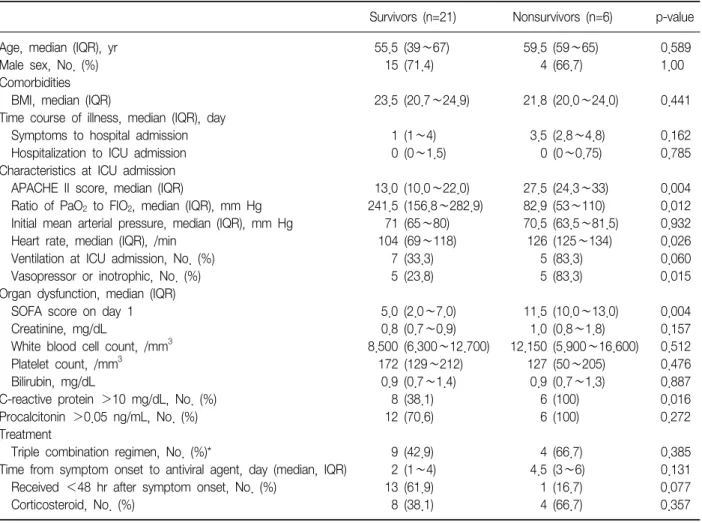
4. Comparison of survivors and non-survivors Patients who died had significantly higher APACHE II and SOFA scores at presentation (Table 5). There were no significant differences in age, sex, comorbid- ities, and antiviral regimens between survivors and non-survivors. Most non-survivors began treatment with antiviral agents at 48 hours or longer from symptom on- set, but this was not significantly different from that for survivors (p=0.077).

Discussion

In our study population, we found that critical illness related to pandemic Influenza A/H1N1 2009 was most common in elderly patients with multiple comorbidities, and that mortality was greater in elderly patients. In our patients, chronic lung disease and malignancy (solid cancer or hematologic malignancy) were common co- morbidities, but, in contrast to other studies

4,5,7

, obesity was rare, and none of our patients was pregnant.

Although there was not a statistically significant differ-

ence in the time from symptom onset to initiation of

antiviral agents between survivors and non-survivors,

most non-survivors began antiviral agents more than 48

(6)

hours after symptom onset. All patients were given high-dose oseltamivir or triple combination therapy, and there was no significant difference in survival rate be- tween these two treatment groups.

Several early reports indicated that critical illnesses re- lated to pandemic Influenza A/H1N1 2009 were more common in young patients than is typically observed for seasonal influenza

4,5,7,8

. This may be because elderly pa- tients are more likely to have cross-reactive antibodies to 2009 H1N1 due to their exposure to a related 1957 influenza virus

9

. According to a previous epidemiologic report, most deaths associated with pandemic Influenza A/H1N1 2009 (51%) were middle-aged patients (age, 20

∼49 years)

10

. However, in our Korean population, pa- tients older than 51 years were more likely to die and more likely to be admitted to an ICU. In a global survey of 2009 H1N1 mortality, Vaillant et al.

10

reported that 12% of deaths were in patients aged at least 60 years, but that 36% of reported deaths in Canada and 28% of reported deaths in Australia were in patients aged at least 60 years. Additionally, a pandemic Influenza A/H1N1 2009 study by Louie et al.

6

reported that per- sons aged at least 50 years in California had the highest mortality rates once hospitalized. Thus, the pandemic Influenza A/H1N1 2009 mortality rate seems to depend on geography and/or race.

Pandemic Influenza A/H1N1 2009 is associated with many of the same comorbidities as seasonal influenza, in addition to obesity and pregnancy

4-7,10

. In this study, more than 80% of our patients had a comorbidity such as malignancy (solid cancer or and hematologic malig- nancy) and chronic lung disease. The high incidence of malignancy among our patients may be explained by the fact that this study was conducted at a tertiary re- ferral hospital. Patients with malignant diseases are im- munocompromised, and death from influenza-related infections has been reported to be more common in cancer patients

11

. However, in contrast to other pop- ulations, only 11% of our patients were obese. This is presumably related to the low rate of obesity in Korea.

A recent report indicated that Korea has the lowest obe- sity rate (3.5%) among all OECD nations

12

. None of our

patients was pregnant and there has been only one re- ported case of pandemic Influenza A/H1N1 2009 asso- ciated mortality in a pregnant woman in Korea

3

. In this study, the time from symptom onset to hospi- talization was less than in most previous reports.

However, only half of our patients received antiviral agents within 48 hours of symptom onset. There was no statistical difference in the time from symptom onset to initiation of antiviral agent between survivors and non-survivors (2 days vs. 4.5 days, respectively), but non-survivors tended to receive treatment for longer af- ter symptom onset. Moreover, only one of the six pa- tients who died received an antiviral agent within 48 hours of symptom onset. Recent reports of Canadian and Taiwanese patients showed that severe pandemic Influenza A/H1N1 2009 that required admission to the ICU was associated with a longer time from symptom onset to initiation of antiviral therapy

13,14

. Zarychanski et al.

14

reported that the median time from symptom on- set to initiation of antiviral therapy was 2 days for pa- tients with community-acquired disease, 4 days for pa- tients admitted to hospital, and 6 days for those admit- ted to an ICU. Moreover, delayed administration of anti- viral agent (s) was the strongest predictor of respiratory failure and death in those studies

13,14

.

Some reports have indicated that high-dose oseltami- vir (300 mg/day) may be more effective for H5N1 (avian influenza) patients with severe pulmonary disease

15

. Nguyen et al.

16

reported that the drugs in the triple com- bination treatment (oseltamivir, amantadine, ribavirin) acted synergistically against influenza A virus. In partic- ular, they found that the triple combination therapy had 2-fold to 13-fold greater potency (depending on the in- fluenza virus subtype) than any double combination. At present, there are insufficient clinical data on the effi- cacy of high-dose oseltamivir or triple combination regi- mens in treatment of pandemic Influenza A/H1N1 2009.

Our pandemic Influenza A/H1N1 2009 patients received

high-dose oseltamivir or triple combination therapy, and

there was no difference in antiviral regimens between

survivors and non-survivors. However, this study was

limited in direct comparisons between the single regi-

(7)

men and triple regimen because the follow-up RT-PCR data were insufficient and more severely ill patients were more likely to receive the triple regimen rather than the single regimen. In Taiwan, some patients re- ceived oseltamivir at a dose of 150 mg twice-daily, but oseltamivir dosage was not significantly associated with death

13

. We suggest that future research assesses the ef- fects of different treatment regimens for pandemic Influenza A/H1N1 2009.

This study has several limitations. First, the retro- spective design could have led to selection bias.

Second, we could have missed certain relevant patient data, such as history of vaccination. Third, this study was conducted at a single institution and only included patients who were aged at least 15 years. Thus, it is possible that we underestimated the number of young and healthy patients infected with pandemic Influenza A/H1N1 2009.

In our Korean population, elderly patients with chronic comorbidities, especially malignancy or chronic lung disease, were more likely to have a critical illness related to pandemic Influenza A/H1N1 2009 infection and were more likely to die from this infection. In con- trast to other study populations, obesity and pregnancy were unrelated to pandemic Influenza A/H1N1 2009 in- fection or mortality. All of our patients received high- dose oseltamivir or triple combination antiviral regimen after hospital admission. Nonetheless, respiratory failure progressed rapidly in some patients, necessitating pro- longed mechanical ventilation and/or frequent use of rescue therapies. In our population, patients with crit- ical illnesses associated with pandemic Influenza A/H1N1 2009 had a death rate of 22.2%.

Acknowledgements

We thank Kil H, Jo EM and Lee NY for their assis- tance in the statistical review and the preparation of the manuscript. Lastly, we acknowledge an informative and insightful review by an anonymous reviewer.

References

1. Centers for Disease Control and Prevention (CDC).

Swine influenza A (H1N1) infection in two chil- dren--Southern California, March-April 2009. MMWR Morb Mortal Wkly Rep 2009;58:400-2.

2. World Health Organization. Global alert and response, pandemic (H1N1) 2009, frequently asked questions:

what is phase 6? [Internet]. Geneva: WHO; c2011 [cited 2011 Jan 10]. Available from: http://www.who.int/csr/

disease/swineflu/frequently_asked_questions/levels_

pandemic_alert/en/index.html.

3. Korea Centers for Disease Control and Prevention.

KCDC Newsletters [Internet]. Cheongwon: KCDC;

c2011 [cited 2011 Jan 10]. Available from: http://www.

cdc.go.kr/kcdchome/jsp/home/common/brd/COM- MBRD0200List.jsp?menuid=100047&contentid=null&

boardid=1010&appid=&pageNum=1&sub=1&sub2=

2&tabinx=1&q_had01=A&q_had02=2011&loadType=

null&boardseq=null.

4. Domínguez-Cherit G, Lapinsky SE, Macias AE, Pinto R, Espinosa-Perez L, de la Torre A, et al. Critically ill pa- tients with 2009 influenza A (H1N1) in Mexico. JAMA 2009;302:1880-7.

5. Kumar A, Zarychanski R, Pinto R, Cook DJ, Marshall J, Lacroix J, et al. Critically ill patients with 2009 influ- enza A (H1N1) infection in Canada. JAMA 2009;302:

1872-9.

6. Louie JK, Acosta M, Winter K, Jean C, Gavali S, Schechter R, et al. Factors associated with death or hospitalization due to pandemic 2009 influenza A (H1N1) infection in California. JAMA 2009;302:1896- 902.

7. Rello J, Rodríguez A, Ibañez P, Socias L, Cebrian J, Marques A, et al. Intensive care adult patients with se- vere respiratory failure caused by Influenza A (H1N1)v in Spain. Crit Care 2009;13:R148.

8. Australia and New Zealand Extracorporeal Membrane Oxygenation (ANZ ECMO) Influenza Investigators, Davies A, Jones D, Bailey M, Beca J, Bellomo R, Blackwell N, et al. Extracorporeal Membrane Oxygena- tion for 2009 Influenza A (H1N1) Acute Respiratory Distress Syndrome. JAMA 2009;302:1888-95.

9. Hancock K, Veguilla V, Lu X, Zhong W, Butler EN, Sun H, et al. Cross-reactive antibody responses to the 2009 pandemic H1N1 influenza virus. N Engl J Med 2009;

361:1945-52.

10. Vaillant L, La Ruche G, Tarantola A, Barboza P; epi-

demic intelligence team at InVS. Epidemiology of fatal

(8)

cases associated with pandemic H1N1 influenza 2009.

Euro Surveill 2009;14(33). pii:19309.

11. Cooksley CD, Avritscher EB, Bekele BN, Rolston KV, Geraci JM, Elting LS. Epidemiology and outcomes of serious influenza-related infections in the cancer population. Cancer 2005;104:618-28.

12. OECD factbook 2009: economic, environmental and so- cial statistics. Paris: OECD; 2009.

13. Chien YS, Su CP, Tsai HT, Huang AS, Lien CE, Hung MN, et al. Predictors and outcomes of respiratory fail- ure among hospitalized pneumonia patients with 2009 H1N1 influenza in Taiwan. J Infect 2010;60:168-74.

14. Zarychanski R, Stuart TL, Kumar A, Doucette S, Elliott L, Kettner J, et al. Correlates of severe disease in pa-

tients with 2009 pandemic influenza (H1N1) virus infection. CMAJ 2010;182:257-64.

15. Writing Committee of the Second World Health Organi- zation Consultation on Clinical Aspects of Human Infection with Avian Influenza A (H5N1) Virus, Abdel- Ghafar AN, Chotpitayasunondh T, Gao Z, Hayden FG, Nguyen DH, de Jong MD, et al. Update on avian influ- enza A (H5N1) virus infection in humans. N Engl J Med 2008;358:261-73.

16. Nguyen JT, Hoopes JD, Smee DF, Prichard MN, Driebe EM, Engelthaler DM, et al. Triple combination of osel- tamivir, amantadine, and ribavirin displays synergistic activity against multiple influenza virus strains in vitro.

Antimicrob Agents Chemother 2009;53:4115-26.

수치

Table  1.  Demographic  characteristics  of  critically  ill  pa- pa-tients  with  confirmed  pandemic  Influenza  A/H1N1  2009
Table  3.  Treatment  of  critically  ill  patients  with  confirmed  pandemic  influenza  A/H1N1  2009
Table  5.  Comparison  of  survivors  and  nonsurvivors

참조

관련 문서

Median overall survival of 28 multiple myeloma patients treated with Cyclophosphamide-Prednisone combination regimens as a primary therapy was 115 weeks.. Median

In addition, if the patients had a high MPV level (cut-off value of 7.95 fL) without low-dose aspirin therapy, they were at risk for ischemic stroke, especially in

Dombret H, Sutton L, Duarte M, Daniel MT, Leblond V, Castaigne S, Degos L: Combined therapy with all-trans retinoic acid and high-dose chemotherapy in

This book contains hundreds of complete, working examples illustrating many common Java programming tasks using the core, enterprise, and foun- dation classes APIs.. Java Examples

Hepatitis B surface antigen loss in antiviral-treated patients with HBeAg(+) chronic hepatitis B (CHB) infection: observations from antiviral-naïve patients

results of a phase II study of high-dose radiation therapy and neoadjuvant plus concomitant 5-fluorouracil with CDDP chemotherapy for patients with anal

First, there was no significant difference as a result of analyzing the differences in psychological capital, achievement goal orientation, and game roots

Intermittent hemodialysis(IDH) and Continuous renal replacement therapy (CRRT) has been used widely for treating critically ill patients with acute renal failure, We