항생제 내성 연구
건양대학교 의과대학 1내과학교실, 2마취통증의학교실
곽엄섭1, 권미혜1, 정지현1, 강미일1, 천지영1, 이고은1, 김영근1, 최유진1, 나문준1, 권희욱2, 손지웅1
Molecular Epidemiology and Antimicrobial Resistance of Met- hicillin-resistant Staphylococcus aureus Isolated from Nasal Swab at Intensive Care Unit
Om Sub Kwak, M.D.
1, Mee Hye Kwon, M.D.
1, Ji Hyun Jeong, M.D.
1, Mi-il Kang, M.D.
1, Ji Young Cheun, M.D.
1, Go Eun Lee, M.D.
1, Young Keun Kim, M.D.
1, Eu Gene Choi, M.D.
1, Moon Jun Na, M.D.
1, Hee Uk Kwon, M.D.
2, Ji Woong Son, M.D.
1Departments of
1Internal Medicine,
2Anesthesiology and Pain Medicine, College of Medicine, Konyang University, Daejeon, Korea
Background: Background : Methicillin-resistant Staphylococcus aureus (MRSA) is the most common organism associated with nosocomial infections. MRSA infections are becoming increasing important because they have emerged no only as healthcare-associated (HA) infections but also as community-associated (CA) ones. This study examined the moleculo-epidemiology of MRSA, which was isolated from nasal swabs in the intensive care unit (ICU) at Konyang University Hospital. MRSA are classified into HA-MRSA and CA-MRSA.
Methods: From June to September 2006, 353 patients who were admitted to the ICU in Konyang University Hospital were enrolled in this study. Single nasal swabs were obtained for culture in the ICU on the 1st day. Pulsed-field gel electrophoresis and the antimicrobial resistant patterns were analyzed between HA- and CA-MRSA. An antimicrobial sensitivity test was also performed.
Results: Forty two strains of MRSA were isolated from 353 patients (11.9%). Among the 42 isolates, HA-MRSA and CA-MRSA were found in 33 (78.6%), and 9 (21.4%), respectively. Eleven different PFGE types (type A to K) were identified. Types A (n=9) and B (n=7) were the most common for HA-MRSA, and types A (n=2) and B (n=2) were identified in CA-MRSA. The proportion of types A and B in CA-MRSA (44.4%) was similar to that in HA-MRSA (48.5%). The rates of resistance rates to erythromycin and ciprofloxacin were higher in HA-MRSA than in CA-MRSA.
Conclusion: The rate of isolation of MRSA in an ICU setting was 11.9%. HA-MRSA was isolated more frequently than CA-MRSA. The rate of resistance of HA-MRSA to erythromycin and ciprofloxacin was higher than that of CA-MRSA. Despite the small number of subjects, the main isolates (type A and B) of CA-MRSA were similar to those of HA-MRSA. (Tuberc Respir Dis 2008;65:91-98)
Key Words: Methicillin-resistance, Staphylococcus aureus, Pulsed-field gel electrophoresis
Address for correspondence: Ji Woong Son, M.D.
Department of Internal Medicine, College of Medicine, Konyang University, 685, Gasuwon-dong, Seo-gu, Daejeon 302-718, Korea
Phone: 82-42-600-9100, Fax: 82-42-545-9103 E-mail: [email protected]
Received: Mar. 12, 2008 Accepted: Jun. 18, 2008
서 론
황색포도알균은 1960년도에 메티실린이 개발되면서 이 듬해인 1961년부터 메티실린 내성 황색포도알균(Methi- cillin-resistant
Staphylococcus aureus
, MRSA)이 영국에 서 보고 되었고, 국내에는 1970년대부터 MRSA가 보고되 어 현재 종합 병원의 원내 감염의 흔한 원인균으로 주요 감염부위는 수술 부위 감염과 폐렴 및 균혈증이 보고되고 있다1,2. MRSA 감염은 항생제를 많이 사용하고 있는 의료 환경에서 많이 발생하나 1990년대부터 원내감염이 아닌지역사회에서 MRSA 감염증이 보고 되었고, 점차 증가하 여 지역사회에서 얻어진 Community-associated (CA) MRSA와 의료기관 관련 Healthcare-associated (HA) MRSA로 분류하고 있다3. 지역 사회 획득 MRSA 감염은 입원 후 48∼72시간 내에 동정되거나 외래 혹은 응급실에 서 동정된 경우를 말하며, MRSA 획득 위험인자가 없으면 CA-MRSA로 정의한다. MRSA 획득 위험인자는 최근 1년 이내 입원 혹은 수술을 받거나 장기 요양소에 거주한 경 우, 혈액투석이나 복막투석을 받고 있는 경우, 과거에 MRSA가 분리된 적이 있는 경우, 중심정맥관, 도뇨관, 기 관지조루, 위조루 등 의료기를 갖고 있는 경우이다4. 이와 같이 지역사회 획득 MRSA가 부각되는 이유는 기존 원내 감염의 특성과 비교되는 부분이 있기 때문이다. 보고된 예에서 CA-MRSA는 나이가 젊은 군에서 많으며 탁아소의 어린이, 죄수, 군인 등 집단 생활하는 사람에게서 자주 발 견된다. 주로 피부와 연조직 감염이 대부분이며 여러 항 생제에 감수성이 있는 특성이 있다. 분자 유전학적으로는 Staphylococcal cassette chromosome (SCC) mec type IV, V가 많으며 Panton-Valentine leukocidine (PVL) gene을 가지고 있다5. 국내에서도 CA-MRSA와 관련하여 다양한 분자역학적 연구가 있어 왔다6. 또한 황색포도알 균은 정상 성인에서 비강 내 80% 정도 보균하고 있으며 여러 논문에서 동일 환자에서 비강 내 균주와 균혈증 같은 감염을 일으키는 균주의 80% 이상에서 같은 유전자형이 라는 것이 보고 되어 비강 내 균주를 동정하는 것이 감염 증 추적과 항생제 선택의 선별검사로서 유용성이 있다7,8. 이에 저자들은 한 대학병원 중환자실에 입원한 환자의 비 강 도말 배양을 통해 MRSA의 의료기관 관련 감염 및 지역 사회 획득 감염으로 나누어 각각의 빈도와 분자 역학, 항 생제 내성에 대해 연구하였다.
대상 및 방법
1. 연구 대상
2006년 6월에서 9월까지 건양대학교 병원 중환자실에 입원한 환자 353명을 대상으로 하였다. 건양대학교 병원 은 813병상의 2차 병원 및 대학 병원이며 중환자실은 4개 구역으로 심혈관계, 신경계, 외과계, 내과계 중환자실 등 46병상으로 되어 있다. 심혈관계는 심질환 환자 및 심장 수술을 받은 환자로 구성되어 있고, 신경계는 신경과 및 신경외과 질환 환자로 구성되어 있다.
2. 배양 및 항생제 내성 검사
중환자실 입실 후 24시간 이내 면봉으로 비강 검체를 채취하여 혈액한천배지에 배양 후 황색포도알균이 의심 되는 집락을 계대 배양하였고, 디스크 확산법을 이용하여 MRSA를 확인하였다. 항생제 내성 검사는 Vitek System I (BioMerieux, USA) 장비를 이용하여 erythromycin, clin- damycin, trimethoprim-sulfamethoxazole, ciprofloxacin, gentamicin, vancomycin에 대한 내성을 각각의 군에서 확인하였다9.
3. Pulsed-Field Gel Electrophoresis (PFGE)
배양된 MRSA를 CHEF-DR II System (Bio-Rad, Her- cules, Ca., USA) 장비를 이용해 PFGE를 시행하였다. 각 균주의 DNA를 분리시켜
SmaI
enzyme으로 Digestion시 킨 후 Genomic DNA fragments를 6.0 V/cm, 14oC에서 20시간 동안 전기영동을 주었고, 전기영동 후 생긴 DNA band를 Ethidium bromide로 염색하여 확인하였다10. PFGE type의 판독은 Tenover 등의 기준에 따라 육안적으 로 같은 Band pattern을 갖는 군별로 묶어 type A부터 명 명하였고 아형은 따로 구분하지 않았다11.4. 자료수집 방법 및 분석
중환자실에 입원하여 비강 도말 배양에서 황색포도알 균이 동정된 경우, 항생제 내성에 따라 메티실린 감수성 황색포도알균(Methicillin-susceptible
Staphylococcus au-
reus
, MSSA)과 메티실린 내성 황색포도알균으로 각각 구 분하였다. 조사 기간 중 나이, 성별, 기저 질환, 최근 입원, 수술 등 병력 조사를 하여 의료기관 관련 MRSA 획득 위험 인자를 확인하였다. 최근 1년 이내 입원 혹은 수술을 받거 나 장기 요양소에 거주한 경우, 혈액투석이나 복막투석을 받고 있는 경우, 과거에 MRSA가 분리된 적이 있는 경우, 중심정맥관, 도뇨관, 기관지조루, 위조루 등 의료기를 갖 고 있는 경우를 의료기관 관련 MRSA 획득 위험인자로 하 였다. 일반 병실 입원 중 중환자실로 전실한 경우는 최근 입원으로 간주하여 위험인자에 추가하였다. 또한, 메티실 린 내성 황색포도알균이 배양된 환자들의 MRSA 획득 위 험인자가 한 개 이상인 경우를 HA-MRSA군으로, 위험인 자가 없는 경우를 CA-MRSA군으로 구분하여 빈도와 특성 을 살펴보았다. 수집된 자료는 SPSS 14.0 version (SPSS Inc., Chicago, IL, USA) 통계분석을 사용하여 CA-MRSA 와 HA-MRSA 각 군 간에 PFGE type과 항생제 감수성 검 사 결과에 따라 Chi square test 또는 Fisher's exact test로Figure 1. Classification of 42 MRSA isolates at Konyang University Hos- pital. IR: isolates rate.
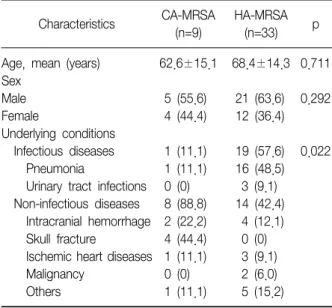
Table 1. Clinical characteristics of patients with CA-MRSA and HA-MRSA
Characteristics CA-MRSA (n=9)
HA-MRSA
(n=33) p
Age, mean (years) Sex
Male Female
Underlying conditions Infectious diseases Pneumonia
Urinary tract infections Non-infectious diseases Intracranial hemorrhage Skull fracture
Ischemic heart diseases Malignancy
Others
62.6±15.1 5 (55.6) 4 (44.4) 1 (11.1) 1 (11.1) 0 (0) 8 (88.8) 2 (22.2) 4 (44.4) 1 (11.1) 0 (0) 1 (11.1)
68.4±14.3 21 (63.6) 12 (36.4) 19 (57.6) 16 (48.5) 3 (9.1) 14 (42.4) 4 (12.1) 0 (0) 3 (9.1) 2 (6.0) 5 (15.2)
0.711 0.292
0.022
Data are numbers (%) of patients unless stated otherwise.
검정하였다. p값이 0.05 미만을 유의한 것으로 판정하였다.
결 과
1. 대상 환자의 임상적 특징
대상 환자 353명의 평균 연령은 62.1세(12세∼98세)이 며, 남자가 223명(63.2%), 여자가 132명(36.8%)이었다.
중환자실에 입원 당시 기저질환은 폐렴이 61명(17.3%), 두개내 출혈 및 두개골 골절이 59명(16.7%), 악성 종양이 44명(12.5%), 허혈성 심질환이 41명(11.6%) 및 기타 순이 었다. 전체 353명 중 164명(46.4%)이 의료기관 관련 MRSA 획득 위험인자를 1개 이상 가지고 있으며 이들의 위험 인자는 총 237예로 1년 이내의 입원이 119예 (50.3%), 의료기를 가지는 경우가 48예(20.3%), 수술이 51예(21.5%), 최근 요양시설에 거주한 경우가 11예 (4.6%), 투석치료가 6예(2.5%), 이전 MRSA가 분리된 경 우가 2예(0.8%) 순으로 나타났다.
2. MRSA 비강 보균 환자의 임상적 특징
353명 중 비강 도말 배양에서 황색포도알균이 동정된 환자는 69명(19.5%)이며 이 중 MSSA는 27명(7.6%), MRSA는 42명(11.9%)이었다. 353명 중 의료기관 관련 MRSA 획득 위험인자를 가진 환자 164명 중 실제 MRSA 비강 보균자는 42명(25.6%)이었으며 MRSA 획득 위험인 자에 따라 나눈 CA-MRSA와 HA-MRSA는 각각 9명(2.5%), 33명(9.4%)이었다(Figure 1). 환자 평균 연령은 CA-MRSA 에서 62.6세, HA-MRSA에서 68.4세이며 성별 분포는
CA-MRSA에서 남자가 5명(55.6%), 여자가 4명(44.4%)이 었으며 HA-MRSA는 남자가 21명(63.6%), 여자가 12명 (36.4%)이었다(Table 1). CA-MRSA가 동정된 환자에서는 두개골 골절이 4명(44.4%), 두개내 출혈이 2명(22.2%) 등 외상성 질환이, HA-MRSA에서는 폐렴이 16명(48.5%), 요 로감염이 3명(9.1%) 등 감염성 질환이 많게 나타나 두 군 간의 유의한 차이를 나타냈다(p=0.022).
HA-MRSA가 동정된 33명에서 의료기관 관련 MRSA 획 득 위험인자를 1개 이상 가지고 있는 경우는 48예로 나타
Figure 3. Prevalence according to PFGE types of CA-MRSA and HA-MRSA.
Table 2. Healthcare-associated risk factors for acquisition of MRSA
Risk factors HA-MRSA
(n=33) Current hospitalization
Current surgery
Previous culture of MRSA Dialysis treatment
Indwelling medical catheter Current nursing home admission
31 (93.9) 11 (33.3) 3 (9.1) 1 (3.0) 1 (3.0) 1 (3.0) Data are numbers (%) of patients unless stated otherwise.
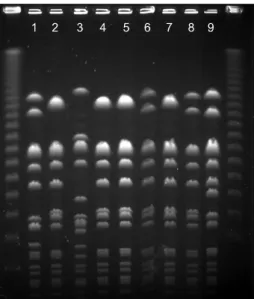
Figure 2. PFGE image of MRSA strains with enzyme SmaI-macrorestriction. Lane 1, type D; lane 2, 4, 5, 7, type A; lane 3, type C; lane 6, type I; lane 9, type H.
Table 3. Antimicrobial resistance rates between CA-MRSA and HA-MRSA
Antimicrobial agents CA-MRSA (n=9)
HA-MRSA
(n=33) p
Erythromycin Clindamycin TMX-SMZ*
Ciprofloxacin Gentamicin Vancomycin
5 (55.6) 4 (44.4) 2 (22.2) 4 (44.4) 4 (44.4) 0 (0)
26 (88.7) 23 (74.2) 11 (33.3) 26 (78.8) 24 (72.7) 0 (0)
0.065 0.120 0.695 0.090 0.133
Data are numbers (%) of patients unless stated otherwise.
*trimethoprim-sulfamethoxazole.
났으며, 1년 이내의 입원이 31예(93.9%), 수술이 11예 (33.3%), 이전 MRSA가 분리된 경우가 3예(9.1%), 투석치 료와 의료기를 가지는 경우, 최근 요양시설에 거주한 경우 는 각각 1예(3.0%) 순으로 나타났다(Table 2).
3. PFGE에 따른 분류
시행한 PFGE에서 11 가지의 다른 pattern이 보여 type A에서 type K까지 구분하였고(Figure 2), HA-MRSA는 type A (n=9), B (n=7)가 가장 많았고, CA-MRSA도 type A (n=2), B (n=2)가 주로 나타났다. Type A와 B는 CA-MRSA (44.4%), HA-MRSA(48.5%)로 두 군에서 비슷 한 비율을 보였다(Figure 3).
4. 항생제 내성률
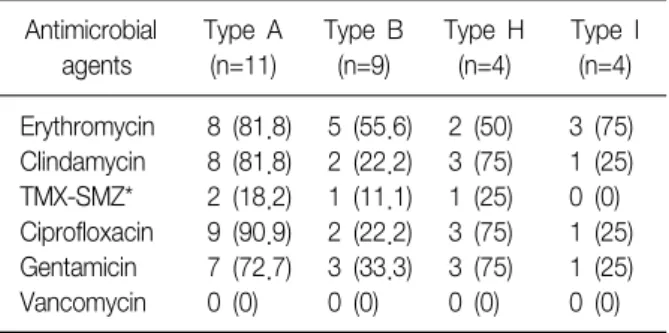
항생제 내성률은 배양된 MRSA 42균주에서 eryth- romycin (73.8%), clindamycin (64.3%), trimethoprim- sulfamethoxazole (31.0%), ciprofloxacin (71%), genta- micin (66.7%), vancomycin (0%)이었으며 HA- RSA가 er- ythromycin, ciprofloxacin에서 각각 88.7%, 78.8%로 CA-MRSA의 내성률 55.6%, 44.4%보다 높게 나타났으나 통계적 유의성은 없었다(Table 3). Sulfamethoxazole-tri- methoprime에 대한 항생제 내성률은 다른 항생제보다 낮 게 나온 특징이 있다(Table 4).
고 찰
중환자실 환경은 병원 감염의 발생 빈도가 높은 곳이며 MRSA는 이미 우리나라에 널리 퍼져있는 병원 감염 관리
Table 4. Antimicrobial resistance rates between PFGE types (Except type C, D, E, F, G, J and K because number of each type is less than 3)
Antimicrobial agents
Type A (n=11)
Type B (n=9)
Type H (n=4)
Type I (n=4) Erythromycin
Clindamycin TMX-SMZ*
Ciprofloxacin Gentamicin Vancomycin
8 (81.8) 8 (81.8) 2 (18.2) 9 (90.9) 7 (72.7) 0 (0)
5 (55.6) 2 (22.2) 1 (11.1) 2 (22.2) 3 (33.3) 0 (0)
2 (50) 3 (75) 1 (25) 3 (75) 3 (75) 0 (0)
3 (75) 1 (25) 0 (0) 1 (25) 1 (25) 0 (0) Data are numbers (%) of patients unless stated otherwise.
*trimethoprim-sulfamethoxazole.
의 가장 중요한 대상 균주이다. MRSA 감염은 균의 집락화 에서 시작되는 것으로 비강 보균자의 경우 수술 후 창상감 염이 비보균자에 비해 17배나 높게 발생하는 것으로 보고 되었다12. 중환자실에서 MRSA에 대한 선별 검사로 비강 도말 배양은 MRSA 감염의 전파 경로를 파악하고 MRSA 감염의 연관성을 밝히기 위해 연구되어 왔다7. 중환자실 에서의 비강 도말 동정률은 국내에서는 Jung 등13이 7.4%
를 보고하였고, 높게는 Kim 등14이 17.4%를 보고하였다.
외국의 경우에는 Corbella 등15이 0.4%, Megan 등16은 13.1%로 보고하였다. 본 연구에서는 MRSA 동정률은 11.9%로 국내외에서 보고한 비슷한 동정률을 보였다17-21. 의료기관 관련 위험인자에 따라 비강에서 동정된 MRSA를 CA-MRSA와 HA-MRSA로 나누었을 때는 각각의 동정률은 2.5%, 9.4%로 HA-MRSA가 더 높게 동정되었는데 이는 중 환자실이라는 설정으로 기저질환이 있어 자주 입원하는 병력 등 의료기관 관련 위험인자가 높은 환자들을 조사한 것에 의한 것으로 사료된다22-24. 여러 보고에 의하면 환자 의 평균 연령은 CA-MRSA가 HA-MRSA보다 낮은데 비해 본 연구에서는 환자의 평균 연령에서 차이가 나지 않았고, CA-MRSA가 피부와 연조직 감염이 많고 HA-MRSA는 호 흡기 및 비뇨기 감염, 패혈증이 많은 반면 본 연구에서는 CA-MRSA가 외상성 질환이 많고, HA-MRSA는 호흡기 및 비뇨기 감염이 많은 것으로 확인되었다. 감염 부위에 대 한 배양검사가 아니고 비강 도말 배양검사라는 점에서 직 접 비교는 어렵지만 HA-MRSA는 감염성 질환으로 의료기 관 관련 획득 위험인자에 노출이 많으므로 HA-MRSA가 높게 나타난 것으로 사료된다. Onorato 등25은 HIV 양성 인 MRSA 감염증 환자와 보균자 74명에 대해 다변량 분석 을 하여 중심 정맥관을 가지고 있는 경우, 기저 피부질환
이 있는 경우, 항생제에 노출 경험이 있는 경우, 입원일이 긴 경우를 MRSA 획득의 독립 위험 인자로 발표한 바 있으 며 Merrer 등26은 중환자실 입원이 의미있는 MRSA 획득의 독립 위험 인자로 설명한 바가 있다. 본 연구에서 MRSA의 비강 정착 경로를 추정하였을 때 의료기관 관련 획득 위험 인자로 최근 입원과 수술이 주된 위험 인자로 생각할 수 있다.
MRSA의 분류는 phage typing, antibiogram 등이 있으나 DNA 분석에 기반을 둔 분자생물학적 분류로는 PFGE, SCCmec typing, Multilocus sequence typing (MLST), PVL gene 등이 있다27,28. 보편적으로 PFGE는 검사 시간 이 많이 소요되고 고가의 장비가 필요한 단점이 있으나 분별력과 재현성이 좋아 최근에는 병원 감염의 역학분석 에 필수적인 기법으로 사용하고 있다. 미국 질병통제예방 센터(Centers for Diseases Control and Prevention)에서 는 PFGE를 이용하여 황색포도알균을 Pulsed-filed types (PFTs) 8개로 분류하여(예, USA 100 PFT, USA 200 PFT, USA 800 PFT) 전국적인 데이터 베이스를 구축하였다29. 본 연구에서 PFGE type A와 B가 CA-MRSA와 HA-MRSA 에서 높게 나타나 차이를 보이지 않아 외국의 논문에서 CA-MRSA와 HA-MRSA 사이에 PFGE type 차이를 보이는 것과 다르다. Huang 등30은 283명의 MRSA 감염증 환자 중 CA-MRSA 127명(44.9%), HA-MRSA 156명(55.1%)을 PFGE type으로 구분하였는데 CA-MRSA는 USA 300이 87%으로 주된 동정균이었고, HA-MRSA는 USA 100이 47%, USA 300이 33% 순으로 동정되었다. Davis 등31은 CA-MRSA 감염증 환자 102명과 CA-MSSA 감염증 환자 102명을 대상으로 PFGE를 시행하였다. CA-MRSA는 USA 300이 49%, USA 100이 13%로 동정되었다. CA-MSSA는 USA 100에서 700까지 다양하게 분류되었다. 미국에서 USA 300이 CA-MRSA에서 주로 동정되는 PFGE type이며 USA 100은 HA-MRSA의 주된 type으로 알려져 있다. 그러 나 국내에는 외국과 비교할 기준 PFGE가 없지만 국내의 PFGE pattern은 외국과 다른 양상을 보인다. Park 등32은 한 대학병원에서 1개월 동안 동정된 황색포도알균에서 임 상 자료의 고찰이 가능한 MRSA 감염증 환자를 대상으로 CA-MRSA 20예, HA-MRSA 22예를 PFGE를 시행한 바가 있다. HA-MRSA는 5가지 PFGE type이 나타났고, A형이 15예(83.3%)로 대부분을 차지하였고, CA-MRSA는 8가지 type에서 A형이 7예(38.9%), B형 4예(22.2%)로 HA- MRSA와 CA-MRSA 두 군에서 A형 균주가 주로 동정되었 다. 또한 Jeong 등33은 서울의 34개 의료 기관에서 MRSA
획득 위험인자가 없는 정상 성인 3,096명의 비강 도말에 서 CA-MRSA 30명을 동정하여 PFGE를 비롯한 분자유전 학검사를 실시하여 세 그룹으로 나누었다. 일반적으로 CA-MRSA는 PVL gene 양성과 SCCmec type IV, V를 갖는 특징이 있는데 첫 번째 그룹(n=18)과 두 번째 그룹(n=3) 는 모두 PVL gene 양성이며 SCCmec type IV, V는 9명 I, II가 12명이었다. 그리나 세 번째 그룹(n=9)은 PVL gene이 모두 음성이고 SCCmec type I, II만 검출되어 CA-MRSA라 하더라도 세 번째 그룹처럼 HA-MRSA가 갖는 pattern을 보이는 경우가 있었다. 본 연구에서와 같이 CA-MRSA 분자 유전학적 pattern이 HA-MRSA와 같은 pattern 이 생기는 원인으로는 HA-MRSA가 지역사회로 수평적 전 파에 의한 가능성을 시사한다.
PFGE를 통해 비강 정착균주 간에, 감염증을 일으키는 균주 간에 비교하고, 국내외 균주를 비교하려면 황색포도 알균에 대한 PFGE pattern을 표준화하여야 비교할 수 있 을 것이다. 국내에서도 미국의 황색포도알균의 PFGE 등 록 같은 사업을 통해 국내 유행하거나 병원 내 상주하는 MRSA를 확인하여 기초 역학 자료를 만들 필요성이 있다.
CA-MRSA가 HA-MRSA보다 대체적으로 항생제 감수성 이 있는 것으로 나왔으며 HA-MRSA는 Genotype상 SCCmec type I, II, III이 많아 beta-lactamase에 내성을 가진 mecA gene뿐만 아니라 bla와 fem 등의 유전자도 메티실린 내성에 관여하는 것으로 알려져 있다34. 대부분 의 MRSA는 이러한 성질의 유전자를 수직계통적으로 전달 하며, 일부의 MRSA에서는 수평적으로 균주간에 내성 유 전자를 전달한다. 대부분 CA-MRSA는 tetracycline, clin- damycin, ciprofloxacin, trimethoprim-sulfamethoxazole 에 감수성이 있는 것을 보고되고 있으며 미국, 프랑스, 스 위스, 호주, 뉴질랜드 등 여러 나라에서도 같은 여러 항생 제에 감수성이 확인되었다35. 본 연구에서도 통계적으로 유의하지 않았지만 HA-MRSA보다 CA-MRSA가 낮은 내성 률을 보였고, 앞으로 어떻게 항생제 내성률이 변할지 주기 적 연구가 필요할 것으로 사료된다. Trimethoprim-sulfa- methoxazole에 대해 낮은 내성률을 보였는데 이는 MRSA 가 각각의 trimethoprim-sulfamethoxazole에 내성을 일으 키는 gene인 sulA 및 dfrB에 대해 획득을 하지 않은 것으 로 추정된다36.
중환자실 환경에서 MRSA의 감시를 위한 비강 도말 배 양에서 HA-MRSA가 항생제 내성률이 높게 나타나는 경향 을 보이고, CA-MRSA는 적은 예지만 PFGE type에서 동정 된 대부분의 type이 HA-MRSA에서 동정된 type과 같은
경향을 보여 원내 균주의 지역사회 전파 또는 지역사회 균주의 병원 정착 가능성이 있다. 앞으로 비강 도말 배양 이 감염성 질환의 선별검사 및 항생제 선택에 도움이 되기 위해서는 향후 감염증 부위 및 비강 도말 배양에서 분리된 모든 균주를 표준화한 PFGE를 시행하여 비교하고, 다른 분자유적학 검사를 병행하는 것이 필요하다.
요 약
연구배경: 메티실린 내성 황색포도알균은 의료기관 관 련 감염 뿐 아니라 지역사회 감염에서도 나타나 이에 저자 들은 한 대학병원 중환자실에 입원한 환자의 비강 도말 배양을 통해 MRSA의 의료기관 관련 감염 및 지역사회 감 염의 빈도와 분자 역학 및 항생제 내성을 연구하였다.
방 법: 2006년 6월에서 9월까지 건양대학교 병원 중환 자실 환자 353명을 대상으로 입실 첫날 비강 도말 배양을 시행하여 MRSA 획득 위험인자에 따라 HA-MRSA와 CA-MRSA로 나누어 Pulsed-Field Gel Electrophorosis (PFGE)로 분류하여 각각의 항생제 내성 검사를 시행하였 다.
결 과: 353명 중 비강 도말 배양에서 동정된 MRSA는 42명(11.9%)이며, 동정된 MRSA 중 HA-MRSA는 33명 (78.6%), CA-MRSA는 9명(21.4%)이다. PFGE에서 type A 에서 type K까지 11형으로 구분하였고 HA-MRSA는 type A (n=9), B (n=7)가, CA-MRSA는 type A (n=2), B (n=2)가 주로 나타났다. 항생제 내성률은 erythromycin, cipro- floxacin에서 HA-MRSA가 CA-MRSA보다 높게 나타났다.
결 론: MRSA의 집락률은 11.9%이며 HA-MRSA의 균주 가 CA-MRSA보다 많고, CA-MRSA는 9예로 적은 예지만 PFGE type에서 대부분의 type이 HA-MRSA에서 동정된 type과 같은 경향을 보여 지역사회전파를 시사한다.
참 고 문 헌
1. Diederen BM, Kluytmans JA. The emergence of in- fections with community-associated methicillin resistant Staphylococcus aureus. J Infect 2006;52:157-68.
2. Kim JM, Park ES, Jeong JS, Kim KM, Kim JM, Oh HS, et al. Multicenter surveillance study for nosocomial in- fections in major hospitals in Korea. Am J Infect Control 2000;28:454-8.
3. From the Centers for Disease Control and Prevention.
Four pediatric deaths from community-acquired methi-
cillin-resistant Staphylococcus aureus--Minnesota and North Dakota, 1997-1999. JAMA 1999;282:1123-5.
4. Beam JW, Buckley B. Community-acquired methi- cillin-resistant Staphylococcus aureus: prevalence and risk factors. J Athl Train 2006;41:337-40.
5. Wijaya L, Hsu LY, Kurup A. Community-associated me- thicillin-resistant Staphylococcus aureus: overview and local situation. Ann Acad Med Singapore 2006;35:
479-86.
6. Park JY, Kim HO, Jeong YG, Kim S, Bae IG. Clinical characteristics and risk factors of community-acquired methicillin-resistant Staphylococcus aureus infections:
comparison of community-acquired methicillin-suscep- tible staphylococcus aureus infections. Infect Chemother 2006;38:109-15.
7. Kluytmans J, van Belkum A, Verbrugh H. Nasal car- riage of Staphylococcus aureus: epidemiology, under- lying mechanisms, and associated risks. Clin Microbiol Rev 1997;10:505-20.
8. Wertheim HF, Vos MC, Ott A, van Belkum A, Voss A, Kluytmans JA, et al. Risk and outcome of nosocomial Staphylococcus aureus bacteraemia in nasal carriers versus non-carriers. Lancet 2004;364:703-5.
9. National Commitiee for Clinical Laboratory Standards (NCCLS). Standard M2-A4. Methods for dilution anti- microbial susceptibility tests for bacteria that grow aerobically. Villanova, PA: NCCLS; 1990.
10. Matushek MG, Bonten MJ, Hayden MK. Rapid prepara- tion of bacterial DNA for pulsed-field gel electro- phoresis. J Clin Microbiol 1996;34:2598-600.
11. Tenover FC, Arbeit RD, Goering RV, Mickelsen PA, Murray BE, Persing DH, et al. Interpreting chromoso- mal DNA restriction patterns produced by pulsed-field gel electrophoresis: criteria for bacterial strain typing.
J Clin Microbiol 1995;33:2233-9.
12. Mest DR, Wong DH, Shimoda KJ, Mulligan ME, Wilson SE. Nasal colonization with methicillin-resistant Staphy- lococcus aureus on admission to the surgical intensive care unit increased with the risk of infection. Anesth Analg 1994;78:644-50.
13. Jung SI, Heo ST, Kim YS, Kim S, Peck KR, Kwon OJ, et al. Prevention of Methicillin-resistant Staphylococcus aureus nasal carriage and infection by conventional method and intranasal fusidic acid. Korean J Nosocom- ial Infect Control 2001;6:33-40.
14. Kim S, Kim CK, Lee H, Peck KR, Kwon J, Lee JH, et al. A study on modes of transmission and role of nasal carriage to subsequent infection with Methicillin- Resistant Staphylococcus aureus in medical ICU using
PFGE. Korean J Nosocomial Infect Control 1998;3:1-10.
15. Corbella X, Dominguez MA, Pujol M, Ayats J, Sendra M, Pallares R, et al. Staphylococcus aureus nasal car- riage as a marker for subsequent staphylococcal in- fections in intensive care unit patients. Eur J Clin Microbiol Infect Dis 1997;16:351-7.
16. Lim MS, Marshall CL, Spelman D. Carriage of multiple subtypes of methicillin-resistant Staphylococcus aureus by intensive care unit patients. Infect Control Hosp Epidemiol 2006;27:1063-7.
17. Kim OS, Yoon SW, Kang YJ, Kim YK, Lee NY, Lee JH, et al. Rate of nasal colonization of methicillin-resistant Staphylococcus aureus at admission to a medical in- tensive care unit. Korean J Nosocomial Infect Control 2007;12:42-9.
18. Song W, Lee TJ, Kim SJ, Park MJ, Lee KM. Methici- llin-resistant Staphylococcus aureus infections in in- tensive care unit (ICU) patients: relation to nasal car- riage of patients or ICU personnels. Korean J Clin Microbiol 2001;4:45-51.
19. Pujol M, Pena C, Pallares R, Ariza J, Ayats J, Dominguez MA, et al. Nosocomial Staphylococcus aureus bacter- emia among nasal carriers of methicillin-resistant and methicillin-susceptible strains. Am J Med 1996;100:
509-16.
20. Garrouste-Orgeas M, Timsit JF, Kallel H, Ben Ali A, Dumay MF, Paoli B, et al. Colonization with methi- cillin-resistant Staphylococcus aureus in ICU patients:
morbidity, mortality, and glycopeptide use. J Infect Control Hosp Epidemiol 2001;22:687-92.
21. Porter R, Subramani K, Thomas AN, Chadwick P. Nasal carriage of Staphylococcus aureus on admission to in- tensive care: incidence and prognostic significance.
Intensive Care Med 2003;29:655-8.
22. Faria NA, Oliveira DC, Westh H, Monnet DL, Larsen AR, Skov R, et al. Epidemiology of emerging methi- cillin-resistant Staphylococcus aureus (MRSA) in Den- mark: a nationwide study in a country with low preva- lence of MRSA infection. J Clin Microbiol 2005;43:
1836-42.
23. Wylie JL, Nowicki DL. Molecular epidemiology of com- munity- and health care-associated methicillin-resistant Staphylococcus aureus in Manitoba, Canada. J Clin Microbiol 2005;43:2830-6.
24. Salgado CD, Farr BM, Calfee DP. Community-acquired methicillin-resistant Staphylococcus aureus: a meta- analysis of prevalence and risk factors. Clin Infect Dis 2003;36:131-9.
25. Onorato M, Borucki MJ, Baillargeon G, Paar DP,
Freeman DH, Cole CP, et al. Risk factors for colo- nization or infection due to methicillin-resistant Staphy- lococcus aureus in HIV-positive patients: a retrospec- tive case-control study. Infect Control Hosp Epidemiol 1999;20:26-30.
26. Merrer J, Santoli F, Appere de Vecchi C, Tran B, De Jonghe B, Outin H. "Colonization pressure" and risk of acquisition of methicillin-resistant Staphylococcus aureus in a medical intensive care unit. Infect Control Hosp Epidemiol 2000;21:718-23.
27. Shopsin B, Kreiswirth BN. Molecular epidemiology of methicillin-resistant Staphylococcus aureus. Emerg Infect Dis 2001;7:323-6.
28. Trindade PA, McCulloch JA, Oliveira GA, Mamizuka EM. Molecular techniques for MRSA typing: current is- sues and perspectives. Braz J Infect Dis 2003;7:32-43.
29. McDougal LK, Steward CD, Killgore GE, Chaitram JM, McAllister SK, Tenover FC. Pulsed-field gel electro- phoresis typing of oxacillin-resistant Staphylococcus aureus isolates from the United States: establishing a national database. J Clin Microbiol 2003;41:5113-20.
30. Huang H, Flynn NM, King JH, Monchaud C, Morita M, Cohen SH. Comparisons of community-associated me- thicillin-resistant Staphylococcus aureus (MRSA) and hospital-associated MSRA infections in Sacramento, California. J Clin Microbiol 2006;44:2423-7.
31. Davis SL, Perri MB, Donabedian SM, Manierski C, Singh A, Vager D, et al. Epidemiology and outcomes of com- munity-associated methicillin-resistant Staphylococcus aureus infection. J Clin Microbiol 2007;45:1705-11.
32. Park CW, Lee JS, Song JY, Kim CH, Eom JS, Cheong HJ, et al. Clinical and molecular epidemiologic study of community-acquired and hospital-acquired methi- cillin-resistant Staphylococcus aureus (MRSA) infection.
J Korean Soc Chemother 2002;20;77-90.
33. Jeong HY, Lee JE, Choi BK, Seo KW, Park SH, Kim YL, et al. Molecular epidemiology of community-asso- ciated antimicrobial-resistant Staphylococcus aureus in Seoul, Korea (2003): pervasiveness of multidrug-resistant SCCmec type II methicillin-resistant S. aureus. Microb Drug Resist 2007;13:178-85.
34. Hiramatsu K. Elucidation of mechanism of antibiotic re- sistance acquisition of methicillin-resistant Staphylococ- cus aureus (MRSA) and determination of its whole ge- nome nucleotide sequence. JMAJ 2004;47:153-9.
35. Vandenesch F, Naimi T, Enright MC, Lina G, Nimmo GR, Heffernan H, et al. Community-acquired methi- cillin-resistant Staphylococcus aureus carrying Panton- Valentine leukocidin genes: worldwide emergence.
Emerg Infect Dis 2003;9:978-84.
36. Lowy FD. Antimicrobial resistance: the example of Staphylococcus aureus. J Clin Invest 2003;111:1265-73.