Repeat Single Incision Laparoscopic Surgery after Primary Single Incision Laparoscopic Surgery for Colorectal Disease
Sun Hye Kim, M.D., Seong Hyeon Yun, M.D., Ph.D., Yoon Ah Park, M.D., Yong Beom Cho, M.D., Ph.D., Hee Cheol Kim, M.D., Ph.D., Woo Yong Lee, M.D., Ph.D.
Department of Surgery, Samsung Medical Center, Sungkyunkwan University School of Medicine, Seoul, Korea
Purpose:
Single-incision laparoscopic surgery (SILS) for colorectal surgery is widely performed for many disease entities. However, there are few reports about the role of repeat single-incision laparoscopic surgery (R-SILS). The aim of this study is to analyze R-SILS data to evaluate the feasibility and safety of the occurrence and review its outcomes.Methods:
This is a retrospective review of the prospectively collected SILS database in Samsung Medical Center, Seoul, Korea, between April 2009 and December 2015. A retrospective review of 38 patients who underwent R-SILS from 2,207 patients who underwent primary SILS for colorectal surgery was performed.Results:
The indications of R-SILS were 23 primary SILS-related complications, 10 cancer-related, and 5 other surgical indications. Of the 38 repeat surgeries, 24 were emergent operations, and 14 were elective operations. Fecal diversion for anastomotic leakage after rectal surgery was the most common reason for reoperation. There were 2 cases of conversions: one case was converted to conventional multi-port, and the other case was converted to open surgery. Mean operative time was 137.9±64.1 min, estimated blood loss (EBL) was 105±98 ml, and length of hospital stay was 10.1±8.1 days. Post-operative complication was noted in 5 (13.2%) of 38 R-SILS cases, and there was no 30-day postoperative mortality.Conclusion:
Repeat single-incision laparoscopy surgery is feasible and safe in select patients when performed by an experienced surgeon.Keywords:
Minimally invasive surgical procedures, Single-incision laparoscopic surgery, Repeat operation, Colorectal surgeryReceived September 7, 2017 Revised 1st October 24, 2017
2nd December 3, 2017 Accepted December 7, 2017
Corresponding author Seong Hyeon Yun
Department of Surgery, Samsung Medical Center, Sungkyunkwan University School of Medicine, 81 Irwon-ro, Gangnam-gu, Seoul 06351, Korea
Tel: +82-2-3410-6546 Fax: +82-2-3410-6980 E-mail: [email protected] ORCID:
http://orcid.org/0000-0003-3913-1481
This is an Open Access article distributed under the terms of the Creative Commons Attribution Non-Commercial License (http://
creativecommons.org/licenses/by-nc/4.0/) which permits unrestricted non-commercial use, distribution, and reproduction in any medium, provided the original work is properly cited.
Copyright © 2018 The Journal of Minimally Invasive Surgery. All rights reserved.
Journal of Minimally Invasive Surgery
J Minim Invasive Surg 2018;21(1):38-42
INTRODUCTION
Single-incision laparoscopic surgery (SILS) for colorectal diseases has developed as an extension of standard lapa- roscopic minimally invasive procedures. Compared to the conventional laparoscopic surgery (CLS), the single-incision approach can enhance certain benefits of minimally invasive surgery, such as less blood loss, shortening of hospital stay,
and faster recovery of bowel function.
1,2There are numerous reports regarding single-incision pro- cedures and laparoscopic reoperations in colorectal disease.
However, there are few reports about the role of repeat single- incision laparoscopic surgery (R-SILS) after the initial single- incision laparoscopic surgery.
Repeat SILS (R-SILS) represents an innovation; however,
its adoption can be limited by technical challenges. Also, there
is no sufficient data on its outcome. The selection of patients suitable for R-SILS, especially in those with a history of SILS, is still being evaluated. Technical challenges with SILS, such as greater difficulty exposing critical structures, more frequent instrument conflicts, and some issues with ease of camera op- eration and ergonomics, all potentially impose a disincentive toward wider adoption of its repetition.
3Furthermore, it is un- clear whether the additional challenges associated with SILS can be balanced by the substantial improvements in length of hospital stay, time to resumption of postoperative diet, and time to complete recovery. Our main concern is whether R- SILS exceeds the concept of a single incision and provides clinical benefits.
The purpose of this research is to analyze the results of R- SILS and evaluate its applicability.
MATERIALS AND METHODS
This is a retrospective review of the prospectively collected SILS database in Samsung Medical Center, Seoul, Korea, be- tween April 2009 and December 2015. Retrospective review of 38 patients who underwent R-SILS from 2207 patients who underwent primary SILS for colorectal diseases was per- formed. The surgeon decided whether to create a diverting ileostomy before making the incision considering the location of the mass, preoperative treatment history, and the patient’s general condition. The initial incision was about 2~4 cm long, reflecting the patient’s body shape and mass size. We used a custom-made glove port consisting of a surgical glove, a wound protector, and three or four Separator access systems.
Unlike other ready-made ports for SILS, the trocars of this
custom-made glove port do not intrude into the skin inci- sion. This can reduce the collision between instruments. An additional port was inserted in case when it was difficult to proceed with the operation for any reason. The 12-mm trocar was mainly used. We used common straight devices for con- ventional laparoscopy in all cases.
Electronic medical records of the selected patients were thoroughly reviewed to obtain their demographic informa- tion, preceding interventions or re-interventions (radiological, endoscopic, and surgical), primary treatment characteristics, pre-operative imaging results, pathologic results, as well as the length of hospital stay and disease status at the last clinical follow-up.
For non-normal distributed data, the mean value is re- ported. All analyses were performed with IBM SPSS Statistics, version 22.0
RESULTS
From April 2009 to December 2015, 38 patients underwent repeat surgery via SILS. Patient characteristics are shown in Table 1.
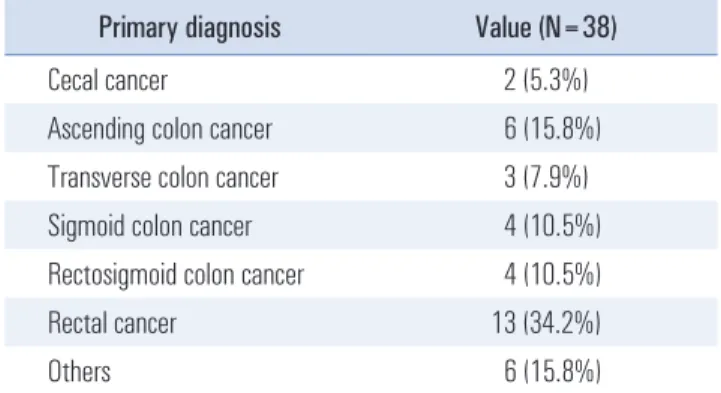
There are various causes of primary surgery; among them, the most common was cancer (Table 2).
Therefore, bowel resection was performed as the most com- mon primary surgery (Table 3).
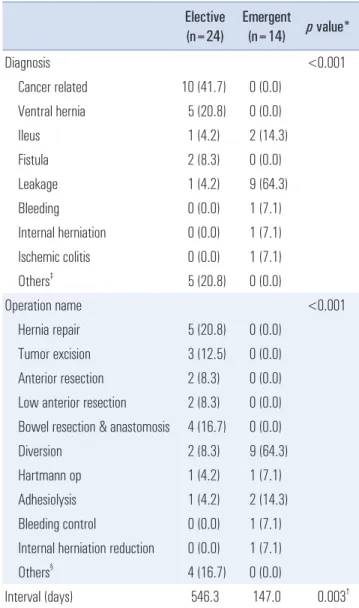
The reasons for reoperation can be classified into three groups; 23 primary SILS-related complications (12 immediate, 11 delayed complications), Ileus was included for this reason of re-operation, it was in a condition requiring surgery due to continuation of ileus for more than two weeks and repeated hospitalization.10 cancer-related (4 metachronous, 6 recurrent colorectal cancers), and 5 other surgical indications (benign tumor, anal dysfunction, ischemic colitis, recurred pheochro- mocytoma, and ectopic pancreas) (Table 4).
Elective group is related to postoperative complications such as ventral hernia which do not require urgent treatment, Table 1. Baseline characteristics of 38 patients who underwent primary-
SILS
Clinical characteristics Value (N=38) Gender
M F
21 (55.3%) 17 (44.7%)
Age (years) 58.95 (±16.35)
BMI (kg/m
2) primary 23.73 (±2.98) kg/m
2ASA stage
I II III
7 (18.4%) 30 (79%)
1 (2.6%) History of abdominal surgery
Yes No
8 (21%) 30 (79%)
Table 2. Reason for primary operation
Primary diagnosis Value (N=38)
Cecal cancer 2 (5.3%)
Ascending colon cancer 6 (15.8%) Transverse colon cancer 3 (7.9%) Sigmoid colon cancer 4 (10.5%) Rectosigmoid colon cancer 4 (10.5%)
Rectal cancer 13 (34.2%)
Others 6 (15.8%)
recurrence of cancer and diagnosis of new cancer. The post- operative interval was 546.3 days on average. The emergent group required urgent treatment like postoperative bleeding and anastomosis leakage, and it was often complication related to the first surgery. The interval after the first operation was 147 days on average, shorter than the elective group (Table 4).
Fecal diversion was the most common type of reoperation, seen in 11 cases. Of those, 10 were due to leakage. With re- gard to procedure details, 9 case of ileostomy, 1 case of end- sigmoidostomy, and 1 colostomy due to anal dysfunction were performed (Table 4). Nine out of 11 diversion surgeries were performed through a single port, which was used later as the stoma site.
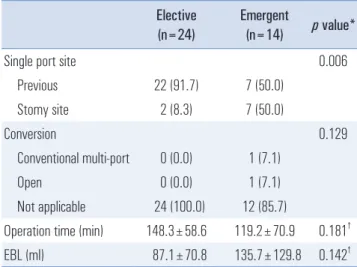
We used the same port sites in 29 patients. When selecting the port site in R-SILS, 22 patients from the elective group showed a tendency to use the previous port site more than the emergent group 7 patients.
There were 2 cases of conversion to an open or conven- tional method, all emergent group: 1 case to CLS due to poor visualization from severe bowel dilatation and 1 case to open surgery due to severe adhesion (Table 5). The Hospital length of stay was elective group at 7.3 days and emergent group at 14.9 days, requiring longer period at the emergent group.
Post-operative complications were found in 5 (13%) of 38 R-SILS cases (1 Grade I, 1 Grade II, 2 Grade IIIa, 1 Grade IIIb complications).
4Ileus was reported in one patient, but im- proved with NPO and conservative treatment. Three patients developed complicated fluid collection, 2 of whom recovered with PCD drainage and antibiotics. The other patient recov- ered after surgery (irrigation & drainage) and intensive antibi- otic treatment for uncontrolled peritonitis, In 1 case, there was a suspected rectovesical fistula in the cystoscope after surgery, but it improved with maintained indwelling urinary catheter.
There was no further abnormal finding in follow-up CT im- ages (Table 6). There were 5 cases of primary SILS-related ventral hernia. However, there was no R-SILS-related ventral
hernia. There was no 30-day postoperative death related to R- SILS.
DISCUSSION
Single-incision laparoscopic surgery (SILS) for colorectal surgery is now widely performed for various disease entities including malignant colorectal tumors. As surgeons become more comfortable with the techniques of SILS, patients with more complex surgical issues will undergo this procedure.
Laparoscopic surgery can also be used during reoperation.
5Laparoscopic reoperation is feasible for the treatment of many Table 3. Type of primary operation
Operation Value (N=38)
Right hemicolectomy 8 (21%)
Left hemicolectomy 2 (5.3%)
Anterior resection 6 (15.8%) Low anterior resection 15 (39.4%)
Colostomy 2 (5.3%)
Others* 5 (13.2%)
*Mass excision, total colectomy, exploration, TPC with IPAA, and trans- verse colectomy.
Table 4. Repeat single-incision laparoscopic surgery type Elective
(n=24) Emergent
(n=14) p value*
Diagnosis <0.001
Cancer related 10 (41.7) 0 (0.0) Ventral hernia 5 (20.8) 0 (0.0)
Ileus 1 (4.2) 2 (14.3)
Fistula 2 (8.3) 0 (0.0)
Leakage 1 (4.2) 9 (64.3)
Bleeding 0 (0.0) 1 (7.1)
Internal herniation 0 (0.0) 1 (7.1) Ischemic colitis 0 (0.0) 1 (7.1)
Others
‡5 (20.8) 0 (0.0)
Operation name <0.001
Hernia repair 5 (20.8) 0 (0.0) Tumor excision 3 (12.5) 0 (0.0) Anterior resection 2 (8.3) 0 (0.0) Low anterior resection 2 (8.3) 0 (0.0) Bowel resection & anastomosis 4 (16.7) 0 (0.0)
Diversion 2 (8.3) 9 (64.3)
Hartmann op 1 (4.2) 1 (7.1)
Adhesiolysis 1 (4.2) 2 (14.3) Bleeding control 0 (0.0) 1 (7.1) Internal herniation reduction 0 (0.0) 1 (7.1)
Others
§4 (16.7) 0 (0.0)
Interval (days) 546.3 147.0 0.003
†Values in parentheses are percentages. *Fisher’s exact test, except for
†t
test.
‡Benign tumor, anal dysfunction, recurred pheochromocytoma, s/p sig-
moid colostomy, and ectopic pancreas.
§Right hemicolectomy, Take down,
TEM with exploration, and Rectum pull-through.
complications following major laparoscopic abdominal sur- gery.
6However, there is no report about the role of repeat single incision laparoscopic surgery (R-SILS). In this study, the purpose was to evaluate the feasibility of R-SILS. SILS has many advantages including a smaller incision, reduced pain and scarring, faster recovery, shorter hospitalization, and improved maintenance of abdominal wall integrity.
1,2Con- sidering these advantages, a single incisional approach can be also used in reoperation in selective cases.
7Simple comparison of R-SILS results and SILS in other published studies, not only there was no significant difference in both morbidity and conversion rate, but average surgery time and bowel function recovery time showed similar to standard laparoscopic surgery.
1,2,8The postoperative mortality 0% and morbidity 13.2% of R-SILS are similar to mortality 0.28% and morbidity 13.2% in the Systemic review (System- atic review with meta-analysis of studies comparing single-
incision laparoscopic colectomy and multiport laparoscopic colectomy) published in 2016. Also, there is no big difference compared with mortality 0% and morbidity 12% of the RCT (Randomized clinical trial of single-incision versus multiport laparoscopic colectomy) published in 2016. In this study, the morbidity over Grade III was 8% similar to 7.9% in RCT.
Comparing the conversion rate, multiport was 2.6% and laparotomy was 2.6% in this study, multiport was 4.5% and laparotomy was 1.4% in the Systemic review, there was no significant difference. The laparotomy conversion rate in the RCT was 1%. Re-operation rate was 2.6%, similar to 1.38% of the Systemic review and 3% of the RCT.
Operation time was mean 137.9 min of R-SILS, mean Op- eration time was 147.28 min at the Systemic review, mean operation time was 156 min at the RCT. In this study, time to return of bowel function was an average 2.1 days, which was not much different from 1.96 days in the Systemic review.
EBL (estimated blood loss) was 105 ml in R-SILS, 75.06 ml in the systemic review and 21.4 ml in the RCT. Comparing the Hospital length of stay, it was 10.1 days in the R-SILS, 5.55 days in the Systemic review, and 6 days in the RCT.
When we compared our results with other published stud- ies, we were able to confirm similar results overall, except for EBL and Hospital length of stay.
1,2,8The length of hospital stay and EBL seemed to be quite in- crease in our study, probably due to complex conditions related to indication of R-SILS. In general, it is possible to take into consideration the difficult situation as reoperation itself and the delay in recovery after surgery (Table 7).
The rate of serious complications was low in our study, with only one anastomotic leak.
Given these results, R-SILS appears to be comparable to standard laparoscopy in terms of both safety and early post- operative clinical outcomes.
In our study, we performed 10 diverting ileostomies through the single port at the stoma marking site in the right lower Table 5. Intraoperative R-SILS outcomes
Elective
(n=24) Emergent
(n=14) p value*
Single port site 0.006
Previous 22 (91.7) 7 (50.0)
Stomy site 2 (8.3) 7 (50.0)
Conversion 0.129
Conventional multi-port 0 (0.0) 1 (7.1)
Open 0 (0.0) 1 (7.1)
Not applicable 24 (100.0) 12 (85.7)
Operation time (min) 148.3±58.6 119.2±70.9 0.181
†EBL (ml) 87.1±70.8 135.7±129.8 0.142
†Values in parentheses are percentages. *Fisher’s exact test, except for
†t test. EBL = estimated blood loss.
Table 7. Perioperative R-SILS outcomes Elective
(n=24) Emergent
(n=14) p value*
Diet (POD#)
Gas out 2.2±1.0 1.8±1.5 0.304
SOW 1.5±1.0 2.4±1.9 0.112
SBD 2.8±1.6 5.3±2.8 0.006
Hospital length of stay (days) 7.3±5.8 14.9±9.5 0.004 Values in parentheses are percentages. *T test. POD = postoperative date; SBD = semi-blended diet; SOW = sips of water.
Table 6. Postoperative complication (R-SILS) Elective
(n=24)
Emergent (n=14)
p value*
None 23 (95.8) 10 (71.4)
Yes
Complicated fluid collection
1 (4.2) Grade III 2 (14.3) Grade III
Ileus 0 (0.0) 1 (7.1) Grade II
Rectovesical fistula 0 (0.0) 1 (7.1) Grade I
Values in parentheses are percentages. *Fisher’s exact test (p=0.072).
quadrant for patients with anastomotic leakage after rectal surgery. It is useful to evaluate the anastomosis condition as well as suction of fecal materials without increasing wound complications.
SILS might be considered as the initial approach when loop ileostomy is planned to treat anastomotic leakage after rectal surgery.
Even though the initial approach started with a single port, additional trocar or conversion to the conventional multiport laparoscopic surgery should be considered if there is technical difficulty or a poor operative field.
5,9We converted to mul- tiport laparoscopic surgery and open surgery due to massive adhesion and poor vision. It was difficult to use the previ- ous post site in the emergent group, which is more relevant to postoperative complications requiring treatment, and food progression and extension of the hospitalization period were confirmed. It is considered that it is necessary to consider these points in the case selection for determining SILS during reoperation.
This study has several limitations. The number of cases of R-SILS was relatively small since this procedure was intro- duced recently and has been performed by few experienced surgeons. Additional time will be required to assess a larger number of patients for comparison to standard laparoscopy.
This is a retrospective study; therefore, there is possibility of selection and information bias. However, we reviewed the medical records as well as prospectively collected SILS data from our center. Factors that we could not assess through the study might have affected our results. Therefore, future prospective studies with a larger sample size should provide evidence-based support for our current observations. Also, the R-SILS in this study was performed by only one experienced surgeon at a single center. External validation of these results is needed, and incorporation of this technique into common surgical practice should be performed with caution.
In conclusion, this study reviewed the advantages of R- SILS such as reducing incisions, blood loss, length of hospital stay, and time of bowel function restoration. These procedures
might improve some of the benefits of minimally invasive surgery with similar short-term clinical and surgical outcomes to the conventional colorectal surgery. We conclude that repeat single-incision laparoscopic surgery is a safe and feasible pro- cedure in selected patients after initial single-port surgery by an experienced surgeon.
REFERENCES
1) Podda M, Saba A, Porru F, Pisanu A. Systematic review with meta-analysis of studies comparing single-incision laparoscopic colectomy and multiport laparoscopic colectomy. Surg Endosc 2016;30:4697-4720.
2) Markar SR, Wiggins T, Penna M, Paraskeva P. Single-incision versus conventional multiport laparoscopic colorectal surgery- systematic review and pooled analysis. J Gastrointest Surg 2014;18:2214-2227.
3) Ross H, Steele S, Whiteford M, et al. Early multi-institution ex- perience with single-incision laparoscopic colectomy. Dis Colon Rectum 2011;54:187-192.
4) Dindo D, Demartines N, Clavien PA. Classification of surgical complications: a new proposal with evaluation in a cohort of 6336 patients and results of a survey. Ann Surg 2004;240:205-213.
5) Feigel A, Sylla P. Role of Minimally Invasive Surgery in the Reoperative Abdomen or Pelvis. Clin Colon Rectal Surg 2016;29:168-180.
6) McCormick JT, Simmang CL. Reoperation following minimally invasive surgery: are the “rules” different? Clin Colon Rectal Surg 2006;19:217-222.
7) Arnell TD. Minimally Invasive Reoperation following Laparoto- my. Clin Colon Rectal Surg 2006;19:223-227.
8) Watanabe J, Ota M, Fujii S, Suwa H, Ishibe A, Endo I. Random- ized clinical trial of single-incision versus multiport laparoscopic colectomy. Br J Surg 2016;103:1276-1281.
9) Lu KC, Cone MM, Diggs BS, Rea JD, Herzig DO. Laparoscopic converted to open colectomy: predictors and outcomes from the Nationwide Inpatient Sample. Am J Surg 2011;201:634-639.