Received: August 26, 2020 Revised: October 12, 2020 Accepted: October 22, 2020
OPEN ACCESS
HORTICULTURAL SCIENCE and TECHNOLOGY 39(1):37-48, 2021
URL: http://www.hst-j.org pISSN : 1226-8763 eISSN : 2465-8588
This is an Open Access article distributed under the terms of the Creative Commons Attribution Non-Commercial License which permits unrestricted non-commercial use, distribution, and reproduction in any medium, provided the original work is properly cited.
Copyrightⓒ2021 Korean Society for Horticultural Science.
This research was supported by Basic Science Research Program through the National Research Foundation of Korea (NRF) funded by the Ministry of Education (NRF-2019R1I1A3A010 63362).
Influence of Shade Treatment on Plant Growth Characteristics and Spear Production in Five Asparagus (Asparagus officinalis L.) Cultivars
Rayhan Ahmed Shawon1, Seo Yeon Ha1, Tae Heon Lee1, Thi Luyen Cao1,2,3,4, Ho Cheol Kim1,4,5, Jong Hyang Bae1,4,5, and Yang Gyu Ku1,4,5*
1Department of Horticulture Industry, Wonkwang University, Iksan 54538, Korea
2Faculty of Agriculture and Natural Resources, An Giang University, Long Xuyen City, An Giang Province, Vietnam
3Vietnam National University, Ho Chi Minh City, Vietnam
4Institute of Life Science and Natural Resources, Wonkwang University, Iksan 54538, Korea
5Institute of Plant Breeding, Wonkwang University, Iksan 54538, Korea
*Corresponding author: [email protected]
Abstract
The objective of this study was to investigate the influence of a shade treatment on plant growth characteristics, bud break, and spear number of five asparagus (Asparagus officinalis L.) cultivars (Apollo, Atlas, Grande, UC157, and Walker Deluxe) and determine the most appropriate cultivar for cultivation in a shaded rain-shelter house. For the experiment, two-month-old seedlings were grown in the rain-shelter house with 30% shade using polyethylene film on the roof of the rain-shelter house, whereas the control plants were grown in a rain-shelter house without the additional layer of polyethylene. The shade treatment significantly increased the plant height, shoot number, shoot number per week, and bud number, but did not affect the mean number of days to bud break. The number of spears on asparagus grown in the shade was significantly higher than in the control. Under the shade treatment, Walker Deluxe and UC157 showed significantly higher shoot number and shoot number per week than the other cultivars. Compared to other cultivars, Walker Deluxe produced the highest bud number. In the control condition, Grande produced a higher number of shoots, shoots per week, buds, and roots than in the shade treatment. However, the shade treatment increased the ratio of spear numbers to bud numbers of Grande, resulting in a higher number of spears. Walker Deluxe with shade treatment had higher shoots, shoots per week, buds, roots, and spears than the control. These results suggest that Grande is more suited for growth in a rain-shelter house without shade treatment but that Walker Deluxe is more appropriate for cultivating in a rain-shelter house with 30% shade.
Additional key words: bud break, bud number, correlation, spear number, walker deluxe
Introduction
Asparagus (Asparagus officinalis L.) is a dioecious perennial vegetable that is nutritionally beneficial for human (Anastasiadi et al., 2020). It is a rich source of bioactive phytochemicals such as asparagusic acid, saponins, folic acid, rutin, amino acids, carotenoids, and polyphenols (Mitchell and
Waring, 2014; Hamdi et al., 2018; Ku et al., 2018a, 2018b; Chitrakar et al., 2019), which have antioxidant, antiviral, antifungal, and anti-inflammatory activities (Ji et al., 2012; Lee et al., 2015; Jaramillo et al., 2016; Iqbal et al., 2017; Ku et al., 2018a). In addition, pharmacological studies have demonstrated health benefits of asparagus that it can prevent cardiovascular disease, rheumatism, diarrhea, and diabetes (Iqbal et al., 2017; Jiménez-Moreno et al., 2019). Consequently, the consumption of asparagus has increased worldwide, particularly in South Korea (Lee et al., 2015; Ku et al., 2018a).
Asparagus is cultivated in open fields in many countries, but in South Korea, it is mostly grown in rain-shelter houses (Seo et al., 2016; Ku et al., 2018b). In both open field and rain-shelter house conditions in South Korea, plants are subjected to high light irradiance stress during the summer (from June to August). Several studies have reported that extremely high light intensity induced photoinhibition, resulting in a constrained plant growth and a decreased plant or fruit yield, therefore, shade treatment has been applied to reduce adverse effects of high light intensity on plant growth (Jeeatid et al., 2017; Zeng et al., 2017). Similarly, Onggo (2012) reported that shade treatment increased the yield and quality of asparagus by protecting the plants from high irradiance levels. Plants require an optimal light intensity for their normal growth and photosynthesis, which depend on cultivar (Jeeatid et al., 2017; Zeng et al., 2017). Therefore, it is important to determine the effects of shade treatment on different cultivars to identify suitable high yield cultivars for shade conditions.
Growing conditions and cultivar selection are important for asparagus cultivation because asparagus plants remain productive for at least 15 years (González and Pozo, 2002). The growth and biochemical properties of asparagus are significantly influenced by cultivar and the surrounding environment (Kim et al., 2016; Fukuda et al., 2018). Cultivation systems, temperature, soil water content, and light intensity affect plant growth characteristics, bioactive compounds, and bioactivities of asparagus (Motoki et al., 2012; Kim et al., 2016; Ku et al., 2018b). Asparagus spear yield is associated with photosynthetic activity, which greatly depends on the light irradiance (Guo et al., 2002).
There is limited information about cultivars suitable for growth under high light irradiance in Korean summers.
Moreover, the effects of shade on bud break and spear number of asparagus have not been thoroughly investigated in the country. Therefore, the objective of this study was to investigate the effect of shade treatment on plant growth characteristics, bud break, and spear number of five asparagus cultivars (Apollo, Atlas, Grande, UC157, and Walker Deluxe) grown in a rain-shelter house.
Materials and Methods
Growing Conditions and Experimental Treatments
The experiment was conducted in a rain-shelter house located at Wonkwang University, Iksan, South Korea (35°56'N, 126°57'E) from May 2018 to April 2019. The seeds of five asparagus cultivars (Apollo, Atlas, Grande, UC157, and Walker Deluxe) were sown in plug trays filled with a commercial growing medium containing 68.51% coco-peat, 10%
peat moss, 10% vermiculite, 5% zeolite, 6% pearlite, 0.18% fertilizer, 0.01% wetting agent, and 0.3% pH regulator (Alpha-Plus; Sang-Lim Company, Iksan, South Korea). After germination, one-month-old seedlings were transplanted into plastic pots (9 cm diameter × 9 cm high) containing a commercial growth medium and grown for one month in the rain-shelter house. The seedlings were then transplanted into larger pots (22 cm diameter × 25 cm high) containing growth
A
B
C
Fig. 1. Sunlight intensity under control and shade treatments in a rain-shelter house during the experiment. A) Irradiance (W·m-2), B) photon flux density (µmol·m-2·s-1), and C) illuminance (lux).
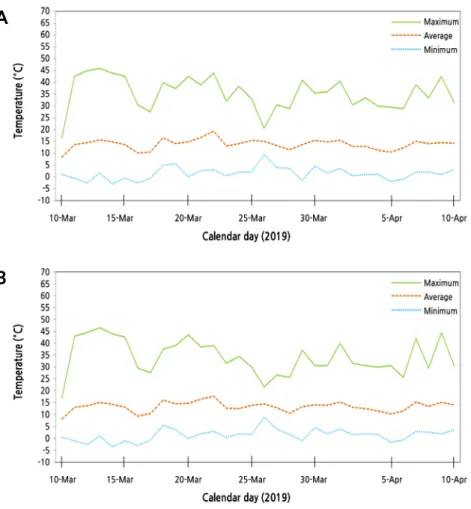
medium. Seedlings with uniform height and number of shoots were used for the experiment. The shade treatment was 30% reduced light irradiance by using a polyethylene film (Nakta Jangsu film; 0.07 mm thick, 10 m long × 5.7 m wide), while the control plants were grown in a rain-shelter house without the additional layer of polyethylene. The light intensity in control and shade treatments was monitored daily at 2 pm at 1 m above ground level using a SpectroPen-SP-110 spectrometer (Photon Systems Instruments, Brno, Czech Republic) (Fig. 1). Temperatures under both control and shade treatments were measured at 30-min intervals using data loggers (Micro Logger, Dallas Semi-conductor, USA) at 1.1 m above ground level (Fig. 2).
A
B
Fig. 2. Temperature under control (A) and shade (B) conditions in a rain-shelter house during the experiment. ( ) Maximum temperature in a day; ( ) average temperature of whole day; ( ) minimum temperature in a day.
Measurement of Plant Growth Parameters
The shoot number per plant was counted weekly. Shoot number was measured once it reached 1 cm in length. The shoot number per week (A) was calculated using equation 1:
(1)
Asparagus plant height was measured from the top of the growing media to the plant tip using a tape ruler (EGT-7525;
Ex-Power). The plants were then uprooted from the pots and the shoots and roots were separated. Roots were carefully washed with tap water to remove soil and adhering materials. Shoot and root diameter were measured at 1 cm from the base of the plant using a digital caliper (CD-20APX; Mitutoyo Corp., Kanagawa, Japan). The number of buds and roots was counted manually. Root length was measured using a tape ruler. Fresh weights of shoots and roots were determined using an electronic balance. Dry weights of the shoots and roots were determined after drying the samples in an oven at 60°C. The root:shoot ratio was calculated after measuring the dry weight.
Measurement of Bud Break
Asparagus seedlings become dormant at low temperature conditions. Dead asparagus ferns were removed, and the pots of the five asparagus cultivars were placed under the control and shade treatments. The increase in temperature in spring encouraged the buds to sprout (Fig. 2). The number of days to the first bud break was recorded.
Measurement of Spear Number
Spear number per plant was counted for the seven weeks of spear harvest. Spear height was measured daily from the soil surface to the spear tip using a ruler. The spears were harvested at 20 cm length. Spear diameter and spear weight were not measured because the spears were very thin and light in weight (less than 3–4 g).
Determination of the Ratio of Spear Number to Bud Number
The ratio of spear number to bud number (B, %) was determined according to equation 2:
× (2)
Statistical Analysis
The experiment was set up in a completely randomized design with five replicates for each cultivar. The effects of the treatments were evaluated, and the level of significance was analyzed using ANOVA with IBM SPSS Statistics for Windows, version 24 (IBM Corp., Armonk, NY, USA). Significant differences between the means and correlation coefficients among the treatments, plant growth characteristics, and cultivars were estimated using Duncan’s multiple range test at p ≤ 0.05.
Results and Discussion
Plant Growth Characteristics and Their Correlations
From the fourth week after treatment, the shade treatment significantly increased the asparagus shoot number compared with the control (Table 1). During summer, an average of 50,000 lux light was received in the control section (Fig. 1). However, the intensity of light (150–200 W/m2; 700–900 µmol m-2s-1; 30,000–40,000 lux) in the 30% shade treatment may be more favorable for a higher number of shoots compared with that of the control. Previous research has shown that 27,000–48,600 lux light levels were good for asparagus grown in South Korea (RDA). Onggo (2012) reported that the shoot number of asparagus seedlings was higher under a 40–50% shade treatment during the dry season in Indonesia.
Research on another Liliaceae member, Sandersonia aurantiaca, has shown that 700 µmol m-2s-1 was beneficial for the growth of this plant based on leaf area, flower number, and flower size (Catley et al., 2002; Davies et al., 2002). Liu and Zhao (2013) reported that Hosta ensata, another Liliaceae member, flowered best under 50% shade. In this study, the shoot number after three weeks of treatment differed significantly by cultivar (Table 1). From six weeks after treatment,
Table 1. Effect of shade treatment on the number of shoots of five asparagus cultivars grown in a rain-shelter house
Treatment
(A) Cultivar
(B)
Initial shoot (no.)
Shoot number per plant Weeks after treatment
1 2 3 4 5 6 7 8
Control
Apollo 4.4z abcy 5.4 cd 6.2 bcd 7.0 de 7.0 c 7.6 e 8.0 f 8.6 e 9.2 d Atlas 4.0 c 5.2 d 7.0 abc 8.0 bc 8.0 c 9.0 de 10.2 cde 11.2 bcd 12.6 bc Grande 4.0 c 6.4 ab 6.4 abcd 7.8 bcd 10.0 ab 11.0 ab 11.6 abc 12.2 bc 14.4 ab UC157 4.2 bc 5.4 cd 6.4 abcd 7.4 cde 8.6 bc 9.2 cde 10.6 bcd 11.4 bcd 12.6 bc Walker Deluxe 4.2 bc 5.6 b-d 6.2 bcd 8.0 bc 8.2 c 9.6 bcd 10.6 bcd 11.2 bcd 12.4 bc
Shade
Apollo 4.8 a 6.2 bc 7.4 a 8.2 bc 9.8 b 10.8 bc 12.2 ab 13.2 b 14.4 ab Atlas 4.2 bc 5.4 cd 6.0 cd 6.6 ef 7.2 c 8.2 de 9.2 def 9.4 de 10.6 cd Grande 4.0 c 5.2 d 5.8 d 6.4 f 7.4 c 8.6 de 8.6 ef 10.0 cde 10.2 d
UC157 4.6 ab 7.2 a 7.2 ab 9.8 a 11.4 a 12.6 a 13.0 a 15.6 a 16.2 a
Walker Deluxe 4.0 c 5.2 d 6.4 abcd 8.4 a 10.0 ab 11.2 ab 12.6 a 15.4 a 16.2 a
Ax ns ns ns ns * ** * *** **
B ** * ns *** *** *** ** *** ***
A × B ns *** ** *** *** *** *** *** ***
zEach value is the mean of five replications per cultivar.
yMeans within columns sharing the same letter are not significantly different based on Duncan’s multiple range test at p ≤ 0.05.
xns, *, **, and *** indicates not significant or significant at the p ≤ 0.05, p ≤ 0.01, or p ≤ 0.001 level, respectively.
the shoot numbers of UC157 and Walker Deluxe were significantly higher than those of other cultivars. Similarly, UC157 seedlings have been found to produce more shoots than Atlas in a pot experiment (Pertierra et al., 2006). Shoot number was significantly affected by the interaction between shade treatment and cultivar.
Under the control condition, eight weeks after treatment, shoot numbers of Atlas, Grande, UC157, and Walker Deluxe did not differ significantly and these cultivars had higher shoot numbers than Apollo from six weeks to eight weeks after treatment (Table 1). The shoot number of Grande from three to eight weeks after shade treatment (except week 7) was significantly higher under control condition compared with those of shade treatment. Under the shade treatment, UC157 and Walker Deluxe produced a higher number of shoots than other cultivars at weeks 3 and 7 after treatment.
Shade-treated UC157 and Walker Deluxe at eight weeks after treatment produced 29% and 31% more shoots, respectively, than those grown under the control condition. The number of shoots in asparagus is related to the number of buds in a cluster (Ku et al., 2008), and the number of buds is associated with the following season’s spear yield (Gasecka et al., 2009).
The shade treatment significantly increased the shoot number per week (Fig. 3A). At week 8, shoot numbers per week in the shaded and control plants were 1.15 and 1.01, respectively. UC157 and Walker Deluxe produced 1.25 and 1.28 shoots per week, respectively, which was significantly more than the other cultivars (Fig. 3B). The shoot number per week for Grande under control condition was 67% higher than that under shade treatment. However, the shoot numbers per week of UC157 and Walker Deluxe with shaded treatment were approximately 40% higher than those of control condition. Shade treatment stimulated plant height but the cultivars had no significant effect on plant height (Table 2). Under the shade treatment, Grande and Atlas were significantly taller than UC157, whereas the plant heights of Apollo, UC157, and Walker Deluxe were not significantly different. The plant heights of Grande and Atlas with the shade
A B
Fig. 3. The effect of shade treatment on shoot number per week (A), and the shoot number of each cultivar per week (B) in a rain-shelter house. The vertical bars represent the standard deviation (A, n = 25; B, n = 5). Different lowercase letters above bars within the figure indicate significant differences based on Duncan’s multiple range test at p ≤ 0.05.
Table 2. Effect of shade treatment on plant growth characteristics of five asparagus cultivars grown in a rain-shelter house
Treatment (A)
Cultivar (B)
Plant growth characteristics per plant Plant
height (cm)
Shoot diameter
(mm) Bud number
Root number
Root length
(cm)
Fresh weight (g) Dry weight (g) Root : shoot Shoot Root Total Shoot Root Total
Control
Apollo 96.6z aby 3.3 ab 31.0 fg 36.8 d 37.0 abc 50.4 abc 151.4 abc 201.8 abc 13.4 ab 42.4 abc 55.8 abc 3.2 a Atlas 83.0 b 2.5 b 38.2 cde 81.6 bc 31.8 c 40.2 abc 128.8 bcd 169.0 bcd 10.4 ab 33.4 bc 43.8 bc 3.2 a Grande 84.6 b 2.8 b 48.2 b 117.0 a 32.4 c 39.8 abc 173.0 ab 212.8 abc 11.6 ab 43.0 abc 54.6 abc 3.7 a UC157 91.8 ab 3.5 ab 33.2 efg 86.4 bc 40.0 ab 42.6 abc 137.2 bcd 179.8 bcd 11.8 ab 35.4 abc 47.2 abc 3.1 a Walker
Deluxe 81.2 b 2.5 b 36.2 def 69.2 c 33.4 bc 33.2 c 126.0 cd 159.2 cd 8.6 b 29.0 c 37.6 c 3.4 a
Shade
Apollo 94.2 ab 3.3 ab 26.6 g 82.2 bc 35.2 abc 34.2 bc 100.8 d 135.0 d 9.4 b 28.4 c 37.8 c 3.1 a Atlas 105.2 a 3.9 a 41.0 cd 83.2 bc 37.0 abc 60.6 a 165.0 abc 225.6 ab 15.8 a 44.8 ab 60.6 ab 3.0 a Grande 104.4 a 3.1 ab 32.6 efg 71.8 c 37.0 abc 49.4 abc 132.2 bcd 181.6 bcd 12.8 ab 32.6 bc 45.4 bc 2.5 a UC157 86.2 b 2.7 b 44.6 bc 85.6 bc 41.0 a 49.8 abc 129.6 bcd 179.4 bcd 12.8 ab 35.2 abc 48.0 abc 2.9 a Walker
Deluxe 97.4 ab 2.8 ab 56.4 a 96.0 b 38.6 abc 56.6 ab 191.6 a 248.2 a 15.4 a 48.8 a 64.2 a 3.2 a
Ax ** ns * ns * * ns ns ns ns ns ns
B ns ns *** *** * ns ns ns ns ns ns ns
A × B * * *** *** ns * *** *** * ** ** ns
zEach value is the mean of five replications per cultivar.
yMeans within columns sharing the same letter are not significantly different based on Duncan’s multiple range test at p ≤ 0.05.
xns, *, **, and *** indicates not significant or significant at the p ≤ 0.05, p ≤ 0.01, or p ≤ 0.001 level, respectively.
treatment were approximately 25% higher than those under the control condition. Shoot diameter was unaffected by the shade treatment or cultivar, however, the interaction between treatment and cultivar had a significant effect on the shoot diameter. The shoot diameter of Atlas was significantly higher than that of UC157 under shade treatment. The shoot diameter of Atlas significantly increased by 56% under the shade treatment, whereas the shoot diameters of Apollo, Grande, UC157, and Walker Deluxe were not significantly different between the shade treatment and the control.
The number of asparagus buds influences the spear yield in the following season (Gasecka et al., 2009). In this study, the shade treatment significantly increased the number of buds compared to the control (Table 2). The increased bud number in the shade treatment indicated that the yield of asparagus spears would be greater in the subsequent year. The enhanced bud number of shade-treated asparagus may have resulted from the high shoot numbers (Table 1). Other studies have shown that the number of buds in asparagus plants is correlated with the number of shoots (Drost and Wilcox-Lee, 1997; Kim et al., 2016; Siomos, 2018). Cultivar had a significant effect on the number of buds. Walker Deluxe showed a significantly higher number of buds than the other cultivars. The significant interaction between treatment and cultivar was also found in the bud number of the asparagus. Under the shade treatment, Walker Deluxe produced the highest number of buds. The number of buds on Walker Deluxe grown in the shade was significantly increased (56%) with respect to that of the control. Under the control condition, the bud number of Grande was significantly higher than that of other cultivars, and 48% higher than that of Grande grown in the shade treatment.
As a perennial crop, asparagus yield also depends on root growth and development (Elmer, 1995; Wilson et al., 2002b).
The number of roots of Grande under the control condition was higher than that under shade treatment (Table 2). The number of roots of Atlas, UC157, and Walker Deluxe with the control condition did not differ significantly. However, under shade treatment, Walker Deluxe produced a higher number of roots than under control condition. Both shade treatment and cultivar had significant effects on the root length of the asparagus. The average root length of shade-treated plants was 37.76 cm, which was 2.84 cm higher than that of the control plants. Under control condition, the root lengths of Apollo, UC157, and Walker Deluxe were not significantly different, whereas the root length of UC157 was higher than that of Atlas and Grande. However, under the shade treatment, root length did not differ significantly between cultivars.
Compared to the control condition, shade treatment significantly increased the fresh weight of shoots (Table 2). However, cultivar had no significant effect on shoot fresh weight, whereas cultivar and treatment had a significant interaction effect. The shoot fresh weight of Walker Deluxe was significantly greater under shade treatment (56.60 g) than under control condition (33.20 g). Shoot dry weight, root fresh and dry weights, total fresh and dry weights, and root:shoot ratio were unaffected by shade treatment or cultivar. However, there was a significant interaction effect between treatment and cultivar, except in the case of the root:shoot ratio. Under shade treatment, root fresh weight, total fresh weight, shoot dry weight, root dry weight, and total dry weight of Walker Deluxe were significantly higher than those of Apollo. There were increases in root fresh and dry weight, shoot dry weight, and total fresh and dry weights of shade-treated Walker Deluxe compared with those under control condition.
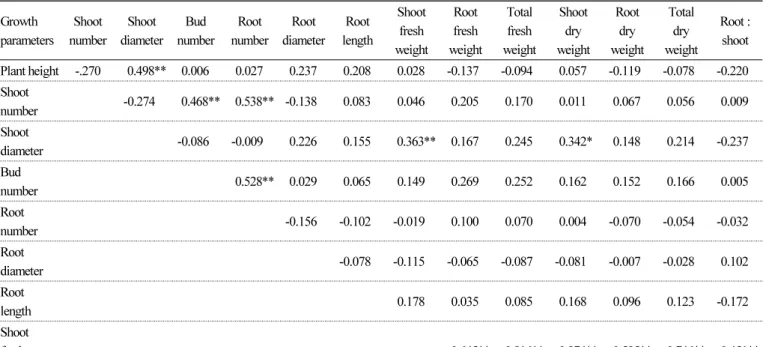
The asparagus plant height showed a positive significant correlation with shoot diameter (p ≤ 0.01, r = 0.49, Table 3).
Machon et al. (1995) also showed a significant positive correlation between the height of asparagus and shoot diameter (r
= 0.60). There was a significant positive relationship between the number of shoots and buds (p ≤ 0.01, r = 0.46), and between the number of shoots and roots (p ≤ 0.01, r = 0.53). Other studies have also observed that the number of shoots and buds are correlated in asparagus plants (Kim et al., 2016). The number of buds in asparagus is an important factor for spear production in the subsequent season. Bud number was significantly positively correlated with root number (p ≤ 0.01, r = 0.52). Total fresh weight and total dry weight showed positive correlations with the shoot and root fresh and dry weights. Shoot and root fresh weights showed significant positive correlations with the shoot and root dry weights at the p ≤ 0.01 probability level.
Table 3. Pearson’s correlation coefficient between different plant growth characteristics of asparagus Growth
parameters
Shoot number
Shoot diameter
Bud number
Root number
Root diameter
Root length
Shoot fresh weight
Root fresh weight
Total fresh weight
Shoot dry weight
Root dry weight
Total dry weight
Root : shoot Plant height -.270 0.498** 0.006 0.027 0.237 0.208 0.028 -0.137 -0.094 0.057 -0.119 -0.078 -0.220 Shoot
number -0.274 0.468** 0.538** -0.138 0.083 0.046 0.205 0.170 0.011 0.067 0.056 0.009
Shoot
diameter -0.086 -0.009 0.226 0.155 0.363** 0.167 0.245 0.342* 0.148 0.214 -0.237
Bud
number 0.528** 0.029 0.065 0.149 0.269 0.252 0.162 0.152 0.166 0.005
Root
number -0.156 -0.102 -0.019 0.100 0.070 0.004 -0.070 -0.054 -0.032
Root
diameter -0.078 -0.115 -0.065 -0.087 -0.081 -0.007 -0.028 0.102
Root
length 0.178 0.035 0.085 0.168 0.096 0.123 -0.172
Shoot fresh weight
0.645** 0.816** 0.974** 0.595** 0.746** -0.451**
Root fresh weight
0.968** 0.705** 0.914** 0.921** 0.143
Total fresh weight
0.853** 0.886** 0.941** -0.040
Shoot dry
weight 0.664** 0.808** -0.409**
Root dry
weight 0.977** 0.346*
Total dry weight
0.156
*Significant at p ≤ 0.05; **significant at p ≤ 0.01.
Bud Break, Spear Number, and the Ratio of Spear to Bud Number
Bud break in asparagus was induced when the daily average temperature reached approximately 10°C in the rain-shelter house (Fig. 2). Ku et al. (2007) showed that bud break of UC157 was induced at 10°C. Other researchers reported that bud break of Mary Washington and Martha Washington asparagus cultivars started at 4.4°C and 5.8°C, respectively (Culpepper and Moon, 1939; Bouwkamp and McCully, 1975). Shade treatment had no significant effect on the mean number of days to bud break (Table 4). However, the cultivar type significantly affected the mean number of days to bud break. Under the shade treatment, the mean number of days to bud break of Apollo, Grande, UC157, and Walker Deluxe did not differ significantly. In addition, the mean number of days to bud break of UC157 was 1.5 days, which was lower
Table 4. Effect of shade treatment on mean number of days to bud break and ratio of spear number to bud number of five asparagus cultivars grown in a rain-shelter house
Treatment (A)
Cultivar (B)
Mean number of days to bud break (day)
Ratio of spear number to bud number (%)
Control
Apollo 4.5z ay 20.0 bcd
Atlas 4.8 a 13.1 d
Grande 3.0 abc 12.9 d
UC157 2.5 abc 25.5 abc
Walker Deluxe 3.0 abc 18.8 bcd
Shade
Apollo 3.8 abc 24.2 abcd
Atlas 4.0 ab 17.1 cd
Grande 2.5 abc 34.8 a
UC157 1.5 c 29.4 ab
Walker Deluxe 2.0 bc 21.0 bcd
Ax ns **
B ** *
A × B ns *
zEach value is the mean of five replications per cultivar.
yMeans within columns sharing the same letter are not significantly different based on Duncan’s multiple range test at p ≤ 0.05.
xns, *, and ** indicates not significant or significant at the p ≤ 0.05, or p ≤ 0.01 level, respectively.
A B
Fig. 4. The effect of shade treatment on spear number (A), and the spear number of each cultivar (B) in a rain-shelter house.
The vertical bars represent the standard deviation (A, n = 25; B, n = 5). Different lowercase letters above bars within the figure indicate significant differences based on Duncan’s multiple range test at p ≤ 0.05.
than that of Atlas (4.0 days) under shade treatment. This trend meant that the bud break of UC157 was 2.5 days earlier than that of Atlas. Ku et al. (2007) showed that the mean number of days to bud break for six-month-old UC157 plants was earlier than that for Jersey Giant.
Shade-treated asparagus plants produced more spears than the control plants (Fig. 4A). This effect has resulted from the response of asparagus plants to the shade treatment in the previous season when the numbers of shoots and buds were significantly greater in the shade treatment than in the control (Tables 1 and 2). Wilson et al. (2002a) reported that the growing condition of the fern stage and established harvest period influenced spear number in asparagus. Siomos (2018) reported that during the fern growth and establishment period of asparagus, bud development occurred in the crown of the
plants and that most of these buds produced spears in the following season. Number of spears of Grande, UC157, and Walker Deluxe did not differ statistically in both control and shade treatments. Under the control condition, the number of spears was not significantly different between the cultivars (Fig. 4B). However, under the shade treatment, Walker Deluxe, UC157, and Grande produced more spears than the other cultivars. The spear numbers of Walker Deluxe, UC157, and Grande cultivated under the shade treatment were 0.8-fold, 0.6-fold, and 0.8-fold higher than those grown in the control, respectively.
The shade treatment significantly increased the ratio of spear number to bud number compared with the control condition (Table 4). Cultivar had a significant effect on the ratio of spear numbers to bud numbers. There was an interaction between shade treatment and cultivar, which affected the ratio of spear numbers to bud numbers. In the control condition, this value for UC157 was significantly higher than it was for Atlas and Grande. In the shade treatment, the ratio of spear number to bud number of Grande was 2.7-fold higher than in the control, but not significantly different from those in the shade-treated UC 157 and Apollo.
In conclusion, shade treatment significantly increased the number of shoots, buds, and spears of asparagus compared to the control plants. Under control condition, Grande produced a higher number of shoots, shoots per week, buds, and roots than under shade treatment. However, Walker Deluxe under shade treatment had higher number of shoots, buds, and spears, suggesting that cultivation of Walker Deluxe with 30% shade would be expected to increase spear yield.
Literature Cited
Anastasiadi M, Collings ER, Shivembe A, Qian B, Terry LA (2020) Seasonal and temporal changes during storage affect quality attributes of green asparagus. Postharvest Biol Technol 159:1-9. doi:10.1016/j.postharvbio.2019.111017
Bouwkamp JC, McCully JE (1975) Effects of simulated non-selective mechanical harvesting on spear emergence of Asparagus officinalis L. Sci Hortic 3:157-162. doi:10.1016/0304-4238(75)90022-9
Catley JL, Brooking IR, Davies LJ, Halligan EA (2002) Temperature and irradiance effects on Sandersonia aurantiaca flower shape and pedicel length. Sci Hortic 93:157-166. doi:10.1016/S0304-4238(01)00324-7
Chitrakar B, Zhang M, Adhikari B (2019) Asparagus (Asparagus officinalis): processing effect on nutritional and phytochemical composition of spear and hard-stem byproducts. Trends Food Sci Technol 93:1-11. doi:10.1016/j.tifs.2019.08.020
Culpepper CW, Moon HH (1939) Effect of temperature upon the rate of elongation of the stems of asparagus grown under field conditions. Plant Physiol 14:255-270. doi:10.1104/pp.14.2.255
Davies LJ, Brooking IR, Catley JL, Halligan EA (2002) Effects of constant temperature and irradiance on the flower stem quality of Sandersonia aurantiaca. Sci Hortic 93:321-332. doi:10.1016/S0304-4238(01)00344-2
Drost D, Wilcox-Lee D (1997) Soil water deficits and asparagus: II. Bud size and subsequent spear growth. Sci Hortic 70:145-153.
doi:10.1016/S0304-4238(97)00042-3
Elmer WH (1995) Association between Mn-reducing root bacteria and NaCl applications in suppression of fusarium crown and root rot of asparagus. Phytopathology 85:1461-1467. doi:10.1094/Phyto-85-1461
Fukuda M, Matsuo S, Watanabe S, Uragami A (2018) Effects of incubation temperature on asparagus bud sprouting, abscisic acid content and sex. Acta Hortic 1223:151-158. doi:10.17660/ActaHortic.2018.1223.21
Gasecka M, Krzesińk W, Stachowiak J, Knaflewski M (2009) The effect of temperature and crown size on asparagus yielding. Folia Hortic 21:49-59. doi:10.2478/fhort-2013-0125
González MI, Pozo AD (2002) Asparagus cultivar trials in bio bio (viii) region of Chile. Acta Hortic 589:117-121. doi:10.17660/ActaHortic.
2002.589.14
Guo J, Jermyn WA, Turnbull MH (2002) Carbon assimilation, partitioning and export in mature cladophylls of two asparagus (Asparagus officinalis) cultivars with contrasting yield. Physiol Plant 115:362-369. doi:10.1034/j.1399-3054.2002.1150305.x
Hamdi A, Jiméez-Araujo A, Rodriguez-Arcos R, Jaramillo-Carmona S, Lachaal M, Bouraoui NK, Guillé-Bejarano R (2018) Asparagus sap onins: chemical characterization, bioavailability and intervention in human health. Nutri Food Sci Int J 7:1-6. doi:10.19080/NFSIJ.201 8.07.555704
Iqbal M, Blbi Y, Raja NI, Ejaz M, Hussain M, Yasmeen F, Saira H, Imran M (2017) Review on therapeutic and pharmaceutically important
medicinal plant Asparagus officinalis L. J Plant Biochem Physiol 5:1-6. doi:10.4172/2329-9029.1000180
Jaramillo S, Muriana FJG, Guillen R, Jimanez-Araujo A, Rodriguez-Arcos R, Lopez S (2016) Saponins from edible spears of wild asparagus inhibit AKT, p70S6K, and ERK signalling, and induce apoptosis through G0/G1 cell cycle arrest in human colon cancer HCT-116 cells.
J Funct Foods 26:1-10. doi:10.1016/j.jff.2016.07.007
Jeeatid N, Techawongstien S, Suriharn B, Bosland PW, Techawongstien S (2017) Light intensity affects capsaicinoid accumulation in hot pepper (Capsicum chinense Jacq.) cultivars. Hortic Environ Biotechnol 58:103-110. doi:10.1007/s13580-017-0165-6
Ji Y, Ji C, Yue L, Xu H (2012) Saponins isolated from Asparagus induce apoptosis in human hepatoma cell line HepG2 through a mitochondrial-mediated pathway. Curr Oncol 19:1-9. doi:10.3747/co.19.1139
Jiménez-Moreno N, Esparza I, Bimbela F, Gandía LM, Ancín-Azpilicueta C (2019) Valorization of selected fruit and vegetable wastes as bioactive compounds: opportunities and challenges. Crit Rev Environ Sci Technol 1-48. doi:10.1080/10643389.2019.1694819 Kim HC, Heo BG, Bae JH, Lee SY, Kang DH, Ryu CS, Kim DE, Choi IJ, Ku YG (2016) Comparison of plant growth characteristics and
biological activities of four asparagus cultivars by cultural method. Korean J Plant Res 29:495-503. doi:10.7732/kjpr.2016.29.4.495 Ku YG, Bae JH, Namieśnik J, Barasch D, Nemirovski A, Katrich E, Gorinstein S (2018a) Detection of bioactive compounds in organically
and conventionally grown asparagus spears. Food Anal Methods 11:309-318. doi:10.1007/s12161-017-1074-0
Ku YG, Kang DH, Lee CK, Lee SY, Ryu CS, Kim DE, Polovka M, Namieśnik J, Gorinstein S (2018b) Influence of different cultivation systems on bioactivity of asparagus. Food Chem 244:349-358. doi:10.1016/j.foodchem.2017.10.044
Ku YG, Wolley DJ, Hughes AR, Nichols MA (2007) Temperature effects on dormancy, bud break and spear growth in asparagus (Asparagus officinalis L.). Hortic Sci Technol 82:446-450. doi:10.1080/14620316.2007.11512257
Ku YG, Woolley DJ, Nichols MA (2008) Effect of CPPU treatment on fern number, bud number, and photosynthetic rate of asparagus.
Acta Hortic 776:471-476. doi:10.17660/actahortic.2008.776.61
Lee JW, Heo BG, Bae JH, Ku YG (2015) Comparison of plant growth, dormancy breaking, yield, and biological activities of extracts in four asparagus cultivars. Korean J Hortic Sci Technol 33:796-804. doi:10.7235/hort.2015.15080
Liu DH, Zhao SW (2013) The impacts of light levels on growth and ornamental characteristics of Hosta. Acta Hortic 977:183-188.
doi:10.17660/ActaHortic.2013.977.20
Machon N, Boulc’h VDL, Rameau C (1995) Quantitative analysis of sexual dimorphism in Asparagus. Can J Bot 73:1780-1786. doi:10.1139 /b95-190
Mitchell SC, Waring RH (2014) Asparagusic acid. Phytochemistry 97:5-10. doi:10.1016/j.phytochem.2013.09.014
Motoki S, Kitazawa H, Maeda T, Suzuki T, Chiji H, Nishihara E, Shinohara Y (2012) Effects of various asparagus production methods on rutin and protodioscin contents in spears and cladophylls. Biosci Biotechnol Biochem 76:1047-1050. doi:10.1271/bbb.120143 Onggo TM (2012) The effect of ratio of rice-hulls and compost for seedling medium and net-shading on the growth of asparagus
seedlings planted in polybags. Acta Hortic 950:81-86. doi:10.17660/ActaHortic.2012.950.8
Pertierra R, Campos J, Carrasco F (2006) Characterization of asparagus (Asparagus officinalis L.) cultivar growth in pots in the first year.
Agricultura Técnica 66:98-106. doi:10.4067/S0365-28072006000100011
Seo HT, Kim YJ, Jang EH, Hong DK, Kang HM (2016) Effects of early shading of roots of asparagus (Asparagus officinalis L.) on harvesting time, spring yield and farm income in Republic of Korea. Acta Hortic 155-160. doi:10.17660/ActaHortic.2016.1132.21
Siomos AS (2018) The quality of asparagus as affected by preharvest factors. Sci Hortic 233:510-519. doi:10.1016/j.scienta.2017.12.031 Wilson DR, Cloughley CG, Jamieson PD, Sinton SM (2002a) A model of asparagus growth physiology. Acta Hortic 589:297-301. doi:10.
17660/ActaHortic.2002.589.40
Wilson DR, Cloughley CG, Sinton SM (2002b) AspireNZ: a decision support system for managing root carbohydrate in asparagus. Acta Hortic 589:51-58. doi:10.17660/ActaHortic.2002.589.5
Zeng G, Guo Y, Xu J, Hu M, Zheng J, Wu Z (2017) Partial shade optimizes photosynthesis and growth in bayberry (Myrica rubra) trees.
Hortic Environ Biotechnol 58(3):203-211 doi:10.1007/s13580-017-0003-x