* Research fund sponsored by Chonbuk National University of Oversea Research Program.
†교신저자:이성필 (동서대학교 디자인학부 산업디자인전공), 홍정표 (전북대학교 산업디자인학전공) E-mail:[email protected]
TEL:051-320-1946 FAX:051-320-1945
Evaluation Method for the Creativity Elements and Emotional design
창의성요소와 감성디자인의 평가방법 관계에 대한 연구*
Sung-Pil Lee**†․Jung Pyo Hong***†
이성필**†․홍정표***†
Department of Industrial Design, Dongseo University**
동서대학교 산업디자인학전공**
Department of Industrial Design, National Chonbuk University***
전북대학교 산업디자인학전공***
Abstract
This modern society is said to be more typical of an emotional society. In such a society, emotional design adds value to products, hence bringing about value-enhanced products. Despite many claims of little substance about emotional design, there have been only a few researches that have identified what criteria to be applied to distinguish between emotional products and generic products or even have clearly defined what emotional products are. This leads to a clear need for providing more definite criteria for defining and classifying design elements useful and available for users. To fill the gap, the purpose of this study is, first, to explore the relationship between evaluation elements for creative design and emotional design, and, based on that, identify some of the most importantly valued elements, and secondly, to examine how the images importantly used for expression relate to creativity evaluation elements according to classified types of design. In this study, chosen products were presented to selected users so that they can choose what they think possesses emotional design elements. Then the products so chosen were classified according to design type for examination of their respective relationship with creativity evaluation elements. In addition, the identification was performed of perceived design images about the selected products and the relationship between those images and creativity evaluation elements. This study is expected to provide a chance to be aware of the fact that essential creativity evaluation elements can vary depending on changing times, environments, and users, and as well, to offer an insight into what images design should be possessive of for it to be preferred by consumers.
Keywords : Emotional Design, Evaluation of Creativity Elements
요 약
현대사회를 감성사회라고 말한다. 감성사회에서 感性디자인은 상품의 가치를 높여 부가가치를 높여준다. 많 은 연구자들이 감성디자인에 대하여 주장을 하고 있지만 감성제품과 일반 제품의 관계에 대해서는 아직까지 판단기준이 무엇인지 명확하게 밝히거나 무엇이 감성제품인지에 대하여 구체적으로 연구된 사례가 많지 않다.
따라서 감성디자인에서, 사용자에게 중요하게 다루어지는 디자인요소가 무엇이며, 감성디자인의 분류와 판단 기준을 제시할 필요가 있다. 이를 위하여 첫 번째로 선행 연구된 디자인 창의성 평가 요소와 감성디자인의 관계, 소비자에게 선호되는 감성디자인은 어떤 창의성평가요소와의 디자인요소가 중요하게 다루어져야 하는지 를 제안하고, 두 번째로, 감성디자인유형별로 중요하게 표현되는 이미지와 창의성평가요소와의 관계는 무엇인 지를 알아보았다. 이를 위하여 사용자들에게 제품을 보여주고 감성디자인이라고 생각하는 제품을 선정하게하 고, 선정된 제품을 디자인유형별로 나누어 창의성평가요소와의 관계를 알아보았다. 또한 선정된 제품에서 느 끼고 있는 디자인이미지를 알아보고 이미지와 창의성평가요소와의 관계도 알아보았다. 본 연구를 통하여, 감 성디자인은 시대의 변화, 환경, 사용자에 따라 중요한 창의성평가요소가 다르게 나타날 수 있으며, 사용자가 선호하는 디자인은 어떤 이미지를 갖는 디자인이어야 한다는 것을 알 수 있을 것이다.
주제어 : 감성디자인, 창의성요소
1. Background and Necessity of Study
According to the latest topic of emotional design customer requirements and companies responding methods have been changed. The diffusion rate also can not be reached to 100%
Figure 1. Annual diffusion rate changing(Hong, 2007)
Therefore, we hope this study to be a basic data for the understanding of emotional design and use of emotional design in the field. Many researchers insist on emotional design however there has not been any clear standard-set to the relationship between emotional products and normal ones and there have hardly been concrete researches on what is emotional product among those we use commonly. It varies depending on viewing angle, each designer and person. Then, it is necessary to examine what properties emotionally designed products
have. A point of reference is necessary for this, and creativity element in emotional design is characterized as provoking interests, stimulating and drawing attention through free idea. Thus, design development by creative ideas accounts for the greatest portion of emotional design. Then, it would be interesting to examine the relationship between emotional design and creativity. In order to do this, it is necessary to grasp the relationship between Elements for Creativity Evaluation and emotional design in previous studies, what Elements for Creativity Evaluation is of importance in emotional design preferred by consumers and how to use it in design.
2. Purpose of Research
The main reason of this research is fallow;
First, Emotional design evaluation method could be applied to the creativity evaluation.
Second, how to emotional design can be classified with its image.
Third, Find of relationship between emotional design area and creativity evaluation area. Further more, what will be consideration issue of creativity evaluation if emotional design evaluation method is applied?
3. Research Subject and Method
Research subject was broadly divided into two: first, the importance of emotional design according to the
general change of environment and researchers’ argument about general emotional design to help understand it and theoretical inquiry on Elements for Creativity Evaluation for case study; second, an examination of the relationship between creative evaluation element and emotional design through case study.
Figure 2. Research purpose and Process.
For research method, we summarized emotional design through previous studies and theoretical study. We carried out two case studies using interview method in which first subjects select the design they think mostly emotional one and they answer viewing show cards of product image in order to know what the selected design belongs to among Elements for Creativity Evaluations.
4. Field of Emotional Design
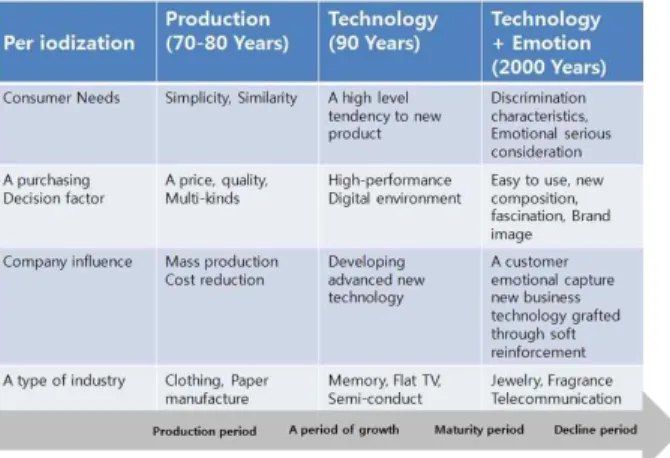
Product centric period, people tend to considered long term life time products, manufacturing cost efficiency.
And customer benefit was most important issue. During user centered period, Easy to use, looking, simple and friendly user interface were most important issue. On present, customer like to product adapting to their eye level and it is particular matter of emotional design. In early study, we classified into 3 types of product design based on functional emotion and color emotion. Also finding how cultural emotion related to the lifestyle. For the better understanding, case study explanation will be fallow;
Figure 3. Changing of design consideration based on period
Figure 4. Field of Emotional design
First, emotional design of change in the way people think by technology. A representative example of revival of business in a bad enterprise environment is that Apple Computer created a culture code of ‘I-Pod’[Figure 5] and was born again as the world’s best digital business. The commonality among these products is that they put new ideas together through change of ideas by advanced technology.
Figure 5. Ipod design
Second, Artistic Emotion.
There are many cases in which products combining artistic idea shave shown visible achievements in market.
In the campaign of ‘now life is art and sensibility,’
painters fashion designers and photographers appeal consumers emphasizing emotional elements breaking from the existing concept in home appliances, ceramic wares, cosmetics and credit cards.
Figure 6.
Art Dios Refrigerator
W ith the blueprint to “spread new concepts to consumers with higher tastes because of
their upgraded life and to change the paradigm of home
appliances design,” this product focuses on implanting
the concept of interior work using famous ‘flower painter’
Ha, Sang-rim’s works
Figure 7.
Andre Kim’s KB Card
Andre Kim’s KB Card Card's
‘e-Queens,’ for women, designed by designer Andre Kim is a part of emotional marketing emphasizing artistic
design.
Third, Emotional and Cultural factor provide to fun.
According to Hartmut Esslinger’s explanation of emotional design, “Form follows emotion” and “form is made by fun, fantasy and sense”[Figure 5, 6, 7]
Figure 8. Coffee maker and Knife holder
And Prof. Donald Norman writes(Norman, 2006)
“Why people like beautiful and interesting things and be happy with using them? After all, why is it that those things get used more and more? What is surprising is that aesthetic pleasure, in fact, allows them to work better. Product people feel good is also satisfactory in use.” Based on the arguments of researchers, we divided the design in market into four areas: Dr. Yeon-seung Jeong(Moon & Jeong, 2005) Yeon-seung, Samsung Economic Research Institute said that the key words at the age of the third distributive revolution include on-line and emotion. This means the age of consumption of not the function of commodities but the image of them. Many provide various convenience facilities that can be used as meeting place where ‘you can have fun.
We don’t care if we can sell our products or not.’
Coffee House, ‘Starbucks’ is a representative case of success by emotional space emphasizing its brand image or experience.
Figure 9. Starbucks, Success in a Cup of Coffee
The reason why people like Starbucks is that it stimulates imagination and is pleasurable. It sells various products for experience as well as coffee: natural and eco-friendly elements such as brown wall, light-colored flowerpot at the counter, green logo in which a woman is hanging her hair, and very modern and artificial elements such as smoothly finished marble counter surface, smooth wooden surface, glass shelf and pure white cups, etc. are harmonized with each other appropriately.
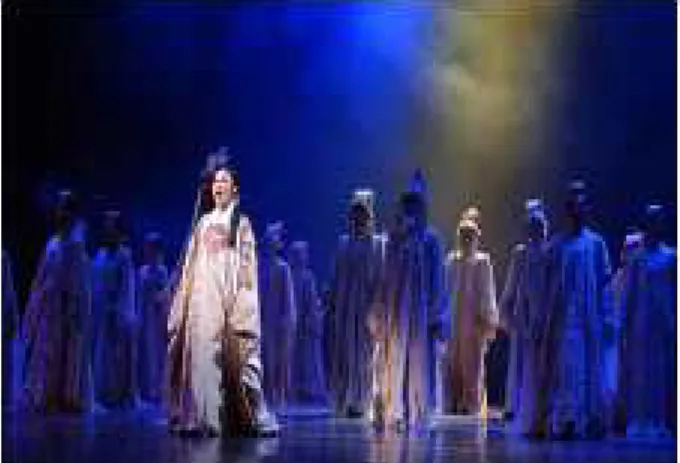
Figure 10. Musical, The Last Empress
Figure 11. Support for J League
In musical and cheering, apart from the past expression methods, music, lighting, dance and songs are harmonized and stimulate the emotion of participants.
This shows that colors and sounds affect not only feeling but also perception.
5. The Relationship between Emotional Design and Elements for Creativity Evaluation
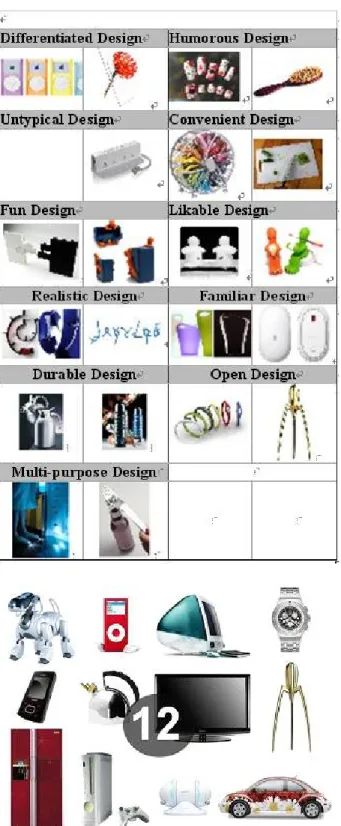
Creative elements in emotional design provoke interests, stimulate and catch attention from people through free ideas. We divided the previous study on the elements for creativity evaluation in design from Kim, Eun-joo(Kim, 2007) First area is divided into newness and interest. The newness is divided into differentiation;
Un-typicality and openness while the interest into fun, like-ability and humor. Originality in design is ability to approach the same object or ideas from various perspectives and suggest various methods or opinions.
Thus, originality means the power to think of a new thing from problems or subject matters to solve which are already exist. The novelty of the originality means to make people feel a design new and have new experience. Berlyne, Daniel E. (1960), Conflict, Arousal and Curiosity, New York : McGraw Hill. Certainly, novelty makes design an object of curiosity. Newness seems to be related to objective, aesthetic dimensions:
i.e. new technology, newness of the materials and colors never seen before. And interest means that design must enrich life and give pleasure. New visual statement and perspective and visual ideas means the design that brings us tension and pleasure. The second area is practicality.
Considering Wucius’s Yoo Han Teak (1982), Basic design structure , Mi Jin Sa definition of design, “design is a process of visual creation fitting Including Function, Particularity and convenient concept for purpose and satisfies practical needs unlike paintings or sculptures representing the perspectives or ideals of artists,”
practicality is an essential element that should be considered in design. Practicality is divided into function and possibility. Function is a tool or product that operates by the intent of user. While the practical function(conveyance) of design focuses on the use, the basic goal of design, the conceptual function of design is deeply related to individual preference and tastes(color or shape) with which users select the outcome of design.
Possibility can be determined only. we actually use something by ourselves. To judge practicality means that the object is actualized.
NOVELTY
§ delightful
§ fun
§ like something
§ preferred
§ positive thinking
§ think clever
§ have wit
§ waggishness
§ make feels good
§ Unique
§ Look first time
§ Think free
§ Ahead of time
§ Free from stereotype
§ Without conventional
§ Not typical
§ Whole new idea
§ Think different
§ With wide eyes
DISTINCTION DISTINCTION
NON-TYPICAL NON-TYPICAL
OPENNESS OPENNESS
FUNFUN
FAVORABLE FAVORABLE
HUMOROUS HUMOROUS
INTEREST ORIGINALITY
FUNCTION
§ make possible
§ real
§ non-chimerical
§ it can be create
§ Making the most profit at the lowest cost
§ intimate
§ without superfluous
§ proper
§ popularity
§ with verification
§ easy interface
§ good to handle
§ convenient
§ have proper function
§ solid
§ durable
§ unbreakable
§ constant
§ long lasting
§ reusable
§ multi-use
CONVENIENCE CONVENIENCE
DURABILITY DURABILITY
VERSATILE VERSATILE
REALITY REALITY
FAVORABLE FAVORABLE
POSSIBILITY PRACTICALITY
Figure 12. Elements for Creative Evaluation
6. Case Study
Case Study No. 1
This case study is on the relationship between elements for creativity evaluation and emotional design.
Based on the elements for creativity evaluation classified above, we selected 30 products that 10 design experts think emotional design. We showed the selected design to 100 college students residing in Jeonbuk province and asked them which products have the elements for creativity evaluation and obtained the following results.
At this time, we explained the meaning of elements for creativity evaluation and had the students select those coming under the meaning. As shown above, emotional design differs depending on each element for creativity evaluation
Figure 13. 2 Elements for Creativity Evaluation and Emotional Design
Table 1. Importance Elements of MP3 player for Creativity Evaluation and Emotional Design
This case study, we selected 43 out of 12 MP3 products which we considered mostly emotional design.
Finally, we selected 4 products and creativity evaluation test. For this evaluation test, we interviewed with 40 design master of design students with one to one method. Open design, humorous design, convenient design were selected with mostly related to emotional design based on creativity design evaluation.
Table 2. Conclusion of MP3 player for Creativity Evaluation and Emotional Design
Table 3. Emotional Design Considering Elements for Creativity Evaluation
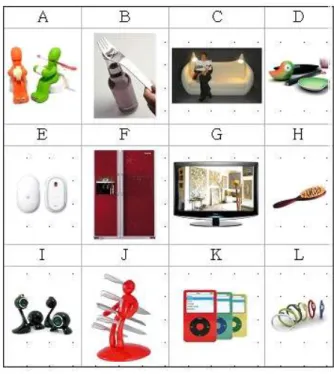
In case study No. 2, we selected 11 products that 20 professional designers consider as emotional design through interview as [Figure 3]. We showed the selected [Figure 3] to 50 persons(college students: 35, professional designers: 15), asking them what elements for creativity evaluation and design elements are of importance in there and inquired which products are original and practical designs and which design elements are considered in them.
Figure 14. Creative Emotional Design
Like the images shown above, the three products are those with creativity and the preference was in the order of E>F>B and the importance of design elements was in the order of Shape>Structure>Color>Surface Treatment.
And as a result of the preference of practicability turned out to be in the order of B>E>F, and The preference of design elements was in order of Structure>Shape>
Material>Color.
B E F
Figure 15. Practical Emotional Design
In addition, the results were different between the groups of students and professionals. Especially, the expert group thinks that even emotional design should get basically practicability considered. In other words, for both originality and practicality, the opener and fork were most preferred. Especially, the professional designers imply here regarding emotional design that for any product to be considered original, it should give fun, practical function and simplicity. And they think multi-functional products as fork and opener to be the most practical design. The reason is that the structure is interesting and new. It suggests that emotional design is not any extraordinary idea but that without any pressure and close to users. In addition, it should have familiar image and allow them to have experience of using
similar thing before. For the details of design elements, as the elements most importantly considered for emotional design, the shape and the structure should be simple and interesting, having a story producing a new image, the color be clean and smooth, the materials and the surface treatment be fitting functionally, familiar and appropriate forindoors.
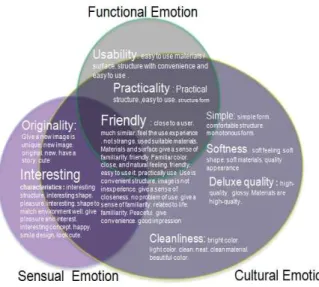
Figure 16. Field of emotional design and images
Through emotional design evaluation test and creativity evaluation test, we found 11 common factors.
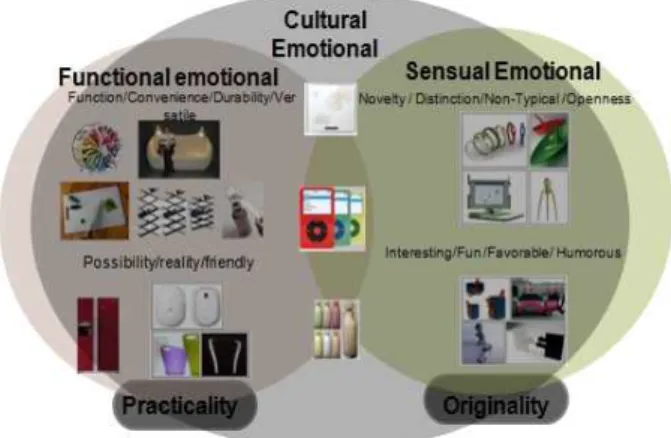
For summarizing this matter, emotional design types divided 3 factors and main consideration factors will be fallow; First, Functional emotion design. Functional, convenient, durability and practical and friendly issues are most important. Second is sensory emotion. Looks new, differentiates, open, non-typical and humorous factors will be good examples. Third, Culture based emotional design. Functional emotion and sensory emotion perfectly matched with current trend.
7. Conclusion
As discussed above, ‘emotional design is more important than ever and has close relationship with our life. Designers should grasp the elements of product that stimulate consumers’ emotions accurately and needs of
them to reflect them on the product. They should design considering consumers’ change of consciousness, desire and socio-economic conditions in developing products applying emotional elements to the basic elements such as convenience of use, function, structure and price, etc.
appropriate for contemporary market environment where consumers’ desire for commodities meets individual properties and tastes rather than performances or functions
Through this study, we came to the following conclusions: first, in emotional design, important Elements for Creativity Evaluation may vary depending on changes of the times, environment and users. Second, as important Elements for Creativity Evaluation in common for home appliances, they should design applying design elements that can express untypical, likable, humorous, convenient, realistic and friendly images. Third, to attract consumers’ purchase, a design should satisfy convenience and familiarity.
Figure 17. Field of emotional design and creativity evaluation
Forth, designer should consider fallow;
1. Emotional design should be easy, accessible, creative and practical design. For this, products should be designed so that users can feel the experience of use.
2. In particular, colors should be clean and smooth, shape should be simple and interesting, having a story that gives a new image, and material and surface treatment should maintain cleanness having right
function. As limitations in this study or suggestions for future study, the target of this study was limited to a certain area and students, so experiments for various consumers are necessary and study on what the concrete design elements and characteristics that can express likable, friendly and familiar images suggested in the conclusion are and they should be used in actual design fields.
References
Ferguson, P. & Geoff, H. (1998). Quality of Service. New York: John Wiley &Sons, Inc.
Glen, U. (2005). Don’t Just Relate-Advocate!.
Pennsylvania: Wharton School Pub.
Hong, J. P. (2007). Emotional Design Appealing to Consumers’ Mind based on Technology. Seoul:
Samcheondang Bulletin.
Jirou, K. (1970). Way of Thinking. Tokyo: Chuoukouron.
Kathryn, F. W. (2000). Service Behaviors that Lead to Satisfied Customers. New York: European Journal of Marketing.
Kazuo, S. (1996). Katsuo INOUE, Handbook of Method for Research and Analysis using EXCEL. Tokyo:
Kaibundou.
Kilkki, K. (1999). Differentiated Services for the Internet.
New York: Macmillan Technical Publishing.
Kim, E. J. (2007). Correlationship between Categorical Elements in Children’s Creativity Evaluation. Seoul:
TTCT KEER.
Mohanbir, S. (2004). Creating Growth with Services. New York: Sloan Management Review.
Moon, J. H. & Jeong, Y. S. (2005). Another Education:
Creativity. New York: Hakji Publishing.
Norman, D. A. (2006). Emotional Design. New York:
Hakji Publishing.
Prahalad, C. K. (1990). The Core Competence of the Corporation. Boston: Harvard Business Review.
Stefan, T. (2003). R&D Comes to Service: Bank of America’s Pathbreaking Experiments. Boston: Harvard Business Review.
Thomas, B., Ronald, A., & Steven, M. (1999). Creativity and Spirit. Seoul: Kimyoung Publishing.
Torrance, E. P. (2005). Torrance’s Creativity and Education. New York: Hakji Publishing.
원고접수:09.11.23 수정접수:09.12.23 게재확정:10.03.17