• 검색 결과가 없습니다.

Effects of the Gait Variable While Using Smartphones During Ramp Gait in Young Adults

N/A
N/A
Protected

Academic year: 2021

Share "Effects of the Gait Variable While Using Smartphones During Ramp Gait in Young Adults"

Copied!
7
0
0

로드 중.... (전체 텍스트 보기)

전체 글

(1)

| Abstract |

Purpose: This study aimed to investigate changes in gait variables depending on whether a task was performed using a smartphone while walking on a ramp.

Methods: The participants of this study were 41 college students attending U University located in Gyeongju City, Gyeongsangbuk-do. In this study, gait variables were measured during ramp gait while using a smartphone to perform a task and during ramp gait without performing such tasks. In other words, four walking conditions were used: 1) walking up a ramp, 2) walking up a ramp while using a smartphone to perform a task, 3) walking down a ramp, and 4) walking down a ramp while using a smart phone to perform a task. Gait variables were measured using a gait analysis tool (Legsys; BioSensics, USA), and stride time, stride length, stride velocity, cadence, and double support were analyzed. The order of measurements was randomized to control for order effects due to repeated measurements.

Results: The comparative analysis of gait variables according to the presence or absence of smartphone use during ramp gait showed that there were significant differences in stride time, stride length, and stride velocity during both ramp ascent and ramp descent (p < 0.05). In both ramp ascent and ramp descent, stride time increased when walking using a smartphone, compared to when walking without using a smartphone (p < 0.05). However, in both ramp ascent and ramp descent, stride length and stride velocity were decreased when walking using a smartphone compared to when walking without using a smartphone (p < 0.05).

Conclusion: The study results showed that the use of a smartphone during walking can affect safety. Therefore, it

†Corresponding Author : Myoung-Hee Lee ([email protected])

Original Article Open Access

젊은 성인에서 경사로 보행 시 스마트폰 사용이 보행 변수에 미치는 영향

윤채효⋅김범수

1

⋅강도영

2

⋅김연서

3

⋅이명희

2†12)

포항세병기독병원,

1

굿연세재활의학과의원,

2

위덕대학교 물리치료학과,

3

마스터플러스병원

Effects of the Gait Variable While Using Smartphones During Ramp Gait in Young Adults

Chae-Hyo Yoon, P.T.⋅Bum-Su Kim, P.T.

1

⋅Do-Young Kang, P.T.

2

⋅Yeonseo Kim, P.T.

3

⋅ Myoung-Hee Lee, P.T., Ph.D.

2†

Department of Physical Therapy, Pohang Semyung Christianity Hospital

1

Department of Physical Therapy, Good Yonsei Rehabilitation Clinic

2

Department of Physical Therapy, Uiduk University

3

Department of Physical Therapy, Master Plus Hospital Received: August 3, 2021 / Revised: August 5, 2021 / Accepted: August 5, 2021

ⓒ 2021 Journal of Korea Proprioceptive Neuromuscular Facilitation Association

This is an Open Access article distributed under the terms of the Creative Commons Attribution Non-Commercial License

(http://creativecommons.org/licenses/by-nc/3.0) which permits unrestricted non-commercial use, distribution, and reproduction

in any medium, provided the original work is properly cited.

(2)

is necessary to improve the awareness of risks associated with walking while using a smartphone, and further research needs to be conducted in various environments and with different ramps.

Key Words: Ramp, Gait variable, Smartphone

Ⅰ. 서 론

실시간으로 다양한 기능을 사용할 수 있는 스마트 폰은 현대인들에게 보급률과 사용량이 급속도로 증가 하였고, 성인 사용자 중 스마트폰 과의존인 사람의 추세는 2017년 17.4%, 2018년 18.1%(+0.7%p), 19년 18.8%(+0.7%p)로 증가하여 상승세를 지속하고 있다 (Ministry of Science and ICT, 2020). 스마트폰은 시간과 장소에 상관없이 사용이 가능한 장점이 있으나 무분 별한 사용이 문제시되고 있으며, 보행 시에도 스마트폰 을 비롯한 IT 기기를 이용하는 경우가 증가하고 있다.

경사로 보행은 사람이 일상생활을 하면서 이동을 위해 꼭 필요한 동작으로 휠체어 또는 자전거와 같이 바퀴가 있는 기구들의 운행이 어려운 계단과 비교했 을 때 유용하다. 또한 보행자들이 자세의 큰 변화 없이 이동이 가능하여 일정 각도 이하에서는 계단에 비해 경사로를 선호한다(Park, 2019). 경사로 오르기는 계단 에 비해 에너지 소비가 높지만, 운동학적 분석 결과에 따르면 계단에 비해 다리 각 관절의 움직임이 적은 것으로 나타났다(Han & Hwangbo, 2009).

이와 같이 계단에 비해 평지 보행에 더 가까운 경사 로 보행 시 자동 보행의 형태가 용이하게 나타나게 되고 이는 인지기능을 활용한 이중과제를 수행하기 쉬운 상황을 만들게 되어 사람들은 쉽게 시도를 하게 된다. 하지만 경사로 보행의 시공간적 보행분석을 실 시한 선행연구에 따르면 평지보행에 비해 경사각이 커짐에 따라 한발짝 길이를 포함한 보행변수의 변화 가 나타났고, 특히 경사로 내림보행 시에 더 큰 변화가 나타나 경사로 내림보행이 오름보행 보다 더 어려운 과제라고 하였다(Han at al., 2006). 또한 경사로를 오르 고 내리는 동안, 변화된 보행 역학을 이해하는 것은

낙상을 일으키는 요인들을 결정하기 위해 꼭 필요하 다(Kim at al., 2009).

이중과제(dual-tasks) 보행은 물건을 옮기거나 숫자 계산 혹은 누군가와 이야기를 하면서 보행을 하는 인 지 수행을 말한다. 평지 보행 시 과제를 수행하는 연구 가 많이 진행되었는데, 평지에서 이중과제 수행 시 일반보행에 비해 두발 지지기(double support) 기간과 좌우의 이동 거리가 증가하게 되면서 속도(velocity), 분속 수(cadence), 두발 길이(step length)가 감소하게 된다고 보고하였다(Al-Yahya, 2011). Alcock 등(2016) 은 과제를 수행하면서 보행을 하는 이중과제 보행 시 보행변수에 변화가 나타나는 것은 운동 제어 조절 기 능이 서서히 감소하면서 순간적으로 중심을 잃기 때 문이라고 하였다.

Licence 등(2015)의 연구에서는 인지적인 과제 수행 시 초당 한발짝 수(step frequency)와 걷기 속력(walking speed)이 감소하는 것을 보고하였고, 또 다른 연구에서 는 문자 전송 시 일반 보행보다 걷기 속도가 33% 감소 하는 것으로 보고하였다(Lamberg et al., 2012).

현재까지 평지 보행 시 이중과제 수행의 영향에 대한 결과는 많이 보고되어 있으나 경사로 보행 시 이중과제 수행에 관한 연구는 많이 보고되지 않았다.

따라서 본 연구는 경사로 보행 시 과제수행이 보행변 수에 어떤 영향이 있는지 알아보고자 실시하였다.

Ⅱ. 연구 방법 1. 연구 대상

본 연구는 경북 경주시에 소재하고 있는 U 대학

(3)

재학생 41명을 대상으로 진행되었다. 본 연구의 제외 대상은 다음과 같다. 1) 경사로 보행에 문제가 있는 자 2) 엉덩관절 또는 무릎관절 및 발목관절에 이상이 있는 자 3) 신경학적 증상이 있는 자. 연구자들은 실험 에 앞서 대상들에게 본 연구의 목적과 방법을 충분히 설명한 후 대상자들을 대상으로 동의서를 작성하도록 하였다. 또한 대상자의 비밀 보장을 약속하며 연구 윤리를 준수하였다.

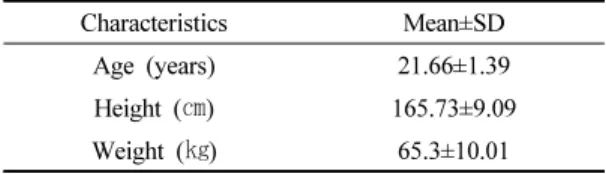
Characteristics Mean±SD

Age (years) 21.66±1.39

Height (㎝) 165.73±9.09

Weight (㎏) 65.3±10.01

Table 1. General characteristics of subjects (n=41)

2. 측정방법 및 절차

연구대상자들은 스마트폰을 사용하여 문자를 보내 는 과제를 수행하면서 자체 제작한 18°기울기의 경사 로 위로 경사로 보행을 실시하였다. 스마트폰으로 문 자를 보내는 과제는 무작위 단어로 QWERTY 가상 키보드를 이용하여 한글 8글자로 구성되도록 하였다.

모든 시기마다 입력한 문자를 전송하도록 하였고 최 대한 빠른 속도로 틀리지 않도록 집중하여 문자를 보 내며 걷도록 지시하였다. 모든 측정은 동일한 날에 이루어졌고, 동일한 연구자에 의해 수행되었으며 반 복 측정으로 인한 순서효과(order effect)를 배제하기 위해 상쇄 균형화(counter balancing)를 사용하여 각각 무작위로 측정 순서를 정하였다.

1) 자연스럽고 편안하게 경사로 올라가기 2) 스마트폰을 사용하여 양손으로 문자를 보내며

경사로 올라가기

3) 자연스럽고 편안하게 경사로 내려가기 4) 스마트폰을 사용하여 양손으로 문자를 보내며

경사로 내려가기

본 연구에서는 보행변수를 측정하기 위해 보행분 석도구(Legsys, BioSensics, USA)를 사용하여 보행 시 한걸음 시간(stride time), 한걸음 길이(stride length), 한 걸음 속도(stride velocity), 분속수(cadence), 두발 지지 기(double support)를 측정하였다. 보행분석도구 (Legsys, BioSensics, USA)는 다섯 개의 움직임 센서와 소프트웨어로 구성되어 있으며 각 센서의 부착 위치 는 양쪽 정강이 발목 앞쪽 5㎝ 윗부분과 양쪽 무릎뼈 바닥의 5㎝ 위, 양쪽 위앞엉덩뼈가시(anterior superior iliac spine)를 연결한 선의 5㎝ 위 중앙에 부착하였다.

측정을 시작하기 전 대상자는 모션 센서를 몸의 이마면(frontal plane)과 평행하도록 부착하고, 무작위 로 보행 순서를 배치하였으며, 출발신호에 따라 보행 을 시작하였다. 모든 테스트는 1회 측정 후 1분간 휴식 을 하고 재측정하는 방식으로 3회 측정한 값의 평균값 을 사용하였으며 측정된 모든 데이터 수집은 블루투 스가 장착된 컴퓨터를 통하여 자료를 처리하였다.

3. 자료 분석

본 연구의 자료 분석은 스마트폰을 사용하여 경사 로 올라가기 및 내려가기와 스마트폰을 사용하지 않 고 경사로 올라가기 및 내려가기를 각각 측정하여 자 료를 수집하였다. 수집한 자료는 SPSS PASW statistics 18.0을 통해서 통계 처리하였으며 기술 통계를 실시하 여 각각 측정된 모든 변수에 대하여 평균과 표준편차 를 산출하였다. 통계 분석은 유의성 검정을 위해 대응 표본 T 검정(paired t-test)을 실시하였고, 이 때 통계학 적 유의수준은 0.05로 설정하였다.

Ⅲ. 연구 결과

1. 한걸음 시간, 한걸음 길이, 한걸음 속도의 비교

경사로 보행 시 스마트폰의 사용 유무에 따른 보행

변수를 비교한 결과 한걸음 시간, 한걸음 길이, 한걸음

(4)

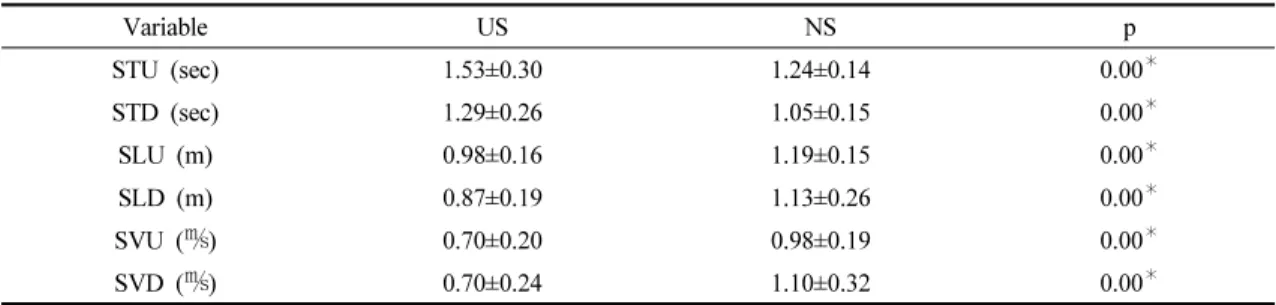
속도가 올라가기와 내려가기 모두에서 유의한 차이가 나타났다(p<0.05). 한걸음 시간의 경우 경사로 올라가 기와 내려가기 모두 스마트폰을 사용할 때가 사용하 지 않을 때에 비해 증가하였다(p<0.05). 반면 한걸음 길이와 한걸음 속도의 경우 경사로 올라가기 및 내려 가기 모두 스마트폰을 사용할 때가 사용하지 않을 때 에 비해 감소하였다(p<0.05)(Table 2).

2. 분속수, 두발 지지기의 비교

경사로 보행 시 스마트폰을 사용할 때와 사용하지 않을 때의 분속수(cadence) 및 두발 지지기(double support)를 비교한 결과 올라가기 및 내려가기 모두에 서 유의한 차이가 나타났다(p<0.05) 분속수의 경우 경 사로 올라가기, 내려가기 모두 스마트폰을 사용할 때

가 스마트폰을 사용하지 않을 때 비해 통계학적으로 유의한 감소를 보였으나(p<0.05), 두발 지지기의 경우 경사로 올라가기, 내려가기 모두 스마트폰을 사용할 때가 스마트폰을 사용하지 않을 때 비해 통계학적으 로 유의하게 증가하였다(p<0.05)(Table 3).

Ⅳ. 고 찰

본 연구는 경사로 보행 시 스마트폰을 이용한 과제 수행 유무에 따른 보행 변수의 변화를 알아보고자 진 행되었다. 그 결과 보행 중 스마트폰을 이용하여 과제 를 수행할 때에 일반 경사로 보행과 비교하여 한걸음 길이(stride length), 한걸음 속도(stride velocity), 분속수 (cadence)는 유의한 감소를 보였으며, 한걸음 시간

Variable US NS p

STU (sec) 1.53±0.30 1.24±0.14 0.00

STD (sec) 1.29±0.26 1.05±0.15 0.00

SLU (m) 0.98±0.16 1.19±0.15 0.00

SLD (m) 0.87±0.19 1.13±0.26 0.00

SVU (㎧) 0.70±0.20 0.98±0.19 0.00

SVD (㎧) 0.70±0.24 1.10±0.32 0.00

Mean±SD

p<0.05

US: use smartphone, NS: nonuse smartphone, STU: stride time up the ramp, STD: stride time down the ramp, SLU: stride length up the ramp, SLD: stride length down the ramp, SVU: stride velocity up the ramp, SVD: stride velocity down the ramp

Table 2. Comparison of walk the ramp test values between US and NS (n=4 1)

Variable US NS p

CU (steps/min) 81.41±15.76 98.20±11.11 0.00

CD (steps/min) 96.88±18.20 116.70±17.25 0.00

DSU (%) 31.25±7.64 25.56±4.19 0.00

DSD (%) 23.80±7.39 17.15±6.23 0.00

Mean±SD

p<0.05

US: use smartphone, NS: nonuse smartphone, CU: cadence up the ramp, CD: cadence down the ramp, DSU: double support up the ramp, DSD: double support down the ramp.

Table 3. Comparison of walk the ramp test values between US and NS (n=4 1)

(5)

(stride time), 두발 지지기(double support)에서는 유의 한 증가를 보였다.

선행 연구의 결과에서도 보행 중 스마트폰을 사용 할 때에 분속수, 한발짝 길이, 한걸음 길이, 두발 지지 기의 상당한 차이가 나타나 본 연구와 같은 결과를 보였다(Agostini et al., 2015; Jeon et al., 2016; Yu, 2015).

Jeon 등(2016)의 연구에서는 복잡한 다중 과제를 수행 할 때에 분속수, 한발짝 길이, 한걸음 길이의 감소와 두발 지지기가 증가하는 것은 주의 집중을 다른 인지 과제로 분산시켜 보행에 대한 집중을 감소시킨 결과 라고 보고하였다.

또한 Hyman 등(2010)의 연구에서는 참가자들이 휴대전화를 이용하며 보행할 때에 정확한 공간 정보 에 대한 집중력을 보행과 휴대전화 이용에 적절하게 나눌 수 없었고, 따라서 보행 속도를 유지하지 못함 을 증명하였다. 또 다른 선행 연구에서는 보행 중 문자 메세지를 보내는 것이 시공간적 주의 집중을 증가시킨다고 하였고, 그 결과 디스플레이 대신 경로 를 보는 데에 더 많은 주의 집중을 발생시키는 것으 로 나타났다. 이러한 주의 집중의 분산은 보행 중 문자 메세지를 보내는 것이 일반 보행과 비교했을 때에 보행 속도의 10% 감소를 나타낸다고 보고하였 다(Agostini et al., 2015).

Choi (2006)의 연구는 비교적 짧은 실험 시간으로 유의한 차이가 나타나지는 않지만, 보행 중 문제 풀이 인지 과제를 수행할 때에 보행 속도가 증가함에 따라 과제의 정답률이 감소함을 보고하였다. 이는 인지 과 제 수행에 의한 주의력 분산으로 정답률이 감소함을 나타낸다. 일반 보행과 비교하여 스마트폰을 이용한 과제를 수행하는 보행에서는 주의 집중과 시각적 정 보에 차이가 발생하게 된다. 이와 같은 차이는 보행 변수의 변화를 발생시키고, 보행 속도가 감소하는 결 과를 초래한다고 하였다(Kim, 2017; Lamberg et al., 2012; Rami et al., 2017).

본 연구도 위의 선행 연구와 유사한 결과가 나타났 다. 이에 근거하여 보행 중 과제 수행은 주의 집중의 분산을 야기시킨다고 판단되고, 본 연구 결과 또한

스마트폰 과제 수행에 대한 정확성과 주의 집중에 따 른 것이라고 사료된다.

보행에 관한 또다른 선행 연구에서는 보행 속도가 10% 감소할 때마다 낙상의 위험도가 7% 증가한다고 하였고 보행 속도가 느린 대상자들은 일반적인 속도 의 보행을 하는 대상자들보다 낙상 위험도가 1.5배 증가하였다고 보고하였다(Verghese, 2009). 보행 속도 의 감소는 낙상의 위험도 증가를 나타낸다는 선행 연 구에 근거하여 보행 중 스마트폰 사용은 보행 속도의 감소를 발생시키고 이는 낙상의 위험도 증가를 초래 할 수 있다고 생각된다.

전정 기능의 변화는 보행 주기의 변화를 초래하고, 한걸음과 디딤기 시간의 증가를 나타낸다고 보고한 연구에서는 이러한 결과가 전체 보행 속도를 늦추는 요인으로 작용되었다고 하였다(Lee, 2013). 이 연구에 서는 머리의 굽혀진 자세가 전정 기능에 영향을 미치 게 됨으로써 주행 오류를 발생시켰으며, 이는 직선 궤도를 따라 걷는 것을 방해한다고 보고하였다(St George et al., 2011). 따라서 본 연구에서도 스마트폰 사용으로 인한 머리의 굽힘 자세 또한 보행 속도에 영향을 미쳤다고 판단된다.

본 연구는 경사로 보행 중 스마트폰 사용이 보행 변수 변화에 영향을 주는 것으로 나타났다. 하지만 다음과 같은 제한점이 있다.

첫째, 보행 분석 도구인 Legsys 만을 사용하여 보행 시 운동학적 변수를 측정하지 못했다. 둘째, 작은 표본 의 크기와 연령층이 다양하지 않음으로 결과를 일반 화하기 어렵다. 셋째, 제한적인 환경에서의 실험으로 일상에서의 보행 시 발생하는 다양한 상황을 고려하 지 못했다.

Ⅴ. 결 론

본 연구의 결과에서 나타나듯이 경사로 보행 시

스마트폰을 사용하는 것이 스마트폰을 사용하지 않는

것과 비교했을 때 보행 변수에서 유의한 차이가 나타

(6)

났다. 이러한 결과를 통해 보행 중 스마트폰 사용이 안전한 보행에 영향을 미친다는 것을 알 수 있다.

따라서 보행 중 스마트폰 사용의 위험성에 대한 인식 개선이 필요하고, 경사로뿐 아니라 다양한 환경 에서의 추가적인 연구가 필요하다.

References

Agostini V, Fermo LF, Massazza G, et al. Does texting while walking really affect gait in young adults? Journal of NeuroEngineering and Rehabilitation. 2015;

12(1):86.

Alcock L, Galna B, Lord S, et al. Characterisation of foot clearance during gait in people with early Parkinson’

s disease: Deficits associated with a dual task. Journal of biomechanics. 2016;49 (13):2763-2769.

Choi JS. Effects of cognitive task on stride rate variability by walking speeds. Journal of Biomedical Engineering Research. 2006;27(6):323-331.

Han JT, Cho JS, Bae SS. The spatio-temporal analysis of gait characteristics during ramp ascent and descent at different inclinations. The Journal of Korean Physical Therapy. 2006;18(1):95-106.

Han JT, Hwangbo G. Kinematic analysis of lower extremities during stairs and ramp climbing with older adults.

Korean Journal of Sport Biomechanics. 2009;19(3):

435-448.

Hyman IE, Boss SM, Wise BM, et al. Did you see the unicycling clown? Inattentional blindness while walking and talking on a cell phone. Journal of Applied Cognitive Psychology. 2010;24(5):597-607.

Jeon SY, Kim CR, Song HS, et al. Changes in gait pattern during multitask using smartphones. Journal of Impacting the World of Science Press. 2016;53(2):

241-247.

Kim HD. The effect of obstacle height on balance control

while stepping over an obstacle from a position of quiet stance in older adults. Journal of Korean Society of Physical Therapy. 2009;21(3):75-80.

Kim K, Seo SK, Yoon HJ, et al. Correlations between muscle strength of the ankle and balance and walking in the elderly. Journal of Korean Society of Physical Therapy. 2008;20(1):33-40.

Kim SH. A comparison of spatio-temporal gait parameters according to smart phone use posture in healthy people.

Gachon University. Dissertation of Master’s Degree.

2017.

Lamberg EM, Muratori LM. Cell phones change the way we walk. Journal of Gait & Posture. 2012; 35(4): 688-690.

Lee HN. Clinical application of gait analysis system using a wireless attachable three-axes gyroscope sensor (gait analysis in vestibular neuritis patients). Pusan University. Dissertation of Doctorate Degree. 2013.

Licence S, Smith R, McGuigan MP, et al. Gait pattern alterations during walking, texting and walking and texting during cognitively distractive tasks while negotiating common pedestrian obstacles. Journal of Public Library of Science One. 2015;10(7):1-11.

Ojha HA, Kern RW, Lin SHJ, et al. Age affects the attentional demands of stair ambulation: evidence from a dual-task approach. Journal of American Physical Therapy Association. 2009;89(10):1080-1088.

Park CB. A Comparative analysis of preference for pedestrian ramp on recommended angle of slop and stairs.

Architectural research. 2019;35(3):59-66.

Rami H, Megan E, Sharpe S, et al. Texting during stair negotiation and implications for fall risk. Journal of Gait & Posture. 2017;58(1):409-414.

Redfern MS, Dipasquale J. Biomechanics of descending ramps.

Journal of Gait & Posture. 1997;6(2):119-125.

St George RJ, Fitzpatrick RC, The sense of self-motion,

orientation and balance explored by vestibular

stimulation. Journal of The Physiological. 2010;

(7)

589(4):807-813.

Verghese J, Holtzer R, Lipton RB, et al. Quantitative gait markers and incident fall risk in older adults. Journal of Gerontology Series A: Biological Sciences &

Medical Sciences. 2009;64(8):896-901.

Yahya EA, Dawes H, Smith L, et al. Cognitive motor interference while walking: a systematic review and meta-analysis.

Journal of Neuroscience & Biobehavioral Reviews.

2011;35(3):715-728.

Yoon NS, Lee KO, Kim JY. Kinematic comparison of walking on various inclined walkways. Journal of Korean Physical Education Association for Girls and Women.

1998;13(1):89-101.

Yu KH, Shim JH, Choung SD, et al. Effect of using a cell phone on gait parameters in healthy young adults:

texting and texting while listening to music. Journal of Korean Society of Physical Medicine. 2015;

10(4):25-31.

수치

Table  1.  General  characteristics  of  subjects      (n=41)
Table  2.  Comparison  of  walk  the  ramp  test  values  between  US  and  NS                                                              (n=4 1)

참조

관련 문서

Finally, after analyzing the differences according to training period, there were significant differences in positive and negative guidance of guiding behavior

Sixth, the analysis of differences in living satisfaction according to the frequency of exercise of participants through living sports showed that there

Sex, parents' educational background, and the state of employment of mother were investigated as demographical variables to determine if there were

Second, the analysis of differences by affiliation showed that the controlled coaching actions were perceived higher in order of the general, secondary, and

The analysis results of differences in tenacity according to the career of winning a prize indicate some differences in desire for victory, fighting spirit,

Finally, there were statistically significant differences in obsessive passion, one of the subfactors of sport passion, and in physical game performance, one

Pharmacokinetic parameters were determined following an oral administration of nateglinide (30 mg/kg) to rabbits in the presence and absence of calcium channel blockers

First, Among the variations in the variables by socio-demographic characteristics, the leader mentoring showed statistically significant differences in