• 검색 결과가 없습니다.

Microblogging Sentiment Investor, Return and Volatility in the COVID-19 Era: Indonesian Stock Exchange

N/A
N/A
Protected

Academic year: 2021

Share "Microblogging Sentiment Investor, Return and Volatility in the COVID-19 Era: Indonesian Stock Exchange"

Copied!
7
0
0

로드 중.... (전체 텍스트 보기)

전체 글

(1)

Print ISSN: 2288-4637 / Online ISSN 2288-4645 doi:10.13106/jafeb.2021.vol8.no3.0061

Microblogging Sentiment Investor, Return and Volatility in the COVID-19 Era: Indonesian Stock Exchange

Putri FARISKA

1

, Nugraha NUGRAHA

2

, Ika PUTERA

3

, Mochamad Malik Akbar ROHANDI

4

, Putri FARISKA

5

Received: November 20, 2020 Revised: January 25, 2021 Accepted: February 03, 2021

Abstract

The covid-19 pandemic scenario caused the most extensive economic shocks the world has experienced in decades. Maintaining financial performance and economic stability is essential during the pandemic period. In these conditions, where movement is severely restricted, media consumption is considered to be increasing. The social media platform is one of the media online used by the public as a source of information and also expressing their sentiment, including individual investors in the capital market as social media users. Twitter is one of the social media microblogging platforms used by individual investors to share their opinion and get information. This study aims to determine whether microblogging sentiment investors can predict the capital market during pandemics. To analyze microblogging sentiment investors, we classified sentiment using the phyton text mining algorithm and Naïve Bayesian text classification into level positive, negative, and neutral from November 2019 to November 2020. This study was on 68 listed companies on the Indonesia stock exchange. A Vector Autoregression and Impulse Response is applied to capture short and long-term impacts along with a causal relationship.

We found that microblogging sentiment investor has a significant impact on stock returns and volatility and vice-versa. Also, the response due to shocks is convergent, and microblogging investors in Indonesia are categorized as a “news-watcher” investor.

Keywords: Microblogging Investor Sentiment, Volatility, Return, VAR, Naïve Bayesian JEL Classification Code: C11, C63, G11, G41, O16

movement to break the chain of virus spread caused economic shocks. Conditions where movement is severely restricted in the last few months, media consumption is considered to be increasing along with internet consumption worldwide.

The social media platform is one of the media online used by the public as a source of valid nor hoax information and also used to express their sentiment on a daily basis.

Information is considered as something that can influence stock price movements towards a new equilibrium known as the concept of market efficiency. Qian and Rasheed (2006) have indicated that news is difficult to predict, so the stock market price will follow a random walk pattern and produce predictions with no more than 50% accuracy. The development of research in the field of behavioral finance with a big data approach showed that even though news or information is unpredictable, the initial indicators can be extracted from social media, one of which is Twitter (Bollen et al., 2011).

The behavioral finance research area that discusses how a person’s sentiment can predict the stock market is sentiment investor. Research conducted by Antweiler and

1

First Author. Doctoral Student in Pasca Sarjana, Universitas Pendidikan Indonesia, Indonesia. Email: [email protected]

2

Professor. Faculty of Economics and Business, Universitas Pendidikan Indonesia, Indonesia. Email: [email protected]

3

Lecturer. Faculty of Economics and Business, Universitas Pendidikan Indonesia, Indonesia. Email: [email protected]

4

Corresponding Author. Lecturer, Faculty of Economics and Business, Universitas Islam Bandung, Indonesia [Postal Address:

Purnawarman Street, No. 59, Tamansari, Bandung Wetan, Bandung, West Java, 40117, Indonesia] Email: [email protected]

5

Lecturer. Faculty of Economics and Business, Telkom University, Indonesia. Email: [email protected]

© Copyright: The Author(s)

This is an Open Access article distributed under the terms of the Creative Commons Attribution Non-Commercial License (https://creativecommons.org/licenses/by-nc/4.0/) which permits unrestricted non-commercial use, distribution, and reproduction in any medium, provided the original work is properly cited.

1. Introduction

World Bank has released data related to economic shocks

caused by pandemic Covid-19 that has occurred for the last

several decades. The imposition of restrictions on human

(2)

Frank (2004) has indicated that the stock message board can predict market volatility with a statistically significant stock return. Microblogging investor sentiment also has a strong prediction on market returns. The accuracy of this prediction is consistent with the behavioral finance hypothesis (Oh & Sheng, 2011). In making decisions, investors not only look at financial information (P/E, Tobin Q) but also at information from social media to reflect their sentiments besides liquidity, and VIX explains the relationship between social media and the stock market (Chousa et al., 2016).

Maintaining stock market volatility is one of the indicators of financial performance that every country must maintain during this pandemic period. High volatility indicates uncertainty in the market and tends to fluctuate, and the volatility of stock returns has a significant impact on future market movements under the impact of shocks (Nguyen &

Nguyen, 2019). Baker and Jeffrey (2006) have indicated that stocks with high volatility generate low returns in subsequent periods. Investor interest is positively influenced by previous stock price performance, and investor sentiment from posting on the internet has predictive power for volatility and trading volume (Kim & Kim, 2014). It makes sentiment investors predict future stock returns either in aggregate or at the corporate and individual level. Furthermore, Zhang et al.

(2011) also have indicated that opinion on Twitter shows a significant positive correlation with stock market volatility. It has indicated that the social media platform has a significant impact on a stock market’s financial feature.

The increase in the number of social media users during the Covid-19 pandemic, especially for those in developing countries, has influenced the way people look in terms of seeking out information or sharing information with the public because social influence originating from expert investors is more influential than the Book Value Per Share (Rahayu et al., 2021). This pandemic situation makes people anxious from a health perspective causes psychological instability for investors when investing in the market (Luu & Luong, 2020). From the description above, the purpose of this study is to determine whether microblogging investor sentiment can predict the stock market in terms of market volatility and return.

2. Literature Review

2.1. The Relation between Microblogging Investor Sentiment Volatility and Stock Returns

Sentiment Investor is a study that discusses the relationship between social interaction and investment (Cabarcos et al., 2019). It is not easy to measure sentiment or human emotions because they used surveys as a tool to determine investor emotions in traditional ways. With technological advancement and the increase in the number

of internet users and social media, it has become making measurement easier than before (Sahana & Anuradha, 2019).

Additionally, Sahana and Anuradha (2019) have indicated that the internet and social media, as a development of information technology, provide a platform to express emotions to the public and greatly influence overall public opinion. Twitter, Facebook, or Web blog, and other social media provide a form of blogging that allows users to text write short updating is called microblogging service. Through microblogging service, people easily share information and opinions by writing short updating because of the function of microblogging as a mediated social practice (Dijck, 2011) or a container of interacting activities.

Some scholars have indicated that through social media such as Twitter, blogs or forums such as Yahoo! Financial message boards or news website can capture investor sentiments, which have an impact on the capital market (Antweiler & Frank, 2004; Sahana & Anuradha, 2019; Petit et al., 2019). Sentiment investor microblogging divided into three categories: those are news media content (Tetlock, 2007), data search or a query on the internet (Da et al., 2014), and posting on social media (Antweiler & Frank, 2004; Bollen et al., 2011).

To capture investor sentiment on social media, some scholars use the text classifier method to convert and measure sentiment investor microblogging. Some of the methods used are naive bayesian classification methods (Antweiler &

Frank, 2004; Sprenger et al., 2013). We use the top-down analysis in this research; investors’ sentiment is measured and its impact on the stock market. Some researchers with this approach are (Sprenger et al., 2013; Coelho, 2019), which summarizes investor sentiment as a determinant of the stock market.

2.2. Hypotheses

According to the theoretical model developed by Van Bommel (2003), investors who have information with limited transaction capacity are motivated to disseminate information about share prices or have the desire to post messages about the shares they are trading. Individual investors are market members with limited access to information. Individual investors are market members with limited access to information (Hirshleifer & Teoh, 2003). With the improvement of information technology, social media platforms can be sources of information for individual investors. Capturing every opinion that appears on social media can be measured easily and even becomes a driving force for developing research in the area of behavioral finance, especially on investor sentiment through text classification technology.

Emotions, opinions, or information conveyed by investors

can be easily analyzed with the naïve Bayesian classification

method (Antweiler & Frank, 2004; Sprenger et al., 2013) to

(3)

deduce the relationship between the general public’s views on stocks and changes in the stock market (Bourezk et al., 2020). Sprenger et al. (2013) use a limited rationality model approach in which individuals are subject to the persuasion bias proposed by DeMarzo et al. (2003), and assume that individual investors on social media platforms reflect the nature of the model where group opinion is not only seen from its accuracy but also seen from how well a person is connected to their social network.

We will look at the causal relationship between the variables. Recent research describing the relationship between local daily happiness sentiment extracted from Twitter and stock returns indicate an interdependence between online activities and the stock market (Zhao, 2020). Moreover, also to see the shocks caused by sentiment investor microblogging, volatility, and return on the stock market during the Covid-19 pandemic. Based on the previous researches, we propose the following hypothesis:

H1: Sentiment investor microblogging can predict volatility and returns on the capital market.

H2: Sentiment investor microblogging, volatility, and return on the capital market have a causal relationship.

H3: The shocks sentiment investor microblogging, volatility, and returns on the capital market are convergent.

3. Research Method

3.1. Naïve Bayesian Text Classification

To measure opinion or information on microblogging investor sentiment, we conducted a message classification approach in line with the Naïve Bayesian classification method and research indicated by (Antweiler & Frank, 2004;

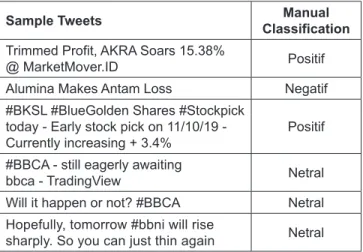
Sprenger et al., 2013). Naïve Bayesian is the most widely used algorithm in text classification. Daily messages or opinions are taken from the social media platform Twitter based on #stockcode, which are listed on the exchange consisting of 68 active stock codes taken from November 2019 – November 2020. The method of taking mining data in the form of daily data uses the approach taken by (Oh & Sheng, 2011), consists of 5 (five) phases pipeline system technique (1) Downloading data, (2) Pre-processing, (3) Sentiment Analysis, (4) Prediction Classification, and (5) Evaluation and Analysis. After Data Cleansing was performed, the number of opinions about 2,840 tweets with 324 usernames. Furthermore, the data is entered into the Naïve Bayesian model, consisting of 80% training data, namely 2,272 data and 20% testing data of 586 data. The following is a table that presents sample data for tweets that were randomly selected for training data with manual labels as follows:

Table 1: Training Set Tweet Manual Classification

Sample Tweets Manual

Classification Trimmed Profit, AKRA Soars 15.38%

@ MarketMover.ID Positif

Alumina Makes Antam Loss Negatif

#BKSL #BlueGolden Shares #Stockpick today - Early stock pick on 11/10/19 -

Currently increasing + 3.4% Positif

#BBCA - still eagerly awaiting

bbca - TradingView Netral

Will it happen or not? #BBCA Netral

Hopefully, tomorrow #bbni will rise

sharply. So you can just thin again Netral

Table 2: Automatic Classification

Random Tweet Positif Negative Neutral The coal mine owned

by PT Adaro Indonesia is one of the seven first-generation PKP2Bs whose contracts expire in the next few years.

0% 11% 89%

“AKR Corporindo’s Net

Profit Increases #AKR 100% 0% 0%

“Cut Profits, AKRA Soars

15.38% #AKR #AKRA 0% 100% 0%

Company Hary Tanoe

Fight Back Moody’s 0% 52% 48%

today technical rebound

.. hit gain out .. #bmtr 92% 0% 8%

From the automatic classification data, 33.45% were negative signals, 10.92% were neutral signals, and 55.63%

were positive signals. It shows that the sentiment signals given by microblogging sentiment investors are more balanced on positive signals. The accuracy of sample classification is 88.02%. For this reason, errors in positive, negative, or neutral labeling are acceptable compared to the manual interpretation. After the classification process, the next step is to convert the data set into −1 for negative signals, 0 for neutral signals, and +1 for positive signals.

3.2. Financial Data Set, Variables

The financial data used were taken from November

2019 – November 2020 using daily data. In this study we use

(4)

daily volatility based on intra-day data constructed Parkinson (1980), as follows:

VOL ln


( ln )

ln

H

t

L

t 2

4 2 (1)

Where H

t

and L

t

show the highest and lowest daily stock prices, while the data for stock returns, the calculations used in this study are based on simple return calculations, namely as follows:

Return = R R

t

R

t

t

  1

(2) R

t

is the return in a certain period, the stock return for one period in the future, so that the stock return calculation is the quotient between the difference between the stock price next year and the current stock price divided by the stock price. Both the opinion on Twitter and the volatility and rate of return on shares are calculated based on each stock code. The definitions of the variables used in this study are as follows:

3.3: Model Specifications

The VAR model is a statistical approach used in this study, with several important analyses, including forecasting, Impulse Response, forecast decomposition variance, and causality test (Juanda & Junaidi, 2012). In addition, in this study, to prove the proposed hypothesis, the Causality Test is testing the causal relationship between the variables of the Vector Autoregressive (VAR) system, which is tested using the Granger Causality test. Based on the literature review, the regression model proposed is as follows:

Volatility = f{Sentiment Investor, Return} (3) Return = f{Volatility, Sentiment Investor} (4) Sentiment Investor = f{Volatility, Return} (5)

4. Results and Discussion

We used a unit root test using the ADF (Augmented Dickey-Fuller) method to see stationary data. It can be seen in table 6 that the three variables used are considered to be stationary at the level * α < 0.01, * α < 0.05, and *** α < 0.10 provided that the absolute value of the F-statistic is < critical value. For this reason, all data is stationary, and the next step is to create a VAR model.

Table 4 shows the VAR model based on the optimal lag.

In the first VAR model, where volatility is the dependent variable, it is known that microblogging investor sentiment in the t−1 and t−2 periods has an opposite relationship with the volatility of period t. According to Hoffmann and Post (2015), this is caused by a structural change in the mindset of investors related to previous investment experience or interpreting situations subjectively (Mitroi & Oproiu, 2014; Malmendier et al., 2020). This result is in line with the opinion of research conducted by (Petit et al., 2019) that argues sentiment appears as vital information and captures information on market variables related to microblogging investor sentiment as well as market volatility. Like-wise with the stock returns in period t−1 has an opposite relationship with volatility. However, the stock returns in the period t−2 have a unidirectional relationship. Meanwhile, the volatility in period t−1 and t−2 has a direct relationship with the sentiment in period t. Whereas in the second VAR model, where the return is the dependent variable, it can be seen that in period t-1, microblogging investor sentiment has a direct relationship with stock returns, but in period t−2, there is an opposite relationship; this is due to a consistent reversal pattern. With sentiment errors that lead to temporary price errors (Da et al., 2014). However, the volatility in period t−1 and t−2 has a direct relationship with the return of shares, as well as return in period t−1 and period t−2 has a direct relationship with the rate of return in period t.

In the third model, where microblogging investor sentiment becomes the dependent variable, the result is that the sentiment in period t−1 and period t−2 has a direct relationship with a sentiment in period t. This illustrates that sentiment in the previous period still affects sentiment in period t; this is due to the bias of conservatism, where once individuals form an impression, they are slow to change that impression in the face of new evidence.

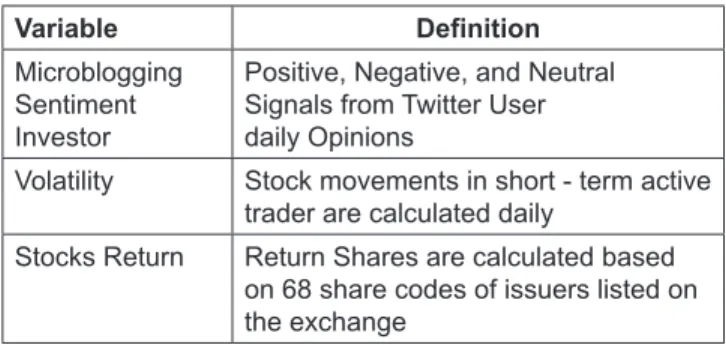
Investors remain skeptical about new information and only gradually update their views (Pompian, 2011). While the rate of return in period t−1 and t−2 has a direct relationship with the sentiment in period t, volatility in the t−1 period has a significant negative effect. However, contrary to the t−2 volatility, which has a significant positive effect, this is due to the momentum where momentum occurs because “traders” move slowly when news appears, or Table 3: Definition of Variables

Variable Definition

Microblogging Sentiment Investor

Positive, Negative, and Neutral Signals from Twitter User daily Opinions

Volatility Stock movements in short - term active trader are calculated daily

Stocks Return Return Shares are calculated based

on 68 share codes of issuers listed on

the exchange

(5)

momentum appears when “ trader” overreacts to previous news when other news comes. According to Hong and Stein (2007), the news will spread slowly to “news- watchers” and react gradually to the news resulting in

“underreaction.” For this reason, it can be concluded that Indonesia’s microblogging investors are “news-watcher”

investors. From the results of the description above, it can be concluded that microblogging investor sentiment can predict the volatility and rate of return of shares and, at the same time, answer the first hypothesis in this study.

Table 4: Var Model

Variable Dependent variable

Variable Dependent variable

Return Sentiment Volatility Return Sentiment Volatility

Return ( − 1) 0.484897 0.968769 − 0.026374 Sentiment ( − 2) − 0.001058 0.135101 − 0.000423

0.02029) (0.54059) (0.01039) (0.00076) (0.02028) (0.00039)

[23.9041] [1.79206] [ − 2.53917] [ − 1.39004] [6.66201] [1.08531]

Return ( − 2) 0.120784 0.211554 0.024481 Volatility ( − 1) − 0.113161 − 2.833.515 0.510211

0.02024) (0.53929) (0.01036) (0.03939) − 104.978 (0.02017)

[5.96871] [0.39228] [2.36253] [ − 2.87269] [ − 2.69915] [25.2945]

Sentiment ( − 1) 0.002209 0.264342 − 0.000638 Volatility ( − 2) 0.049697 0.386345 0.138707

0.00076) (0.02025) (0.00039) (0.03942) − 105.059 (0.02019)

[2.90646] [13.0534] [ − 1.63863] [1.26062] [0.36774] [6.87131]

R-squared 0.325750 0.126198 0.373203 Mean − 1,36 − 0,000831 − 2,59

F-statistic Model 193,8151 579,3802 238,8595 Std.Dev 0,038689 1,1217 0,019595

F-statistic 156,0836 149,1304 183,9306 t-statistic − 13,76337 − 9,181872 − 13,80163

Table 5: Granger Causality Test

Null Hypothesis F-statistic Prob.

Sentiment does not Granger

Cause Return 4.65196 0.0096

Return does not Granger

Cause Sentiment 3.21555 0.0403

Volatility does not Granger

Cause Return 4.54950 0.0107

Return does not Granger

Cause Volatility 4.17022 0.0156

Volatility does not Granger

Cause Sentiment 5.06410 0.0064

Sentiment does not Granger

Cause Volatility 2.97086 0.0514

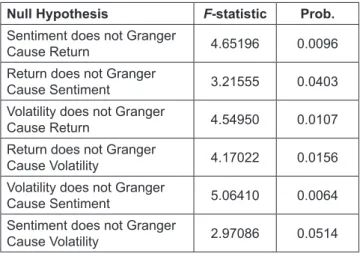
Table 5 use to answer the second hypothesis in this study; it appears that microblogging investor sentiment has a significant effect on stock returns and vice versa at the significance level or α < 0.01 and α < 0.05, so it can be concluded that between microblogging investor sentiment and stock returns have a two-way causality relationship.

This is in line with the opinion proposed by (Hoffmann

& Post, 2015), which states that the rate of return has a strong impact on the rate of return on sentiment formation.

Petit, et al. (2019) states that sentiment influences the future return rate. Volatility is also considered a two-way causal relationship with microblogging investor sentiment at the significance level or α < 0.01 and α < 0.10. Like Antweiler and Frank (2004), who use the online sentiment on yahoo finance to predict volatility in the market, and Da et al. (2014), investor sentiment is closely related to transitory daily volatility. This study also captures a two-way causality relationship on volatility and stock returns at a significance level or α < 0.05. In other words, volatility has a significant effect on the rate of return and vice versa.

Figure 1 shows the convergent effect of each variable

used in this study using the Impulse Response Function or

IRF analysis approach. In the first graph, the response of

return to sentiment shows a movement that is getting closer

to the balance point or returning to the previous balance

point. This shows that the impact of the response received by

stock returns due to 10 months of investor sentiment shocks

(6)

is convergent, or the shock response will disappear over time and will not leave a permanent effect on stock returns.

The response return to shocks caused by investor sentiment at the beginning of the response will be positive and move closer to the equilibrium point. The response received by volatility due to shocks to the investor is also convergent.

The response to these shocks will disappear over time. It will not leave a permanent effect on volatility in the stock market with a negative initial response and move closer to zero.

Like-wise, with the response received by investor sentiment due to shocks caused by stock returns and stock market volatility; as a result, these shocks will eventually disappear and leave no permanent effect. The impact of investor sentiment on volatility and stock returns or vice versa has a short term impact, and this factor is in line with the results of research on investor underreaction where they sometimes make mistakes where they do not react to financial news and over the next six months, these errors are gradually corrected because stock prices slowly move towards levels that should be (Barberis et al., 1998). This explanation also indicates that the market is inefficient.

5. Conclusions

First, with the increasing number of social media users during the Covid-19 pandemic, information, news, or opinions posted on social media, especially on the Twitter platform, have been converted into positive, negative, and neutral sentiments. This sentiment appears as a strong source of opinion or information. It impacts stock returns with a significant positive impact and a significant negative impact on market volatility. The conservatism bias is a factor in the relationship between microblogging investor sentiment and financial features, and the research concludes that

microblogging investors in Indonesia are included in the

“news-watcher” investor category. Second, microblogging investor sentiment, stock returns, and market volatility have a two-way causality, this is in line with the opinion of previous research built by (Hoffmann & Post, 2015) for the relationship between sentiment and stock returns, and Da et al. (2014) stated investor sentiment is closely related to transitory daily volatility. Third, shocks during the Covid-19 pandemic will not leave a permanent impact or shows a convergent effect for microblogging investor sentiment shocks on stock returns and market volatility

References

Antweiler, W. & Frank, M. Z. (2004). Is all that talk just noise?

The information content of internet stock message boards.

The Journal of Finance, 59(3), 1259–1294. https://doi.org/

10.2139/ssrn.282320

Baker, M., & Wurgler, J. (2006). Investor Sentiment and the Cross- Section of Stock Returns. The Journal of Finance, 61(4), 1645–1680. https://doi.org/10.1111/j.1540-6261.2006.00885.x Barberis, N., Shleifer, A., & Vishny, R. (1998). A model of investor

sentiment. Journal of Financial Economics, 49(3), 307–343.

https://doi.org/10.1016/s0304-405x(98)00027-0

Bollen, J., Mao, H., & Zeng, X. (2011). Twitter mood predicts the stock market. Journal of Computational Science, 2(1), 1–8.

https://doi.org/10.1016/j.jocs.2010.12.007

Bourezk, H., Raji, A., Acha, N., & Barka, H. (2020). Analyzing Moroccan Stock Market using Machine Learning and Sentiment Analysis. 2020 1

st

International Conference on Innovative Research in Applied Science, Engineering and Technology.

https://doi.org/10.1109/iraset48871.2020.9092304

Coelho, J., D’almeida, D., Coyne, S., Gilkerson, N., Mills, K., &

Madiraju, P. (2019). Social Media and Forecasting Stock

Figure 1: Impulse Response Graph

(7)

Price Change. 2019 IEEE 43

rd

Annual Computer Software and Applications Conference (COMPSAC). https://doi.org/10.1109/

compsac.2019.10206

Da, Z., Engelberg, J., & Gao, P. (2014). The Sum of All FEARS Investor Sentiment and Asset Prices. Review of Financial Studies, 28(1), 1–32. https://doi.org/10.1093/rfs/hhu072 DeMarzo, P. M., Vayanos, D., & Zwiebel, J. (2003). Persuasion

Bias, Social Influence, and Unidimensional Opinions.

The Quarterly Journal of Economics, 118(3), 909–968. https://

doi.org/10.1162/00335530360698469

Dijck, J. (2011). Tracing Twitter: The rise of a microblogging platform. International Journal of Media & Cultural Politics, 7(3), 333–348. https://doi.org/10.1386/macp.7.3.333_1 García Petit, J. J., Vaquero Lafuente, E., & Rúa Vieites, A. (2019).

How information technologies shape investor sentiment:

A web-based investor sentiment index. Borsa Istanbul Review, 19(2), 95–105. https://doi.org/10.1016/j.bir.2019.01.001 Hirshleifer, D., & Teoh, S. H. (2003). Limited attention, information

disclosure, and financial reporting. Journal of Accounting and Economics, 36(1–3), 337–386. https://doi.org/10.1016/j.

jacceco.2003.10.002

Hoffmann, A. O. I., & Post, T. (2015). How return and risk experiences shape investor beliefs and preferences. Accounting and Finance, 57(3), 759–788. https://doi.org/10.1111/acfi.12169 Hong, H., & Stein, J. C. (2007). Disagreement and the Stock

Market. Journal of Economic Perspectives, 21(2), 109–128.

https://doi.org/10.1257/jep.21.2.109

Juanda, B. & Junaidi, J. (2012). Time Series Econometrics. Bogor, Indonesia: IPB Press.

Kim, S.-H., & Kim, D. (2014). Investor sentiment from internet message postings and the predictability of stock returns.

Journal of Economic Behavior & Organization, 107, 708–729.

https://doi.org/10.1016/j.jebo.2014.04.015

López-Cabarcos, M. Á., Pérez-Pico, A. M., Vázquez-Rodríguez, P.,

& López-Pérez, M. L. (2019). Investor sentiment in the theoretical field of behavioural finance. Economic Research- Ekonomska Istraživanja, 33(1), 2101–2119. https://doi.org/10.

1080/1331677x.2018.1559748

Luu, Q. T., & Luong, H. T. T. (2020). Herding Behavior in Emerging and Frontier Stock Markets During Pandemic Influenza Panics.

The Journal of Asian Finance, Economics and Business, 7(9), 147–158. https://doi.org/10.13106/jafeb.2020.vol7.no9.147 Malmendier, U., Pouzo, D., & Vanasco, V. (2020). Investor

experiences and international capital flows. Journal of International Economics, 124, 103302. https://doi.org/

10.1016/j.jinteco.2020.103302

Mitroi, A., & Oproiu, A. (2014). Behavioral finance: new research trends, socionomics and investor emotions. Theoretical and Applied Economics, XXI,4(593), 153–166.

Nguyen, C. T., & Nguyen, M. H. (2019). Modeling Stock Price Volatility: Empirical Evidence from the Ho Chi Minh City Stock Exchange in Vietnam. The Journal of Asian Finance, Economics, and Business, 6(3), 19–26. https://doi.

org/10.13106/JAFEB.2019.VOL6.NO3.19

Oh, C., & Sheng, O. (2011). Investigating predictive power of stock micro blog sentiment in forecasting future stock price directional movement. In: ICIS, 1–19.

Parkinson, M. (1980). The extreme value method for estimating the variance of the rate of return. Journal of Business, 53(1), 61–65. https://doi.org/10.1086/296071

Piñeiro-Chousa, J. R., López-Cabarcos, M. Á., & Pérez-Pico, A. M. (2016). Examining the influence of stock market variables on microblogging sentiment. Journal of Business Research, 69(6), 2087–2092. https://doi.org/10.1016/j.

jbusres.2015.12.013

Pompian, M. M. (2011). Behavioral Finance and Wealth Management: How to Build Optimal Portfolios That Account for Investor Biases (Wiley Finance Book 318) (1

st

ed.). Wiley.

Qian, B., & Rasheed, K. (2006). Stock market prediction with multiple classifiers. Applied Intelligence, 26(1), 25–33. https://

doi.org/10.1007/s10489-006-0001-7

Rahayu, S., Rohman, S., & Harto, P. (2021). Herding Behavior Model in Investment Decision on Emerging Markets: Experimental in Indonesia. The Journal of Asian Finance, Economics, and Business, 8(1), 53–59. https://doi.org/10.13106/JAFEB.2021.

VOL8.NO1.053

Sahana, T. P., & Anuradha, J. (2019). Analysis and Prediction of Stock Market Using Twitter Sentiment and DNN. Advances in Intelligent Systems and Computing, 38–45. https://doi.

org/10.1007/978-3-030-30465-2_5

Sprenger, O. T., Tumasjan, A., Sdanner, G. P., & Welpe, M. I.

(2013). Tweets and Trades: the information content of stock microblogs. European Financial Management. 20(5):

926–957. https://doi.org/10.1111/j.1468-036x.2013.12007.x Tetlock, P. (2007). Giving Content to Investor Sentiment:

The Role of Media in the Stock Market. The Journal of Finance, 62(3), 1139–1168. https://doi.org/10.1111/j.

1540-6261.2007.01232.x

Van Bommel, J. (2003). Rumors. The Journal of Finance, 58(4), 1499–1520. https://doi.org/10.1111/1540-6261.00575

Zhang, X., Fuehres, H., & Gloor, P. A. (2011). Predicting Stock Market Indicators Through Twitter “I hope it is not as bad as I fear.” Procedia - Social and Behavioral Sciences, 26, 55–62.

https://doi.org/10.1016/j.sbspro.2011.10.562

Zhao, R. (2020). Quantifying the cross sectional relation of daily happiness sentiment and stock return: Evidence from US.

Physica A: Statistical Mechanics and its Applications, 538,

122629. https://doi.org/10.1016/j.physa.2019.122629

수치

Table 1:  Training Set Tweet Manual Classification
Table 4 shows the VAR model based on the optimal lag.
Table 5:  Granger Causality Test

참조

관련 문서

With the opening of the Songdo Bridge 4, IFEZ is looking forward to less congestion in traffic that connects from Songdo International City locations, including Incheon New

In conclusion, it can be seen that the performance of male gymnastics athlete influences the factors of personal characteristics, the interaction of

On the other hand, Diba-Grossman and Yuhn theorems postulate that stock prices are cointegrated with market fundamentals in a nonlinear fashion if there is

Ross: As my lawfully wedded wife, in sickness and in health, until

다양한 번역 작품과 번역에 관한 책을 읽는 것은 단순히 다른 시대와 언어, 문화의 교류를 넘어 지구촌이 서로 이해하고 하나가

(4) After a certain period of tightening time with tightening torque, Z-axis and rotating axis return in positioning control mode to the retracted

The index is calculated with the latest 5-year auction data of 400 selected Classic, Modern, and Contemporary Chinese painting artists from major auction houses..

First one is to explore the issue of Immunity Passport and Travel Bubble in the context of COVID-19 and the international travel for leisure purpose.. The second one is to