First author:Shim, In-Su, Woosung Engineering Group Inc., Daegu 701-849, Korea, Tel:+82-53-965-8012, E-mail:[email protected]
Corresponding author:Cho, Kwang-Jin, National Institute of Ecology, Eco-database Research Department Seocheon 325-813, Korea,
Tel:+82-41-950-5402, E-mail:[email protected] Received:2 June, 2015. Revised:19 August, 2015. Accepted:28 August, 2015.
- 29 -
휴경연차에 따른 묵논 식생의 생태식물상 특성
심인수1)․김종봉2)․정용규2)․박인환3)․김명현4)․신현선5)․조광진6)
1)(주)우성기술단․2)대구가톨릭대학교 의생명과학과․3)경북대학교 조경학과
4)농촌진흥청 국립농업과학원․5)농촌진흥청 연구운영과․6)국립생태원 생태정보연구부
Eco-floristic Characters of Vegetation in Successional Stages of Abandoned Paddy Fields
Shim, In-Su1)․Kim, Jong-Bong2)․Jung, Yong-Kyoo2)․Park, In-Hwan3) Kim, Myung-Hyun4)․Shin, Hyun-Seon5) and Cho, Kwang-Jin6)
1)Woosung Engineering Group Inc.,
2)Dept. of Biomedical Science, Catholic University of Daegu,
3)Dept. of Landscape Architecture, Kyungpook National University,
4)National Academy of Agricultural Science, Rural Development Administration,
5)Climate Change Team, Rural Development of Administration,
6)Eco-database Research Department, National Institute of Ecology.
ABSTRACT
Abandoned paddy field provides an excellent opportunity to improve the species diversity and habitat quality. Ecological characteristic on the changing of plant communities at different seral stages is a major basis data for ecological restoration. In this study, we investigated changes of the species composition and community indices on the plant community associated with abandonment of cultivated rice paddies. The ecological stability of the habitat was evaluated by using eco-floristic characters(Di;
Disturbance index, AUI; Actual urbanization index). Survey sites were grouped into six stages(stageⅠ (≤3years), stageⅡ(3-5years), stageⅢ(5-7years), stageⅣ(7-10years), stageⅤ(10-15years), stageⅥ(≥
20years). Vegetation investigation was done from May 2009 to October 2012 and carried out phytosociological approach. The total flora were summarized as 176 taxa including 58 families, 127 genera, 157 species, 3 subspecies, 15 varieties and 1 forms. At each of successional stages, 64 taxa in stage Ⅰ, 34 taxa in stage Ⅱ, 84 taxa in stage Ⅲ, 83 taxa in stage Ⅳ, 92 taxa in stage Ⅴ, 23 taxa in stage Ⅵ were identified. Of the occurrence plants, the species with the highest r-NCD value were Alopecurus aequalis, Juncus effuusus var. decipiens, Persicaria thunbergii, Artemisia princeps, Salix koreensis and Alnus japonica at each stages. Herbaceous annual plants were dominated in the early stage, but its r-NCD value declined in the middle stage and the late stage. On the other hand, herbaceous perennial plants and Persicaria thunbergii, annual hydrophytes, increases in the middle stage. Woody plant and herbaceous plant which appeared in the forest edge increases in the late stage.
Community indices correlate with successional stages. Richness and diversity index increase along the successional gradient. But dominance index decrease along the successional gradient. Evenness index was correlated with lower. In the ecological stability analysis of the habitat that evaluated by eco-floristic characters, stage Ⅰ was the most unstable habitat. And the stability of the habitat has improved according to the successional stage.
Key Words:Community indices, Phytosociological approach, Seral stage.
I. 서 론
환경적 변화에 따라 나타나는 식물특성의 차 이는 식물의 적응 메카니즘에 대한 상대적인 중 요성을 반영하며, 환경적 변화에 기반을 둔 식물 특성분석은 식물의 반응과 환경과의 상관관계를 수치화 할 수 있는 방법을 제공한다(Barboni et al., 2004). 묵논은 자연이 본래의 모습으로 회복되 어가는 과정을 이해하는데 매우 중요한 장소이 며(Yun, 2007), 이러한 시간의 흐름에 따라 변 화하는 묵논의 종조성적 변화에 대한 생태적 특 성을 파악하게 되면 묵논을 기반으로 살아가는 생물의 서식처 보전 및 복원을 위한 기초정보를 제공해 줄 수 있다.
사회․경제적 여건으로 인하여 의도적 또는 일시적으로 휴경상태에 있거나 경작을 포기한 논을 묵논(abandoned paddy field)이라 하며 (Yun, 2007), 우리나라는 1970년대 이후 급속한 산업화에 의한 공업중심의 경제구조 변화로 인
해 경지면적이 줄어들었고 상대적으로 묵논은 증가하고 있는 추세이다(Park et al., 2006). 또한 세계무역기구(WTO) 체제 하에 농산물시장의 개방이 본격화되면, 국내농산물은 공급이 많아 지고 가격이 하락하게 되고 국내 농가는 경쟁력 을 잃게 되어 결국, 경작면적을 대폭 축소하거 나 영농 자체를 포기 할 수밖에 없어진다(Choi et al., 2005).
묵논을 오랜 기간 방치하게 되면 식물 종조 성의 변화로 인해 논으로서의 기능을 잃는 동시 에 인근농지에도 피해를 줄 수 있으며, 넓게는 농업 이외의 용도로 전용하려는 개발압력에 의 해 국토관리차원에서도 심각한 문제를 야기 시 킬 수 있다(Choi et al., 2005). 토지를 이용․관 리함에 있어 기본적으로 수행되어야 할 부분은 유형화된 녹지에 대한 생태적 연구이며, 묵논식 생에 대한 자세한 생태적 정보는 농촌지역의 효 율적 토지활용을 위한 입지 평가 및 관리계획에 유용한 자료를 제공할 수 있다.
Region No. of sites
Mean altitude
(Min.-Max., m) Latitude(N) Longitude(E)
Gangwon
Gangdong-myeon, Gangneung-si 5 33-307 37°72 128°57 Gujeong-myeon, Gangneung-si 5 34-62 37°74 128°51 -55 Seongsan-myeon, Gangneung-si 2 32-34 37°73 128°51 Pyeongchang-eup, Pyeongchang-gun 3 292-295 37°21 128°22 -23
Gyeonggi Bubal-eup, Icheon-si 9 44-86 37°15 -18 127°28 -31
Gyeongnam
Gonyang-myeon, Sacheon-si 3 55-62 35°3 127°56
Sacheon-eup, Sacheon-si 2 28-30 35°5 128°8
Geumgok-myeon, Jinju-si 1 80 35°3 -4 128°9 -11
Yongju-myeon, Hapcheon-gun 9 114-189 35°30 -35 128°5 -8
Gyeongbuk
Geoncheon-eup, Gyeongju-si 4 80-213 35°53 129°6
Seo-myeon, Gyeongju-si 1 151 35°55 129°5
Yangbuk-myeon, Gyeongju-si 3 14-18 35°45 129°27
Moseo-myeon, Sangju-si 3 172-205 36°16 -17 127°51
Pungcheon-myeon, Andong-si 3 90-91 36°34 128°30
Yeongdeok-eup, Yeongdeok-gun 4 39-59 36°25 -26 129°22 -23 Yeonghae-myeo, Yeongdeok-gun 3 71-104 36°31 129°20 Gogyeong-myeon, Yeongcheon-si 5 180-198 35°56 -57 129°3 Bukan-myeon, Yeongcheon-si 3 162-190 35°55 -56 129°2 -3 Geunam-myeon, Uljin-gun 4 110-119 36°55-56 129°20 -21
Seo-myeon, Uljin-gun 5 284-378 36°56 129°13 -14
Bongyang-myeon, Uiseong-gun 10 88-122m 36°17 128°33
Jeonnam
Heunghae-eup, Buk-gu, Pohang-si 7 69-112m 36°5 -6 129°18
Moksadong-myeon, Gokseong-gun 1 228m 35°5 127°17
Mundeok-myeon, Boseong-gun 10 118-158m 34°55 -57 127°9 -12
Juam-myeon, Suncheon-si 1 107m 35°2 127°16
Deokjin-myeon, Yeongam-gun 4 28-81m 34°49 -50 126°43-44
Sinbuk-myeon, Yeongam-gun 3 25-125m 34°51 126°42
Jeonbuk
Gurim-myeon, Sunchang-gun 3 233-240m 35°25 127°7 Sunchang-eup, Sunchang-gun 1 85m 35°21 -22 127°8
Yongjin-myeon, Wanju-gun 3 51-63m 35°52 127°9 -10
Chilbo-myeon, Jeongeup-si 13 45-194m 35°34-35 126°58 Chungam Janggi-myeon, Gongju-si 6 84-98m 36°28 -31 127°12 -13
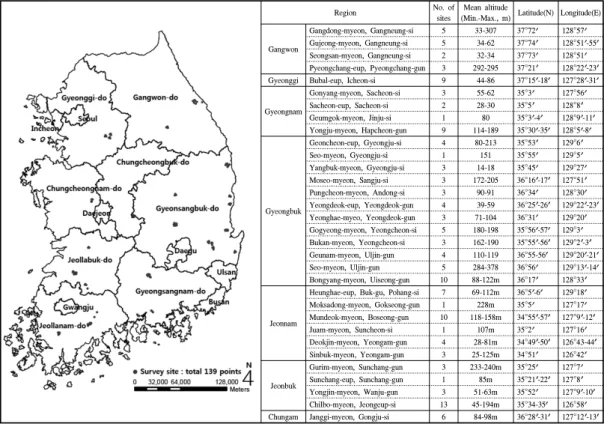
Figure 1. Location of survey site.
국내 묵논에 대한 생태적 연구는 1990년대 후반부터 지속적으로 이루어져 왔으며, 지역별 로 분포하는 묵논습지에 대하여 식생특성을 기 반으로 이차천이에 따른 생태적 변화양상(Lee et al., 1998; Kuk, et al., 2002; Kang et al., 2003; Yun, 2007, Shim et al., 2013)과 묵논습지 를 기반으로 살아가고 있는 주요 생물종의 생태 적 특성(Sung, 2009; Yoon et al., 2010; Kim, 2011; Cho et al, 2012)에 대한 연구가 이루어져 있다. 이외에도 농업적 활용을 위하여 재경작을 목적으로 하는 묵논의 잡초 방제 연구 및 관리 방법에 대한 연구(Lee et al., 2005; Lee et al., 2006; Han et al., 1998) 등이 수행되어 있다. 그 러나 군집분석을 통한 종다양성 변화 및 식물특 성(plant trait)을 활용한 서식처의 안정성을 평 가한 생태적 연구는 아직 이루어진 바 없다.
따라서 본 연구에서는 점점 증가하는 묵논의
효율적인 토지활용과 생태적 관리를 위한 기초 자료를 제공하고자 전국에 분포하는 묵논을 대 상으로 휴경연차별로 식생조사를 실시하여 식 생을 유형화하고 유형화된 식생이 포함하는 식 물들의 생태적 특성을 파악하여 향후 묵논의 생 태적 활용을 위한 기초자료를 제공하고자 한다.
II. 연구범위 및 방법
1. 자료수집
조사지역은 전국적으로 분포하는 묵논을 임의 적으로 선정하여 총 139개(강원도 15개, 경기도 9 개, 경상도 63개, 전라도 46개, 충청도 6개)의 식 생자료를 수집하였다. 조사지역의 지리적 범위는 북위 34°49 ∼37°74 , 동경 126°42 ∼129°27° 으로 해발고도 14-378m 사이에 위치한다(Figure 1).
현장조사는 초본식물의 생육시기를 고려하여
2009년부터 2012년까지 5월부터 10월까지 16차 례에 걸쳐 수행하였고 일․이년생 광엽성 초본 식물의 생육이 활발한 봄철(5월 9회)과 화본형 식물의 생태적 특성 파악이 양호한 여름(6∼8월 3회), 가을철(9∼11월 4회)에 주로 이루어졌다.
휴경연차에 따른 식물상의 생태적 특성을 파 악하고자 묵논을 휴경기간에 따라, Ⅰ-Ⅵ단계 (Ⅰ단계: 3년 이하, Ⅱ단계: 3년 초과 5년 이하,
Ⅲ단계: 5년 초과 7년 이하, Ⅳ단계: 7년 초과 10년 이하, Ⅴ단계: 10년 초과 15년 이하, Ⅵ단 계: 15년 초과)로 구분하여 조사하였다. 휴경연 령에 대하여 폐경 후 3년째 묵논을 초기, 7년째 묵논을 중기, 10년째 묵논을 후기로 구분한 연 구가 있으며(Lee et al., 1998) 본 연구에서는 이 를 좀 더 세분하여 천이 단계별 식생특성을 분 석하였다.
식생조사는 식물사회의 종조성을 강조하는 Z.-M. 학파의 조사 방법에 따랐으며, 묵논식생 의 전형적인 종조성과 동질한 환경조건(토양, 수분 등)을 갖춘 지점을 선택하였다. 그리고 선 정된 조사지점에 식생형에 따른 종급원의 차이 를 고려하여 최고식생높이에 자승한 값에 준하 는 면적 내에 생육하고 있는 식물종을 기입하고 9계급의 변환통합우점도를 활용하여 식물종별 우점도를 조사하였다. 기타 세부적인 조사방법 은 Kim and Lee(2006)을 참고하였다.
2. 식물동정
조사된 식물종명은 국가표준식물목록에 따라 표기하였으며, 식물 동정시 여러 도감(Lee, 1996a;
Lee, 1996b; Lee, 2003; Park, 2009)을 활용하여 기재하였다.
3. 천이 단계별 종조성 및 군집특성
천이 단계별로 획득된 139개 조사지점(Ⅰ단 계: n=41, Ⅱ단계: n=7, Ⅲ단계: n=31, Ⅳ단계:
n= 32, Ⅴ단계: n=26, Ⅵ단계: n=2)의 식생자료 는 컴퓨터프로그램(Ms-Excel, 한컴오피스 등)을
활용하여 모둠화 하였으며, 단계별 종조성의 특 성 및 천이진행에 따른 군집구조의 특성을 파악 하였다. 천이 단계별 출현식물종의 기여도는 천 이 간 질적, 양적 비교분석이 가능하도록 백분율 로 환산한 상대기여도(r-NCD)를 산출하여 정량 적인 값으로 나타내었다(Kim and Manyko, 1994, Kim and Lee, 2006). 또한 천이 단계별 종조성 이 나타내는 생태적 차이를 확인하고자 각 조사 지점에서 확인된 1년생 초본식물(Herbaceous annual plant), 목본성 식물(Woody plant), 다년 생 초본식물(Herbaceous perennial plant)의 비율 을 산출하여 평균하였다.
한편, 군집분석에는 풍부도(Brower et al., 1990), 다양도(Kent and Coker, 1992), 균등도(Pielou, 1969), 우점도(McNaughton, 1967)가 이용되었다.
∙ 종풍부도(S): S는 조사지점의 출현식물종 수이다.
∙ Shannon-Wiener 종다양도지수(H ): H = -∑(pi log pi), 여기서 pi는 조사지점의 우 점도의 총합(N)에 대한 i종의 비율로서 pi
= ni / N이다.
∙ 균등도지수(J ): J = H / log S, 여기서 H 는 종다양도지수이고 S는 조사지점의 출현식 물종수이다.
∙ 우점도지수(DI): DI = n1 + n2 / N, 여기서 N은 조사지점의 우점도 총합이고 n1과 n2
는 각 조사지점에서 제 1, 2 우점종의 우점 도이다.
4. 서식처 안정성 평가
천이 진행에 따른 서식처의 안정성을 평가하 기 위해 단계별 생활형을 이용한 교란지수(Di;
Disturbance index, Benabdelmoumence, 2014)의 백분율과 귀화식물을 이용한 체감도시화지수 (AUI; Actual urbanization index)를 산출하였다.
교란지수, 체감도시화지수는 서식처에 대한 인 간간섭의 정도와 강도를 간접적으로 파악할 수 있는 척도가 되며(Benabdelmoumence, 2014; Kim
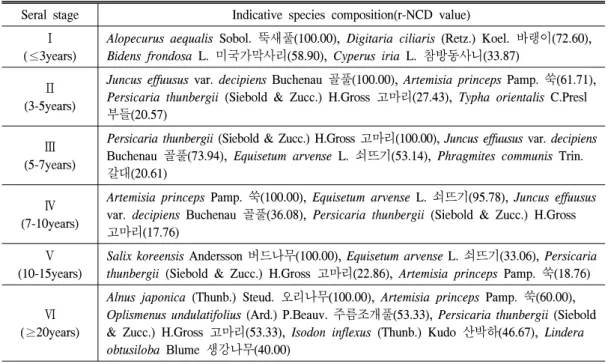
Table 1. Occurrence patterns of main plants at different seral stages.
Seral stage Indicative species composition(r-NCD value)
Ⅰ (≤3years)
Alopecurus aequalis Sobol. 뚝새풀(100.00), Digitaria ciliaris (Retz.) Koel. 바랭이(72.60), Bidens frondosa L. 미국가막사리(58.90), Cyperus iria L. 참방동사니(33.87)
Ⅱ (3-5years)
Juncus effuusus var. decipiens Buchenau 골풀(100.00), Artemisia princeps Pamp. 쑥(61.71), Persicaria thunbergii (Siebold & Zucc.) H.Gross 고마리(27.43), Typha orientalis C.Presl 부들(20.57)
Ⅲ (5-7years)
Persicaria thunbergii (Siebold & Zucc.) H.Gross 고마리(100.00), Juncus effuusus var. decipiens Buchenau 골풀(73.94), Equisetum arvense L. 쇠뜨기(53.14), Phragmites communis Trin.
갈대(20.61)
Ⅳ (7-10years)
Artemisia princeps Pamp. 쑥(100.00), Equisetum arvense L. 쇠뜨기(95.78), Juncus effuusus var. decipiens Buchenau 골풀(36.08), Persicaria thunbergii (Siebold & Zucc.) H.Gross 고마리(17.76)
Ⅴ (10-15years)
Salix koreensis Andersson 버드나무(100.00), Equisetum arvense L. 쇠뜨기(33.06), Persicaria thunbergii (Siebold & Zucc.) H.Gross 고마리(22.86), Artemisia princeps Pamp. 쑥(18.76)
Ⅵ (≥20years)
Alnus japonica (Thunb.) Steud. 오리나무(100.00), Artemisia princeps Pamp. 쑥(60.00), Oplismenus undulatifolius (Ard.) P.Beauv. 주름조개풀(53.33), Persicaria thunbergii (Siebold
& Zucc.) H.Gross 고마리(53.33), Isodon inflexus (Thunb.) Kudo 산박하(46.67), Lindera obtusiloba Blume 생강나무(40.00)
and Lee, 2006), 산출값이 낮을수록 인위적인 간섭에 따른 서식처의 안정성이 높다는 것을 의 미한다.
∙ 교란지수(Di): Di = (Chi + Thi) / Si × 100 으 로 Chi는 i지역의 지표식물(Chamaephytes) 종 수이고 Thi는 i지역의 일년생식물(Therophytes) 종수이며, Si는 i지역의 출현식물종수이다.
∙ 체감도시화지수(AUI): AUI = Ei / Si × Ei / Et × 1 / Ai로 Ei는 i지역의 귀화식물 종수 이며 Si는 i지역의 출현식물종수이다. Et는 조사지역을 포함한 비교 전체지역의 출현 귀화식물종의 총수로서 321종(Lee et al., 2011)을 적용하였고 Ai는 전체지역 내에서 i지역(각)의 면적비로 산출하였다.
III. 결과 및 고찰
1. 천이 단계별 종조성적 특성
조사지역에서 확인된 식물종은 58과 127속 157종 3아종 15변종 1품종으로 총 176분류군이
확인되었으며, 이 가운데 벼과 식물이 가장 높게 출현하였고 천이단계별 대표조사지점은 Figure 3 과 같다. 천이 단계별로Ⅰ단계에서 19과 64분류 군이, Ⅱ단계에서 15과 34분류군이, Ⅲ단계에서 30과 84분류군이, Ⅳ단계에서 32과 83분류군이,
Ⅴ단계에서 39과 92분류군이, Ⅵ단계에서 20과 23분류군이 확인되었다.
천이 단계별 r-NCD 분석결과, 천이 초기단계 (Ⅰ단계)에는 뚝새풀, 바랭이, 미국가막사리, 참 방동사니와 같이 1년생 초본들이 높은 출현빈 도를 나타내다가 천이가 진행됨에 따라 천이 중 기(Ⅱ-Ⅳ단계)에는 기존에 출현했던 1년생초본 식물의 출현빈도가 낮아지고 골풀, 부들, 쑥, 쇠 뜨기 등과 같은 다년생 초본식물과 수생 1년생 초본식물인 고마리의 출현빈도가 높아졌다. 천 이 후반(Ⅴ-Ⅵ단계)으로 갈수록 버드나무, 오리 나무, 주름조개풀, 산박하, 생강나무 등과 같은 목본성 식물과 산지 임연부에서 나타나는 초본 성 식물종들의 출현빈도가 높은 것으로 분석되 었다(Table 1, Figure 2). 천이 초기에는 1년생초
Stage Ⅰ Stage Ⅱ Stage Ⅲ
Stage Ⅳ Stage Ⅴ Stage Ⅵ
Figure 3. Main survey sites at different seral stages.
Figure 2. Occurrence rate of herbaceous perennial, woody, herbaceous annual plants. Error bars represent standard error.
본식물의 출현빈도가 높다가 천이가 진행될수 록 다년생초본식물과 목본성 식물의 출현빈도 가 높아지는 종조성적 변화양상은 일반적인 2 차천이개념과 일치하였다(Miller and Spoolman, 2009).
3년이하의 묵논에서 가장 높은 출현 빈도를 차지하는 뚝새풀은 모내기 전까지 휴경작 상태 에서 발달하는 전형적인 식물종으로(Kim and Nam, 1998), 휴경 후 계속적으로 생육하여 천이 초기단계를 특징짓는 대표적인 식물종이라 생 각된다. 미국가막사리는 sulfonylurea계 제초제 에 대해 상당한 저항성이 있고(Itoh et al., 1994) 많은 종자생산과 장기간의 종자생존력으로 인 해(Guh, 1995, Lewis, 1973) 휴경 후 1-2년에서 중기묵논에 접어드는 5년 동안 발생하는 특성 을 나타낸다고 보고되어 있다(Kuk et al., 2002).
바랭이는 묵밭(Lee and Kim, 1995), 과수원(Park et al., 2005)과 같은 건조한 토양에서 천이초기 에 우점하는 종으로 알려져 있는데, 논둑이나 논 주변 길가에서 흔하게 발달하기 때문에(Oh et al., 2008) 휴경 후 일부 건조한 토양입지에 짧은 기간에 유입되어 우점한 것으로 생각된다.
참방동사니는 초기묵논의 여름에서 가을에 걸 쳐 발달하는 식물종으로(Kim and Nam, 1998), 농업생태계에서 계절에 따라 광엽성 초본에서 화본형 초본으로 식생변화가 발생하는 양상을 고려해 볼 때 본 종은 추계의 초기 묵논을 대표
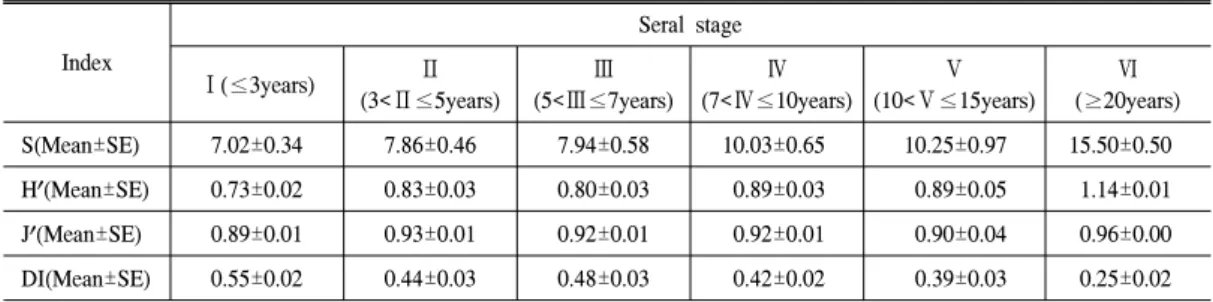
Table 2. Structural attributes of plant diversity at different seral stages.
Index
Seral stage
Ⅰ(≤3years) Ⅱ
(3<Ⅱ≤5years)
Ⅲ (5<Ⅲ≤7years)
Ⅳ (7<Ⅳ≤10years)
Ⅴ (10<Ⅴ≤15years)
Ⅵ (≥20years) S(Mean±SE) 7.02±0.34 7.86±0.46 7.94±0.58 10.03±0.65 10.25±0.97 15.50±0.50
H (Mean±SE) 0.73±0.02 0.83±0.03 0.80±0.03 0.89±0.03 0.89±0.05 1.14±0.01
J (Mean±SE) 0.89±0.01 0.93±0.01 0.92±0.01 0.92±0.01 0.90±0.04 0.96±0.00
DI(Mean±SE) 0.55±0.02 0.44±0.03 0.48±0.03 0.42±0.02 0.39±0.03 0.25±0.02
S: Richness index, H : Shannon-Wiener diversity index, J : Evenness index, DI: Dominance index, SE: Standard error
하는 식물종이라 여겨진다.
천이 중기를 특징짓는 골풀은 천이 초기부터 출현하여 Ⅱ-Ⅲ단계의 천이 단계에서 높은 출현 빈도를 나타내다가 천이가 계속될수록 그 빈도가 낮아져 결국 Ⅵ단계에서는 출현하지 않는 것으로 분석되었고 부들도 유사한 경향을 나타내었다.
골풀의 이러한 분포경향은 Kim and Nam(1998) 의 연구와 유사하나, 본 연구에서는 애기고추나 물이 출현하지 않은 것이 본 조사와 상이하였다.
쑥과 쇠뜨기는 건조하고 입지 접근성이 매우 강 한 입지에 서식하며, 논둑 가장자리나 하천 변 고수부지, 제방 둔치 등에서 군락형태로 관찰된 다. 따라서 휴경한지 7년 이상이 되면 논의 토양 환경이 담수에서 건조상태로 유지되면서 본격 적으로 육상화가 이루어진다고 볼 수 있다. 이러 한 육상화의 진행으로 천이 후기에는 버드나무 와 오리나무의 기여도가 높게 나타나며, 버드나 무가 오리나무보다 먼저 출현하였다. 이러한 경 향은 버드나무가 생태적으로 오리나무에 비해 입지교란이 빈번한 하천환경에 우점 할 수 있는 생육조건(영양번식 가능, 넓은 생육범위, 가지와 뿌리의 생장력 우수)을 가지고 있기 때문에 버 드나무가 우점한 후 입지가 좀 더 안정적이 되면 오리나무가 우점하는 것으로 보인다.
2. 천이 단계별 군집특성
분석된 군집지수는 식생의 천이진행과 관련 이 있었다(Table 2). 각 천이 단계의 풍부도는
초기에 증가하다가 중기에 일정한 양상을 유지 하다가 후기에 다시 증가하였다. 다양도는 5년 이하까지 증가하다가 5-7년사이에 감소한 후 7-15년까지 상승하여 일정한 양상을 유지하다 가 15년 이상이 되면 다시 큰 폭으로 증가하는 경향을 나타내었다. 이러한 경향은 경기도 성남 시 일원의 묵논에 대한 천이양상을 연구한 Lee et al.(1998)과 유사한 결과로, 휴경이후 천이 초 기에 논에 잠재해 있던 종이 출현하거나 주변으 로부터 이입된 종이 빠르게 정착했기 때문인 것 으로 여겨진다. 균등도는 천이단계에 따라 뚜렷 한 상관성을 나타내지 못했는데, Lee et al.(1998) 의 결과와 유사하였다. 우점도는 천이가 진행됨 에 따라 낮아졌으며, 천이가 진행됨에 따라 다 양한 생활형의 식물종이 추가적으로 출현하게 되고 이로 인해 단일 또는 소수 몇몇 초본성 식 물들에 의해 우점되는 현상이 감소하기 때문인 것으로 판단된다.
3. 천이 단계별 서식처의 안정성 평가
생태식물상 지수를 통하여 천이 단계별 서식 처의 안정성을 평가 한 결과(Table 3), 교란지수 는 Ⅰ단계에서 가장 높았으며 천이단계가 진행 될수록 낮아지는 경향이 나타났다. 체감도시화 지수 또한 천이 초기인 Ⅰ단계에서 가장 높게 나타났으며 천이가 진행됨에 낮아지는 경향을 나타내었다. 천이가 진행될수록 두 종류의 지수 가 낮아지는 특성을 고려해 볼 때 생태적으로
Table 3. Eco-floristic indices at different seral stages.
Eco-floristic index
Seral stage
Ⅰ (≤3years)
Ⅱ (3<Ⅱ≤5years)
Ⅲ (5<Ⅲ≤7years)
Ⅳ (7<Ⅳ≤10years)
Ⅴ (10<Ⅴ≤15years)
Ⅵ (≥20years) Di(Mean±SE) 84.15±2.69 60.37±12.86 50.83±3.50 36.06±2.60 37.55±3.13 29.17±4.17 AUI(Mean±SE) 0.0002±0.0001 0.0001±0.00004 0.0001±0.00003 0.00002±0.00001 0.00001±0.00001 0.0000±0.0000 Di: Disturbance index, AUI: Actual urbanization index, SE: Standard error
불안정한 천이초반(5년 이내)에는 이입과 정착, 생장이 빠른 1년생 식물종과 귀화식물종이 선 구적으로 출현하고 이후 다년생식물과 목본성 식물이 증가하면서 군집구조가 안정화되는 특 성을 간접적으로 보여주는 것으로 여겨진다.
IV. 요 약
묵논은 농촌경관에 있어 종다양성 및 서식지 의 질적 향상에 훌륭한 기회를 제공해주며, 연 차별 식물군락의 변화에 대한 생태적 특성은 생 태복원의 주요한 기초자료가 된다. 본 연구에서 는 휴경연차에 따라 변화하는 식물군락의 종조 성, 군집지수 그리고 생태식물상 특성을 분석하 여 서식지의 안정성을 평가하였다. 묵논의 휴경 연차를 6단계(Ⅰ단계: 3년 이하, Ⅱ단계: 3년 초 과 5년 이하, Ⅲ단계: 5년 초과 7년 이하, Ⅳ단 계: 7년 초과 10년 이하, Ⅴ단계: 10년 초과 15 년 이하, Ⅵ단계: 15년 초과)로 구분하였다. 식 생조사는 2009년 5월부터 2012년 10월에 걸쳐 수행하였고 기본적으로 식물사회적적 방법에 따라 이루어졌다. 조사지역에서 확인된 식물종 은 58과 127속 157종 3아종 15변종 1품종으로 총 176분류군이 확인되었다. 그리고 천이 단계 별로Ⅰ단계에서 64분류군, Ⅱ단계에서 34분류 군, Ⅲ단계에서 84분류군, Ⅳ단계에서 83분류 군, Ⅴ단계에서 92분류군, Ⅵ단계에서 23분류군 이 확인되었다. 출현 식물종 가운데 뚝새풀, 골 풀, 고마리, 쑥, 버드나무, 오리나무가 각 천이 단계에서 가장 높은 상대기여도를 나타내었다.
천이 초기단계에는 1년생 초본들이 높은 출현 빈도를 나타내다가 천이가 진행됨에 따라 천이 중기에는 기존에 출현했던 1년생 초본식물의 출현빈도가 낮아지고 다년생초본식물과 1년생 수생식물인 고마리의 출현빈도가 높아졌다. 천 이 후반에는 목본성 식물과 산지 임연부에서 나 타나는 초본성 식물종들의 출현빈도가 높게 나 타났다. 모든 군집지수는 식생의 천이진행과 관 련이 있었다. 풍부도와 다양도는 천이가 진행됨 에 따라 증가하는 경향이 나타났고 균등도는 천 이와의 상관성이 다소 낮은 것으로 분석되었다.
우점도는 천이가 진행됨에 따라 낮아지는 경향 을 나타내었다. 서식지의 생태적 안정성은 Ⅰ단 계가 가장 불안정한 상태이며 천이가 진행될수 록 안정성을 찾아가는 것으로 나타났다.
References
Barboni, D.․Harrison, S. P.․Bartlein, P. J.․
Jalut, G.․New, M.․Prentice, I. C.․Sanchez- Goni, M.-F.․Spessa, A.․Davis, B. and Stevenson, A. C. 2004. Relationships between plant traits and climate in the Mediterranean region: A pollen data analysis. Journal of Vegetation Science 15: 635-646.
Benabdelmoumene F.․Benabadji N.․Benchenafi S. and Benmensour D. 2014. Research of the eco-floristic data into the contribution of groups to halophyte, Hammam Boughrara Area West Algeria. European Scientific
Journal 10(29): 296-307.
Brower, J. E.․Zar, J. H. and von Ende, C. N.
1990. Field and laboratory methods for general ecology. Wm. C. Brown Publishers.
Dubuque, IA.
Cho KT․Kim HW․Kim HR․Jeong HM․Lee KM․Kang TG and You YH. 2012. Ecological characteristics of habitat of Nannophya pygmaea Rambur (Libellulidae, Odonata), an Endangered Species for Conservation. Journal of Wetlands Research. 14(4): 667-674. (in Korean with English summary)
Choi HJ․Ji DS․Choi S and Kim SJ. 2005.
Institutional improvements for utilization and management of idle agricultural land. Korea Research Institute for Human Settlements Report. (in Korean)
Guh JO․Kwon YW and Pyon JY. 1995. Weed control. Hyangmunsa, Korea.
Han SU․Chung GC․Chon SU․Lee HJ and Guh JO. 1998. Changes of physico-chemical soil properties, major soil nutrient contents, and weed vegetation in paddy fields during fallow. Korean J. Environ. Agric. 17(3):
211-214. (in Korean with English summary) Itoh, K. J.․Lee JJ and Tachibana, M. 1994.
Characters of seed emergence and effect of sulfonylurea herbicides on three Bidens paddy weeds. Proc. of 15th Asia-Pacific Weed Science Society conference: 339-345.
Kang BH․Shim SI and Ma KH. 2003. Floristic composition of plant community in Set-Aside fields with regard to seral stages. Korean J.
Environ. Agric. 22(1): 53-59. (in Korean with English summary)
Kent, M. and Coker, P. 1992. Vegetation description and analysis. London: Belhaven Press.
Kim DE. 2011. The study on the habitat change of Nannophya pygmaea Ramber in the abandoned paddy field Ulsan City and its management. Kor. J. Env. Eco. 25(6):
867-877. (in Korean with English summary) Kim JW and Lee YK. 2006. Classification and
assessment of plant communities, pp. 1-240.
Worldscience, Korea.
Kim JW and Manyko, Y. I. 1994. Syntaxonomical and synchorological characteristics of the cool-temperate mixed forest in the Southern Sikhote Alin, Russian East. Korean J. Ecol.
17(4): 391-413.
Kim JW and Nam HK. 1998. Syntaxonomical and synecological characteristics of rice field vegetation. Korean J. Ecol. 21(3): 203-215.
Kuk YI․Park TD and Kwon OD. 2002. Changes of ecological traits of weed species as affected by fallow period in paddy fields.
Kor. J. Weed Sci. 22(2): 137-146. (in Korean with English summary)
Lee CS․Park HS․You YH and Hong SK. 1998.
A study on vegetation succession in aban- doned paddy fields. J. Nat. Sci. Inst., Seoul Women’s Univ. 10: 29-43. (in Korean with English summary)
Lee IY․Kwon OS․Park JE․Lee YK․Park NI․Ji SH and Lim ES. 2005. Weed management of fallow land and paddy- upland rotation on rice fields. Kor. J. Weed Sci. 25(1): 87-89. (in Korean with English summary)
Lee IY․Park NI․Kwon OS․Park JH․Lee YK․
Ji SH․Lim ES and Park JE. 2006. Fallow land and method of weed control in rice paddy field converted from fallow land. Kor.
J. Weed Sci. 26(1): 108-114. (in Korean with English summary)
Lee KS and Kim JH. 1995. Seral changes in floristic composition during abandoned field succession after shifting cultivation. Korean J. Ecol. 18(2): 275-283.
Lee TB. 2003. Illustrated flora of Korea. pp.
1-1,928, Hyangmunsa, Korea.
Lee WT. 1996a. Standard illustrations of Korean plants, pp. 1-624, Academy Press., Korea.
Lee WT. 1996b. Lineamenta florae Koreae, pp.
1-1,688, Academy Press., Korea.
Lee YM․Park SH․Jung SY․Oh SH and Yang JC. 2011. Study on the current status of naturalized plants in South Korea. Korean J.
Pl. Taxon. 41(1): 87-101.
Lewis, J. 1973. Longevity of crop and weed seed:
survival after 20 years in the soil. Weed Res.
13: 179-191.
McNaughton, S. J. 1967. Relationship among functional properties of california grassland.
Nature 216: 168-169.
Miller, G. T. and Spoolman, S. E. 2009. Essentials of ecology 5th edition. Brooks/Cole Publishing Co. USA.
Oh YJ․Sohn SI․Kim CS․Kim BW and Kang BH. 2008. Phytosociological Classification of vegetation in paddy Levee. Korean Journal of Environmental Agriculture 27(4): 413-420.
(in Korean with English summary) Park JE․Lee IY․Oh SM․Park TS․Kim CS․
Moon BC․Cho JR․Lim ST․Im IB․
Kang JG․Kim S․Hwang JB․Song SB․Ji SH․Kang DS and Chung KR. 2005.
Characteristics of weed flora and weed community on orchard field in the central region of Korea. Korean Journal of Weed Science 25(4): 267-274. (in Korean with
English summary)
Park MY․Yim YR․Kim KG and Joo YW. 2006.
The Status and characteristics of wetlands created from within abandoned rice paddy fields in South Korea. J. Korean Env. Res.
Tech. 9(2): 1-15. (in Korean with English summary)
Park SH. 2009. New illustrations and photographs of naturalized plants of Korea, pp. 1-575, Ilchokak, Korea.
Pielou, E. C. 1969. Shannon's formula as a measure of specific diversity, its use and misuse. American Nation 100: 463-465.
Shim IS․Kim JB and Cho KJ. 2013. Syntaxo- nomical characteristics of abandoned paddy fields by seral stages in South Korea. Korean J. Environ. Agric. 32(2): 185-192. (in Korean with English summary)
Sung HC․Ra NY․Cheong SK․Kim SK․Cha SM and Park DS. 2009. Reproductive dynamics of the Gold-spotted Pond Frog (Rana plancyi chosenica) population located at Cheongwon, Korea. Korean J. Environ.
Biol. 27(1): 20-30. (in Korean with English summary)
Yoon J․Nam JM․Kim H․Bae YJ and Kim JG.
2010. Nannophya pygmaea (Odonata:
Libellulidae), an endangered dragonfly in Korea, prefers abandoned paddy fields in the early seral stage. Environmental entomology.
39(2): 278-285.
Yun KS. 2007. Soil and vegetation characteristics of abandoned paddy field. Journal of the Korean Association of Regional Geographers.
13(2): 129-142. (in Korean with English summary)
Scientific and Korean name
Seral stage
Life form
Naturalized plant
Ⅰ (≤3 years)
Ⅱ (3<Ⅱ≤5years)
Ⅲ (5<Ⅲ≤7years)
Ⅳ (7<Ⅳ≤10years)
Ⅴ (10<Ⅴ≤15years)
Ⅵ (≥20years)
Alopecurus aequalis Sobol. 뚝새풀 100.00 5.71 6.40 0.40 0.07 10.00 Th(w)
Digitaria ciliaris (Retz.) Koel. 바랭이 72.60 13.71 0.51 0.00 0.00 0.00 Th
Bidens frondosa L. 미국가막사리 58.90 2.29 2.91 0.00 0.15 0.00 Th ●
Cyperus iria L. 참방동사니 33.87 3.43 0.00 0.01 0.00 0.00 Th
Juncus effuusus var. decipiens Buchenau 골풀 28.77 100.00 73.94 36.08 2.97 0.00 HH
Typha orientalis C.Presl 부들 0.75 20.57 10.76 4.43 0.13 0.00 HH
Persicaria thunbergii (Siebold & Zucc.) H.Gross 고마리 24.66 27.43 100.00 17.76 22.86 53.33 HH(Th)
Artemisia princeps Pamp. 쑥 18.31 61.71 20.07 100.00 18.76 60.00 Ch
Equisetum arvense L. 쇠뜨기 0.00 17.14 53.14 95.78 33.06 40.00 G
Phragmites communis Trin. 갈대 0.37 4.57 20.61 10.68 13.50 0.00 HH
Salix koreensis Andersson 버드나무 0.00 0.00 5.82 4.76 100.00 20.00 MM
Alnus japonica (Thunb.) Steud. 오리나무 0.00 0.00 0.29 0.01 1.37 100.00 MM
Oplismenus undulatifolius (Ard.) P.Beauv. 주름조개풀 0.00 0.00 0.00 0.00 1.98 53.33 H
Isodon inflexus (Thunb.) Kudo 산박하 0.00 0.00 0.07 0.00 0.39 46.67 G
Lindera obtusiloba Blume 생강나무 0.00 0.00 0.00 0.00 0.00 40.00 N
Glycine soja Siebold & Zucc. 돌콩 20.05 4.57 11.20 2.12 1.87 0.00 Th
Aneilema keisak (Hassk.) Hand.-Mazz. 사마귀풀 16.81 4.00 1.31 0.10 0.00 10.00 HH(Th)
Oenanthe javanica (Blume) DC. 미나리 14.20 2.29 15.05 13.42 2.56 0.00 HH
Conyza canadensis (L.) Cronquist 망초 3.99 0.57 0.07 0.01 0.02 0.00 Th(w) ●
Salix gracilistyla Miq. 갯버들 2.62 5.71 2.40 0.75 0.18 0.00 N
Agropyron ciliare (Trin.) Franch. 속털개밀 0.75 2.29 0.73 0.25 0.71 0.00 Th(w)
Miscanthus sinensis var. purpurascens (Andersson) Rendle 억새 0.75 0.57 2.18 15.36 1.74 0.00 H
Persicaria longiseta (Bruijn) Kitag. 개여뀌 27.90 0.00 0.18 0.16 0.06 0.00 Th
Stellaria alsine var. undulata (Thunb.) Ohwi 벼룩나물 4.86 0.00 0.58 0.04 0.04 0.00 Th(w)
Stellaria aquatica (L.) Scop. 쇠별꽃 2.99 1.71 0.44 0.00 1.28 0.00 Th(w)
Ranunculus sceleratus L. 개구리자리 1.00 0.00 0.04 0.15 0.04 0.00 HH(Thw)
Erigeron annuus (L.) Pers. 개망초 0.75 0.00 11.63 0.47 1.01 0.00 Th(w) ●
Artemisia selengensis Turcz. ex Besser 물쑥 0.50 1.14 0.18 0.12 0.00 0.00 H
Kummerowia stipulacea (Maxim.) Makino 둥근매듭풀 0.37 0.00 0.07 0.02 0.37 0.00 Th
Commelina communis L. 닭의장풀 0.37 0.00 0.07 0.01 1.19 0.00 Th
Carex dickinsii Franch. & Sav. 도깨비사초 0.37 0.00 0.00 0.02 0.02 6.67 H
Setaria viridis (L.) P.Beauv. 강아지풀 0.25 5.71 0.22 0.00 0.22 0.00 Th
Humulus japonicus Sieboid & Zucc. 환삼덩굴 0.00 8.00 0.76 0.35 7.25 0.00 Th
Persicaria muricata (Meisn.) Nemoto 넓은잎미꾸리낚시 0.00 2.29 0.29 0.16 0.50 0.00 HH(Th)
Crepidiastrum sonchifolium (Maxim.) Pak & Kawano 고들빼기 0.00 0.00 0.04 0.01 0.04 6.67 Th(w)
Echinochloa crus-galli (L.) P.Beauv. 돌피 7.97 2.86 0.58 0.00 0.00 0.00 HH(Th)
Ludwigia prostrata Roxb. 여뀌바늘 6.48 1.14 0.18 0.00 0.00 0.00 HH(Th)
Capsella bursa-pastoris (L.) L.W.Medicus 냉이 5.98 0.00 0.18 0.01 0.00 0.00 Th(w)
Elymus mollis Trin. 갯그령 2.24 0.00 0.11 0.64 0.00 0.00 G
Bidens tripartita L. 가막사리 1.74 2.86 0.00 0.00 0.04 0.00 HH(Th)
Persicaria perfoliata (L.) H.Gross 며느리배꼽 1.74 0.00 0.29 0.00 0.11 0.00 Th
Cardamine lyrata Bunge 논냉이 0.75 0.00 0.00 0.11 0.39 0.00 H
Salix koriyanagi Kimura Goerz 키버들 0.37 0.00 1.09 0.60 0.00 0.00 N
Trifolium repens L. 토끼풀 0.25 0.00 0.07 2.21 0.00 0.00 Ch ●
Beckmannia syzigachne (Steud.) Fernald 개피 0.25 0.00 0.07 0.01 0.00 0.00 HH(Thw)
Hololeion maximowiczii Kitam. 께묵 0.13 0.00 0.07 0.01 0.00 0.00 Th(w)
Cyperus amuricus Maxim. 방동사니 0.00 1.71 0.07 0.14 0.00 0.00 Th
Oenothera biennis L. 달맞이꽃 0.00 1.14 0.36 0.00 0.04 0.00 Th(w) ●
Typha angustifolia L. 애기부들 0.00 0.57 0.04 0.18 0.00 0.00 HH
Lycopus lucidus Turcz. Benth. 쉽싸리 0.00 0.00 1.75 0.16 0.44 0.00 HH
Agropyron tsukushiense var. transiens (Hack.) Ohwi 개밀 0.00 0.00 0.87 0.04 0.44 0.00 Th(w)
Lycopus maackianus (Maxim. ex Herder) Makino 애기쉽싸리 0.00 0.00 0.36 0.15 0.00 6.67 HH
Phalaris arundinacea L. 갈풀 0.00 0.00 0.26 1.53 0.04 0.00 HH
Scirpus karuizawensis Makino 솔방울고랭이 0.00 0.00 0.22 1.96 0.06 0.00 HH
Fallopia dumetorum (L.) Holub 닭의덩굴 0.00 0.00 0.11 0.02 0.06 0.00 Th ●
Rosa multiflora Thunb. 찔레꽃 0.00 0.00 0.07 0.13 5.44 0.00 N
Carex maximowiczii Miq. 왕비늘사초 0.00 0.00 0.04 0.03 0.04 0.00 H
Clematis apiifolia DC. 사위질빵 0.00 0.00 0.00 0.12 1.19 33.33 N
Impatiens textori Miq. 물봉선 0.00 0.00 0.00 0.00 0.33 23.33 Th
Echinochloa crusgalli var. oryzicola (Vasinger) Ohwi 물피 15.69 0.00 1.09 0.00 0.00 0.00 H
Lindernia procumbens (Krock.) Philcox 밭뚝외풀 6.97 0.00 0.04 0.00 0.00 0.00 HH(Th)
Appendix 1. The list of vascular plants at different seral stages (Value: r-NCD).
Scientific and Korean name
Seral stage
Life form
Naturalized plant
Ⅰ (≤3 years)
Ⅱ (3<Ⅱ≤5years)
Ⅲ (5<Ⅲ≤7years)
Ⅳ (7<Ⅳ≤10years)
Ⅴ (10<Ⅴ≤15years)
Ⅵ (≥20years)
Oryza sativa L. 벼 3.49 2.29 0.00 0.00 0.00 0.00 Th
Carex jaluensis Kom. 참삿갓사초 2.24 0.00 0.00 0.00 0.29 0.00 H
Ranunculus japonicus Thunb. 미나리아재비 0.75 0.00 0.00 0.00 0.04 0.00 H
Conyza bonariensis (L.) Cronquist 실망초 0.62 1.14 0.00 0.00 0.00 0.00 Th(w) ●
Monochoria vaginalis var. plantaginea (Roxb.) Solms 물달개비 0.50 0.00 0.22 0.00 0.00 0.00 HH(Th)
Rumex crispus L. 소리쟁이 0.25 0.57 0.00 0.00 0.00 0.00 H ●
Youngia japonica (L.) DC. 뽀리뱅이 0.25 0.00 0.00 0.00 0.02 0.00 Th(w)
Plantago asiatica L. 질경이 0.00 1.71 0.00 0.04 0.00 0.00 H
Taraxacum platycarpum Dahlst. 민들레 0.00 0.57 0.04 0.00 0.00 0.00 H
Carex dispalata Boott 삿갓사초 0.00 0.00 1.09 0.00 0.07 0.00 HH
Astragalus sinicus L. 자운영 0.00 0.00 0.58 0.00 0.04 0.00 Th(w) ●
Leersia sayanuka Ohwi 겨풀 0.00 0.00 0.51 0.41 0.00 0.00 HH
Carex dimorpholepis Steud. 이삭사초 0.00 0.00 0.44 0.29 0.00 0.00 H
Carex transversa Boott 화살사초 0.00 0.00 0.36 0.01 0.00 0.00 H
Salix chaenomeloides Kimura 왕버들 0.00 0.00 0.29 0.14 0.00 0.00 MM
Eleocharis tetraquetra Nees 네모골 0.00 0.00 0.18 0.05 0.00 0.00 HH
Ischaemum crassipes (Steud.) Thell. 쇠보리 0.00 0.00 0.15 0.04 0.00 0.00 H
Lactuca indica L. 왕고들빼기 0.00 0.00 0.15 0.00 0.07 0.00 Th,Th(w)
Arthraxon hispidus (Thunb.) Makino 조개풀 0.00 0.00 0.11 0.00 0.07 0.00 Th
Zanthoxylum piperitum (L.) DC. 초피나무 0.00 0.00 0.11 0.00 0.00 6.67 N
Hypericum ascyron L. 물레나물 0.00 0.00 0.04 0.15 0.00 0.00 H
Rhus javanica L. 붉나무 0.00 0.00 0.04 0.00 0.04 0.00 M
Pueraria lobata (Willd.) Ohwi 칡 0.00 0.00 0.00 0.46 1.10 0.00 Ch
Potentilla freyniana Bornm. 세잎양지꽃 0.00 0.00 0.00 0.25 0.04 0.00 Ch
Angelica cartilagino-marginata var. distans (Nakai) Kitag. 흰바디나물 0.00 0.00 0.00 0.19 0.26 0.00 G
Boehmeria spicata (Thunb.) Thunb. 좀깨잎나무 0.00 0.00 0.00 0.18 0.26 0.00 Ch
Rubia akane Nakai 꼭두서니 0.00 0.00 0.00 0.08 0.11 0.00 G
Agrimonia pilosa Ledeb. 짚신나물 0.00 0.00 0.00 0.06 0.04 0.00 G
Bromus japonicus Thunb. 참새귀리 0.00 0.00 0.00 0.05 0.29 0.00 Th
Robinia pseudoacacia L. 아까시나무 0.00 0.00 0.00 0.03 0.04 0.00 MM ●
Polystichum tripteron (Kunze) C.Presl 십자고사리 0.00 0.00 0.00 0.03 0.00 16.67 H
Spiraea prunifolia f. simpliciflora Nakai 조팝나무 0.00 0.00 0.00 0.02 0.18 0.00 N
Acer tataricum subsp. ginnala (Maxim.) Wesm. 신나무 0.00 0.00 0.00 0.01 0.02 0.00 M
Rubus crataegifolius Bunge 산딸기 0.00 0.00 0.00 0.01 0.18 0.00 N
Stephanandra incisa (Thunb.) Zabel 국수나무 0.00 0.00 0.00 0.01 0.13 0.00 N
Akebia quinata (Houtt.) Decne. 으름덩굴 0.00 0.00 0.00 0.01 0.06 0.00 N
Ligustrum obtusifolium Siebold & Zucc. 쥐똥나무 0.00 0.00 0.00 0.01 0.33 0.00 M
Parthenocissus tricuspidata (Siebold & Zucc.) Planch. 담쟁이덩굴 0.00 0.00 0.00 0.00 0.06 13.33 M
Boehmeria tricuspis (Hance) Makino 거북꼬리 0.00 0.00 0.00 0.00 0.02 6.67 Ch
Lespedeza bicolor Turcz. 싸리 0.00 0.00 0.00 0.00 0.02 6.67 N
Fimbristylis miliacea (L.) Vahl 바람하늘지기 23.16 0.00 0.00 0.00 0.00 0.00 HH(Th)
Cyperus difformis L. 알방동사니 4.11 0.00 0.00 0.00 0.00 0.00 HH(Th)
Setaria glauca (L.) P.Beauv. 금강아지풀 2.24 0.00 0.00 0.00 0.00 0.00 Th
Aeschynomene indica L. 자귀풀 1.49 0.00 0.00 0.00 0.00 0.00 Th
Carex neurocarpa Maxim. 괭이사초 0.87 0.00 0.00 0.00 0.00 0.00 H
Eclipta prostrata (L.) L. 한련초 0.75 0.00 0.00 0.00 0.00 0.00 Th
Chenopodium album var. centrorubrum Makino 명아주 0.75 0.00 0.00 0.00 0.00 0.00 Th
Persicaria japonica (Meisn.) H.Gross ex Nakai 흰꽃여뀌 0.62 0.00 0.00 0.00 0.00 0.00 HH
Cyperus nipponicus Franch. & Sav. 푸른방동사니 0.62 0.00 0.00 0.00 0.00 0.00 Th
Draba nemorosa L. 꽃다지 0.62 0.00 0.00 0.00 0.00 0.00 Th(w)
Gnaphalium affine D.Don 떡쑥 0.50 0.00 0.00 0.00 0.00 0.00 Ch
Mazus miquelii Makino 누운주름잎 0.25 0.00 0.00 0.00 0.00 0.00 H
Echinochloa utilis Ohwi & Yabuno 피 0.25 0.00 0.00 0.00 0.00 0.00 HH(Th)
Persicaria hydropiper (L.) Delarbre 여뀌 0.25 0.00 0.00 0.00 0.00 0.00 HH(Th)
Portulaca oleracea L. 쇠비름 0.13 0.00 0.00 0.00 0.00 0.00 Th
Crassocephalum crepidioides (Benth.) S.Moore 주홍서나물 0.13 0.00 0.00 0.00 0.00 0.00 Th ●
Quamoclit coccinea Moench 둥근잎유홍초 0.13 0.00 0.00 0.00 0.00 0.00 Th ●
Cardamine flexuosa With. 황새냉이 0.13 0.00 0.00 0.00 0.00 0.00 Th(w)
Vigna umbellata (Thunb.) Ohwi & H.Ohashi 덩굴팥 0.00 1.14 0.00 0.00 0.00 0.00 Th
Spirodela polyrhiza (L.) Sch. 개구리밥 0.00 0.00 0.36 0.00 0.00 0.00 HH(Th)
Scirpus wichurae var. asiaticus (Beetle) T.Koyama W.T.Lee 방울고랭이 0.00 0.00 0.29 0.00 0.00 0.00 HH
Appendix 1. Continued